


Uncategorized
2025’s Jewish highlights — from ‘Marty Supreme’ to Max Fried’s menschy move
Jews have been in the spotlight in the past years for all kinds of reasons, many of them less-than-fun: Gaza, war, hostages, protests. But looking back, we wanted to boil it down into highlights. Or at least things that were just really, really Jewish. Basically, everything we thought was worth making note of in the last year, whether for its merits, its lack thereof, or just for its pure oddity.
You may notice reading that there seem to be a few doubles in these categories. But, you see, the “best Jewish movie” is not necessarily the “most Jewish movie.” That’s because there has been a glut of loudly Jewish content that’s awfully hard to ignore, screaming for our attention. That doesn’t mean it’s good, but it’s notable.
So read on for the Jewish things you should remember — whether you want to or not — from 2025.
Best Jewish movie
It’s apparently a Safdie family tradition to induce anxiety in movie-going Jews on Christmas. (Uncut Gems arrived Dec. 25, 2019.) Josh Safdie’s film, about salesman-hustler-table-tennis dynamo Marty Mauser, accumulates Yiddishkeit as it goes, including a brief cameo by a Forward delivery truck. Timothée Chalamet dons thick-rim glasses and hangs a Magen David over his chest as he jousts with a Holocaust survivor opponent (there were a few ping-pong champs who did, in fact, survive Auschwitz). A character in the tradition of Sammy Glick and Duddy Kravitz, Marty is as magnetic as he is entitled. While the film’s concerns are universal, it is perhaps primarily a portrait of the New Jew, not of the Nordau school, but the American one, who regarded success as something he’s owed.
Most Jewish movie
These days, there is such a glut of Holocaust content that each new book, movie or show has to find a unique niche. Nuremberg did so by focusing on the relationship between Hermann Goering, Hitler’s right-hand man, and the psychiatrist assigned to analyze him before the eponymous trials, a man who hoped to find some genetic or mental component for evil that he can diagnose.
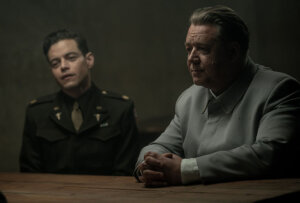
But the movie is so intent on being informative that it neglects to actually develop its characters and give real insight into Goering’s mind and motivations, or anyone else’s. Though it purports to be a movie about the banality of evil, it was actually just banal. It culminates in the shocking realization that evil has no genetic component, and most of its reveals carry just as little weight. Its most impactful moment is actually a piece of another film: the archival footage shown during the actual trial, which the movie excerpts.
Most Jewish movie that isn’t actually Jewish
Sentimental Value
In Joachim Trier’s film, which won the Grand Prix prize at Cannes, aging filmmaker Gustav Borg pursues reconciliation with his daughters by trying to cast them in his next film, which is a dramatization of his life. He wants the younger sister Nora, a theater actress who battles crippling anxiety, to play his mother who died by suicide; he’s cast the preteen son of Agnes, the elder sister, as a younger version of himself.
The Norwegian family depicted in this film isn’t Jewish. But Trier introduces all the classic beats of Jewish cultural concern: inherited trauma, the artist’s struggle, and the allure/disappointment of goyish blondes (this one played distractingly by Elle Fanning).
(Bonus points for Jewish musical-comedy darling Catherine Cohen’s bit part as Fanning’s phone-addicted manager.)
Most Jewish TV
The second season of Netflix’s Hot Rabbi hit rom-com, once again dominated Jewish conversations — and the streamer’s most-watched list. But much like its huge first season, the second left something to be desired in terms of its representation of Jews, who once again seemed to be incredibly limited by their religious identity and beliefs, and yet simultaneously eager to cast them off given the right opportunity. Stereotypes — like Jews being bad at sports or good at complaining — do a lot of the work of making the show Jewish. The effect is that Nobody Wants This doesn’t feel Jewish so much as it screams at the audience “this is a Jewish show!”
The show’s approach to Jewishness is perhaps best captured by the fact that menorahs, inexplicably, constantly appear in the background, even though it’s not Hanukkah at any point in either season. But without a hanukkiah on display — and, sometimes, lit — how would we know it’s Jewish?
Best Jewish TV
Long Story Short
The animated show from the creator of the surrealist show Bojack Horseman, Raphael Bob-Waksberg, managed to avoid the pitfalls that so often plague very Jewish media — namely heavy-handedness around Israel, or antisemitism, or leaning on clumsy exposition to define Jewish practices for a gentile audience. Instead, the show just lets its Jewish family be, while also showcasing a wide range of Jewish diversity; the family includes a Black Jewish convert, both a ba’al teshuva son and another son who struggles to connect with his Jewishness, and a queer couple. Each character feels deeply familiar to anyone who spends time in Jewish community, but the show doesn’t try to make the jokes easy to read to non-Jews. Maybe that means some of them fly over the heads of anyone not in the tribe, but that means it’s pitch-perfect for those of us looking for a deeper, subtler representation of Jewish life.

Most Jewish play
The latest play from writer and actress Liba Vaynberg, imagines how six of the Biblical matriarchs — Miriam, Sara, Rebecca, Rachel, Leah and Tziporrah — would have lived today. Set over the course of decades, the girls start the play as 13-year olds and end it in the late stages of adulthood. Each girl’s path is a smart imitation of their matriarch’s actual story, transposed into the modern day. Sara struggles with infertility. Miriam becomes a rabbi, believing that studying Torah will help her lead a good life and avoid misfortune. Leah’s mandrake root is substituted by weed edibles. With humor and an impressive amount of Jewish references that only those steeped in biblical expertise might catch, the play asks: Why is life full of sacrifices, especially ones that seem unjustified? Vaynberg is not interested in giving a solid answer, but still provides a satisfying ending, assuring that life, no matter what it brings, is meant to be lived in full.
Best Jewish play
Slam Frank
Ragebait maestro Andrew Fox’s opus, which reimagines Anne Frank as Anna Franco, a pansexual Latinx immigrant from the “barrios of Frankfurt,” is a piece with many moving parts: a social media campaign that shames the Auschwitz-Birkenau Museum for not including chanclas in their mountains of shoes and, yes, also a “real musical,” despite the doubts of many online who assumed it was pure trolling. In fact, it’s a lucid commentary on the state of woke, where identity boxes serve as proxies for character development, and stops just short of being a full referendum on inclusion.
The piece, riffing on nearly every virtue-signalled mega-musical of the last two decades, is at its most knotty when it takes on Jewishness; Fox knows being Jewish doesn’t map neatly to the fashionable formulas of white privilege and oppressor-oppressed. In the end, it is the reimagined attic residents’ existence as Jews that unravels the simple binaries of progressive politics.

Most Jewish book
Sam Sussman’s novel takes the author’s own nebulous biography as its subject — and the suspicion that Bob Dylan may be his father. If this wasn’t Jewish enough, the initial meeting of his mother and the future-Nobel Laureate took place in the studio of painter Norman Raeben, whose father was Solomon Naumovich Rabinovich (aka Sholem Aleichem). The book generated a lot of interest as a work of a promising debut from a young novelist.
Another extremely Jewish book
Kaplan’s Plot
A rollicking story that toggles between a Ukrainian mobster scraping by and a modern-day tech worker digging through family history, essayist and memoirist Jason Diamond’s first novel digs into Jewish Chicago. Really, as any good Jewish story spanning generations, the book is an examination of the impact of inherited trauma, but it’s not too heavy; it crackles with fast-paced Yiddishisms and the propulsive plot of a thriller. Jewishness isn’t the book’s subject as much as it is its entire ethos.
Funniest Jewish newsletter
One of the brightest and least-talked-about trends in the Jewish world right now is the second wave of Substack newsletters introducing new perspectives on Jewish life. (Read about the first wave here.) Bagel Emoji, a semiregular dispatch from a semi-anonymous, gay semi-Orthodox Jew who lives in Los Angeles, delivers feverish, meandering riffs on niche trends like AI content in Jewish print publications and the notorious odor of a particular kosher grocer to say something deeper about frum life. Bagel’s general sass — thinly masking affection, I think — makes each entry essential reading.
Spiciest Jewish newsletter
Picture a newsletter about Israel discourse so hot it must be handled with gloves. That’s NonZionism, a regular rant from an Israel-based writer who goes by the pen-name Mascil Bina. Skewering the excesses and hollowness of both pro-Israel and anti-Israel ideology, the author’s perspective offers a third position: That Israel is “something that wasn’t inevitable, but cannot now be undone.” His takes are unsparing, and unexpected — one week, it’s the case for Bibi Netanyahu; the next, it’s a withering critique of hasbara titled “Zionism turns your brain to mush.” Just recommending it feels risky.
Best Jewish music moment
Streisand and Dylan duet
Streisand announced an album of duets, The Secret Of Life: Partners, Volume Two, with the likes of Hozier, Paul McCartney, Mariah Carey, Ariana Grande and — finally — Bob Dylan, resolving decades of a great musical will-they-won’t-they.
“The track opens with the sound of harmonica, a sound often associated with Dylan,” wrote the Forward’s Seth Rogovoy. “But this harmonica sounds nothing like Dylan’s style, and it is definitely not Dylan playing.” He is singing though, and Barb comes in by the fourth line. Unfortunately, they have yet to duet on “Lay Lady Lay,” a song Dylan purportedly wrote with Barb in mind.
Best “Good for the Jews” moment
Britney Spears admiring the beards of Chabadniks playing chess
The Instagram post was rizz recognizing rizz.
Best Jewish Food Moment
Manischewitz launches food truck

Since 1888, the Manischewitz Company has been a Jewish household staple. But now, it’s taking its signature products on the road. The Manischewitz Deli on Wheels, an orange truck that serves rugelach, hot dogs, vegetarian egg rolls, and matzo ball soup, launched this March as part of the brand’s plan to market to younger audiences. Last year, the company launched a frozen food line that emphasized convenience, a quality they are also trying to capture in their truck. Manischewitz has a city-wide license and plans to take the truck all over New York and New Jersey. Its creative branding and warm servings of classic Jewish comfort food are a welcome addition to the already bustling food-truck scene.
Most Jewish Food Moment
New York City sets a new record for the world’s biggest Shabbat dinner
On Nov. 20, more than 2,500 Jews — 2,761 to be exact — sat down at the Javits Convention Center in Manhattan and broke the record for the world’s biggest Shabbat dinner. The previous record had been set by Berlin in 2015 with a dinner of 2,322 people. The Forward’s Hannah Feuer was in attendance to get all the details — and do her best to eat all the food served over the multi-course meal. The event included 811 pounds of kugel, 402 challahs, and 22,500 hors d’oeuvres and, in an AI generated video, Albert Einstein, Ruth Bader Ginsburg, Golda Meir and the Hebrew patriarch Abraham offered commentary on the dinner. For entertainment, a woman in a leotard, suspended by wires from the ceiling, played “If I Were a Rich Man” on the violin and the Jewish a capella group Six13 sang “We Are the Champions” to celebrate the victorious occasion.
Biggest Jewish sports disaster
A bicycle blowup
Canadian-Israeli billionaire Sylvan Adams had a hobby — competitive cycling — and a dream: using the sport to bolster Israel’s image abroad. That dream crashed hard into reality this summer at the Spanish Vuelta, where Adams’ team — called Israel-Premier Tech, and featuring zero Israeli or Jewish riders — turned out thousands of anti-Israel protesters.
Several of the race’s stages were altered or cancelled, including the final, which was halted several miles short of the finish line. By the Vuelta’s conclusion, some of the other riders were openly campaigning for Israel-Premier Tech’s exclusion and the team had removed “Israel” from its jerseys. The team’s demise became official this month when it was announced that retired Spanish footballer Andres Iniesta had bought IPT and, er, rechristened it.
Best Jewish sports performance
Avdija delivers
Deni Avdija was not supposed to be this good. Yet in his sixth season, the Portland Trail Blazers’ forward has been producing like an All-Star — he’s averaging 26 points, 7 rebounds, 6 assists per game as of this writing, with borderline elite efficiency — and with any justice, he’ll soon become one.
Most heartwarming Jewish sports moment
A very Jewish draft
It’s gotta be the back-to-back selections of Jewish Brooklyn Nets rookies Ben Saraf and Danny Wolf at June’s NBA Draft. Some draft prognosticators were expecting Wolf, a dynamic seven-footer who led Michigan to the Sweet 16, to be picked early in the first round — before Saraf, a spindly Israeli point guard. Instead, when Nets took Saraf with the 26th pick, the Wolf ganze mishpoche was still twiddling their thumbs. Moments later, though, Commissioner Adam Silver called Wolf’s name, sending older brother Jake Wolf into full-blown sobs — and into the unofficial sports meme hall of fame.
Menschiest Jewish athlete
Max Fried
The Yankees ace called reigning Cy Young winner Tarik Skubal to tell him he deserved to start the All-Star game in his stead. “It’s a very professional thing to do, and you got a ton of respect for guys that do stuff like that,” Skubal later told reporters. What we were thinking: This kid must have great parents!
The post 2025’s Jewish highlights — from ‘Marty Supreme’ to Max Fried’s menschy move appeared first on The Forward.
Uncategorized
‘I made a mistake’: Abdul El-Sayed apologizes to Michigan Jews for past comments about synagogue attack
(JTA) — LANSING — Michigan U.S. Senate candidate Abdul El-Sayed apologized for his past comments regarding the March attack on Temple Israel in suburban Detroit during a meeting with the state Democratic party’s Jewish caucus at the party convention on Saturday.
The Democratic nominee told the room that his remarks following the attempted targeting of the West Bloomfield synagogue preschool, in which he had said, in part, “Hurt people hurt people,” were intended to provide “context.”
Reflecting on them, he said on Saturday, “I made a mistake.”
“If my statement caused pain, I’m sorry. It was not what I intended to do,” El-Sayed continued. Referencing the first of two statements he had made about the attack, he added, “We issued a statement, of course, condemning it, and that just should have been it, full stop.”
El-Sayed’s initial Temple Israel comments, which many Jews interpreted as justifying the attack, have alienated Jewish voters in the state. After an initial statement condemning the attack, El-Sayed then followed up with one referencing Israel’s war in Lebanon, where the attacker had lost family in an Israel airstrike.
On Saturday, El-Sayed, a former county health director, insisted that his push for “context” to the attack was broadly appropriate, but not at that moment, explaining that such “conversations” could happen “in the fullness of time.”
“Sometimes you can’t really see context in the moment of acuity or pain,” he said. “The intention for me was not to trample that pain. It was not to discount it. It was not at all to justify any sort of domestic terrorism. That’s wrong, full stop.”
El-Sayed’s apology, which was in response to a question posed to him by a Jewish Democrat in attendance, came amid a new round of outreach efforts he has been making with Jewish voters since he won Michigan’s Democratic senate primary earlier this month. He also plans to attend a Sunday Jewish caucus gathering honoring state Attorney General Dana Nessel with congressional nominee Jeremy Moss in attendance, both of whom the candidate has publicly been at ideological odds with over Jewish issues.
In recent days El-Sayed has also minimized some of his harsh critiques of Israel in his stump speeches and issued a statement distancing himself from onetime campaign ally Hasan Piker, the left-wing anti-Israel streamer.
His nomination acceptance speech later that day made only one, oblique, reference to American support for Israel: “It shouldn’t be this hard to pay your taxes and know that that money’s going to be spent on you, and your kids, and your schools, instead of being dropped in the form of a bomb on somebody else, and their kids, and their school.”
But skepticism was still palpable among the 30 or so Jewish Democrats in the room, a crowd that included one delegate who said his daughter and grandson had been inside Temple Israel when it was attacked.
“Our safety as Jews in America relies on, I think, what’s said by public figures, and how they present themselves in public, and how they advocate for Jews in public,” he said just prior to El-Sayed’s apology.
Not all of El-Sayed’s answers pleased the room. Fielding another question about whether he would support the longstanding Democratic platform of a two-state solution in the Middle East if elected senator, the candidate pivoted.
“It’s incoherent to start with a solution and say, ‘Figure out how to work here,’” El-Sayed said. “To me, it’s about starting with a process and saying, ‘How do we dignify equal rights to peace, dignity, and self-determination for Palestinian people and Jewish Israelis alike?’”
He added, as he has in other interviews, that he was open to the possibility of a two-state solution “if that’s what a free Palestinian and free Jewish Israeli people decide.” But, he qualified, “Our country, under the guise of a two-state solution, has been aiding, arming, and abetting a government that wants to foreclose on the possibility of a second state.”
That didn’t sit well with some in attendance, even as El-Sayed’s apology for his other comments was broadly appreciated.
“I really liked him apologizing for misspeaking. We’ve all made comments that we regret later on,” Rebecca Kasen, a Lansing-area Michigan Jewish Democrat in attendance, told the Jewish Telegraphic Agency. “I was less comfortable with what he said about not supporting a two-state solution.”
Overall, Kasen said, her opinion of El-Sayed had improved after the Jewish caucus meeting as a result of his apology.
“I was probably a more reluctant voter for him” beforehand, she said. That had changed: “Instead of just going to vote now, I am going to be enthusiastically voting for him.”

As the senate race is shaping up to be the potential tipping point to decide control of the chamber in a crucial midterm year seen as a referendum on President Donald Trump, the views of the state’s Jewish Democrats regarding their party have been placed under a microscope for more reasons than just El-Sayed. That has led some longtime Jewish Democratic voters to defect to the Republican opponent, former U.S. Rep. Mike Rogers, and also led to some awkward moments at the convention.
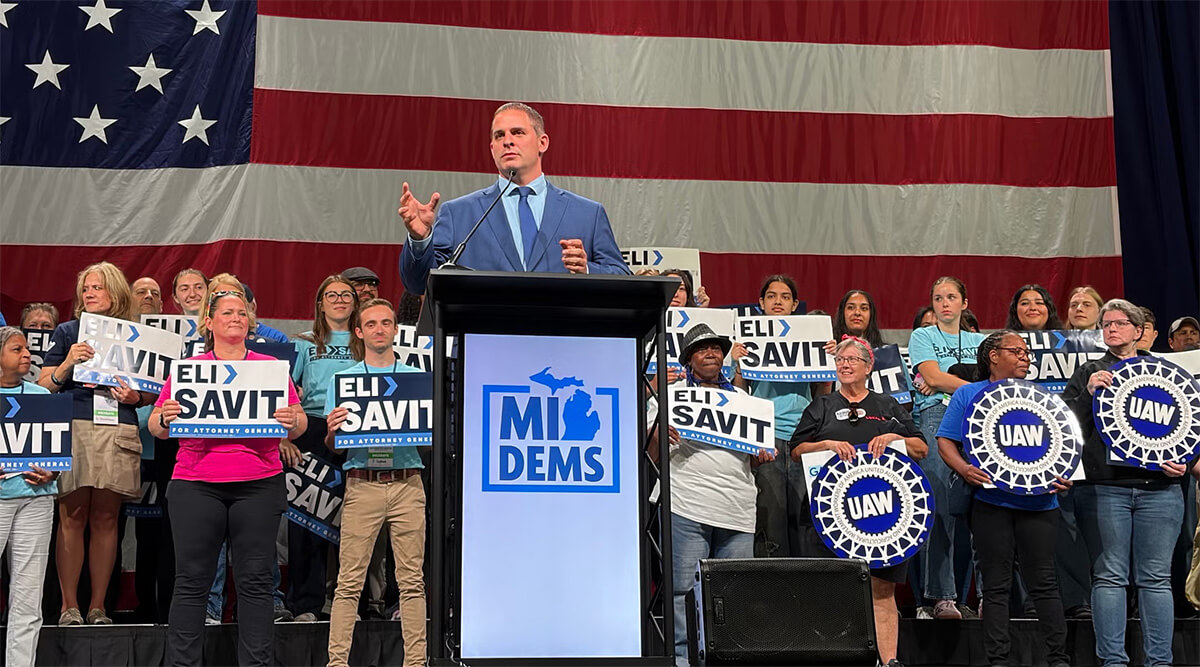
In one example, Washtenaw County Prosecutor Eli Savit, the party’s progressive Jewish nominee for state attorney general, addressed the Jewish caucus by declaring, “We’re going to win and keep the attorney general’s office in the hands of a Michigan Jewish Democrat.” Conspicuously absent from the day’s events was Nessel, the Jewish Democrat currently holding the seat.
Prior to the Saturday convention, Nessel, the state’s highest ranking Jewish official, had announced she would not be attending for fear she would be targeted by antisemitic harassment. Earlier this week, in a podcast interview with The Atlantic, Nessel had reiterated her issues with El-Sayed’s comments about Temple Israel and expressed hope he would walk them back soon.
Nessel’s son Zach Nessel, secretary of the state Jewish Democratic caucus, told the caucus that his mother’s absence stemmed from “agitators” who had targeted her at the party endorsement convention in the spring. Attendance at Saturday’s event was less than one-third of what the Jewish caucus had drawn at the spring convention, organizers said.
Zach Nessel criticized the state Democratic Party for failing to take prompt action to remove the agitators from the earlier convention. He told JTA that Jews in the party “have a right to be concerned.”
“I think the Democratic Party needs to put more work into addressing their concerns,” Zach Nessel said. “But I think that can’t happen without showing up.”
Moss, the Michigan state senator who has recently been at the center of another El-Sayed-related controversy, was spotted at the convention on Saturday but did not attend the Jewish caucus events.
One ally of El-Sayed’s who also addressed the caucus is University of Michigan Board of Regents nominee Amir Makled. He is an attorney for members of the school’s pro-Palestinian encampment movement who had pushed out a Jewish pro-Israel incumbent at the previous convention. During his own address to Jewish delegates, Makled did not mention his history of social media posts including retweeting far-right antisemitic conspiracy theorist Candace Owens and sharing praise for Hezbollah leaders.
Makled’s speech later that day at the nominating convention alluded to his work with the encampments as he declared that Michigan “will never have a university where students are punished simply because their speech makes the powerful uncomfortable.”
In-between candidate meet-and-greets, Jewish caucus members shared their anxieties about their closely scrutinized role in the midterm elections. They were gravely concerned about protecting democracy and election security from Republican threats, and felt that flipping the Senate was crucial.
Yet it was hard, they said, to get much of the Jewish community onboard this time, given the positions of El-Sayed and some other members of the Democratic slate. Michigan is home to an estimated 100,000 Jews, and the senate race is currently polling in a dead heat, making their votes potentially pivotal.
“How do we unify our community to put the country first?” one attendee asked the group. “I have a hard time doing that.”
This article originally appeared on JTA.org.
The post ‘I made a mistake’: Abdul El-Sayed apologizes to Michigan Jews for past comments about synagogue attack appeared first on The Forward.
Uncategorized
The woodcutter and the water carrier in the Torah portion, Nitzavim
לעילוי נשמת מײַן באָבע מנוחה וויטקא ע״ה לזרוב, לכבֿוד איר יאָרצײַט, ט״ו אלול
איינער פֿון די שטאַרקסטע קעגנער מיט וועמען אַ מענטש דאַרף זיך אויסקעמפֿן איז…זיך אַליין.
די סיבה איז פּשוט: די געדאַנקען און געפֿילן וואָס אַ מענטש קען צום בעסטן, זענען זײַנע אייגענע. און ווײַל דאָס זענען זײַנע פּערזענלעכע געדאַנקען און נײגונגען, איז מען נאַטירלעך גענייגט זיי צו געבן אַ גרויסע חשיבות. אויב איך פֿאַרשטיי אַזוי, אָדער איך פֿיל אַזוי, איז דאָס שוין לכאורה אַ גענוג גוטע סיבה צו טאָן אַלץ וואָס איך קען כּדי אויסצופֿירן מײַנע געדאַנקען און באַפֿרידיקן מײַן ווילן.
אָבער זייער אָפֿט טרעפֿט דווקא דאָס פאַרקערטע. דער מענטש וואָס שטעלט אויס זײַן לעבן בלויז לויט דעם וואָס אים דאַכט זיך ריכטיק אָדער באַקוועם, קען צום סוף שאַפֿן געלעגנהייטן וואָס גייען ווײַט העכער פֿון זײַנע באַגרענעצטע און פֿאַרבײַגייענדיקע פּערזענלעכע געפֿילן.
מיט אַנדערע ווערטער, באַקוועמלעכקייט און צוגעוווינטקייט קענען זײַן די גרעסטע שׂונאים פֿונעם מענטשן, אַנשטאָט זײַנע מיטהעלפֿער.
אין דער סדרה פֿון דער וואָך, נצבים־וילך, ווענדט זיך משה רבינו צום ייִדישן פֿאָלק אַזוי:
„אַתֶּם נִצָּבִים הַיּוֹם כֻּלְּכֶם לִפְנֵי ה׳ אֱלֹקֵיכֶם… מֵחֹטֵב עֵצֶיךָ עַד שֹׁאֵב מֵימֶיךָ“ — איר שטייט הײַנט אַלע פֿאַר דעם אייבערשטן, אײַער ג־ט… פֿון דײַנע האָלצהעקערס ביז דײַנע וואַסער־שעפּערס (וואַסער־טרעגערס).
דער גרינדער פֿון חב״ד, רבי שניאור זלמן, באַקאַנט ווי דער אַלטער רבי, דערקלערט אַז דאָס האָלצהאַקן און וואַסער־שעפּן האָבן, אויסער זייער פּשוטן באַטײַט, אויך אַן אינערלעכן טײַטש אין דער פּערזענלעכער עבֿודה פֿונעם מענטש.
דער אויסדרוק „עֵצֶיךָ“, דײַן האָלץ, קען מען אויך פֿאַרשטיין ווי „עצותיך“, דײַנע אייגענע עצות, געדאַנקען און חשבונות.
דאָס „וואַסער“ איז מרמז אויף דעם יסוד המים פֿונעם נפֿש הבהמית — דער מקור און טרײַבקראַפֿט פֿון קערפּערלעכע תּענוגים.
די לערנונג, זאָגט רבי שניאור זלמן, איז אַז אַ מענטש דאַרף „אויסהאַקן“ די אייגענע חשבונות און „אויסשעפּן“ די תּאוות וואָס צילן בעיקר אויף פּערזענלעכע קערפּערלעכע הנאות.
ערשט ווען אַ מענטש קען נייטראַליזירן אָט די צוויי כּוחות און זיך נישט לאָזן פֿירן פֿון זיי, קען ער צום בעסטן מקיים זײַן זײַן שליחות אין לעבן — אָן דעם שוחד פֿון פּערזענלעכער באַקוועמלעכקייט. שוחד פֿאַרבלענדט דאָך די אויגן און לאָזט ניט זען קלאָר און אָביעקטיוו. דאָס זעלבע טרעפֿט מיט באַקוועמלעכקייט. עס לאָזט ניט טראַכן אָביעקטיוו.
מען וואָלט אָבער געקענט מיינען אַז אַזאַ דיסציפּלין איז שייך בלויז צום תּורה־לערנען, צו מענטשן וואָס פֿירן אַ רוחניותדיק לעבן, אָדער בלויז ווען אַ מענטש וויל מצליח זײַן אין זײַן אייגענער גײַסטיקער זוכעניש.
וואָס איז אָבער מיט מסחר, פּרנסה אָדער אַ פּראָפֿעסיע — מיט די לכאורה „נישט־רעליגיעזע“ געביטן פֿון לעבן? דאָרט מעג מען דען נישט טאָן וואָס מען אַליין האַלט פֿאַר ריכטיק און וואָס גיט פּערזענלעכע צופֿרידנקייט?
דער ליובאַוויטשער רבי — זכותו יגן עלינו — ווײַזט אָן אַז דער ענטפֿער אויף דער פֿראַגע ליגט שוין אינעם פּירוש רש״י אויפֿן פסוק.
ווער זענען געווען די דאָזיקע האָלצהעקערס און וואַסער־שעפּערס?
רש״י דערקלערט אַז זיי זענען געווען כּנענים וואָס זענען געקומען צו משה רבינו ע״ה מיט דער כּוונה זיך מגייר צו זײַן, און משה האָט זיי באַשטימט צו דינען ווי האָלצהעקערס און וואַסער־שעפּערס.
דער רבי ווײַזט אן אַז דאָס וואָרט „כּנעני“ מיינט אויך אַ סוחר.
דער רמז איז, אַז נישט בלויז ווען עס רעדט זיך וועגן הימלישע און רוחניותדיקע ענינים — „רעליגיעזע“ באַשעפֿטיקונגען — דאַרף מען זיך באַפֿרײַען פֿון פּערזענלעכע אינטערעסן, צי שׂכלדיקע צי פֿילעוודיקע.
אויך אין מסחר, אין אַלע ענינים וואָס האָבן צו טאָן מיט גשמיות און מאַטעריע, דאַרפֿן די „האָלצהעקערס“ און „וואַסער־שעפּערס“ גיין צו דער אַרבעט.
מען דאַרף זיך העכערן איבער די אייגענע חשבונות און תּאוות, און זיך אָפּגעבן מיט די גשמיותדיקע טעטיקייטן מיט דער כּוונה, אַז דורך זיי זאָל מען אַרײַנברענגען הייליקייט און ג-טליכקייט אין דער וועלט — דורך דעם ליכט פֿון דער תּורה און דער נפֿש האלוקית.
עס זענען דא מענטשן וואָס קענען דאָס באַטראַכטן ווי אַ באַגרענעצונג: „מען לאָזט מיר נישט טאָן וואָס איך וויל.“
מען קען דאָס אָבער באַטראַכטן גאָר אַנדערש — ווי אַן אויסערגעוויינטלעכע געלעגנהייט:
„שטענדיק — אַפֿילו אין די מערסטע וועלטלעכע און לכאורה נישטיקע טעטיקייטן — האָב איך די מעגלעכקייט צו דערגרייכן עפּעס וואָס האָט אַן אומענדלעכע און אייביקע ווערט.“
דעריבער איז די געצײַג פֿון דער וואָך:
אויב דו פֿילסט זיך שלעכט ווײַל עס דאַכט זיך דיר אַז אַ גרויסער טייל פֿון דײַן לעבן האָט נישט קיין באַזונדערן זין אָדער ווערט, געדענק אַז עס ליגט אין דײַנע הענט צו באַשליסן אין וועלכער ריכטונג דו וועסט גיין.
דו קענסט צייכענען דײַן וועג לויט דײַנע פּערזענלעכע געדאַנקען און געפֿילן, וואָס קומען און גייען און לאָזן נישט קיין אייביקע שפּור.
אָדער דו קענסט זיך באַפֿרײַען פֿון זייער הערשאַפֿט און זיך אָפּגעבן מיט עפּעס וואָס איז אַ טייל פֿון אַ ציל וואָס איז אומענדלעך גרעסער — און אומענדלעך מער ווערטפֿול.
The post The woodcutter and the water carrier in the Torah portion, Nitzavim appeared first on The Forward.
Uncategorized
Vance, who’s drawn ire of Jewish conservatives, will speak at Republican Jewish confab
(JTA) — Vice President JD Vance, who has drawn the ire of a number of Jewish conservatives, will speak at the Republican Jewish Coalition’s annual summit in Las Vegas on Monday, the RJC confirmed.
“The Republican Jewish Coalition is proud to welcome Vice President JD Vance to our National Leadership Summit in Las Vegas,” said an RJC spokesperson. “JD Vance is a friend, who is coming back after first joining us in 2022 as a candidate for the US Senate.”
Vance’s appearance comes as a number of Jewish Republicans and major GOP donors have indicated that they would rather support Marco Rubio for the presidential nomination in 2028 than Vance, who is seen as Donald Trump’s likeliest successor. Some of those donors will be in the room on Monday at the Venetian Resort, which is owned by the billionaire Adelson family — a major backer of Trump and various Jewish and Israeli causes.
The vice president has lost the confidence of the pro-Israel crowd with his reprimanding of Israeli officials, indulgence of anti-Israel conspiracy theories and silence on Tucker Carlson, the prominent pundit who has spread antisemitic conspiracy theories. Multiple donors told the Jewish Telegraphic Agency during last year’s confab that they would not support Vance in 2028.
Carlson, meanwhile, was a major focus of the discussion at the RJC’s 2025 summit, where signs reading “Tucker is not MAGA” were handed out to attendees. His son, Buckley Carlson, is a former Vance staffer.
An agenda sent by the RJC lists Vance as a speaker during a Monday evening session that will be closed to press. A spokesperson confirmed that Vance will be speaking in a “fireside chat.”
A number of high-profile Republican candidates are also expected to speak at the RJC confab, which is being held on Sunday and Monday, a few months ahead of the midterm elections. Speakers include U.S. Senate candidates Mike Collins, the Georgia congressman who is challenging Jewish Democrat Jon Ossoff, and former Rep. Mike Rogers, who is running against Abdul El-Sayed in Michigan.
Collins has faced accusations of antisemitism and having ties to the far right. He has said that some of his statements were misunderstood, and has defended himself by citing his support for Israel.
This article originally appeared on JTA.org.
The post Vance, who’s drawn ire of Jewish conservatives, will speak at Republican Jewish confab appeared first on The Forward.
