


Uncategorized
How I found freedom in a Passover Seder, an amp and a red Fender Duo-Sonic guitar

Passover at my cousin Doug’s house was always a strange blend of ritual, impatience and barely contained chaos. None of us was particularly religious, but we knew the drill: Read the Haggadah, dip the bitter herbs, eat a boatload of matzo, and laugh along as Uncle Sonny delivered his annual denunciation of religion. We rushed through the Seder with the urgency of people trying to outrun a bullet train. Everyone wanted to get to the oleshkas, the tzimmis, and my Grandma Min’s gefilte fish.
At some point during the adult drone that followed — politics, real estate, digestive-related medical complaints — I slipped away from the table in search of Doug’s electric guitar: a red Fender Duo-Sonic. Sleek, curved, impossibly alluring. The first time I saw it, Doug, then 17 or 18, played a halting version of “Hey Joe” for my sister and me. But it wasn’t only the sound that hooked me; it was the shape of the thing. I was 13, only a few months after my Bar Mitzvah, and the guitar felt like contraband, akin to the pot I would soon be smoking. I stared at it with the same stunned focus I reserved for an occasional glimpse of the bare backside of a Playboy centerfold.
The Haggadah asks: Why is this night different from all other nights?
For me, the answer was simple: It was the night I transformed from a pimply suburban teen into something mythic. If daily life — compulsive worry about my untamable Jewy hair, god-awful grades, and a steady stream of unrequited urges — felt like Egypt, then that red Duo-Sonic was my personal Moses.

A few weeks after Passover, my father — a serial entrepreneur who once marketed his own brand of car battery, opened the first Suzuki motorcycle shop in Minneapolis, and launched an eight-track cassette store he called Tape-O-Rama — bought Doug’s Duo-Sonic guitar and his Princeton Reverb amplifier for $150. He was as thrilled about it as I was. I remember him standing in my room, sleeves rolled up, trying to look like he knew what he was talking about. It was endearing and a little sad when he pointed at the amp’s knobs — treble, bass, tremolo, and reverb — and suggested I set them all to five.
“Let’s make ’em all the same, Pete.” He said. “Even Steven.”
My dad knew less than zero about rock, but as always, he wanted to help with something that mattered to me.
The guitar changed my life. Not instantly, but decisively. The first time I played with another kid my own age, my drummer friend Andy Kamman, an impressive musician even as a fifth-grader, I felt something shift. It wasn’t like school band, where I played the alto sax while the band director hovered over us, selecting songs notable only for their excruciating lameness. This was fully ours. No supervision. No rules. No permission required. I pulled my Duo-Sonic and the Princeton amp down the street in my Radio Flyer and set it up in Andy’s basement.
When he and I started playing, it felt shockingly intimate — frightening at first. Not that I knew what a sexual encounter was, but that’s what it felt like: two separate things — guitar and drums; two separate people — me and Andy — merging into a kind of oneness. I had no idea that this sudden unanimity would become an aspiration, not only in music but in all things. Music was simply the clearest expression of that spiritualized coming-together.
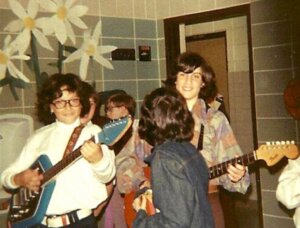
I’d play a riff; he’d shift the rhythm; I’d shift again. Words I hadn’t planned poured out. It was as close to conception as I’d get for a while. That transcendent aspect of music — its weird mixture of beauty, ego, and power — was already becoming clear.
By sixth grade we had a band: me on lead guitar and vocals, Andy on drums, Steve Grossman on bass, and Aron Goldfarb on rhythm guitar. We were rehearsing for the Peter Hobart Elementary Spring Concert in Andy’s basement and the whole neighborhood seemed to show up. We had a makeshift PA — one microphone duct-taped to his brother’s stereo — and we played our three originals on repeat. Most of them barely counted as songs. “Sorrowland” was two lines of lyrics and a four-chord progression. “Down by the River” had two chords and one line clearly stolen from Creedence Clearwater.
Our masterpiece was “Exit,” which I wrote during Drug Prevention Week. Every kid had to make a filmstrip warning against marijuana. Mine consisted entirely of dinosaurs I’d rubbed from National Geographic onto overhead projector sheets. I told the class that pot would make you hallucinate brontosauruses, which — completely contrary to the purpose of the curriculum — made drugs sound irresistible.
“Exit” was about a boy who tried to touch his girlfriend’s breast before she was ready and, to soothe his rejection, turned to pot. Its last verse closed with these lyrics:
Your hopes are down and you pick up a J,
it ain’t gonna help you anyway.
But you strike a match and you let it burn
now your mind is ready to turn…
I hit the tremolo pedal on the line “strike a match,” making my voice wobble in druggy vibrato. Everyone went nuts.
With all the attention, the band drama kicked in. Aron, our rhythm guitarist, kept insisting he sing lead — even though we had only one microphone and it was plugged directly into the stereo’s single input. “Hey, Goldfarb, stop being such a dickfarb,” I said into the mic. It got a big laugh. I repeated it until the phrase turned into a song. I strummed some chords and chanted “Goldfarb’s a dickfarb,” over a riff stolen from “Exit.” The room roared. Aron turned red, threw down his gorgeous sunburst Vox Teardrop — an absurdly expensive guitar his parents bought him before he could even play — and stormed upstairs.
Things began to snowball. Kids at the school drinking fountain hummed my guitar riffs. Laura Bloomenthal finally noticed me. And then: incredible news. Mrs. Perhofsky called my house to ask if our band would perform for residents of the Saint Paul Cerebral Palsy Center. $25 plus unlimited orange pop and Fritos. I was ecstatic — and terrified. I had a problem with inappropriate laughter. Not cruelty — just a tendency to laugh when I wasn’t supposed to. A waitress once spilled pancakes at Uncle John’s Pancake House, and I burst out laughing for no good reason. I worried this gig might trigger the same response.
We practiced nonstop: our originals, Creedence’s “Who’ll Stop The Rain,” a few Beatles songs. My nerves tightened with every rehearsal.
The center’s cafeteria was huge. We set up our amps and waited. Then the audience poured in — dozens of people reaching toward us, smiling, stomping, yelling with unbounded eagerness. One guy’s head was long and cylindrical, strapped to the back of a metal wheelchair. A pretty teenage girl with no hands drew a beautiful picture with a crayon held between her toes. An older woman with skin so thin I could see every vein greeted us warmly and made us feel at ease. When we started to play, the place exploded. People pounded on tables, shouted, danced and laughed. Andy played better than I’d ever heard him. We all did.
I felt something then I couldn’t name, a sense of having stepped into the world, of finally being part of something important. I was so overwhelmed I almost cried then and there. I probably would have, if I hadn’t been afraid the guys would laugh at me. After our originals and the Creedence numbers, they demanded more. So we played everything again. We cracked open my Beatles songbook and sight-read our way through half its pages.
I didn’t laugh. I didn’t feel the need. Not even close.
Without question, it was the best day of my life so far.
Freedom is like that.
The post How I found freedom in a Passover Seder, an amp and a red Fender Duo-Sonic guitar appeared first on The Forward.
Uncategorized
Queen Esther would want Jews to save humanity at their own expense, said Michigan’s attorney general. Would she?
Queen Esther has been name-checked not once, but twice in the last week by sitting politicians in New York and Michigan in addresses to Jewish constituents. The first reference passed largely without notice. The second caused a national Jewish uproar.
Promising better protections for the Jews of New York, Governor Kathy Hochul said Friday night during Shabbat services at Central Synagogue that she was willing to “be your Esther, every time you need me.” A bit ironic as Hochul, who is Catholic, invoked the story of a Jew in disguise, but the metaphor tracked: a leader going to bat for a vulnerable Jewish community. Central had been the site of an attack on a congregant and security guard two weeks prior.
Michigan Attorney General Dana Nessel took a different tack — and paid a price. Nessel, who is Jewish, has voiced concerns about antisemitism in her party. But in a speech Sunday to Jewish Democrats, Nessel suggested they follow Esther’s path and “sacrifice the comfort, safety and security and even the very future of our own people in exchange for the opportunity to save the rest of humanity.”
“What good is defending the historic homeland of our ancestors and demanding that candidates acknowledge its right to exist,” Nessel reportedly said, “if the planet upon which it rests is no longer inhabitable?”
What followed was a borderline Ahaseurus-ian backlash as Jews around the country decried Nessel’s interpretation of the Megillah. Writing in the conservative publication Commentary, Seth Mandel said Nessel had “counseled servitude and suicidality.” Ron Halber, chief executive of the Jewish Community Relations Council of Greater Washington, called Nessel “an embarrassment.”
The comparison came as Michigan’s Jewish Democrats, including Nessel, navigate a tenuous political reality in the swing state following the party’s nomination of Abdul El-Sayed, a vocal critic of Israel, for Senate. Nessel had hoped both to reassure Jewish voters and rally their support in a meeting where El-Sayed also apologized for earlier comments about an attack on a Michigan synagogue.
Nessel made waves earlier last month when she said she would skip the state’s Democratic convention out of concern for her safety. Her comments Saturday seemed to cast those remarks in a new light: to many who read them, Nessel seemed to be saying that Jewish people should learn to hide, rather than rise to the occasion. (Nessel’s office did not respond to an inquiry Tuesday.)
That’s certainly not the story of the Megillah. For the uninitiated (or just forgetful): With the Jewish people in imminent danger, Queen Esther boldly (but carefully) reveals to the king her identity as a Jew, underscoring that the viceroy’s known genocidal plotting in fact affected her. As she does so, Esther repeatedly imperils herself — a standard some were eager to point out Nessel herself missed by sitting out the convention.
It’s easy to point to Nessel’s reading as an inversion of a story that seems to insist on a particularist reading. Or one could admire an ambitious attempt at universalizing the text: Maybe Nessel was saying that Esther put the needs of a nation — the Jewish nation — above her own safety, knowing that she could have lived the rest of her life in secret. The United States is the Jewish people in this analogy; Jewish Democrats, by subjugating their immediate security, are Esther. (Haman, the story’s villain, is the spectre of Republican control.)
Or maybe the Purim lesson Nessel was trying to invoke was even simpler: With great power — as Michigan’s Jewish Democrats may have in a close race — comes great responsibility. That’s Spiderman, but also Esther’s relative Mordechai, who famously helps her work up the nerve by suggesting her ability to intervene could be the very reason she was chosen for royalty in the first place.
Esther is often the subject of pop-culture fascination: 17th-century Dutch painters were obsessed, for example, including non-Jewish ones. Contemporary Christian playwrights seem to be, too, as do red-state school curriculums. Evangelicals once compared Trump to Esther — a fearless hero who would dismantle the deep state — and former Vice President Kamala Harris invoked Esther on the campaign trail in 2024.
The common thread in this history, more than anything else, is Esther’s reinvention to suit a self-serving political narrative. For the Dutch — at the time newly liberated from Spanish empire — Esther represented resilience in the face of persecution; for the Christian right, she is a flawed but valorous normie who fulfills a holy mission. For Hochul and Harris (and maybe Nessel, too), she’s a woman who meets the moment.
She’s also the title character of a helluva story — and a familiar one — which makes her as eminently useful to people today as she was to her famously insecure husband in the Megillah. If one thing seems assured, it’s that Esther will continue to feature in our own storytelling — and that she will continue to change with the times.
The post Queen Esther would want Jews to save humanity at their own expense, said Michigan’s attorney general. Would she? appeared first on The Forward.
Uncategorized
She was elected the first Jewish president of the Catholic Biblical Association. Then came the hate.
When Amy-Jill Levine was elected president of the Catholic Biblical Association earlier this month, she faced vicious backlash.
Those who opposed her election couldn’t exactly point to a lack of qualifications. Levine has written dozens of books on the New Testament, taught a New Testament course at the prestigious Pontifical Biblical Institute in Rome, served on the editorial board of Catholic Biblical Quarterly and spoken privately with Pope Francis three times.
Instead, her critics fixated on one trait they apparently consider disqualifying: She’s Jewish.
“Your Zionist ass doesn’t belong in our religion. Keep yourself to the Talmud and keep eating babies. STAY THE FUCK AWAY FROM CHRISTIANITY,” someone wrote in an email to Levine, which she shared with the Forward.
Levine’s Facebook page was bombarded with so much hate that she asked her daughter to moderate the comments. Online critics called Levine “anti-Christian,” denounced her as “Zionist,” and attacked her efforts to push back against antisemitic interpretations of the Bible.
On its face, a Jew at the helm of a professional association devoted to the study of Christian scripture might seem odd. After all, the Catholic Bible Association, unlike some other academic associations for the study of scripture, promotes study of the Bible “within a context of faith,” and most of the association’s presidents in its 90-year history have been priests. Levine attends an Orthodox Jewish synagogue.
Some more even-keeled critics of Levine’s presidency focused on this argument. “At some point, we have to ask: what is the word ‘Catholic’ actually doing?” Mark Lambert, co-host of the podcast Catholic Unscripted, posted to X.
Levine, meanwhile, argues that the Catholic Biblical Association is a professional society, not a church. People of all faiths are eligible for membership, as long as they hold an advanced degree in biblical studies.
“An academic society, like a hospital, museum or university, is not the same thing as being a member of the clergy,” Levine wrote in an email to the Forward.
In fact, while Levine is the first Jewish president of the Catholic Biblical Association, she is not the first non-Catholic. Several Protestants have served in the role, according to chair of the executive board Gregory Sterling.
Levine was nominated by a committee and then ran unopposed for the presidency, Sterling said. It is an unpaid, one-year position.
“She was not elected because she is Jewish, but because she is an exceptional scholar and has played a very important role in Catholic-Jewish dialogue,” Sterling and the association’s executive director, Archie Wright, wrote in a joint statement. “The vitriol of some of the comments only reinforces the need to address the problem of Anti-Semitism.”
Several Catholic clergy also wrote letters of support for Levine amid the pushback.
Levine, for her part, said she has “no interest in undermining the Church.” The 70-year-old grew up in North Dartmouth, Massachusetts, in a predominantly Portuguese Roman Catholic neighborhood, where she would occasionally go to Mass with her friends.
She preferred Mass to synagogue because “there were snacks, except you got the snacks in the church during the service, and you got the snacks in synagogue after the service,” she joked in an August interview on Nashville Public Radio.
Levine recalled that when she was 7 years old, a classmate told her she had killed Jesus — an accusation the elementary schooler had picked up from her priest. Levine, confused, went to her mother, who assured her that “God was doing just fine.”
That incident inspired Levine to attend Catholic catechism classes as a child, in addition to Hebrew School.
She went on to get a PhD in religion from Duke University and teach at Vanderbilt University as a professor of both the New Testament and Jewish Studies. Much of her scholarly work revolves around the Jewish context of Jesus and dispelling what she sees as antisemitic misinterpretations of the Bible.
“We do not need to make Judaism look bad in order to make Jesus look good,” Levine posted on Facebook after she was elected.
Catholic-Jewish relations
Sixty years ago, Levine’s election “would have been an astonishing thought,” said Philip Cunningham, director of the Institute for Jewish-Catholic Relations at Saint Joseph’s University in Philadelphia.
Though the Catholic church has a long history of antisemitism— including violent conversion efforts and teaching the theological belief that Jews were condemned by God — that has all changed in recent decades.
In the 1960s, Pope John XXIII took on the task of modernizing the Church, convening the Second Vatican Council to produce a theological document reconsidering many teachings and practices. The resulting document, often referred to as Vatican II, is perhaps most famous for allowing priests to host Mass in the local vernacular language of their parish instead of Latin. But it also changed Catholicism’s teachings about Jews.
Nostra Aetate, the section of Vatican II most famously concerned with Jews, shifted Catholic teachings about other religions enormously; while still maintaining that the Catholic Church is the “one true religion,” it also affirmed that other religions contain a “ray of truth,” a massive theological shift from the belief that any non-Catholic religion was false or even harmful.
Nostra Aetate spends significant time on Jews, specifically, including rejecting the belief that Jews should be held collectively responsible for killing Jesus. The document calls out antisemitism both theologically and politically.
“What happened in His passion cannot be charged against all the Jews, without distinction, then alive, nor against the Jews of today,” it reads. “The Jews should not be presented as rejected or accursed by God, as if this followed from the Holy Scriptures.”
Since Vatican II, popes have continued to advance dialogue with Jews, and with members of other religions. And the Church has forcefully rejected antisemitism, continuing to change its teachings on Judaism and Jewishness. That includes removing the term “perfidious Jews” from a Good Friday prayer, updating Catholic school classes on Judaism and even releasing statements acknowledging the legitimacy of Judaism alongside Christianity, placing Jews into a special and elevated relationship with the Church.
“The council set in motion a process of rapprochement between Jews and Catholics that took root particularly effectively in the United States, because the world’s largest Jewish diaspora community lives here and frequently alongside Catholics in cities and suburbs,” Cunningham said.
Levine, too, highlighted the importance of Nostra Aetate to her career, writing in an email that the document’s acceptance of Jews “opened the door for me to work in New Testament studies.”
But not all Catholics embraced the teachings of Vatican II. A diffuse movement often referred to as traditionalist Catholics, or tradcaths, felt that the efforts toward modernization had gone too far. Some tradcath groups simply sought to preserve the rituals of Latin Mass.
Others, however, including the recently excommunicated Society of Saint Pius X, or SSPX, take issue with the council’s teachings, believing that acknowledging the freedom and legitimacy of other religions takes away from the centrality of the Catholic Church’s teachings. In short, if the Catholic Church’s teachings are true, they argue, then no other religion can be legitimate.
The French-language account of SPPX posted to X, calling Levine an “objectively scandalous choice” and denouncing her “relativist interpretation of the texts condemning homosexuality,” as well as the fact that “a person who refuses to recognize Jesus Christ as Lord and Savior is placed at the head of an institution that claims to be Catholic.”
Despite the newer Catholic teachings about Judaism, some tradcath groups, as well as individual Catholic influencers such as Nick Fuentes, Candace Owens and Carrie Prejean Boller, have been endorsing antisemitic beliefs including supersessionism and deicide, as well as conspiracy theories about Jewish devil worship or government control. Though the Vatican has chastised these figures and repudiated their stances, they have continued to spread antisemitic dogma, including the belief that Jews hate and seek to oppress Christians and that Kabbalah endorses pedophilia. Many also endorse Christian nationalism, which the Vatican opposes.
This antisemitic subgroup within Catholicism is relatively small, but extremely visible thanks to influencers like Fuentes and Owens with millions of followers, and their understanding of Catholicism spreads to people both inside and outside the church. Their antisemitic version of Catholic ideology, as well as the conspiracy theories they spread, can be seen in some of the hate emails Levine received, such as references to eating babies, a version of the age-old blood libel that Jews used Christian children’s blood to make matzo.
Still, while the antisemitic fringe of the Catholic church is loud, the institutions are stalwart in their support for Vatican II’s acceptance of Judaism.
Levine’s election is an indication “that the changes that Vatican II sought to inspire have been happening,” Cunningham said. “That does not mean that all the issues between Jews and Catholics have been resolved — but at least amongst the much of the leadership in the Catholic community, the old stereotypes and caricatures are recognized for what they are.”
The post She was elected the first Jewish president of the Catholic Biblical Association. Then came the hate. appeared first on The Forward.
Uncategorized
Northeast Philadelphia says goodbye to its last Jewish deli
(JTA) — PHILADELPHIA — After running the family deli for several decades, Steve Stein says his 83-year-old legs were telling him it was time to call it quits. But it wasn’t only that.
The neighborhood has totally changed since his dad, Mike, first took over the business more than 60 years ago. Back then Northeast Philadelphia was an epicenter of Jewish life, packed with synagogues and other Jewish establishments. Most of them are gone. And now — with the close of Steve Stein’s Famous Deli and Restaurant — the area just lost its last Jewish deli.
But only after an outpouring of affection from longtime customers, who flocked to the place once news spread in the last few weeks. “It’s overwhelming,” Stein said. “The amount of people that came in here in the last 10 days, two weeks. Their comments are very touching. I knew I was liked. I didn’t know I was loved.”
To be sure, several customers told the Jewish Telegraphic Agency that they’ll miss Stein, but they also bemoaned the fact there aren’t many Jewish food options left. Certainly none with prices as low as Famous.
“I’ve been going there my whole life, “ said Rebecca Asheuer, who grew up a few miles away from Famous’ current location — its third since the Steins took over the business. “I feel surprise and sadness, because it’s the last one in the Northeast.
“I think the Jewish people are moving out of the city and also the businesses used to be passed down in families. Now with the economy and other stuff, people don’t want to take over the family business anymore,” she said.
Another longtime customer mourned the closing of the deli, but also the disappearance of Jewish life in the area.
“I kind of expected it to go sooner or later,” said Aileen Owens, who remembered going to Famous when the Auspitz family ran over six decades ago. “There’s nobody around. Synagogues and all that stuff, it’s all fading out. They went to the suburbs.”
According to Steve’s account, his father Mike Stein, his brother Arnold and cousin Jack began running the produce concession at the Famous Deli in Philly’s Castor Gardens neighborhood in the late 1950s. Around 1960, they bought the deli from the Auspitz family, which had operated a chain of Philadelphia delis dating to the 1920s.
Steve and his brother Arnie eventually ran the deli together. As Jewish families moved farther into Northeast Philadelphia, the deli moved as well — first to Krewstown Road in the mid-1970s, eventually having two locations there, and then about 14 years ago to its final location at 1619 Grant Ave.
If all goes right, Steve’s 57-year-old son Lee hopes to continue the migration and resurrect the family business in the suburbs. Sort of.
“I’m looking to have a place of my own,” said Lee, who started off as an eight-year-old taking out the trash, but would occasionally try to cut the lox when no one was looking. “I have a lot of experience in this business.
“I call myself multi-talented, not just in the deli business, but in cooking and baking, I would probably downsize and not do fruit and produce like we do here. It’s just not worth, you know, the space for what you’re paying. I would do a similar situation to here. Deli, prepared foods, a little bit of bakery, a small sit down. But what I’ve told the people that come in here, ‘You’ll never, ever see some of this product again. And you’ll probably never, ever see these prices ever again.’”
Still, he wants his new venture to be affordable.
“My father always liked being a people-pleaser,” the younger Stein said. “So he tries to please people with a price. But that price affects you eventually.”
As for Steve, he wishes his son well, but knows it won’t be the same. “Lee wants to try something, but not here,” Stein said.
He added that some remaining establishments in the wider region – “they do 90% restaurant and 10% deli, I do 90% deli and 10% restaurant” – will “benefit from me not being here.”
One former competitor isn’t so sure. “I’m upset another Jewish deli has closed and he’s been in business a long time and certainly has his whole clientele,” said Michael Young, longtime owner of Ben & Irv’s, a deli restaurant in Huntingdon Valley, a suburb about 20 minutes northwest of Famous. “But it’s a different world today; a different area. So I don’t know if it will help us.”
Lee Stein said he actually tried to stay put, but needed a little help.“The real problem is the landlord never took care of the building,” said Lee, who wishes his dad had been more assertive on that front. “I tried to make it work here with them, figuring this would be an easy fix. I asked them for some renovations; to put a new roof on. The roof has several holes in it. When it rains outside, it pours in here. So, I tried to negotiate with them first before I did anything else, but that wasn’t going anywhere.”
JTA’s attempts to reach the landlord for comment were unsuccessful. Regardless, Steve Stein, who was forced to close the deli for a short while last year due to health code issues, says he is ready to turn the page.
The first thing he’ll do once things settle down is get therapy on his aching legs. And he’s excited to have more time to devote to his wife of 61 years, Sheila, along with his children, Lee and Mindy, seven grandchildren and two great-grandchildren. “But I’ll miss my customers. They’re like family.”
Already he’s feeling the difference “It’s devastating,” he said on Aug. 24, the day after the store officially closed, amid a final “blowout sale” to get rid of what little was left. “I’m usually the first one in the store.
“It’s going to be very much missed by me.”
He’s not the only one.
“Nothing lasts forever,” said one customer before heading into Famous one last time. “But it’s very sad.”
This article originally appeared on JTA.org.
The post Northeast Philadelphia says goodbye to its last Jewish deli appeared first on The Forward.
