


Uncategorized
Irving Berlin’s 1926 interfaith marriage sparked a Jewish debate that, 100 years later, hasn’t gone away
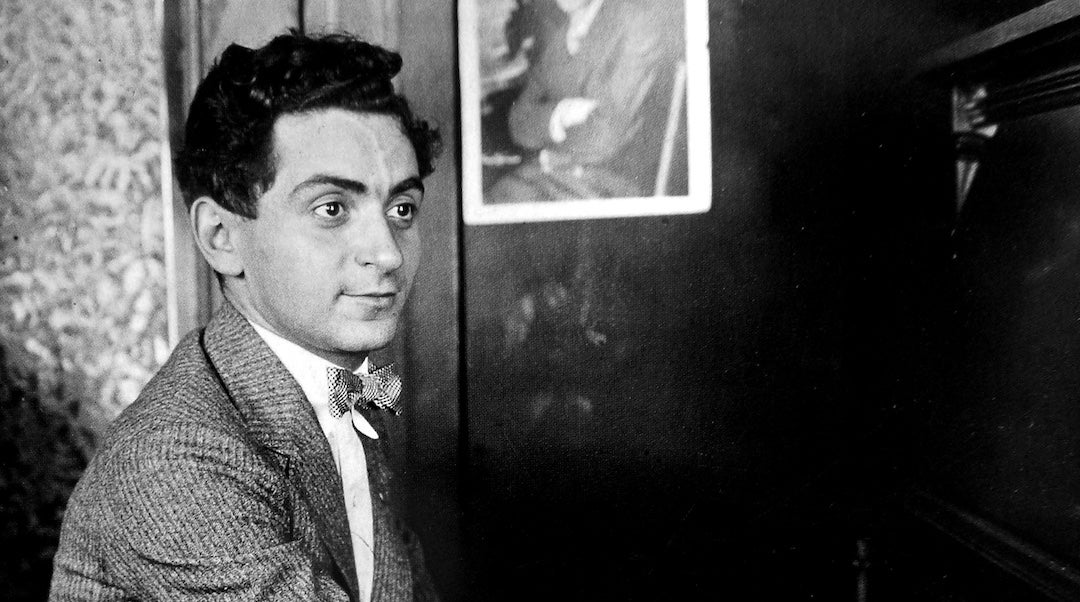
(JTA) — Exactly 100 years ago, on Jan. 4, 1926, legendary American Jewish songwriter Irving Berlin married Ellin Mackay, a Roman Catholic heiress, in a civil ceremony in Manhattan’s City Hall. What some considered a misalliance of prominent figures from different worlds was the subject of much comment, as much for their class differences as their religious ones. This is the story of how Irving met Ellin, of the difficulties they faced at the start of what proved a happy, 62-year marriage, and of how Irving’s fellow Jews felt about the union.
For more than a century, interfaith marriage has functioned as a kind of Rorschach test within American Jewish life, alternately framed as an existential threat, a sociological inevitability or, more recently, a potential avenue for renewal. Only last month, for example, the Conservative movement formally apologized for decades of discouraging intermarriage and committed itself to a new approach centered on engagement. This is worlds apart from the prevalent attitude in the second half of the 20th century, when intermarriage skyrocketed and communal leaders warned that it was hastening assimilation, eroding a fragile minority culture and causing a crisis.
Such voices were also heard in the 1920s, but in Irving and Ellin’s day the attitude of most Jews was a good deal more benign. A robust Yiddish and Jewish press — including the Jewish Telegraphic Agency — closely followed the couple’s romance, and pulpit rabbis discussed it in their sermons, but there was no consensus on whether the celebrity intermarriage was a “menace” to the Jews or, indeed, a sign of their growing acceptance.
The couple’s courtship began on a May evening in 1925 at the home of Frances Wellman, the socially prominent wife of a New York district attorney. Frances had invited her good friend Ellin to dinner. The 21-year-old Ellin, presented to society four years earlier, had recently begun writing for The New Yorker as a voice of the younger, privileged set.

A publicity photo of Irving Berlin taken by his early music publishing company, 1906. (Life magazine images via Wikipedia)
A theater aficionado, Frances was also close enough to 38-year-old Irving Berlin that she felt comfortable calling him to fill in when a dinner guest cancelled at the last minute. That was what happened on the Saturday night that Irving was introduced to Ellin in a meeting that was entirely unplanned.
Irving’s rags-to-riches story was already well-known. Journalist Alexander Woolcott had just published a biography of him and like most everyone, Ellin had enjoyed his songs. Born Israel Baline in a shtetl in Belarus, he had arrived in America in 1893 at age five. His father, a cantor, worked as a meat cutter and a Hebrew tutor in New York; his mother was a midwife. Young Izzy left school to earn a living when his father died in 1901. He began by selling newspapers, but the musical ability he had inherited opened other doors. He found work as a singing waiter in Chinatown, and later at Jimmy Kelly’s Greenwich Village nightclub, the “Montmartre of New York.”
By 1907 he was already writing music. He was erroneously identified on the sheet music of his first published song, “Marie from Sunny Italy,” as “I. Berlin” and the spelling stuck; he also began going by “Irving” rather than “Izzy.” His first megahit, “Alexander’s Ragtime Band,” which sold over a million copies, came in 1911 and catapulted him to fame. Drafted into the army in 1917, he wrote a patriotic musical, Yip Yip Yaphank, and produced it with an all-soldier cast. His blockbuster hit, “God Bless America,” was composed for that show, but not released until years later. By the 1920s, he was internationally famous and quite wealthy, with assets estimated at a million dollars (about $25 million in today’s currency).
Lean and wiry at five feet six, Berlin had briefly been married before. He had wed Dorothy Goetz, a 20-year-old Catholic girl, in a civil ceremony in 1912. During their honeymoon, however, Dorothy had contracted typhoid fever and she died just five months after the wedding. After her tragic death, he composed a plaintive waltz called “When I Lost You” to express his grief. From time to time since then, Irving’s name had been linked with those of other women, but in 1925 he was unattached. He liked to quip that if he were engaged to anyone, it was to Sam Harris, his partner at New York’s Music Box Theatre.
Ellin, for her part, was a bit more attached. She had been seen with Leopold Stokowski, the eminent conductor, and wooed by a Scottish aristocrat, Capt. Ian Campbell, heir to the Dukedom of Argyll. She had even accepted an expensive bauble from the latter, but no engagement had ever been announced.
Nonetheless, the attraction that Saturday night in 1925 was strong and mutual, and the evening did not end with dessert. After dinner, Irving invited Ellin to hear the band at Jimmy Kelly’s. The evening marked the beginning of a passionate romance.
Dancing with the Prince of Wales
To say Ellin Mackay came from money would be a colossal understatement. Her grandfather, John William Mackay, was one of the 20 richest people in the world at his death in 1902. Born into poverty in a Dublin slum, John had arrived in New York in 1840 and answered the call of the California Gold Rush. But it was silver rather than gold that accounted for his vast wealth. He and three other miners had struck it rich in the silver mines of the Comstock Lode.

Ellin Mackay’s insider chronicle of Manhattan nightlife, published in The New Yorker in 1925, became a sensation. (The New Yorker)
John used some of his fortune to form the Commercial Cable Company, which broke financier Jay Gould’s monopoly on transatlantic telegraphy, and the Postal Telegraph Company, which operated networks in the U.S. His wealth rivaled that of Gould and railroad magnate Cornelius Vanderbilt II. But his money could not buy him and his wife Louise social acceptance when they moved back east in 1878. As a nouveau riche Irish Catholic, John was snubbed by New York society.
Upon his death, his son Clarence, known as Clarie, inherited some $45 million ($1.7 billion today) and became president of both enterprises. He would eventually extend the telegraph and cable service to three quarters of the circumference of the earth. In 1898 he wed Katherine “Kitty” Duer, a Protestant and a member of the New York “smart set” whose family was listed among the “Four Hundred”; in so doing, he bought himself the social standing that had eluded his parents.
For a wedding gift, John gave the couple a 648-acre estate in Roslyn, Long Island known as Harbor Hill, and Clarie spared no expense in building his new wife a dream house there. He engaged world-famous architect Stanford White to design a 52-room, 80,000-square-foot French chateau at a cost of $6 million ($207 million today) that took two years to complete. Erected on the second highest point on Long Island, it commanded impressive views of the ocean and the sound. The manor boasted a grand entrance hall, a ballroom, a library, a music room, a dining room, a billiard room, an indoor swimming pool, squash courts, a private chapel and multiple bedroom suites with bathrooms equipped with indoor plumbing. Kitty’s personal lavatory included a $17,000 ($664,000 today) sunken bathtub imported from Italy, carved from a solid block of marble.
This was conspicuous consumption at its grandest, and it was the fairyland in which Ellin Mackay grew up, together with her elder sister Katherine and a younger brother, John. But her sheltered life was not without its share of heartache. When Ellin was eight, her mother took up with her husband’s physician and departed for Europe with her paramour, causing one of the most sensational scandals of the Gilded Age. In the divorce, Clarie retained Harbor Hill and Kitty received $2 million ($65 million today), but had to forfeit custody of their children.
Because Clarie was viewed as a victim, his social standing did not diminish. In fact, he became one of the most lavish hosts in America. In 1921, for example, he outspent the parents of all the other debs on Ellin’s coming out party. The $20,000 event — the equivalent of about $360,000 today — was held at the Ritz-Carlton Hotel. Among the luminaries in attendance were the Cornelius Vanderbilts, the John D. Rockefeller, Jrs., the Kermit Roosevelts, the August Belmonts, Mrs. J. P. Morgan and the Harry Payne Whitneys.
The most memorable event Clarie ever hosted, however, was his 1924 reception for the future British King Edward VIII, who was on a two-week tour of the United States. One thousand guests were invited for dinner and dancing at Harbor Hill. Ellin would remember that party as the night she danced with the Prince of Wales — seven years before he would meet Wallis Simpson. His Royal Highness found her “one of the most charming girls I ever met.”
Clarence’s social position demanded that he marry his daughters off to prominent, well-to-do young men. He approved of Kenneth O’Brien, son of a New York State Supreme Court justice and fellow Irish Catholic, as a proper helpmate for Ellin’s sister Katherine. The couple were wed in September of 1922 and feted at a 2,000-guest event. Ellin, who served as her sister’s maid of honor, had every reason to expect a similar celebration when the time came for her to marry. But such a wedding, it would soon be clear, was not to be.
‘A songwriter? And a Jew to boot!’
When the RMS Olympic arrived in New York harbor from Cherbourg on April 15, 1925, Ellin, who had been in Europe for half a year, was mobbed by newspapermen even before she disembarked. Decked out in the latest fashion, Ellin was the picture of poise as she consented to answer a few questions.
“We understand there are well-founded reports that you and Irving Berlin are engaged,” one of them asked.
“There is positively not a jot of truth in it,” she replied. “I have met Mr. Berlin at a number of parties, but I have met many men at social events, and I don’t see that this calls for the creation of something out of nothing.” Taking her father’s arm, she continued, tongue firmly in cheek, “If I married, I would leave Dad alone, and I cannot bear to think of parting with him. I have not met the young man I would marry and give up my father.”
The truth was, she had met him. Whether or not there was an actual engagement, there was something serious going on between her and Berlin. They had kept company for the four months between their first meeting and her departure for Europe. In fact, not only were Ellin and Irving already an item before she left, but Irving was the reason for the trip. Clarie, deeply unhappy about the relationship, voiced many concerns: her youth, the gap in their ages, their religious differences, how any children would be raised, his lack of education and his lifestyle as an entertainer. He actually hired detectives to tail Berlin, hoping to catch him misbehaving, and it was he who had arranged his daughter’s extended vacation in Europe. He hoped it would break the couple up.
Clarie’s attempts to part them proved fruitless, however. By mid-June it was widely reported that the two would soon marry. Ellin, it was said, had secretly traveled to Rome and secured special dispensation from the Pope to marry outside her faith on the condition that any children be raised Catholic. Clarie denied that rumor, certainly untrue. And Irving, accustomed to speculation about his love life, continued to deny that the couple were betrothed.
“The story of our engagement seems to be based on my writing ‘What’ll I Do?’ and ‘All Alone,’” he told Time Magazine. “It has always been assumed after I have written a ballad that I have been through some heartbreaking experience.” The smash hit “What’ll I Do,” the lament of a man apart from his beloved “with just a photograph to tell my troubles to” has indeed often been cited as a wedding tribute composed by Berlin for his new bride while she was away. But the piece was actually published several months before the composer ever met Ellin. “All Alone,” on the other hand, whose lyrics also suggest a man separated from his love, was indeed written in the summer of 1924 when Ellin was in Europe.
The Jewish newspapers used their imagination in reporting about the nuptials. The fact that they were in no position to listen in on private conversations did not stop them from reporting ostensible verbatim transcripts of them. By one account in the Yiddish-language Forverts (Forward), Clarie said to Ellin, “A songwriter? And a Jew to boot! How can an aristocrat tolerate this?” And this, from Di Yidishe Shtimme (The Jewish Voice): “Very well. Marry your ragtime peddler. But the children — Catholic, every one! And the ceremony — no synagogue stench.”
Irving’s Irish Rose
Berlin would not be the first prominent American Jew to intermarry. Harry Houdini (born Erik Weisz) had married out of the faith in 1894, and, more recently, Al Jolson (born Asa Yoelson) had wed twice, both times to gentiles. None of those weddings had made headlines, however. Jolson did get plenty of publicity when his first wife sued him for divorce, but the coverage had focused on accusations of desertion and did not mention ethnic differences.

The lobby card for the 1928 film adaptation of Abie’s Irish Rose, the popular Broadway play about an intermarriage. (LMPC, via Getty Images)
This, however, was different. Jewish intermarriage had caught the public’s imagination when a Broadway hit called Abie’s Irish Rose, a three-act comedy by playwright Anne Nichols, opened in 1922. Nichols had weaved a tale of a secret Jewish-gentile marriage and the discord it caused in the bride and groom’s families. It was still running when the papers announced the Berlin-Mackay engagement, and the comparison was too obvious to resist.
In the play, Abraham Levy and Rosemary Murphy, Jewish and Catholic, meet and marry in France. When the couple returns to New York, Abie introduces his bride as his fiancée and allows his parents to believe she is Jewish. Similarly, Rosemary’s father assumes that her betrothed is an Irishman. But when the parents meet, the ruse is discovered. A priest and a rabbi get involved and there are two more weddings. Reconciliation eventually comes about when Rosemary gives birth to twins, strategically named Rebecca and Patrick.
The production broke Broadway box office records by racking up a record 2,327 performances during its five-year run; even Jewish theatergoers enjoyed it. But it was reviled by most reviewers and was especially unpopular around the Algonquin Round Table, the famous gathering spot for wits. Humorist Robert Benchley called it “something awful”; theater critic Heywood Broun derided it as “synthetic farce” and journalist Dorothy Parker noted that it had defeated another production “for the distinction of being the season’s worst play.”
The attitude of the Jewish press toward the play, however, was mostly favorable. The American Israelite found “not the slightest affront to even the most devout adherent in either of the faiths involved.” The Jewish Exponent noted that “on your way out you are still laughing at some of the humor typical of the respective race.” And the Jewish Advocate went even further, commenting on “the deep regard the Jewish people of the metropolis have for this wonderful play of love and tolerance.”
Only the Forverts was unimpressed, condemning it as stupid and noting that “it doesn’t bear the slightest resemblance to Jewish or Irish life.” Missing, even from the Forverts’ rebuke, was any outrage over the stereotypical portrayal of the characters, the mocking of Jewish religious and cultural practices or the sympathetic depiction of interfaith marriage.
Inevitably, Irving and Ellin were widely compared to Abie and Rose. Ann Nichols even reported that attendance at the play rose substantially after the couple’s nuptials were announced. And a Tin Pan Alley duo wrote a song about them that echoed the play, entitled “When a Kid Who Came from the East Side Found a Sweet Society Rose.”
‘Mazel tov, Mr. and Mrs. Berlin!’
By September, Ellin was still insisting to reporters that she knew Berlin only “slightly.” But the reporters weren’t buying it, nor should they have. Because just a few months later, on January 4, 1926, Irving Berlin and Ellin Mackay were united in a civil ceremony in New York City. The bride and groom arrived at City Hall by subway — the first subway ride of the aristocratic Ellin’s life, she maintained — and a deputy city clerk performed the ceremony. Only after it was all over did Ellin wire her father with the news.

The Jewish Telegraphic Agency’s Daily Bulletin reports that Irving Berlin and Ellin Mackay were wed on Jan. 6, 1925. The article quoted Clarie Mackay, saying, “The bride’s father, when informed of the wedding, declared: ‘The marriage comes as a complete surprise to me and was done without my knowledge or approval. Beyond this I have nothing to say.’” (JTA archive)
The marriage became a front-page story all across the United States. Most of the coverage mentioned the religious difference between the new spouses, but the focus was more on class difference. The reports ran more less along these lines, penned by columnist Eddie Dougherty:
A Catholic girl, finely reared, splendidly educated, a girl who had only to wish for a thing to obtain it, gave herself to a Jew who came out of poverty and hardship into the stars. She gave up for him her religion, her people, her countless society friends, everything she had known and held priceless before Berlin came into her existence.
After receiving his daughter’s cable, Clarence Mackay asserted that the wedding “was a complete surprise and was without my knowledge or consent.” Ellin’s mother, who had initially raised some red flags, was supportive of the marriage. Berlin’s parents were deceased by the time of the wedding, but one reporter managed to track down his sister Ruth in New Jersey. She told him she had expected the marriage and wished her brother Izzy and his bride “every happiness.”
The couple disappeared to Atlantic City for a couple of days, biding time before their departure for Europe. Irving had originally planned to travel there alone, but now they would go as a couple. He booked the $5,000 presidential suite on the S.S. Leviathan, which was to set sail on Saturday, Jan. 9. Tackled by reporters at the Ritz-Carlton Hotel on the Boardwalk, Ellin asserted that “We are supremely happy, and that is all that counts.” She also allowed that the “greatest wedding present” she could receive would be her father’s blessing and that she was hopeful of receiving it.
But on the same day, Kenneth O’Brien, Ellin’s brother-in-law, told the newspapers that Clarence would neither “forget nor forgive” his daughter. Mackay insisted that his son-in-law’s statements had been unauthorized, but he refused to comment on the possibility of a reconciliation. A press account held that he had disinherited Ellin.
By the day of their departure for Europe, the only signal from Ellin’s father was a statement that his opposition to the marriage was unchanged. The couple made no attempt to contact him and went ahead with their plans. Late that night, to avoid gawkers, they slipped down the fire escape of Berlin’s apartment building and hailed a taxi for Chelsea Piers. At midnight they boarded the S.S. Leviathan and set sail for Southampton, England in luxury.
During the voyage, the couple hosted a dinner to which they invited a small group of passengers with whom they were acquainted. That Ellin was now being snubbed by her “people” became clear when fellow voyagers Alice Claypoole Vanderbilt and Gertrude Vanderbilt Whitney declined to attend. And soon her name was dropped from the Social Register. There appeared to be some truth in Eddie Dougherty’s prediction that in marrying Irving, Ellin would be giving up her society friends.
The Jewish press actually reported the news of the wedding rather proudly. It was almost as if, in an era that demanded that Jews balance tradition with assimilation, they thought it a badge of honor that an immigrant Jewish boy from the slums could be deemed a suitable helpmate for a high-society, patrician girl. It meant that Jews were achieving a measure of acceptance among America’s gentiles. The only part of the story that gave the lie to the assimilation dream was the stubborn prejudice of some like Ellin’s father.

Irving Berlin with actors Alice Faye, Tyrone and Don Ameche on the set of the 1938 film, “Alexander’s Ragtime Band,” based on Berlin’s first major hit. (Boston Globe/Wikipedia)
“Berlin is of Jewish immigrant parentage,” the American Israelite noted. “He attained his present position by strenuous efforts and certainly the good fortune that has come to him is well-deserved. As for the religious question, that is a matter of concern only to the parties themselves.”
From the Forverts: “Old Mackay is terribly embittered . . . he hates Irving. Yes, Irving is a talented man. For the aristocrat Mackay that means nothing. Song-writer, actor — for him it is a lowly orphan.” And from the editor of the Jewish Criterion: “Mazel tov, Mr. and Mrs. Berlin! That’s what I call an ideal marriage. The bride is satisfied, the bridegroom is satisfied . . . The only one who seems unanimously against it is Clarence Mackay.”
The Zionist weekly Jewish Transcript took exception to Dougherty’s characterization of the match as a misalliance. It pointed out that Ellin, despite her lofty social standing, was in fact the granddaughter of a common laborer who had struck it rich by pure chance.
If any Jewish newspaper might have been expected to be judgmental about the marriage, it was surely the Yidishes Tageblatt (Jewish Daily News), an Orthodox, Yiddish-language daily. And sure enough, in a column published a couple of days after the wedding, Rabbi Isaac Lipa Brill offered this snide comment:
Irving, our very own, once upon a time of Cherry Street, is not much of a Jew. So it does not matter at all, although we expect him some day to be invited to lay the cornerstone of a synagogue or preside over a Zionist meeting. He may be good for a donation. But we refuse to get excited.
A muted debate around intermarriage
The prohibition against Jews marrying out of the faith has roots in Biblical and later rabbinic sources. There is a proscription against it in Deuteronomy and similar admonitions in Ezra and Nehemiah. Over the ages, the rabbis came to believe that exogamy posed an existential threat to Jewish identity, and Jewish communities often imposed severe social consequences on those who married out. It was not uncommon for the Jewish party in such a union to be mourned as if dead.
The rate of such marriages in Russia and Eastern Europe had thus been exceptionally low, and that did not change significantly among the immigrant generation when they got to America. The only statistical survey of Jewish intermarriage from the early 20th century, a study by a Smith College professor, concluded that the interfaith marriage rate for Jews in America was less than five per 100 marriages and that for New York City it was even less — just over one percent.
That number was surely still quite low in the 1920s, but the match did spawn a robust discussion of interfaith marriage. Rabbis preached against it, social organizations discussed it — even the Junior Hadassah girls in San Francisco debated it — and the Jewish press was full of articles and letters about it.
Nathaniel Zalowitz, a prominent Jewish-American journalist, opposed mixed marriage but didn’t discern much of a threat in it. “Intermarriage, I emphatically believe, is decidedly not a growing menace,” he wrote in the Forverts, calling it “at most, one of the minor ailments of Jewish life in the United States.” Reform Rabbi Ferdinand Isserman, on the other hand, could not have disagreed more. “Intermarriage is an assault on the Jewish home,” he wrote. It is a breach in the defense of our faith against which we must guard ourselves . . . Our opposition against it is not that of bigots or of narrow-minded people, but is based on our belief that when the bars against intermarriage are removed, the death knell of Judaism will be sounded.”
From Conservative Rabbi Israel Goldstein of New York’s Congregation B’nai Jeshurun: “Marrying out of the faith is the crucial step leading to the extinction of Israel’s separate identity, and is for that reason to be condemned as the ultimate breach of loyalty.” And from Brooklyn Reform Rabbi Alexander Lyons, “I say that Catholic, Protestant and Jew who still represent radically antagonistic traditions and tendencies should marry within their own folds until such time, still — alas! — a long way off, when all denominations are more truly divine in being more nobly human in mutual respect, considerate sympathy and cooperative helpfulness.”
‘When it comes to love’
While on the couple’s extended honeymoon, Ellin became pregnant. They returned by way of Montreal, where their efforts at disguise — they registered as Mr. and Mrs. Johnson — failed miserably. “I traveled from Europe to America via Quebec to avoid publicity,” Berlin complained, “and the first three people I met on landing there were newspapermen!”
They came home to New York to speculation that to appease Ellin’s father they would marry a second time in a Catholic church. Berlin had gotten kudos in Jewish circles for the civil union; Chicago-based Reform Rabbi Samuel Felix Mendelson, for example, had noted that by choosing civil marriage “he has displayed more self-respect than certain leading Jews of New York who had allowed Christian clergymen to perform the ceremony.” The matter of a Catholic wedding met with a firm denial from an annoyed Berlin.

Berlin and Mackay, shown together at the Stork Club, were married for 62 years. (Bettmann vis Getty Images)
Ellin gave birth to Mary Ellin, their first child, on Thanksgiving Day. Her mother immediately went to the hospital to greet the new arrival, but even the appearance of a grandchild failed to move her father toward reconciliation. That would come, but not until the fall of 1928, at the bedside of Ellin’s grandmother Louise, who had expressed a deathbed wish that father and daughter reconcile.
Marya Zaturensky, a well-known Russian-born Jewish-American poet and herself a spouse in a mixed marriage, gave her take in the Forverts on why the Berlin-Mackay match had caused such a furor. “Not because it was an intermarriage, surely,” she opined. It was the social and not the religious background that really mattered. “Similarity of taste, of mental and social adjustment are of more importance than the background of religious differences,” she insisted, though she did allow that “if you are an intense and Orthodox Jew and a fanatical and devout Catholic, you cannot do it.”
Berlin, of course, was not an observant Jew, nor was Ellin a zealous Catholic. Although he embraced his Jewish heritage, he had abandoned the Orthodoxy of his parents. And Ellin had been raised as a Protestant until her parents divorced, at which point, under her father’s influence, she became a Catholic. She continued to go to Mass after the marriage, but was otherwise not especially devout.
Irving Berlin shared Zaturensky’s opinion that factors other than religion were more important. The composer of “God Bless America” — not to mention “White Christmas” and “Easter Parade” — believed in a broadly inclusive American cultural narrative with room for everyone. He had little use for sectarianism and rejected the notion that religion and culture had to divide people.
Perhaps without intending to, he had the last word on the subject. While the couple was still in Paris, he was cornered at a cabaret by an American reporter. She engaged him in conversation without revealing that she was a journalist, and he was quite candid with her. He didn’t know his remarks would wind up on the pages of American Jewish World, but he probably didn’t mind it when they did.
“When it comes to love, religion passes to the background. It never struck me that I would be sacrificing a parcel of my Jewishness by marrying Ellin, and I suppose Ellin felt the same way about her religion,” he said. “I am proud of my Jewishness, but you will never convince me that intermarriage is anti-anything.”
“If the subjects are well-mated, religion, race, or any other collective definition for a group does not hold any serious difficulty. To make a definite problem of intermarriage is narrow-minded. It is a matter of individuals. Age, material circumstances, temperament and character of the two people may be considered. But for God’s sake, leave out religion.”
This article originally appeared on JTA.org.
The post Irving Berlin’s 1926 interfaith marriage sparked a Jewish debate that, 100 years later, hasn’t gone away appeared first on The Forward.
Uncategorized
American music producer Justin Goldner at work on a Yiddish album
How many Yiddish rock stars do you know?
Maybe more than you think.
If you watched the Grammy Awards back in 2018, you might have seen one of them, Justin Goldner, accompany Ben Platt as he sang “Somewhere” from the Broadway musical West Side Story.
A multi-instrumentalist who plays guitar, bass, mandolin, ukulele, and lute, Goldner has worked with an all-star array of artists as a session musician and producer, including Bruce Springsteen, James Taylor, Ricky Martin and Macy Gray. Goldner also appeared on Broadway and in Madison Square Garden, performed with the New York Philharmonic Orchestra, and recorded music for Disney’s live-action Snow White.
Goldner is no stranger to the spotlight, but for his latest project, he stepped away from the roaring arenas of pop stardom to inhabit a more intimate space: a dive into Yiddish culture. His work in progress, Songs of Longing and Belonging (Vi shturem a benken in Yiddish), sets Yiddish poetry to music, creating tracks that sound refreshingly contemporary even as they plumb the Yiddish literary archives for inspiration.
By the end of the project — which is being supported by a fellowship from the Jewish Writers Institute — the songs will comprise an entire album. Goldner estimates the full album will appear next spring. For now, he has been releasing them one at a time on YouTube under his Yiddish moniker, Reb Tsudek.
Like many younger people interested in Yiddish today, Goldner didn’t grow up with the language. Although Judaism was part of his upbringing in suburban Philadelphia, it was not a central part of his identity. “I grew up in what I would imagine is a pretty typical Reform family,” Goldner said when I spoke with him. “I had a bar mitzvah. I went to Jewish summer camp. But in retrospect, my memory of my Jewish upbringing was a little bit like: ‘Here’s Judaism. Don’t get too close to it.’”
If he had anything resembling religious commitment, it was to music, specifically the guitar, an instrument he took up at 13. “Relatively quickly it became an all consuming pursuit,” he recalled. “In high school, I barely did anything else. I was a very obsessive listener and wanted to devour as much music as possible.” After graduating high school, he earned a degree in music from NYU.
Goldner said he began to think differently about his Jewish heritage when he saw how his friends related to their own cultural backgrounds. “The thing that sort of primed the pump for me was getting into Greek and Spanish and Arabic and other languages and cultures,” he said. “I just found that so engaging. I was really inspired by my friends and colleagues who come from these backgrounds and carry their culture and their heritage with them, but they’re not living in the past.”
That epiphany, combined with the experience of getting to know a great-aunt with dementia who increasingly reverted to her native Yiddish, led Goldner to purchase a copy of College Yiddish, the classic textbook by Uriel Weinreich. For many years, Yiddish was a linguistic passion that he nurtured privately. Now it has become central to the evolution of his musical career.
The Yiddish title of Goldner’s project — Vi shturem a benken — comes from “Dos lid fun a meydl” (The Song of a Girl), a poem by Anna Margolin, a 20th-century Yiddish poet who immigrated to the United States from Lithuania in 1906. Previously unfamiliar with her work, Goldner was drawn to the “intensity” of Margolin’s lyric, which he translated for me as “it rocks me like a storm, this yearning.”
“I feel like she, as a writer, leaps off the page,” Goldner told me. “The intensity of wanting to do something or be something and not even knowing what, but just feeling like you can’t hold yourself back.”
Featuring vocalists Temma Schaechter and Ben Abraham, Goldner’s version of “The Song of a Girl” reveals another facet of Songs of Longing and Belonging: its blending of heritage languages and diasporic experiences. Besides Yiddish and English, “The Song of a Girl” also includes lyrics in Indonesian, one of the languages spoken by Abraham’s parents.
Future songs will take a similar approach. For example, “Meyerkepl” ( Seashell), based on a poem by the Yiddish writer Yehoash, will include words by Cuban poet José Marti. “I’ve been fascinated by Cuban music for a very long time,” Goldner said. “My wife’s family is Cuban. I was struck by how this sense of exile, of diaspora, of being far away from something or someone that we construe as home, manifested with these two very different authors in very similar imagery.”
In taking up Yiddish as a medium of musical expression, Goldner joins a growing group of artists recording contemporary music in the language, including Daniel Kahn, whose Yiddish versions of classics by Bob Dylan, Leonard Cohen, and Tom Waits are ingenuous feats of translation; Isabel Frey, whose 2020 debut album Millennial Bundist repurposes Yiddish labor and protest anthems; and the Bashevis Singers, a Melbourne-based folk band who, like Goldner, frequently turn to Yiddish poetry as a source of musical inspiration.
Meanwhile, independent record labels like Borscht Beat are producing Yiddish music that runs the gamut from traditional to experimental.
This thriving world of Yiddish popular music reflects a larger cultural and linguistic renaissance in which Goldner is a passionate participant. He has attended the Yidish Vokh, an annual week-long retreat for Yiddish speakers in upstate New York, takes online Yiddish classes, and has even developed a Yiddish keyboard app, YidShrift, that aims to bring familiar features like autocorrect and autocomplete to modern Yiddish communication.
Beyond the Yiddish lyrics he sets to music, Goldner has incorporated his affinity for the language into Songs of Longing by including Yiddish interviews with some of his collaborators, emphasizing the currency of Yiddish as a medium of colloquial expression.
While Songs of Longing and Belonging is firmly rooted in Goldner’s engagement with Yiddish language and lyrics, he also believes that the texts he is drawing on speak to shared human experiences.
“I think that there is a longing for connection that is universal and that manifests itself through the concepts and stories of who we are,” he said. That longing often pushes people to ask themselves probing questions of identity like “Who are my people?” or “where is my home?”
“I don’t think that there are ever simple answers,” he said.
The post American music producer Justin Goldner at work on a Yiddish album appeared first on The Forward.
Uncategorized
Katie Zacharia’s brief White House stint included a rebuke from the Auschwitz Memorial
Katie Zacharia’s five-day stint as White House Press Secretary ended almost as soon as it began. But before she was fired on Friday, she managed to draw a rebuke from the Auschwitz-Birkenau State Museum.
The museum’s reprimand came in response to a claim Zacharia posted to X in November 2025, asserting that the abortion pill is “connected to the manufacturer of the deadly gas Zyklon B, used in the World War II concentration camps.”
The supposed connection? A company descended from the conglomerate involved in producing Zyklon B later owned the company that developed the abortion pill, Zacharia intimated in her post.
The official Auschwitz Memorial X account rebuked Zacharia on Monday, calling the argument “a misleading chain of guilt by association.”
Mifepristone, commonly known as the abortion pill, was first synthesized in 1980 — more than three decades after World War II’s end — by Georges Teutsch, a chemist at the French pharmaceutical company Roussel-Uclaf, based on an idea developed by Jewish endocrinologist Étienne-Émile Baulieu.
The tenuous connection to the poison gas used in concentration camps goes something like this: Zyklon B was distributed by a company called Degesch, which was partly owned by the German conglomerate I.G. Farben. After World War II, I.G. Farben was broken up into successor companies, including Hoechst AG, which in 1997 acquired a majority stake in the French company that developed mifepristone.
“A corporate relationship between companies separated by decades is presented as if it proved continuity of products, purposes, or chemical composition,” the Auschwitz Memorial wrote on X. “That is not historical analysis, but the selective combination of unrelated facts to produce a predetermined conclusion.”
Zacharia offered another version of the claim in a June 2025 podcast episode of We the People with Gates Garcia, saying that “the abortion pill has the same chemicals that they used in the exterminant (sic) camps in Nazi Germany.”
Suffice it to say, mifepristone, a steroidal progesterone blocker, is not the same as cyanide. Zacharia, the Auschwitz Memorial wrote, “confuses corporate history with chemical composition.”
After the overturning of Roe v Wade in 2022, anti-abortion activists have increasingly set their sights on banning the abortion pill nationwide. Prescribing, dispensing, or mailing mifepristone is currently banned in 13 states. In May, the Supreme Court blocked a lower court ruling that would have effectively ended mail delivery and telemedicine prescribing of mifepristone nationwide, including in states where abortion is legal.
Zacharia has framed her opposition to abortion as deeply personal. Zacharia said that, when she met her biological mother at 18, she learned she was “approximately 20, 30 minutes away from being aborted.” A Christian counselor, Zacharia said, convinced her mother to place her for adoption instead.
On the podcast, Zacharia also spoke about her work on the board of the White Rose Resistance, an anti-abortion advocacy group named for the Nazi resistance movement of the same name.
Groups including the International Holocaust Remembrance Alliance and the Anti-Defamation League have condemned comparisons between abortion and the Holocaust, arguing that they trivialize the Holocaust and exploit its victims’ memory for political ends.
Zacharia has also made Nazi comparisons in other contexts: According to CNN, in September 2022, she reposted a Truth Social post comparing then-President Joe Biden and anti-fascist protesters to Nazis. It included the hashtags #Antifa, #PedoHitler and #WrongSideOfHistory.
The White House Press Office did not respond to the Forward’s request for comment Friday morning, before Zacharia’s firing had been announced.
The post Katie Zacharia’s brief White House stint included a rebuke from the Auschwitz Memorial appeared first on The Forward.
Uncategorized
After my dad died, I discovered a lost history of Iranian Jews in the US
I was a freshman in college when my dad died. An Iranian Jew who came to the United States four years before the Islamic Revolution to study at the University of Missouri, he went both by Farzad and by his Hebrew name, David. Eventually, he became a traveling jeweler — or, as he put it, a “merchant,” a word evoking an image of independence, shrewdness and valor on the Silk Road. After each business trip, he’d return home with stories of how nice people were in Raleigh, how cold it was in Minneapolis, and how beautiful the Florida Keys were.
Growing up in an Iranian Jewish community in Great Neck, a suburb on the North Shore of Long Island, I had spent my life mostly surrounded by people just like me, and rarely ever boarded a plane. The contrast between my dad’s cosmopolitanism and my provincialism mirrored another contrast, between his capability and my incapability. These differences made me distrust and worship him.
I knew my dad was getting older. The pace of his hair growth had slowed down, making his insistence on monthly haircuts a regular source of ridicule. But he was only 62; he wasn’t supposed to die. In 2019, he had a fatal heart attack on a flight to Key West — while he was in the air.
It seemed fitting that he — a cosmopolitan who had always seemed separate from the rest of my more provincial family — would die several hundred miles away from where we all lived. In the wake of his death, my desire to better understand his life led me to discover a forgotten chapter of Iranian Jewish history.
My community’s identity, like all identities, reflects a series of choices we’ve made about which parts of our experiences we wish to keep, and which we wish to throw away in the name of self-preservation. But despite our better efforts, the things we try to discard tend to remain with us, sometimes without us even knowing it.
Roots in Mashhad
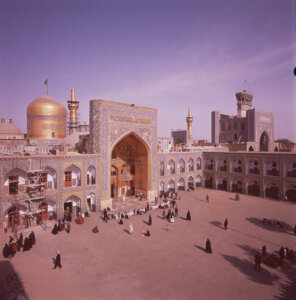
My Iranian Jewish community traces its roots back to Mashhad, a city in northeastern Iran. In 1839, a mob of Muslim Mashadis raided the Jewish ghetto and killed more than 30 people. They seized and married Jewish women, selling others into slavery. Some Jews converted to Islam to escape death; others fled the country.
My ancestors appeared to convert to Islam. But community lore goes that when no one was watching, they wore tiny tefillin, prayed in basements and kept kosher as best they could. On Saturdays, Jewish shopkeepers kept their stores open so as not to be seen keeping Shabbat — but jacked up prices so high no one would buy anything. Jewish parents arranged their children’s engagements at young ages, so that if a non-Jew came requesting their daughter’s hand in marriage, they could honestly say she was taken.

Decades later, under a new government, my ancestors slowly began practicing Judaism openly again. In the mid-20th century, my grandparents and other Mashadi Jews left the city and moved to Iran’s capital, Tehran. But they remained insular. In Tehran’s much larger Jewish community, Mashadis separated themselves, praying in Mashadi synagogues and marrying fellow Mashadis.
They did the same in the U.S., where they first settled in Queens, then later helped form the ethnic enclave where I grew up.
As a child, I learned that being Mashadi made me different from all the other Iranian Jews in Great Neck, whom we called Tehrani even though many of their families came from other cities. So, when I learned that my parents were actually born in Tehran, I was scandalized. If my parents came from Tehran, didn’t that make us Tehrani?
“Why are we Mashadi?” I asked my dad one night, a year before he died: Why was I defined by this city, and not the other Iranian cities where my ancestors lived? Why weren’t we just Iranian?
Unable to explain, my dad laughed off the question. But I know now why Mashadis are Mashadi. It’s because pretending to be Muslim while secretly continuing to practice Judaism was a defining experience, one that taught my ancestors ugly ways to survive.
“To omr-e mani,” my dad would tell me in Farsi, in lieu of a simple “I love you.” Translation: “You are my life.” He always had a flair for hyperbole. And though he didn’t intend it this way, my teenage brain twisted his words to mean: “It will kill me if you aren’t a good Mashadi girl.”
Going to Missouri
When I was little, my mom told me a version of the Mashadi immigration story that matched her own experience: It began in Tehran and ended in Forest Hills, Queens. But when my dad died, I became more invested in piecing together the parts of his life that my mom’s story didn’t capture.

I got his yearbook and attendance records from the University of Missouri; obtained his immigration records from the U.S. Citizenship and Immigration Services; pored over more than 100 old newspapers, magazines and other archival documents; read academic articles and history books; and spoke to about a dozen people who I thought might have relevant intel, including extended family members, scholars and people who attended or worked at my dad’s college.
Arriving in 1974, my dad was one of tens of thousands of Iranians who came to the U.S. in the 1960s and 1970s for college. In Iran, as in other major oil-exporting countries, economic development had led to increasing demand for skilled workers — but there weren’t enough colleges to meet this demand. So the Iranian government gave scholarships to students studying abroad.
Determined to develop allies during the Cold War, the U.S. government doled out scholarships, too. The idea was that students in Iran’s expanding middle class could study engineering in the U.S., then bring that expertise back to their home country, which needed it.
Many of these college students, seeking a lower cost of living, wound up in the Midwest. Plus, in the logic of a tight-knit ethnic community, where one person goes, others follow.
My dad followed a small group of Mashadi men to the University of Missouri in Columbia. His older brother, Behzad, had gone there for graduate school and still lived nearby. In Tehran, both he and my dad had attended an elite boys’ prep school called Alborz, named for the mountain range that stretches along the coast of the Caspian Sea. Historically run by American Christian missionaries, Alborz was considered the best high school in Iran, and American colleges knew it. Plus, if my dad’s kitchen-table bragging is to be believed, he was among Alborz’s top students in math.
Protest and persecution
By the time my dad arrived in Missouri, the tensions that would give way to the Islamic Revolution in 1979 had already emerged. Many Iranians protested the country’s then-leader, Shah Mohammad Reza Pahlavi, over restrictions he placed on democratic institutions, torture against political opponents under his leadership, and his significant expansion of the military.
The Iranian community in the U.S. — then disproportionately composed of college students — leaned into the opportunity this country gave them to express themselves politically. Articles from the Columbia Missourian, once my dad’s local paper, show that at one point in the mid-’70s, anti-Shah protests took place at least once a month at local colleges.

The protesters were embracing an American freedom: The Iranian secret police couldn’t get them, at least not while they were in the U.S. But American authorities had issues of their own.
In October 1975, police maced then arrested protesters at an anti-Shah rally at Lincoln University in Missouri. The protesters were denied food and prevented from calling lawyers because, a spokesperson for the Iranian Students Association said, “they were foreigners and had no rights.” The mayor sent the student-protesters’ names and photos to the Shah, even though students said that could get them executed or imprisoned for life.
At the University of Missouri, letters to the editor in the student newspaper, as well as classified ads, called for Iranian students to go back to where they came from. Graffiti on bathroom walls spread a similar message. Some people simply told their Iranian classmates face-to-face to return to the very place whose government they were protesting.
Many Iranian Jewish students liked the Shah, because he believed in secular government and undertook westernizing reforms. But 2,500 years of living as a minority had taught them to keep quiet. “Normally, Jews would stay out of politics,” mom’s brother Bahram, who studied in the Midwest beginning in 1969, told me. “If you were pro-Shah, you had a lot of students against you. If you were against, you had the embassy that would come after you.”
Two people I interviewed — Bahram and one of my dad’s cousins — both said something I can envision my dad also saying: that being Jewish protected them from anti-Iranian hostility on campus.
My dad’s cousin Sohrab, who went to New York’s Queens College, said that when encountering potentially hostile people, he made sure to emphasize being Jewish. “We feel like somebody’s uncomfortable, we made sure we told them first, ‘I am Jewish. I ran away from Iran,’” Sohrab said.
“We are first Jewish, then Iranian.”
What my dad and I never talked about
When my dad was 22, and a senior at the University of Missouri, his native country erupted into violence.
More than 40 years after the revolution, I sat in my college dorm, reading back issues of the Columbia Missourian, imagining my dad as a young, longish-haired man following the news from afar.
December 1978: “2 million protesters hit Tehran.” February 1979: “10,000 dead in Iran’s crisis.” March: “Firing squads execute 13 in Iran.” As the revolution took place, so did frequent earthquakes, which also claimed thousands of lives.
The college students who’d risked it all in order to advocate against the Shah seemingly got their way when he fled Iran in January 1979. But they were blindsided by the zealotry of the man who took his place: Ayatollah Ruhollah Khomeini, a Shi’ite Muslim cleric who established an Islamic theocracy. He offered a foil to Pahlavi’s friendliness with the West by preaching against the U.S., Israel and imperialism.
After the revolution, the new government tried to assure Iranian Jews that they’d be safe, yet some were executed on trumped-up charges of spying for Israel. My dad’s parents were quick enough to leave by air, landing in Queens. Those who waited too long to emigrate had to pay smugglers to help them over mountainous borders.
When the Mashadi community followed in the footsteps of its sons and immigrated en masse to the U.S., American-educated Mashadi men — now in their 20s and 30s — became informal secretaries, translators, immigration consultants, financial advisors, business consultants, and advocates for higher education, for their own families and for the wider community.
Despite what Sohrab said, de-emphasizing their Iranian origins didn’t always protect the new immigrants from bigotry. Mohsen Mobasher, an anthropologist at the University of Houston-Downtown, told me that because of anti-Iranian hostility that later grew rampant, “some Iranians developed deep feelings of anxiety, suspicion, insecurity and inferiority.”
Once, I asked my dad whether he ever experienced antisemitism or anti-Iranian hostility. He let out a hearty laugh, as though it was ridiculous for me to imagine that he had.
If the question was ridiculous, it was only because I asked it so casually; just as I might ask him to do my laundry or cut me a pineapple. It was as if I’d asked him to synthesize his whole experience of identity into some set of words that might satisfy me. My dad did not see fit to tell me, a girl he was charged with protecting, about times in his life when he may have felt small.
Singled out by the federal government
In November 1979, months after my dad graduated, a group of Iranian militant college students took over the U.S. embassy in Tehran and held 66 Americans hostage. The hostage crisis gave way to unprecedented levels of anti-Iranian sentiment in the U.S., and the animus fell hardest on college students. Members of Congress introduced resolutions calling for all Iranian students to be deported. At Mizzou, one professor announced that he would no longer advise Iranian students.

On Nov. 10, President Jimmy Carter ordered immigration checks on all Iranian college students in the U.S., saying that anyone found to be violating the terms of their student visa would be deported. More than 200 Mizzou students were told to report to an immigration office in Kansas City. To some of these students, the visa checks felt wrong, and they refused to participate.
“I would feel like a criminal,” an Iranian student who did not report told the Missourian.
“This is discrimination — singling out one nationality and investigating them,” said another, who also refused to participate in the check.
By this time, my dad had moved to St. Louis, where he was working for the chemical manufacturer Olin Corporation. But he still had to report for the visa checks. He had a visa for students and recent graduates who were gaining practical training in their field of study. In December, he received a frantic letter from Carl Leistner, the international student program coordinator at Mizzou, telling him to report to Kansas City the following week.
“I regret this delayed notice,” Leistner wrote in the letter. “However, we simply overlooked our practical training students in the rush associated with the registration of our 258 currently enrolled students from Iran.”
My dad traveled more than 200 miles for his interview, but when he arrived, he was sent home. A federal judge had ruled the visa checks were unconstitutional. If that ruling was overturned, my father was told, he might have to come back for an interview later.
Back on the Mizzou campus, some 600 students held a protest where some students advocated “deporting all Iranians from the United States.” “Deport, deport,” the crowd chanted at one point.
By being away from campus, my dad managed to evade these sorts of protests, plus other horrors that befell his collegiate counterparts. Abe Manzour, an Iranian American Jew who was my dad’s classmate at the University of Missouri, was still earning his degree.
“Sometimes, we were scared to go outside,” Abe told me over Zoom in 2021. “I almost got beat up by some guys on the street because they knew I was Iranian.”
Scared to go outside? Almost got beat up? Despite everything I had already read about anti-Iranian hostility, I was still surprised. What Abe was describing seemed a world apart from tales my dad used to tell — stories of beer, women and football games, which would’ve taken place just months beforehand.
“My dad always talked about his time in college,” I said. “He made it sound like the best thing ever.”
“For me it was, too,” Abe said.
A conservative enclave
Growing up in Great Neck, I lived a life very different from my dad’s. Our suburb was full of Iranian Jews, and until I was 18, I rarely ever left it. He was worldly; I was provincial, and in my senior year of high school, as I applied for college, I could no longer contain my jealousy.
“Can I apply to UC Berkeley?” I asked him one Sunday afternoon during my senior year, while he was making “early-bird breakfast.” I knew he’d say no, but wanted to see him squirm.
“I don’t see! I don’t see!”
“Dad!”
“Bache nazaideem ke befresteemesh Ca-lee-forn-yaw!” — “We didn’t have a child so that we could ship her off to California!”

“I know two people who sent their son to college on a different continent!”
“That was over 10 years ago!” At 61, my dad enjoyed describing events of his youth as having taken place “over 10 years ago.”
I never applied to Berkeley; instead, I stayed close to home and went to CUNY Hunter College in Manhattan. For better or worse, my life would be different from my dad’s, in ways that were tied up with the increasingly conservative nature of our community.
In Tehran, Mashadi Jews lived scattered around the city. In Great Neck, Mashadis are neighbors and attend a set of synagogues all within a mile of each other. And many Mashadi Jews in Great Neck have become more religious than their ancestors in Tehran were.
When most people think of assimilation, they envision people becoming more secular and better educated. But most Jewish people in Great Neck — Mashadi and otherwise — have assimilated into a different yet equally compelling idea of America, one that emphasizes religious freedom over other aspects of American culture.

In the Midwest, Mashadi men learned the valuable lesson that Abe Manzour expressed: that it’s possible to experience happiness and personal growth in the midst of a hostile environment. Years later, when they moved to Great Neck, their environment rendered that wisdom useless, like a vestigial organ at risk of evolutionary disappearance.
To the men who’d left Iran to study abroad, we, their children, must have at times seemed narrow-minded and irredeemably young. Especially when I think about my dad’s life, I sometimes resent that I wasn’t allowed to go to California and feel embarrassed to have attended a commuter school.
What made me want to study his life was a binary I imagined between him — worldly — and me — ignorant. But actually, I don’t really believe that a binary between cosmopolitanism and provincialism captures the nuances entailed in our father-daughter relationship. And I don’t believe that being poorly traveled is the same as being ignorant.
Regardless of where one lives or visits, there are many different ways to be ignorant, and many different ways to learn something new.
The post After my dad died, I discovered a lost history of Iranian Jews in the US appeared first on The Forward.
