



Uncategorized
Deborah Lipstadt has second thoughts about tying Jackson synagogue arsonist to ‘Globalize the Intifada’
(JTA) — As news broke over the weekend of an arson attack that heavily damaged the only synagogue in Jackson, Mississippi, a few prominent individuals connected the culprit to pro-Palestinian activism.
“This is a major tragedy. But it’s more than that,” Deborah Lipstadt, formerly the State Department’s special envoy to combat antisemitism, wrote on the social network X. “It’s an arson attack and another step in the globalization of the intifada.”
Later, upon learning that the arsonist appeared to have been motivated by a strain of antisemitism associated with the far right, not the pro-Palestinian movement, she walked back her comments — to a degree. But Lipstadt’s initial comments about the arsonist’s motives reflect a larger sense of disorientation among diaspora Jews as they face increased levels of antisemitism from across the spectrum of left-wing, right-wing and Islamist extremism.
Jewish activists and communities have been engaged in fierce debate over which corner poses the greatest threat, and reports of new incidents are often met with immediate speculation over the attacker’s motivations. Lipstadt, an Emory University professor who had served in the State Department under President Biden, has herself criticized the politicization of antisemitism charges. “When you only see it on the other side of the political transom,” she told the Los Angeles Times in 2024, “I have to ask: Are you interested in fighting antisemitism, or was your main objective to beat up on your enemies?”
“Globalize the Intifada” is a term commonly used in left-wing, pro-Palestinian protests. Most of the perpetrators of the large-scale antisemitic attacks in the diaspora since the Oct. 7, 2023 Hamas attacks in Israel — including in Washington, D.C.; Boulder, Colorado; Bondi Beach, Australia; and the arson attack on Pennsylvania Gov. Josh Shapiro’s home — have made their pro-Palestinian and/or Islamist affiliations public.
But when the identity of the Jackson arsonist was revealed and the suspect appeared in court, his comments and social media presence betrayed no obvious link to the pro-Palestinian movement.
Instead the suspect, 19-year-old Catholic school graduate Stephen Spencer Pittman, used language —including “synagogue of Satan” and “Jesus Christ is Lord” — popular among leading figures of the online far right who peddle antisemitism, including Nick Fuentes and Candace Owens. (“Synagogue of Satan” also has deeper roots; it was popularized by Nation of Islam leader Louis Farrakhan.)
An Instagram account appearing to be Pittman’s also contains references to a “Christian diet” and a clip from “Drawn Together,” an adult animated series, referencing an antisemitic “Jew crow.” (One of the show’s creators is Jewish.) Neither Pittman’s public statements in court, nor his Instagram account, referred to pro-Palestinian activism.
In hindsight, was Lipstadt right to preemptively link the fire to “globalize the intifada”?
“It may have been inopportune of me to say that,” she told the Jewish Telegraphic Agency about her invocation of the phrase.
Lipstadt insisted, “I was not saying this was a leftist attack. Clearly it’s not.” Nor did she “mean to suggest that this was an Islamist attack.”
She offered that the phrase, which uses the Arabic word associated with the violent Palestinian uprisings of the late 1980s and early 2000s, could be interpreted as hatred toward Jews coming from all sides.
“If ‘globalize the intifada’ means ‘attack Jews everywhere,’ then it certainly fits,” she said. “So it depends on how you want to interpret the sentence.”
Lipstadt wasn’t the only prominent figure linking the arsonist to “globalize the intifada” and other pro-Palestinian phrases before his identity was revealed.
“It began with BDS. Some said, it’s just words,” Marc Edelman, a Jewish law professor at the City University of New York, wrote on X over the weekend.
He continued, “CUNY Law speech: ‘globalize the intifada.’ Still, just words? Recent pro-Hamas chants. Words again? And now the violence in Pittsburgh, Washington D.C., Sydney, Jackson, Mississippi and more. As the Left used to say, words matter!”
Even a pro-Palestinian politician condemned the arson while also addressing recent hard-line pro-Palestinian activism in her own city.
“Mississippi’s oldest and largest synagogue, and two of their Torah scrolls, were burned yesterday on Shabbat in a horrific antisemitic attack—days after protestors chanted ‘We support Hamas’, here in NYC,” Shahana Hanif, a New York City council member from Brooklyn who won re-election in a race that pivoted largely on Israel, wrote on X.
She was referencing recent pro-Hamas protesters outside synagogues in New York, who have been denounced by progressives who are critical of Israel including Mayor Zohran Mamdani and Rep. Alexandria Ocasio-Cortez.
Hanif added, “These chants are antisemitic and deeply harmful. You can oppose land sales in the West Bank without supporting violence against Jews. Yesterday’s arson in Mississippi is a stark reminder of the consequences of hate.”
She attracted some criticism from the pro-Palestinian movement for her statement — including from the group that organized the pro-Hamas New York synagogue protests, which took offense at the comparison.
“Linking chants at a Palestine protest that support a resistance movement of occupied people to the klan bombing of a synagogue is absolutely irresponsible and disgusting,” PAL-Awda NY/NJ, a radical group, wrote to Hanif.
In the group’s Telegram channel viewed by JTA, PAL-Awda added, “We see you, politicians who claim to support Palestine but then follow the hasbara playbook to link people resisting colonial oppression with white supremacists bombing synagogues in Mississippi.” “Hasbara” is a Hebrew term used to describe Israeli public relations efforts.
Pro-Israel groups, meanwhile, claimed hypocrisy, with some sharing a screenshot of Hanif previously retweeting a pro-Palestinian activist’s post that included the phrase “Globalize the Intifada.” JTA was unable to verify the post.
Unlike Lipstadt, Edelman, the CUNY law professor, told JTA he stands by his initial assessment of the arson.
“Nothing changes the fact that the actions taken in Washington, D.C. and Sydney, Australia, coalesced with an extreme left anti-Israel position,” he said, referring to the mass shootings at the Capital Jewish Museum and Bondi Beach — the former by a declared pro-Palestinian activist, the latter by declared Islamists. (Edelman noted that he recently undertook a Fulbright scholarship in Australia.)
Edelman added, “It is also not surprising that far-right rhetoric, much as it has for generations in this country, has also led to increased violence against minority groups including Jewish Americans.”
But there’s a key difference between the two sides, in Edelman’s eyes.
“The big distinction here, and I say this as a member of the Democratic Party, is that the left has historically been better than this,” he said. “And now, perhaps, they are not.”
For Lipstadt, the incident has largely taught her that Jews shouldn’t spend time trying to determine which kinds of antisemitic attacks, whether from the left or right, are worse.
“It’s all horrible,” she said. “Much of it is lethal. It’s toxic and it’s dangerous.”
The post Deborah Lipstadt has second thoughts about tying Jackson synagogue arsonist to ‘Globalize the Intifada’ appeared first on The Forward.
Uncategorized
Democrats’ split over Israel in spotlight, as Chris Van Hollen challenges Chuck Schumer for Senate leader
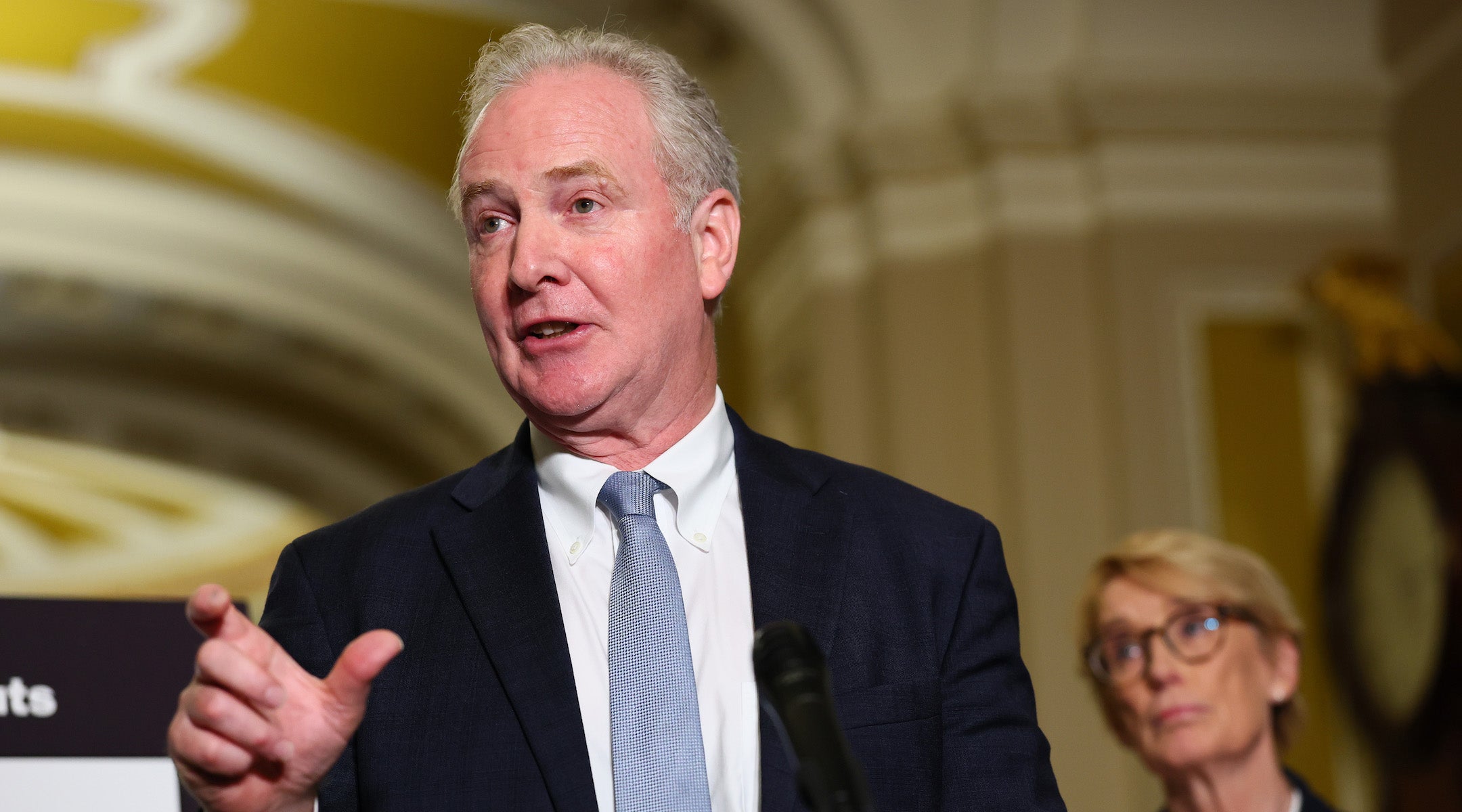
Sen. Chuck Schumer helped Democrats win back the Senate with a historic gain of at least nine seats in the midterm elections, giving his party a 56-seat majority, just four votes short of overcoming most filibusters.
Yet the New York Democrat, who has led Senate Democrats since 2017, now faces a rare leadership challenge from Sen. Chris Van Hollen of Maryland — a contest that will not only determine who leads the chamber but also how Democrats use their regained power.
As majority leader, Schumer would have considerable influence over which bills receive floor time, which amendments get considered and how the party manages disagreements over Israel.
Schumer has largely held firm to his longtime support for Israel, trying to manage his caucus even as the party has grown increasingly divided over U.S. military assistance and weapons sales. Now, the leadership battle could force him to confront those divisions more directly, including whether to allow votes on legislation that would restrict aid to Israel. Schumer, the country’s highest-ranking Jewish elected official, has said defending Israel is a central part of his political identity. Van Hollen, meanwhile, has emerged as one of the Senate’s fiercest critics of the Israeli government.
The challenge to Schumer was sparked by a pair of Jewish Democrats: Sen. Bernie Sanders of Vermont, the progressive icon, and Sen. Elissa Slotkin of Michigan, both of whom called for a change in leadership. It comes at a moment when the Democratic Party is changing. A new generation of senators is entering Congress; progressive activists, emboldened by their victories in recent years, are demanding a more confrontational approach to President Donald Trump and the United States’ long and unwavering commitment to Israel.
On Election Day earlier this month, Trump himself announced his plan to end roughly $4 billion in annual U.S. military aid to Israel.
Does Schumer have the votes?
Senate Democrats will choose their leader in a secret-ballot election on Dec. 1. A candidate would need 29 votes to win if all 56 members participate.
Schumer expressed confidence that he has enough support to remain leader. Van Hollen has acknowledged that he is the underdog, and claims to have the backing of more than 10 senators.
A Punchbowl News tracker on Sunday showed 14 senators publicly supporting Schumer, five backing Van Hollen, three opposed to Schumer without expressing support for his challenger, and 36 who remain uncommitted. The Hill separately reported that at least 22 senators have privately indicated they will support Schumer.
Van Hollen has attracted support from several newly elected senators, including Abdul El-Sayed of Michigan and Peggy Flanagan of Minnesota, along with Sanders and Sen. Jeff Merkley of Massachusetts.

Opposition to Schumer or supporting a leadership contest does not automatically translate into support for his challenger.
Schumer has a significant advantage mathematically, given the relationships he has built over decades in the Senate. He also played an active role in recruiting candidates who won seats in red and purple states, including Sens. Sherrod Brown of Ohio, Roy Cooper of North Carolina, Josh Turek in Iowa and Scott Colom in Mississippi.
Israel becomes part of the leadership fight
Neither candidate has made Israel central to their campaign for Senate majority leader. But their differences on the issue have drawn attention from Jewish organizations and progressive groups, which are taking opposite sides.
Van Hollen has repeatedly called for restrictions on U.S. military aid to Israel, supported measures to block weapons sales and accused Israel of committing genocide in Gaza. In remarks at the New Jewish Narrative’s annual gala in Washington last month, Van Hollen said, “We’re doing nobody any favors by providing a blank check regardless of the conduct of the government of Israel.” The progressive Jewish group is backing Van Hollen’s bid.
Schumer has sharply criticized Israeli Prime Minister Benjamin Netanyahu, most notably in a March 2024 Senate speech calling for new Israeli elections. But he has continued to defend Israel’s security and preserve the U.S.-Israel relationship. In a 2024 interview with the Forward, Schumer said that “having a majority leader who’s committed to Israel is vital for Israel’s relationship with the U.S.” He faced online backlash earlier this year for saying his job as leader is to “fight” for Israel aid.
That distinction has become central to how Democratic-aligned organizations view the leadership contest — part of a larger debate over the direction of the party, particularly its relationship with Israel.
The progressive organization Our Revolution endorsed Van Hollen, calling for an agenda that includes ending U.S. military aid to Israel and reducing the influence of wealthy donors.
Track AIPAC, a group that monitors contributions from the pro-Israel lobbying organization, also pledged to help Van Hollen win. “The voters who delivered this majority want a leader who answers to them, and Chris Van Hollen has shown he will,” Casey Kennedy, the group’s co-founder, said in a statement.
On the other side, the Jewish Democratic Council of America announced Friday that it supports Schumer’s continued leadership, along with Rep. Hakeem Jeffries’ bid to become House speaker. “Advancing these priorities will require experience and steady leadership,” said Halie Soifer, the organization’s CEO.
Winning may be the easy part
Schumer remains the favorite to win. But the vote could mark a difficult political chapter for the 75-year-old senator, who may also face a primary challenge if he seeks reelection in 2028.
If Van Hollen attracts only a small number of votes, Schumer will emerge with a stronger mandate to lead. If his challenger wins substantial support, Schumer could begin his new term with a fractured and more progressive caucus seeking a different approach.
Schumer might face pressure to allow more debate on Israel-related legislation, even if he personally opposes it. But there are also limits to how far those debates would likely go. The new majority also includes moderates, longtime supporters of Israel and senators representing swing and red states that flipped blue in this cycle.
The post Democrats’ split over Israel in spotlight, as Chris Van Hollen challenges Chuck Schumer for Senate leader appeared first on The Forward.
Uncategorized
When a Jewish prisoner died in Ohio in 1918, four fellow inmates left the penitentiary in civilian clothes to ensure he got a proper burial
Jack Nast wanted to be buried in a Jewish cemetery.
He died in April 1918 while incarcerated at the Ohio Penitentiary in Columbus. Little is known about the circumstances that brought him there, but another prisoner, Morris Hess, preserved an account of his final days.
As he lay ill, Nast cried out that he was a Jew, Hess wrote. He expressed pride in Jewish history and its achievements, faith in the teachings of Judaism, and regret that his own life had not lived up to its principles. He wished to receive a burial befitting someone “born in the House of Israel.”
With the aid of others, his request was granted.
Isaac B. Jashenosky and Jacob Myers, two men who regularly visited the Jewish prisoners, were with Nast before he died. Jashenosky, whom the prisoners called “rabbi,” conducted the funeral service at an unidentified Jewish cemetery, likely in Columbus. When Nast’s relatives, whom Hess described as wealthy, refused to contribute toward the expenses, Warden Preston E. Thomas permitted the prison’s Jewish inmates to contribute to a collection for the funeral.
Four prisoners were also allowed to attend the burial in civilian clothing. They listened as Jashenosky delivered his remarks and Nast’s remains were returned to the earth.
“Kaddish was said and will be said every week for him,” Hess wrote.
The account appeared in The American Israelite, a Cincinnati Jewish newspaper, under the heading “Prisoners in Ohio Penitentiary are Grateful.” Hess signed the letter with his name and prison number, 45511.
Jewish life behind prison walls
The men who helped bury Nast were part of a larger effort to sustain Jewish religious life inside Ohio’s prisons. By 1899, prisoners were being excused from work for Jewish holidays and provided with special food. In 1902, about ten Jewish inmates received matzo for Passover. By 1913, religious services were also being arranged at correctional institutions in Mansfield and Lancaster.
In 1915, Charles Albert Rosenbaum wrote to The American Israelite about B’nai B’rith’s efforts to reach Jewish prisoners in Ohio.
For years, Rosenbaum wrote, Jewish prisoners had watched representatives of other faiths visit their institutions, “not with envious but with saddened eyes.” They wondered why their own people had been so neglectful. In prison libraries, they read of “the beauties and the godlike charities of the Jewish peoples,” but turned from those pages, looked at “the cold steel walls of their cells” and doubted.
“How all of this has been changed!” Rosenbaum declared.
Rosenbaum credited Jashenosky, Myers and other Columbus volunteers with organizing visits and religious services. With Warden Thomas’ permission, more than 100 services had been held over the preceding two years, he reported, without guards present.
Hess was among those who recorded these gatherings. In 1917, he described a service attended by Jashenosky and Myers, noting that one visitor, Mrs. I. J. Shatz, had distributed cigars to the prisoners.
Freedom in the penitentiary
In 1920, Hess described Passover services held with the cooperation of Warden Thomas and his wife, Mary Thomas. Women from Columbus’ Ezrath Nosheim Society provided a holiday meal.
Jashenosky preached that although everyone desired liberty, true freedom came through “the awakening of the soul.” He told the prisoners that, “Freedom is not alone a privilege, but a lifelong obligation.”
In December 1921, another prisoner, Harry Joseph, writing on behalf of the Jewish inmates, described the work of B’nai B’rith, the Council of Jewish Women and the Ezrath Nosheim Society.
He recalled the holiday meals that women from Columbus had prepared and served, including a dinner following Yom Kippur services. Their presence, he wrote, reminded the prisoners of “the Jewish fireside with its family love.”
He continued, “The knowledge that someone cares is an incentive to reach the end of this rocky road of adversity and become useful citizens.”
Jashenosky died in April 1930, at the age of 79. Newspapers reported that he had served as a prison chaplain for more than half a century.
Before he died, Jashenosky made one final request. He wanted two Jewish prisoners, Abe Shapiro and Adam Sikorski, to attend his funeral.
Warden Thomas granted permission.
The post When a Jewish prisoner died in Ohio in 1918, four fellow inmates left the penitentiary in civilian clothes to ensure he got a proper burial appeared first on The Forward.
Uncategorized
Houston Astros hire former Team Israel manager Brad Ausmus as skipper
(JTA) — The Houston Astros hired Brad Ausmus as manager, the team announced Wednesday, making the former Team Israel skipper the lone active Jewish manager in Major League Baseball.
This will be Ausmus’ third managerial stint in MLB. He previously led the Detroit Tigers from 2014-2017 and the Los Angeles Angels in 2019. Ausmus, 57, owns a 386-422 career managerial record. He will be introduced at a press conference at Houston’s Daikin Park on Friday.
Ausmus most recently served as the New York Yankees’ bench coach from 2024-2026 and also previously worked in the front offices of the San Diego Padres and Angels. He had interviewed for the Astros’ managerial opening in 2020 and for their general manager role in 2022.
Ausmus spent 10 of his 18 MLB seasons with the Astros. He finished his playing career with a .251 batting average, .325 on-base percentage and .344 slugging percentage. The New Haven, Connecticut, native managed Team Israel during the qualifiers for the 2013 World Baseball Classic, served on its coaching staff in the 2023 WBC and managed the team in the 2026 tournament.
“Regarding Aus, he is just a perfect big league manager in every way and there are not many people you can say that about,” Nate Fish, the CEO of Israel Baseball Americas and a former Israel player and coach, told the Jewish Telegraphic Agency. “He is smart. He is calm. He has the experience. He is a good fit for any team but a perfect fit in Houston considering he played 10 years there.”
Fish also pointed out that “this is the second time [Ausmus] has been hired to manage in the big leagues following a stint managing Team Israel. Just sayin’. There is a pattern!”
Israel won two of its four games in the 2026 tournament, securing a spot in the 2030 competition.
“I am honored and excited to take on this role,” Ausmus said before the March tournament. “I’ve been incredibly proud to be part of Team Israel’s journey. My focus remains exactly where it has always been: building a cohesive, competitive team that proudly represents Israel on the world stage. We have a solid foundation, and I’m ready to hit the ground running with our talented staff and players to achieve our goals for 2026.”
Ausmus, a former catcher, played for the Astros from 1997-1998 and again from 2001-2008. He won three Gold Glove Awards for his defense with Houston and was an All-Star in 1999 with Detroit. His 1,971 career MLB appearances are the most ever by a Jewish player, according to the Jewish Baseball Museum.
“I am very excited to be back in Houston,” Ausmus said in a statement. “The Astros and the city of Houston have been a huge part of my life, and I’m thrilled to create a new chapter as the team’s manager. I can’t wait to get to work.”
This article originally appeared on JTA.org.
The post Houston Astros hire former Team Israel manager Brad Ausmus as skipper appeared first on The Forward.
