


Uncategorized
How yizkor books bring the sights, sounds, and even smells and tastes of lost Jewish shtetls back to life

Rye bread, sour milk, and maybe some herring — for a poor Jew, these were the makings of a meal. The Jews I have in mind were residents of the small market towns, or shtetls, once strewn across Eastern Europe. Shtetls had their token elites, the grain and lumber brokers who ate white bread with butter. For the vast majority, however, the bread was black and there was no butter.
I’ve spent the last few years reading about these towns for Once There Was a Town, a book I’ve written about yizkor books and the world they portray. But my interest is more than academic; my father was born in one of these towns, and I’ve been hearing its stories since I was a kid.
The word yizkor is a form of the Hebrew verb “to remember.” Literally translated, it means “may he remember.” A yizkor book is a book of remembrance.

While the yizkor book tradition goes back to medieval times, those I’ve been studying were written after the Holocaust as a way to memorialize the communities destroyed by the Nazis and their facilitators. Anthologies of a sort, these books were written by both Holocaust survivors and emigrés from before the war, all from the same shtetl, working together to document the ways of life characteristic of their fallen hometowns.
Key players in their production were organizations that had formed decades before the Holocaust. Starting in the late 19th century, in immigrant cities like New York, Jews from the same town had banded together to create self-help societies which you could turn to in times of crisis. If a family member was sick and couldn’t work, these societies provided financial support. When a townsperson died, they ensured a plot in a Jewish cemetery. After the war, they assumed responsibility for writing the town yizkor book.
Erased from the physical world, those towns are conjured back into existence in these yizkor books. Working with the theory that whatever was left out would be forgotten, yizkor book writers sought to cast a wide net and record everything. Caught in that net were the foods people ate.
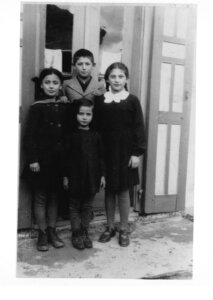
Left to right: Chaya Liba Peltz, Aaron Ziegelman, Luba Ziegelman.
In front, Tova Peltz Courtesy of Jane Ziegelman
The books speak eloquently to the sparsity of the weekday diet, which for many consisted primarily of potatoes, porridge and coarse, rye bread. Six days of austerity, however, were followed by the Sabbath, when Jews are commanded to partake “of fruits and delicacies and to inhale sweet odors.” Sabbath foods shared certain characteristics. Challah and gefilte fish were sweet and delicate, and so was compote (stewed fruit) and tsimmes, (carrots sweetened with prunes.) It was fat, however, that people hankered for most. Chicken soup with golden rings of fat dancing across the surface, chopped liver enriched with onions fried in goose fat (shmaltz), stuffed derma (cow intestine stuffed with flour and schmaltz) and a schmaltz-laden kugel.
Our modern-day food groups — protein, fat, carbohydrates — held no meaning for a poor Jew who saw food in just two categories. Like heaven and earth, like men and women, like time itself, food was divided into the holy and the mundane.
A qualification: All food comes from God so all food is holy. Certain foods, however, are fortified with an extra dose of holiness. In some cases, it was obvious which was which — between rye bread and challah, for example, there was no confusion. With some foods, however, it all depended on preparation. During the week, dried beans were combined with kasha or barley for a meal that was both cheap and filling. Saturday’s cholent was also made with beans, but these beans had been braising all night with a fatty bone. A potato soup “whitened” with a splash of milk was among the mundane foods Jews subsisted on Sunday through Friday. But a potato kugel, glistening with schmaltz and redolent of onion, was a dish worthy of the Sabbath Queen!
And then there were zoyers, the fermented foods that defied classification. Cucumbers, beets, mushrooms, radishes, cabbage, apples and even berries were some of the foods that homemakers turned into zoyers, what we call pickles. For people who relied so heavily on bread and potatoes, the tang of a zoyer provided a welcome counterpoint to all that starchiness. And when the pickles were gone, you could dip your potato into the sour and salty brine.
Zoyers also came in liquid form, the most popular of which was a drink called kvass. A fermented drink made from stale bread, kvass was produced both at home and by the local kvassnik or kvass maker. Jews loved their kvass for its fizzy tartness. More than that, however, they saw it as a kind of culinary metaphor. In the sourness of kvass, they saw their own lives. Here, a former resident of Rakishok, a shtetl in Lithuania,, remembers his weekly visits to the kvass maker:
I remember how my father would send me with a kopek on Shabbos night to buy kvass for Havdalah. The kvass, alas, was made from the crusts of black bread, and was very sour, like the sourness of the mood of the coming gray week and its worries.
Zoyers were also at home on the Sabbath table; in fact, meals were considered incomplete without them. Or to put it another way, zoyers offered a kind of culinary satisfaction that no other food could deliver.
“A young man sat down to a holiday meal of chicken, kreplach and tsimmes,” one yizkor book author wrote. “After the meal, his wife asked if he was satisfied with the food. ‘Of course,’ he answered, ‘but unless I have eaten even a little bit of zoyers, I am not a person.’”
I take comfort knowing that this is a feeling I have experienced too.
The post How yizkor books bring the sights, sounds, and even smells and tastes of lost Jewish shtetls back to life appeared first on The Forward.
Uncategorized
Irish national soccer team won’t shake hands with Israel after win
(JTA) — It only took 25 minutes of play for the Irish national soccer team to build a 3-0 lead over Israel in the countries’ UEFA Nations League B match on Sunday. But there were decades of bad blood that preceded Ireland’s shutout victory in a game dominated more by the geopolitics of the Gaza war than about sports. One soccer writer described it as “arguably one of the most contentious football matches of this century.”
At the match, held in a mostly empty stadium in the neutral site of Debrecen, Hungary, the Irish players wore black armbands and bowed their heads in protest during the Israeli national anthem. There were no pre- or postgame handshakes, and one Irish player declined to participate altogether, citing his “personal belief that the killing of innocent people is wrong.”
Ireland’s soccer federation did not reserve tickets for its fans, and the country’s public broadcaster scaled back its coverage of the game. The teams are set to meet again on Oct. 4 in Serbia, this time with Ireland as the “home” team.
Ireland and Israel have a long history of icy relations. Ireland became the first member of the European Union to call for an independent Palestinian country in 1980, and was among the first of the Western European countries to recognize an official Palestinian state in 2024. Israel closed its embassy in Dublin in response. Irish Prime Minister Micheál Martin has rejected claims that his country’s sharp criticism of Israel bleeds into antisemitism.
In the months leading up to Sunday’s match, Ireland’s football governing body faced intense pressure to boycott the match. At a meeting in July, the Football Association of Ireland voted 75-32, with three abstentions, in favor of proceeding with the match, “while acknowledging the strength of feeling regarding support for Palestine.” The motion also noted that a boycott would come with UEFA sanctions, both financial and competitive: In League B matches, mid-tier nations seek to advance to the top division and boost their chances of qualifying for the quadrennial World Cup tournament. The Irish team itself also held a last-minute vote over whether to participate.
Earlier this month, more than 160 Irish athletes and sports figures signed an open letter calling on the national team to pull out of the match. The signatories included former Irish national team head coach Brian Kerr — who had led Ireland to a 2-2 draw against Israel in a 2005 match in Dublin that also took place amid protests.
Former Irish national team star Kevin Kilbane also authored a column in The Irish Times, writing, “Ireland should not play Israel. Not in Dublin, not in Hungary, not in Serbia. Not when Israel is committing genocide.” Israel denies the charge of genocide.
There were also a number of public barbs exchanged between leaders of the two countries and their football associations.
At a press conference last week, Irish coach Heimir Hallgrímsson replied to questions about the match by saying, “We are not playing with genocide, we are playing against genocide. We are playing against Israel; we are not playing with Israel.”
Israel’s football association responded to that comment with a post on X, writing, “We have contributed to the world and humanity in countless fields, earning an impressive number of Nobel Prizes along the way. Unfortunately, we have not yet found a cure for stupidity, ignorance and hypocrisy displayed by the @IrelandFootball team coach. We’re not playing with ignorance, hypocrisy and stupidity. We’re playing against the coach who embodies them.”
That drew a rebuke from Martin, who told reporters, “They are unacceptable remarks and should be withdrawn.”
And on Sunday, the morning of the match, Israeli Foreign Minister Gideon Sa’ar posted a lengthy tweet referencing the 1939 Irish squad that gave a Nazi salute before a game against the German national team.
“Almost 90 years have passed. Ireland’s unique talent for finding itself on the wrong side of history remains intact,” Sa’ar wrote. “Back then, they gave the Nazi salute. This time, they stand on the side of Palestinian terrorism. Above the black armbands the Irish players will wear tonight flies the black flag of jihadism.”
After the match, Israeli captain Manor Solomon said the Irish players who bowed their heads during the Israeli anthem “don’t interest me.”
“We have a country 10 times better than theirs, stronger, an amazing country with amazing people,” said Solomon, who plays in the English Championship league. “We are proud to wear the team shirt and to be Israelis. We are proud of our state and of our soldiers. [The Irish] can play all their tricks. We are Israelis and love the country. And that will always be the case.”
The post Irish national soccer team won’t shake hands with Israel after win appeared first on The Forward.
Uncategorized
Why is Karl Rove supporting a progressive Jewish candidate in Texas?
(JTA) — Progressive Jewish Texas state Sen. Jon Rosenthal has earned an unusual distinction: He is the first Democrat to win the vote of GOP guru Karl Rove in more than 30 years.
What did the only Jew serving in the Texas state house do to earn this distinction? It’s more what he didn’t do: run for statewide office with a track record of spewing racially charged and antisemitic comments.
Bo French, the Republican nominee for Texas Railroad commissioner, has a history of rhetoric targeting people of color, Muslims and Jews, including a social media poll last year asking whether “Jews” or “Muslims” pose “a bigger threat to America.”
He also faced bipartisan blowback for a recent post targeting college students of color, and this week a CNN investigation revealed that French, in since-deleted posts, had called for public executions for former President Barack Obama, Jewish California Sen. Adam Schiff and government workers targeted by the so-called Department of Government Efficiency last year.
The controversy has elevated the race for an obscure statewide office – albeit one that regulates the state’s all-important energy industry – into a larger referendum on the GOP’s tolerance for bigotry, including antisemitism, among its nominees.
Rove, for one, has made it clear where he thinks the party should stand.
“The GOP has a growing number of Bo Frenches — and not only in Texas,” Rove wrote in The Wall Street Journal earlier this month in explaining his decision to back Rosenthal.
Rove singled out growing antisemitism in the party: “There are ‘just asking questions’ Jew-haters, misogynists who worship hypermasculinity, conspiracy nuts seeking clicks for profit, and religious bigots who won’t differentiate between Muslim terrorists and Muslim American patriots.”
Rove isn’t the only GOP stalwart to turn on French.
“Are other Republican elected officials going to condemn the intolerance and racism, or look the other way while it becomes normalized,” outgoing Texas Sen. John Cornyn wrote in condemning French’s social media musings. “This is how great political parties self-destruct.”
Cornyn has stopped short of backing Rosenthal, instead saying he might leave the ballot blank.
Texas Rep. Jon E. Rosenthal inside the House Chamber at the Texas Capitol in Austin on Aug. 18, 2025. (Mikala Compton/Austin American-Statesman via Getty Images)
Rosenthal and French have agreed to a debate on Oct. 22. French leads the race in polling released last week from Texas Southern University, but by a much slimmer margin than GOP candidates are accustomed to in Texas. Rosenthal’s campaign could also see a boost from fellow statewide Democratic candidate James Talarico, who is polling neck-and-neck with his opponent in the U.S. Senate race.
On social media, Rosenthal celebrated Rove’s endorsement, writing, “When GOP architect Karl Rove breaks a 30-year voting streak to endorse our campaign, it proves this race isn’t about party lines, it’s about competence vs. chaos.”
A former county Republican Party chair who defeated the incumbent GOP state railroad commissioner in a runoff primary, French spurred widespread backlash earlier this month after posting a photo of students of color at the University of Texas celebrating a football win to the social network X.
“I heard UT graduation this year looked like this. I didn’t believe it,” French had captioned the photo on Sept. 13. “The problem is now obviously far worse than anyone imagined.” He has since doubled down on the sentiment, replying, “I weep for the families in Texas who can’t get into UT because they prioritize foreigners over Texans,” and using the backlash to solicit donations.
Texas Gov. Greg Abbott and state House Speaker Dustin Burrows were among the other Republicans who criticized French for the post, though neither formally rescinded their support, and French continues to list Abbott’s endorsement on his site.
It was not French’s first brush with bigotry. In 2025, during his stint as Tarrant County GOP Chair, French posted an online “poll” asking his followers whether “Jews” or “Muslims” pose “a bigger threat to America.” In a follow-up post, he argued, “You may not like Jews, but to suggest they are a bigger threat to Americans is Jew Derangement Syndrome.”
French later deleted both posts, and has few visible tweets about Jews today. In later posts, he claimed, of himself, “There has never been any evidence of antisemitism. It would certainly be surprising to my Jewish partners.”
Jewish Republicans in the state and beyond are largely keeping their distance from French, with one exception. His campaign site currently touts an endorsement from American Jewish Conservatives, whose only listed chapter is in Dallas.
Neither French nor the group, formerly Dallas Jewish Conservatives, responded to JTA requests for comment on the endorsement. A spokesperson for the Republican Jewish Coalition also did not return a request for comment on French.
Last month French cited a desire to combat antisemitism when arguing that Texas should not use mosques as polling places. In other posts, he accused a university in the state of “harboring radical left/antisemitic professors,” identified himself as both pro-Israel and pro-Tucker Carlson, the talk show host who has platformed antisemites and anti-Jewish conspiracy theories, and told one follower, “I have never served Israel. Don’t be a retard.”
Texas Lt. Gov. Dan Patrick was among the GOP officials who condemned French’s tweet about Jews last year, calling on him to resign as county chair. “Antisemitism and religious bigotry have no place in Texas,” Patrick said then. French ultimately resigned months later in order to run for railroad commissioner.
Today, French lists Patrick as one of his endorsements. A spokesperson for Patrick, who recently told JTA he supported Texas schools assigning books on the Holocaust after public remarks apparently to the contrary, did not return a Jewish Telegraphic Agency request for comment.
French’s other listed endorsements include Texas congressional candidate Brandon Herrera, who has made jokes about Hitler and the Holocaust in YouTube videos.
Rove’s essay led to President Donald Trump wading into the controversy, calling Rove “so bad for the Republican Party, and completely wrong so often,” in a post on his social network Truth Social. Trump’s post did not mention French, nor address his past post about Jews.
The Texas railroad commission, composed of three members, oversees the state’s large and powerful oil and gas industry. It has no oversight into immigration or religion. Even so, French’s campaign has drifted far afield from energy issues: One of his pledges is “Stop the Islamic Invasion of Texas.”
French’s controversies have elevated the profile of Rosenthal, who was raised a Reform Jew in an interfaith household and whose Houston-area district is home to large Muslim communities. This year Rosenthal marked Rosh Hashanah and Yom Kippur by sharing links to Chabad-Lubavitch webpages about the holidays.
Rosenthal’s campaign did not respond to a JTA request for comment, but he told the Forward last year that he identifies as agnostic and “multireligious,” and attends synagogues as well as mosques and churches.
Rosenthal is also a trained mechanical engineer, a background he has drawn on in his bid for railroad commissioner: one campaign ad, quoting a conservative radio host, approvingly calls him “a ‘drill, baby, drill’ Democrat.” He has accused French of “overt racism,” while French has dubbed his opponent “Radical Rosenthal” and posted images, generated using artificial intelligence, of cross-shaped Texas oil wells to promote his blending of energy policy with Christian iconography.
Last year, Rosenthal cited his Judaism in response to legislation that would require the Ten Commandments to be displayed in every public school classroom. Rosenthal introduced an amendment that would have required a “Jewish” version of the commandments to be displayed alongside the “Protestant” one. The amendment failed, and the bill passed.
The post Why is Karl Rove supporting a progressive Jewish candidate in Texas? appeared first on The Forward.
Uncategorized
California Gov. Gavin Newsom signs bill to create safe spaces around synagogues
(JTA) — California Gov. Gavin Newsom, a Democrat, has signed a law that will create protective spaces around religious institutions, after a pro-Palestinian protest at a Los Angeles synagogue last year turned violent.
The legislation, AB 2664, establishes 100-foot zones around the entrances to houses of worship. Within the zones, no one will be allowed to come within eight feet of a congregant without consent to distribute leaflets, hold a sign or engage in oral protests that aim “to harass, obstruct, threaten or intimidate the person.”
Failure to comply could result in fines of up to $1,000 and/or imprisonment of no more than six months, with second violations raising those bars to $5,000 and one year, per the law.
“Every Californian should be able to walk into a synagogue, church, mosque, or other house of worship without fear,” Newsom said in a statement.
“California is continuing to protect these organizations and the people they serve, and we’re strengthening that work from the front door to expanding security resources to community events statewide.”
Newsom’s status as a leading Democrat – and one considering a 2028 presidential run – makes his enthusiastic endorsement notable. Progressives in other locales, including New York City, have pushed back against similar laws, saying they endanger speech protections.
The bill’s signing came less than a year after a violent protest rattled the Wilshire Boulevard Temple in Los Angeles. At the December event, pro-Palestinian demonstrators blocked people from entering the synagogue and cut off parental access to the religious school. Protesters destroyed property and assaulted a security guard; one person was arrested for battery and another for vandalism.
At the time, Mayor Karen Bass denounced the incident, which took place at one of the largest synagogues in the city, as both “abhorrent” and antisemitic.
The following spring, California Assembly member Rebecca Bauer-Kahan, a Democrat, introduced the legislation, drafted by Jewish California, a lobby representing a number of the state’s Jewish groups.Newsom signed the bill on Friday inside Wilshire Boulevard Temple, joined by Jewish California leaders, synagogue clergy and members of the California Legislative Jewish Caucus and the broader community.
The legislation advanced despite vocal opposition. The Council on American-Islamic Relations slammed the bill for infringing upon free speech by creating “new criminal penalties that would put peaceful protesters and community advocates at risk.”
In a statement following Newsom’s signing ceremony, the council’s California CEO, Hussam Ayloush, argued that some sales of “illegally occupied land” are occurring “exclusively to Jewish Americans at events hosted by American synagogues.”
“If a house of worship in America chooses to serve as a platform for illegal land sales meant to normalize Palestinian displacement, Americans should be able to peacefully demonstrate against that immoral activity,” Ayloush said. The protest at the Wilshire Boulevard Temple did not target land sales, but a public safety and technology event organized by the Consulate General of Israel.
Jewish California stressed that the legislation not only gained support from dozens of Jewish groups but also from Muslim, Sikh, Christian and Hindu organizations. Ultimately, the bill passed with 34 out of 40 State Senate votes and 61 of 80 State Assembly votes.
“With the Governor’s signature, California is sending a clear message: everyone has the right to practice their faith safely and freely,” Bauer-Kahan said in a statement.
“Antisemitism is rising, and so is hostility towards other religious communities,” she added. “This law protects all worshippers of all faiths, and it ensures that faith can be practiced without fear.”
AB 2664 was one of six bills relevant to the Jewish community that passed in California’s state legislature last month. Newsom signed one of the other bills, AB 1853, on Monday afternoon — enacting a ban on including misleading or threatening information, like hate speech, in California voter guides.
The governor has until Sept. 30 to either sign or veto the other four pieces of legislation. Among the most contentious is SB 1387, a bill that would expand the definition of ethnicity “to include Jewish identity” on state agency data collection forms.
The post California Gov. Gavin Newsom signs bill to create safe spaces around synagogues appeared first on The Forward.
