


Uncategorized
As the last generation of Holocaust survivors die, is AI the future of Holocaust education?
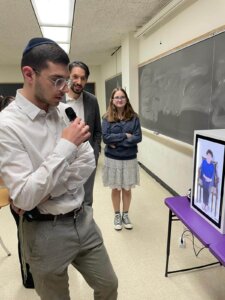
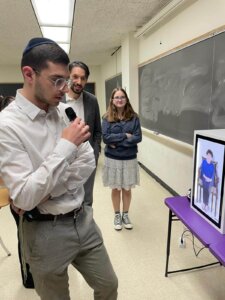
At a Brooklyn synagogue on a recent Monday afternoon, a video of Holocaust survivor Sonia Warshawski played on a two-foot-tall box. Seated in a leopard-print chair, her hands folded in her lap, Warshawski blinked and nodded her head expectantly on a continuous loop.
“Did anyone else from your family survive?” a Hebrew school student asked the AI-powered avatar.
The video cut to a separate clip. Warshawski said she and her sister had survived. Her brother, mother and father did not.
Warshawski, who survived three concentration camps and ran a tailoring shop in Kansas City until 2023, had made it part of her life’s mission to tell her story wherever she could. She spoke with students, filmed the 2016 documentary Big Sonia about her life, and was even a guest speaker at a local prison.
But Warshawski knew she wouldn’t live forever. So in 2021, with the help of the interactive media company StoryFile and her granddaughter’s production company, Inflatable Film, Warshawski recorded answers to hundreds of questions about her life, from “What do you remember about the death march?,” to “Why do you like leopard print so much?” Those answers were loaded into an AI-powered avatar of Warshawski that can converse through a video screen, which debuted as an exhibit at the Museum of Kansas City last year.
The technology also caught the attention of the Blue Card, a nonprofit that provides financial assistance to Holocaust survivors in need. The organization adapted it into a portable format and brought the virtual Warshawski to 20 schools and community centers across the New York area over the past year, with plans to expand nationwide. A parallel effort from the USC Shoah Foundation, called “Dimensions in Testimony,” also enables students to have conversations with virtual versions of Holocaust survivors.
The initiative reflects recognition that as survivors age, a model of Holocaust education built on firsthand testimony will be increasingly difficult to sustain. No lesson plan can match the impact of hearing directly from survivors, many of whom dedicate their golden years to speaking tours retelling their traumatic stories. But 90% of the world’s roughly 200,000 living Holocaust survivors are projected to die in the next 15 years. And for aging survivors — who have already lost so much of their lives to violence and deprivation — the weight of transmitting Holocaust memories to the next generation is a burden they cannot shoulder alone.
“It’s absolutely the future of Holocaust education,” said Masha Pearl, the Blue Card’s executive director. “It actually is as close as possible to hearing a live survivor speak.”
Warshawski’s story
Warshawski grew up in Międzyrzec, Poland, and was 17 years old when she and her family were forced into a ghetto. Sonia and her mother were deported to the Majdanek death camp, where she watched Nazis march her mother to her death via gas chamber. Warshawski was then sent to Auschwitz-Birkenau, where she was forced to spread her fellow prisoners’ ashes as fertilizer, and then to the Bergen-Belsen concentration camp, where she was shot in the chest on liberation day.
She recovered and met her husband, John, at the Bergen-Belsen displaced persons camp. The couple moved to Kansas City in 1948.
Using AI technology, students can ask the virtual Warshawski about all of those harrowing moments — with the added benefit that the real-life Warshawski only had to recall them once.
Many survivors “suffer from depression and PTSD, and it’s very difficult for them to recount these extremely painful experiences,” Pearl said. “This actually bypasses that in a way.”
The interactive element is also engaging for kids, Pearl said. At the Conservative synagogue Temple Sholom, after watching Big Sonia, nearly all 25 students ages 10 to 13 — half from the parochial school at the church across the street — raised their hands to ask the virtual Warshawski a question. A few students stayed after the programming had formally ended to ask more.
“It’s the same thing I heard from my uncle’s great grandpa,” said fifth-grader Noah Stein, who attends Hebrew school at Temple Sholom. “It’s amazing — I’ve never seen something like that.”
An imperfect technology
Warshawski, now 100 years old and still going strong, celebrated her birthday in November at a party with more than 1,000 people. But she doesn’t have as much energy as she used to and was unavailable to interview for this piece. So I interviewed her avatar instead.
My question — how she felt about her memory being preserved through AI — triggered an unrelated response.
“After we left [Majdanek], there were still people there, and I must tell you, one day when I was…”
“Can we pause this?” said Rechan Meshulam, special projects director at the Blue Card, who operated the technology at Temple Sholom.
Meshulam said the system had not matched my question to the correct response. She then manually selected the closest question, “Are you glad that you recorded this with StoryFile?”
“I feel this is a very important thing for the people in the world, not to forget and [to] read more about it. Read more history,” Warshawski said. “I’m very grateful that I had a chance to do it. I am thanking the Almighty for it, to give me the strength still to go on.”
The initial mismatched response illustrated the technology’s limits: Warshawski can only answer questions that StoryFile asked her during the original interview in 2021. If a question is similar enough, the AI is designed to redirect Warshawski to the appropriate answer. But this didn’t seem to work in practice. Whenever a student asked a question outside the suggested question bank, operators had to ask the student to rephrase — or pause Warshawski and jump in with their own knowledge about her story.
But according to Pearl, the limited scope of questions is a feature, not a bug. Limiting Warshawski to questions she actually answered prevents her words from being taken out of context or misconstrued, Pearl said.
“Sonia cannot tell you what the weather is today, what her thoughts are on politics — anything that’s really current,” Pearl said. “She can only speak to her experience.”
Not everyone draws the same line. Last year, a Utah-based tech startup called SchoolAI drew controversy for its AI-generated version of Anne Frank, which spits out responses that Frank never wrote herself. Henrik Schönemann, a German historian who tested the chatbot, found AI-Frank avoided holding Nazis responsible for her death and spun her story in an overly positive light.
“How anyone thinks this is even remotely appropriate is beyond me,” Schönemann posted to social media, adding that the technology “violates every premise of Holocaust-education” and amounted to “a kind of grave-robbbing.”
SchoolAI, which also offers the ability to chat with historical figures such as Alexander Graham Bell and Frederick Douglass, said it was implementing additional safeguards to help characters more directly address difficult questions.
I asked SchoolAI’s Anne Frank chatbot about how Frank feels about comparisons between ICE agents and the Gestapo. She didn’t take the bait.
“That’s a difficult question. When I lived in hiding, the Gestapo and police searched for people like us because of who we were, not because we had done anything wrong. I was always afraid,” AI-Frank wrote. “I believe it’s important to treat people with humanity and fairness, no matter their situation. What matters most is how we treat one another, especially those who are vulnerable.”
Yet even with careful control over the accuracy of testimony, some educators are uncomfortable with the idea of immortalizing Holocaust survivors in an interactive form.
In a research paper titled “Creating the ‘virtual’ witness: the limits of empathy,” Corey Kai Nelson Schultz argues that digital versions of Holocaust survivors can have the effect of undermining empathy. Viewers may treat the avatars more like virtual assistants than people, he wrote, and could be tempted to gamify the experience or test the technology’s limits.
Schultz told the Forward he prefers more traditional forms of Holocaust education — seeing artifacts like survivors’ shoes or toys, or watching video testimonies — mediums he believes better capture survivors’ humanity.
But the technology’s novelty was part of the appeal for Warshawski’s granddaughter, Leah, who directed Big Sonia — and said the AI component is just one more way to ensure her grandmother’s story lives on.
Warshawski “does authentically, passionately believe that everybody needs more education, and specifically, Holocaust education. And if this is the way to do it in the future, then so be it,” Leah told the Forward. “You know, ideally, everybody would be able to read more books.”
Pearl said the survivors she works with also have a different set of worries.
“We actually didn’t hear any ethical issues or concerns,” Pearl said. “The concerns that we heard were, Who will tell my story after I’m no longer here?”
The post As the last generation of Holocaust survivors die, is AI the future of Holocaust education? appeared first on The Forward.
Uncategorized
More Michigan Jews sign a petition pressuring El-Sayed on Israel. Will it matter?
(JTA) — ANN ARBOR – The activists on the Zoom supporting Abdul El-Sayed knew they faced an uphill climb when it came to persuading their fellow Jewish Democrats to overcome their concerns about the Michigan Senate candidate and vote for their party’s nominee despite his strong disapproval of Israel.
Two progressive Jews, former Biden administration appointee Sam Bagenstos and Detroit Jews for Justice co-founder Hayley Sakwa, made the Jewish case for the candidate to a sometimes skeptical, sometimes combative crowd of around 30 people on Sunday night.
Sakwa and Bagenstos urged voters to prioritize the chance to put a check on the larger Trump agenda – including heavy immigration crackdowns and the rightward tilt of the federal judiciary – given that the Michigan seat could help determine who controls the legislative chamber.
But their appeal wasn’t enough for several of the people on the call, who less than two days later would sign on to the “Nonnegotiables” petition. Spearheaded by a group of Michigan Jewish clergy, the open letter calls for El-Sayed to moderate his views on Israel and affirm more vocal support for Jews in politics as a condition for earning their votes.
The 17 new names to the petition, shared with the Jewish Telegraphic Agency ahead of their release on Tuesday morning, include state Rep. Noah Arbit, the founder of the Michigan Jewish Democratic Caucus.
Arbit recently gave a speech denouncing antisemitism on the floor of the Michigan House and has been critical of El-Sayed publicly: After progressive Jews recently hosted the candidate for a Rosh Hashanah dinner at their house, the representative accused them of “tokenism.” (Arbit declined to comment to the Jewish Telegraphic Agency.)
Other new names on the list include an elected University of Michigan regent and prominent local attorney, as well as several board members of the Jewish Democratic caucus, which itself is not endorsing a candidate in the race.
Concerns raised on the Sunday night Zoom call included El-Sayed’s opposition to Iron Dome funding for Israel and his earlier campaigning with anti-Israel streamer Hasan Piker, whom he has since distanced himself from. Some said they were worried he could open a door to a more hostile Democratic Party for Jews.
“With Abdul it sort of feels like letting a fox into the henhouse,” one said.
“I refuse to be anyone’s dhimmi,” another wrote in the chat, referring to a term for non-Muslims living under Islamic rule.
Yet any pressure Jewish Democratic critics of El-Sayed hope to place on the candidate are partly balanced out by the work of those such as Sakwa, who along with other Jewish liberals has to date secured 900 signatures pledging to vote for El-Sayed. A competing letter of Jewish voters pledging to back his Republican challenger, former U.S. Rep. Mike Rogers, has picked up 524.
At the same time, the broader Democratic Party has ramped up its efforts to get elected officials in line behind the nominee. The El-Sayed campaign has yet to respond publicly to the “Nonnegotiables,” and with little more than a month to go before Election Day, it might not need to.
Former Vice President Kamala Harris campaigned with El-Sayed last week in Detroit, and the liberal-leaning editorial board of the Detroit Free Press, the state’s largest daily newspaper, endorsed the former county health director over the weekend.
The Free Press wrote that its own endorsement was against an “extremist” — referring to Rogers and President Donald Trump — in language that one bloc of Jewish voters also used to refer to their own decision to vote for Rogers over El-Sayed.
In addition, Michigan Attorney General Dana Nessel, who is Jewish and has fiercely criticized El-Sayed for his past comments about Jews and Israel, endorsed and appeared with the candidate on a local liberal podcast hosted by a Jewish woman to project unity.
“There is no choice,” Nessel said.
But the conversation demonstrated that tensions still remain even with many Jewish Democrats who have thrown in their lot with El-Sayed.
“Is there space for a Jewish Zionist like myself?” she asked him. “Is there space for us in the big tent of the Democratic Party?”
“I believe in a big tent,” he answered. “I am committed to having a tent where we march in lock step on the 95% of issues that we agree on.”
But the attorney general, who cited the risk of antisemitic threats as the reason she skipped the party convention earlier this year, wasn’t done.
“The question many of us have is: Are you seeking our votes?” Nessel asked El-Sayed. “Do they matter to you?”
“Yes,” the candidate responded. “If you trust that I’ll lead well for the community, even if there’s an issue on which we deeply disagree, then I hope I can earn your vote.” Later, El-Sayed said, “I look forward to working” on the Jewish American Security Act, a bipartisan bill to institute new Jewish security measures, including in synagogues and on college campuses.
“We’ve had an uptick in antisemitism, and it is critical to protect Jewish Americans,” El-Sayed said.
As with Nessel, El-Sayed’s candidacy is pushing other Jewish Democrats to perform a difficult two-step: pushing for the party platform and against Trump, without getting too close to the candidate himself.
The Jewish Democratic Council of America, whose CEO, Halie Soifer, is a Michigan native, is also not endorsing in the race. Yet Soifer told JTA, “Jewish voters will support Democrats in large numbers in the midterms, including in Michigan.” She predicted that Rogers wouldn’t earn more than one-quarter of the Jewish vote.
“Jewish voters recognize that a vote for any Republican in 2026 is a vote for Donald Trump,” Soifer told JTA over text. “We know Jewish voters are a critical component of a winning Democratic coalition.”
Decky Alexander, who chairs the Michigan Jewish Democratic Caucus, pointed to consistently high Democratic voting records for Jews in arguing that Jews still matter to the party’s coalition. She also favorably noted the Democratic National Committee’s recent announcement that it would establish a “Jewish American Council,” to convene in 2027.
“We can’t be distilled down to one vote or one idea,” Alexander told JTA.
One part of the state’s Jewish Democratic bloc unlikely to support El-Sayed: members of Temple Israel, the country’s largest Reform congregation. Speaking to the national publication The Free Press last week, several members, including a preschool teacher who was in the building when it was attacked in March, said El-Sayed’s apology for his earlier remarks about the temple was insufficient and that they couldn’t bring themselves to vote for him.
“No thinking Jew could vote for Abdul El-Sayed,” a former temple president told The Free Press.
None of the synagogue’s clergy signed the “Nonnegotiables” letter, or any other Jewish letter circulating about El-Sayed. But one of the temple’s rabbis told congregants in a Kol Nidre sermon that they had a say in drafting it, stating, “Our full participation in American political life is also non-negotiable.”
“No one should have to pass a test about Israel to be welcomed into a coalition on a campus or in a political party,” Rabbi Josh Bennett told his congregation, which had convened in the Temple Israel building for the High Holidays for the first time since the March attack. Rabbi Jen Lader, also of Temple Israel, recently testified before Congress to advocate for the Jewish American Security Act.
As Rogers has looked to win over dissatisfied Jews to his campaign, he has also moved toward El-Sayed on at least one issue tangentially related to Israel: opposition to the war in Iran. Initially a supporter of the war, Rogers in recent days has said he thinks it should “end quickly.”
El-Sayed, meanwhile, has raised eyebrows of his own in recent days. He dithered on denouncing the Iranian regime when urged to by an Iranian Christian college student, and appeared at a Dearborn fundraiser with Osama Siblani, a local Arab-American activist and newspaper publisher who once stated at a rally, “We are not going to be intimidated by staying silent when they say Hamas is a terrorist organization.”
The “Nonnegotiables” petition was launched earlier this month by a group of more than a dozen Michigan Jewish clergy after a series of apologies by El-Sayed to Jewish audiences for past comments he had made about the Temple Israel attack. The candidate needs to do more to earn the community’s confidence, the campaign’s organizers have told JTA.
“A large number of Jews haven’t decided how they will vote,” David Kramer, the caucus’s vice chair and one of the new signers, told JTA about the letter’s potential influence. “I speak to these people every day. Regardless of how they vote, Michigan Jews want and deserve to feel safe and have a seat at the table.”
As the Zoom call wrapped, some of the assembled Jews said they would vote for El-Sayed, even if reluctantly. Alexander of the state’s Jewish Democratic Caucus, who signed the letter supporting him, told the crowd the candidate has nothing to hide, even if they don’t like what he says.
“He’s basically stated what he believes,” she said. “And you have to decide if that’s the word for you.”
This article originally appeared on JTA.org.
The post More Michigan Jews sign a petition pressuring El-Sayed on Israel. Will it matter? appeared first on The Forward.
Uncategorized
Irish national soccer team won’t shake hands with Israel after win
(JTA) — It only took 25 minutes of play for the Irish national soccer team to build a 3-0 lead over Israel in the countries’ UEFA Nations League B match on Sunday. But there were decades of bad blood that preceded Ireland’s shutout victory in a game dominated more by the geopolitics of the Gaza war than about sports. One soccer writer described it as “arguably one of the most contentious football matches of this century.”
At the match, held in a mostly empty stadium in the neutral site of Debrecen, Hungary, the Irish players wore black armbands and bowed their heads in protest during the Israeli national anthem. There were no pre- or postgame handshakes, and one Irish player declined to participate altogether, citing his “personal belief that the killing of innocent people is wrong.”
Ireland’s soccer federation did not reserve tickets for its fans, and the country’s public broadcaster scaled back its coverage of the game. The teams are set to meet again on Oct. 4 in Serbia, this time with Ireland as the “home” team.
Ireland and Israel have a long history of icy relations. Ireland became the first member of the European Union to call for an independent Palestinian country in 1980, and was among the first of the Western European countries to recognize an official Palestinian state in 2024. Israel closed its embassy in Dublin in response. Irish Prime Minister Micheál Martin has rejected claims that his country’s sharp criticism of Israel bleeds into antisemitism.
In the months leading up to Sunday’s match, Ireland’s football governing body faced intense pressure to boycott the match. At a meeting in July, the Football Association of Ireland voted 75-32, with three abstentions, in favor of proceeding with the match, “while acknowledging the strength of feeling regarding support for Palestine.” The motion also noted that a boycott would come with UEFA sanctions, both financial and competitive: In League B matches, mid-tier nations seek to advance to the top division and boost their chances of qualifying for the quadrennial World Cup tournament. The Irish team itself also held a last-minute vote over whether to participate.
Earlier this month, more than 160 Irish athletes and sports figures signed an open letter calling on the national team to pull out of the match. The signatories included former Irish national team head coach Brian Kerr — who had led Ireland to a 2-2 draw against Israel in a 2005 match in Dublin that also took place amid protests.
Former Irish national team star Kevin Kilbane also authored a column in The Irish Times, writing, “Ireland should not play Israel. Not in Dublin, not in Hungary, not in Serbia. Not when Israel is committing genocide.” Israel denies the charge of genocide.
There were also a number of public barbs exchanged between leaders of the two countries and their football associations.
At a press conference last week, Irish coach Heimir Hallgrímsson replied to questions about the match by saying, “We are not playing with genocide, we are playing against genocide. We are playing against Israel; we are not playing with Israel.”
Israel’s football association responded to that comment with a post on X, writing, “We have contributed to the world and humanity in countless fields, earning an impressive number of Nobel Prizes along the way. Unfortunately, we have not yet found a cure for stupidity, ignorance and hypocrisy displayed by the @IrelandFootball team coach. We’re not playing with ignorance, hypocrisy and stupidity. We’re playing against the coach who embodies them.”
That drew a rebuke from Martin, who told reporters, “They are unacceptable remarks and should be withdrawn.”
And on Sunday, the morning of the match, Israeli Foreign Minister Gideon Sa’ar posted a lengthy tweet referencing the 1939 Irish squad that gave a Nazi salute before a game against the German national team.
“Almost 90 years have passed. Ireland’s unique talent for finding itself on the wrong side of history remains intact,” Sa’ar wrote. “Back then, they gave the Nazi salute. This time, they stand on the side of Palestinian terrorism. Above the black armbands the Irish players will wear tonight flies the black flag of jihadism.”
After the match, Israeli captain Manor Solomon said the Irish players who bowed their heads during the Israeli anthem “don’t interest me.”
“We have a country 10 times better than theirs, stronger, an amazing country with amazing people,” said Solomon, who plays in the English Championship league. “We are proud to wear the team shirt and to be Israelis. We are proud of our state and of our soldiers. [The Irish] can play all their tricks. We are Israelis and love the country. And that will always be the case.”
The post Irish national soccer team won’t shake hands with Israel after win appeared first on The Forward.
Uncategorized
Why is Karl Rove supporting a progressive Jewish candidate in Texas?
(JTA) — Progressive Jewish Texas state Sen. Jon Rosenthal has earned an unusual distinction: He is the first Democrat to win the vote of GOP guru Karl Rove in more than 30 years.
What did the only Jew serving in the Texas state house do to earn this distinction? It’s more what he didn’t do: run for statewide office with a track record of spewing racially charged and antisemitic comments.
Bo French, the Republican nominee for Texas Railroad commissioner, has a history of rhetoric targeting people of color, Muslims and Jews, including a social media poll last year asking whether “Jews” or “Muslims” pose “a bigger threat to America.”
He also faced bipartisan blowback for a recent post targeting college students of color, and this week a CNN investigation revealed that French, in since-deleted posts, had called for public executions for former President Barack Obama, Jewish California Sen. Adam Schiff and government workers targeted by the so-called Department of Government Efficiency last year.
The controversy has elevated the race for an obscure statewide office – albeit one that regulates the state’s all-important energy industry – into a larger referendum on the GOP’s tolerance for bigotry, including antisemitism, among its nominees.
Rove, for one, has made it clear where he thinks the party should stand.
“The GOP has a growing number of Bo Frenches — and not only in Texas,” Rove wrote in The Wall Street Journal earlier this month in explaining his decision to back Rosenthal.
Rove singled out growing antisemitism in the party: “There are ‘just asking questions’ Jew-haters, misogynists who worship hypermasculinity, conspiracy nuts seeking clicks for profit, and religious bigots who won’t differentiate between Muslim terrorists and Muslim American patriots.”
Rove isn’t the only GOP stalwart to turn on French.
“Are other Republican elected officials going to condemn the intolerance and racism, or look the other way while it becomes normalized,” outgoing Texas Sen. John Cornyn wrote in condemning French’s social media musings. “This is how great political parties self-destruct.”
Cornyn has stopped short of backing Rosenthal, instead saying he might leave the ballot blank.
Texas Rep. Jon E. Rosenthal inside the House Chamber at the Texas Capitol in Austin on Aug. 18, 2025. (Mikala Compton/Austin American-Statesman via Getty Images)
Rosenthal and French have agreed to a debate on Oct. 22. French leads the race in polling released last week from Texas Southern University, but by a much slimmer margin than GOP candidates are accustomed to in Texas. Rosenthal’s campaign could also see a boost from fellow statewide Democratic candidate James Talarico, who is polling neck-and-neck with his opponent in the U.S. Senate race.
On social media, Rosenthal celebrated Rove’s endorsement, writing, “When GOP architect Karl Rove breaks a 30-year voting streak to endorse our campaign, it proves this race isn’t about party lines, it’s about competence vs. chaos.”
A former county Republican Party chair who defeated the incumbent GOP state railroad commissioner in a runoff primary, French spurred widespread backlash earlier this month after posting a photo of students of color at the University of Texas celebrating a football win to the social network X.
“I heard UT graduation this year looked like this. I didn’t believe it,” French had captioned the photo on Sept. 13. “The problem is now obviously far worse than anyone imagined.” He has since doubled down on the sentiment, replying, “I weep for the families in Texas who can’t get into UT because they prioritize foreigners over Texans,” and using the backlash to solicit donations.
Texas Gov. Greg Abbott and state House Speaker Dustin Burrows were among the other Republicans who criticized French for the post, though neither formally rescinded their support, and French continues to list Abbott’s endorsement on his site.
It was not French’s first brush with bigotry. In 2025, during his stint as Tarrant County GOP Chair, French posted an online “poll” asking his followers whether “Jews” or “Muslims” pose “a bigger threat to America.” In a follow-up post, he argued, “You may not like Jews, but to suggest they are a bigger threat to Americans is Jew Derangement Syndrome.”
French later deleted both posts, and has few visible tweets about Jews today. In later posts, he claimed, of himself, “There has never been any evidence of antisemitism. It would certainly be surprising to my Jewish partners.”
Jewish Republicans in the state and beyond are largely keeping their distance from French, with one exception. His campaign site currently touts an endorsement from American Jewish Conservatives, whose only listed chapter is in Dallas.
Neither French nor the group, formerly Dallas Jewish Conservatives, responded to JTA requests for comment on the endorsement. A spokesperson for the Republican Jewish Coalition also did not return a request for comment on French.
Last month French cited a desire to combat antisemitism when arguing that Texas should not use mosques as polling places. In other posts, he accused a university in the state of “harboring radical left/antisemitic professors,” identified himself as both pro-Israel and pro-Tucker Carlson, the talk show host who has platformed antisemites and anti-Jewish conspiracy theories, and told one follower, “I have never served Israel. Don’t be a retard.”
Texas Lt. Gov. Dan Patrick was among the GOP officials who condemned French’s tweet about Jews last year, calling on him to resign as county chair. “Antisemitism and religious bigotry have no place in Texas,” Patrick said then. French ultimately resigned months later in order to run for railroad commissioner.
Today, French lists Patrick as one of his endorsements. A spokesperson for Patrick, who recently told JTA he supported Texas schools assigning books on the Holocaust after public remarks apparently to the contrary, did not return a Jewish Telegraphic Agency request for comment.
French’s other listed endorsements include Texas congressional candidate Brandon Herrera, who has made jokes about Hitler and the Holocaust in YouTube videos.
Rove’s essay led to President Donald Trump wading into the controversy, calling Rove “so bad for the Republican Party, and completely wrong so often,” in a post on his social network Truth Social. Trump’s post did not mention French, nor address his past post about Jews.
The Texas railroad commission, composed of three members, oversees the state’s large and powerful oil and gas industry. It has no oversight into immigration or religion. Even so, French’s campaign has drifted far afield from energy issues: One of his pledges is “Stop the Islamic Invasion of Texas.”
French’s controversies have elevated the profile of Rosenthal, who was raised a Reform Jew in an interfaith household and whose Houston-area district is home to large Muslim communities. This year Rosenthal marked Rosh Hashanah and Yom Kippur by sharing links to Chabad-Lubavitch webpages about the holidays.
Rosenthal’s campaign did not respond to a JTA request for comment, but he told the Forward last year that he identifies as agnostic and “multireligious,” and attends synagogues as well as mosques and churches.
Rosenthal is also a trained mechanical engineer, a background he has drawn on in his bid for railroad commissioner: one campaign ad, quoting a conservative radio host, approvingly calls him “a ‘drill, baby, drill’ Democrat.” He has accused French of “overt racism,” while French has dubbed his opponent “Radical Rosenthal” and posted images, generated using artificial intelligence, of cross-shaped Texas oil wells to promote his blending of energy policy with Christian iconography.
Last year, Rosenthal cited his Judaism in response to legislation that would require the Ten Commandments to be displayed in every public school classroom. Rosenthal introduced an amendment that would have required a “Jewish” version of the commandments to be displayed alongside the “Protestant” one. The amendment failed, and the bill passed.
The post Why is Karl Rove supporting a progressive Jewish candidate in Texas? appeared first on The Forward.
