



Uncategorized
Israeli Strikes in Lebanon Kill at Least 10, Including Senior Hezbollah Official

People inspect the damage at the site of an Israeli strike on Friday, in Bednayel, Bekaa valley, Lebanon, February 21, 2026. Photo: REUTERS/Mohamed Azakir
At least 10 people were killed and 50 wounded in Israeli strikes in Lebanon’s Bekaa Valley, two security sources told Reuters, after the Israeli military said it had targeted Hezbollah sites in the Baalbek area.
The strikes on Friday were among the deadliest reported in eastern Lebanon in recent weeks and risk testing a fragile US-brokered ceasefire between Israel and Shi’ite Islamist group Hezbollah, which has been strained by recurring accusations of violations.
The Israeli military said in a statement that it struck Hezbollah command centers in the Baalbek area, part of eastern Lebanon’s Bekaa Valley.
In a separate statement on Saturday, it said it had “eliminated several terrorists of Hezbollah’s missile array in three different command centers … recently identified as operating to accelerate the organization’s readiness and force build-up processes, while planning fire attacks towards Israel.”
Hezbollah said on Saturday that eight of its fighters, including a commander, Hussein Mohammad Yaghi, were killed in Friday’s strikes in the Bekaa area.
CEASEFIRE BROKERED IN 2024
Israel and Hezbollah agreed to a US-brokered ceasefire in 2024 intended to end more than a year of cross-border exchanges of fire that culminated in Israeli strikes that weakened the Iran-aligned group. Since then, the sides have traded accusations of ceasefire violations.
US and Israeli officials have pressed Lebanese authorities to curb Hezbollah’s arsenal, while Lebanese leaders have warned that broader Israeli strikes could further destabilize the country already battered by political and economic crises.
Separately, the Israeli military said it also struck what it described as a Hamas command center from which militants operated in the Ain al-Hilweh area in southern Lebanon. Ain al-Hilweh is a crowded Palestinian refugee camp near Sidon.
Lebanese President Joseph Aoun condemned the overnight Israeli strikes on the Sidon area and towns in Bekaa as a “new violation” of Lebanon’s sovereignty and a breach of U.N. obligations, urging countries backing regional stability, including the United States, to press for an immediate halt to avert further escalation, the presidency said.
Hamas condemned in a statement the Israeli strike on Ain al-Hilweh and rejected Israeli assertions about the target, saying the site belonged to the camp’s Joint Security Force tasked with maintaining security.
Uncategorized
A View From Inside Iran: Silencing a Generation — Voices Lost to the Gallows

Iranian demonstrators gather in a street during anti-regime protests in Tehran, Iran, Jan. 8, 2026. Photo: Stringer/WANA (West Asia News Agency) via REUTERS
“Don’t tell Mom.”
It is a sentence that has echoed through Iran’s prisons for decades. A sentence carried through monitored phone lines in the final minutes granted to the political prisoners before execution.
It’s a closing plea made just before the state carries out a sentence from which there is no appeal in practice, regardless of what the law suggests in theory.
Political prisoners are typically permitted one final phone call. The call is brief and the tone measured. A father or a sibling answers. There is no explicit reference to what awaits. The word execution is rarely spoken aloud. Surveillance renders such candor both futile and dangerous.
Instead, there is a restraint.
“Dad … please don’t tell Mom.”
He once imagined a different future. He is a teenager with dreams. Employment. Stability. The ordinary dignity of contributing to his household. A simple life with shared meals, familiar arguments, the slow accumulation of years.
He did not anticipate becoming an example.
In the final hours, time takes on a different texture. Memory becomes intrusive. Childhood surfaces with disorienting clarity. The mind hangs between improbable hope and quiet comprehension. There may be a reprieve. Perhaps international pressure will intervene. Perhaps the sentence will be suspended. Hope flickers irrationally. But the machinery of execution is efficient. The last image is not of ideology. Not of slogans. It is of home.
And then, silence.
Executions function not only as punishment, but as communication. A message sent through prison walls into society: dissent has consequences. Protest has a cost. Silence is safer.
Within Iran’s Revolutionary Courts, outcomes in political cases are determined long before the hearing begins. Access to a lawyer is restricted. Trials may last minutes; in some cases, there are no trials. Charges such as “enmity against God” or “corruption on earth” are applied, enabling capital punishment under a broadly interpreted definition of dissent.
By the time the final call is made, the legal process has typically run its course.
What follows is administrative efficiency.
Hours later, families are notified. The burial conditions are controlled and restricted. Public mourning is not permitted. Grief itself becomes regulated.
The executions of political prisoners in Iran emerge from a judicial architecture that has long blurred the boundary between adjudication and enforcement.
Political cases are typically adjudicated in Revolutionary Courts, institutions established in the aftermath of the 1979 coup d’état to address actions perceived as threats to the state. Over time, their jurisdiction has significantly expanded. Proceedings are conducted behind closed doors. Defendants in national security cases, as defined by the regime, may not be allowed to consult their preferred attorney during the investigative stage, which is a crucial time when coerced confessions are frequently obtained.
Claims of forced confessions, brief trials, and a lack of evidentiary transparency have all been documented by human rights organizations on numerous occasions. The way charges like “enmity against God” (moharebeh) and “corruption on earth” (efsad fel-arz) are phrased leaves room for interpretation. These offenses are punishable by death under Iran’s Islamic Penal Code.
In politically sensitive cases, appeals are reviewed in minutes and without public scrutiny. The interval between sentencing and execution is usually brief, especially during nationwide protests.
The outcome is a system in which capital punishment transcends its role as a criminal penalty and instead operates as a deliberate instrument of state control and intimidation.
The right to a fair and public hearing, access to independent legal counsel, and the exclusion of evidence obtained under duress are guaranteed under international legal standards, notably those set out in the International Covenant on Civil and Political Rights, to which Iran is a member. International Law limits the use of capital punishment, where it has not been abolished, to the most serious crimes, understood to involve deliberate killing. Significant concerns arise regarding proportionality and due process when the death penalty is applied in cases related to protests. In such conditions, the legitimacy of the sentence itself is called into question, and fundamental legal protections are undermined.
Executions in this context serve a dual function: they eliminate the individual and communicate a warning to the broader public. Particularly in the aftermath of protest movements, they operate as instruments of deterrence, reinforcing the cost of dissent.
This is not merely a domestic judicial matter; it is a question of whether procedural form can substitute for substantive justice and whether the language of law can obscure the absence of its protections.
The cases differ in detail, but the structural concerns remain consistent: restricted legal representation, opaque trials, and the rapid advancement of capital sentences.
Time, in such cases, is measured not in months but in days, sometimes hours.
The international community has mechanisms at its disposal. Governments engaged in diplomatic relations with Tehran possess channels through which urgent appeals have been raised, yet these efforts have too often failed to elicit meaning response. The UN Special Rapporteur on the situation of human rights in Iran has repeatedly called for transparency and adherence to international fair trial standards, but such appeals lack effective means to hold authorities inside Iran accountable.
Public pressure matters. Diplomatic engagement matters. Clear and coordinated messaging matters. Silence, too, carries consequences.
In the context of war and ceasefire, the Islamic Republic of Iran has intensified its repressive measures, imprisoning and executing young individuals for the simple act of sharing images and videos with international media. The Internet blackout has severely restricted access to information about detainees and ordinary Iranians.
As the United States and Islamic Republic of Iran prepare to engage in more high-stakes talks in Islamabad, aimed at stabilizing a fragile ceasefire following weeks of conflict, concerns are intensifying that those at risk of execution and ordinary Iranians may face heightened risk under an increasingly vengeful policy of the regime.
For Iranians, the future remains uncertain and unsettling. Rather than offering reassurance, these negotiations are met with anxiety and distrust, as many fear that diplomatic engagement may come at the cost of further repression at home.
Amid pervasive fear and danger, the fate of millions of Iranians remains unknown.
The men and women awaiting execution today are not abstractions. They are sons and daughters who once ended a phone call with the same plea:
“Don’t tell Mom.”
The question now is not only what will happen inside prison walls, but also what will happen outside of them — in foreign ministries, in multilateral institutions, in the public conscience. Because once the sentence is carried out, there is no correction. What Iranians might face now is the aftermath of an unfinished war.
Maddie Ali is based in Iran. In addition to her academic work, she has been involved in civic activity in her hometown, including participating in and helping organize local protests alongside friends and family. Her name has been changed to protect her identity.
Uncategorized
Haftarat Shabbat Rosh Chodesh: All Who Mourn for Jerusalem
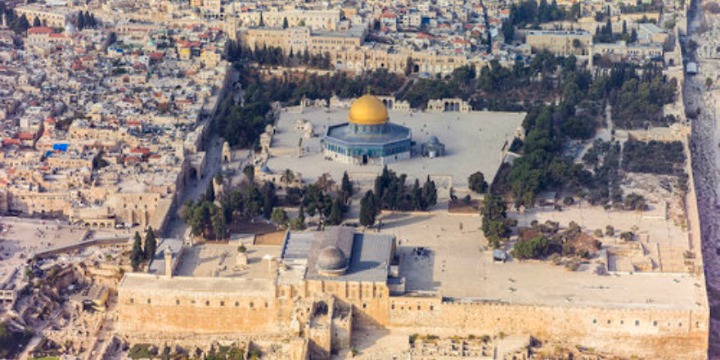
An aerial view of the Temple Mount in the Old City of Jerusalem. Photo: Wikimedia Commons.
This year, as Parshat Tazria-Metzora coincides with Shabbat Rosh Chodesh, and the weekly haftara gives way to the closing chapter of the Book of Isaiah, it is impossible to hear Yeshayahu’s stirring words of consolation this season without feeling their weight.
Almost three years have passed since the horrors of October 7th. We have lived through war fought on multiple fronts — in Gaza and Lebanon, Syria and Iran. Homes destroyed across the north, south, and center of Israel. Families cycling through bomb shelters and reserve duty. Non-stop shiva calls. And, as this haftara falls just before Yom Hazikaron, military cemeteries that have grown far too large.
Yeshayahu’s vision of comfort is addressed precisely to this kind of grief — and it places a profound and demanding condition on that comfort.
The prophet paints a future of joy and renewal: Jerusalem rebuilt, her streets once again filled with laughter and light. “Bring Jerusalem joy, exult in her, all of you who love her; celebrate her joy with her, all of you who mourned her” (Isaiah 66:10). The Gemara (Taanit 30b) reads this verse with care and draws out a powerful principle: Only those who have genuinely mourned for Jerusalem will merit sharing in her future joy. The invitation to rejoice in redemption is conditional upon having grieved.
This teaching about who truly “mourns for Jerusalem” carries urgent contemporary weight. A Pew Research Center study released last month found that American favorability toward Israel has dropped eight percentage points in a single year, with 60% of Americans now holding an unfavorable view. More troubling is the trend within the Jewish community: just last year, 73% of American Jewish respondents held a favorable view of Israel. That figure has fallen to 64% — a decline of nearly 10 points in 12 months. For those who love Zion, these are not merely political data points. They are a challenge to the very solidarity that Yeshayahu’s vision demands.
What lies behind this shift? Part of the answer is a well-funded, coordinated campaign to delegitimize the State of Israel and Zionism — visible in American higher education, in the media, and in political lobbying. This must be named and addressed.
But it would be a mistake to look only outward. We in Israel must honestly ask whether the policies and public statements of top Israeli officials have not made it easier to misrepresent Israel as a state unconcerned with minorities, insensitive to other faiths (including Jewish denominations which are not Orthodox), and willing to flatten Gaza and repopulate it with Jewish settlements. The obligation to protect the state is sacred; so too is the obligation to ensure that the vision of an independent, flourishing Jewish State remains one that Jews in Israel and the diaspora can embrace together.
“As a man is consoled by his mother, just so shall I comfort you, and in Jerusalem, you shall be consoled” (v. 13). Yeshayahu’s image of consolation is strikingly intimate — the warmth of a mother, the certainty of belonging. This comfort is not meant to be experienced alone. It is promised to a people that returns to Jerusalem together, whose grief has been communal and whose joy will be shared. Since October 7th, so many Jews worldwide have indeed mourned, prayed, donated, advocated, and made aliyah. That solidarity is real, and must not be taken for granted.
Generations ago, a visitor to the Kotel etched into its ancient stones a verse from this very haftara: “You shall look on, your heart rejoicing, while your bones grow vigorous, like grass, and the hand of the Lord becomes known to His servants” (v. 14). An anonymous hand carved those words of hope into the wall — a private prayer left for all who would come after. This person understood Yeshayahu’s meaning precisely: Our hope is not merely personal. The rejoicing, the vigorous renewal, the recognition of God’s hand in history — all of it belongs to all our people, as one.
As we approach Yom Hazikaron, mourning our fallen with aching hearts, may we recommit to the work of shared solidarity that Yeshayahu demands. May we grieve together, hold one another, and confront with honesty and courage whatever stands between us and the vision of Jerusalem restored. And may we all merit, as a nation, and not merely as individuals, to see that day of consolation soon.
Rabbi Dr. Kenneth Brander is President and Rosh Yeshiva, Ohr Torah Stone.
Uncategorized
Erdogan’s Turkey Weaponizes Judicial Mechanisms Against Israel

Turkish President Tayyip Erdogan is welcomed by Qatar’s Emir Sheikh Tamim bin Hamad al-Thani in Doha, Qatar, Oct. 22, 2025. Photo: Murat Kula/Turkish Presidential Press Office/Handout via REUTERS
As the US and Israel are attempting to eradicate the nuclear threat of Iran’s Islamist regime with Operation Epic Fury and Operation Roaring Lion, usual suspect Turkey — a nominal NATO ally of the US — undermines their efforts. Turkey has been a close ally of the Iranian Islamist regime and Hamas’ most vocal supporter on an international level. Ever since Hamas launched a horrific attack on Israeli civilians on October 7, 2023, Turkey has been opposing Israel. Now Turkey resorts to renewed threats against Israel by weaponizing its judicial mechanisms.
On Apr. 10, the regime-affiliated Istanbul Chief Public Prosecutor’s Office filed indictments against 35 top Israeli officials, including Prime Minister Benjamin Netanyahu, Defense Minister Israel Katz, National Security Minister Itamar Ben Gvir, and IDF Chief of Staff Lt. Gen. Eyal Zamir. seeking a total of more than 4,500 years in prison.
The indictments relate to Israel’s Oct. 1, 2025, interception of the Global Sumud Flotilla that was trying to breach the Israeli blockade of Islamist Hamas in Gaza. The indictment seeks aggravated life sentences as well as prison terms ranging from 1,102 years and 9 months to 4,596 years for each suspect on charges, including “crimes against humanity,” “genocide,” “deprivation of liberty,” “torture,” “damage to property,” “qualified looting,” and “obstructing, hijacking or detaining transportation vehicles.”
The supposed investigation is said to unfold within the framework of the United Nations Convention on the Law of the Sea (UNCLOS), which Turkey itself has not signed.
Israeli Premier Benjamin Netanyahu did not hold back in his response, accusing Erdogan of massacring Kurds in his own country. “Israel under my leadership will continue to fight Iran’s terror regime and its proxies, unlike Erdogan who accommodates them and massacred his own Kurdish citizens,” he wrote on X. The persecution of the Kurdish population, both inside Turkey and in neighboring countries — Syria and Iraq — by Turkish authorities, has been going on for decades. Turkey’s Foreign Ministry repeated well-known tropes of anti-Israeli propaganda, calling the Israeli premier “the Hitler of our time.”
Israeli Defense Minister Israel Katz, a vocal critic of Turkey’s aggression, also lashed out at Erdogan on X, calling him a “paper tiger.” “Erdogan, who did not respond to missile fire from Iran into Turkish territory and has proven to be a paper tiger, is now fleeing into the realm of antisemitism and calling for show trials in Turkey against Israel’s political and military leadership,” he said. “What an absurdity. A man of the Muslim Brotherhood, who massacred the Kurds, accuses Israel — defending itself against his Hamas allies — of genocide,” Katz added. “Israel will continue to defend itself with strength and determination — and he would do well to remain silent.”
Israel has established a trilateral cooperation on security, defense, and energy with Greece and Cyprus, two European states that function as Israel’s necessary strategic depth in its greater Islamic neighborhood. In an interview with state-affiliated Anadolu news agency on Apr. 13, Turkish Foreign Minister Hakan Fidan criticized Greece and Cyprus over their cooperation with Israel, warning it could heighten regional tensions. The Turkish official also claimed that Israel “may seek to characterize Turkey as a new adversary after Iran, as it cannot survive without an enemy.” Greece’s Foreign Ministry replied promptly that it owes no explanations to Turkey over its long-standing alliance with Israel.
Turkish aggressive rhetoric against Israel, Greece, and Cyprus have recurred time after time.
Turkish President Recep Tayyip Erdogan has repeatedly threatened to use military force against all three states. In this context, Israel’s growing cooperation with Greece and Cyprus is essential in lifting Israel out of its Arab surroundings and engaging with a greater Mediterranean and pro-Western security environment.
“Turkey’s latest wave of anti-Israeli rhetoric following the Israel–Greece–Cyprus cooperation mechanisms reflect a familiar pattern rather than a sudden shift. Ankara views the deepening cooperation among these three states as a direct challenge to its regional influence in the Eastern Mediterranean. Israel’s growing strategic relationship with Greece and Cyprus in the Eastern Mediterranean gives Israel an alternative regional anchor that is not dependent on Arab consensus, and it opens pathways for security cooperation that can survive diplomatic storms in the Middle East. For Turkey in particular, the Israel–Greece–Cyprus triangle is a constant reminder that Israel has options, and that attempts to corner Israel politically can push it deeper into partnerships that Turkey cannot easily penetrate,” US national security lawyer, geopolitical analyst, and fellow at the Jerusalem Center for Public Affairs Irina Tsukerman, told the Investigative Project on Terrorism (IPT).
The relations of Turkey and Hamas have run deep for decades, and have been thoroughly documented by IPT in various analyses (here and here). Erdogan’s Turkey has an ambiguous relationship with extremist Islamist ideology, having supported the Islamic State and other terrorist Islamist organizations in Syria and Libya. The Turkish government supports the notorious Muslim Brotherhood, designated by the US as a foreign terrorist organization. Erdogan himself has repeatedly met with the leadership of Hamas in Turkey.
According to Israel’s Shin Bet, Hamas has established a command post in Turkey which it uses to recruit operatives and oversee operations in the Middle East and specifically in the West Bank against Israel. In September 2023, just weeks before the October 7 assault, Israeli customs authorities seized 16 tons of explosive material sent from Turkey to Gaza, hidden behind packages of construction supplies.
In many instances after the October 7 attack, Turkish Erdogan has lauded Hamas as “a liberation group, ‘mujahideen’ waging a battle to protect its lands and people.” Just weeks after the horrific attack, Erdogan cancelled a planned visit to Israel. Turkey suspended its trade with Israel, closed its airspace to Israeli planes, and issued arrest warrants for 37 Israeli officials, including Netanyahu.
Erdogan has treated Hamas as a sort of bulwark for Turkish interests, claiming in various instances that if the Islamist organization were to be eradicated, then Israel would come for Turkey next. Meanwhile, state-affiliated Turkish media continue to portray Israel as a “number one threat” for Turkey, while they always describe Hamas as a “Palestinian resistance movement.” Even after the October 7 attacks, the Turkish leadership called for an Islamic alliance against Israel, effectively a call to jihad.
IPT Senior Fellow Ioannis E. Kotoulas (Ph.D. in History, Ph.D. in Geopolitics) is Adjunct Lecturer in Geopolitics at the University of Athens, Greece. A version of this article was originally published by IPT.