


Uncategorized
At this Dallas synagogue, Purim comes with fog machines, zip lines and Broadway flair
(JTA) — Excited chatter and the rattling of noisemakers echoed throughout the halls of Congregation Shearith Israel as 900 people streamed into its Purim spiel Sunday morning.
But as similar festivities commenced at synagogues around the world, the congregants of the historic Conservative shul in Dallas knew they were in for something far more ambitious than the average holiday festivities.
A Purim spiel, Yiddish for “play,” is the comedic retelling of the Book of Esther for the holiday of Purim. At many synagogues, the production features a costume parade, Jewish parodies of popular songs and the annual megillah reading.
For the past eight years, however, the Purim performance at Shearith Israel has taken the form of a high-octane theatrical performance, featuring intricate set designs, original music, and a yearly stunt that has included its rabbi riding into the sanctuary on horseback and ziplining onto the stage.
This year, the performance featured confetti canons and a mechanical rig that lowered a child onto the stage behind a giant disco ball.
The congregation’s annual performance did not always resemble the elaborate, effects-laden production it is today. The spectacular is the brainchild of one of the synagogue’s senior rabbis, Adam Roffman, whose second act in the clergy followed an earlier stint in a musical theater in New York City.
“The Purim spiel is a love letter to the community,” Roffman said. “I work on this for, you know, close to 200 hours … it’s tedious, it’s difficult, but ultimately, what gets me over the hump of like, okay, it’s 11 o’clock at night, and I’ve been staring in front of my computer for the last five hours making a video, is I love these people.”
Melissa Goldberg, a congregant whose husband’s family had been members of Congregation Shearith Israel for five generations, said the spiel had become her family’s “favorite time of year.”
“I love it because it gives Rabbi Roffman a chance to create, to flex his creative muscles, so we don’t lose him to Broadway, because he can have his moment every year,” said Goldberg.
Roffman grew up in Baltimore attending a Jewish day school where he said he “idolized and worshiped” his rabbis before he was “bit by the bug” of musical theater in high school.
After graduating from Amherst College, Roffman studied musical theater at Circle in the Square Theater School in New York City and began his stint as an actor and director.
But a few years into the scene, Roffman said that he began to question whether the profession suited him.
“In my mid 20s, I found myself kind of realizing, like, it didn’t matter how much talent I had as an actor, the industry was not for me,” said Roffman. “When you’re an actor, you’re the president of Adam Roffman Inc, you have to fight for yourself all the time, and that just isn’t my personality, and what I was missing, I think, was sort of connection and community.”
So Roffman reengaged in the Jewish community, saying he became “addicted in the same way that I was when I started acting in high school.” His rediscovered passion soon inspired him to seek rabbinic ordination from the Jewish Theological Seminary in New York City.
After coming to Dallas to join Congregation Shearith Israel’s clergy with his wife, Rabbi Shira Wallach, in 2013, Roffman said the pair soon discovered that the local Jewish community had “tremendous institutional loyalty” and a unique commitment to Jewish life.
“They’re very cognizant of the fact that they are the minority here in the Bible Belt,” said Roffman. “This is a Christian place, and that gives them even more incentive to commit to their Judaism and to commit to being here, being present here.”
Roffman said he spent his first few years adjusting to the role before beginning to think about how to get back on the stage — even though, for him, the parallels between the two professions were endless.
“I think a lot about the overlap between Jewish practice and theater,” said Roffman. “I think of the prayer book as a script. It’s one of the oldest scripts written, I think, in human history, because it is a book of words written by somebody else that you have to open up and personalize and process.”
During his time at Shearith Israel, Roffman has performed two self-written autobiographical one-man-shows at local theaters, including “On Sunday the Rabbi Sang Sondheim” in 2017 and “Songs the Rabbi Shouldn’t Sing,” which he took a sabbatical to write in 2023.
In 2019, Roffman told his fellow rabbis that he would be taking over preparations for the Purim spiel.
It began fairly simple, with Roffman pulling off a Broadway-themed performance that featured him and Wallach singing songs from “Phantom of the Opera” as they rolled into the sanctuary in a canoe surrounded by fog.
Things escalated from there, with Roffman incorporating a “stunt” every year to outdo the last, including standing atop a cherrypicker for a “Lion King”-inspired spiel, riding into the sanctuary on a horse and ziplining above congregants’ heads for last year’s “Wicked” theme.
“We try and do something that nobody’s really ever seen before in a synagogue,” said Roffman. “But there’s a primary goal, really, which is that the people see their rabbis, all four of us on stage, really putting it out there and doing crazy stuff to show that we’re people too, and also to really build a connection between us and the people who are here.”
The buildup to the Purim spiel is a monthslong affair, with Roffman beginning to work on his concept in December. In the weeks leading up to the extravaganza, he said his colleagues rotate him out of leading Shabbat so he can focus his efforts on crafting the performance.
“Starting in January, I start to work on lyrics, and then four weeks out, basically what I do is I do lifecycle events, I teach on Shabbat, and that’s it,” said Roffman. “I’m spending another 40 or 50 hours a week just on Purim.”
Roffman said the performance was largely unconstrained by a budget, noting that “it could cost $20,000, and then it could be a lot more than that, and people would be OK with that.” He and others declined to say what was being spent on this year’s production.
“The people here are just extremely committed to Judaism and Jewish life and Jewish continuity, so the fact that this Purim show costs what it does, and people don’t blink an eye,” said Roffman.
During this year’s spiel, the congregation screamed and applauded as Queen Esther descended onto the stage in a giant disco ball suspended on a mechanical lift, a fog cannon blasting as she made her entrance.
Later in the performance, the clergy danced to Roffman’s parody of the Village People’s “Y.M.C.A.,” complete with the lyric “It’s fun to pray to the yud hey vav hey,” a reference to the Hebrew name for God. Audience members lifted coordinated signs to spell out the letters in unison.
Rabbi Ari Sunshine, Roffman and Wallach’s co-senior rabbi, said the attendance to the spiel had more than doubled since the first year Roffman took over.
“We like to joke ‘we take our Purim fun seriously’ because we think that this is a great opportunity,” said Sunshine. “We know it’s one that people look forward to, we know it’s a great community-building experience.”
The spiel is not the only place where the synagogue has seen a surge in participation. Over the past five years, Shearith Israel’s religious school has gone from 60 students to 250.
“When we first came, the shul was kind of in a little bit of a downturn in terms of energy and membership,” said Wallach. “One of the things that was really important to Adam and me when we came is that we changed the culture so that it was really warm and embracing.”
Debbie Mack, who has belonged to Congregation Shearith Israel for 48 years, said the synagogue “wasn’t always as lively and as fun and youthful” as it feels today.
“Our children don’t live here, our grandchildren are not here, but we love coming to see all that the synagogue is now, and remember the difference between how it was and the way it is,” said Mack.
But even amid the spectacle, the story’s darker themes were not lost on congregants.
For Shiva Delrahim Beck, a Persian congregant who has attended the Shearith Israel Purim spiel for 12 years, this year had a special significance in the wake of joint U.S.-Israeli attacks on Iran.
“For us, the story of Purim and the way that they did it at the spiel really brought to life the significance of Purim and modern day Purim, as it happened yesterday,” said Delrahim Beck. “So this was great for my family, and I could not be happier to be here.”
During the opening prayers for the performance, Wallach, Roffman’s wife and co-senior rabbi, drew parallels between the story of Purim and the burgeoning conflict in Iran.
“In that same way, our heroes of today are risking their lives so that we can continue to do what we are doing here, showing our love for and pride in Judaism and the Jewish people in Israel and all over the world,” said Wallach.
This year was not the first time that the spiel intersected with heavier themes. Last year, when the spiel’s theme was “Wicked,” Roffman played a montage of images of the Israeli hostages coming out of Gaza as the congregation’s cantor sang “Somewhere Over the Rainbow.”
“I think it really moved people,” said Roffman. “They weren’t expecting it, because they were there to laugh, but, you know, that’s the thing about theater. It sort of hits you in places that you don’t expect.”
The post At this Dallas synagogue, Purim comes with fog machines, zip lines and Broadway flair appeared first on The Forward.
Uncategorized
‘He made Black Jews not invisible anymore; he was the bridge’
Rabbi Capers C. Funnye, Jr. rabbi and spiritual leader of Beth Shalom B’nai Zaken Ethiopian Hebrew Congregation in Chicago, and the Chief Rabbi of the International Israelite Board of Rabbis, died Nov. 2 at the age of 74.
A cousin of Michelle Obama and an important leader for Black Jews in America, Funnye was raised in the African Methodist Episcopal Church and converted to Conservative Judaism. He held leadership positions in Chicago’s Jewish community and was a consultant to many cultural institutions throughout the United States.
“I’ve known him my whole life,” said Rabbi Tamar Manasseh said. “There is nothing that prepares you for this. I think it’s really important for people to know that he made Black Jews not invisible anymore. He was the bridge.”
“At that time it was not the priority for other Black Jews, but for him it was the priority,” Manasseh continued. “There were a million times that he was uncomfortable to one day bring comfort to us all.”
Funnye was born in 1952, in Georgetown, South Carolina, and attended Howard University. He received a B.A. in Hebrew literature and a rabbinic ordination from the Israelite Board of Rabbis, Inc., in Queens, New York, and a B.A. in Jewish studies and an M.A. in human services administration from the Spertus Institute of Jewish Studies, in Chicago.
In 1995, Funnye, Michelle Stein-Evers and Robin Washington (an editor-at-large at The Forward) founded the Alliance of Black Jews.
Funnye became the first African American member of the Chicago Board of Rabbis in 1997, and was named Chief Rabbi of the International Israelite Board of Rabbis, in New York in 2015.
He also served as a rabbi for congregations in Nigeria, Uganda, and other sub-Saharan African nations.
“Rabbi Capers Funnye was my ‘rebbe’ for connecting with the Black community and for understanding how important it is to bring the Black Jewish community to the very center of the Jewish community,” said Rabbi Asher Lopatin.
“I was inspired as he fought hard to gain acceptance as a full member of the Chicago Board of Rabbis and then succeeded in getting full membership in the New York Board of Rabbis and opening up the New York Board of Rabbis to graduates of the Israelite Rabbinical Academy,” Lopatin said. “I will never forget his passion, his brilliance, his insight and his love for Judaism, the Jewish community and Israel. May his memory be a blessing.”
“It was an honor to welcome Rabbi Funnye and members of the International Israelite Board of Rabbis to become part of our rabbinic family. His steadfast commitment to group relations helped us to better understand the dynamics of the Black Jewish community,” said Rabbi Joseph Potasnik, executive vice president of the New York Board of Rabbis. “May we continue to perpetuate his legacy.”
“Rabbi Funnye has touched countless lives with his spiritual leadership, wisdom, and unwavering commitment to our congregation and the broader Hebrew Israelite community. His legacy of faith, service, and dedication will continue to inspire generations,” Beth Shalom B’nai Zaken Ethiopian Hebrew Congregation wrote on its Facebook page.
The post ‘He made Black Jews not invisible anymore; he was the bridge’ appeared first on The Forward.
Uncategorized
Top Jewish lawyers quit Indiana ACLU amid controversy over new director
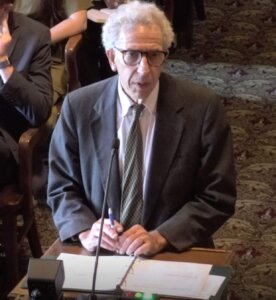
Four attorneys have resigned from the ACLU of Indiana amid concerns over the incoming executive director’s approach to free speech and allegations of antisemitism.
Legal director Kenneth Falk, a prominent Jewish civil rights lawyer who has twice argued before the U.S. Supreme Court, along with deputy legal director Gavin Rose, senior staff attorney Stevie Pactor and staff attorney Josh Bleisch, all resigned in recent weeks, the ACLU of Indiana’s board confirmed in a statement to the Forward. Their resignations were first reported by the Indy Star.
The concerns center on Nikkita Oliver, a lawyer and longtime Seattle activist who was announced in June as the next executive director of the ACLU of Indiana.
Oliver, who posted a Palestinian flag on Instagram about two weeks after Oct. 7, 2023, alongside quotes about oppressed peoples’ “right to resist,” made comments during a July meeting that a former staff member interpreted as questioning Jewish attorneys’ ability to represent pro-Palestinian activists fairly.
Oliver, who uses they/them pronouns, also said they objected to the ACLU’s landmark legal defense of neo-Nazis’ right to march in Skokie, Illinois in 1977, which raised questions for some former staff about whether Oliver was committed to defending free speech irrespective of ideology.
Oliver’s original start date of Sept. 1 has been pushed back as the ACLU of Indiana conducts a third-party investigation “to establish the facts.”
“It is distressing that a small group of staff who have, at most, interacted with me once seem to have generated these rumors and false allegations,” Oliver wrote in a statement to the Forward, adding that they “welcome a fair, third-party review.”
A disputed meeting
The wave of resignations followed a July “get to know you” coffee conversation between Oliver and Neil Hudelson, ACLU of Indiana’s director of philanthropy at the time.
Hudelson told the Forward that during that meeting, Oliver brought up a 2016 free speech case involving pro-Palestinian student activists at Indiana University, which the ACLU had declined to take. Two community members had reached out about the case after their hiring was announced, Oliver said.
Hudelson said he was unfamiliar with the case, or why the ACLU might have decided not to pursue it, and asked Oliver for details, which Oliver said they didn’t know. Hudelson then recalled explaining to Oliver that the ACLU of Indiana has repeatedly defended pro-Palestinian activists’ right to free speech.
Where the conversation took a turn, according to Hudelson, was when Oliver said three times that it was “very interesting” that the ACLU had declined to take the case.
The two parties’ interpretations of the interaction differ.
Hudelson’s interpretation was that Oliver viewed the organization’s Jewish attorneys, who had vigorously defended pro-Palestinian activists’ free speech rights, as biased against Palestinians.
“It’s not hard to know that 50% of our legal team at the time was Jewish,” Hudelson, who is not Jewish himself, told the Forward. “The fact they kept repeating, just finding it ‘very interesting,’ struck me as antisemitic.”
While Oliver also recalled bringing up the 2016 case, they disputed the idea that it had anything to do with the attorneys’ religious background.
“I am a direct person who says exactly what I mean without hedging,” Oliver said in a written statement documenting their recollection of the meeting. “I did not intend or insinuate anything beyond providing an example of a meritorious case the affiliate did not take.”
Hudelson filed a complaint at the time about the interaction and said he hoped the matter would be resolved with a private investigation.
Tensions flare
Pactor, one of the Jewish attorneys who resigned, told the Forward she had raised concerns about Oliver’s commitment to the ACLU’s nonpartisan mission. (The legal arm of the ACLU must refrain from intervening in political campaigns in order to maintain its 501(c)(3) tax-exempt status.)
Pactor said she filed a complaint expressing concern over a comment Oliver made during a meeting with her in July about wanting to turn Indiana “light red.”
In a statement to the Forward, Oliver said by turning the state “light red,” they meant ensuring equal access to voting, which “naturally shifts the political landscape away from an exclusive focus on a single party.” (Indiana has largely voted for Republicans for president.) Oliver also noted that Pactor was in the running to become executive director but was not selected.
For Pactor, those concerns were compounded by Oliver’s social media history.
Less than two weeks after the Oct. 7 attacks, Oliver posted a Palestinian flag to Instagram and quoted author Arundhati Roy, who said “People have the right to resist annihilation.” Oliver added in the post that Martin Luther King Jr. “began to see the limits of non-violent protest” toward the end of his life.
“I am heartbroken and angry,” Oliver wrote at the time. “If we want the violence to stop, we must stop the root cause. This means ending the occupation of Palestine by Zionist Israel, supporting Palestinian liberation and ending the apartheid state.”
The ACLU of Indiana board defended the post to the Forward as “an intellectual critique of power dynamics, not an incitement of violence.”
After two Israeli embassy staff, Yaron Lichinsky and Sarah Milgrim, were shot and killed outside the Capital Jewish Museum in May 2025, Oliver reposted this message on their Instagram story: “20k children dead: violence is okay. 2 israeli embassy staff members dead: violence is not okay anymore.”
In another post, after the May 2026 shooting at the Islamic Center of San Diego that killed three people, Oliver reshared an image on their Instagram story calling the attack “the direct result of white supremacist, Zionist and anti-Muslim rhetoric being pushed by the state and media.”
Blaming the mosque attack on “Zionist” rhetoric without evidence was concerning, Pactor said, especially since the two teenage gunmen had expressed neo-Nazi views in writings they left behind.
In a statement to the Forward addressing their social media posts, Oliver wrote, “These posts speak to the double standard that can exist in the media when some deaths are deemed tragic, and others are deemed necessary. All life is precious. I understand that, outside of free speech, pro-Palestine advocacy is not within the ACLU of Indiana’s portfolio, and I do not intend to change that.”
On Sept. 27, a group of 79 Jews across the country who identified themselves as “organizers for Palestinian rights” submitted a letter of support for Oliver, writing that they could “attest that Nikkita [Oliver] explicitly and consistently cares about the safety of Jewish people.”
Tensions continued to flare among the ACLU staff, culminating in a Sept. 29 board meeting attended by Hudelson, who said board members said Oliver was the victim of false allegations.
Hudelson said he was fired two days later. The board said it would not comment on the details of personnel matters but noted that one employee was fired “for cause.”
Pactor resigned a few weeks later, on Oct. 19.
The Skokie question
Oliver also brought a perspective to free speech advocacy that appeared to diverge from the ACLU’s longstanding tradition of defending the rights of even the most objectionable speakers.
In 1977, the ACLU famously represented neo-Nazis who wanted to march through Skokie, Illinois, a heavily Jewish suburb of Chicago that has been home to many Holocaust survivors. The neo-Nazis never ended up marching, though they won the legal right to do so in court — with Jewish ACLU attorney David Goldberger arguing on the neo-Nazis’ behalf.
The ACLU’s decision to defend the rights of neo-Nazis was controversial; at the time, many Jewish lawyers resigned in protest. But it also helped establish the organization’s credibility as a group committed to the principle of free speech for all.
The ACLU has repeatedly reaffirmed its decision in the Skokie case. Today, the ACLU website notes that many consider the Skokie case “one of the ACLU’s finest hours.”
Oliver told Hudelson during their July meeting that they disagreed with how the ACLU handled the case.
“If I had been the head of the ACLU during Skokie, I would have found a different approach through integrated advocacy — such as submitting an amicus brief on the First Amendment — that protected the free speech of all without subjecting a Jewish community to potential harm,” Oliver wrote in their account of the meeting with Hudelson.

That approach conflicts with the way the ACLU has historically operated. Falk, who had served as legal director at the Indiana ACLU since 1996 before resigning, is among those Jewish free speech lawyers who have represented clients many find unsavory. He has argued on behalf of the Ku Klux Klan on multiple occasions, including when the hate group wanted to host a rally at the Gary, Indiana City Hall.
“If we don’t stand up for the rights of everyone, even people we don’t necessarily personally agree with, all of our rights are diminished,” Falk told The Indiana Lawyer in May. (The Forward was unable to reach Falk for comment.)
Hudelson and Pactor both told the Forward they were concerned by Oliver’s approach.
“Ken was always saying, ‘You don’t know what it’s like until your rabbi has to ask you why you have the Grand Wizard of the KKK in your office,’” Hudelson said. “But that’s what we do. We’re the ACLU.”
In a statement, the board said the ACLU of Indiana was not changing its approach to free speech litigation.
“I understand that under the law hate speech is free speech, and I believe in the ACLU’s mandate to protect all people’s civil liberties and civil rights,” Oliver wrote in a statement to the Forward. “I am aware of the ACLU’s stance and understand the difference between the affiliate’s work and my own frameworks and political leanings.”
The third-party investigation is set to be completed in November.
The post Top Jewish lawyers quit Indiana ACLU amid controversy over new director appeared first on The Forward.
Uncategorized
Arab parties are kingmakers, but will Israel’s Jewish leaders accept them?
(JTA) — JERUSALEM – Less than an hour after election night exit polls were published, Mansour Abbas, the leader of the Islamist Ra’am party, whose representation was predicted to almost double, declared: “We will translate this electoral power into an influential political force … we’re here — not on the sidelines.”
With all the votes now counted, Ra’am has indeed grown from five to eight seats, while the other Arab party, the Joint List, has received 11. Their combined unprecedented 19 seats out of a total of 120 in Israel’s parliament, the Knesset, now make the Arab parties a powerful force and one that could potentially break the political deadlock after neither the bloc led by Prime Minister Benjamin Netanyahu nor the opposition bloc led by Gadi Eisenkot have enough seats to form a governing coalition.
A record number of Arab-Israelis voted in last Tuesday’s election, signaling for the first time in Israel’s history that the country’s Arab public, which makes up around 21% of the general population, is demanding to be counted in Israel’s political process.
The question, now, is whether Israel’s Jewish political leaders — and the public they represent — are ready to accept them as legitimate partners in governing the country.
“The Arab parties managed to produce an historic turnout in the Arab community, a reflection of this population joining Israeli democracy and the democratic process, and their desire to see their issues being taken care of by the Israeli government and political system,” Yohanan Plesner, president of the Israel Democracy Institute, told the Jewish Telegraphic Agency.
“But while they performed phenomenally and beyond any expectation, it’s still too early to tell whether the massive expectations that led Israeli Arab voters to the streets will actually be met by a political system willing to respond to this desire,” he said.
The record voter turnout among Arab-Israeli citizens breaks with a decades-old tradition of shunning Israel’s political institutions in protest over the conflict with the Palestinians – many themselves identify as Palestinian citizens of Israel – and a feeling that whoever is in power will not truly address their needs.
After four years of a government dominated by far-right Israeli nationalists, however, Arab voters felt they had no choice but to step up, analysts told JTA. It was not only the inflammatory rhetoric and attacks on the Arab community by senior government ministers that drove up turnout to some 80% – compared to only 53.2% in the last election in 2022 – but also the outgoing government’s policies.
Minister of National Security Itamar Ben-Gvir, who prior to his political career was convicted for incitement to racism, has overseen mass demolitions of illegally built homes, especially in the Bedouin towns in Israel’s Negev region, and failed to address soaring crime rates in Arab towns.
Finance Minister Bezalel Smotrich has threatened to force the Arab population in Israel out of the land, outlining in September a plan to Judaize Arab-majority areas in Israel’s periphery. In one recent case, he even backed young Israeli Jews who set up an illegal outpost inside an Israeli-Arab town.
It is such moves, as well as multiple statements casting suspicion on Israel’s Arab sector, especially following Hamas’s Oct. 7, 2023, massacre in southern Israel, that ultimately pushed the community to vote en masse, according to experts on the Arab community. Many cast ballots for the first time.
“It was an existential fear,” said Michael Milshtein, head of the Palestinian Studies Forum at the Moshe Dayan Center at Tel Aviv University, who has researched political trends in Israel’s Arab community for years.
He pointed to a poll published following the election by Arabic-language newspaper Kul al-Arab showing that nearly 92% of Arab voters said that the main thing driving them out to vote was the fear of Smotrich and Ben-Gvir.
“It’s an almost unprecedented motivation,” he said. “But it can also be a formula for a cascade of expectations.”
Among those expectations now is that Israel’s majority Jewish parties that have promised change in the country – and promised to oust Netanyahu and his far-right partners – will include Arab parties or at least make use of this electoral momentum.
The political party Ra’am, which has roots in the Muslim Brotherhood, has already shown a willingness to join the government. The party, which focuses on social welfare issues and fighting crime, already broke down barriers in 2021 by joining former prime ministers Naftali Bennett and Yair Lapid in a government that briefly ousted Netanyahu.
For the Joint List, an alliance of three majority Arab parties focusing on socialist politics, civic equality for Arab citizens of Israel and Palestinian nationalism, joining an Israeli government or even providing it with a safety net from the outside is a big step.
All three parties – Hadash, a left-wing socialist party, Ta’al, a party promoting Arab civic rights and equality, and Balad, which represents pan-Arab nationalism – hold at their core the fight for Palestinian rights and national statehood.
Yet at least two of the parties, Hadash and Ta’al, have indicated a willingness to put some of their agenda aside in order to help change Israel’s current leadership.
“We are ready for political cooperation to form an alternative government that will present a genuine alternative and commit to a fundamental change in the current government’s racist policies,” Yousef Jabareen, head of the Joint List, said as votes were being counted on Thursday. “A government that will work to recognize the rights of the Arab public and end its exclusion, and that of its representatives, from the political system.”
However, Gadi Taub, a professor at Hebrew University of Jerusalem and co-host of the Israel Update podcast, called including such parties in Israel’s government “ridiculous.”
“These parties are anti-Zionist, they are against the very existence of Israel and some of them are direct terror supporters,” he said, referring to statements made by Balad’s leader Sami Abu Shehade after Oct. 7, which he later walked back.
“None of them will designate Hamas as a terror organization, even after Oct. 7,” noted Taub, adding that Israeli law should forbid parties that are openly against a Jewish state from running for parliament.
He pointed out that attempts to ban the Arab parties from running in this election were ultimately blocked by Israel’s Supreme Court, although Shehade did withdraw from the race. No other country would tolerate political leaders that “do not acknowledge the self-determination” of the country they live in, said Taub.
Including Arab parties in a government is something that was not even considered by Jewish or Zionist-focused parties until the offer came from Ra’am in 2021. In fact, there have only ever been two Muslim Arab ministers, Ghaleb Majadele, a member of the Labor Party, who served under former prime minister Ehud Olmert and Issawi Frej, from the Meretz Party who served from June 2021 to December 2022.
Three years after Oct. 7, when fear and mistrust of Arabs because of the attack remain high, the idea of aligning politically with Arab politicians who openly advocate for Palestinians is even more complex.
While Netanyahu and his coalition partners painted such a collaboration as an existential threat for the state in the lead-up to last week’s vote, almost all the parties in Eisenkot’s bloc, except for the Democrats headed by Yair Golan, also ruled out the possibility.
Mairav Zonszein, a senior Israel analyst with the International Crisis Group, said it was difficult to evaluate whether Israeli society as a whole was now ready for such political influence from Arab Israelis, but said the more pertinent question was whether Eisenkot and his political partners, Naftali Bennett and Avigdor Lieberman, were ready for it.
“This is pretty much their only option if they want to get rid of Benjamin Netanyahu,” she said. “The main question is how important it is for them to remove Netanyahu that they would be willing to compromise on something that they made a frontline issue?”
Zonszein added that even center-left former prime minister Yair Lapid, whom she characterized as pragmatic in every other way in his efforts to oust Netanyahu, has stated that he would not work with the Arabs.
She called lumping the entire sector together “outrageous.”
“It really defies the very notion of a democracy,” Zonszein said, accusing Netanyahu of dismissing “Palestinians just for being Palestinians, regardless of the fact that they are law-abiding citizens, that they pay taxes and are present in all aspects of the workforce.”
Throughout Election Day, the embattled Netanyahu published a stream of video clips declaring that Arabs were “flocking” to the polls. He told his supporters that if they did not want an Islamist state in Israel, then they’d better get out and vote for him.
Analysis by some fact-checkers has since revealed that many of the images Netanyahu used to scare his voters were in fact AI-generated fakes.
Tani Frank, director of the Shalom Hartman Institute’s Center for Judaism and State Policy, argued that the delegitimization of the Arab vote was one of the “focal points of the Likud campaign.”
“One reason for this is to weaken the ability of the change bloc to form a government with the support of, or reliance on, the Arab parties — specifically Ra’am and Mansour Abbas, who has already done so previously,” he said.
Frank said he believed that the willingness of Jewish Israelis to accept cooperation with Arab parties, especially after Oct. 7 and the Likud campaign, was extremely limited.
A few days before the election, a snap poll conducted by the Israel Democracy Institute found that “a clear majority of Israeli Jews opposed either Arab party playing a role in any government.”
While a majority of those on the left said that they would support a coalition of center and left-wing parties with the support or participation of the Arab parties, those in the center and right preferred another round of voting rather than forming a coalition with them.
Since the election, Netanyahu and his supporters have tried to cast doubt on the mass Arab turnout and on the legitimacy of the Arab political leadership. This has included accusations by members of his Likud party of voter fraud and foreign interference from Qatar, followed by statements Thursday from the Central Elections Committee that it was investigating foreign funding irregularities.
Netanyahu wrote in a post on X: “The elections in the State of Israel were stolen by Arab parties that support terrorism and the elimination of the Jewish state, through serious criminal offences involving bribery, threats, violence, forgery and the use of prohibited software to mobilize voters.”
Supreme Court Justice Noam Sohlberg, head of the elections committee, said on Sunday at a press conference with the country’s attorney general and the director of the Israel Security Agency, the Shin Bet, that the investigation into alleged foreign funding was serious and ongoing but would not change the results.
“Our position is that even if the suspicions are substantiated, this would not undermine the integrity of the electoral process or the election results as a whole,” he said.
On Saturday night, protests were held by both those against allowing Arabs into the government and those who believe it is the only way forward. A small group of those who are against such a move gathered in Tel Aviv chanting that Israel must not allow “terror supporters into the government.” Much larger groups of protesters in favor of a collaboration gathered around the country urging Eisenkot to take the step.
Mohamed Darawshe, a political analyst and director of strategy at Givat Haviva, a leading center educating for a shared society in Israel, said that if after the massive turnout on Election Day the Arab parties were not included in a change government, there would be great “disappointment.”
“If they are blocked from the right wing, that is understandable. But if their natural partners in Jewish society block them, they will end up turning their back on the whole political scene,” he said.
Darawshe said such a scenario would make Arab society unlikely to participate in such numbers in future elections.
“It will be like a vote of no confidence in the Israeli political system and complete disbelief in the promise that Israel can offer political equality as promised in the Declaration of Independence,” he said.
Political equality, Darawshe pointed out, is “not just allowing Arab citizens to exercise their equal rights on the day of the elections, but also to exercise their rights the day after the election, meaning allowing them to be part of the coalition and not to create a glass ceiling at representation in parliament.”
This article originally appeared on JTA.org.
The post Arab parties are kingmakers, but will Israel’s Jewish leaders accept them? appeared first on The Forward.
