



Uncategorized
Two Argentine Jewish Tourists Assaulted in Milan as Antisemitic Incidents Surge Across Italy

A protester uses a pole to break a window at Milano Centrale railway station, during a demonstration that is part of a nationwide “Let’s Block Everything” protest in solidarity with Gaza, with activists also calling for a halt to arms shipments to Israel, in Milan, Italy, Sept. 22, 2025. Photo: REUTERS/Claudia Greco
Two young Argentine Jewish tourists were violently assaulted in Milan by a group of North African migrants after being targeted for wearing kippahs, in one of the latest antisemitic attacks amid a relentlessly hostile climate toward Jewish communities across Europe.
According to Italian media reports, the two 19-year-old Argentine tourists were attacked late Sunday night outside a 24-hour supermarket in Milan, a city in the northern part of the country, at Piazzale Siena after leaving the store when a group of about 10 people approached them.
After spotting the kippahs worn by the two young men, the attackers began shouting antisemitic insults, including “f**king Jews,” before violently assaulting them, leaving one of the victims with a broken nose.
Authorities and emergency responders were quickly dispatched to the scene following the attack, with police and paramedics providing assistance before transporting the two victims to a local hospital.
Local law enforcement has now opened a criminal investigation into the assault, reviewing surveillance camera footage and analyzing cell phone data from areas surrounding Piazzale Siena.
The European Jewish Congress (EJC) strongly condemned the incident, describing it as a sign of rising antisemitic hostility and calling for renewed efforts to safeguard Jewish communities across Europe.
“This disturbing incident highlights the very real dangers Jews continue to face in public spaces across Europe simply for expressing their identity. Antisemitic violence must be confronted with the utmost seriousness,” EJC said in a statement.
“Authorities must ensure that those responsible are swiftly identified and brought to justice. No one in Europe should fear being attacked for being visibly Jewish,” it continued.
Two young Jewish tourists from Argentina were violently assaulted outside a supermarket in Milan after being identified as Jewish by their kippahs.
The attackers first hurled antisemitic insults before punching the victims, leaving one with a broken nose.
This disturbing… pic.twitter.com/Ch0IzlgWt4
— European Jewish Congress (@eurojewcong) March 4, 2026
Amid heightened tensions tied to the recent US-Israeli joint military campaign against Iran, Walker Meghnagi — president of the Jewish community of Milan — called on authorities to strengthen protection for Jewish schools and synagogues.
“We must remain vigilant. We have asked the prefect to increase surveillance around our schools and places of worship, as well as to safeguard our freedoms, but we cannot isolate ourselves,” he said.
“We are Italians and deserve to be respected as such. We are a free people, and we will not hide — we must stand firm in defense of our freedom,” Meghnagi continued.
Like most countries across Europe and the broader Western world, Italy has seen a rise in antisemitic incidents over the last two years, in the wake of the Hamas-led invasion of and massacre across southern Israel on Oct. 7, 2023.
According to newly published figures, antisemitism in Italy surged to record levels in 2025, reflecting a broader climate in which Jews and Israelis across Europe have faced harassment, vandalism, and targeted violence.
In Italy, the Milan-based CDEC Foundation (Center of Contemporary Jewish Documentation) confirmed that antisemitic incidents in the country almost reached four digits for the first time last year.
Of 1,492 reports submitted through official monitoring channels, the CDEC formally classified a record high 963 cases as antisemitic, according to the EJC and Union of Italian Jewish Communities (UCEI), the main representative body of Jews in Italy.
By comparison, there were 877 recorded incidents in 2024, preceded by 453 such outrages in 2023 and just 241 in 2022.
Uncategorized
Iran Hits Ships and UAE Oil Port in Show of Force After Trump Orders Navy to Open Strait
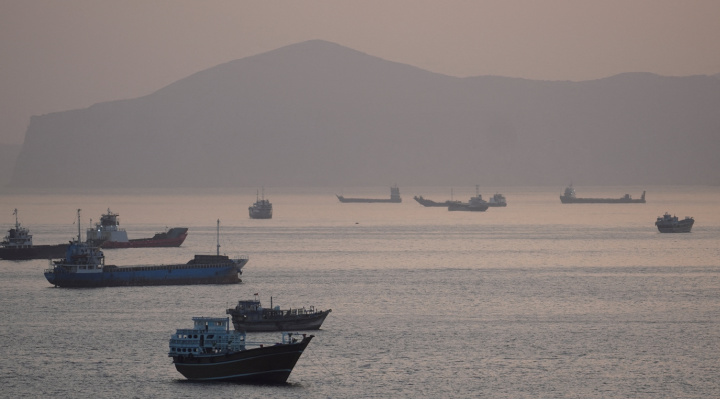
Ships and boats in the Strait of Hormuz, Musandam, Oman, May 1, 2026. Photo: REUTERS/Stringer TPX IMAGES OF THE DAY
Iran hit several ships in the Strait of Hormuz on Monday and set a UAE oil port ablaze, following President Donald Trump‘s announcement that he will use the US Navy to free up shipping.
The Iranian attacks marked the war’s biggest escalation since a ceasefire was declared four weeks ago.
Trump‘s new mission “Project Freedom,” which he announced on social media overnight to release ships stuck in the strait, was the first apparent attempt to make use of naval power to unblock the world’s most important energy shipping route.
But at least in the initial hours on Monday, the effort brought no surge of merchant shipping through the strait while provoking a show of force from Iran, which had long threatened to respond to any escalation with new attacks on its neighbors.
The US military said two US merchant ships had made it through the strait, without saying when. Iran denied any such crossings had taken place.
The commander of US forces in the region said his fleet had destroyed six small Iranian boats, which Iran also denied. Admiral Brad Cooper said he “strongly advised” Iranian forces to keep clear of US military assets carrying out the mission.
Iranian authorities, for their part, released a map of what they said was an expanded sea area now under their control, which went far beyond the strait to include swathes of international waters, including long stretches of the United Arab Emirates’ coastline on either side of the strait.
South Korea reported one of its merchant ships had been hit by an explosion and fire inside the strait. The British maritime security agency UKMTO reported two ships had been hit off the coast of the UAE, and the Emirati oil company ADNOC said one of its empty oil tankers was hit by Iranian drones while trying to cross.
“Iran has taken some shots at unrelated Nations with respect to the Ship Movement, PROJECT FREEDOM, including a South Korean Cargo Ship. Perhaps it’s time for South Korea to come and join the mission!” Trump posted on social media on Monday.
After reported drone and missile attacks inside the UAE throughout the day, including one that caused a fire at an important oil port, the UAE said Iranian attacks marked a serious escalation and it reserved the right to respond.
STRAIT STILL BLOCKED
Trump has struggled to find a solution to the disruption of international energy supplies caused by Iran‘s blockade of the strait, which carried a fifth of global oil and liquefied natural gas before the war.
In the more than two months since Trump launched an air war against Iran alongside Israel, Tehran has largely blocked the strait to ships apart from its own. Since last month, the United States has imposed its own blockade of ships leaving and entering Iranian ports, further crippling Iran’s already ailing economy.
The warring sides issued contradictory statements on Monday about the initial impact of the new US mission, and Reuters could not independently verify the full situation there.
But there was no immediate sign that large numbers of merchant ships were making new attempts to cross, and major shipping companies said they were likely to wait for an agreed end to hostilities before trying to sail through.
REVOLUTIONARY GUARDS SAY NO TRANSITS TOOK PLACE
In a post on X, US Central Command said some of its Navy guided-missile destroyers were inside the Gulf supporting the operation, and that two US-flagged merchant vessels had crossed the strait “and are safely headed on their journey.”
It did not identify either the warships or the merchant vessels or say when any of those crossings had taken place.
Iran‘s Revolutionary Guards said no commercial vessels had crossed the strait in the past few hours, and that US claims to the contrary were false.
Earlier, Iran said it had fired on a US warship approaching the strait, forcing it to turn around. An initial Iranian report had said a US warship was struck, but Washington denied this and Iranian officials later described the fire as warning shots.
South Korea’s Foreign Ministry said there was a fire and an explosion onboard the Namu, a merchant ship operated by South Korean shipper HMM. Yonhap news agency reported that the government was checking intelligence indicating the vessel may have been attacked.
The UAE, meanwhile, reported a fire at an oil installation in its port of Fujairah following an Iranian drone attack. Fujairah lies beyond the strait, making it one of the few export routes for Middle East oil that does not require passing through it.
SHIPPING INDUSTRY AWAITS CLARITY ON SAFETY
Oil prices jumped more than 5% in volatile trade as news of the increased Iranian attacks emerged.
In his social media post announcing the new mission, Trump gave few details of what action the US Navy would take to get ships through the strait.
“We have told these Countries that we will guide their Ships safely out of these restricted Waterways, so that they can freely and ably get on with their business,” Trump wrote.
In response, Iran‘s unified command told commercial ships and oil tankers:
“We have repeatedly said the security of the Strait of Hormuz is in our hands and that the safe passage of vessels needs to be coordinated with the armed forces … We warn that any foreign armed forces, especially the aggressive US Army, will be attacked if they intend to approach and enter the Strait of Hormuz.”
The United States and Israel suspended their bombing campaign against Iran four weeks ago, and US and Iranian officials held one round of face-to-face talks. But attempts to set up further meetings have failed.
Iranian state media said on Sunday that Washington had conveyed its response to a 14-point Iranian proposal via Pakistan, and that Tehran was now reviewing it. Neither side gave details of any US response.
The Iranian proposal would postpone discussion of Iran‘s nuclear program until after an agreement to end the war and resolve the standoff over shipping. Trump said over the weekend he was still studying it but would probably reject it.
Uncategorized
Australia Begins Hearings Into Bondi Beach Attack and Rising Antisemitism

Rabbi Levi Wolff lights a menorah at Bondi Pavilion to honor the victims of a shooting during a Jewish holiday celebration at Bondi Beach, in Sydney, Australia, Dec. 15, 2025. Photo: REUTERS/Hollie Adams
Australia began public hearings on Monday in an inquiry into the Bondi Beach mass shooting in December, with Jewish Australians giving evidence of their experience of rising domestic antisemitism.
The attack on a Jewish Hanukkah celebration killed 15, fueling calls for tougher gun controls and more action to tackle hatred toward Jews, following a spate of antisemitic incidents.
The first block of public hearings will investigate the nature and prevalence of antisemitism, said Virginia Bell, the retired judge leading the wide-ranging national inquiry known as a Royal Commission.
“The sharp spike in antisemitism that we’ve witnessed in Australia has been mirrored in other Western countries and seems clearly linked to events in the Middle East,” Bell said.
“It’s important that people understand how quickly those events can prompt ugly displays of hostility toward Jewish Australians simply because they’re Jews.”
‘WE DON’T FEEL SAFE HERE’
Witnesses from the Jewish community told the inquiry they felt increasingly unsafe amid rising hostility since the October 2023 start of the war in Gaza.
“What is happening in Australia today is not a faint echo of a distant past,” said Peter Halasz, an 86-year-old Holocaust survivor who fled to Australia from Hungary.
“For those of us who lived through the 1930s and 1940s, it is something we recognize, and that recognition is frightening and cause for alarm.”
Sheina Gutnick, who lost her father Reuven Morrison in the Bondi attack, said antisemitism had damaged her family’s sense of safety and freedom of movement.
“As a mother, I’m constantly weighing up the risk of exposing my children to environments where they may be witness, or subject, to antisemitism,” she told the panel.
She recounted an incident in which a stranger at a shopping center called her an “effing terrorist” for wearing a Star of David necklace.
Another witness said her family was relocating to Israel because of safety concerns.
“We never expected synagogues to be burned down,” said the woman, who used the pseudonym “AAM.” “We never expected Jews to be hunted on Bondi Beach.
“My family and I no longer want to live in Australia. We don’t feel safe here. We don’t feel welcome.”
JEWISH SCHOOL LOOKS ‘MORE LIKE A PRISON’
Stefanie Schwartz, the president of Sydney Jewish primary school Mount Sinai College, spoke of holding drills to prepare young students to deal with terrorist attacks, and requiring an “extreme” security presence on campus.
“You walk past our school, and it looks a lot more like a prison than a primary school.”
Antisemitism has “run riot,” with Jewish Australians being held responsible for the actions of the Israeli government, said Benjamin Elton, the chief minister of the Great Synagogue in Sydney.
The inquiry released an interim report of 14 recommendations last Thursday, urging greater security for Jewish public events and further counterterrorism and gun reforms.
A second block of hearings later in May will focus on the circumstances leading up to the Bondi Beach attack and issues raised in the interim report.
The commission is due to deliver its final report on Dec. 14, exactly a year after the attack.
Uncategorized
This graphic novel illustrates the story of America’s first Jewish congregation — pirates and all
Graphic novelist Julian Voloj was walking through Manhattan’s Chinatown when he stumbled across the cemetery of the United States’ oldest Jewish community, Shearith Israel. This inspired him to write Remnants, an interpretation of the story of 23 Jews from Brazil who established North America’s first congregation.
When people think about Jewish immigration to New York, it usually brings to mind the waves of Eastern and Central European Jewish migrants in the early 20th century. But Remnants sheds light on the Sephardic immigration that introduced Judaism to the Americas far earlier.
These Jews were originally from the Iberian Peninsula and had fled to the Netherlands during the Portuguese and Spanish Inquisitions that lasted from around the middle of the 15th century to the 19th century. When the Dutch began occupying Recife, Brazil in 1630, several Jews immigrated to the new South American colony and founded the first synagogue in the Americas, Kahal Zur Israel. Through the eyes of a young girl, Remnants recounts how they had to flee for their lives again in 1654, when Recife was seized by the Portuguese, who banished all Jewish and Dutch settlers. This group of Jews eventually arrived in New Amsterdam, now known as New York.
Voloj is used to challenging assumptions about the homogeneity of Jewish identity in his work. His graphic novel Ghetto Brother told the story of a Puerto-Rican gang member living in the Bronx who finds out later in life that he comes from a family of crypto-Jews. Recently, Voloj co-created the graphic novel Hyphen: Jewish Stories in Our Own Words, which features a dozen personal stories from Jews from across the globe. In Remnants, vibrantly illustrated by Brazilian comic book creator Andre Diniz, Voloj turns his attention to the diversity of American Jewish history.
Voloj weaves together multiple Jewish stories in Remnants. The young female narrator is a fictionalized daughter of Asser Levy (stylized in Remnants as Asher Levy), America’s first kosher butcher and an early advocate for Jewish civil liberties. (Although Levy was one of the first Jews to arrive in New Amsterdam, there are differing accounts of what ship he arrived on and it is unknown if he was on the ship with the group from Recife.) He was originally from Vilna, then part of the Polish-Lithuanian Commonwealth. Asser Levy Place, a section of Avenue A in Manhattan that spans 23rd to 25th Street, and the Asser Levy Recreation Center are both named for him.
Jacob Barsimon, another Jew who arrived in New Amsterdam a month before the group from Recife, also features prominently. In Remnants, he serves as the main advocate for the newly arrived Jews after they are jailed for allegedly not paying the ship that brought them to New Amsterdam. This is a slight historical liberty — it’s not known if Barsimon was directly involved with freeing the Jews from prison. But he did partner with Levy to abolish the ban on Jews serving in the military and the exemption tax imposed on them. Though their petition was refused, Levy later successfully petitioned the government of Holland as an individual and was allowed to serve as a soldier. Barsimon and other Jews later successfully appealed to Holland to overrule Governor Peter Stuyvesant’s discriminatory practices against the Jewish people.
It’s not just bigotry that puts the Jews in Remnants in danger; during their migration out of Recife, they face terror on the open waters when their ship is seized by pirates. The scene is inspired by a historical report from a Venetian rabbi, Saul Levi Morteira, although historians have debated whether or not these captured Jews were the same ones who arrived in New Amsterdam. If what Morteira wrote is accurate, the Jewish hostages were eventually saved by the French. However, in Remnants, the Jews find salvation in a different, unexpected source — another piece of Jewish history that Voloj has woven into the tale. But no spoilers.
Although it’s a complex history, Voloj and Diniz’s illustrative approach helps make the story of America’s first Jewish congregation accessible to readers of all ages. Through the optimistic perspective of Levy’s daughter, the story of Recife’s Jews is not solely about the tragedies of exile and discrimination, but a tale of strength, resilience and the occasional miracle. Although Voloj takes some liberties to bring the different historical narratives into one storyline, Remnants provides a well-timed look into America’s Jewish history. As the American semiquincentennial approaches, Jewish institutions across the country are creating programming about the stories of Jews in America. Remnants takes readers back to the colorful beginning.
The post This graphic novel illustrates the story of America’s first Jewish congregation — pirates and all appeared first on The Forward.