



Uncategorized
New York Judge Overturns Disciplinary Sanctions for Columbia University Students Who Occupied Hamilton Hall

Protesters gather at the gates of Columbia University, in support of student protesters who barricaded themselves in Hamilton Hall, in New York City, US, April 30, 2024. Photo: REUTERS/David Dee Delgado
A New York state judge has overturn disciplinary sanctions imposed on a group of anti-Israel protesters who illegally occupied Columbia University’s Hamilton Hall and interned janitorial staff while destroying property to protest the Israel-Hamas war, raising concerns that colleges may be deprived of the power to punish severe misconduct perpetrated by students who claim to be advancing progressive causes.
Twenty-two current and former students, all of whom contested their punishments anonymously, may soon walk away without being held accountable following Judge Gerald Lebovits’s ruling last Friday that Columbia’s actions were “arbitrary and capricious.” Lebovits went further, citing the students’ concealment of their identities with masks and keffiyeh scarves as evidence that the university lacked evidence to determine that they were actually in Hamilton Hall despite that they had been arrested on the scene by the New York City Police Department (NYPD).
“In the disciplinary proceedings against the 22 Columbia students, the sole evidence that they were present in Hamilton Hall during its occupation was a report reflecting that petitioners had been arrested,” he wrote. “No evidence was offered in the disciplinary proceedings of actions taken inside Hamilton Hall by any particular student, as opposed to the conduct of the group of occupiers as a whole.”
Lebovits, after arguing that the group should not be disciplined even as he described their infractions, then argued that illegally occupying Hamilton Hall is “decades-long tradition.”
He continued, “Others might see the occupiers’ actions as manifestations of an ugly hatred against Jews, using rhetoric about Gaza mainly as a pretext. But the task for this court is not to decide between these perspectives, or to opine on the moral or political issues implicated by the actions of the parties to this proceeding.”
In a statement shared with The Algemeiner on Wednesday, Columbia University noted that Lebovits’s vacating the disciplinary sanctions does not take effect for 30 days, during which time university lawyers may pursue other legal avenues.
“The order does not take effect for at least 30 days, and no student who was disciplined for the occupation of Hamilton Hall can return to campus at this time,” a university spokesperson said. “Columbia is considering all of its options, including seeking a stay of the order and appealing the decision.”
As previously reported by The Algemeiner, in April 2024, anti-Israel agitators occupied Hamilton Hall, forcing then-university president Minouche Shafik to call on the NYPD for help, a decision she hesitated to make. During a search of the scene, the NYPD found a number of disturbing items, including “gas masks, ear plugs, helmets, goggles, tape, hammers, knives, ropes, and a book on TERRORISM [sic].” Police also found signs which said “death to America” and “death to Israel.”
During the same period, a group that calls itself “Columbia University Apartheid Divest” (CUAD) commandeered a section of campus and, after declaring it a “liberated zone,” lit flares and chanted pro-Hamas and anti-American slogans, according to numerous reports. When the NYPD arrived to disperse the unauthorized gathering, hundreds of students reportedly amassed around them to prevent the restoration of order.
“Yes, we’re all Hamas, pig!” one protester was filmed screaming during the fracas, which saw some verbal skirmishes between pro-Zionist and anti-Zionist partisans. “Long live Hamas!” said others who filmed themselves dancing and praising the al-Qassam Brigades, the armed wing of the Palestinian terrorist organization.
Beyond the occupation of school property, Columbia has produced some of the most indelible examples of antisemitism, pro-jihadist sentiment, and extreme anti-Zionism in American higher education since the start of the Gaza war in October 2023. Such incidents include a student who proclaimed that Zionist Jews deserve to be murdered and are lucky he is not doing so himself and administrative officials who, outraged at the notion that Jews organized to resist anti-Zionism, participated in a group chat in which each member took turns sharing antisemitic tropes that described Jews as privileged and grafting.
In July, interim then-university president Claire Shipman said the institution would hire new coordinators to oversee antisemitism complaints alleging civil rights violations; facilitate “deeper education on antisemitism” by creating new training programs for students, faculty, and staff; and adopt the International Holocaust Remembrance Alliance (IHRA) definition of antisemitism — a tool that advocates say is necessary for identifying what constitutes antisemitic conduct and speech.
Shipman also announced new partnerships with the Anti-Defamation League (ADL) and other Jewish groups while delivering a major blow to the anti-Zionist movement on campus by vowing never to “recognize or meet with” the infamous organization CUAD, which had serially disrupted academic life with a number of other unauthorized, surprise demonstrations attended by non-students.
However, Columbia University has retained a professor, Joseph Massad, who celebrated Hamas’s Oct. 7, 2023, massacre across southern Israel — where the Palestinian terrorist group sexually assaulted women and men, kidnapped the elderly, and murdered children in their beds — allowing him to teach a course on the history of the Israeli-Palestinian conflict.
Speaking to The Algemeiner in January, Middle East expert and executive director of Scholars for Peace in the Middle East Asaf Romirowsky said that Massad’s remaining on Columbia’s payroll is indicative of the university’s hesitance to enact meaningful and lasting reforms.
“Joseph Massad is a notorious tenured antisemite who has spent his career at Columbia bashing Israel and Zionism, a poster child for BDS and a scholar propagandist activist. Furthermore, he has shown his true colors time and time again defending Hamas and calling the 10/7 barbaric attack on Israel ‘awesome,’” Romirowsky said.
Noting that Columbia’s own antisemitism task force said in a December report that the institution employs few faculty who hold moderate views on the Israeli-Palestinian conflict, he added, “By allowing Massad to continue teaching and spreading his venom, Columbia is only codifying the dearth of knowledge as it relates to the Middle East. It should take the finding of the report and act upon it by getting rid of the tenured radicals they allowed to hijack the institution.”
Follow Dion J. Pierre @DionJPierre.
Uncategorized
Progress Without Power: The Limits of the Lebanon Ceasefire
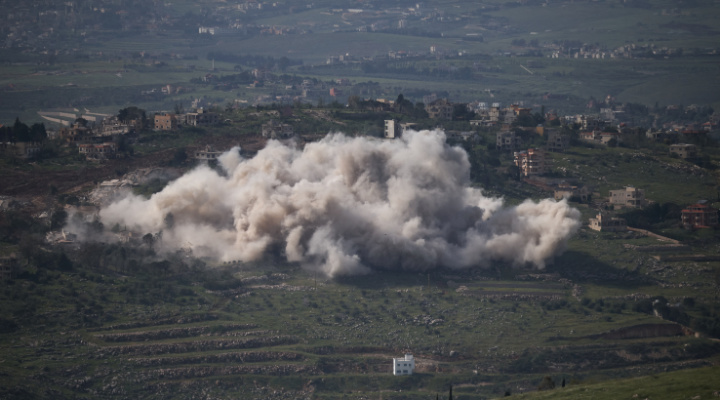
Smoke rises following explosions in southern Lebanon, near the Israel-Lebanon border, as seen from northern Israel, April 27, 2026. Photo: REUTERS/Shir Torem
Last month’s announcement by President Donald Trump of a temporary extension to the Lebanon–Israel ceasefire, amidst ambassador-level Israeli-Lebanese talks in Washington, was greeted, in some quarters, with cautious optimism.
This is understandable.
Lebanon and Israel have been in a technical state of war for decades, with even basic engagement once unthinkable.
What’s more, rhetoric emerging from the Lebanese government of President Joseph Aoun — including unprecedented criticisms of Hezbollah, the heavily armed Iranian terrorist proxy which has dominated Lebanon for decades — provides even more reasons for optimism.
But that optimism collided almost immediately with reality. Soon after the extension was announced, Israeli troops came under attack from a Hezbollah drone strike, leaving six wounded and 19-year-old Sgt. Idan Fooks dead — the third Israeli soldier killed since the ceasefire began in early April.
Israel responded, as it was entitled to under the terms of the ceasefire agreement, with targeted strikes on Hezbollah positions and infrastructure. Retaliatory attacks have since continued.
These events expose the limits of the ceasefire.
The intentions may be honorable, and hopes may be real. But hope is not a strategy. And the situation in Lebanon is such that any positive hopes for an end to the violence cannot be fulfilled while an armed Hezbollah remains a decisive power in Lebanon.
Hezbollah has long operated as a state within a state — exercising power far beyond Lebanon’s elected government. Any agreement struck with Beirut is therefore inherently constrained, because the Lebanese government does not control much of its own territory, and does not currently have the ability to make Hezbollah stop firing at Israel, much less disarm. Indeed, Hezbollah openly says it will not be bound by any deal the Lebanese government makes with Israel.
This reality was laid bare in March, when Lebanon expelled the Iranian ambassador — only for him to simply refuse to leave.
To its credit, for the first time in years, Lebanon has shown signs of recognizing the problem, and trying to actually do something about it. For example, Lebanon has moved to end Hezbollah’s control over Beirut’s airport, taken steps against unauthorized weapons, and President Joseph Aoun has even accused Hezbollah of treason.
Meanwhile, Israeli forces continue to uncover Hezbollah weapons stockpiles — including in children’s rooms and underground bunkers within populated areas in southern Lebanon, which the Lebanese army claimed to have cleared of Hezbollah military bases and activity last year. All of this is in direct violation of the 2006 United Nations Security Council Resolution 1701, which calls for Hezbollah’s disarmament, as well as the ceasefire agreement that ended the Israel-Hezbollah war in 2024, in which Beirut promised to finally fulfill its obligation under 1701.
This is why the current ceasefire does not fully address the real sources of violence and instability, even as too many in the international community continue to confuse ceasefires with peace.
Reports indicate that Hamas is using the ceasefire in Gaza to rebuild capabilities and consolidate control there. Hezbollah has followed a similar pattern. So even if periods of calm emerge, they are unlikely to last long.
There is no question that Iran and its proxies have been weakened by the last two and a half years of war. But ideological regimes do not measure success in conventional terms. They do not concede defeat. And they do not abandon their objectives.
This is why the persistent focus by parts of the international community on ceasefires and “de-escalation” — with the demands directed mainly at Israel — risks overlooking the central challenge.
French President Emmanuel Macron continues to push for de-escalation, urging Israel to withdraw from Lebanese territory and calling for Hezbollah to cease its attacks. He also says Hezbollah must ultimately be disarmed by the Lebanese themselves.
Australian Foreign Minister Penny Wong echoes similar concerns, condemning Hezbollah’s attacks on Israel and calling for an immediate cessation. At the same time, she has condemned in the “strongest terms” Israeli strikes on Lebanon, without fully acknowledging that they have been targeted against Hezbollah infrastructure and operatives. She mentions in passing that Hezbollah should be disarmed.
Yet both leaders failed to address just how Hezbollah can be disarmed — which is the central question. Statements that Hezbollah “should” be disarmed are nothing but empty words.
When dealing with absolutist religious ideologies, diplomacy is not necessarily a strength. It can become a vulnerability — exploited by those who understand that the Western aversion to conflict can itself be weaponized.
The Israel-Lebanon talks are signs of progress. But progress without power is terribly fragile. And as long as Hezbollah remains armed and entrenched, hope is a dangerous strategy.
Justin Amler is a policy analyst at the Australia/Israel & Jewish Affairs Council (AIJAC).
Uncategorized
Israel Must Stop Handing Victories to Its Critics

A general view shows the plenum at the Knesset, Israel’s parliament, in Jerusalem, May 29, 2019. Photo: Reuters / Ronen Zvulun.
Are some of Israel’s own decisions undermining its future?
No one who cares about Israel wants to ask that question. No one who understands Jewish history, regional reality, or the relentless threats Israel faces wants to even entertain it. Yet concern is growing among many who support Israel deeply and sincerely. They are not questioning Israel’s right to exist — but they are questioning if Israel’s actions are harming the Jewish State in the long run.
Let me be clear from the start: Israel has every right to exist. Israel has every right to defend its citizens. Israel has every right to confront terrorism and prevent those who openly seek its destruction from succeeding. In a region where genocidal rhetoric is still common, self defense is not optional. It is essential.
But rights alone do not guarantee wisdom. A nation can be morally justified and strategically misguided at the same time.
Recent events surrounding attempts to breach the Gaza maritime blockade offer a telling example. Many of the activists involved are not neutral humanitarians. Some seek spectacle more than solutions. They understand that confrontation with Israel generates headlines and outrage, and that images travel quickly across the world. Provocation is often the point.
Yet Israel too often responds in ways that hand these provocateurs exactly what they want.
Stopping a vessel at sea may secure an immediate tactical objective. But if the result is another cycle of global accusations, another flood of hostile coverage, and another round of diplomatic damage, then a narrow operational success becomes a strategic failure.
Israel frequently wins the immediate encounter while losing the larger narrative.
That problem extends well beyond maritime incidents.
Many people around the world defend Israel in increasingly hostile environments. Diaspora Jews face intimidation on campuses and in public life. Christian allies speak out despite social pressure. Non-Jewish advocates challenge lies, distortions, and double standards at personal cost. They write, donate, organize, and absorb abuse.
Too many feel taken for granted.
Allies matter. Gratitude matters. Communication matters. Nations under pressure cannot afford to neglect those who stand with them. Support should not be treated as automatic or endless. It must be nurtured.
Another issue that troubles even committed supporters is the use of administrative detention and other extraordinary emergency powers. Israel undeniably faces real security threats. Some dangers cannot be handled through ordinary methods alone. But emergency measures that become routine create a moral and political burden.
When people are held for long periods without normal judicial processes, Israel’s critics seize on every case. More importantly, genuine friends of Israel become uneasy. They ask whether a state founded as a refuge for a persecuted people is drifting from the democratic principles it was meant to embody.
There is also a message for ordinary citizens in Israel — especially those on the far right.
Israel is judged by a harsher standard than most nations. That reality is unfair, often hypocritical, and sometimes openly antisemitic. But it is reality nonetheless. Every act of racist violence, every attack on innocent civilians, every mosque vandalized, every tree burned, every mob chanting hatred, every soldier filmed humiliating noncombatants without cause becomes a global symbol.
One reckless act by one person can damage an entire nation.
Israel does not have the luxury of indiscipline. It is not a quiet country insulated by geography and history. It carries the security of millions of Jews. It carries the memory of exile and extermination. It carries the burden of proving that Jewish sovereignty can be both strong and just.
That requires more than military power. It requires discipline, humility, gratitude, legal integrity, and strategic patience.
Israel’s enemies would love nothing more than to see the Jewish State become isolated, angry, careless, and morally confused. Their greatest victory would not come on the battlefield. It would come if Israel helped destroy its own legitimacy.
The answer, then, is not despair. It is course correction.
Think carefully before reacting. Think strategically before escalating. Think morally before normalizing emergency measures. Think politically before alienating allies.
Israel was built through courage, sacrifice, and vision. It should not be weakened by avoidable mistakes.
The gravest danger to Israel may not come only from those who seek to destroy it from without. It may also come from forgetting how to preserve itself from within.
Sabine Sterk is the CEO of Time To Stand Up For Israel.
Uncategorized
BDS, Pro-Terror, and Anti-Israel Activism Are Still Happening at US Colleges and Universities

A pro-BDS demonstration. Photo: Wikimedia Commons.
Universities remain under pressure from market forces as well as the Trump administration regarding DEI, antisemitism, and funding. Polls also indicate that public trust in higher education continues to decline. The continued closure of smaller institutions such as Hampshire College and the elimination of courses and majors deemed unproductive point to the continuing consolidation of the higher education industrial complex across the US.
Foreign student enrollment has been reduced by US scrutiny of visa applicants, and the administration has proposed steep cuts to US research funding. A new report on academia’s narrowing donor base, where some 2% of donors provided 89% of the $78 billion given in FY 2024-2025, suggests another crisis. Despite these crises, analytical and anecdotal evidence indicate that universities have retained most DEI programs and staff under different labels.
Surprisingly, a report by Yale University faculty attributed plummeting public trust in higher education to institutions themselves, citing rising costs and lowering standards. Harvard president Alan Garber obliquely expanded this critique by noting the combination of student ignorance and arrogance regarding the Arab-Israeli conflict.
Another tacit recognition that protests have damaged both campus safety and public image may be continuing restrictions on student commencement speakers, some of whom particularly in New York City area universities have excoriated Israel and the universities themselves since October 7th.
Amidst these structural changes Jewish students have continued to migrate to southern and southwestern institutions such as Vanderbilt and Clemson which are regarded as safer and more supportive. Active campaigns aimed at Jewish students by other institutions such as American University have touted safety.
Recent studies have suggested that institutions such as Yale and Harvard have deliberately reduced their Jewish populations to post- World War II quota levels as a function of both embracing DEI and globalization. As colleges seek to increase more Arabic and Muslim enrollment, it is undeniably clear that anti-Jewish sentiment has increased on campus. It’s fair to ask questions about whether there is a direct correlation — but critics try to stifle any attempt at an actual conversation or debate with charges of anti-Muslim prejudice.
Finally, reports indicate that the Qatar Foundation has hired two Washington, D.C. public relations firms to provide crisis communications regarding that country’s massive funding to American universities. The move came after a US House committee released emails it had subpoenaed from Northwestern University showing foundation executives consulting university officials regarding PR issues that arose immediately after October 7th.
Faculty misrepresentation of Middle Eastern affairs on campus — and in the press — continues to be a major problem. This was exemplified by an op-ed in The New York Times authored by University of California Berkeley faculty member Ussama Makdisi, in which he attacked Israel over its policy in Lebanon. Makdisi has a long record of troubling anti-Israel hatred. Makdissi’s appointment as the chair of a newly established program in “Palestinian and Arab Studies” at Berkeley institutionalizes and further legitimizes Palestinian grievance and antisemitism.
In a sign of European academic attitudes towards Israel, three Belgian universities conveyed honorary degrees on the deeply antisemitic and relentlessly hostile to Israel United Nations Special Rapporteur for human rights in the Palestinian territories, Francesca Albanese, who remains under US sanctions.
Students for Justice in Palestine (SJP) chapters and their allies continue to disrupt pro-Israel events across the country, including at Ohio State, the University of Connecticut, SUNY Buffalo, Florida State, the University of Minnesota, the University of Oregon, Stanford University, Rutgers University, and the University of Washington. SJP protestors also disrupted a trustees meeting at Bryn Mawr College. A pro-Hamas encampment was also created at Occidental College.
BDS resolutions and referendums continue to be considered by student governments. At Ohio University, a divestment referendum approved by the student government in March was overwhelmingly approved by students. Similar resolutions were passed at Colorado State, the University of Wisconsin, and San Diego State University. New divestment campaigns have also been launched at Rutgers University and other schools.
Student groups continue to showcase actual Palestinian terrorists in events. In one recent case the Berkeley SJP featured Israa Jabaris, convicted of attempting a car bombing outside Jerusalem in 2015. She was released from prison in exchange for Israeli hostages held in Gaza. Jabaris thanked students for their “solidarity.”
In another case at the University of Washington, Students United for Palestinian Equality & Return at UW (SUPER UW) co-hosted a fundraiser to support the “Lebanese resistance.” The university banned the group after a building takeover which caused several million dollars in damage. Reports now indicate the group is under investigation by the Civil Rights Division of the US Department of Justice.
Support for those with terror ties was also expressed by the Georgetown SJP chapter, which held a letter writing campaign for “Palestinian prisoners” including those convicted in the Holy Land Foundation case and other “comrades caged by the US empire” including several convicted of arson and assault.
Student governments also remain in the lead in limiting other Jewish and Israeli events. The appearance of former Gaza hostage Omer Shem Tov at UCLA was condemned by the student government as the “selective platforming of narratives that obscure the broader reality of state violence” which shows a “troubling disregard for Palestinian life and contributes to a campus climate in which Palestinian, Arab, and Muslim students are further marginalized, silenced, and harmed.” The university condemned the statement as did trustee Jay Sures who stated he was “disgusted and appalled” by the decision. Conversely, the student government at Stanford awarded the Muslim Student Union $175,000, more than all Christian groups combined or the marching band.
Finally, the role of teachers unions as key drivers of left wing politics inside and outside of classrooms was highlighted by a report that noted that since 2015 unions have contributed more that $1 billion to political activism and advocacy. Causes include “human rights” — which often means anti-Israel activism.
In a convenient illustration of teachers union attitudes towards Israel, New York City delegates of the United Federation of Teachers approved a resolution condemning Israel and demanding a US arms embargo. The measure will be voted on by members in May.
Alex Joffe is the Editor of SPME’s BDS Monitor and director of Strategic Affairs for the Association for the Study of the Middle East and Africa (ASMEA). A completely different version of this article was originally published by SPME.