



Uncategorized
BDS, Pro-Terror, and Anti-Israel Activism Are Still Happening at US Colleges and Universities

A pro-BDS demonstration. Photo: Wikimedia Commons.
Universities remain under pressure from market forces as well as the Trump administration regarding DEI, antisemitism, and funding. Polls also indicate that public trust in higher education continues to decline. The continued closure of smaller institutions such as Hampshire College and the elimination of courses and majors deemed unproductive point to the continuing consolidation of the higher education industrial complex across the US.
Foreign student enrollment has been reduced by US scrutiny of visa applicants, and the administration has proposed steep cuts to US research funding. A new report on academia’s narrowing donor base, where some 2% of donors provided 89% of the $78 billion given in FY 2024-2025, suggests another crisis. Despite these crises, analytical and anecdotal evidence indicate that universities have retained most DEI programs and staff under different labels.
Surprisingly, a report by Yale University faculty attributed plummeting public trust in higher education to institutions themselves, citing rising costs and lowering standards. Harvard president Alan Garber obliquely expanded this critique by noting the combination of student ignorance and arrogance regarding the Arab-Israeli conflict.
Another tacit recognition that protests have damaged both campus safety and public image may be continuing restrictions on student commencement speakers, some of whom particularly in New York City area universities have excoriated Israel and the universities themselves since October 7th.
Amidst these structural changes Jewish students have continued to migrate to southern and southwestern institutions such as Vanderbilt and Clemson which are regarded as safer and more supportive. Active campaigns aimed at Jewish students by other institutions such as American University have touted safety.
Recent studies have suggested that institutions such as Yale and Harvard have deliberately reduced their Jewish populations to post- World War II quota levels as a function of both embracing DEI and globalization. As colleges seek to increase more Arabic and Muslim enrollment, it is undeniably clear that anti-Jewish sentiment has increased on campus. It’s fair to ask questions about whether there is a direct correlation — but critics try to stifle any attempt at an actual conversation or debate with charges of anti-Muslim prejudice.
Finally, reports indicate that the Qatar Foundation has hired two Washington, D.C. public relations firms to provide crisis communications regarding that country’s massive funding to American universities. The move came after a US House committee released emails it had subpoenaed from Northwestern University showing foundation executives consulting university officials regarding PR issues that arose immediately after October 7th.
Faculty misrepresentation of Middle Eastern affairs on campus — and in the press — continues to be a major problem. This was exemplified by an op-ed in The New York Times authored by University of California Berkeley faculty member Ussama Makdisi, in which he attacked Israel over its policy in Lebanon. Makdisi has a long record of troubling anti-Israel hatred. Makdissi’s appointment as the chair of a newly established program in “Palestinian and Arab Studies” at Berkeley institutionalizes and further legitimizes Palestinian grievance and antisemitism.
In a sign of European academic attitudes towards Israel, three Belgian universities conveyed honorary degrees on the deeply antisemitic and relentlessly hostile to Israel United Nations Special Rapporteur for human rights in the Palestinian territories, Francesca Albanese, who remains under US sanctions.
Students for Justice in Palestine (SJP) chapters and their allies continue to disrupt pro-Israel events across the country, including at Ohio State, the University of Connecticut, SUNY Buffalo, Florida State, the University of Minnesota, the University of Oregon, Stanford University, Rutgers University, and the University of Washington. SJP protestors also disrupted a trustees meeting at Bryn Mawr College. A pro-Hamas encampment was also created at Occidental College.
BDS resolutions and referendums continue to be considered by student governments. At Ohio University, a divestment referendum approved by the student government in March was overwhelmingly approved by students. Similar resolutions were passed at Colorado State, the University of Wisconsin, and San Diego State University. New divestment campaigns have also been launched at Rutgers University and other schools.
Student groups continue to showcase actual Palestinian terrorists in events. In one recent case the Berkeley SJP featured Israa Jabaris, convicted of attempting a car bombing outside Jerusalem in 2015. She was released from prison in exchange for Israeli hostages held in Gaza. Jabaris thanked students for their “solidarity.”
In another case at the University of Washington, Students United for Palestinian Equality & Return at UW (SUPER UW) co-hosted a fundraiser to support the “Lebanese resistance.” The university banned the group after a building takeover which caused several million dollars in damage. Reports now indicate the group is under investigation by the Civil Rights Division of the US Department of Justice.
Support for those with terror ties was also expressed by the Georgetown SJP chapter, which held a letter writing campaign for “Palestinian prisoners” including those convicted in the Holy Land Foundation case and other “comrades caged by the US empire” including several convicted of arson and assault.
Student governments also remain in the lead in limiting other Jewish and Israeli events. The appearance of former Gaza hostage Omer Shem Tov at UCLA was condemned by the student government as the “selective platforming of narratives that obscure the broader reality of state violence” which shows a “troubling disregard for Palestinian life and contributes to a campus climate in which Palestinian, Arab, and Muslim students are further marginalized, silenced, and harmed.” The university condemned the statement as did trustee Jay Sures who stated he was “disgusted and appalled” by the decision. Conversely, the student government at Stanford awarded the Muslim Student Union $175,000, more than all Christian groups combined or the marching band.
Finally, the role of teachers unions as key drivers of left wing politics inside and outside of classrooms was highlighted by a report that noted that since 2015 unions have contributed more that $1 billion to political activism and advocacy. Causes include “human rights” — which often means anti-Israel activism.
In a convenient illustration of teachers union attitudes towards Israel, New York City delegates of the United Federation of Teachers approved a resolution condemning Israel and demanding a US arms embargo. The measure will be voted on by members in May.
Alex Joffe is the Editor of SPME’s BDS Monitor and director of Strategic Affairs for the Association for the Study of the Middle East and Africa (ASMEA). A completely different version of this article was originally published by SPME.
Uncategorized
Progress Without Power: The Limits of the Lebanon Ceasefire
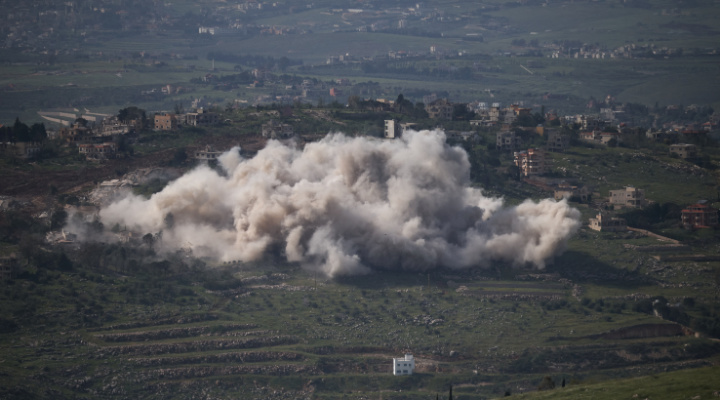
Smoke rises following explosions in southern Lebanon, near the Israel-Lebanon border, as seen from northern Israel, April 27, 2026. Photo: REUTERS/Shir Torem
Last month’s announcement by President Donald Trump of a temporary extension to the Lebanon–Israel ceasefire, amidst ambassador-level Israeli-Lebanese talks in Washington, was greeted, in some quarters, with cautious optimism.
This is understandable.
Lebanon and Israel have been in a technical state of war for decades, with even basic engagement once unthinkable.
What’s more, rhetoric emerging from the Lebanese government of President Joseph Aoun — including unprecedented criticisms of Hezbollah, the heavily armed Iranian terrorist proxy which has dominated Lebanon for decades — provides even more reasons for optimism.
But that optimism collided almost immediately with reality. Soon after the extension was announced, Israeli troops came under attack from a Hezbollah drone strike, leaving six wounded and 19-year-old Sgt. Idan Fooks dead — the third Israeli soldier killed since the ceasefire began in early April.
Israel responded, as it was entitled to under the terms of the ceasefire agreement, with targeted strikes on Hezbollah positions and infrastructure. Retaliatory attacks have since continued.
These events expose the limits of the ceasefire.
The intentions may be honorable, and hopes may be real. But hope is not a strategy. And the situation in Lebanon is such that any positive hopes for an end to the violence cannot be fulfilled while an armed Hezbollah remains a decisive power in Lebanon.
Hezbollah has long operated as a state within a state — exercising power far beyond Lebanon’s elected government. Any agreement struck with Beirut is therefore inherently constrained, because the Lebanese government does not control much of its own territory, and does not currently have the ability to make Hezbollah stop firing at Israel, much less disarm. Indeed, Hezbollah openly says it will not be bound by any deal the Lebanese government makes with Israel.
This reality was laid bare in March, when Lebanon expelled the Iranian ambassador — only for him to simply refuse to leave.
To its credit, for the first time in years, Lebanon has shown signs of recognizing the problem, and trying to actually do something about it. For example, Lebanon has moved to end Hezbollah’s control over Beirut’s airport, taken steps against unauthorized weapons, and President Joseph Aoun has even accused Hezbollah of treason.
Meanwhile, Israeli forces continue to uncover Hezbollah weapons stockpiles — including in children’s rooms and underground bunkers within populated areas in southern Lebanon, which the Lebanese army claimed to have cleared of Hezbollah military bases and activity last year. All of this is in direct violation of the 2006 United Nations Security Council Resolution 1701, which calls for Hezbollah’s disarmament, as well as the ceasefire agreement that ended the Israel-Hezbollah war in 2024, in which Beirut promised to finally fulfill its obligation under 1701.
This is why the current ceasefire does not fully address the real sources of violence and instability, even as too many in the international community continue to confuse ceasefires with peace.
Reports indicate that Hamas is using the ceasefire in Gaza to rebuild capabilities and consolidate control there. Hezbollah has followed a similar pattern. So even if periods of calm emerge, they are unlikely to last long.
There is no question that Iran and its proxies have been weakened by the last two and a half years of war. But ideological regimes do not measure success in conventional terms. They do not concede defeat. And they do not abandon their objectives.
This is why the persistent focus by parts of the international community on ceasefires and “de-escalation” — with the demands directed mainly at Israel — risks overlooking the central challenge.
French President Emmanuel Macron continues to push for de-escalation, urging Israel to withdraw from Lebanese territory and calling for Hezbollah to cease its attacks. He also says Hezbollah must ultimately be disarmed by the Lebanese themselves.
Australian Foreign Minister Penny Wong echoes similar concerns, condemning Hezbollah’s attacks on Israel and calling for an immediate cessation. At the same time, she has condemned in the “strongest terms” Israeli strikes on Lebanon, without fully acknowledging that they have been targeted against Hezbollah infrastructure and operatives. She mentions in passing that Hezbollah should be disarmed.
Yet both leaders failed to address just how Hezbollah can be disarmed — which is the central question. Statements that Hezbollah “should” be disarmed are nothing but empty words.
When dealing with absolutist religious ideologies, diplomacy is not necessarily a strength. It can become a vulnerability — exploited by those who understand that the Western aversion to conflict can itself be weaponized.
The Israel-Lebanon talks are signs of progress. But progress without power is terribly fragile. And as long as Hezbollah remains armed and entrenched, hope is a dangerous strategy.
Justin Amler is a policy analyst at the Australia/Israel & Jewish Affairs Council (AIJAC).
Uncategorized
Israel Must Stop Handing Victories to Its Critics

A general view shows the plenum at the Knesset, Israel’s parliament, in Jerusalem, May 29, 2019. Photo: Reuters / Ronen Zvulun.
Are some of Israel’s own decisions undermining its future?
No one who cares about Israel wants to ask that question. No one who understands Jewish history, regional reality, or the relentless threats Israel faces wants to even entertain it. Yet concern is growing among many who support Israel deeply and sincerely. They are not questioning Israel’s right to exist — but they are questioning if Israel’s actions are harming the Jewish State in the long run.
Let me be clear from the start: Israel has every right to exist. Israel has every right to defend its citizens. Israel has every right to confront terrorism and prevent those who openly seek its destruction from succeeding. In a region where genocidal rhetoric is still common, self defense is not optional. It is essential.
But rights alone do not guarantee wisdom. A nation can be morally justified and strategically misguided at the same time.
Recent events surrounding attempts to breach the Gaza maritime blockade offer a telling example. Many of the activists involved are not neutral humanitarians. Some seek spectacle more than solutions. They understand that confrontation with Israel generates headlines and outrage, and that images travel quickly across the world. Provocation is often the point.
Yet Israel too often responds in ways that hand these provocateurs exactly what they want.
Stopping a vessel at sea may secure an immediate tactical objective. But if the result is another cycle of global accusations, another flood of hostile coverage, and another round of diplomatic damage, then a narrow operational success becomes a strategic failure.
Israel frequently wins the immediate encounter while losing the larger narrative.
That problem extends well beyond maritime incidents.
Many people around the world defend Israel in increasingly hostile environments. Diaspora Jews face intimidation on campuses and in public life. Christian allies speak out despite social pressure. Non-Jewish advocates challenge lies, distortions, and double standards at personal cost. They write, donate, organize, and absorb abuse.
Too many feel taken for granted.
Allies matter. Gratitude matters. Communication matters. Nations under pressure cannot afford to neglect those who stand with them. Support should not be treated as automatic or endless. It must be nurtured.
Another issue that troubles even committed supporters is the use of administrative detention and other extraordinary emergency powers. Israel undeniably faces real security threats. Some dangers cannot be handled through ordinary methods alone. But emergency measures that become routine create a moral and political burden.
When people are held for long periods without normal judicial processes, Israel’s critics seize on every case. More importantly, genuine friends of Israel become uneasy. They ask whether a state founded as a refuge for a persecuted people is drifting from the democratic principles it was meant to embody.
There is also a message for ordinary citizens in Israel — especially those on the far right.
Israel is judged by a harsher standard than most nations. That reality is unfair, often hypocritical, and sometimes openly antisemitic. But it is reality nonetheless. Every act of racist violence, every attack on innocent civilians, every mosque vandalized, every tree burned, every mob chanting hatred, every soldier filmed humiliating noncombatants without cause becomes a global symbol.
One reckless act by one person can damage an entire nation.
Israel does not have the luxury of indiscipline. It is not a quiet country insulated by geography and history. It carries the security of millions of Jews. It carries the memory of exile and extermination. It carries the burden of proving that Jewish sovereignty can be both strong and just.
That requires more than military power. It requires discipline, humility, gratitude, legal integrity, and strategic patience.
Israel’s enemies would love nothing more than to see the Jewish State become isolated, angry, careless, and morally confused. Their greatest victory would not come on the battlefield. It would come if Israel helped destroy its own legitimacy.
The answer, then, is not despair. It is course correction.
Think carefully before reacting. Think strategically before escalating. Think morally before normalizing emergency measures. Think politically before alienating allies.
Israel was built through courage, sacrifice, and vision. It should not be weakened by avoidable mistakes.
The gravest danger to Israel may not come only from those who seek to destroy it from without. It may also come from forgetting how to preserve itself from within.
Sabine Sterk is the CEO of Time To Stand Up For Israel.
Uncategorized
How to Defeat Iran’s Strait Strategy

FILE PHOTO: Birds fly near a boat in the Strait of Hormuz amid the U.S.-Israeli conflict with Iran, as seen from Musandam, Oman, March 2, 2026.REUTERS/Amr Alfiky/File Photo
Iran’s strategy to close the Strait of Hormuz has been well known for years. As long ago as 1993, Iran’s parliament passed a law giving itself the right — in violation of the UN Convention on the Law of the Sea — to close the Strait. This position was reiterated during the 12-Day War of June 2025, when the Iranian parliament voted to close the Strait — though at that time, the Islamic Revolutionary Guard Corps (IRGC) held off from doing so.
Iran has two navies, the regular navy (IRIN) and the Islamic Revolutionary Guard Corps Navy (IRGCN). The IRIN is part of the Artesh (Iran’s regular military). Prior to the current conflict, the IRIN consisted of larger surface ships like frigates and corvettes, a few submarines, and a drone carrier. It is the older of the two maritime services, rebuilt after World War II and greatly expanded under the Shah, with ambitions that reached beyond the Gulf into the Arabian Sea and the Indian Ocean. Early in the Iran-Iraq War, the IRIN was able to establish sea control and strike Iraqi oil infrastructure. It is associated with the more traditional “fleet side” of Iranian sea power.
The IRGCN, on the other hand, is Iran’s specialized asymmetric naval force. Rather than functioning like a conventional blue-water navy, it is designed specifically for fighting in the Persian Gulf and the Strait of Hormuz, where geography, cluttered littoral waters, and short engagement ranges help offset US and allied technological superiority. The IRGCN is the “guerrilla warfare” side of Iran’s maritime services.
The IRGCN is built around shore-based anti-ship cruise missiles, naval mines, small agile boats called FAC/FIAC (fast attack craft and fast inland attack craft), and drones. The shore-based missiles are located in “missile cities” up to 500m (1,640 feet) underground and some sections are underwater, making US strikes difficult.
Iran planned to use both naval arms, the IRIN and the IRGCN, to attrit US naval forces until Washington tired of the conflict. From Tehran’s perspective, the logic was sound. The Strait of Hormuz is narrow, crowded, economically vital, and tactically favorable to a defender employing sea denial tactics such as mines and shore-launched anti-ship missiles. This plan also reflected the broader Iranian belief that the United States tends to lose interest in foreign conflicts when costs rise and victory is not clearly in sight.
The United States has been aware of Iran’s plans for the Strait for decades. In fact, Tehran’s deterrent logic depended on that awareness. Washington had to know the threat existed for it to influence American decision-making about whether to go to war with Iran in the first place.
In the opening days of the conflict, America’s plan to address this threat was revealed. Washington and Jerusalem opened the war at the theater level with decapitation strikes, the destruction of command and control, and the suppression of Iranian air defenses. Once Iran’s air defense network and command structure were sufficiently degraded, the United States could strike Iranian naval forces, missile infrastructure, drone facilities, logistics nodes, and other supporting assets with stand-off weapons and aircraft rather than send major surface combatants directly into the Strait. Tomahawk Land Attack Missiles (TLAMs), carrier aviation, land-based aircraft, submarine-fired torpedoes, and even long-range artillery were then brought to bear against Iranian targets without US forces entering the Strait.
By now, the IRIN is largely combat-ineffective if not sunk. The IRIN was meant to provide the IRGCN with conventional naval support. Its frigates, auxiliaries, and submarines provided sensors such as radar and sonar, support fire with missiles and guns, and extended operational reach through drones and helicopters, and it broadened Iran’s maritime presence beyond the Strait’s immediate approaches in the Indian Ocean and Persian Gulf. In a Strait contingency, the IRIN was intended to support the IRGCN’s resistance.
The US sidelined the Strait at the outset of the conflict, but the Iranian naval threat must now be addressed. While it poses a less complicated problem today than it did before the outbreak of hostilities because of the elimination of the IRIN and the degradation of Iran’s missiles and drones, the IRGCN’s continued presence in the Strait remains a significant challenge.
On March 2, Israel and the US began targeting IRGCN forces. American A-10 Warthog airplanes and AH-64 Apache helicopters began eliminating close-range elements of the IRGCN’s sea-denial network, especially its small craft, swarm staging areas, and coastal launch points. Air-dropped bunker-busting munitions were used against hardened missile sites, tunnel complexes, and buried support infrastructure along the Iranian coast. A US Navy littoral combat ship, the USS Santa Barbara, was used to launch multiple LUCAS one-way attack drones; this was not part of the ship’s original design, but the improvisation was surprisingly successful.
On March 10, the United States reported that it had “eliminated” 16 Iranian mine-laying vessels near Hormuz. There remains some ambiguity as to whether the IRGC actually mined the Strait. In an abundance of caution, the US is actively hunting for mines that may have been laid. (Mine hunting is the process of locating and identifying individual mines for destruction, while mine sweeping clears an area more broadly. Hunting takes longer, but it offers greater confidence that an area has been cleared.)
The US Navy has four Avenger-class mine countermeasures ships in the region and two littoral combat ships: the aforementioned USS Santa Barbara and the USS Tulsa, which have been augmented with counter-mine capabilities. These forces have some of the Navy’s most advanced mine-countermeasure resources, including unmanned undersea systems, helicopters, and divers. The MH-60S Seahawk, for example, can employ the Airborne Laser Mine Detection System to locate mines from the air and then help neutralize them. At the same time, the Knifefish unmanned undersea vehicle can hunt mines below the surface while keeping its mothership out of danger.
But these capabilities are not enough. The IRGCN, though significantly degraded, still retains enough capability — including FACs, FIACs, and shore-based missile systems — to threaten commercial shipping in the Strait. For this reason, the United States is taking additional measures in parallel with operations in the Strait.
There is little doubt that the US could engage in direct military action to secure the Strait, but this would require significant land forces in addition to further air and maritime operations. There would be a cost in both American blood and treasure, and if the action did not end quickly, it could become a political liability. For these reasons, the Trump administration is actively pursuing alternative means to the direct military option to achieve the desired end state, including making diplomatic overtures.
One indirect measure has been to attempt to compel Tehran to reopen the Strait by striking vital targets, with a threat to strike even more. These attacks are aimed at the regime’s capacity to continue the confrontation. Targets include leadership, command and control, missile infrastructure, naval forces, air defenses, logistics nodes, and key elements of the regime’s economic base. The purpose is to impose cumulative strategic costs, degrade Iran’s coercive tools, and convince Tehran that keeping the Strait closed will cause the regime greater harm than reopening it.
The US has also embarked on an economic pressure campaign against Iran called Operation Economic Fury. This operation is centered on fully enforced oil sanctions, action against sanctions-evasion networks, and pressure on the shipping and financial channels that keep Iranian exports moving. The US Treasury has sanctioned 29 new targets, including three individuals, 17 companies, and nine vessels tied to Iranian oil smuggling and associated financing networks as part of the broader economic pressure campaign.
The most visible portion of Operation Economic Fury is a maritime blockade, a clear demonstration of economic coercion bolstered by the credible use of force to compel compliance. This tactic echoes the naval blockade the US employed to weaken Venezuela before Maduro’s ouster. That blockade brought the Venezuelan economy to the brink of collapse by strangling the nation’s oil revenues.
The current US blockade, originally framed as targeting the Strait, is more accurately described as a blockade against ships calling at and departing from Iranian ports and terminals. A few vessels carrying crude from Saudi Arabia, the UAE, and Iraq – not Iran – have successfully exited the Persian Gulf. US Central Command (CENTCOM) clarified that as part of the blockade, “all Iranian vessels, vessels with active Office of Foreign Assets Control (OFAC) sanctions, and vessels suspected of carrying contraband (weapon parts, nuclear components, precursors, etc.), are subject to belligerent right to visit and search.”
Through all of this, Washington is leaving open a diplomatic off-ramp. If Iran accepts American red lines, especially with respect to its nuclear weapons program, and reopening the Strait is folded into a broader agreement, Washington could end the war and provide some measure of sanctions relief. In this sense, diplomacy is not separate from coercion but part of the same strategy. Military pressure, economic coercion, and diplomatic opportunities are being applied together to persuade Tehran that compliance is less costly than continued resistance.
In the end, Iran’s long-prepared Strait strategy failed. Rather than rush major naval forces into a confined battlespace built for attrition, Washington and Jerusalem widened the fight, dismantled key elements of Iran’s military system, and then combined limited operations in and around the Strait with economic coercion and diplomatic pressure. The remaining challenge is real, as the IRGCN can still threaten shipping in the Strait. However, Tehran has lost whatever influence it had on the initiative or direction of the campaign.
David Levy is a retired US Navy Commander and Foreign Area Officer. He was the Director for Theater Security Cooperation for US Naval Forces Central Command located in Bahrain and was the US Air and Navy Attaché in Tunis. He served in several campaigns, including Iraqi Freedom and Inherent Resolve. A version of this article was originally published by The BESA Center.