



Uncategorized
Florida International University College Republicans Denounce Antisemitic, Racist WhatsApp Group

Conservative youth at Turning Point USA event in October 2025. Photo: Cheney Orr via Reuters Connect
The Florida International University (FIU) chapter of College Republicans, one of the largest conservative student groups in the US, has condemned antisemitism and other forms of bigotry following the revelation of a virulently racist group chat in which conservative youth exchanged antisemitic slurs while calling for the of murder African Americans.
“As the first female Jewish president of FIU College Republicans, I can personally attest that the recent reports regarding an external chat have no place in our society,” Gabriela Burstein said in a blistering statement condemning the chat, which reportedly included members of her College Republicans chapter.
“There is simply no place for antisemitism, racism, or violence of any kind and in no way reflect our conservative community within Florida,” she continued. “Our executive board, chapter members, community supporters, and I are absolutely appalled by the rhetoric that has surfaced.
As first reported by The Miami Herald, the group chat, created on WhatsApp, was described by its members as “Nazi heaven” for the daily barrage of extremist comments contributed to it. Individuals affiliated with the Miami Dade Country Republicans, Turning Point USA, and College Republicans casually said “ni—er,” denounced women as “whores,” and spoke rapturously about Adolf Hitler.
Dariel Gonzalez, according to the Herald, was one of the chat’s most prolific contributors, bandying about comments regarding “color professors” and telling members that “You can f—k all the k—kes you want. Just don’t marry them and procreate.” Gonzalez, a former board member of FIU’s College Republicans, also reportedly promoted belief in “Agartha,” a Nazi utopia confected by Heinrich Himmler, while fantasizing about the possibility of engaging in onanism there. Some vile remarks drew the approbation of other chat members, many of whom are connected to Republican Party organizations across the state.
The Herald added that the chat was founded by Abel Alexander Carvajal, secretary of the Miami-Dade County Republican Party. On Thursday, the organization denounced him and the chat, adding that it has demanded his resignation.
“His words and actions are reprehensible and are completely inconsistent with the values of the Republican Party of Miami-Dade County. The words and actions of this individual do not speak for our party,” chairman Kevin Cooper said in a statement. “We are the party that fought to end slavery, the party that welcomed Cuban refugees fleeing communism to freedom in Miami, and the party that continues to welcome Americans of every race, faith, gender, and nationality who believe in liberty and opportunity.”
FIU president Jeanette Nuñez described the content of the group chat as “abhorrent and extremely disturbing language” in her own statement.
“FIU does not and will not tolerate violence, hate, discrimination, harassment, racism or antisemitism. This is not who we are. This is not what FIU stands for,” she added. “We take these allegations very seriously. The alleged conduct continues to be investigated by FIU Police Department in coordination with local, state, and federal law enforcement. In addition, the FIU Office of Civil Rights and the Office of Student Conduct and Academic Integrity are actively investigating the matter.”
The group chat’s exposure comes at a time when, according to recent polling, young Republicans have increasingly embraced antisemitism and conspiracy theories.
Last month, for example, survey by Irwin Mansdorf, a fellow at the Jerusalem Center for Security and Foreign Affairs, and Charles Jacobs, president of the Jewish Leadership Project, found that 45 percent of Republicans under the age of 44 said Jews pose a threat to the “American way of life.”
In December, the Manhattan Institute, a prominent US-based think tank, released a major poll showing that younger Republican voters are much less supportive of Israel and more likely to express antisemitic views than their older cohorts.
According to the data, 25 percent of Republicans under 50 openly express antisemitic views as opposed to just 4 percent over the age of 50.
Startlingly, a substantial amount, 37 percent, of GOP voters indicate belief in Holocaust denialism. These figures are more pronounced among young men under 50, with a majority, 54 percent, agreeing that the Holocaust “was greatly exaggerated or did not happen as historians describe.” Among men over 50, 41 percent agree with the sentiment.
This dynamic has played out on college and university campuses across the US, where antisemitism has surged in the aftermath of Hamas’s Oct. 7, 2023, massacre across southern Israel.
The Algemeiner has reported daily on campus antisemitism incidents which involved identity-based physical assaults, verbal abuse, and others acts of discrimination. These included anti-Zionists spitting on Jewish students at the University of California, Berkeley while calling them “Jew”; gang assaults at Columbia University’s Butler Library; swastika graffiti; the desecration of Jewish religious symbols; and the expulsion of a sexual assault survivor from a victim support group over her support for Zionism.
Other incidents include a faculty group’s sharing an antisemitic political cartoon which marked Jews and Israel as enemies of people of color; a Cornell University student threatening to murder Jewish men, whom he called pigs, and to rape Jewish women, and perpetrate a mass shooting at the campus’ kosher dining hall; and professors praising Hamas’s Oct. 7 atrocities, which included mass murder, sexual assault, and kidnapping as legitimate modes of “resistance.”
Many such incidents preceded the Oct. 7 massacre by several years and received little to no coverage in the mainstream press.
Follow Dion J. Pierre @DionJPierre.
Uncategorized
London Police Set Up Specialist Jewish Protection Team

A police officer stands at the scene, after a man was arrested following a stabbing incident in the Golders Green area, which is home to a large Jewish population, in London, Britain, April 29, 2026. Photo: REUTERS/Hannah McKay
British police are setting up a new team of 100 officers including counter terrorism specialists to help protect Jewish communities across London after a series of antisemitic attacks including the stabbing of two men.
The plan announced on Wednesday for a dedicated protection team comes as officers announced more arrests for antisemitism, including detaining a 35-year-old man on Saturday after rocks were thrown at an ambulance belonging to the Jewish community.
London‘s top police boss Mark Rowley said Jewish communities were facing “sustained threats” from hostile state actors as well as extreme right-wing groups, elements of the extreme left, and Islamist terrorists.
Detectives are examining whether the arson incidents have possible Iranian links, after British security officials warned that Iran was using criminal proxies to carry out hostile activity.
Since late March, there have been a number of high-profile arson attacks with four Jewish ambulances burned and synagogues targeted. Last week, two Jewish men were also stabbed. Both victims survived the attack.
Over the past four weeks, police said they had arrested around 50 people for antisemitic hate crimes and charged eight individuals. On top of that, 28 arrests have been made as part of investigations alongside counter terrorism policing for arson and other serious incidents.
“This new team will be primarily focused on protecting the Jewish community, which faces some of the highest levels of hate crime alongside significant terrorist and hostile state threats,” said a statement from London‘s Metropolitan Police force.
British Prime Minister Keir Starmer convened a meeting on Monday with business, health and cultural leaders aimed at trying to tackle antisemitism.
Uncategorized
Iran Reviewing US Proposal to End War, Though Key Demands Remain Unaddressed
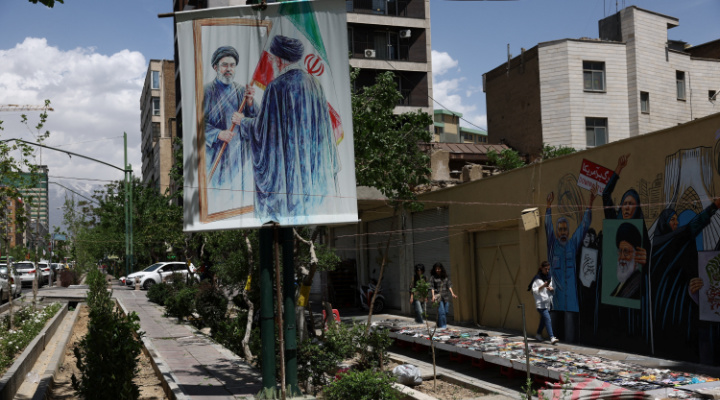
People walk on a street near a mural featuring an image of the late Supreme Leader of Iran, Ayatollah Ali Khamenei, in Tehran, Iran, May 6, 2026. Photo: Majid Asgaripour/WANA (West Asia News Agency) via REUTERS
Iran said on Wednesday it was reviewing a US peace proposal that sources said would formally end the war while leaving unresolved the key US demands that Iran suspend its nuclear program and reopen the Strait of Hormuz.
An Iranian foreign ministry spokesperson cited by Iran‘s ISNA news agency said Tehran would convey its response. US President Donald Trump said he believed Iran wanted an agreement.
“They want to make a deal. We’ve had very good talks over the last 24 hours, and it’s very possible that we’ll make a deal,” Trump told reporters in the Oval Office on Wednesday.
Earlier in the day, Trump had sounded more pessimistic about the chances of a deal. In a Truth Social post, he threatened to restart the US bombing campaign in Iran, calling the possibility of Tehran agreeing to the latest US proposal a “big assumption.”
Trump has repeatedly played up the prospect of an agreement that would end the war that started Feb. 28, so far without success. The two sides remain at odds over a variety of difficult issues, such as Iran‘s nuclear ambitions and its control of the Strait of Hormuz, which before the war handled one-fifth of the world’s oil and gas supply.
A Pakistani source and another source briefed on the mediation said an agreement was close on a one-page memorandum that would formally end the conflict. That would kick off discussions to unblock shipping through the strait, lift US sanctions on Iran, and set curbs on Iran‘s nuclear program, the sources said.
It was unclear how the memorandum differs from a 14-point plan proposed by Iran last week, and Iran has yet to respond to the latest US proposal.
Iran‘s semi-official Tasnim news agency, citing an unnamed source, said the US proposal contained some unacceptable provisions, without specifying which ones.
Iranian lawmaker Ebrahim Rezaei, a spokesperson for parliament’s powerful foreign policy and national security committee, described the text as “more of an American wish-list than a reality.”
“The Americans will not gain anything in a war they are losing that they have not gained in face-to-face negotiations,” he wrote on social media.
OIL PRICES TUMBLE
Reports of a possible agreement caused global oil prices to tumble to two-week lows, with benchmark Brent crude futures falling around 11% to around $98 a barrel at one point before rising back above the $100 mark.
Global share prices also leapt and bond yields fell on optimism about an end to a war that has disrupted energy supplies.
Trump on Tuesday paused a two-day-old naval mission to reopen the blockaded strait, citing progress in peace talks.
The US military has kept up its own blockade on Iranian ships in the region. US Central Command said forces fired at an unladen Iranian-flagged tanker on Wednesday, disabling the vessel as it attempted to sail toward an Iranian port in violation of the blockade.
NO MENTION OF KEY US DEMANDS
The source briefed on the mediation said the US negotiations were being led by Trump’s envoy Steve Witkoff and son-in-law Jared Kushner. If both sides agreed on the preliminary deal, that would start the clock on 30 days of detailed negotiations to reach a full agreement.
The full agreement would end the competing US and Iranian blockades on the strait, lift US sanctions, and release frozen Iranian funds. It would also include some curbs on Iran‘s nuclear program, with the aim of a pause or moratorium on Iranian enrichment of uranium.
While the sources said the memorandum would not initially require concessions from either side, they did not mention several key demands Washington has made in the past, which Iran has rejected, such as curbs on Iran‘s missile program and an end to its support for proxy militias in the Middle East.
The sources also made no mention of Iran‘s existing stockpile of more than 400 kg (900 pounds) of near-weapons-grade uranium.
Israeli Prime Minister Benjamin Netanyahu, Trump’s ally against Iran, said on Wednesday the two leaders agreed that all enriched uranium must be removed from Iran to prevent it from developing a nuclear bomb.
Tehran denies wanting to acquire a nuclear weapon.
Uncategorized
Brussels cathedral installs plaques apologizing for medieval antisemitic persecution depicted in stained glass
(JTA) — More than 650 years after Jews in Brussels were executed and expelled following false antisemitic accusations, church officials at the Cathedral of St. Michael and St. Gudula have installed a plaque apologizing for the persecution commemorated in its stained glass windows.
At a ceremony on April 27, Archbishop Luc Terlinden of Mechelen-Brussels and Rabbi Albert Guigui, the chief rabbi of Brussels, unveiled four plaques, written in Dutch, French, English and Hebrew, providing historical context for the windows and an apology for the antisemitic persecution tied to the events they depict.
The plaques, which Terlinden signed, state that “baseless accusations of the desecration of the Eucharistic host were made against Jewish communities” in medieval Europe and that the accusations “led to persecution, massacres, and unjustifiable expulsions.” The windows show Jews being executed at the stake in response to their alleged attacks on the Eucharist, bread that Catholic doctrine considers a literal representation of Jesus’ body.
“Theological and social anti-Judaism is in direct contradiction with the Gospel of Christ, which calls for truth, justice, and brotherhood,” the plaques say. “We ask forgiveness from the Jewish people for the suffering these accusations have caused.”
The stained glass windows in the cathedral depict the “Brussels Host Desecration,” an antisemitic accusation in 1370 that Jews had desecrated communion wafers, leading to the execution of Jews in Brussels and the expulsion of the city’s Jewish community.
The windows have drawn scrutiny for decades, particularly as the Catholic Church sought to reckon with its history of antisemitism. In 1969, shortly after the landmark Nostra Aetate declaration rejecting longstanding anti-Jewish Catholic doctrine, the Archbishop of Brussels ordered that several paintings be removed and a plaque be mounted to offer context about the remaining depictions.
Several years later, the European Jewish Congress noted last week, Catholic leaders did install a plaque that drew readers’ attention to “the biased nature of the accusations [against the Jews accused of the desecration] and to the legendary presentation of the ‘miracle.’”
But Flora Cassen, the director of the Brandeis Center for Jewish Studies and a scholar of European antisemitism, said the existing plaque was “very ambiguous about the responsibility and what happened” and installed in an easy-to-miss location. The new plaques, she said, contain a clear and “very moving” apology and cannot be missed by anyone who comes to see the windows.
“The significance is enormous of the church finally putting a plaque there that tells the story, that acknowledges the antisemitism behind it, that acknowledges that it was a slander and that it resulted in persecution and in the execution of Jews in Brussels and their expulsion,” Cassen said.
The new plaques cite Nostra Aetate and the Catholic Church’s subsequent effort under Pope John Paul II to reckon with historical antisemitism in 2000. They affirm the church’s “commitment to combat all forms of antisemitism, to deepen dialogue between Jews and Christians, and to pass on to future generations a clear remembrance, based on the acknowledgement of truth and mutual respect.”
While some have called for the historic windows to be removed, Guigui said in a statement that the plaques represented an appropriate way to address relics of historical antisemitism.
“What matters today is how we look at these images,” the rabbi said. “They must not be erased, because they are part of history, but they must be accompanied by explanation and moral insight in order to understand the context and avoid repeating past mistakes.”
The post Brussels cathedral installs plaques apologizing for medieval antisemitic persecution depicted in stained glass appeared first on The Forward.