


Uncategorized
This initiative is helping Israeli war survivors heal through art – and is making therapy cool
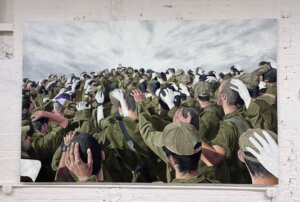
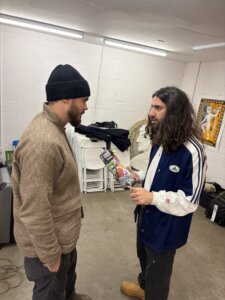
Tomer Peretz opened the door to his unassuming gallery in Chelsea, draped in a studded black shawl and sporting cartoonishly large – but very cool – sneakers. It was the day after the biggest snowstorm in recent NYC history, and the shoes were, of course, the most practical option for an LA-based Israeli with limited snow experience.
The 8 Project gallery opened in New York this winter, but it is only one piece of a larger initiative. The program, founded by Peretz, brings Oct. 7 survivors, bereaved siblings, Israeli soldiers coping with PTSD, and others affected by the war to Los Angeles for a two-month therapeutic art residency. Participants spend hours each day creating art while also undergoing therapy and mentorship. Now, Peretz has brought the residency program and its accompanying art gallery, which is open only for private events, to New York City.
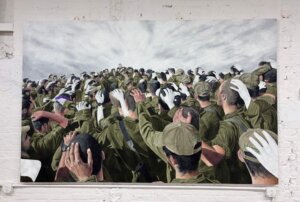
Upon entering the 8 Project gallery in downtown Manhattan, the first painting one is greeted with is Peretz’s own, a group of Israeli soldiers huddled together, accompanied by the spirits of their fallen comrades represented by icy-white hands painted on the heads of the living. In a city where torn-down hostage posters became almost a fixture of the streets during the Gaza war, the gallery feels both out of place and deeply intentional.
Peretz receives applicants for his therapeutic residency program through rehabilitation hospitals in Israel and via social media. The only real requirement, he says, is a passion for art.
“They don’t have to have technical skills,” he told me. “Art is our toolbox to get through their soul. If they can sit every day and create, they’re already qualified.”
Peretz flies incoming residents to Los Angeles and covers their living expenses so they can focus entirely on healing.
Peretz was a volunteer with ZAKA, the Israeli humanitarian organization that specializes in recovering human remains after terror attacks. In the immediate aftermath of Oct. 7, he helped identify bodies at the sites of the attacks.
Once he returned to his home in LA, where he had been working as a painter for years, he found he could no longer approach his work in the same way. “I realized that everything I had been doing in my life had no real purpose,” he said. “We artists, we think we are so important. But if the work doesn’t do something, it’s just fucking art.”
He began working with artists informally and gradually developed what would become the 8 Project Residency. “I couldn’t create anything besides creating with people who were affected by the war. I cared about nothing else.”
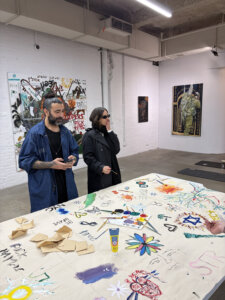
Part of the appeal for residents, he says, is the cool-factor of the program. “People get attracted to cool, fun people.” Unlike traditional therapy — “a boring therapist and psychiatrist in a room,” as he put it — the program offers something different. “We literally brought something completely new, as far as therapy and healing, that is really, really fun.”
Shaked Salton, a former 8 Project resident whose best friend was killed on Oct. 7 and who served as a sergeant in the IDF’s search and rescue unit, told me on Zoom from her new home in LA that she struggled to find motivation after the war. The residency program helped her to find it. “Every day, I needed to wake up in the morning. For someone who’s been through a war, it can be tough.” But in the program, “there is no way you’re not coming to the studio.”
Now, she told me, she’s more connected to her feelings. “I paint better,” she told me. “I came to think more creatively. My brain was blocked.”
Sahar Haba, another former resident who now works as a mentor for the project, also serves as the self-ordained de facto DJ at the gallery. As residents worked on their art in the gallery’s back room, Haba played everything from Billy Joel’s “New York State of Mind,” to techno and Israeli Mizrahi music.
Haba served 15 years in the IDF and experienced the death of several of his friends on Oct. 7 and during the war, including American Hersh Goldberg Polin, whom he met through their shared love for the Israeli soccer team, Hapoel Jerusalem. He adores fashion, evidenced not only by the sneakers and jerseys he designed, displayed throughout the gallery, but also by his decidedly funky graphic socks.
During his residency, Peretz encouraged him to lead art workshops.
“Most of the time, the healing process is like, ‘Let’s talk about you, what do you need?’” Haba said. “Here I had the chance to do it the opposite way — to be the guide.”
Haba led art workshops for Nova survivors, soldiers, families and couples who were affected by the war.
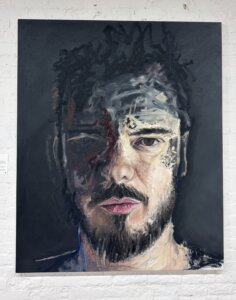
One of the most striking paintings at the 8 Project Gallery is a portrait Peretz painted of Andrei Kozlov, a freed hostage and former 8 Project resident. In the piece, half of Kozlov’s face is incomplete, streaked with black and red contours that suggest the rest of his features.
The painting hung across from where I was conducting interviews that afternoon, so his face had been staring back at me from the gallery wall for much of the day. Unexpectedly, the real Kozlov walked in and introduced himself to me — before joking that I must be interviewing Peretz for a clerk position.
Kozlov became an 8 Project resident a mere five months after he was freed from captivity in Gaza. Now, he lives in New York and spends hours a day working on his art.
Haba showed me a pair of boots he had designed during the war, covered in a collage of hostage posters and featuring a QR code linking to the Bring Them Home website on the tongue of the shoe. He showed his creation to Kozlov, joking that the QR code no longer worked before pulling him into a bear hug.
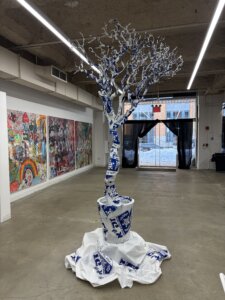
In the center of the gallery stands a giant tree that Peretz explained was sculpted out of the body bags ZAKA used to collect human remains. References to ZAKA appear throughout the exhibit. In a small side room, a video created by one of the residents is played, which shows ZAKA volunteers sitting in the ruins of the kibbutzim in Israel that were ravaged by the Oct. 7 attacks. The volunteers were instructed to sit in silence for an hour and stare into the camera, resulting in a deeply unsettling film that felt almost too intimate to watch.
Peretz has a self-professed “radical” perspective on healing. “I do not like when therapists or psychiatrists like to dig too much about the past,” he said. “I’m all about shaking the hand of the devil that was with you that day. But once you shake the devil’s hand, OK, let’s move on.”
That’s why the second half of the program is dedicated to helping residents plan for their future. “It’s all about how do we become hungry to wake up tomorrow morning?” said Peretz. “So if I’m going to speak about the past all day, I will not be hungry to wake up tomorrow.”
That concept is where the 8 Project got its name from. “God created the world in 6 days,” said Peretz. “On the 7th day, we got some rest, and on the 8th day, we started to live.” After residents leave the program, Peretz hopes that they, too, can start to live.
Peretz has remained in touch with all of his past residents. “Some of them are going to school. Some of them are building relationships. Some of them are building a career.” He said all have continued to pursue their passion for art.
The gallery is open for private events, and while staff say they have had several people walk into the gallery who are not connected to Judaism or the war in any way, they are not Peretz’s target audience.
“I like that we’re not open for the public, I don’t think we are for the public.” He explained, “I’m not interested to tell my story at all. I don’t want to tell the Jewish story. I’m not trying to get more fans for the Jewish people through this exhibit.”
“I’m not for everyone,” he added. I care only about my brothers and sisters who created this, and the next people who are gonna create more, and that’s it.”
Still, Peretz believes the project’s presence in New York matters.
“New York needs this more than any other city. I realized that the Jewish people in New York are so traumatized, and they need that connection so badly,” he said. “A lot of us, Jewish people in the diaspora, got lost. We need that connection. We want to get the hug.”
The post This initiative is helping Israeli war survivors heal through art – and is making therapy cool appeared first on The Forward.
Uncategorized
NAZA exposes Israel’s crisis of credibility over Gaza
More than two decades ago, when I was the The Associated Press bureau chief for Israel, the West Bank and Gaza, the Israeli military called off an attack on a senior Hamas leader after learning at the last moment that family members and children were inside the targeted building.
What stayed with me was what happened next. The military sent a senior officer to my office to explain the decision.
This was during the Second Intifada, the murderous explosion of terrorism launched by armed Palestinians after Israel had offered the Palestinian Authority an independent state in over 90 percent of the territory it sought. Hamas leaders sent suicide bombers into Israel on a daily basis to blow up buses, restaurants, malls, cafes. I checked for explosives whenever I got into my car, perhaps with my little daughters, Maya and Noa.
Yet Israeli officials understood that demonstrating concern for civilian life was part of maintaining the country’s credibility. Maybe they also thought that concern for innocent life, even on the enemy side, was the Jewish thing to do. I want to believe this, as both a Jew and as a manager who had colleagues in Gaza, some of whom were hurt over the years.
That memory returned to me amid the uproar surrounding NAZA, the new documentary by Israeli filmmakers Yuval Abraham and Rachel Szor, who shared in the 2024 Oscar for No Other Land, a critique of Israel’s practices in the West Bank.
The new film, which premiered at the Venice Film Festival and won the Special Jury Prize, is titled after the Hebrew acronym for “collateral damage” (and is also a play on “Gaza”). It examines Israel’s targeting practices in Gaza through testimony from 24 Israeli soldiers and intelligence personnel who allege the IDF used artificial intelligence.
Some of those soldiers, the filmmakers say, operated or helped design the AI systems at the center of the film. Their identities are concealed in various ways, yet their testimony portrays a disturbing picture about how technology, intelligence and estimates of civilian casualties intersected in decisions to strike.
The reaction in Israel has been ferocious. Culture Minister Miki Zohar – from the governing Likud Party led by Benjamin Netanyahu – has called the filmmakers traitors and raised the prospect of revoking their citizenship.
Former football star and prominent television personality Eyal Berkovic has similarly argued that loss of citizenship should be the best-case scenario for Israelis who harm their country. As the film moves beyond Venice, efforts to prevent its screening in Israel seem likely.
That reaction creates a sad irony. One of the strongest criticisms of NAZA is that its highly combustible testimony comes from anonymous sources – and that is a valid criticism indeed. Yet threats directed at the filmmakers offer a fairly vivid illustration of why soldiers and intelligence officers making explosive allegations about their own military might fear speaking publicly. The filmmakers say anonymity was necessary to protect people who could face serious consequences for revealing classified information. I can credibly assess they’d end up in jail.
Nonetheless, the anonymity remains a serious weakness. Claims that are this grave demand intense scrutiny, and viewers have limited means of establishing whether the witnesses held the positions they claim, possessed the knowledge they describe or represent the targeting system accurately. The IDF has challenged precisely this aspect of the film and rejected its portrayal of Israeli targeting practices.
That said, and not for the first time, the military is more reasonable than the government and the IDF’s spokesman invited the filmmakers to screen it for the military. A detailed military response to the evidence presented in NAZA would provide an essential counterweight.
The central dispute also reaches beyond whether Israel used artificial intelligence. The IDF says decisions to select and approve strikes are made by human personnel. The more consequential question is what information those people received and what weight they gave to civilian lives when making those decisions. If a system identified a Hamas operative inside a residential building, what level of civilian harm was considered acceptable in order to kill him? To what degree was AI part of the decision-making process?
Amid a global uproar over fears of AI, and in particular systems operating independently in ways that harm humans, this film catapults such questions to a very high place in the global discourse.
The AI questions lead to others. Did the permissible number of civilian casualties change according to the importance of the target? How confident did intelligence officers have to be that the intended person was actually present? What happened when information indicated that children or other family members were inside? How frequently did commanders cancel strikes because the expected civilian toll had become too high?

NAZA offers disturbing answers, and its central concern is ultimately a human one: what values and tolerances were built into the targeting process, and how were they applied by the people responsible for approving strikes?
Israel, this time around, has provided only a limited public account of those calculations during the war. Officials have emphasized the extraordinary difficulties of fighting Hamas in densely populated Gaza, the organization’s use of civilian areas for military purposes and Israeli estimates of a civilian-to-combatant casualty ratio that they say compares favorably with other episodes of urban warfare, including Mosul. The precise civilian death toll in Gaza also remains contested, particularly the division between civilians and combatants.
There is no doubt in my mind – none whatsoever – that Hamas is the embodiment of evil. It is obvious to anyone paying attention that the jihadist group engineered the entire war to maximize casualties on its own side in order to make Israel an international pariah. But it is also rather obvious by Israel’s conduct in the war and the tens of thousands of civilians who have died, that Israel to walked into the trap laid by Hamas.
Aggregate ratios tell only part of the story. They reveal little about why a particular building was struck, how many civilians were expected to be inside, what military advantage commanders anticipated or how that anticipated advantage was weighed against the likely human cost. Repeated incidents involving substantial civilian casualties have often been followed by broad explanations rather than detailed accounts of the decision-making that produced them. Foreign journalists, of course, have not been freely allowed in.
That is where my memory from more than 20 years ago feels especially relevant. The military that sent an officer to my office understood the value of a transparent process. It understood that credibility depended partly on demonstrating, in specific cases, that civilian lives carried meaningful weight in operational decisions. During the Gaza war, amid extraordinary civilian loss of life, that instinct has been far less visible, to say the least.
Why did Israel act this way? Part of it has to do with the unspeakable trauma of the Oct. 7 Hamas invasion and massacre, which left Israelis in no mood for explanations, and placed its government in a defensive posture. Part of it is the nature of that government – an ultranationalist assemblage of highly illiberal and astoundingly cynical politicians. And part of it is the global demonization targeting Israel – so thorough and unfair that it almost explains the surrender of any serious effort at PR.
None of this was smart. The resulting information vacuum has given NAZA much of its power. A documentary built substantially around anonymous testimony carries an obvious credibility burden, particularly when its allegations concern classified practices that outsiders have little ability to examine independently. Yet Israel’s sparse public accounting of its targeting decisions has left relatively little detailed evidence against which those accounts can be measured. The filmmakers have supplied one version of what happened inside the targeting system; a detailed Israeli account could provide another.
Demonizing a couple of filmmakers based on the idea that they meant to do Israel harm will not convince intelligent people and will deepen Israel’s isolation. Israel needs to explain to its own people how it failed so utterly to protect the massacre of Jews. It needs to explain to the world what went on in Gaza. In fact, it needs to explain that to its own people as well.
All of that will await another government. This will not come from Netanyahu.
The post NAZA exposes Israel’s crisis of credibility over Gaza appeared first on The Forward.
Uncategorized
Police investigating threats against prominent Munich Holocaust survivor and AfD opponent
(JTA) — Police said they are investigating death threats made against a senior Jewish leader in Germany, after she criticized the far-right Alternative for Germany (AfD) party.
A witness found graffiti scrawled in white ink on a park bench and a trash bin in Munich’s English Garden park, threatening the life of 93-year-old Holocaust survivor Charlotte Knobloch, , the Munich Police Department said in a statement.
Citing police sources, The Abendzeitung on Sept. 11 reported the threat contained the phrase “Die AfD hat gewonnen, morgen hängen wir die Knobloch,” which translates to, “The AfD has won, tomorrow we’ll hang Knobloch.” A police spokesperson had not responded to JTA’s request for confirmation of the threat content by press time.
The witness reported the graffiti to police and an investigation was launched on Wednesday, Sept. 9, police said.
Knobloch, chair of the Jewish Community of Munich and Upper Bavaria, canceled plans to attend a public event as an audience member right after learning of the threat, the Jewish Telegraphic Agency has confirmed with the Jewish Community in Munich.
The Munich Criminal Investigation Department has categorized the incident as a case of incitement to hatred, threats, and property damage, and has asked witnesses to contact police.
The AfD won 43.8% of the votes in the state of Saxony-Anhalt on Sept. 6. The election set the stage for a right-wing party to control a German state government for the first time since the Nazi era. But the AfD fell three seats short of a majority and has yet to secure enough support to form a government, Reuters reported Sept. 11.
Knobloch, an ardent critic of the AfD, had said the party’s record of success “frightens me.” In a statement released Sept. 6 by her office, she said that she “couldn’t have imagined even in my worst nightmares that right-wing extremists could win elections in Germany again in this way.” She has long called for the party to be banned.
The Department for Research and Information on Antisemitism (RIAS) has a reporting mechanism for witnesses or victims, and provides statistics to federal and local authorities. Antisemitic crimes may be motivated by left, right or Islamic extremism, but the specific reference to the AfD and a specific target made this case unusual, spokesperson Felix Balandat said. “We have not recorded anything like that before,” he told JTA.
Munich Mayor Dominik Krause (Greens) asked in a public address, “How many more death threats, how much Nazi rhetoric, how many more deportation announcements do we actually need” before the federal government initiates steps towards banning the AfD.
Meanwhile, in Berlin, a woman was injured in a suspected antisemitic attack, according to city police.
Early on Sept. 11, two men attacked a 43-year-old woman in the Mitte section of Berlin. The attackers, who fled the scene, commented on her wearing a Star of David and shouted antisemitic insults at her, Berlin police said.
One of the men allegedly attacked her with a broken glass bottle, police said. While defending herself, she suffered several cuts to her hand. Paramedics transported her to a hospital for treatment. The State Security Unit of the State Criminal Police Office has taken over the investigation.
According to RIAS, more than 2,000 antisemitic and anti-Israel insults, threats, acts of vandalism and attacks were registered in Berlin in 2025, slightly down from 2024 but still more than twice as many as before the attacks on Israel on October 7, 2023.
This article originally appeared on JTA.org.
The post Police investigating threats against prominent Munich Holocaust survivor and AfD opponent appeared first on The Forward.
Uncategorized
Jake Lang led a protest against Mamdani and Muslims. Then the Nazis showed up to protest him.
Far-right activist Jake Lang led a march last week protesting Mayor Zohran Mamdani’s presence at the 9/11 25th anniversary memorial ceremony. The protest attracted swastika-sporting men describing themselves as Nazis; they were there to counterprotest Lang, whose mother is Jewish.
Around 100 demonstrators attended Lang’s march, which happened blocks away from the ceremony held at Ground Zero. Lang described the march on X as a “Great CRUSADE on Muslim SCUM Zohran Mamdani.”
The “crusade” was laden with anti-Muslim messaging, including a poster reading “Deport All Muslims.” About 40 counter-protesters arrived to oppose Lang. While most were antiracist protesters, seven were neo-Nazis. One counter-protester got into a physical altercation with someone from Lang’s march.
Lang is best known for his role in the Jan. 6 insurrection. He spent four years in prison, facing assault charges for attacking a police officer with a baseball bat, before being pardoned by President Donald Trump. In August, Lang lost a campaign to secure a Republican congressional nomination in Florida.
Though Lang’s mother is Jewish, he identifies as Christian, and has brandished wooden crosses at his marches, some of which he called “Christian Crusades.” Lang has publicly renounced his Judaism and the state of Israel, burning a copy of the Talmud and performing a Heil Hitler salute outside the AIPAC headquarters in D.C.
Nevertheless, seven men wearing swastika armbands — and one clad in an Elmo suit draped with a Palestinian flag as a cape — stood near Lang’s march holding a sign reading, “Jake Lang is a Jew.”
The men performed Sieg Heil salutes and, in an unusual move for self-identifying Nazis, chanted “Free, free Palestine,” alongside the declaration, “We are the real racists.” They passed out flyers reading “no more wars for Jews” and ranted about American soldiers lost in battles they said were directed by Israel.
“I want them out of our government,” said one of the men, Gregory Conte, a former schoolteacher who was fired for his white-nationalist ties. “And not just Zionists — Jews.”
The swastika-clad men drew a bevy of critics, including one man who told them, “I agree Israel did 9/11, but you guys are Nazis, man, you guys brought them to Palestine.”
One person filming the protest asked Conte, “Do you hate Jewish people?” He replied: “I’ve never had one do a good thing for me.” Conte then asked whether the man behind the camera was Jewish and he said he was; Conte refused to speak to him further, stating that he does not talk to Jews.
Footage showed Conte on the subway, this time without his armband, talking about how “Jake Lang is trying to start a war.” Independent journalist Talia Jane asked him, “Want to show them your armband?” Conte declined to take it out.
The post Jake Lang led a protest against Mamdani and Muslims. Then the Nazis showed up to protest him. appeared first on The Forward.
