


Uncategorized
Jews in Iran and in the diaspora find respite in celebrating Nowruz amid war
Anna Hakakian, a resident of Great Neck, New York, grew up in Iran during the Iran-Iraq war. At that time, Nowruz, the secular Persian New Year, offered a rare moment of respite from a conflict that claimed hundreds of thousands of lives.
That war came in the aftermath of the 1979 Islamic Revolution, when Iran’s new leaders tried to ban Nowruz, seeing it as un-Islamic. But Iranians of all religions refused to let it go.
This week, Hakakian is celebrating Nowruz in the shadow of another war. For her, the holiday carries the legacy of Iranians fighting to preserve thousand-year-old traditions despite efforts to suppress them.
“They really tried to erase this from our culture these past 47 years, but it didn’t work,” she said. “It had nothing to do with religion, and all the religions celebrated it, and that’s why it really lasted, because they all fought to keep it.”
How Jews celebrate a Zoroastrian holiday
Nowruz is a 3,000-year-old celebration rooted in ancient Persian tradition, predating the religious divisions that later shaped the region. Its name, meaning “New Day,” marks the arrival of spring.
Though rooted in Zoroastrianism, one of the world’s oldest monotheistic religions, Nowruz is celebrated by Iranians of all faiths. Even observant Jews mark the holiday. “You don’t get the sense that Iranian Jews took Nowruz any less seriously than non-Jewish Iranians,” said Lior Sternfeld, an expert on Iranian Jews and author of Between Iran and Zion.
The holiday lasts 13 days and begins at the exact moment of the spring equinox. Every year, the start time varies, so Iranians often stay awake until the early hours of the morning to welcome the new year. This year, Iranians brought in the holiday on March 20, around 6 p.m. in Tehran. The celebrations will continue until April 2.
Iranians mark the event by setting up a haft-seen table — a vibrant display of symbolic objects that represent themes of spring and renewal. The table traditionally includes seven items beginning with the Persian letter “S,” like sprouts (sabze), the Iranian spice sumac, and hyacinth flowers (sombol). Iranians also visit one another’s homes, hold neighborhood parties and — during the final days of the holiday — gather for picnics.
According to an Iranian Jewish woman living in the U.S., who asked to remain anonymous because her family remains in Iran, some Jewish Iranians are going to great lengths to celebrate the holiday even amid the war. During her biweekly, one-minute phone calls with her parents — kept short to avoid state surveillance and the exorbitant cost of roughly $50 per minute — they told her they had celebrated Nowruz at home, the last thing they did before fleeing to a safer part of the country to avoid bombardment.
“We only talk for one or two minutes. Usually, they just call to tell me they’re alive. But this time because of Nowruz, the call was a little bit longer,” she said. “It was three minutes! Now three minutes is long.”
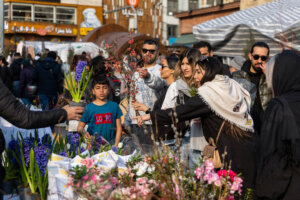
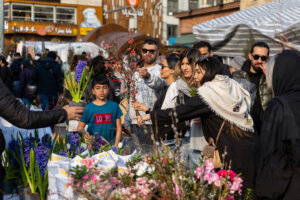
Videos and photos circulating on social media show the bazaar in Tehran, which had been closed since the war began, alive once more with patrons shopping for Nowruz essentials like fresh flowers and greens.
Most Nowruz traditions are shared across religions, but Jews have adapted certain customs to reflect their heritage.
Many Muslim families include a Quran on their haft-seen table, but “We Jews … put a little Torah in there,” Hakakian said. “We just adjust a little bit to include our history, but everything else is the same.” Some Jewish families elect instead to include a book of Hafez poetry, a secular symbol of Iranian culture and literary tradition.
The holiday typically falls a week or two before Passover, which shares similar themes of renewal and rebirth. While Nowruz is traditionally marked by spring cleaning, Sternfeld said many Jewish Iranians connect the two for practical reasons.
“If Pesach is a few days away, you want to use this occasion to get rid of chametz while you’re cleaning for Nowruz.”
The only holiday celebrated in public
In Iran, Jewish holidays are kept quiet, confined to private homes, and sometimes even basements or secret locations to maintain discretion. But Nowruz is the one holiday Jews are able to celebrate outwardly.
“Holidays were stressful. They were very stressful. I associate holidays with having to watch myself. I thought there was no such thing as a carefree holiday,” said the anonymous Iranian Jewish woman.
Cindy Chaouli, an Iranian Jew who left the country in 1978 and now lives in Los Angeles, recalled how “subdued” it felt celebrating holidays like Purim and Passover during her childhood. “It was celebratory, but it was still quiet from the outside world.”
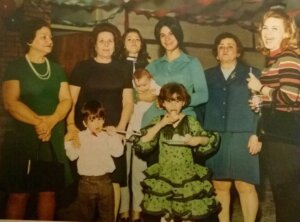
Nowruz, by contrast, spilled into the streets.
“It was totally different,” said Chaouli. “This was the one holiday that was universal. It had nothing to do with religion. You felt it as much outside as you did inside yourself.”
She recalled visiting the homes of non-Jewish neighbors during the holiday.
“I remember going to our neighbor’s house downstairs and having sweets … they’d make a drink called sharbat with cherries, sugar and water. You would just eat and play. It was just extremely celebratory.”
Nowruz in exile
After the 1979 Iranian Revolution, much of Iran’s Jewish community dispersed — many settling in Los Angeles and Long Island, New York, now home to two of the largest Iranian diasporas in the U.S., where Iranians continue to celebrate Nowruz with fervor.
“Here … everyone has parties, all the families get together, we have Nowruz billboards everywhere,” Chaouli said, referring to advertisements across the city publicizing Nowruz events, which this year, honor the plight of Iranians in Iran.
In the days leading up to the holiday, Persian grocery stores become scenes of near chaos. At Elat Market, a kosher Persian grocery store in Los Angeles, the crowds are notoriously intense when Nowruz and Passover coincide.
“There was a woman and her mother — one was standing at this container, filling bags and throwing them over people’s heads,” Chaouli recalled.
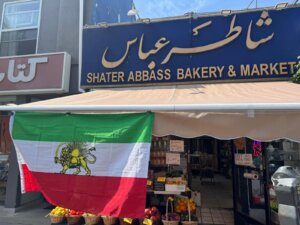
This year, many of the Persian stores are adorning their windows with the pre-revolutionary Iranian flag, a symbol of protest against the Islamic Regime.
Out on the streets, the celebratory mood is unmistakable. “Everyone I say hello to, it’s ‘Happy Nowruz,’” she said. “It’s a very celebratory time here.”
The sense of shared celebration has been tested in recent years. Chaouli said she has felt tensions between Jewish and Muslim Iranians in the diaspora grow in the wake of the Hamas attack on Israel and the Gaza war that followed.
“After October 7, there was definitely a rift and a lot of friendships were lost,” she said.
But with the new war dredging up shared feelings of grief and cautious hope for the country’s future, Chaouli feels Iranians of all religions are celebrating the holiday together more intensely than before.
“I’ve heard multiple people say that it doesn’t feel the same this year,” said Hakakian. “There’s a feeling of guilt to celebrate and to be happy when all this is going on. But at the same time, we say, Nowruz is here. It’s giving us hope.”
In Hakakian’s Persian calligraphy class, which she takes alongside Iranians of different faiths, the holiday became a moment of shared mourning.
“We sat together, and first we said, ‘Happy Nowruz,’ and then we all sat together in a moment of silence for the Iranian people,” she said. “It didn’t matter who’s Jewish, who’s not. We were all grieving for Iranians. And that, to me, was a moment — like, yes, we do need a moment of silence together.”
The post Jews in Iran and in the diaspora find respite in celebrating Nowruz amid war appeared first on The Forward.
Uncategorized
‘Nobody Wants This’ star Adam Brody on Gaza: ‘Put me down as thinking it’s a genocide’
Adam Brody, the Jewish actor who plays a “hot rabbi” on the hit Netflix rom-com Nobody Wants This, called the war in Gaza a genocide in a new interview, making him one of just a few Jewish celebrities to speak out publicly against the Israeli campaign.
The comments came in an interview with GQ about Brody’s efforts canvassing for Democratic candidates in the upcoming midterms.
“Put me down as thinking it’s a genocide. Put me down as wanting a free Palestine,” he said. “It’s awful that it’s taken so much death and misery, but it does feel like it’s reaching a breaking point that it should have a while ago. I’m hopeful that another administration can really do some good and correct some of these policies that are helping that situation be as awful as it is.”
The claim of genocide in Gaza is heavily disputed. Several international bodies, human rights organizations and academic institutions have concluded Israel’s actions in Gaza since Oct. 7 fit the description, including a United Nations Commission of Inquiry. Other similar groups, like the International Court of Justice, have not applied the term.
Brody’s comments were surprising in part because he had previously kept his feelings about the war private, even as other leading Hollywood figures openly criticized it. He does not maintain a public social media presence, and he did not participate in pin-wearing campaigns or sign various petitions related to the war — an approach he indicated he might change going forward.
“I’m not wearing a pin, so I’m not inviting a certain question, and perhaps I should,” he said. “I really admire people who do. But 99% of what I’m asked about is about the show. I’m not trying to plead ignorance—here we are doing a political interview, so it makes sense that we wade into this territory—but I’ve never ducked a question, really, not a political question anyway.”
Brody — who came to fame in the 2000s as the teenager Seth Cohen on The O.C. — joins Hacks star Hannah Einbinder and Wallace Shawn (The Princess Bride) as perhaps the most high-profile Jewish actors to publicly call the war a genocide. Other Jewish entertainment figures, like Mandy Patinkin and The Zone of Interest director Jonathan Glazer, have criticized the war but stopped short of calling it a genocide.
Yet Brody’s comments are perhaps especially notable because of the character he plays on TV. In Nobody Wants This, Brody plays a rabbi dating a non-Jewish woman — introducing her to the beauty and foibles of Jewish faith and culture. Israel has been conspicuously absent from the show, with its creator, Erin Foster, saying she deliberately avoided geopolitics.
Season 3 of Nobody Wants This releases to Netflix October 22.
The post ‘Nobody Wants This’ star Adam Brody on Gaza: ‘Put me down as thinking it’s a genocide’ appeared first on The Forward.
Uncategorized
Why Mamdani remains focused on Israel as NYC mayor
When Israeli Prime Minister Benjamin Netanyahu spoke at the UN this week, New York City Mayor Zohran Mamdani was there — not in body, but in spirit, having condemned the Israeli prime minister and previously encouraged protests against him.
As a leader in the Jewish community, I know that many American Jews oppose Netanyahu’s government. But many also believe strongly that Israel’s survival as a Jewish homeland is critically important. They, therefore, feel boxed in by the mayor: compelled by conscience to oppose Israel’s leader and to condemn Mamdani’s repeated attacks on Israel’s existence, many of which they find offensive and dangerous.
Because of my previous work for Mayor Bloomberg, I am often asked by Jewish community members why this mayor so frequently puts them in this painful bind. The answer, I believe, lies in motivations worth understanding more clearly.
Of course, Mamdani’s focus on Israel seems partially motivated by principle. He clearly thinks Israel is illegitimate and opposes how it defends itself. I take him at his word that these convictions are sincere. But sincerity still does not explain his single-mindedness. A mayor willing to absorb this much political friction must see some benefit. But what?
To understand, let’s reexamine the 2025 election, often described as a “political tsunami.” The facts, however, are more complicated. Mamdani did defeat his closest opponent by nearly 10%, but in so doing he secured under 51% of the total vote – against a flawed and divided opposition. Viewed this way, his impressive margin seems less sweeping and much narrower.
More important than his electoral margin, though, is the coalition that produced it. His victory rested heavily on three blocs: self-identified very liberal voters; and Muslim and South Asian voters, who turned out in historic numbers. South Asian and Indo-Caribbean turnout, for example, rose 350% between 2021 and 2025, with 87% of South Asian votes going to Mamdani. Analyzing available data, I believe that, taken together, these three blocs accounted for well over 50% of all Mamdani votes.
What makes this coalition intriguing is that it consists of such strange bedfellows. The blocs differ sharply on many key local issues. On same-sex marriage, PRRI’s American Values Atlas found 33% support among Muslim-Americans in 2024, with support among very liberal Americans substantially higher. The divergence is similarly stark on policing, education, and many other policies.
In fact, it is hard to identify many things uniting these blocs besides this candidate: a skilled politician speaking the language of the left, while activating Muslim and South Asian voters just as Mayors Bloomberg and Koch activated Jewish voters and Mayors Adams and Dinkins activated Black voters.
Which brings us back to Israel.
When one barely ekes out a majority against flawed opponents, and one’s coalition is fundamentally misaligned, one must find ways to hold it together. To this end, Mamdani seems to be taking a page from Donald Trump. When Trump’s coalition buckles, he reaches for a “shiny distraction” — attacks on the press; trade wars; threatened invasions of Greenland. For Trump, the specifics are almost irrelevant; what matters is the theater of conflict and the distraction it produces.
For Mamdani, his Greenland is Israel.
Yes, it is a subject on which he holds sincere convictions. But, more importantly, it is one of few issues on which his coalition agrees. His relentless focus on Israel — to the exclusion of other worthy targets, including grave human rights offenders across South Asia and the Muslim world — is no accident. It is a political calculation allowing him to don the mantle of moral crusader while keeping his coalition on-side and united.
For those who believe Mamdani’s politics pose a danger to the Jewish community and want to slow his political momentum, this analysis yields two insights.
First, trying to persuade the mayor to soften his Israel attacks is unlikely to succeed. Doing so is not his inclination or in his political interests.
Second, and maybe more interestingly, Mamdani has a vulnerability that he seems to recognize – a fragile coalition. Allowing Mamdani to
make Israel his “shiny distraction” and engaging him on it plays his game. A different approach would be to defend Israel as-needed, but focusing efforts on pressing Mamdani to do his job – for example, elevating important issues, such as specialized high school admissions practices, on which his coalition happens to be divided.
The upshot? When smart politicians do things that seem politically risky, they usually see something others do not. Mamdani’s Israel focus offers a case-in-point. Those looking to respond should consider resisting the temptation to take the bait when possible. The wiser strategy is to engage under different rules: defending Israel when necessary, then pivoting to the difficult local issues from which Israel is meant to distract.
The post Why Mamdani remains focused on Israel as NYC mayor appeared first on The Forward.
Uncategorized
New voices in Yiddish: A prose and poetry contest
לכּבֿוד דעם 85סטן יאָר זינט מע האָט פֿאַרלייגט דעם ייִדישן זשורנאַל „אױפֿן שװעל“, וועט די אָרגאַניזאַציע וואָס שטיצט דעם זשורנאַל, די „ייִדיש־ליגע“, דורכפֿירן אַ קאָנקורס פֿון נײַע ייִדיש־שפּראַכיקע לידער און פּראָזע.
אַ זשורי פֿון אָפּגעקליבענע מומחים וועט אָפּשאַצן די אַרבעטן, און די דרײַ בעסטע פֿון ביידע קאַטעגאָריעס וועלן באַלוינט ווערן מיט געלטפּרעמיעס.
די פּראָזע־שאַפֿונגען קענען זײַן ביז 2,500 װערטער, און אַלע אַרײַנגעשיקטע מאַטעריאַלן מוזן זײַן נאָך נישט קיין געדרוקטע. דער טערמין אַרײַנצושיקן די שריפֿטן איז דער 31סטער אָקטאָבער 2026.
די געווינער-ווערק, און בכלל אַן אָפּקלײַב פֿון די אַרײַנגעשיקטע שאַפֿונגען, וועט מען אויך דרוקן אין דעם יובֿל-נומער. „זאָלן אונדזערע לייענערס געניסן פֿון נײַע ליטעראַרישע שאַפֿונגען אויף מאַמע-לשון!“ האָט די שעף־רעדאַקטאָרין פֿון „אויפֿן שוועל“, מרים טרין, געזאָגט.
די שריפֿטן שיקן מען דורך בליצפּאָסט צו info@leagueforyiddish.org.
The post New voices in Yiddish: A prose and poetry contest appeared first on The Forward.
