



Uncategorized
The Verdict Came First: How the ‘Genocide’ Charge Against Israel Was Preloaded

Students accusing Israel of genocide at Harvard University in Cambridge, Massachusetts, US, Nov. 16, 2023. Photo: REUTERS/Brian Snyder
On Holocaust Remembrance Day, which just ended in Israel, we are asked to do something very specific: remember, in detail, what actual genocide looks like.
Six million murdered. Their annihilation planned, industrialized, and executed.
In 2026, many Jews marking that day encountered something else at the same time: a flood of accusations on their phones and screens that Jews — through the State of Israel — are now committing or supporting “genocide.”
That term was coined because of the Holocaust.
Now it is deployed against its primary historical victims — even on the very day they commemorate it.
That is not coincidence. It is the endpoint of a narrative that was built in advance — and activated on cue.
On October 7, while Hamas terrorists were still inside Israeli communities massacring families — the word “genocide” was already being widely applied on Western college campuses and on the streets of Western capitals.
Not against Hamas. Against Israel.
Not after the facts. Not after a response. During the massacre itself.
Within hours of the October 7 massacre, social media platforms were saturated with claims that Israel’s response — which had not yet meaningfully begun — was “genocide.” This wasn’t fringe noise. Activists, influencers, and NGO-adjacent voices were deploying the charge in real time, before a battlefield even existed.
That should have ended the discussion. It didn’t — because this wasn’t an evidentiary claim. It was a preloaded one.
For years, a campaign — linguistic, political, and ideological — had been methodically reframing Israel from a state engaged in conflict with openly authoritarian enemies into a uniquely illegitimate actor. The progression was deliberate. Jewish self-determination became “settler colonialism.” Defensive wars became “Israeli aggression.” Territorial disputes became “war crimes.” And “war crimes,” predictably, became — “genocide.”
By October 7, the most damning label in international law was not waiting to be earned. It was waiting to be deployed.
And it was.
But, if “genocide” had been occurring in Gaza in the years leading up to this war, as anti-Israel activists and NGOs had been claiming for years, it would show up first in the most basic indicators: population decline, collapsing life expectancy, rising infant mortality.
The opposite occurred.
Gaza’s population grew from roughly 1.1 million in the early 2000s to around 2.2 million by 2023. Life expectancy rose from the high 60s in the 1990s to approximately 74–75 years by the early 2020s. Infant mortality declined significantly over that same period, falling from roughly 30–35 per 1,000 live births in the 1990s to the mid-teens by the 2020s.
Those are not marginal data points. They are baseline indicators used in any serious assessment of population-level destruction.
Yet throughout those same years — before Israel fired a single shot in response to October 7 — the charge of “genocide” was already embedded in anti-Israel activist and academic discourse.
In modern conflicts, whoever defines the terms early often shapes the perception of the war. Here, the “genocide” framing was set before Israel mobilized, before it attempted to rescue hostages, before any sustained military campaign began.
“Genocide,” however, is a legal term with a precise and demanding definition under international law: the specific intent to destroy, in whole or in substantial part, a national, ethnic, racial, or religious group as such.
When that standard has been met historically, the evidence has been overwhelming. As it was during the Holocaust, as well as the Armenian and Rwandan genocides.
But nothing in Israel’s conduct in the October 7 war meets that standard.
Israel has issued evacuation warnings, facilitated humanitarian corridors, and coordinated large-scale humanitarian efforts — including vaccination campaigns to prevent disease outbreaks — while targeting military objectives in a battlefield deliberately embedded within civilian infrastructure. The adversary it was fighting in Gaza — Hamas — operates without uniforms, places command centers beneath hospitals, stores weapons in residential buildings, and constructed an underground tunnel network exceeding 500 kilometers, with entrances embedded almost entirely within and beneath civilian areas.
This is not incidental. It is strategic.
As military analysts like John Spencer have repeatedly explained, warfare in such an environment inevitably produces civilian casualties — even when the attacking force operates within the bounds of the law of armed conflict. And even the casualty figures cited to support the “Gaza genocide” accusation collapse under scrutiny.
Hamas-controlled sources have reported roughly 70,000–75,000 deaths over the course of more than two years of war. These figures are opaque, unverifiable in real time, and do not reliably distinguish between civilians and combatants, as well as those who died from natural causes (which before October 7 averaged at around 7,000 per year). Israeli and independent analyses have consistently assessed that a substantial portion — often estimated in the tens of thousands — are Hamas and Islamic Jihad terrorists.
Additional demographic analysis has shown a disproportionately high percentage of fatalities among males in the 15–40 age range — the cohort most likely to be combatants — relative to their approximately 20% share of the overall population. That is not what indiscriminate or exterminatory warfare looks like. It is what targeted engagement with a fighting force that wears civilian attire looks like in a dense urban environment.
Even taking the higher-end figures at face value, the numbers do not resemble “genocide.” They reflect a brutal, protracted urban war against an embedded militant force — not an effort to destroy a population. Gaza’s population has not collapsed. There has been no systemic attempt to eliminate it as such.
Both intent and outcome matter. Neither here support the charge.
Which brings us back to the beginning.
The verdict did not emerge from the evidence. It preceded it.
And the fact that it now saturates public discourse — even as Jews commemorate the historical event that gave the term its meaning — only underscores the point: this is not law being applied. It is language being weaponized.
Once introduced, the accusation became self-reinforcing. NGOs cited one another. Media outlets cited NGOs. International bodies cited both. Assertions hardened into assumptions, and assumptions into accepted “truths,” all without meeting the evidentiary burden such a charge requires.
This is how modern blood libels function.
For centuries, Jews have been accused of uniquely monstrous crimes — poisoning wells, intentionally spreading disease, engaging in ritual murder. The language evolves. The pattern does not. The accusation is absolute. The credible evidence is non-existent. The conclusion is predetermined.
Today, the claim is “genocide.”
The scale of that accusation demands rigor, discipline, and proof.
Instead, the verdict came first. And everything since has been an attempt to justify it. And to try and shame — as “deniers” — those who stand up to it.
Micha Danzig is an attorney, former IDF soldier, and former NYPD officer. He writes widely on Israel, Zionism, antisemitism, and Jewish history. He serves on the board of Herut North America.
Uncategorized
A pioneering Reform synagogue makes way for a booming Iranian Jewish community
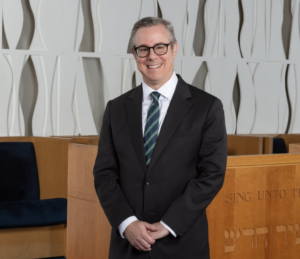
Temple Beth-El is an island of Reform Judaism in the Iranian milieu of deep Great Neck, a suburb on the North Shore of Long Island 35 minutes away from Manhattan by train. There are around two dozen synagogues in Great Neck; three of them are Reform, and two of those are tucked away at the edges of the peninsula. Temple Beth-El stands bravely at the center, with frontage on Middle Neck Road, the main street, just steps away from multiple Orthodox synagogues and kosher restaurants serving a spectrum of cuisines.
As an Iranian-American Jew from Great Neck, I’ve been to Temple Beth-El twice before: once, in middle school, for a classmate’s bar mitzvah, and then, in 2021, to get the COVID vaccine. I called it, simply, “the Ashkenazi synagogue.” Tonight, as the oldest synagogue in Great Neck prepares to downsize, I am here for the third time ever, for Friday night services.
Temple Beth-El formed in 1928, when Great Neck was dominated by Protestants. The presence of the synagogue made even more Jews from the city want to move east. Its rabbis were outspoken civil rights activists and hosted Martin Luther King, Jr. in 1967. Now, as Great Neck’s demographics shift further toward more religious Jews, Temple Beth-El’s congregation is shrinking. The synagogue is selling its property to an Iranian Orthodox yeshiva and will be leasing back a portion of it.
In the mid 1980s, Temple Beth-El had around 1,500 families, with a 500-person waiting list, said Stuart Botwinick, the synagogue’s executive director. Now, as members have died off and younger ones aren’t joining as quickly, it has around 400, and can’t fill up its main sanctuary on Rosh Hashanah. Wielding cold economic calculus, I can envision someone arguing that if fewer people choose to attend a synagogue, then whatever happens to it must be natural, or deserved. I can even envision myself arguing that. It’s not guilt, because I did nothing wrong, but as a member of the majority group, some sense of duty makes me want to see with my own eyes what is being lost.
A man hands me a siddur and wishes me a Shabbat shalom. The chapel is beautiful, with a dark wood vaulted ceiling, stained glass and hanging lanterns. I find a seat in the gender-integrated pews among some 30 congregants. I try to follow the prayers, but I don’t know any of the tunes — my home synagogue is not nearly this musical. I am surprised to see some men not wearing kippahs. Rebelliously, I stray from the page everyone else is on and flip briefly to the back of the siddur. There are lyrics to “Hatikvah,” “America the Beautiful,” “God Bless America,” “The Star-Spangled Banner” and, maybe worst of all, “O Canada.” My inner Satmar rebbe shudders.
Fortunately, national hymns are not part of tonight’s repertoire. From the bimah, the rabbi, Brian Stoller, outs me as a Forward reporter. The moment the service ends, several excited Ashkenazi seniors approach me; clearly, the name of this news outlet carries much more clout here than in my typical Great Neck circles.
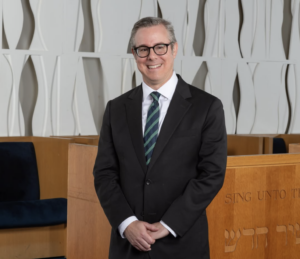
Stoller holds an optimistic vision of Temple Beth-El’s future that emphasizes adult education and cultural arts above physical space. In other words, “we’re not here to be landlords,” says Jennifer Still-Schiff, a co-president of the synagogue sisterhood. Still, losing ownership and part of their space must be somewhat traumatic. Once the service ends, Howard Herman, an honorary vice president of the board who’s been a member since the 1980s, gives me a tour and shows me all of the things the synagogue will need to sell.
“We have this beautiful Judaica museum, and we’re going to be selling it or giving a lot of it away,” he says. Then he shows me the large sanctuary. We can’t find the light switch, so we turn on our cell phone flashlights to inspect a 55-foot-long sculpture behind the bimah: “The White Flame of the Six Million” by Louise Nevelson. In the sculpture, which integrates the Torah ark, shapes carved out from white wood represent the uniqueness of every life lost in the genocide. “We’re going to have to sell this,” Herman says. “Who can buy this?”
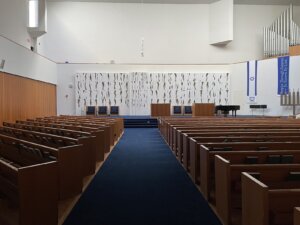
That sanctuary, where Temple Beth-El used to hold regular Shabbat services and now only holds High Holy Day services, seats almost 900 people. It will become part of the yeshiva’s space. Sisterhood co-president Rochelle Rosenbloom says the chapel, which seats about 250, will be enough to seat worshipers even on the High Holy Days. If it isn’t, she and Still-Shiff said, they can stagger two sets of services or have people watch the services on a TV in the lobby.
At a time when Great Neck was still mostly Christian, the existence of Temple Beth-El “was an essential sign that Jews could live in Great Neck and that there were enough of them, committed to religious participation through the Reform movement, to make it safe and desirable for others to try it out,” historian Judith Goldstein wrote in her book Inventing Great Neck. It was the peninsula’s only synagogue until 1941, when Temple Israel of Great Neck formed, said Brad Kolodny, an amateur historian of Long Island Jewish history. In the 1960s, Jews — particularly liberal, Reform Jews — began to outnumber Christians in Great Neck. Temple Beth-El had to build a bigger sanctuary. At times, even that sanctuary — the one with the Holocaust memorial sculpture — filled up, and administration had to set up overflow seating in other rooms.
Persian synagogues started cropping up in Great Neck after the Islamic Revolution in 1979. Great Neck has Iraqi and Syrian synagogues, too, plus several synagogues that are not officially Mizrahi but have Mizrahi congregants. Now, any car trying to drive on, say, Steamboat Road on a Saturday morning must use caution, as the sidewalks aren’t wide enough for the large groups of skipping children, bike-riding kippah-clad young men, and moms pushing double strollers in their Shabbat finest.
People in the Jewish world can get accused of being “Ashkenormative,” but since 1979, Great Neck has become Mizrahi-normative. When I was a child, a last name like “Weiss” or “Katz” connoted nothing to me, and for the longest time I assumed that my classmates whose hair was lighter than mine couldn’t possibly be Jewish. I used to watch The Nanny with my mom; one night, as Fran and Sylvia Fine peppered their speech with schleps, schvitzes, and other Yiddishisms, I asked my mom what language the characters were speaking. “I don’t know,” she said.
Fran was a prime example of what I eventually came to understand as the stereotype of the liberal American Jew, a character so familiar to American audiences that she could speak Yiddish and expect to be understood. But as the growth of the Orthodox community outpaces that of other denominations, I realize that stereotype is becoming less and less accurate. Forty-four percent of Jews ages 65 or older identify as Reform, but only 29% of Jews who are 18 to 30. And more concerningly: among people raised Reform, 12% of them are “no longer Jewish,” according to a 2020 Pew research study. When, in 1994, Fran Fine wished for “a husband and a house in Great Neck,” she was talking about a place already in flux, a place where a legacy of civil rights activism would soon give way to people who voted heavily for Donald Trump and helped elect George Santos.
When I told my mom I was writing about Temple Beth-El, she told me in an approving tone of voice that they lend out wheelchairs and other medical equipment for free, and collect donations from families of people who’ve died and no longer need theirs. Indeed, “social action” is an important value here: The synagogue also sends volunteers to an interfaith food pantry based at a local church, and some congregants volunteer to support undocumented immigrants, said Botwinick.
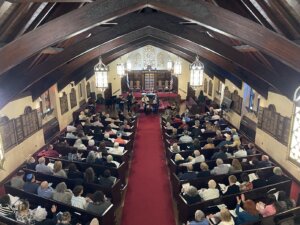
That willingness to look outward distinguishes Temple Beth-El from, say, my synagogue, and Botwinick argues many Iranian Jews benefit from it. “We believe that the Jewish community and the greater community actually falls in line with a lot of what we do and what we believe,” but doesn’t say so “because of cultural pressures,” Botwinick said. “Equal rights is important, health is important, caring for the immigrant community matters. It takes a strong voice — Temple Beth-El is that strong voice — to say these things matter.”
This is the most compelling thing anyone has told me for this story: that even Orthodox Jews benefit from having a Reform synagogue for a neighbor. If, for example, Temple Beth-El hadn’t opened as a vaccine hub, I struggle to see my synagogue, where many congregants are vaccine-skeptical, filling that gap.
Dr. Gary Zola, Temple Beth-El’s historian in residence, addressed the threats of decline facing Reform Judaism in a March 13 sermon, and said the synagogue’s long history should serve as a source of hope. “Let’s not forget that 98 years ago, a handful of Jewish scholars decided to create a Jewish community out of nothingness.”
“It is clear that the enervation of liberal Jewish life is a challenge,” he said, “but it’s a challenge that awaits our response.”
The post A pioneering Reform synagogue makes way for a booming Iranian Jewish community appeared first on The Forward.
Uncategorized
Top British private Jewish school closing amid funding challenges
(JTA) — Immanuel College, a top-ranked Jewish private day school in the outskirts of London, announced on Tuesday that it will close its doors at the end of this year amid financial pressures and declining enrollment.
“This is an incredibly difficult and painful moment,” Daniel Levy, the chair of governors for the school, said in a statement. “Immanuel College has been a cornerstone of education and community life for more than 35 years, and we know how deeply this news will be felt by all those connected to it.”
The Modern Orthodox Jewish day school, which was ranked the U.K.’s top-performing Jewish school in The Sunday Times Parent Power Guide in 2025, is one of a small number of independent Jewish schools in the London area.
Founded in 1990 by Lord Immanuel Jakobovits, the former Chief Rabbi of the British Commonwealth, the school serves roughly 360 pupils ages 10-18. Last year, Immanuel College’s prep school also shut down due to “unprecedented financial pressures.”
The school sits alongside a much larger network of state-funded Jewish schools, including the prestigious JFS (formerly Jews’ Free School) and the Jewish Community Secondary School.
Levy said that the school was “committed to ensuring that every pupil is guided to the right next step,” and was working with schools across the Jewish and independent school landscape to find placements for its students. (Independent schools in the U.K. are fee-paying private schools, while state schools are government-funded and free to attend.)
A press release pinned the closure on a litany of factors, including “the introduction of VAT on independent school fees, rising operational costs driven by inflation and increased National Insurance contributions, and a decline in pupil numbers.”
VAT, or the U.K.’s value added tax, was applied to private schools in the country last year after they were previously exempted from it.
In the release, the school also said the decline in enrollment “reflects a broader trend across the sector, with a growing number of independent schools closing in recent years.”
“Additionally, changing dynamics within the Jewish education landscape, including the increased popularity of Jewish state schools, have contributed to reduced enrolment,” the release continued, adding that Immanuel faced ongoing annual losses exceeding £2 million, or $2.3 million.
Oliver Dowden, a British lawmaker and member of the Conservative Party, lamented the closure in a post on X, writing that it was “yet another victim of Labour’s VAT raid on private schools.”
“Very sad to learn of closure of the brilliant Immanuel College at the end of the current academic year. A real blow to Bushey and the Jewish community,” Dowden wrote, referring to the Hertfordshire village where Immanuel is located.
Writer and political analyst Arieh Kovler described the school as an “oddity” in the British Jewish educational landscape, writing in a post on X that it was “not religious enough for ‘black hat’ type modern Orthodox, not prestigious enough for parents who want excellent private schools, and parents who just want a Jewish school for their kids have many free state options now.”
According to Britain’s Institute for Jewish Policy Research, of the Jewish children enrolled in Jewish schools, 60 percent attend haredi (or “strictly”) Orthodox schools, a figure that does not include haredi Orthodox teenagers studying in yeshivot and seminaries not included in government data. In the 1990s, only 46 percent of Jewish students attended haredi schools.
For many parents and members of the British Jewish community, the loss of the school cut deep.
“At a time when our children’s strength in their own identity is so essential, it feels doubly tragic for a school that instills that Jewish pride to close,” Naomi Greenaway, an Immanuel College parent and journalist, wrote in an op-ed in The Jewish Chronicle. “But this tragedy is one that the Immanuel College community of parents, pupils, teachers, trustees, governors and alumni will have to mourn together.”
Rabbi Alex Chapper, the leader of the Borehamwood & Elstree United Synagogue in England, wrote in a post on Facebook that the closure served as a reminder of “just how important Jewish education is for our community.”
“It must never be taken for granted, outsourced, or undervalued,” Chapper wrote. “Instead, we should redouble our commitment to supporting the education of the next generation, so they can build a proud, knowledgeable, and confident Jewish future.”
The Hertfordshire Friends of Israel also mourned the closure in a post on Facebook, writing, “This is more than just a school closure story, it’s about a community, a legacy and the growing pressures on Jewish education across the UK.”
This article originally appeared on JTA.org.
The post Top British private Jewish school closing amid funding challenges appeared first on The Forward.
Uncategorized
Hochul pushes 25-foot buffer around New York houses of worship as Mamdani wavers on local bills
New York Gov. Kathy Hochul on Tuesday doubled down on her support for proposed legislation that would create a 25-foot buffer zone around houses of worship statewide, stepping into a growing debate over public safety and free speech in a move that puts her at odds with New York City Mayor Zohran Mamdani.
Hochul, who is running for reelection this year, pushed the plan ahead of a final budget agreement with the state Legislature, now more than two weeks past its April 1 deadline. It comes as Mamdani has declined to say whether he will sign a more limited measure passed by the City Council aimed at curbing disruptive demonstrations outside synagogues and schools.
“I want to get that done,” Hochul, speaking alongside Jewish leaders and law enforcement officials, said about her proposed 25-foot buffer, which would be upheld by police around places of worship. “That is common sense. It’s a statement when people leave their homes, that they will feel safe from harassment.” She added that the fear of Jews facing antisemitic attacks and harassment “is not a hypothetical. It is happening. It has happened, and the effects are lingering.”
The governor’s proposal marks a more aggressive statewide approach than the one recently passed by the New York City Council, led by Speaker Julie Menin, who is Jewish, as anti-Jewish incidents continue to make up a majority of reported hate crimes in New York. The Council’s package of bills directs the NYPD to develop a plan within 45 days for managing protests near houses of worship and educational institutions. The synagogue-focused measure passed 44–5 — a veto-proof margin — while a companion bill addressing protests near schools cleared the chamber with a narrower majority.
Mamdani, a strident critic of Israel who rose to power aligned with pro-Palestinian activism, has not committed to signing or vetoing the legislation, citing “serious concerns” raised by free speech advocates and pro-Palestinian supporters about limiting New Yorkers’ constitutional rights. Under city law, the bills could also become law automatically if he takes no action within 30 days.
The mayor, however, did publicly express objections to the Council’s initial proposal to establish buffer zones of up to 100 feet outside synagogues. “I wouldn’t sign any legislation that we find to be outside of the bounds of the law,” he said. The perimeter proposal was omitted in the final version of the bill following reservations expressed by Police Commissioner Jessica Tisch, who cautioned that a one-size-fits-all rule might not withstand legal challenge and could prove unworkable across neighborhoods with vastly different street layouts.
A City Hall spokesperson referred to Mamdani’s previous statements when asked for comment on the Hochul proposal. The state measure could supersede any action he takes.
The proposals emerged following disruptive protests outside houses of worship in recent months centered on events promoting immigration to and real estate in Israel, at Park Avenue Synagogue in Manhattan and Young Israel of Kew Gardens Hills in Queens.
Hochul was uncompromising about her approach. “I believe I have the right to protect people’s constitutional right to free exercise of religion,” she told reporters. “And so if that needs to be tested in court, bring it on.”
Hochul, who endorsed Mamdani in the mayoral election last year, has maintained a warm relationship with Jewish leaders since becoming governor. If passed, the buffer zone bill could bolster her chances among the state’s more than one million Jewish voters against Bruce Blakeman, the Republican candidate and the first Jewish executive of Nassau County on Long Island. In 2022, former Rep. Lee Zeldin came within five percentage points of winning the governor’s race, powered by strong Jewish support.
Hochul made the announcement to call for an additional $70 million in funding for the state’s Securing Communities Against Hate Crimes program, which provides grants to protect vulnerable institutions, as well as a new online system for reporting bias incidents. Hochul has already allocated $131 million in grants for a total of 1,745 security projects since taking office in 2021.
The post Hochul pushes 25-foot buffer around New York houses of worship as Mamdani wavers on local bills appeared first on The Forward.