



Uncategorized
Stop Platforming Bigotry and Hate: We Can’t Build Bridges with Destructionists

US Rep. Alexandria Ocasio-Cortez (D-NY). Photo: Mike Jourdan/Flickr.
A society that cannot distinguish between a critic and a destructionist is a society in the process of dismantling itself.
For decades, the leaders of Western institutions — universities, legacy media, and political think tanks — have operated on the Liberal Consensus Model. This model assumes that every stakeholder, no matter how radical, ultimately wants a seat at the table to negotiate a better version of the status quo.
But we are currently witnessing the total collapse of this assumption. Institutions are mistaking a siege for a negotiation.
The “Destructionist” does not want a seat at the table; they want to use the wood for kindling. When an institution offers a “bridge” to someone whose starting premise is the dismantling of liberal democracy or the erasure of a people, they aren’t practicing “inclusion.” They are providing a tactical ramp for an assault.
This is not a “Left” or “Right” problem; it is a vulnerability of the center. Across the political spectrum, we see the same mechanics of “laundering” at work — where moderate leaders trade their institutional credibility for access to a radical’s megaphone.
On the left, we see the normalization of figures like Hasan Piker. When the “Pod Save America” crew or politicians like Alexandria Ocasio-Cortez (D-NY) treat Piker as a “bold youth voice,” they are signaling that his destructionist starting points — such as supporting the eradication of Zionism — are within the bounds of a reasonable democratic coalition.
They frame it as “outreach,” failing to realize that they are importing eliminationist rhetoric into the heart of the mainstream.
On the right, the rot is equally visible in the laundering of Tucker Carlson. When Kevin Roberts, President of the Heritage Foundation, or politicians like Vice President JD Vance defend Carlson even as he platforms Holocaust revisionists and Nazi apologists, they are breaking a decades-old covenant. By framing Carlson’s descent into conspiratorial bigotry as “challenging the establishment,” they are laundering a brand of hatred that was rightly ostracized from the movement generations ago.
In both cases, these “bridge-builders” suffer from a form of institutional narcissism: the belief that their own empathy or political utility is powerful enough to transcend a destructionist ideology. They believe they can negotiate a floor plan with an arsonist who has already lit the match.
It is common to lump these figures in with Joe Rogan, but the distinction is critical for understanding where our accountability must lie.
Rogan is a private citizen having a public conversation. While he causes undeniable material harm by uncritically platforming bigoted views –and we should absolutely pressure him to do better — he is fundamentally only representing himself.
Conversely, we must hold the Ezra Kleins, the Jon Favreaus, and the Heritage Foundations to a far higher standard because they represent institutions. When a gatekeeper stops guarding the gate on behalf of an institution, the gate ceases to exist. Rogan is a symptom of a culture that finds fire interesting; these institutional leaders are the architects who were supposed to be building the firewalls. Their failure is not just an error in judgment; it is professional malpractice.
The solution is not state-censorship, but a renewal of communal self-respect. We must re-learn the lesson of how we defeated the KKK: we didn’t “win the debate” at a shared seminar; we made the white hood socially disqualifying.
The path forward requires a two-fold strategy:
1. Enforce “Social Jail”
We must return to a model of principled ostracization. If your starting point is the destruction of a people or the subversion of the democratic covenant, you belong in “social jail.” This is not “cancel culture” — which often offers no path back — but a boundary. Social jail allows for repair. When an individual renounces the destructionist framework and demonstrably accounts for the harm they’ve advocated through public renunciation and restorative action, the door can be reopened. But until then, the line must be held.
2. Critical Friction vs. Laundering
Journalists and pundits must stop acting as facilitators. If they choose to engage with these figures, the “friendly engagement” model must be replaced with hostile exposure. You can interview an arsonist about why he likes fire, but you don’t hire him as a fire safety consultant.
The standard defense for this laundering is the phrase: “I don’t agree with everything he says.”
In the context of eliminationist bigotry, this is not a defense; it is a confession of moral cowardice — or at best, professional dereliction. To be a journalist or a civic leader is to have the courage to name the “tripwire.” If you platform a bigot, you have a professional obligation to state, explicitly, which of their hateful taboos you oppose. If you refuse to name the bigotry — if you treat it as a mere “difference of opinion” — you are not conducting an interview; you are providing a sanitation service.
We have spent years building bridges with people who are committed to destroying them. We have watched as they used those bridges to infiltrate our schools, our media, and our political parties.
It is time to stop being the architects of our own demise. If we cannot say “No” to those who wish to see our foundations destroyed, our “Yes” to progress and our democratic system will eventually mean nothing at all. We must stop exhausting our moral vocabulary on minor transgressions so that we have the collective clarity required to name the destructionists for what they are.
It is time to stop building the bridge and start holding the line.
Uncategorized
Iran Fast-Boat Swarms Add to Hormuz Threats for Shipping

A satellite image shows a fleet of small boats at sea, north of the Strait of Hormuz near the Kargan coast, Iran, April 22, 2026. Photo: European Union/Copernicus Sentinel-2/Handout via REUTERS
Iran‘s use of a swarm of small, fast boats to seize two container ships near the Strait of Hormuz could undermine suggestions US forces have disabled its naval threat and reveals the challenges facing reopening one of the world’s most important oil export routes.
US President Donald Trump on Monday acknowledged that while Iran’s conventional navy had been largely destroyed, its “fast-attack ships” had not been considered much of a threat.
He said any such vessels coming near a US blockade set up outside the strait would be “immediately ELIMINATED” using the “same system of kill” deployed in the Caribbean and Pacific where US air strikes have hit suspected drug boats and killed at least 110 people.
Those boats were not attacking large, unarmed commercial ships, however, nor nearly as heavily armed, with Iran‘s Revolutionary Guards packing heavy machineguns, rocket launchers and, in some cases, anti-ship missiles.
Speedboat attacks now form part of a “layered system of threats,” alongside “shore-based missiles, drones, mines, and electronic interference to create uncertainty and slow decision-making,” Greek maritime security company Diaplous told Reuters.
Iran was estimated to have hundreds, if not thousands, of these boats before the war, often hidden in coastal tunnels, naval bases, or among civilian vessels, according to maritime security specialists.
Some 100 or more may have been destroyed since the Iran war began on Feb. 28, said Corey Ranslem, chief executive of maritime security group Dryad Global.
CHANGE IN TACTICS
Before this week, Iran had relied on missile and drone strikes to hit shipping traffic around the strait, a route which normally handles 20% of the world’s daily oil and liquefied natural gas supply.
Those attacks had stopped with the April 8 ceasefire.
The seizure of the two container ships by Iran followed Washington imposing a blockade on Iran‘s trade by sea and the start of it intercepting Iran-linked oil tankers and other ships.
“The civilian shipping industry is not equipped to prevent Iranian armed forces from seizing vessels,” said Daniel Mueller, a senior analyst at British maritime security company Ambrey.
Typically, about a dozen boats are used in a seizure operation, he added.
Iran‘s fast boats now serve as the “backbone” of Iran’s naval strategy, able to deploy rapidly as part of its “asymmetrical war against the enemy,” a senior Iranian security official told Reuters.
“Because of their very high speeds, these boats can successfully carry out hit-and-run attacks without being detected,” the official said, speaking on condition of anonymity.
FAST BOAT LIMITATIONS
Including this week’s seizures, Iran has used small, fast boats at least seven times going back to 2019, Ambrey’s Mueller said.
High winds and swells in the waters off Iran during summer make it hard to conduct such operations, said one Iranian shipping source familiar with the waters.
“When it is very bumpy, they [armed forces onboard] cannot shoot,” the source said.
They are also ill-equipped to go head-to-head with a warship, and would likely suffer “very heavy casualties” in any direct assault on one, said Jeremy Binnie, a Middle East specialist at defense intelligence company Janes.
“Even if they tried to saturate the ship’s defenses by attacking from multiple directions, they would be extremely vulnerable to the air support that would be called in,” he said.
On paper, guided missile strikes would easily destroy these boats, but shoulder-fired missile launchers would pose a threat to low-flying US aircraft, Binnie said.
“It is going to be much harder to eliminate the small boat threat than it was to destroy Iran’s larger naval vessels, which were big targets that were relatively easy to find and track and, at most, only had a limited ability to defend themselves from air attack,” he said.
The reality for the shipping sector is further disruption as well as elevated insurance costs.
After the so-called “tanker war” of the 1980s, Iran increasingly used asymmetric tactics as the Iranian navy was effectively destroyed, much as it has been in the current conflict, said Duncan Potts, a director with consultancy Universal Defense and Security Solutions and a former British Royal Navy vice admiral.
“When the US Navy and the president say, ‘We’ve destroyed the navy, we’ve sunk a frigate off Sri Lanka’ – you’ve done that before, but you’ve forgotten that your opposition here went asymmetric. And they’ve perfected it.”
Uncategorized
UK’s Starmer Worried by Foreign-Backed Proxy Attacks on Jewish Sites in Britain

British Prime Minister Keir Starmer and US President Donald Trump (not pictured) hold a bilateral meeting at Trump Turnberry golf course in Turnberry, Scotland, Britain, July 28, 2025. Photo: REUTERS/Evelyn Hockstein
British Prime Minister Keir Starmer said on Thursday he was “increasingly concerned” about a growing use of proxies by foreign states to carry out attacks in Britain, pledging to bring forward new legislation following recent attacks.
London has seen a string of attacks – mostly arson – on Jewish-linked sites in recent weeks. Some of these are being investigated by counter-terrorism officers, although police say they are not currently being treated as terrorist incidents.
British authorities have increasingly pointed to hostile state activity as part of the backdrop to recent incidents, warning that foreign governments may seek to operate through criminal networks or proxies to maintain deniability.
“I’m increasingly concerned that a number of countries are using proxies for attacks in this country,” he said, speaking after meeting members of the Jewish community at Kenton United Synagogue, which was the target of an arson attack last Sunday.
The fire caused minor smoke damage to an internal room and there were no injuries. A 17-year-old British boy pleaded guilty on Tuesday to arson not endangering life in connection with the incident.
“We have to deal with malign state actors,” Starmer said, adding that it would require legislation by the government.
“I want this country to be a place where everybody feels safe and secure. This is not just a battle for the Jewish community,” Starmer said. “It is our battle. The Britain that I want is a Britain where people can practice their religion, their faith, in safety and security.”
British counter-terrorism police on Wednesday made two further arrests over an alleged plot to carry out an arson attack on a Jewish-linked site in London.
Detectives arrested two men aged 19 and 26 in Watford, northwest of London, on Tuesday, police said. Both remain in custody.
Police did not name a specific location but said the intended target was connected to the Jewish community.
Seven other people arrested earlier in the investigation have since been released on bail, London’s Metropolitan Police said.
British police have been investigating the string of attacks as part of a wider rise in antisemitic threats and criminal activity since the outbreak of the Israel-Hamas war in Gaza in October 2023.
Uncategorized
Son of Former Shah of Iran Appeals to Western Countries for Support
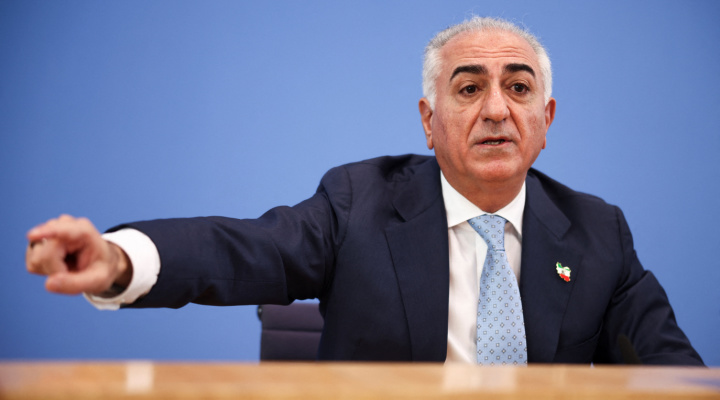
Reza Pahlavi, the exiled son of Iran’s last shah and an Iranian opposition figure, gestures as he speaks during a press conference at the House of the Bundespressekonferenz in Berlin, Germany, April 23, 2026. Photo: REUTERS/Liesa Johannssen
The son of the former Shah appealed to Western countries to join the war against Iran and criticized the decision of the German government not to meet him during his visit to Berlin on Thursday.
Reza Pahlavi, whose father was deposed in the revolution that brought Ayatollah Ruhollah Khomeini to power in 1979, accused Europe of standing by and allowing the Tehran government to continue the bloody repression of protests that killed thousands at the end of last year.
“The question is not whether change will come. Change is on the way,” he told a press conference in Berlin. “The real question is how many Iranians will lose their lives while the community of Western democracies continue to merely watch.”
Demonstrations by both supporters and opponents were held in central Berlin and a person was detained after Pahlavi, who made an appearance, was spattered with some form of red liquid.
POTENTIAL OPPOSITION LEADER
Pahlavi, who has spent most of his life in exile, emerged as a potential opposition leader after anti-government protests erupted in Tehran and other Iranian cities last year.
But Iran‘s opposition movements are deeply divided and many Western governments have been cautious about offering their endorsement because it remains unclear what support he enjoys, almost half a century after his father’s reign was overturned.
European countries, including Germany, have ruled out joining the United States and Israel, which opened the war on Feb. 28 with a wave of airstrikes that killed Iran‘s Supreme Leader Ayatollah Ali Khamenei.
Pahlavi’s visit to Germany came as efforts to end the conflict appear to have stalled, with Iran and the United States both maintaining blockades of the vital Strait of Hormuz, the conduit for around a fifth of the world’s oil.
He said it was a shame that Chancellor Friedrich Merz’s government had not offered a meeting during his visit to Germany.
“Exercise your prerogative. As democracies, you’re entitled to talk to whoever you want,” he said.