



Uncategorized
Hamas Exploits Gaza Ceasefire to Rebuild Military Power, Tighten Civilian Control

Hamas fighters on Feb. 22, 2025. Photo: Majdi Fathi via Reuters Connect
As tensions in the Middle East escalate and global attention focuses on the war with Iran and fragile talks over Lebanon, Hamas is quietly exploiting the ceasefire in Gaza to tighten its grip on civilian life while rebuilding its military strength behind the scenes.
Even as Hamas operatives seem to keep a lower profile on Gaza’s streets, the Palestinian terrorist group’s hold of roughly half the enclave remains readily apparent through checkpoints, tight control over goods, and the takeover of civilian institutions, including hospitals, Israel’s Channel 12 reported.
According to new Israeli military intelligence assessments, Hamas is exploiting the cover of the ceasefire to rapidly rebuild its operational capabilities, restore its command structure, and tighten its grip across strategic sectors of the war-torn enclave.
Israeli officials estimate that Hamas’s military wing, the al-Qassam Brigades, is rebuilding its forces, with its ranks now totaling roughly 27,000 members.
The terrorist group has also reportedly maintained monthly salary payments to some 49,000 officials who oversee the administration of daily life in Gaza.
Across the enclave, Hamas continues to oversee ministries responsible for the economy, education, health, and welfare, along with 13 municipalities, maintaining a largely behind-the-scenes system of governance.
Under the ceasefire, the Israeli military currently controls 53 percent of Gaza, while Hamas remains entrenched in the nearly half of Gazan territory it still controls, where the vast majority of the population lives.
Beyond its efforts to rebuild military capabilities, Hamas is tightening its hold over civilian life, extending its reach through local authorities, revenue collection, and control of aid and goods, including taxation, attempts to dominate aid distribution, regulation of commerce, and the imposition of commercial fees.
With the apparent goal of operating under the radar, Hamas has reportedly embedded itself within civilian institutions, including hospitals and charitable organizations, where it collects money from patients and exerts de facto control over management and resources.
There have also been reports of Hamas intensifying its crackdown and social control across the enclave, amid allegations of widespread abuse, coercion for food, sexual exploitation, rising child marriages, and an increase in child pregnancies.
According to the United Nations Population Fund (UNFPA), while pre-war numbers of child brides fell to 11 percent in 2022, a decrease from 26 percent in 2009, marriage records from 2025 showed that at least 400 girls between 14 and 16 had become wives.
Even as Hamas’s military presence appears less visible on the ground, the organization continues consolidating power behind the scenes through civilian institutions, the economy, and the health system — quietly rebuilding its influence across Gaza’s daily life infrastructure.
Israeli officials have warned that Hamas’s ongoing rebuilding efforts are allowing the group to retain control and steadily sustain its influence despite over two years of military conflict.
Last month, the Meir Amit Intelligence and Terrorism Information Center (ITIC) — an Israel-based research institute — released a report explaining how the US-Israeli war against the Islamic regime in Iran has disrupted the second phase of the ceasefire agreement in Gaza, which requires Hamas to disarm in order for Israeli troops to withdraw.
The report warns that such delays are giving Hamas a window of opportunity to rearm and further tighten its control over Gaza, complicating fragile efforts to move forward with the next stage of the truce.
ITIC’s assessment shows Hamas has moved to reassert control over parts of the war-torn enclave and consolidate its weakened position by targeting Palestinians it labels as “lawbreakers and collaborators with Israel.”
With its security control tightening, Hamas’s brutal crackdown has escalated, sparking widespread clashes and violence as the group seeks to seize weapons and eliminate any opposition.
According to ITIC’s report, Hamas is also rebuilding its military capabilities by smuggling arms from Egypt and producing weapons independently, while simultaneously consolidating civilian control through expanded police presence, regulation of markets, and the distribution of financial aid to residents in areas it governs.
On Sunday, the New York Times reported that two Hamas officials said the Palestinian terrorist group planned to surrender thousands of automatic rifles and small weapons which belonged to Gaza police and other internal security organizations. However, this would not entail full disarmament, which according to the US-backed peace plan is a key prerequisite for beginning major reconstruction of Gaza and for Israel to further withdraw its force.
According to several reports, Hamas recently rejected the Board of Peace’s eight-month phased plan for the terrorist group to disarm. US President Donald Trump proposed the Board of Peace in September to oversee his plan to end the Israel-Hamas war in Gaza, subsequently saying it would address other conflicts.
Earlier this month, Hamas demanded that Israeli forces exit Gaza first before giving up weapons.
Uncategorized
New York City Comptroller Affirms Commitment to Israel Bonds as Mamdani Under Fire Over Handling of Antisemitism
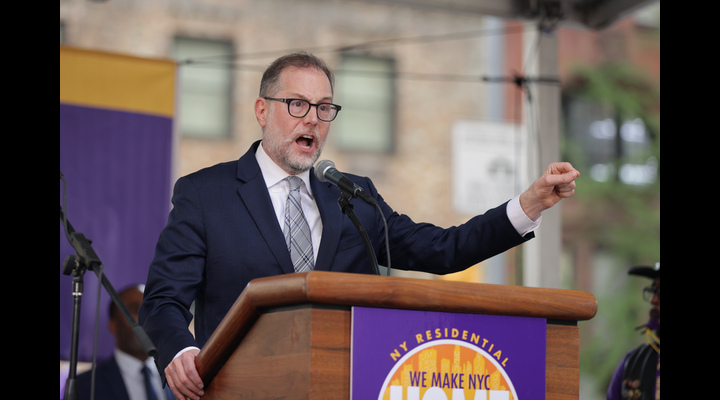
New York City Comptroller Mark Levine speaking on April 15, 2026. Photo: Luiz Rampelotto/EuropaNewswire/Sipa USA via Reuters Connect
New York City’s top financial official defended the city’s ongoing investment in Israel bonds as the administration of Mayor Zohran Mamdani faced growing criticism over its refusal to adopt a formal definition of antisemitism and continued hostile posture toward the Jewish state, paving the way for a showdown over how New York should address hate crimes and foreign investment policy.
Comptroller Mark Levine said on Wednesday that bonds issued by the Israeli government remained a safe, long-standing investment for city pension funds, insisting that financial decisions must be separated from political pressure. Levine pointed to the bonds’ decades-long record of repayment and argued his office’s responsibility was to maximize returns for retirees, not respond to shifting political campaigns.
“This is not political. It shouldn’t be political,” said Levine, a Democrat. “Israel bonds have never missed a payment in 70 years, ever, not once.”
The comptroller noted that the city has investments in other foreign countries but only faces protests for its association with Israel.
“And by the way, we’ve had no protesting about our investments in Saudi Arabia, our investments in Pakistan or China — only this one little, tiny sliver,” Levine said.
His comments came as the Mamdani administration faced continued scrutiny over its approach to Israel and antisemitism policy. Mamdani, a far-left democratic socialist who has made anti-Israel activism a cornerstone of his political career, has urged Levine to end city investments in Israel bonds.
Mamdani has long been an outspoken supporter of the boycott, divestment, and sanctions (BDS) movement, which seeks to isolate Israel on the international stage as the first step toward its elimination. Leaders of the movement have repeatedly stated their goal is to destroy the world’s only Jewish state.
In New York City specifically, records show that Israel bonds, historically yielding approximately 5 percent annually, have outperformed many alternatives.
Meanwhile, Israeli firms pour billions of dollars and tens of thousands of jobs into the local economy, and business experts have warned that a push for divestment could lead Israeli-associated and Jewish-owned companies to leave.
A study released by the United States-Israel Business Alliance in October revealed that, based on 2024 data, 590 Israeli-founded companies directly created 27,471 jobs in New York City that year and indirectly created over 50,000 jobs when accounting for related factors, such as buying and shipping local products.
These firms generated $8.1 billion in total earnings, adding an estimated $12.4 billion in value to the city’s economy and $17.9 billion in total gross economic output.
As for the entire state, the report, titled the “2025 New York – Israel Economic Impact Report,” found that 648 Israeli-founded companies generated $8.6 billion in total earnings and $19.5 billion in gross economic output, contributing a striking $13.3 billion in added value to the economy. These businesses also directly created 28,524 jobs and a total of 57,145 when accounting for related factors.
From financial tech leaders like Fireblocks to cybersecurity powerhouse Wiz, Israeli entrepreneurs have become indispensable to the innovation ecosystem. The number of Israeli-founded “unicorns,” privately held companies with a valuation of at least $1 billion, operating in New York City has quadrupled since 2019, increasing from five to 20.
Beyond its finances, New York City will not use a codified definition of antisemitism in evaluating complaints or incidents, according to administration officials. Instead, the Mayor’s Office to Combat Antisemitism, led by Phylisa Wisdom, will assess cases individually without relying on a fixed legal or policy definition.
“The first thing I’ll say is that across city government, there is not a definition codified for any form of hate at all,” Wisdom said on Wednesday while presiding over the City Council’s Task Force to Combat Antisemitism
The decision marks a departure from previous city policy, which had incorporated the International Holocaust Remembrance Alliance (IHRA) definition of antisemitism. The Mamdani administration revoked that standard when he entered office, arguing that rigid definitions can risk conflating criticism of Israel with antisemitism and may complicate the handling of politically sensitive speech.
IHRA — an intergovernmental organization comprising dozens of countries including the US and Israel — adopted the “working definition” of antisemitism in 2016. Since then, the definition has been widely accepted by Jewish groups and lawmakers across the political spectrum, and it is now used by hundreds of governing institutions, including the US State Department, European Union, and United Nations. Law enforcement also uses it as a tool for matters such as hate-crime investigations and sentencing.
According to the definition, antisemitism “is a certain perception of Jews, which may be expressed as hatred toward Jews. Rhetorical and physical manifestations of antisemitism are directed toward Jewish or non-Jewish individuals and/or their property, toward Jewish community institutions and religious facilities.” It provides 11 specific, contemporary examples of antisemitism in public life, the media, schools, the workplace, and in the religious sphere. Beyond classic antisemitic behavior associated with the likes of the medieval period and Nazi Germany, the examples include denial of the Holocaust and newer forms of antisemitism targeting Israel such as demonizing the Jewish state, denying its right to exist, and holding it to standards not expected of any other democratic state.
Critics say the absence of a clear definition could weaken enforcement and create inconsistency in how incidents are classified. Some lawmakers have pointed to recent public exchanges in which officials were unable or unwilling to clearly articulate what constitutes antisemitism under the city’s current framework.
The debate has intensified against the backdrop of a broader surge in antisemitic hate crimes in New York City. Advocacy groups and elected officials have raised concerns that the policy shift could make it harder to respond effectively at a time of heightened tension and increased reported incidents.
The majority of all hate crimes in New York City over the first three months of this year have targeted Jews, according to data released by the New York Police Department (NYPD).
“Confirmed hate crimes increased nearly 12 percent this quarter citywide. We continue to see that the vast majority of our hate crimes are antisemitic in nature,” NYPD Commissioner Jessica Tisch said earlier this month. “In fact, in the first quarter of 2026, more than half of all confirmed hate crimes, or 55 percent, were antisemitic, despite Jews only making up approximately 10 percent of the population of New York City.”
Mamdani took office on Jan. 1.
However, the surge in anti-Jewish hate crimes predated Mamdani.
Jews were targeted in the majority (54 percent) of all hate crimes perpetrated in New York City in 2024, according to data issued by the NYPD. A recent report released in December by the Mayor’s Office to Combat Antisemitism noted that figure rose to a staggering 62 percent in the first quarter of 2025, despite Jewish New Yorkers comprising a small minority of the city’s population.
Uncategorized
Israel-Lebanon Ceasefire Extended by Three Weeks, Trump Says

Smoke rises after an Israeli strike, amid escalating hostilities between Israel and Hezbollah, as the US-Israeli conflict with Iran continues, in southern Lebanon, March 24, 2026. Photo: REUTERS/Stringer
US President Donald Trump on Thursday said in a post on Truth Social the ceasefire between Israel and Lebanon will be extended by three weeks.
Trump posted on social media that he and several top officials in his administration met with Israeli and Lebanese representatives in the Oval Office.
“The Meeting went very well! The United States is going to work with Lebanon in order to help it protect itself from Hezbollah,” Trump said, referring to the Iran-backed Lebanese terrorist group which Israel was fighting before a temporary truce was reached earlier this month.
“The Ceasefire between Israel and Lebanon will be extended by THREE WEEKS,” the president added. “I look forward in the near future to hosting the Prime Minister of Israel, [Benjamin] Netanyahu, and the President of Lebanon, Joseph Aoun. It was a Great Honor to be a participant at this very Historic Meeting!”
The US-mediated ceasefire, which was set to expire on Sunday, has yielded a significant reduction in violence, but attacks have continued in southern Lebanon, where Israeli troops have seized a self-declared buffer zone.
Hezbollah says it has “the right to resist” occupying forces.
Wednesday marked Lebanon‘s deadliest day since the ceasefire took effect on April 16.
Hostilities between Hezbollah and Israel reignited on March 2, when the terrorist group opened fire in support of Tehran in the regional war. The ceasefire in Lebanon emerged separately from Washington’s efforts to resolve its conflict with Tehran, though Iran had called for Lebanon to be included in any broader truce.
Hezbollah said it carried out four operations in south Lebanon on Wednesday, saying they were a response to Israeli strikes.
Nearly 2,500 people have been killed in Lebanon since Israel went on the offensive in response to Hezbollah’s March 2 attack, according to Lebanese authorities. Israeli officials say the vast majority of those killed have been Hezbollah terrorists.
Israel is occupying a belt of the south that extends 5 to 10 km (3 to 6 miles) into Lebanon, saying it aims to shield northern Israel from attacks by Hezbollah, which has fired hundreds of rockets during the war.
The Lebanese government has opened direct contacts with Israel despite strong objections from Hezbollah, which was established by Iran’s Revolutionary Guards in 1982.
Lebanese President Joseph Aoun had said Beirut’s envoy to Thursday’s talks in Washington, Lebanese ambassador to the US Nada Moawad, would seek a ceasefire extension and a halt to demolitions being carried out by Israel in villages in the south.
A Lebanese official said Beirut wants a ceasefire extension as a prerequisite for talks to expand beyond the ambassadorial level to the next phase, in which Lebanon would push for an Israeli withdrawal, the return of Lebanese detained in Israel, and a delineation of the land border.
Israel says its objectives in the talks with Lebanon include securing the dismantlement of Hezbollah and creating conditions for a peace deal. Israel has sought to make common cause with the Lebanese government over Hezbollah, which Beirut has been seeking to disarm peacefully for the past year.
US Secretary of State Marco Rubio attend Thursday’s meeting along with Vice President JD Vance and the US ambassadors to Israel and Lebanon. Israel was represented by its ambassador to Washington, Yechiel Leiter.
Rubio hosted the first meeting between Leiter and Moawad on April 14 – the highest-level contact between Lebanon and Israel in decades.
Washington has denied any link between its Lebanon mediation and diplomacy over the Iran war.
Hezbollah says the Lebanon ceasefire was the result of Iranian pressure rather than US mediation.
Aoun has cited goals including halting Israeli attacks on Lebanon and securing the withdrawal of Israeli troops.
Uncategorized
Israel-Lebanon Ceasefire Extended by Three Weeks, Trump Says
Smoke rises after an Israeli strike, amid escalating hostilities between Israel and Hezbollah, as the US-Israeli conflict with Iran continues, in southern Lebanon, March 24, 2026. Photo: REUTERS/Stringer
U.S. President Donald Trump on Thursday said in a post on Truth Social the ceasefire between Israel and Lebanon will be extended by three weeks.
Trump posted on social media that he and several top officials in his administration met with Israeli and Lebanese representatives in the Oval Office.
“The Meeting went very well! The United States is going to work with Lebanon in order to help it protect itself from Hezbollah,” Trump said, referring to the Iran-backed Lebanese terrorist group which Israel was fighting before a temporary truce was reached earlier this month.
“The Ceasefire between Israel and Lebanon will be extended by THREE WEEKS,” the president added. “I look forward in the near future to hosting the Prime Minister of Israel, [Benjamin] Netanyahu, and the President of Lebanon, Joseph Aoun. It was a Great Honor to be a participant at this very Historic Meeting!”
The US-mediated ceasefire, which was set to expire on Sunday, has yielded a significant reduction in violence, but attacks have continued in southern Lebanon, where Israeli troops have seized a self-declared buffer zone.
Hezbollah says it has “the right to resist” occupying forces.
Wednesday marked Lebanon‘s deadliest day since the ceasefire took effect on April 16.
Hostilities between Hezbollah and Israel reignited on March 2, when the terrorist group opened fire in support of Tehran in the regional war. The ceasefire in Lebanon emerged separately from Washington’s efforts to resolve its conflict with Tehran, though Iran had called for Lebanon to be included in any broader truce.
Hezbollah said it carried out four operations in south Lebanon on Wednesday, saying they were a response to Israeli strikes.
Nearly 2,500 people have been killed in Lebanon since Israel went on the offensive in response to Hezbollah’s March 2 attack, according to Lebanese authorities. Israeli officials say the vast majority of those killed have been Hezbollah terrorists.
Israel is occupying a belt of the south that extends 5 to 10 km (3 to 6 miles) into Lebanon, saying it aims to shield northern Israel from attacks by Hezbollah, which has fired hundreds of rockets during the war.
The Lebanese government has opened direct contacts with Israel despite strong objections from Hezbollah, which was established by Iran’s Revolutionary Guards in 1982.
Lebanese President Joseph Aoun had said Beirut’s envoy to Thursday’s talks in Washington, Lebanese ambassador to the US Nada Moawad, would seek a ceasefire extension and a halt to demolitions being carried out by Israel in villages in the south.
A Lebanese official said Beirut wants a ceasefire extension as a prerequisite for talks to expand beyond the ambassadorial level to the next phase, in which Lebanon would push for an Israeli withdrawal, the return of Lebanese detained in Israel, and a delineation of the land border.
Israel says its objectives in the talks with Lebanon include securing the dismantlement of Hezbollah and creating conditions for a peace deal. Israel has sought to make common cause with the Lebanese government over Hezbollah, which Beirut has been seeking to disarm peacefully for the past year.
US Secretary of State Marco Rubio attend Thursday’s meeting along with Vice President JD Vance and the US ambassadors to Israel and Lebanon. Israel was represented by its ambassador to Washington, Yechiel Leiter.
Rubio hosted the first meeting between Leiter and Moawad on April 14 – the highest-level contact between Lebanon and Israel in decades.
Washington has denied any link between its Lebanon mediation and diplomacy over the Iran war.
Hezbollah says the Lebanon ceasefire was the result of Iranian pressure rather than US mediation.
Aoun has cited goals including halting Israeli attacks on Lebanon and securing the withdrawal of Israeli troops.