



Uncategorized
When Assassination Attempts Stop Shocking Us

US President Donald Trump takes questions from media at a press briefing at the White House, following a shooting incident during the annual White House Correspondents’ Association dinner, in Washington, D.C., U.S., April 25, 2026. Photo: REUTERS/Jonathan Ernst
The villagers of Chelm once faced a serious problem.
A wooden bridge at the edge of town had a loose plank in the middle. People kept stepping on it, falling through, and breaking their legs. The town elders gathered for an emergency meeting. Some said, “We should put up warning signs!” Others said, “We should add lights along the bridge!”
Then one leader stood up and said, “I have the answer! Let’s build a hospital at the bottom of the bridge!”
This, I fear, is where America stands today.
Just a few days ago, during the White House Correspondents’ Dinner in Washington, D.C., a gunman rushed past a security checkpoint and opened fire. The President, the First Lady, and members of the Cabinet were evacuated. The suspect, a 31-year-old teacher with an engineering degree, had written a manifesto targeting administration officials, and investigators later found anti-Trump and anti-Christian rhetoric on his social media accounts.
Regardless of where one stands politically, this news should shake our very core. A civilized society cannot become comfortable with such evil acts of violence. And yet, by morning, the conversation had already shifted: More security. Stricter gun laws. Better screening.
All of it sounded like building another hospital at the bottom of the bridge — because while some of these ideas are worthy and necessary, they do not answer the deeper question that should be at the forefront of our minds: How did we arrive at a moment when evil has become so banal that it no longer shocks us?
Many blame all sorts of reasons — from political extremism to mental illness, from social media to economic anxiety — and while each of these may contain parts of the truth, none addresses the root of the problem. Because the broken plank is not only political. It is a crisis of the nation’s soul.
Shortly after the attempted assassination of President Ronald Reagan in 1981 at the same Washington Hilton in Washington D.C., the Lubavitcher Rebbe addressed the nation with remarkable clarity. The Rebbe rejected the explanation that crime grows from deprivation and poverty, as some suggested. The Rebbe noted that Reagan’s attacker lacked nothing materially. The real issue, the Rebbe said, was that he lacked education. Not education of the mind alone, but education of the conscience.
A child must grow up knowing that there is “an Eye that sees and an Ear that hears,” that human life is sacred, that actions matter even when no one is watching, and that freedom is not permission to do whatever one wishes, but responsibility to do what is right.
Without that foundation, a society may produce people of dazzling intellectual brilliance, but with almost no goodness to guide it.
Alas, history has already shown us where that road leads. The Nazi era proved that reason alone can rationalize anything, even evil. Germany of the 20th century produced philosophers, scientists, poets, and composers. And yet, it also produced Auschwitz.
In Schindler’s List, there is a haunting scene during the liquidation of the Krakow Ghetto in which a little girl, hiding near a piano, is shot by an SS guard. As her tiny body lies in blood, another guard sits down and begins to play the piano. One guard asks the other, “Is that Bach?” His friend replies, “No. Mozart.” And they continue to discuss the music as if nothing had happened. That was Nazi Germany: murder alongside Mozart.
Elie Wiesel once asked the Lubavitcher Rebbe how he could still believe in God after Auschwitz. The Rebbe responded with a question of his own: “In whom do you expect me to believe after Auschwitz? In man?”
Because without God and the absolute truth of His Bible, morality becomes negotiable. Without grounding ourselves in Divine commandments such as “Do not murder,” even cultured and educated people can descend into evil.
We must act responsibly in the face of real threats, increase security, and pass legislation where needed. But if we truly want to prevent the next attack, we must repair the bridge itself. And that repair begins with teaching our children not only how to think, but how to live. Not only how to succeed, but how to serve. Not only how to respect life, but how to recognize “the Lord your God” Who gives us life and Who commands us to protect it in ourselves and in others.
A few years ago, here in Arizona, I had the privilege of working with Governor Doug Ducey and others to help bring a statewide Moment of Silence to the beginning of the school day. Just one quiet minute in which students can pause and remember that life has purpose, that actions have meaning, and that there is something greater than themselves.
This responsibility belongs to all of us. Adults and children alike must know that kindness is not optional, that words matter, and that every human being — even those who are different from us — is created in the image of God. And the simple moral truths that built our civilization must once again guide the way we live: “Honor thy father and thy mother.” “Love your fellow as yourself.” “Do not stand idly by while your fellow’s blood is being shed.”
Let us repair the bridge. Let us return to God and His guidance, and strengthen the soul of our country. For when a nation strengthens its soul, it not only survives. It rises.
Rabbi Pinchas Allouche is the founding Rabbi of Congregation Beth Tefillah and the founding dean and spiritual leader of the Nishmat Adin High School in Scottsdale, Arizona, where he resides with his wife, Esther, and 10 children.
Uncategorized
UK Counterterrorism Police Investigate Arson at Jewish Memorial Wall

An Orthodox Jewish man walks by at a wall showing pictures of protesters killed during anti-government demonstrations in Iran, in Golders Green, London, Britain, March 7, 2026. Photo: REUTERS/Jack Taylor
Police said on Tuesday they were investigating suspected arson at a memorial wall in a part of north London that is home to a large Jewish community, amid a recent spate of such incidents in the British capital.
London’s Metropolitan Police said the investigation was being led by Counter Terrorism Policing, though it was not being treated as a terrorist incident. They said no arrests had been made.
The incident occurred on Monday at the site of a memorial wall dedicated to people killed in Iran in a bloody crackdown after anti-government protests spread across the country in January. Police said the memorial wall had not been damaged.
“We recognize that this incident will heighten concerns in the Golders Green area, where residents have already faced a series of attacks,” Detective Chief Superintendent Luke Williams said in a statement.
Over the last month, counter–terrorism officers have arrested more than two dozen people as part of investigations into attacks on Jewish-linked premises, including the torching of ambulances belonging to the Jewish volunteer emergency service Hatzola in Golders Green on March 23.
Police said after an arson attack at a synagogue this month that they were investigating possible Iranian links to the incidents. A pro-Iranian government group has said it was responsible.
Uncategorized
Ukraine in Diplomatic Tussle With Israel Over Grain Kyiv Says ‘Stolen’ by Russia
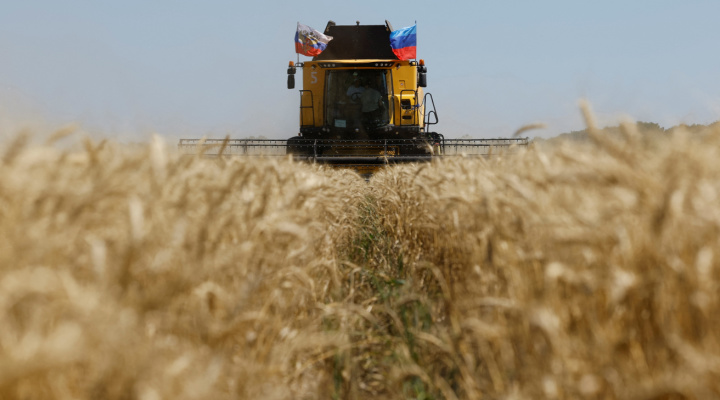
A farmer operates a combine during the start of the wheat harvesting campaign in a field near the town of Starobilsk (Starobelsk) in the Luhansk Region, a Russian-controlled area of Ukraine, July 9, 2025. Photo: REUTERS/Alexander Ermochenko
Ukraine and Israel traded diplomatic blows on Tuesday as President Volodymyr Zelenskiy condemned what he said were grain purchases from occupied Ukrainian territory “stolen” by Russia and threatened sanctions against those attempting to profit from it.
Kyiv considers all grain produced in the four regions that Russia claims as its own since invading Ukraine in 2022 as well as Crimea, annexed by Russia in 2014, to be stolen and has protested over its export to other countries.
Russia calls the regions its “new territories,” but they are still internationally recognized as Ukrainian. Moscow has not commented on the legal status of grain collected in them.
“Another vessel carrying such grain has arrived at a port in Israel and is preparing to unload,” Zelenskiy said on X, adding: “This is not – and cannot be – legitimate business.”
“The Israeli authorities cannot be unaware of which ships are arriving at the country’s ports and what cargo they are carrying,” added Zelenskiy.
Ukraine on Tuesday summoned Israel‘s ambassador over what Kyiv described as Israeli inaction in allowing shipments of grain to enter the country from Russian-occupied Ukraine.
Ukraine‘s foreign ministry said in a statement it handed the ambassador a “note of protest.”
Israeli Foreign Minister Gideon Saar said that Kyiv has not provided any evidence for its claims.
“The vessel has not entered the port and has yet to submit its documents. It’s not possible to verify the truth of the Ukrainian claims,” he told a news conference in Jerusalem.
Saar said Ukraine had not submitted any request for legal assistance and rejected what he called “Twitter diplomacy.”
“Israel is a state that abides by the rule of law. We say again to our Ukrainian friends, if you have any evidence of theft submit it through the appropriate channels,” he said.
Ukrainian foreign ministry spokesman Heorhii Tykhyi told reporters that Kyiv has provided “extensive information and proof” that the cargo was illegal before going public. The foreign ministry published a timeline of its actions and contacts with Israeli authorities.
“We will not allow any country in any geography to facilitate illegal trade with a stolen grain that finances our enemy,” Tykhyi said.
Kremlin spokesman Dmitry Peskov declined to comment on Tuesday, saying Russia would not get involved. “Let the Kyiv regime deal with Israel on its own,” he said.
Traders have told Reuters that it is impossible to track the origin of wheat once it is mixed.
UKRAINE PREPARING SANCTIONS PACKAGE
Anouar El Anouni, EU foreign affairs spokesperson, said the bloc had taken note of reports that a “Russian shadow fleet vessel” carrying stolen grain had been allowed to dock at Haifa. He said the European Commission had approached Israel‘s foreign ministry on the issue.
“We condemn all actions that help fund Russia‘s illegal war effort and circumvent EU sanctions, and remain ready to target such actions by listing individuals and entities in third countries if necessary,” he said.
Zelenskiy said Ukraine was preparing a sanctions package against those transporting the grain and the individuals and legal entities attempting to profit from the scheme.
Zelenskiy said Kyiv has taken “all necessary steps through diplomatic channels,” but the ship had not been stopped.
“Russia is systematically seizing grain on temporarily occupied Ukrainian land and organizing its export through individuals linked to the occupiers,” Zelenskiy said.
“Such schemes violate the laws of the State of Israel itself,” he added.
Ukraine expected Israel to respect Ukraine and refrain from actions that undermine bilateral relations, he added.
Uncategorized
Britain Challenges Court Decision That Palestine Action Ban Was Unlawful

Protesters from “Palestine Action” demonstrate on the roof of Guardtech Group in Brandon, Suffolk, Britain, July 1, 2025. Photo: REUTERS/Chris Radburn
Britain on Tuesday sought to uphold a ban on anti-Israel group Palestine Action, which it has designated a terrorist organization, after a court ruling that the move unlawfully interfered with freedom of expression.
Palestine Action, which had increasingly targeted Israel‑linked defense companies in Britain with a particular focus on Israel’s largest defense firm Elbit Systems, was proscribed under terrorism laws last year.
London’s High Court ruled in February that the ban was unlawful, although it remains in force pending the outcome of the government’s appeal, which began on Tuesday.
Lawyers for Britain‘s interior minister, Shabana Mahmood, told the Court of Appeal that the finding that the ban had a significant impact on freedom of expression was “overstated and wrong.”
Huda Ammori, who co-founded Palestine Action in 2020 and brought the successful challenge, argues proscription has imposed “severe restrictions on the fundamental free speech and assembly rights of vast numbers of people.”
UK APPEAL COMES DURING CRIMINAL TRIAL
Palestine Action was banned shortly after a June break-in at the Royal Air Force’s Brize Norton air base, in which activists damaged two military planes.
The ban placed the group on a par with Islamic State or al Qaeda, making membership a criminal offense punishable by up to 14 years in prison.
More than 2,700 people have since been arrested for holding signs in support of Palestine Action, though charges could be dropped if the High Court‘s ruling is upheld.
After February’s decision, London’s Metropolitan Police said it would pause arrests while reviewing its position, but resumed enforcement earlier this month, arresting over 500 people.
The High Court‘s decision was announced shortly after six people charged over the 2024 raid on Elbit were all acquitted of aggravated burglary.
Those six are currently on trial for criminal damage, with one defendant also accused of assaulting a police officer with a sledgehammer. All have pleaded not guilty.