



Uncategorized
If It Can’t Build Nuclear Weapons, Iran Will Likely Ramp Up Its Chemical and Biological Weapons Capacities

A general view of Tehran Iran, April 16, 2026. REUTERS/Thaier Al-Sudani Foreign media in Iran operate under guidelines set by the Ministry of Culture and Islamic Guidance, which regulates press activity and permissions
Alongside Iran’s persistent progress towards nuclear weapons, which was recently stemmed by Israel and the US, the Islamic regime possesses arsenals of other weapons of mass destruction, specifically chemical and biological weapons (CBW).
Now that its nuclear strategy has been largely derailed, the Iranian regime is likely to continue to pursue and to considerably upgrade its ballistic capabilities, particularly in terms of CBW warheads. Ballistic CBW warheads (possibly including radiological weapons as well) will thus constitute Iran’s primary strategic offensive alignment.
Iran has doggedly pursued the development and manufacture of CBW arsenals while being an ostensibly “obedient” state party to the global CBW conventions. Iran’s already operational CBW programs and first-generation weaponry inventories were expounded comprehensively in 2005, in a 52-page article in the International Journal of Intelligence and Counter-Intelligence. The regime’s subsequent progress in the CBW field is examined below.
While some of its CBW facilities were somewhat incapacitated during the 2025-26 Israel-US attacks on Iran, the regime is liable — particularly now that it is likely to be deprived of its goal of achieving nuclear weapons — to take steps to significantly augment its CBW capacities.
First, we should note several assaults that took place during the 2025-26 conflict that apparently undermined some of Iran’s CBW-related assets (among other things). Nuclear and ballistic infrastructures across Iran were the attackers’ top-priority military-associated targets, but within six specific facilities, CBW-related assets were at times deliberately and directly damaged in parallel.
These facilities were: Malek-Ashtar University of Technology (MUT), Imam Hussein University (IHU), Shahid Beheshti University (SBU), Iran University of Science and Technology (IUST), the Tofigh Daru Research and Engineering Company (ToDa), and the Shahid Meisami Research Center (SMRC).
Following the Russians
Two classes of toxic substances comprise the second-generation core of Iranian chemical warfare agents. They basically follow Russian courses, as detailed below.
Pharmaceutical-based agents (PBAs): This category of dose-dependent toxicants is used routinely for anesthetic procedures. Its use as a CBW broke out at the 2002 terrorism incident at a Moscow theater, where Russian security forces employed these substances against the perpetrators at the scene. Iran followed the same line. Ever since 2005, the regime has worked on designing incapacitating agents – mainly fentanyl and medetomidine plus their derivatives – to be used for dispersal via grenades, mortars, drones and bullets. Iran may also intend them to be employed by its regional proxy forces.
The IRGC is the central entity developing PBAs. Key contributors to this effort include IHU, MUT, and the SMRC. The IRGC has conducted open-air field tests involving incapacitant-filled hand grenades and cartridges (such as the 38mm MK 2) as dispersing mechanisms. The tests optimized various aerosolization techniques of those agents.
The potential deployment of these agents via drone is a significant concern. Deployment can take place via existing multi-rotor drones like the Arbaeen bomber, which can carry chemically converted grenades, cartridges and rounds. While no definitive evidence exists confirming extensive operational use of these agents in combat, it is notable that during the 2022 Mahsa Amini protests, in which female protesters, including schoolchildren, were key participants in the demonstrations, victims reported “feelings of anesthesia” inconsistent with standard tear gas as well as unexplained severe delayed impacts.
This group of substances is considerably more potent than ordinary incapacitants. Verified images confirm that MK 2 cartridges (manufactured by Shahid Sattari Industries in Iran) that matched those in hacked PBA development documents were used against Iranian civilians during the crackdowns. Anesthetic-derived tactical munitions were procured, with supporting production linked to the Chemical Industries and Development of Materials Group (affiliated with the Iranian Defense Industries Organization), in specialized, concealed production tunnels beneath Tehran’s District 22.
Furthermore, during the January 2026 protests, aerosolized fentanyl derivatives and medetomidine were employed, probably by means of weaponized grenades and canisters, mortars and projectiles, military-style vehicles equipped with dispersal systems, and drones. The resulting impacts included sudden collapse and immediate loss of consciousness, neurological impairment and mental disorientation, temporary muscle paralysis or acute inability to move, as well as delayed fatality.
As expected, the Iranian regime flatly denied having employed CW in these ways, just as it did about its conduct during the 2022 protests.
Novichok nerve agents: While the potency of the above-mentioned anesthetic agents is controversial due to their being critically dose-dependent, Novichok nerve agents are unequivocally the most toxic synthetic molecules ever created by man. They were initially developed by the Russians. Apart from the USSR (and NATO, in terms of protection), only Iran was (overtly, at least) working on Novichok agents, ostensibly on a scientific level alone. Yet the timing, uniqueness, focus, and meticulousness of Iran’s engagement with these agents are quite striking. According to a scientific paper published in 2016 by Iranian researchers, five Novichok agents – likely including at least some of the four weaponized by Russia – were synthesized at the Iranian Defense Chemical Research Laboratory (the above-referenced complex near Karaj). The syntheses were reportedly performed on a micro-scale to minimize exposure.
Iranian researchers succeeded in synthesizing and obtaining detailed mass spectral data on a series of unusual top nerve agents, and those data were added to the Central Analytical Database of the Organization for the Prohibition of Chemical Weapons. The Iranian researchers explained their study as follows: “For unambiguous identification of Chemical Weapons Convention-related chemicals in environmental samples, the availability of mass spectra, interpretation skills and rapid microsynthesis of suspected chemicals are essential requirements. For the first time… spectra of a series of Novichok agents related to CWC were collected and investigated with the aim of enriching the Organization for the Prohibition of Chemical Weapons Central Analytical Database, which may be used in OPCW verification activities, on/off site analysis, and toxic chemical destruction monitoring.” Through this graceful means, the Iranians pursued both legitimacy and access to the domain of Novichok-based CW.
Biological warfare agents
While the first-generation of Iranian biological warfare agents includes traditional bacterial pathogens and toxins (see below), the second generation includes virulent viruses and sophisticated toxins, as follows.
Highly lethal snake venoms. Alongside synthetic toxic molecules (such as Novichok), one of the most poisonous natural substances in the world is the venom produced by the Caspian cobra. Like the class of PBAs dealt with by the Iranians in terms of dispersibility (as described), this venom was upgraded at Iran’s Razi Vaccine and Serum Research Institute in Karaj. This was done in several ways: by isolating lethal, low molecular weight portions of crude Caspian cobra venom by gel filtration chromatography; by encapsulating that venom into copolymer-shaped poly-microspheres in the size range of 1-10 μm as a biotoxin carrier; and through the advanced encapsulation into nanoparticles of a polysaccharide with an estimated diameter of 120-150 nanometers as a carrier.
These dual-use technologies are applicable to both pharmaceuticals and weapons design. Notably, while the Razi Institute is a fairly autonomous civilian entity, it is linked to both the Iranian Ministry of Health and the Ministry of Agriculture and is indirectly involved with the Iranian CBW weapons program and alignment. Crude Caspian cobra venom is centrifuged, frozen in a -80 °C deep freezer, and lyophilized at the Razi Institute.
Ostensibly, this product is used solely to attain an anti-venom horse serum. However, it is entirely plausible that an unknown portion of it is turned into a biological warfare agent alongside others developed in conjunction.
Highly virulent viruses. Deadly viruses that cause smallpox, influenza or hemorrhagic fevers might comprise components of Iran’s second generation of biological warfare agents.
Smallpox: Infections of the smallpox virus were last recorded in Iran in 1972. The reference strain, IRN72_tbrz, is held at the CDC in the US. It is not known whether additional virus isolates were obtained from Iranian patients and kept in Iran. What is known is that in recent years, the analogous virus – the one that causes monkeypox – has been reviewed at Tarbiat Modares University in Tehran, an institution known for its relationship with the IRGC. In parallel, further viruses that constitute the causative agents of notorious hemorrhagic fevers like Ebola, Marburg, Rift Valley, Crimean-Congo, Chikungunia and dengue, were meticulously investigated at both Tarbiat Modares University and Islamic Azad University. The latter maintains close ties to the IRGC, particularly in terms of military research collaboration. It is not known whether the Ebola and Marburg viruses, which are exotic to Iran, have been obtained by it, but this is likely.
In 2007, a notable interface formed between Iran and Indonesia with regard to the highly pathogenic H5N1 avian influenza virus, which emerged indigenously in Indonesia. While the global average mortality rate for H5N1 was about 60% (in humans), the rate in Indonesia was as high as 85% during 2005-07. A confrontation with WHO arose when Indonesia refused to share local virus samples with the organization. Iran took advantage and established a joint project with Indonesia to produce an H5N1 vaccine in Iran. The Iranian regime took possession of Indonesia’s extremely virulent strains in the process.
Finally, though it appears not to have been attacked in 2025-26, mention should be made of the Baqiyatallah University of Medical Sciences and its associated Institute of Research for Military Medicine (co-located in Vanak, Tehran), which are affiliated with and operated by the IRGC. These are premier Iranian institutions, leading R&D in cardinal areas like neuroscience, genetics, and biotechnology. As for CBW, while these institutions publicly focus on defense against such weapons, they are also oriented towards offensive aspects, covering a range of typical chemical and bio-agents like the pathogens of plague, anthrax, tularemia, brucellosis, typhoid, cholera, botulism, staph-B enterotoxemia and certain fungal toxicoses. They also deal with traditional chemical warfare agents, including mustard, sarin, VX, soman, phosgene and cyanides.
By 2005, Iran already possessed sizable self-made stockpiles of operational CBW, composed of such traditional chem-bio warfare agents (plus ricin, aflatoxin and T-2 toxin). These agents were weaponized with various delivery systems, including aerial bombs, spraying tanks, unmanned aircraft, and unitary missile warheads. These constitute Iran’s first-generation CBW. The systems concerned have been gradually upgraded ever since in terms of quality of the agents in the payloads, spreading mechanisms, and range.
Moreover, during the 2026 war, Iran demonstrated its mastery of the effective delivery of conventional cluster (bomblet) warheads, particularly warheads of ballistic missiles. In all probability, Iran tried over the past decade to weaponize cluster warheads with chemical and biological weapons, which would be a meaningful force multiplier.
If self-production of ballistic missiles is continuously blocked or halted in Iran, the regime may either convert residual stocks of conventional warheads into CB warheads or purchase ballistic missiles with empty warheads from China, Russia or North Korea for the purpose of chemically and biologically supplementing them. At least one of the three allies is likely to consent to such a supply request.
In addition to CB warheads, we must consider the possibility of Iranian radiological warheads, which is not negligible. As long as it is deprived of the ability to obtain nuclear weapons, Iran will maximize its efforts to achieve sub-nuclear weapons of mass destruction, notwithstanding its position as a state party to the conventions banning such weapons.
The Iranian regime’s prolonged and filthy maneuvering in these arenas will undoubtedly persist. The damage inflicted upon the six attacked facilities was considerable and important, certainly, but will not severely hamper Iran’s renewed efforts to procure further upgrades to its CBW armaments.
Dr. Dany Shoham is a former senior analyst in IDF military intelligence and the Ministry of Defense. He specializes in chemical and biological warfare in the Middle East and worldwide. A version of this article was originally published by The BESA Center.
Uncategorized
UK Counterterrorism Police Investigate Arson at Jewish Memorial Wall

An Orthodox Jewish man walks by at a wall showing pictures of protesters killed during anti-government demonstrations in Iran, in Golders Green, London, Britain, March 7, 2026. Photo: REUTERS/Jack Taylor
Police said on Tuesday they were investigating suspected arson at a memorial wall in a part of north London that is home to a large Jewish community, amid a recent spate of such incidents in the British capital.
London’s Metropolitan Police said the investigation was being led by Counter Terrorism Policing, though it was not being treated as a terrorist incident. They said no arrests had been made.
The incident occurred on Monday at the site of a memorial wall dedicated to people killed in Iran in a bloody crackdown after anti-government protests spread across the country in January. Police said the memorial wall had not been damaged.
“We recognize that this incident will heighten concerns in the Golders Green area, where residents have already faced a series of attacks,” Detective Chief Superintendent Luke Williams said in a statement.
Over the last month, counter–terrorism officers have arrested more than two dozen people as part of investigations into attacks on Jewish-linked premises, including the torching of ambulances belonging to the Jewish volunteer emergency service Hatzola in Golders Green on March 23.
Police said after an arson attack at a synagogue this month that they were investigating possible Iranian links to the incidents. A pro-Iranian government group has said it was responsible.
Uncategorized
Ukraine in Diplomatic Tussle With Israel Over Grain Kyiv Says ‘Stolen’ by Russia
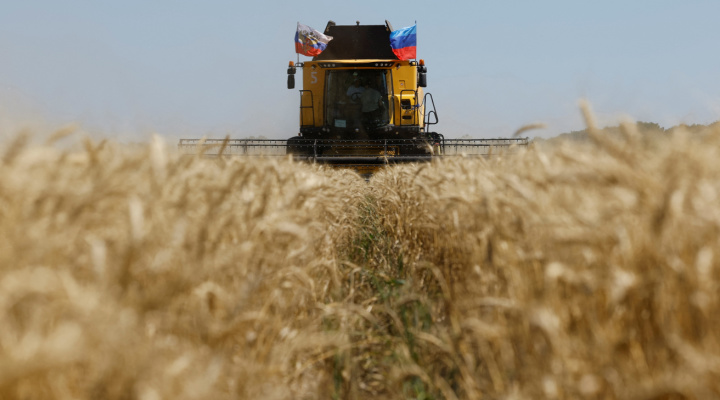
A farmer operates a combine during the start of the wheat harvesting campaign in a field near the town of Starobilsk (Starobelsk) in the Luhansk Region, a Russian-controlled area of Ukraine, July 9, 2025. Photo: REUTERS/Alexander Ermochenko
Ukraine and Israel traded diplomatic blows on Tuesday as President Volodymyr Zelenskiy condemned what he said were grain purchases from occupied Ukrainian territory “stolen” by Russia and threatened sanctions against those attempting to profit from it.
Kyiv considers all grain produced in the four regions that Russia claims as its own since invading Ukraine in 2022 as well as Crimea, annexed by Russia in 2014, to be stolen and has protested over its export to other countries.
Russia calls the regions its “new territories,” but they are still internationally recognized as Ukrainian. Moscow has not commented on the legal status of grain collected in them.
“Another vessel carrying such grain has arrived at a port in Israel and is preparing to unload,” Zelenskiy said on X, adding: “This is not – and cannot be – legitimate business.”
“The Israeli authorities cannot be unaware of which ships are arriving at the country’s ports and what cargo they are carrying,” added Zelenskiy.
Ukraine on Tuesday summoned Israel‘s ambassador over what Kyiv described as Israeli inaction in allowing shipments of grain to enter the country from Russian-occupied Ukraine.
Ukraine‘s foreign ministry said in a statement it handed the ambassador a “note of protest.”
Israeli Foreign Minister Gideon Saar said that Kyiv has not provided any evidence for its claims.
“The vessel has not entered the port and has yet to submit its documents. It’s not possible to verify the truth of the Ukrainian claims,” he told a news conference in Jerusalem.
Saar said Ukraine had not submitted any request for legal assistance and rejected what he called “Twitter diplomacy.”
“Israel is a state that abides by the rule of law. We say again to our Ukrainian friends, if you have any evidence of theft submit it through the appropriate channels,” he said.
Ukrainian foreign ministry spokesman Heorhii Tykhyi told reporters that Kyiv has provided “extensive information and proof” that the cargo was illegal before going public. The foreign ministry published a timeline of its actions and contacts with Israeli authorities.
“We will not allow any country in any geography to facilitate illegal trade with a stolen grain that finances our enemy,” Tykhyi said.
Kremlin spokesman Dmitry Peskov declined to comment on Tuesday, saying Russia would not get involved. “Let the Kyiv regime deal with Israel on its own,” he said.
Traders have told Reuters that it is impossible to track the origin of wheat once it is mixed.
UKRAINE PREPARING SANCTIONS PACKAGE
Anouar El Anouni, EU foreign affairs spokesperson, said the bloc had taken note of reports that a “Russian shadow fleet vessel” carrying stolen grain had been allowed to dock at Haifa. He said the European Commission had approached Israel‘s foreign ministry on the issue.
“We condemn all actions that help fund Russia‘s illegal war effort and circumvent EU sanctions, and remain ready to target such actions by listing individuals and entities in third countries if necessary,” he said.
Zelenskiy said Ukraine was preparing a sanctions package against those transporting the grain and the individuals and legal entities attempting to profit from the scheme.
Zelenskiy said Kyiv has taken “all necessary steps through diplomatic channels,” but the ship had not been stopped.
“Russia is systematically seizing grain on temporarily occupied Ukrainian land and organizing its export through individuals linked to the occupiers,” Zelenskiy said.
“Such schemes violate the laws of the State of Israel itself,” he added.
Ukraine expected Israel to respect Ukraine and refrain from actions that undermine bilateral relations, he added.
Uncategorized
Britain Challenges Court Decision That Palestine Action Ban Was Unlawful

Protesters from “Palestine Action” demonstrate on the roof of Guardtech Group in Brandon, Suffolk, Britain, July 1, 2025. Photo: REUTERS/Chris Radburn
Britain on Tuesday sought to uphold a ban on anti-Israel group Palestine Action, which it has designated a terrorist organization, after a court ruling that the move unlawfully interfered with freedom of expression.
Palestine Action, which had increasingly targeted Israel‑linked defense companies in Britain with a particular focus on Israel’s largest defense firm Elbit Systems, was proscribed under terrorism laws last year.
London’s High Court ruled in February that the ban was unlawful, although it remains in force pending the outcome of the government’s appeal, which began on Tuesday.
Lawyers for Britain‘s interior minister, Shabana Mahmood, told the Court of Appeal that the finding that the ban had a significant impact on freedom of expression was “overstated and wrong.”
Huda Ammori, who co-founded Palestine Action in 2020 and brought the successful challenge, argues proscription has imposed “severe restrictions on the fundamental free speech and assembly rights of vast numbers of people.”
UK APPEAL COMES DURING CRIMINAL TRIAL
Palestine Action was banned shortly after a June break-in at the Royal Air Force’s Brize Norton air base, in which activists damaged two military planes.
The ban placed the group on a par with Islamic State or al Qaeda, making membership a criminal offense punishable by up to 14 years in prison.
More than 2,700 people have since been arrested for holding signs in support of Palestine Action, though charges could be dropped if the High Court‘s ruling is upheld.
After February’s decision, London’s Metropolitan Police said it would pause arrests while reviewing its position, but resumed enforcement earlier this month, arresting over 500 people.
The High Court‘s decision was announced shortly after six people charged over the 2024 raid on Elbit were all acquitted of aggravated burglary.
Those six are currently on trial for criminal damage, with one defendant also accused of assaulting a police officer with a sledgehammer. All have pleaded not guilty.