



Uncategorized
Iran Faces Economic Disaster as US Blockade Suffocates Regime’s Oil Lifeline

Ships and boats in the Strait of Hormuz, Musandam, Oman, April 22, 2026. Photo: REUTERS/Stringer
As intensifying US pressure squeezes the Iranian energy sector, Iran’s oil lifeline is fraying — exports are sliding, storage is nearing capacity, and mounting economic strain is fueling the risk of renewed internal unrest that could further test the regime’s grip on power.
According to a newly released report from commodity analytics firm Kpler, Iran’s oil exports fell sharply after a US naval blockade on Iranian ports took hold in mid-April, dropping from an average of just over 2 million barrels per day earlier this month and 1.85 million in March to only five tracked cargoes and roughly 567,000 barrels per day in the past two weeks.
Even with Iran’s national oil company already cutting output to avoid dangerous bottlenecks as storage approaches capacity limits, the country is running out of space quickly, with Kpler estimating remaining storage could be exhausted within 12 to 22 days.
Despite Iranian officials claiming that 31 tankers have escaped the blockade zone, there is no evidence of any successful transits, with vessels reportedly passing through the Strait of Hormuz only to be stopped short of the US blockade further south between the Gulf of Oman and the Arabian Sea.
The US blockade has prevented the regime from exporting energy through the Strait of Hormuz — a critical global energy chokepoint through which about one-fifth of the world’s oil supply passes.
Amid a collapse in exports of more than 70 percent, the Iranian government has been forced to start cutting production, signaling a deepening economic crisis. Now the regime faces a critical choice between shutting wells and risking long-term damage to critical fields.
Sudden and prolonged shutdowns at oil production plants can cause lasting damage to reservoirs by disrupting pressure systems and flow dynamics, making it increasingly difficult — and in some cases impossible — to restart operations and restore production levels to their previous capacity, often costing millions to reverse.
According to Homayoun Falakshahi, head of Kpler’s crude oil analysis team, Iran’s oil sector has long suffered from underinvestment and poor reservoir management, resulting in an average recovery rate of just 25 percent. This means only about a quarter of the oil in a field can typically be extracted before production must be halted, and once wells are shut, restarting them makes it harder and less efficient to recover what remains.
Even though Kpler’s report estimates Tehran may not feel the full revenue hit for another three to four months due to payment delays and pre-existing sales flows, the regime is expected to face a heavy blow, with losses potentially reaching $200–250 million per day.
In an effort to prevent a wider infrastructure breakdown and avoid sharper production slowdowns, Iran is turning to improvised oil storage and alternative export routes.
Specifically, the regime is reportedly turning to disused “junk storage” sites, makeshift containers, floating storage on vessels, and even rail shipments of crude to China as export bottlenecks continue to build.
After repeated efforts to bring Iran back to the negotiating table to discuss its nuclear and missile programs and support for terrorism, the Trump administration escalated pressure on the Islamist regime earlier this month by imposing a naval blockade against vessels of all nations entering or departing Iranian ports and coastal areas, aiming to reach a deal that would bring an end to the conflict.
Trump told aides this week to prepare for an extended blockade of Iran until the regime agrees to a favorable deal, according to multiple reports.
Since the start of the war with joint US-Israeli strikes earlier this year, Iran has used control over the Strait of Hormuz as a major source of leverage, militarizing the waterway and sharply restricting maritime traffic through one of the world’s most critical shipping corridors. However, the US blockade as taken away much of that leverage, with the calculus that the regime can only hold out for so long as Iran faces total economic collapse.
Adding to an already crippling economy, Iran’s national rial currency hit a record low Wednesday of 1.8 million to the dollar. The fall is expected to trigger further fuel inflation.
Meanwhile, Iran’s foreign trade has also collapsed sharply during the first month of the conflict, deepening the country’s isolation from global markets.
Official customs data shows non-oil trade dropped to just $6.4 billion last month, a 30 percent decline from the previous month and 50 percent lower than a year earlier, before the war, Iran International reported.
As the country’s industrial base — a target of US-Israeli strikes before the ceasefire took effect earlier this month — comes under strain, the Iranian government has been forced to halt petrochemical and steel exports, sectors that account for more than a third of its non-oil revenue.
On Monday, the Iran Trade Promotion Organization ordered a suspension of steel slab and sheet exports until May 30, putting at risk industries that generate up to $20 billion annually.
With domestic tensions rising and the internal economic crisis worsening, Iranian officials are increasingly wary that renewed protests could erupt in the coming days, further destabilizing an already volatile situation.
Iran International reported that, this week, Iran’s Supreme National Security Council held an emergency meeting amid growing concern over a possible resurgence of protests, warning of renewed unrest following the nationwide anti-government demonstrations earlier this year, which security forces violently crushed, leaving tens of thousands of demonstrators tortured, imprisoned, or killed.
Officials now reportedly warn that worsening economic hardship, driven by inflation, rising unemployment, and damage to key industries such as petrochemicals and steel, could ignite the next wave of unrest.
According to Israeli intelligence assessments, widespread damage to Iran’s petrochemical and defense sectors has already wiped out an estimated 100,000 jobs.
Iranian security officials estimate that nationwide internet shutdowns have also left around 20 percent of online-dependent workers unemployed, warning that up to two million more private-sector jobs could be lost by the end of spring.
Uncategorized
Iran Has Executed At Least 21 People, Arrested Over 4,000 Since Start of War With US and Israel, UN Reports

A February 2023 protest in Washington, DC calling for an end to executions and human rights violations in Iran. Photo: Reuters/ Bryan Olin Dozier
The Islamic regime in Iran has intensified efforts to oppress the civilian population through arrests and executions since the beginning of the conflict with the US and Israel, according to the United Nations.
On Wednesday, the UN Office of the High Commissioner for Human Rights (OHCHR) revealed that Iran had executed at least 21 people and arrested more than 4,000 over the last two months, following the launch of joint US-Israeli strikes on Feb. 28.
Allegations which resulted in death sentences included espionage (two), opposition group membership (10), and involvement with protests (nine).
“In times of war, threats to human rights increase exponentially,” said Volker Türk, the UN High Commissioner for Human Rights.
Türk called for regime officials to “halt all further executions, establish a moratorium on the use of capital punishment, fully ensure due process and fair trial guarantees, and immediately release those arbitrarily detained.”
Iranian courts have reportedly fast-tracked convictions and sentencing in recent months, citing the war as justification.
According to the OHCHR, those detained face brutal conditions, overcrowding, and even torture to coerce confessions. The bodies of some detainees who have died in custody appear to show possible torture. Those detained also experience weaponized medical neglect, a human rights violation which has reportedly led to the deteriorating health of imprisoned Nobel laureate Narges Mohammadi.
In addition to forced confessions, Iranian judges can also resort to the principle of elm‑e‑qazi, a concept in Iran’s Islamic Penal Code which allows a guilty sentence based solely on circumstantial evidence.
Last week, Maryam Rajavi, president‑elect of the National Council of Resistance of Iran (NCRI), spoke about the regime’s executions at the European Parliament in Brussels.
“The mullahs are exploiting wartime conditions to resort to relentless executions to block the path of popular uprisings. Today, political prisoners face the threat of mass killing,” Rajavi said. “The silence of European Union leaders and member states is unjustifiable. And today, I wish to once again raise my voice in protest against this silence in the face of these executions.”
Rajavi added that “a number of young people have been arrested in recent weeks on charges of alleged contact with or support for the Mojahedin Organization,” referring to the People’s Mojahedin Organization of Iran (MEK), an Iranian opposition group.
“The names of a group of them have been submitted to and communicated to international bodies,” she said. “By order of the regime’s judiciary chief, pressure and torture on political prisoners have intensified, and their sham trials and the issuance of criminal sentences have been expedited.”
Stating that 11 political prisoners alleged to be members of the MEK face execution, Rajavi implored that “urgent action must be taken to save their lives. Our position is that a halt to executions in Iran, as a demand of the entire Iranian people, must be included in any international agreement.”
Last month, the Human Rights Activists News Agency (HRANA), an independent group monitoring, released a report documenting that from March 2025 to March 2026, police had arrested 78,907 people on ideological or political grounds.
Executions in the last Iranian year (covering much of calendar year 2025) reached at least 2,488, according to HRANA, with 63 of them women and two children. Drug offenses accounted for 955 executions, approximately three killings per day on average.
The Islamic regime chose to conduct 13 of the executions in public.
Earlier this month, the European groups Iran Human Rights (IHR) in Norway and Together Against the Death Penalty (ECPM) in France released a separate joint report finding that Iran executed at least 1,639 people in 2025, a 68 percent leap from the 975 killed in 2024 and the highest seen since tracking began in 2008. All known executions were reportedly conducted by hanging.
Differences in methodology partially explain the discrepancy in tallies. IHR warned in its report that the full body count is likely much higher, as the group requires two sources to confirm an execution.
Iran’s penal code offers a variety of options for killing a human being, including hanging, firing squads, and even crucifixion or stoning. Hanging was the only method used from 2008 until the firing squad execution of Kurdish political prisoner Hedayat Abdullahpour on May 11, 2020.
In executions for murder under a sentence known as qisas, the Islamic regime encourages the family members of the victim to carry out the killing themselves. IHR has received reports of family members taking advantage of what is regarded as a “right” to do so.
In cases of public executions, prison officials use cranes. This brutal method leaves the condemned suffocating and strangling, lifted above the crowds for as much as 20 minutes before their suffering can conclude.
Photographs have documented children in attendance at public executions in Iran to watch the violence and cruelty. A 2006 study found that 52 percent of 200 children who witnessed public executions in Iran later showed symptoms of post-traumatic stress disorder (PTSD), with “88 suffering re-experiences, 24 avoidance and 62 hyperarousal.”
IHR has not found any executions by stoning since 2010, following the international outcry of the sentencing of Sakineh Ashtiani whose sentence was commuted, allowing her 2014 release.
Given the historical impact of the global community’s condemnations, Iranian officials have sought to hide human rights abuses from the world, imposing an internet blackout for 61 days since the war with the US and Israel began.
“This is denying people across the country access to vital information, silencing independent voices, and inflicting enormous social and economic harm,” Türk said. “It is exacerbating an already precarious humanitarian and economic situation and must be lifted immediately.”
Concluding her address to the European congress in Brussels, Rajavi called on the gathered representatives to implement a new policy toward Iran.
Rajavi advocated an approach that “provides the necessary technical means to ensure the Iranian people’s access to a free internet. Conditions relations with the clerical regime on an end to the execution of political prisoners and the killing of protesters. Brings the regime’s leaders to justice for crimes against humanity and genocide.”
Uncategorized
Norwegian Holocaust Center Defends Decision to Host Event Drawing Parallels Between Holocaust, Palestinian ‘Nakba’

One of the most famous pictures of Jews being rounded up by Nazi Germans during the Holocaust, this from the Warsaw Ghetto Uprising in May 1943. Photo: Wikimedia Commons.
The Norwegian Center for Holocaust and Minority Studies on Wednesday responded to backlash over its decision to host a discussion this week in which parallels will be drawn between the Holocaust and the Palestinian “Nakba” as two “cultural traumas.”
The event on Thursday will focus on the Holocaust, the so-called “Nakba,” and the deadly Hamas-led terrorist attack in Israel on Oct. 7, 2023, as well as the ensuing war in Gaza.
“Nakba,” the Arabic term for “catastrophe,” is used by Palestinians and anti-Israel activists to refer to the establishment of the modern state of Israel in 1948. Activists often invoke the term when discussing the displacement of some 750,000 Palestinian Arabs following Israel’s War of Independence, many of whom left the nascent state for varied reasons, including that they were encouraged by Arab leaders to flee their homes to make way for the invading Arab armies. At the same time, about 850,000 Jews were forced to flee or expelled from Middle Eastern and North African countries in the 20th century, primarily in the aftermath of Israel’s declaring independence.
Thursday’s event will feature Nadim Khoury, an associate professor at the University of Inland Norway, who will explore how the Holocaust and “Nakba” are “traumas [that] have shaped Israeli and Palestinian national narratives and how they have functioned as competing cultural traumas,” according to a description of the event.
“[Khoury] will trace their trajectories since 1948 and explore how they are intertwined and how the tensions between them are shaping the path forward in Israeli and Palestinian lives,” the description further states. “What meaning, he asks, does the entanglement of the Holocaust and the Nakba gain in the shadow of October 7 and the war on Gaza?”
The event is part of the lecture series, “In the Shadow of War – the Way Forward,” which is a collaboration between the Norwegian Holocaust Center and the University of Oslo.
In a written statement to The Algemeiner on Wednesday, Jan Heiret, director of the Norwegian Holocaust Center, claimed the event will make no attempts to equate the Holocaust to the “Nakba,” despite the event’s description stating the contrary.
“The question of how the Holocaust and the Nakba as historical traumas can be understood, acknowledged, and remembered, without thereby constructing a kind of competition between trauma and victimhood, is crucial for any path to future peace and reconciliation,” he said. “To find a way out of a destructive spiral of hatred, dehumanization, and violence, we must understand the long-lasting ‘shadows’ of historical traumas. Without equating, or even putting up, the Holocaust with the Nakba – which would be a historical distortion given the events are so different in nature, course, and scope – we acknowledge that the consequences for the individuals and collectives traumatized by them are interconnected, and that the denial of the trauma of the other lies at the core of the dynamics of the Israeli-Palestinian conflict.”
The Israeli embassy in Norway said on Tuesday that the center’s decision to host the event is a “grotesque distortion of Holocaust memory.”
“It dishonors the memory of more than 750 Norwegian Jews murdered by the Nazis and their Norwegian collaborators, and betrays the very purpose for which this institution was established,” the embassy wrote in a post on X. “A center founded to preserve Holocaust remembrance has chosen political activism over historical responsibility. This is not education. It is moral failure. The planned events should be canceled immediately, and the center must return to its core mission: safeguarding Holocaust remembrance and confronting antisemitism – not legitimizing its modern forms.”
Israel’s official X account in French published the same statement on Tuesday.
Khoury teaches classes at the University of Inland Norway about the history of political thought and international relations. He has published literature that repeatedly accuses Israel of committing a “genocide in Gaza,” a “genocidal war,” and a “second Nakba” in Gaza during its war with the Hamas terror group. He has also written articles accusing Israel of “occupation” and “apartheid.”
When asked about Khoury’s anti-Israel comments, Heiret told The Algemeiner that he is invited to speak at Thursday’s event as “an independent scholar” and does “not speak on the behalf of” the institution. “This is a principle that guides all our events and should be well known,” he added.
Heiret added that as part of the center’s lecture series, it hosts speakers “who shed light on important aspects of what may be the consequences of the Gaza war, but also: whether there are ways out of the destructive spirals of violence, oppression, and hatred.”
As part of the series, the institution was scheduled to hold an event titled “Recognizing and Denying the Trauma of the Others,” which was set to take place on March 10 but was pushed to May 7 and then ultimately canceled. Martin Auerbach, former clinical director of the National Israeli Center for Psychosocial Support of Survivors of the Holocaust and the Second Generation (AMCHA) in Jerusalem, was invited to be a speaker at the event but had trouble traveling out of Israel due to the war with Iran, according to Heiret. The center will try to reschedule the event for the fall, he added.
Uncategorized
How to Respond to the Moment: After the Rupture, the Rebuild
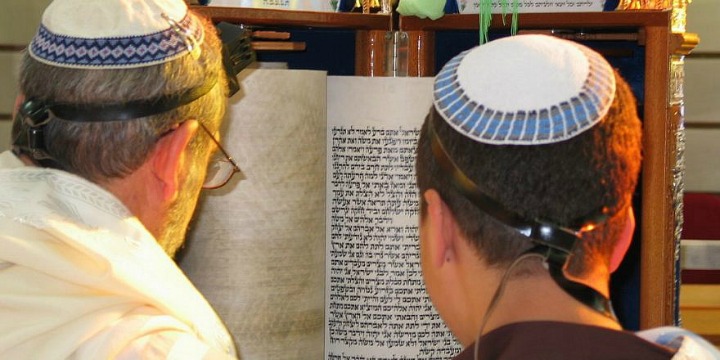
Reading from a Torah scroll in accordance with Sephardi tradition. Photo: Sagie Maoz via Wikimedia Commons.
I often teach with photographs. In my Politics and geography course, I not only present arguments, data, figures, and charts, I show pictures – of faces, streets, institutions, and the lived texture of how people organize themselves into communities and nations. I keep piles of images, catalogs, and books that I return to each semester, selecting and setting aside, trying to find the picture that will do the work a paragraph of writing cannot achieve.
Wrapping up the spring semester, sorting through those piles, I came back to Maya Benton’s Roman Vishniac Rediscovered. It had been months since I had opened it. I had not used it this term and was prepared to reshelf it, and then I stopped and looked through it.
I paused and I then gasped. I had completely forgotten how hard these photographs hit.
We tend to remember Vishniac for the images he made in Eastern Europe before the war with faces marked by poverty, communities suspended between endurance and fragility, a world that now feels both intimate and impossibly distant. Those photographs read, in retrospect, like a warning. The New York photographs, taken just a few years later after Vishniac arrived in the city on New Year’s Day 1941 having escaped internment in Nazi-occupied France, read like something else. They read like a response.
At first glance, the images are almost disarmingly ordinary. Children sit in classrooms. Boys cluster in hallways. Girls lean over desks. There are games, gatherings, moments of quiet instruction and supervised play. Nothing announces itself as extraordinary. But the longer you look, the more deliberate everything appears. These are not scenes of life unfolding. They are scenes of life being organized.
Benton’s scholarship makes the construction explicit. Many of these photographs were commissioned by the Joint Distribution Committee and other Jewish philanthropic organizations documenting and in some sense justifying the work they were doing in a new American context. Settlement houses, community centers, schools, youth programs: the infrastructure of a transplanted community. The camera was not wandering. It was directed. It was capturing not just people, but systems. As the historian Hasia Diner observes in her essay for the Benton volume, the Jewish child in New York is the emotional and strategic center of this archive; photographed again and again, by a people who understood that the next generation was the plan.
The contrast is unmistakable when you hold the two bodies of work together. In Europe, Vishniac’s subjects often appear precarious even when dignified: children thin, environments worn, futures uncertain. In New York, the children are sturdy, structured, embedded in institutions designed to carry them forward. They are not simply living Jewish lives. They are being prepared for them.
Preparation, here, is everything.
After the Shoah, Jewish life did not regenerate spontaneously. It was rebuilt — deliberately, systematically, and often quietly — through institutions. Schools transmitted identity. Community centers created belonging. Camps, classrooms, and after-school programs became the mechanisms through which a dispersed and traumatized people ensured that there would be a future at all. Continuity and formation was not treated as an inheritance. It was treated as a responsibility. L’dor v’dor – “from generation to generation” – was not taken or considered a sentimental phrase. It is a theory of formation and resilience, and these photographs are what it looks like in practice.
I closed the book thinking about my son. He is coming into his own now and he loves being Jewish. He asks questions; real ones, the ones that may you pause and think about how to answer, the kind that do not settle for a first answer. He is looking for community in a world that has made plain, in the months since October 7, that it is not always on his side. He wants to know where he fits, who his people are, what tradition is asking of him. He wants to belong to something older and larger than himself.
And I find myself asking a question that Vishniac’s New York children never had to ask on their own behalf, because the adults around them had already answered it. Will the institutions be there? Will there be places where my son can practice being Jewish with other Jews, learn the texts, observe the holidays, form the friendships that last, and develop the habits of mind and values that make a Jewish life possible? Being Jewish is not a solo activity. It is inherently social, communal, structured. It requires spaces, budgets, teachers, clergy, tables, calendars. It requires other people showing up, year after year, for reasons that are not reducible to individual preference.
The data are not encouraging. Pew’s 2020 study of Jewish Americans documented significant declines in synagogue membership and attendance, in denominational identification, in day school enrollment, in attachment to Israel. Jack Wertheimer, writing in Tablet, described non-Orthodox congregations as “hemorrhaging members, aging, merging, and closing.” The institutional map that Vishniac photographed has, in many American cities, thinned considerably. Buildings are sold. Schools consolidate. Federations struggle. The scaffolding that was built in the 1940s has not been uniformly maintained.
And yet the UJA-Federation of New York’s 2025 recontact study — conducted after October 7 — found that a majority of Jewish adults in New York reported increased engagement in some form of Jewish life since the attacks. While not a national study, roughly one in five in New York reported increased participation in specifically communal Jewish life: attending Jewish museums, cultural events, adult education, JCCs, Chabad. Synagogue attendance, by some measures, ticked up. People showed up. They wanted to be with other Jews. They wanted to do Jewish things in Jewish places.
That is the Vishniac parallel made present in his images. In the 1940s, the institutions were built before anyone could be certain who would fill them. Today, the people are arriving and searching despite being wounded over the past few years, and the question is whether the institutions are still there, and strong enough, to receive them. The 1940s answer was construction. The 2020s answer has to be the same. Reconstituting. Reformulating. Rethinking and rebuilding what has atrophied and building anew where the old forms no longer fit and apply.
This is often described as resilience. Resilience is too soft a word in today’s situation. What Vishniac documented, and what this moment demands, is something closer to discipline; the kind that prioritizes long-term survival over short-term ease, that invests in institutions even when the payoff is not immediate, that understands community as something to be maintained rather than merely felt. It is the work of people who do not assume that identity will take care of itself.
I want my son to inherit a Jewish life that is thick rather than thin and authentically rooted rather than curated with a focus on the communal and the individual. I want him to walk into synagogues and schools and camps and community centers that are full, confident, and alive and are places built by people who understood, as Vishniac’s subjects understood, that continuity is not ambient or emerges by fiat. It is constructed.
The Vishniac photographs do not tell us what to build. They do something more useful. They remind us that building is the work, and that the work does not end with one generation. The men and women who commissioned those photographs are gone. The children in them are now old or gone. The institutions they built have carried us this far.
Whether they carry our children further is up to us.
Samuel J. Abrams is a professor of politics at Sarah Lawrence College and a senior fellow at the American Enterprise Institute.