


Uncategorized
This Jewish feminist has been the NYC’s sanitation department’s official artist for 50 years. A new movie tells her story.
(JTA) — In 1976, deep in New York City’s fiscal crisis, the artist Mierle Laderman Ukeles read a review of her conceptual work in the Village Voice. In his review, critic David Bourdon made a radical suggestion inspired by Ukeles’ thesis: What if municipal work, like the Sanitation Department, were conceptual art? Could it get funded by grants, instead of by the city?
Ukeles presented the idea to Sanitation Department commissioner Anthony T. Vaccarello, who invited her to create art for 10,000 sanitation workers. The job would be unpaid. And, it turns out, she would keep it for nearly 50 years and counting.
Now 86, Ukeles is the subject of the documentary film “Maintenance Artist” directed by Jewish filmmaker Toby Perl Freilich, which made its New York theatrical release last week at the IFC Theater in Greenwich Village.
The title refers to Ukeles’ 1969 manifesto, which declared that the everyday activities often relegated to women — cooking, cleaning, changing diapers — were “maintenance art.”
But the movie spans all of Ukeles’ career, looking at her role as the artist-in-residence at the New York City Sanitation Department to her early activism on behalf of Tanzanian independence. The throughline, Ukeles says, has been a belief — rooted in her Jewish identity — that people are more than the roles that society assigns to them.
“As a Jew, I was in love with the notion of freedom,” Ukeles said in an interview. “This message of art as freedom, I felt that’s what I’m about. That’s what I’m for.”
As artist-in-residence, Ukeles plans, stages, and records public works of performance and conceptual art that recognizes the workers of the Sanitation Department. After the piece’s initial staging, photos from the performance might be shown at a museum or gallery.
Despite having been coined New York’s “trash artist” because of her Sanitation Department role, Ukeles does not actually dig in dumpsters or landfills to create her work. But much of her art has mined something else: her Jewish values, as the daughter of an Orthodox rabbi who herself has divided time between New York and Israel.
Some of her pieces have included conceptual and interactive works focusing on Jewish themes and traditions, such as the creation story and the mikvah, or ritual bath.
A 2010 interactive piece “Birthing Tikkun Olam,” for example, invited onlookers to reflect in an installation of glass mirrors, then make a “covenant” to repair the world. Their responses were collected and exchanged for a mirror in the piece, which she staged at the Yeshiva University Museum.
“The site of the art is going to move out into the world, and with it, the acts that you will do,” Ukeles told the university’s newspaper at the time.
Though Ukeles does not consider herself a Jewish artist, because she prefers to avoid being categorized as such, she observes Shabbat — even turning down a stint in the Peace Corps and Friday-night gallery openings to maintain her observance. She lives in Israel, where she advises art students at the Bezalel Academy Academy of Art and Design and attends a “partnership” minyan that aims to widen women’s participation in Orthodox Judaism.
“I have many deep beliefs in great Jewish ideas and commitments,” Ukeles said.
For Freilich, the daughter of Polish Holocaust survivors and a descendant of Hasidic dynasties who is herself an observant Jew, Ukeles’ identity was core to why she became so transfixed by the artist that she decided to make a movie about her.
“Her reading of Jewish texts, her reading of Jewish philosophy, of Judaism was profoundly moving to me because it emphasized things like, ‘we’re all created in God’s image’ and and we’re all equally deserving of respect and honor, or that the, the profane is the pathway to the sacred,” Freilich said. “And these are deep, deep kinds of concepts in Judaism that a lot of people aren’t really that familiar with.”
That first piece with DSNY, titled “Touch Sanitation Performance,” spoke to Freilich, who was inspired by a visit to the 2016 retrospective of Ukeles’ work at the Queens Museum.
“I was completely, really blown away,” said Freilich, whose previous documentary works have covered broad swaths of Jewish history, from the partisans of World War II to kibbutz life in Israel.
Ukeles’ works, funded by grants, endowments, fellowships, and commissions, have taken shape in every possible art medium — including performance art and landscape art.
Initially experimenting with paint, she got into trouble while at the Pratt Institute for creating a bulbous multimedia piece with cheesecloth and debris. The school’s administration found it provocative. Her mentor, the abstract expressionist Robert Richenburg, defended Ukeles’ work and ultimately resigned from the school, rather than change his teaching methods at the administration’s request.
“It was a very, very difficult time in my life,” Ukeles said. “I was shocked.”
That controversial piece, titled “Second Binding,” is currently hanging in New York’s Jewish Museum.
Ukeles’ work with the Sanitation Department is perhaps best known for a year-long project from 1979 to 1980, where she sought to shake all 8,500 department workers’ hands. It was documented in a series of photographs.
“They were looked down upon,” Ukeles said. “Not race, not religious, not ethnic, but as a kind of class of maintenance workers and names that people were called.”
Coming up on her 49th year with the New York Sanitation Department, Laderman still has project ideas for the city. She has two projects at Fresh Kills Landfill on Staten Island — formerly the largest landfill in the world. One of those projects is an ongoing conversion of the landfill into a public park, set to be completed in 2036. The other project is an overlook above the park.
“I now call it ‘intergenerational,’ because it’ll probably take other people to pick it up,” Ukeles said.
“There’s a Jewish source of that notion that the earth is sacred and that we have to redeem the earth when it’s been degraded,” she added. “I don’t know if it will ever finish.”
The post This Jewish feminist has been the NYC’s sanitation department’s official artist for 50 years. A new movie tells her story. appeared first on The Forward.
Uncategorized
He was a privileged Jewish kid from NYC’s Upper East Side. Donald Trump was his greatest invention.

American Scoundrel: Roy Cohn’s Dark Journey from Joe McCarthy to Donald Trump
By Kai Bird with Susan Goldmark
Scribner, $32, 528 pages
By the beginning of the new millennium, Roy Cohn, the red-baiting scourge of the McCarthy hearings, lived largely in the pages of U.S. history books, trotted out on occasion to illustrate how America always manages to overcome its worst nativist impulses. But just in case someone never knew or had forgotten about Cohn’s malign influence on U.S. politics, Tony Kushner brought him back as a villain in his brilliant drama of the early 1990s, Angels in America.
Then, in 2016, Donald Trump was elected president and suddenly, Cohn was breaking news again. The very next year, when Trump was furious at then-Attorney General Jeff Sessions for recusing himself from an investigation into whether Russia meddled with the election, the president cried out to his advisers, “Where’s my Roy Cohn?”
Now, as if in answer to that question, Kai Bird has written a magisterial biography of the notorious lawyer and Trump whisperer that is indispensable reading for anyone who wants to understand the current political moment. Bird, the co-author of American Prometheus, the Pulitzer Prize-winning biography of Robert J. Oppenheimer and inspiration for the Oscar-winning movie, began it in 2022, a couple years before Trump’s re-election. He collaborated with his wife, Susan Goldmark, who did the research for this riveting account of the unseemly, outrageous life of the hustler and con man about whom Trump once said, “If you need somebody to get vicious, hire Roy Cohn.”
Though Cohn has been long gone from public life — he died of AIDS at age 59 in 1986, insisting to the very end that he had succumbed to liver cancer — Bird demonstrates how he practically invented the dark political arts of resentment and division adopted by his former client, protégé and future president of the U.S.
Indeed, over the recent 4th of July weekend — decades after the collapse of the Soviet Union — Trump used Cohn’s divisive, inflammatory rhetoric in back-to-back speeches, including one at Mount Rushmore, branding his political opponents as evil, godless communists.

Bird walks us through Cohn’s life decade by decade. He grew up as an only child in a wealthy Jewish family on the Upper East Side and attended elite private schools, where his boyhood friends included Si Newhouse Jr., heir to the Condé Nast media empire, Gene Pope Jr., who would go on to found the National Enquirer, and, improbably, Al Lowenstein, later a well-known liberal Democratic activist and politician.
After Cohn graduated from Columbia Law School, his father, a judge, pulled strings to get him a job in the U.S. attorney’s office for the Southern District of New York, where he made a name for himself as the boy prosecutor who sent Julius and Ethel Rosenberg to the electric chair in 1953 for passing nuclear secrets to the Soviets. His tactics were highly irregular, including private meetings with the trial judge.
Not long after that, he went to work as chief counsel to Wisconsin Senator Joe McCarthy, using his position to force U.S.-funded libraries abroad to purge 30,000 books on the flimsy pretext that the authors were communists or Soviet sympathizers. He was also a central figure in the so-called Lavender Scare, when hundreds of federal employees thought to be gay lost their jobs because they were deemed a security risk.
By the 1960s, Cohn was back in New York, hanging out at the Stork Club and 21, squiring Barbara Walters around town, and representing mobsters though still living at home with his mother at 1165 Park Avenue. Over the next decade he would be indicted three times by U.S. Attorney Robert Morgenthau Jr. for bribery, perjury, extortion and other white-collar crimes. In each case, he managed to beat the rap though months before his death he was finally disbarred for unethical conduct.
After Cohn’s mother died in 1967, he moved into a stately townhouse on East 68th Street, where he established his law practice and stopped the pretense of dating women though he never publicly came out as gay. Then, in 1973, Cohn met his most consequential client. At the time, Trump was the 27-year-old son of a Queens real estate mogul trying to break into the Manhattan market and living in a rent-controlled studio on East 75th Street with a view of a water tank on an adjacent building.
Cohn advised the family on how to fight a Justice Department lawsuit accusing the real estate company of violating the Fair Housing Act by refusing to rent to Black tenants. Over the course of the litigation, Cohn taught Trump his signature moves: Keep your name in the paper. Never settle. Countersue. Claim victory. Don’t pay the bills.
Cohn also advised Trump on his first major real estate deal in Manhattan — buying the dilapidated Commodore Hotel on East 42nd Street, next to Grand Central Terminal. To get the deal done, Cohn worked his extensive connections to New York’s first Jewish mayor, Abraham Beame, a player in Democratic machine politics and an old friend of Cohn’s father.
For more than a decade, Trump continued to model himself after his mentor, adopting his penchant for personalized license plates and his snarling, scowling demeanor. Bird argues that in the decades since Cohn died, the McCarthyism of the 1950s has morphed into a nativist, America Firster politics that transformed the Republican Party into one of resentments against the old establishment, multiculturalism, globalization and liberal culture — in other words, the MAGA movement of today.
Cohn’s “values, his unethical behavior, and his political mindset have survived and replaced the values of the establishment he so resented,” Bird writes. “Perhaps his life is proof of the ability of one individual to change the arc of history. Certainly, he gave us the narcissistic politics of Donald Trump.”
The post He was a privileged Jewish kid from NYC’s Upper East Side. Donald Trump was his greatest invention. appeared first on The Forward.
Uncategorized
Trump wants to remake Washington — Hitler tried to do the same to Berlin
“It was natural that I also followed my passion for architecture. My faith increased that after many years my dreams would become reality. I was firmly convinced that I would win fame as a builder.”
–Adolf Hitler
“I own buildings. I’m a builder; I know how to build. Nobody can build like I can build.”
–Donald Trump
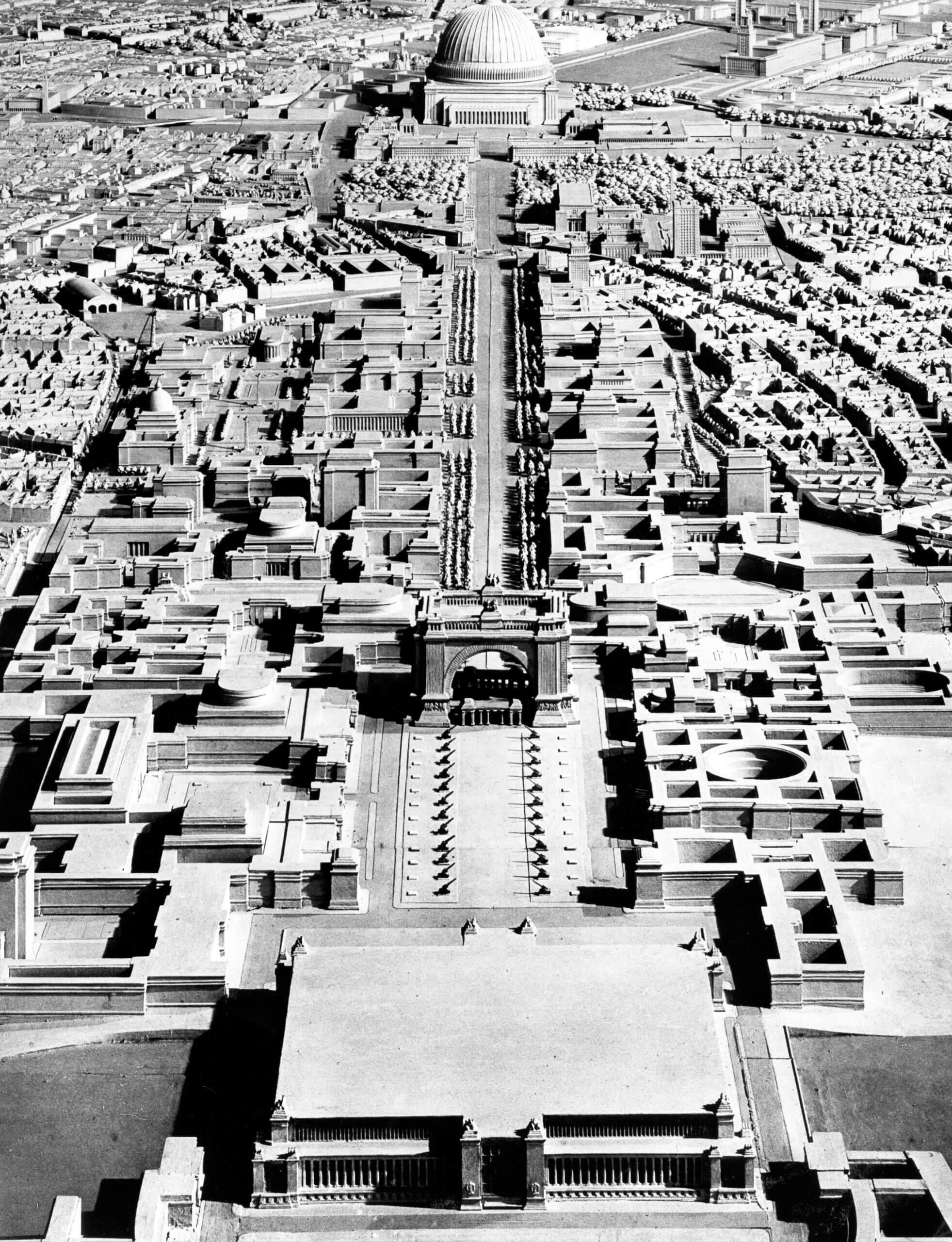
Adolf Hitler personally drew up architectural plans to remake Berlin into a 1,000-year monument to himself with a three-mile-long “Avenue of Splendors,” on one end an Arch of Triumph that would dwarf the Paris original, and on the other, the domed Hall of the People, which would have been the largest enclosed structure in the world.
Hitler’s grandiose remodeling schemes were suspended in 1943, in order to redirect resources to the war he had begun.
Like Hitler, Donald Trump is also busy designing and creating monuments to himself, including an arch even larger than the one Hitler had planned for Berlin. Unlike Hitler, Trump is proceeding at a fevered pace on completing his legacy projects despite the soaring costs of a war he began.
History is replete with monarchs, emperors, pharaohs and tyrants who sought to immortalize themselves with monuments. In modern times, what sets Trump and Hitler apart is their decision to personally draw up a plan to entirely change the look of a capital city to project their powers.
Hitler began sketching his plans to remake Berlin in the 1920s, years before he came to power. In his postwar book Inside the Third Reich, Hitler architect Albert Speer recalled Hitler showing him two sketches the Nazi leader had already made of his own concept, hoping to recruit the architect to the project. In 1937, the Hitler tasked Speer with making it happen.
Speer started by making a model of the redesigned city, to be renamed Germania. In his book, Speer wrote of Hitler’s glee while inspecting the scaled model.
“He bent down, almost kneeling, his eye an inch or so above the level of the model, in order to have the right perspective, and while looking he spoke with unusual vivacity. These were the rare times when he relinquished his usual stiffness. In no other situation did I see him so lively, so spontaneous, so relaxed,” Speer wrote.
Hitler admired the imperial architectural styles of Rome, Vienna and Paris, but came up with designs for Berlin that were meant to surpass those cities not in elegance, but in expressions of Teutonic power.
The Germania model designed by Speer looks like an elaborate Wagnerian stage set: Visitors disembarking from a new train station would immediately see the 380-foot-tall Arch of Triumph, and as they passed beneath they would follow a wide boulevard lined with about a dozen monumental ministry buildings made of hand-hewn stone, a Soldiers’ Hall with a crypt for the tombs of German field marshals, and, at the terminus of the avenue, the monstrous centerpiece of the whole project — the domed Hall of the People, with enough space to hold 150,000 people.
“He wanted the biggest of everything to glorify his works and magnify his pride,” Speer wrote.

The New Reich Chancellery went up, and some other pieces of Germania were completed. But as Hitler’s regime focused on building concentration camps and death camps, and German invasion forces spread across Europe and the Soviet Union, Hitler had to divert resources to pay for his war crimes.
The Reich suspended work on Germania in 1943. Hitler’s original idea was to complete the transformation in 1950, creating Germania as a new Rome, capital of a vanquished continent. But when the Soviet army entered Berlin, the city had been reduced to ruins. Hitler’s Germania fantasy came to a bloody end on April 30, 1945 when he put a bullet in his head inside the Führerbunker.
Like Hitler, Donald Trump seems to favor classical architectural styles for public buildings, although his love of gaudy glitter – on display inside the White House and at Trump’s own properties — contrasts with Hitler’s preference for a Teutonic austereness.
A few days ago Trump gave the White House press pool a tour of work that he has directed to be done on and around the White House. It reminded me of Speer’s description of Hitler’s glee while inspecting Speer’s model of Germania.
“I’m fixing the country. We’re fixing the White House too. One thing I know how to do is build,” said Trump, who spoke of having columns of the White House repaired, its exterior cleaned, of work on his ballroom and the “military complex” that would be built beneath it. He staged the dog-and-pony show to show off a helipad that was under construction.
“It’s ridiculous the way this place was taken care of. Nobody, including presidents, they didn’t see it. But I see it because I was very good at real estate, like maybe the best in a lot of ways,” said the man who went through multiple bankruptcies and has a history of failed business ventures: Trump University, Trump Steaks, and Trump’s airline, to name only a subset of available examples.
Despite Trump’s boasts, his vanity projects have hit some rough patches. There’s the reflecting pool debacle, a court ruling that his name had to come off the John F. Kennedy Center for the Performing Arts. Some Senate Republicans tried to stop him from spending taxpayer money on his garish ballroom.
But because of a Supreme Court ruling, it looks like the ballroom will go up after all. And Trump is not about to abandon other legacy projects – like his Triumphal Arch, and a National Garden of American Heroes.
Trump’s powers are cracking faster than he can build these monuments to himself. His approval ratings are abysmal. Global respect for America is tanking. Allies who have tried to mollify him are beginning to defy him. Iran has outsmarted him. Former MAGA loyalists like Marjorie Taylor Greene and Tucker Carlson have abandoned him. Trump is increasingly looking like an empty shell – a man who has chosen building narcissistic monuments, and corruptly enriching himself and his family, over paying heed to Americans who are suffering because of his self-aggrandizing rule.
Economist Paul Krugman just released a video titled Der Untergang, and subtitled “How badly will Trump punish America?” Der Untergang, German for “downfall,” is the title of a 2004 movie about Hitler’s last days in the Führerbunker. Krugman says that Trump’s obsession with his vanity projects is an indication that Trump knows his powers are rapidly vanishing, and that Trump is becoming perilously desperate.
“In many ways he is behaving like somebody who knows that his days of supreme power are about to end,” Krugman said.
Krugman argues that Trump is showing a deranged proclivity to tear things down rather than preserve them, as evidenced by his demolition of the beloved East Wing. And now Trump is threatening to raze the Kennedy Center for the Performing Arts, simply because he can’t get his name on it.
History has shown how perilous things can become when a despot finds himself backed into a corner. As we approach the mid-term elections, we should all worry about the wreckage Trump is capable of wreaking while watching his powers vanish. Trump’s downfall, whenever and however it may come, must not also be America’s.
The post Trump wants to remake Washington — Hitler tried to do the same to Berlin appeared first on The Forward.
Uncategorized
John Galliano bows out of Met exhibition as backlash over antisemitism mounts
(JTA) — John Galliano withdrew from a planned exhibition of his work at the Metropolitan Museum of Art in response to a rapidly escalating controversy over the museum’s decision to honor the fashion designer despite his history of antisemitic and racist remarks.
Galliano said Monday that, after discussions with the Met and others involved in the exhibition, he had decided that it was best for the show not to take place “at this time.” He said he remained accountable for the pain caused by his past words, particularly to Jews and Asians, and recognized that an exhibition honoring his work could be painful for some. The Met said it agreed with his decision.
The reversal came less than a month after the Met announced that Galliano would be the subject of its spring 2027 Costume Institute exhibition, a rare honor that would have made him only the third living designer to receive a solo show there. The exhibition was to open in conjunction with the Met Gala, one of New York’s biggest annual cultural and celebrity events.
Opposition to the exhibition appeared to mount steadily in recent weeks. Early public pushback came from Dana Thomas, Galliano’s biographer, who wrote in an Aug. 6 New York Times guest essay that the Met had made a serious error in choosing to honor him. The criticism then broadened, with Jewish leaders, museum donors and New York politicians publicly urging the museum to reconsider.
Those criticizing the exhibition were New York City Council Speaker Julie Menin, who called the decision deeply painful for Jewish New Yorkers. Prominent Met donor Alice Tisch described the planned exhibition as a “whitewash,” according to the Times.
The reversal is also a setback for Anna Wintour, Condé Nast’s chief content officer and the driving force behind the Met Gala. She had championed Galliano for decades and was among the Met figures most closely associated with bringing the exhibition to the museum.
The controversy was complicated by the fact that some prominent rabbis had actually met with Galliano before the exhibition was announced and had come away believing that his repentance was sincere, as JTA reported earlier this month.
Rabbi Rick Jacobs, president of the Union for Reform Judaism, said Galliano had shown the contrition necessary to earn his return to the fashion world. Rabbi Joshua Davidson of Congregation Emanu-El, a Reform synagogue in New York, likewise said he was convinced by Galliano’s statements of remorse and his efforts to educate himself about Judaism and the Holocaust. Neither rabbi endorsed the Met’s decision to honor Galliano, however. Rather, both told the museum that if it proceeded, it had a responsibility to make Galliano’s antisemitic conduct and the lessons of his repentance an explicit part of the exhibition.
That distinction was reflected in the Met’s original plans. Andrew Bolton, the Costume Institute’s curator, said in announcing the exhibition that it would address Galliano’s antisemitic and anti-Asian conduct, as well as his firing from Dior, a hate speech conviction in France and his subsequent treatment for addiction and public acknowledgment of his actions.
Galliano, among the most celebrated designers in the world, was fired by Christian Dior in 2011 after a video surfaced showing him praising Hitler and making antisemitic remarks in a tirade in a Paris cafe, and directing an anti-Asian slur at the partner of a Jewish woman. A French court convicted him of making public insults based on race, religion and ethnicity.
After entering treatment for substance abuse, he embarked on a process of rehabilitation and eventually returned to the fashion industry. Abraham Foxman, then national director of the Anti-Defamation League, met privately with Galliano repeatedly; in 2013 the ADL said that Galliano had demonstrated “true contrition.”
After the initial announcement of the exhibition, Jonathan Greenblatt, CEO and national director of the ADL, noted that the organization had “long since accepted his apology,” but added that he understood “why some Jews may question the decision to include Galliano’s work in an exhibit given the massive spike in antisemitism in recent years.”
In a statement Monday, Greenblatt appeared to take a harder line in welcoming Galliano’s withdrawal.
“With antisemitism at crisis levels, the Met honoring John Galliano at this moment was misguided, and even Galliano ultimately recognized what the Met should have done from the start,” Greenblatt wrote on X. “This was the wrong move at the wrong moment. Timing matters.”
Galliano’s withdrawal leaves the Met without a planned spring 2027 Costume Institute exhibition. The museum said information about a replacement exhibition and the 2027 Met Gala will be announced later.
This article originally appeared on JTA.org.
The post John Galliano bows out of Met exhibition as backlash over antisemitism mounts appeared first on The Forward.
