


Uncategorized
Monitored phone calls and fear of arrest: What life looks like for Iran’s Jews now

Amid the war in Iran, one Iranian Jewish woman who lives in the United States, but whose family remains in Iran, has been wracked with fear. Before the ceasefire, she spoke with her parents once a week for exactly one minute — both because of the exorbitant cost, about $50 per minute, and because of the fear of surveillance.
During one call a few days into the war, she said, something felt off.
“I could see that something is so wrong. It’s as if someone was there,” the woman, who moved to the U.S. in 2008, said in an interview with the Forward. “It seemed like my mom was actually reading from a note.”
She later learned that the Islamic Revolutionary Guard Corps had come to her parents’ home, questioning why they frequently called an American number. They instructed her parents to download Bale, an Iranian messaging app widely believed to be monitored by authorities, before making any further calls.
“It’s a spy app, and everyone knows that,” the woman said with a wry laugh. Her parents refused. Instead, they were told to call their daughter and read from a script while IRGC members watched.
“Basically, they said to prove that you are with us and not with Israel, read this when you call her,” the woman said. “After that day, they didn’t call for a long time.”
Eventually, she learned that her parents had fled to a safer part of the country to escape bombardment.
Her family are among the estimated 10,000 Jews who still live in Iran, in the largest Jewish community in the Middle East outside of Israel. Once numbering around 120,000, the community has dwindled significantly since the 1979 Islamic Revolution, when life for religious minorities fundamentally changed. Today, Jews who remain in Iran must carefully navigate life under the regime, publicly expressing loyalty to avoid being falsely accused of Zionist espionage.
Amid Iran’s war with the U.S. and Israel, that pressure has intensified.
With an ongoing internet blackout, communication is limited and closely monitored. To understand what life is like for Iranian Jews today, I spoke with several people in the U.S. who remain in sporadic contact with family members inside Iran. Everyone interviewed requested that they not be identified, fearing repercussions for either themselves or their families.
A synagogue vigil for the Supreme Leader
On April 16, Tehran’s Yusef Abad synagogue held a memorial for Ayatollah Ali Khamenei, who was killed on the first day of the war. The event was attended and reported on by several state-affiliated media channels, filming as participants from Iran’s Jewish community shared their appreciation for the deceased Supreme Leader.
Inside and around the synagogue, posters featuring photos of Khamenei were displayed alongside Farsi slogans like “Unity of Iran’s faiths against aggression — condemnation of the attack on the Tehran synagogue by the child-killing Zionist regime and criminal America” and “The Jewish faith is separate from Zionism.”

Regime media pointed to the vigil as evidence of Jewish support for Iran’s theocratic government. But experts say that interpretation misses the reality.
Beni Sabti, an Iranian-born analyst at Tel Aviv’s Institute for National Security Studies, said displays like the synagogue vigil are often a matter of survival. Jews who remain in Iran are frequently compelled to demonstrate loyalty to the regime — and opposition to Israel — in order to avoid suspicion of having ties to Israel. Allegations of such ties have often led to imprisonment and executions following the Islamic Revolution in 1979.
To protect the community, Jewish leaders — especially rabbis — often participate in pro-regime events, including memorials for senior regime figures. In some cases, Iranian rabbis have even sat alongside members of Hamas and Hezbollah to pay their respects to senior IRGC commanders responsible for funding and training terror groups across the Middle East.
The regime exerts significant pressure to stage these displays, Sabti said, “because it’s good for them to show the world, ‘You see, we don’t oppress anyone.’”
Beyond public displays, much of Iran’s economy is tied to the state — what officials often describe as a “resistance economy.” In that system, some say, expressions of loyalty can become intertwined with economic survival.
The woman who left Iran in 2008 said one of her relatives was once pressured to confiscate land from dozens of people and transfer it to the government in order to keep his job — a loyalty test she says was especially harsh because of his Jewish identity. “In the job interview, they told him, you have a Jewish background, so you have to first prove how far you will go,” she explained.
Since the 12-Day War between Israel and Iran in June 2025, the situation has grown even more tense. More than 30 Jewish Iranians were reportedly detained during that conflict because of alleged contact with Israel. While some Jewish community members were arrested during the wave of anti-regime protests that occurred at the beginning of the year, Sabti said he has not heard of a similar wave of arrests during the current war.
Still, the fear remains.
Synagogues as shelter
Some Iranian Jews have managed to stay in touch with relatives via landline phones, although calls are expensive and likely monitored. Most avoid discussing politics, using their limited time simply to confirm they are alive.
“After the 12-Day War, people really didn’t talk on the phone,” said the woman who moved to the U.S. in 2008. “We do talk, it’s not like they literally cannot, it’s just like they realized that the scrutiny was so high that no one has meaningful conversations.”
Even so, fragments of sentiment emerge.
One 25-year-old Iranian Jew from Los Angeles said his Jewish cousins in Iran cried tears of joy when they heard of the Ayatollah’s death.
He said his great uncle and cousin told him over the phone, “I don’t care, whatever the cost. If you can eliminate Khamenei, if you can eliminate Mojtaba, his son, if you can eliminate any threat… do it.” He added, “Most Persian Jews in Iran are happy, is what I hear.”
Amid the current ceasefire, a 64-year-old Iranian Jewish woman from LA said her Jewish friends in Iran have expressed relief. “They are happy that the situation is calm, but on the other hand, nobody is happy. They all want it to get finished,” she said, adding that they hope for “regime change.”
For Nora, an Iranian Jew living in New York, the war has come at a time of crisis for her family in Iran. She says her aunt has been focused on caring for her son, who is suffering from bone marrow cancer. Because the family keeps kosher, her aunt has had to leave the house — even during bombardments — to ensure he has food and other necessities.
Around three weeks into the war, her house in Tehran was destroyed after a nearby police station was struck. She briefly moved into a local synagogue; now, she lives with another Jewish family who opened their home to her. Her son remains too sick to leave the hospital.
A synagogue destroyed
Nora’s aunt is not the only Iranian Jew to find shelter in a synagogue. Sabti heard from another Jewish family inside Iran that Jewish communities have been using synagogues as bomb shelters throughout the war. He recalled doing the same during his youth at the time of the Iran-Iraq war that began in 1980.
Beyond using the space for physical safety, synagogues have also become a place for Jews to be together during the difficult time. “They come just to gather there, passing the time, meeting and having a little bit better time together,” he said.
For members of the Rafi’ Nia synagogue, a 150-year-old religious institution in Tehran, this sense of comfort has disappeared. On April 6, the community gathered there for Passover services. The next morning, they learned the building had been destroyed by an Israeli strike.
The Israel Defense Forces said that the target of the strike was not the synagogue, but rather a top commander from Khatam al-Anbiya, Iran’s military emergency command. But Iranian media suggested that the IDF had intentionally targeted the building. The head of the synagogue made a statement condemning the attacks and wishing the Iranian regime success in the war.
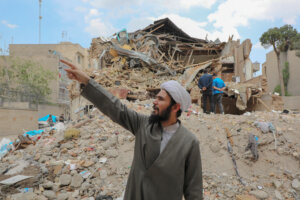
The woman who immigrated in 2008 had visited the Rafi’ Nia synagogue during Passover around 10 years ago. She described it as a beautiful old building. Seeing images of its destruction brought back painful memories of her family’s past.
She and her family were forcibly converted to Islam around 70 years ago, she said, with one uncle publicly hanged after he refused to convert. Her family continued practicing Judaism in secret — celebrating Shabbat behind locked doors and in her grandmother’s basement, always afraid.
She believes her family became a target for conversion after the synagogue in their area was destroyed, leaving them without formal affiliation to a recognized religious institution. On two occasions, she said, the IRGC raided their home during Jewish holidays, searching for evidence of religious practice. When they found a menorah, her father was detained. “When my dad came back, he was a ghost.” She fears that members of the destroyed synagogue could now face a similar vulnerability.
In Iran, certain religious minorities, including Jews, are constitutionally recognized. But she says that their protection is closely tied to existing institutions.
“When we talk about the lack of protection, it has a very nuanced meaning. In Iran, this doesn’t mean that the synagogues cannot exist, but it means that the existing synagogues are the only legal protection that Jews do have,” she said. “Good luck with rebuilding that place. Good luck with asking for a new synagogue.”
Sabti said the regime has already used the synagogue’s destruction as propaganda, publicly condemning the attack while reinforcing the state narrative of religious inclusion. “The head of the Islamic clerics condemned Israel and paid condolences to the Jews,” he said. “Everyone pays condolences and says, ‘Oh, sorry, we are in this together’ … but everyone knows that the other one also is lying.”
An American Jewish detainee
For one Iranian American Jew, the war has made a dire situation worse.
Kamran Hekmati, a 70-year-old Iranian American from Great Neck, New York, traveled to Iran in June 2025 and was detained during the 12-Day War. According to advocates, his alleged crime was traveling to Israel 13 years earlier for his grandson’s bar mitzvah.
Kieran Ramsey of the Global Reach advocacy group, who represents Hekmati’s family, said in an interview that Kamran being the Iranian regime’s only Jewish American prisoner puts him in a particularly precarious position. “There can be risk of retribution or reprisals against him at any moment,” Ramsey said, “from prison guards or other prisoners…his identity certainly puts him at higher risk.”
On March 16, almost three weeks into the war, Secretary of State Marco Rubio designated Hekmati as wrongfully detained, a status that allows the federal government to deploy all possible levers — diplomatic, legal, and economic — to secure his release. Ramsey says that change in designation is helpful, but only goes so far.
His organization is now pushing for the release of all American prisoners in Iran to be an integral part of the U.S.-Iran negotiations to end the war.
“Our hope is that Kamran Hekmati and the other Americans that are being held are put to the front of the list in terms of issues to decide, and not as a deal sweetener,” he said adding, “We know the U.S. negotiators have a list of American names. We know Kamran is at the top of that list…. We also know there are some very rational actors inside the regime, and we are trying to convince them that you have a no-cost way to open doors. Use Kamran as that no-cost way.”
The last time the woman who emigrated in 2008 visited Iran was two years ago. Even then, she worried that photos taken of her in the U.S. wearing a Jewish star necklace might draw the regime’s suspicion.
Now, she believes whatever space existed for quiet concessions from the Iranian government to Jews may disappear. The regime’s efforts to retain a firm grip on the Iranian people following January’s massive anti-regime protest wave and the war pose new risks.
“Just because of everything that has happened… I’m sure that any type of like ‘OK, let this go,’ ‘Let this person go,’ will end,” she said.
“Now I know that I could not go back,” she added. “I really feel if the Islamic Republic stays — and they probably have a good chance of staying — I feel like I lost Iran.”
The post Monitored phone calls and fear of arrest: What life looks like for Iran’s Jews now appeared first on The Forward.
Uncategorized
Regan Katz manages not just one, but two different – and successful baseball teams in two different cities

By BERNIE BELLAN About three months ago I wrote a story about an up and coming local football star by the name of Gavin Katz – who, although only 14 years old, had already received widespread recognition for his defensive abilities on the football field. (You can read that story at “Gavin Katz: ‘The next great Jewish football player’.”)
Gavin had been both a linebacker and defensive lineman for his pee-wee Fort Garry Lions Bantam football team – and he was voted most outstanding defensive player on his team by his coach, John Makie.
One thing that stood Gavin in especially good stead as a football player was that, in his 14th year, he grew 4 inches to 5’8″ and added 35 pounds to weigh 170 pounds at the time I spoke to him in July.
With him graduating from Ecole River Heights last June and moving on to Kelvin High School this September, Gavin had hopes to make the Kelvin football team, but he was realistic about his chances, saying that he thought he would probably “end up on the practice roster” for the Clippers varsity team “where he will be fighting for a playing role,” because if he did make the team he’d be among the youngest players on the team (which is usually made up predominantly of players from Grades 11 & 12).
Well, as I noted in my introduction to my story about Gavin Katz, the idea for doing that story came from sportswriter Scott Taylor. Recently, Scott sent me another email about a story, but this time the idea he suggested was to do a story about Gavin’s father, Regan.
I had mentioned Gavin’s parents’ names in my story about Gavin – also that Regan is former Mayor Sam Katz’s nephew (His father is Sam’s older brother, David), but other than adding Gavin’s mother’s name (Mandy), I didn’t go into any detail about Regan Katz and his own very successful career.
Then I received another email from Scott Taylor, this time about Regan (with a photo attached):
“Here’s a photo of the best baseball executive in Canada — Regan Katz.
“He runs both the Goldeyes and the Ottawa Titans. He helped get the Goldeyes to the playoffs, just won a championship with the Ottawa Titans and also set the affiliated minor league attendance record in Ottawa with more than 10,000 fans for the Frontier League opener and again for the Championship series.
“This guy has his shit together.”
And so, since my story about Gavin Katz was one of the most widely read stories on this website this past summer (It was also very widely read in the print Jewish Post newspaper.), I decided that, if Scott Taylor sends me a story idea, it’s an idea worth following up.
Which led me to contacting Regan Katz again. (The last time I contacted him it was to see whether he could wake Gavin up to talk to me. After all, like most teenagers, Gavin likes to sleep in when he can, but it was already 11 am on a Saturday morning when I was calling, so I figured: “Dad, go wake up your son. There’s a not-so-important journalist who wants to talk to him.”
Which is how I ended up having a very enjoyable interview with a very personable and unassuming young man – who did seem a little bit drowsy as I talked to him.
This time though, when I spoke with Gavin’s father, Regan was very much alert. Considering the hectic schedule he maintains though during baseball season, I could have forgiven him for sounding just a wee bit tired himself. But, at the time we did our phone interview, Regan’s baseball season had wound up. He sounded quite relaxed – still very much enjoying the accolades he had received for his work running not just one, but two different minor league baseball teams.
Before I began to ask Regan about his life in baseball, however, I wanted to touch base with him about Gavin’s football career. By now, the high school football season was in full tilt, and I was curious to know whether Gavin had made the Kelvin football team?
Regan told me that Gavin was one of only three “freshmen” to make the team and “Gavin’s the only one who started every game, and, yesterday got defensive player of the game” (which would have been played Thursday, Oct. 1, as our interview was conducted Friday, Oct. 2.)
I asked Regan whether Gavin was still playing linebacker (which, Gavin had told me, was his preferred position on defense)?
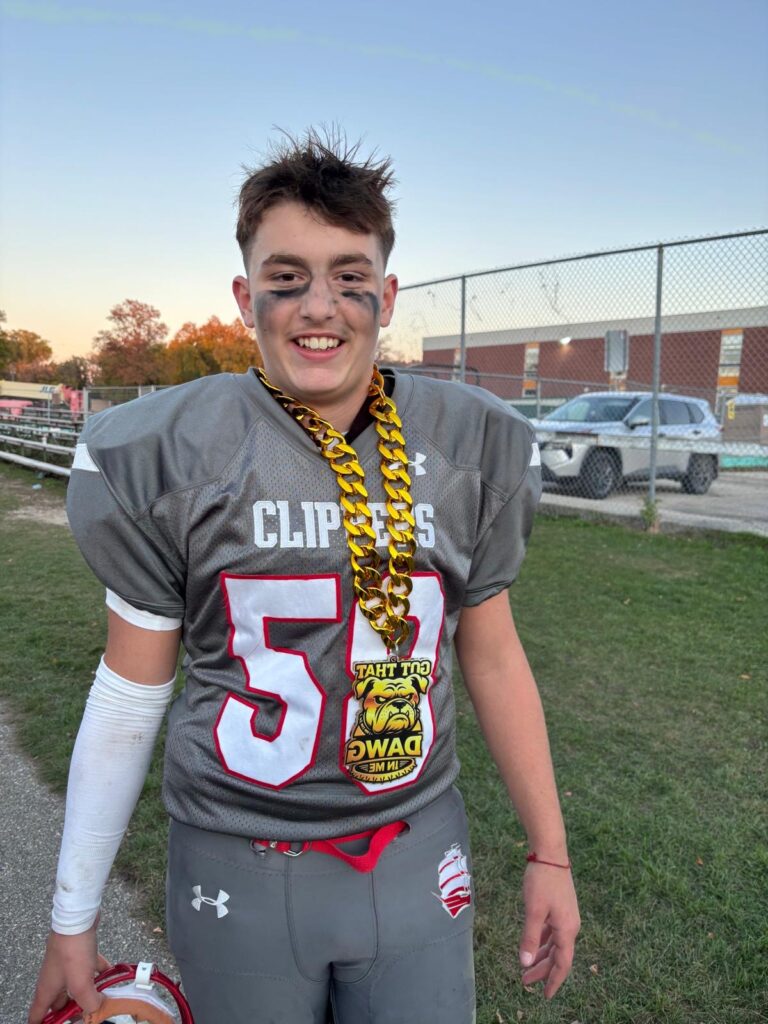
Regan responded that “they moved him to defensive tackle, so he’s right in the front line instead of at the back, but he’s breaking through the offense and helping the linebackers take down the tackles. He got two sacks yesterday and two running back tackles, which is not his job, but he’s breaking (through) kids larger than him and making his way through.”
At some point, as we follow Gavin’s football career, I hope to provide further updates as to his success on the “gridiron.” (By the way, the term “gridiron” – which refers to a football field and which used to be used quite often by sportswriters in the past “comes from the historical layout of the field, which was marked with intersecting lines every few yards that made it look like a metal cooking grate (or gridiron) used for broiling food over an open fire.”)
Enough about Gavin. Now, here’s the main point of why I wanted to do this story, which was to write about Regan.
I asked him how long he’s been involved with organized baseball?
He answered: “I’m in my 28th year.” As Regan observed, although he was born in Winnipeg, “when I was three, my dad decided he was allergic to snow and moved the family west (to Victoria). I came back in my late teens and joined up with the Winnipeg Goldeyes.”
Even before Regan moved back to Winnipeg, however, he had already embarked on a business career in his early teens, working for Westfair Foods (owners of Superstore and Wholesale Club) in British Columbia, helping to build grocery stores all over the province.
As he explained it, “So, when they would open up a new store, I would be the regional person who would go in and ensure that the setup and the staff was on plan.”
Regan was also responsible for training the staff and making “sure that everyone was ready” – traits that were to prove indispensable to what was to come during his current career in baseball. ”I was part of seven store openings in a two-year span, in that role” (with Westfair), Regan added.
He noted that when he left, he told them he was taking a “two-year sabbatical from the job.”
Regan added though, that “since I haven’t gone back, I assume they figured out I’m not returning.”
I asked: “Well, have they sent you a message saying, ‘Hey, the door’s still open?’ “
Regan answered: “No, but every year I get my superannuation for the time I served with them.”
He went on to note that he got married in 2010, “to a wonderful Manitoba woman, ” (Mandy, whose maiden name Gavin had told me, was Falk.)
Sam Katz actually revived the Winnipeg Goldeyes as a baseball franchise in 1994, when the team played out of the north end of what was then Winnipeg Stadium – in what was a very oddly shaped baseball field.
Regan, who came on board full-time with the Goldeyes in early 1999, says that he had spent some time with the team during a few previous summers spent in Winnipeg and had been able to see the Goldeyes play on that field which, he says, was affectionately known as “Deformity Field.”
(The left field fence was only 225 feet from home plate. It was a hitter’s dream – knocking easy home runs over that very short distance to the fence.)
Regan arrived in Winnipeg, however, just in time for what was to be the first season in what was to become the Goldeyes’ new home – what was then called CanwWest Park (now Blue Cross Park), in 1998.
His first title with the Goldeyes, he said, was “account executive, but I was truly a ‘gofer,” he observed.
“At the time construction was on full throttle at the new ballpark – downtown. And so, we were commuting from our offices on Maroons Road (where Winnipeg Stadium was located), and on McDermot – at Sam’s offices for Nite Out (Entertainment), as well as the ballpark trying to get things set up.
“So, when I wasn’t hauling or setting things up, I was making calls off a list to try and convince people to buy tickets.”
In those early years with the Goldeyes, as Regan noted, he was mostly involved in ticket sales, and in “2003, I moved to director of group sales and looked after all of our group sales, which are the outings where people are coming out (for things like) birthday parties, baseball teams, family gatherings, that kind of thing.”
In 2005, Regan moved up from director of group sales to assistant general manager, then in 2016 to vice president and chief operating officer – which are the positions he holds to this day.
In March 2020, however, Regan and his uncle Sam Katz took a trip to Ottawa – just as Covid was beginning to shut down things everywhere – including sporting venues.
There was a baseball park in Ottawa – called Ottawa Stadium, owned by the city, that was sitting empty.
As Regan explained, the city was “taking RFPs for an operator. (It had) sat empty for a year and a bit, and its previous occupant had left all kinds of turmoil and unpaid bills and whatnot.
“So they were looking for a team, trying to decide what to do with the venue. So we went out to tour – just as COVID shutdowns were starting in late March. We toured the venue, contemplated for a bit. And so, we went back and forth for a while, trying to decide if this was something we wanted to take on.
“In September of 2020, we agreed to terms with the city on a lease for the venue. We couldn’t travel across the border, so we started the team in 2022.”

The Ottawa team, known at the Titans, play in what is called the “Frontier League (which will be rebranding in 2027 to become the “National Association.” The Goldeyes, by the way, are in a league known as the “American Association.”)
There is a difference in the calibre of baseball players in the two leagues, as Regan explained to me: Players in the Frontier League would move up to Single A baseball, while players in the American Association would move up either to Double A or Triple A. (The level of baseball in the American Association is at a level wherein you can often see former major leaguers playing on teams.)
As vice-president and chief operating officer for both the Winnipeg Goldeyes and the Ottawa Titans, Regan said that he oversees general operations for both teams, but is not involved with the day to day management of players or coaches of the teams. That is the responsibility of the teams’ general managers and field managers, he clarified.
While there is no specific award for executive of the year in either the Frontier League or the American Association, when Scott Taylor wrote to me that Regan Katz is “the best baseball executive in Canada,” he didn’t say that he was referring only to minor league baseball.
As Regan noted, the Goldeyes received an award for “Game Presentation of the Year” this year, while the “Ottawa Titans received the Commissioner’s Award of Excellence.”
“When we started the (Ottawa) team five years ago,” he observed, “we were averaging about 1,200 fans. This year we were in excess of 2,600. We set attendance records, both for the ballpark in Ottawa, as well as for the league. We also sold 10,278 tickets to our opener, which is a record that will probably stand true for the rest of time.”
As far as the Winnipeg Goldeyes’ season went, not only did the team perform well on the field, making it to the first round of the playoffs, average attendance was the highest it’s been since before Covid, with games averaging over 4,000 fans.
Not only that, but the Goldeyes received a number of accolades for how they produce their games.
“Our broadcaster got Broadcaster of the Year,” Regan noted. (The games are broadcast on Nostalgia Radio Station CJNU. The play by play announcer is Trevor Curl.)
“We (also) received Game Presentation of the Year, which, you know is a big one because that’s what we work so hard on. What we’re selling – it’s all about fan experience.”
Regan continued: “Obviously, we try to put together a winning team, but to us, it’s all about having fun at the ballpark, win or lose – even if you don’t like baseball. So that one meant the most to us.
“We also won Social Media Team of the Year – for Winnipeg. All three of (those awards) are big ones to us because they’re pieces that we choose and work hard on.
“The essence of what I do (is) we’re trying to put on family entertainment that happens to have a baseball game in the background. ..and that’s what we built in Winnipeg.”
I asked Regan whether “in terms of, of how you rate in in Minor League Baseball – without trying to blow your own horn, I know the Goldeyes have always been considered a top-notch operation. Have the Goldeyes received any particular awards from organizations that look at all of minor league baseball and compare all teams?”
“ ‘Baseball Digest’ has acknowledged us a number of times over our 33 years for various pieces of what we do,” Regan answered, “whether it be attendance or game experience or most creative promotion. We’ve certainly received many, many mentions in ‘Baseball Digest,’ which is probably the most well-known for all of Minor League Baseball and independent leagues for sharing what’s out there.”
I asked Regan – and it was based on everything he had told me to that point: “Has anyone in a much more senior league tried to recruit you?”
He responded: “Are there headhunters out there who have called me? Absolutely, yes. Many, many teams call me to consult all the time, but I do keep my advice and recommendations to those within our league because I want to see the leagues that we’re in succeed.”
Regan added: “I have a young family. (In addition to Gavin, the Katz’s have a daughter, Brynlee, who is nine). I like where I’m at. I don’t think any other team is going to come to Winnipeg, so I’m well-planted here.”
My final question was about how difficult it is to run two separate teams that are so far apart?
He answered: “Anybody else who has overlap between two teams has a much shorter commute than I do – with a three-hour flight each way. It’s incredibly challenging. Fortunately, technology’s made it a lot easier with virtual meetings and things like that. I speak with my staff in Ottawa every single day. I’m in constant contact with at least some of them, if not all of them. All of our meetings are virtual so that I can be part of them.”
Only 47 years old, Regan Katz has been working full time since he was a young teenager. I didn’t even mention that, while he was working for the Goldeyes here after he had just moved to Winnipeg, he managed to finish university, where he studied business administration. If anyone would be interested in learning about business administration, with everything he has accomplished so far, Regan Katz could be the perfect teacher.
Uncategorized
Mamdani faces growing pressure over Jewish NYPD Commissioner Tisch and over Israel from left flank
(JTA) — New York City Mayor Zohran Mamdani is facing increasing pressure from some on the leftmost flank of his voting coalition, and an ICE shooting Thursday led democratic socialist allies to add their voices to a major demand: dump police commissioner Jessica Tisch.
“The NYPD’s Strategic Response Group must be disbanded as quickly as possible, and Commissioner Tisch must step down,” said Darializa Avila Chevalier, who won her Democratic primary with Mamdani’s endorsement. The democratic socialist, who is expected to join Congress next year representing Upper Manhattan and parts of the Bronx, was referring to the heavily armed police department unit that often responds to protests.
The calls for Tisch’s removal follow strident criticism of the mayor from pro-Palestinian activists on Wednesday night who called him names, including “traitor” and “Ziohran,” when he showed up at an Oct. 7 Israeli peace vigil mourning the loss of both Jewish and Palestinian lives. The demonstrators assailed him for not doing more to advance the pro-Palestinian agenda that has long been central to his political beliefs, raising questions over whether he could lose parts of his base as he pledges to be a mayor for all New Yorkers.
The demand for Tisch’s removal came after an ICE agent shot and wounded a Dominican man in his car on Thursday afternoon while his 5-year-old son was in the back seat. Avila Chevalier, who joined protests against ICE on Thursday, wrote on X that the NYPD “spent more time protecting a militia that just shot someone than protecting New Yorkers.”
Mamdani’s decision last year to retain Tisch — a self-described “proud Zionist” who comes from a prominent Jewish family — was seen as a reassuring move by moderates and establishment Jewish organizations including UJA-Federation of New York and the Jewish Community Relations Council. (70 Faces Media, the parent company of the Jewish Telegraphic Agency and New York Jewish Week, receives UJA funding.)
A number of progressives were skeptical of the decision at the time, citing her background as an appointee of Mamdani’s predecessor, Eric Adams, and her past criticism of campus pro-Palestinian protests. Some viewed her as an impediment to criminal justice reform.
Meanwhile, some on the left have dinged him for not yet following through on campaign promises 10 months into his term, including dissolving the Strategic Response Group, or backing down from his vow to arrest Israeli Prime Minister Benjamin Netanyahu, a plan which he later said he did not have the power to execute.
Anti-Zionist groups including Pal-Awda, Within Our Lifetime and a number of student organizations who rallied against Mamdani at the Oct. 7 vigil accused him of succumbing “to Zionist pressure.” Protesters called him a “traitor” and a number of chants rang out including, “Mayor Mamdani you can’t hide, we charge you with genocide,” drowning out speakers at the vigil and forcing the organizers to move it behind police barricades to keep the protesters from overrunning the event.
Among those protesters’ many gripes with the mayor was his decision to retain Tisch. One sign at the demonstration depicted Mamdani with the text, “Chief Executive of the NYPD SRG” with a Star of David in the middle, and a name tag on the mayor’s chest reading, “Ziohran.”
Criticism was also directed at Mamdani for not stopping Israeli real estate events at synagogues, and for his strategy to combat antisemitism, released last week, which allocates funds to a number of community-based organizations aimed at preventing hate crimes. Some critics have charged that some of the funding will aid Zionist organizations.
“The Jewish community is a large part of New York and it should be cherished. But you cannot fund these Anti-Defamation Leagues that prioritize Zionism over Judaism,” a John Jay College student protester, who declined to be named, told JTA during the demonstration.
On Thursday, the Democratic Socialists of America’s New York City chapter — which Mamdani has called his “political home” — wrote that Tisch “must end NYPD complicity with ICE” and that if she “cannot put a stop to these injustices, she must be fired.”
“Abolish ICE. Disband the SRG. Fire Tisch,” wrote Illapa Sairitupac, a fellow democratic socialist who won the Democratic nomination for a Lower Manhattan State Assembly district. Mamdani endorsed both Sairitupac and Avila Chevalier this past year.
While some protesters at the vigil said they were Mamdani voters — and one speaker even identified herself as a former intern for the now-mayor — some of the mayor’s allies have stressed that the crowd protesting him was not representative of his base.
“If I had to gamble, I would gamble that the vast majority of them were people who never supported him,” activist Abby Stein told JTA on Thursday night, during the Mazals gala held by left-wing group Jews for Racial & Economic Justice. Mamdani was due to attend the JFREJ event, but because of the ICE shooting was instead in the Bronx, where he denounced the federal agency and demanded that it cease its operations in New York City.
Many of the signs excoriating Mamdani at Wednesday’s protest outside of City Hall were signed with the name of the Maoist Communist Union, an organization that opposed Mamdani before he took office. Some protesters were handing out copies of Spartacist, the Trotskyist International Communist League’s journal.
“We certainly didn’t support Mamdani or vote for him,” said Erica Jones, among the Trotskyist protesters. “We knew he was running as a Democrat and he would be as big of a sellout as AOC and Bernie Sanders and all the rest of those who claim to have, at one time, stood for socialism but in reality, stand for the capitalist masters who are oppressing us all.”
Stein, a member of the DSA in addition to JFREJ, called out some of the protesters’ rhetoric and the choice to crash the Israelis for Peace Oct. 7 vigil. But she also acknowledged that there was overlap between their demands and her views, including over the police commissioner.
“There are things that people are upset over that I think are legit — like keeping Jessica Tisch on, for example,” Stein said. “A lot of us were not very happy about it.”
Ultimately, Stein said there is “always going to be something to protest” with any politician, and pointed to a quote from New York’s mayor in the 1970s and ‘80s, Ed Koch: “If you agree with me on 9 out of 12 issues, vote for me. If you agree with me on 12 out of 12 issues, see a psychiatrist.”
This article originally appeared on JTA.org.
The post Mamdani faces growing pressure over Jewish NYPD Commissioner Tisch and over Israel from left flank appeared first on The Forward.
Uncategorized
A planned non-Zionist Jewish school in Boston hopes to ride the momentum of the left
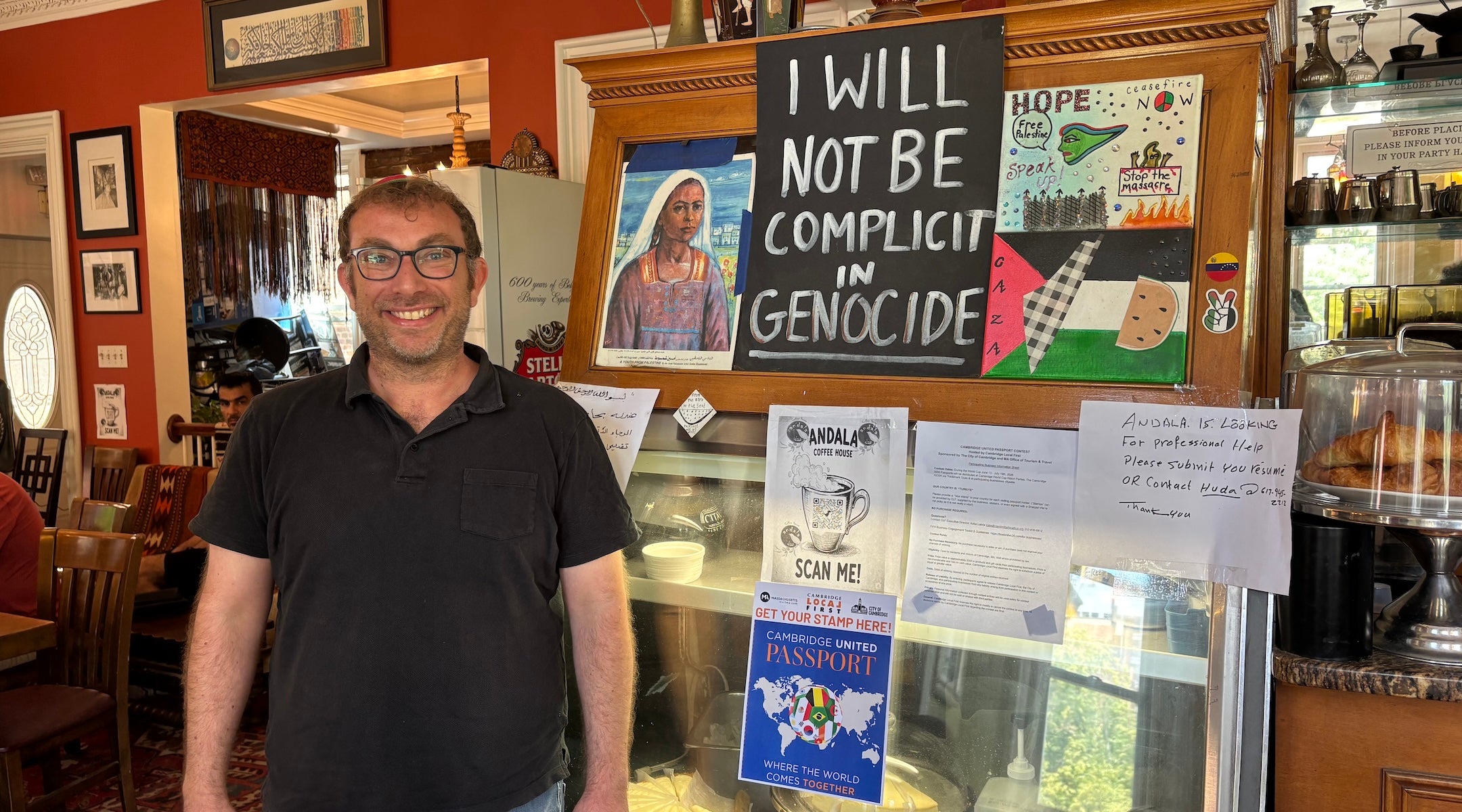
(JTA) — BOSTON — In the middle of a conversation about her future children, it dawned on Leah Robbins that the school she imagined for them did not exist.
Robbins envisioned a Jewish school where children studied Jewish texts, history and observance, as she did at the school run out of her Conservative synagogue in northern Florida. But having long ago rejected the allegiance to Israel that was entwined with her education, she could not fathom sending her children to a school that promoted Zionism — which ruled out all the Jewish day schools she knew.
“I was just overwhelmed with a sense of grief that my kids could be less Jewishly educated than I was,” Robbins, who has lived in Boston for 10 years, told the Jewish Telegraphic Agency. “I would never ever consider sending my kids to any of the local day schools because of total values misalignment.”
Four years after that conversation, Robbins is building her own institution for the children she hopes to have. She plans to open Achvat Olam, a “diasporist” day school whose name translates to “global solidarity” in Hebrew, in the Boston area in fall 2029. The school aims to launch with eight to 10 families, starting with a kindergarten and adding grade levels until ultimately becoming a K-8 school.
Achvat Olam is fiscally sponsored by Beloved Builders, a Massachusetts-based nonprofit that supports progressive Jewish projects. Robbins, who has a background in fundraising for Jewish nonprofits, hopes to raise $625,000 for the launch. She said she has met about 20 local families who expressed interest, and will start formal recruitment efforts, including focus groups and open houses, next year.
Achvat Olam will teach about Jewish history, cultures and languages outside of Israel, while engaging with Hebrew and Israel’s history from a non-Zionist perspective. The school’s website includes a page on “Israel/Palestine,” saying its community will share a belief that “the pursuit of justice, dignity, and thriving for all people is a Jewish moral imperative.”
“This includes an age-appropriate, honest confrontation with Zionism and the ongoing Nakba against the Palestinian people,” the website says, using the Arabic word for the displacement of over 700,000 Palestinians at the time of the State of Israel’s founding. The school also says that students will consider “the complicity and support of the US government and Diaspora Jews.”
Micah-Shalom Kesselman is the parent of a 4-year-old in Medford, Massachusetts, and participates in local left-wing Jewish groups such as the Boston Workers Circle. He’s disappointed that his son Oren will age out of Achvat Olam by the time it is scheduled to open as a kindergarten. “I would super want Oren to attend something like what Achvat Olam is shaping up to be,” he said.
Kesselman, who studies Yiddish with his son, explained that he would like Oren to be steeped in Jewish traditions and culture. But as a parent who is “not a supporter of Zionism,” he said he has found few Jewish educational opportunities that match his beliefs.
Diverse day school histories
Jewish day schools have historically encompassed a range of orientations toward Israel, according to Jonathan Krasner, a historian of American Jewish education at Brandeis University. The modern day school movement was born in the 1920s and initially dominated by orthodox schools, some of which did not emphasize Zionism. In the 1950s, secular Yiddishist schools taught varied attitudes toward Israel. Some yeshivas in the orthodox Haredi movement still today oppose Zionism on religious grounds, believing that Jewish sovereignty should only be established through the coming of the Messiah.
But Krasner could not name another day school that has Achvat Olam’s goal: education for Jewish families who disavow the current-day political realities of Israel and Zionism. In the aftermath of the Hamas attacks on Israel on Oct. 7, 2023, many day schools went the opposite direction, adding curricula to strengthen solidarity between Diaspora Jews and Israel.
“The initial response of the organized Jewish community was, understandably, to circle the wagons and to reinforce their connections to Israel and to the Israeli people,” Krasner said.
Jack Wertheimer, a professor of American Jewish history at the Conservative movement’s Jewish Theological Seminary, isn’t convinced that Achvat Olam will change that trend. He said he was “highly skeptical” that Robbins could attract enough families to sustain a school. According to historical data, he said, Jews who lean more politically left tend to be less engaged in Jewish life.
“From what I know, the overwhelming majority of parents who are interested in sending their children to Jewish day schools are pro-Israel,” said Wertheimer.
Nonetheless, Robbins believes that the market for her school is growing. Survey after survey has captured a drop in Americans’ support for Israel since the Gaza war, and Jews are not an exception to the trend. After decades of being treated as fringe in many of their communities, left-wing Jews who are anti-Zionist — or simply do not see Israel as part of their identity — say that instead of adapting to their congregations and Jewish schools, the institutions should adapt to them.
There are signs that this group makes up a substantial portion of Jews in the United States. About 30% of Jewish adults believe that Israel has committed genocide in Gaza, according to a June poll of 1,022 Jews from the Associated Press-NORC Center for Public Affairs Research, which had a 5% error margin. Less than 40% said that “supporting Israel” was crucial to their Jewish identity.
Younger Jews emphasize traditions
At the same time, among adults who identified as religiously Jewish, younger people said they emphasized Jewish traditions more than their older counterparts. Younger Jews were more likely than older ones to say that “celebrating Jewish holidays” and “celebrating or marking Shabbat” were important to them, while Jews over 45 placed more emphasis on “remembering the Holocaust” and “supporting Israel” than younger ones.
This finding could reflect the growing share of younger Jews who are Orthodox. It also comes amid a boom in Jewish leftist organizations that explicitly ground their activism in religious tradition. IfNotNow, an anti-occupation group that has grown from 1,000 dues-paying members in 2023 to 7,000 this year, says it is “growing a community rooted in Jewish values and ritual.” The anti-Zionist Jewish Voice for Peace, which has amassed 32,000 dues-paying members, often frames its protests through Jewish holidays, texts and prayer.
Robbins is betting that a significant pool of younger Jews, many of them now parents to young children, are seeking avenues to both protect their Jewish traditions and reset their community’s relationship with Israel for the next generation. Instead of supporting Israel, Achvat Olam says that its students will learn a curriculum of “collective liberation at home, globally, and in Israel/Palestine.”
“This is a very experimental moment in Jewish history. The Jewish left is growing by leaps and bounds,” said Robbins, referencing estimates of dozens of anti-Zionist congregations and prayer groups sprouting across the country. “There is hunger for this.”
Boston is a hub for such new organizations. Since 2024, the city has hosted the Conference on the Jewish Left at Boston University, a gathering of left-wing Jewish scholars, students, activists and faith leaders. The first annual meeting drew 300 people, the second 700, and the third in February saw more than 900 participants. A poll of Greater Boston by Combined Jewish Philanthropies, the central fundraising arm of Boston’s Jewish community, found earlier this year that 38% of Jews aged 18 to 29 identified as “anti-Zionist,” and another 30% said they were “uncommitted” to Zionism or anti-Zionism.
Rabbi Greg Hersh left his congregation at Temple Emmanuel in Wakefield, north of Boston, in 2024. He said he became increasingly alienated from his congregants after Oct. 7. Hersh felt that the congregation, focused on supporting Israel and fighting antisemitism locally, did not share his anguish about the deaths of Palestinians.

Last year, Hersh founded V’ahavtah, a mostly Cambridge-based congregation devoted to “practicing Judaism beyond Zionism.” V’ahavtah joined Jews, like him, who felt uncomfortable with the norm of Israeli flags flying inside synagogues. Their Shabbat services regularly draw 30 to 40 people, numbers he said he never saw in Wakefield. He believes that is proof of growing demand for non-Zionist Jewish institutions.
“You take Israel out of the equation and the Jews will show up, and that’s what happened with V’ahavtah,” said Hersh. “My expectation is Achvat Olam is going to be very well poised to fill that void.”
On the ground, Robbins faces formidable obstacles to funding Achvat Olam. Jewish day schools struggle across the country to attract enrollment in the face of tuition that many families can’t afford, along with budgets strained by economic uncertainty and heightened spending to ward off security threats. Earlier this year, MetroWest Jewish Day School in Framingham, a suburb of Boston, shuttered and said that its “model of highly individualized Jewish day school education is no longer sustainable.”
Heavy investments from local philanthropies have helped day schools offset high costs. Prizmah, a national network of 305 day schools, recently reported that it saw enrollment rise across denominations for the first time last year, thanks in large part to philanthropy.
But many groups that fund Jewish education hold values that are antithetical to Robbins’ — including CJP, which calls itself a “pro-Israel, Zionist organization.” Prizmah and CJP declined requests for comment from JTA.
The individual donors who fund Jewish schools also tend to be older, more conservative than Robbins and more motivated by support for Israel, according to Krasner.
“The people who are most likely to be in a financial position to support day schools with generous philanthropic gifts are demographically very different from the population that Leah is trying to attract,” he said.
Robbins admitted that funding challenges meant the success of Achvat Olam was not “any sort of inevitability.” But she believes there is inevitability to the political momentum that could drive families toward such a school. “Something I want to convey to people is that the train has already left the station,” she said. “There is no stemming the tide of the growth of the Jewish left.”
Robbins has turned to funding from left-wing organizations, which already siphon much of their resources to grassroots activism, legal defense and awareness campaigns.
“It can be hard to get in the face of people to make the case for something that requires long-game thinking,” she said. “I’m trying to make the case, when the last fire has been put out, what’s going to be left if we’re not building it right now?”
This article originally appeared on JTA.org.
The post A planned non-Zionist Jewish school in Boston hopes to ride the momentum of the left appeared first on The Forward.
