


Uncategorized
Reform Judaism helped craft the Voting Rights Act. Its evisceration gives Jews a new mission
Last week, the Supreme Court further gutted what is left of the Voting Rights Act of 1965. The Court’s ruling was terrible for the country, and particularly for communities of color whose votes will be diminished by this decision. But the ruling touched another, very personal nerve because the Voting Rights Act was partially drafted in my office, the Religious Action Center of Reform Judaism.
The RAC is a longtime hub of civil rights activity. From the earliest days after our 1962 dedication, Reform movement staff with the RAC worked alongside the staff of other civil rights and public interest organizations, including the Leadership Conference on Civil Rights. The era’s social justice luminaries, our movement’s leaders among them, would gather around our conference table to discuss, debate and craft policies to address racial injustices — including legislation that became the Civil Rights Act of 1964 and Voting Rights Act of 1965.
Many American Jews have no idea of our community’s connection to the law’s origins, rooted in a Jewish commitment to working across lines of difference and in an understanding that our safety is in solidarity with other marginalized communities who experience bigotry. But as Jews, we all know that we can only flourish in a true democracy in which every voice is heard, because every vote counts equally.
For decades, section two of the Voting Rights Act helped ensure that voters of color had a fair opportunity to participate in the political process. By narrowing how states can use race data to draw electoral maps, the Court’s ruling will dilute the voices of communities of color, and further weaken a law often called the “crown jewel” of the Civil Rights Movement — one that was the product of a moral struggle in which people of many faiths, including Jews, risked their lives.
Rabbi Dick Hirsch, the founder of the RAC marched with Dr. Martin Luther King Jr. in Selma because he understood that American Jewish safety is tied to the health of American democracy. During Freedom Summer, Andrew Goodman and Michael Schwerner — two white, Jewish men — were murdered alongside James Chaney, a non-Jewish Black man, while registering voters in Mississippi. Goodman and Schwerner did not see voting rights as someone else’s issue, but understood fighting for them to be a Jewish obligation.
That understanding is rooted in Jewish tradition. The Talmud teaches that “a ruler is not to be appointed unless the community is first consulted.” The VRA, which was reauthorized repeatedly over the decades by bipartisan majorities in Congress, was a crucial step to ensuring that communities of color were fairly consulted on the issues that affect their lives.
For decades after Reconstruction, Black representation in Congress was negligible and at times effectively nonexistent. That began to change only after the VRA became law. Today, there are more than 60 Black members of Congress, the highest number in American history. That progress was not inevitable. It was the direct result of legal protections that ensured fair access to the ballot.
By making it easier for states to defend discriminatory maps under claims of partisanship, the Court has weakened one of the most important tools to ensure fair representation. The result will be fewer fair Congressional maps — an effort well underway, in the wake of the decision, in states like Tennessee — less representative institutions, and a political system that reflects fewer voices.
Some will argue that this is simply the normal push and pull of constitutional interpretation, but history suggests otherwise. When democratic norms weaken, minority communities are among the first to feel the consequences.
For American Jews, this progression is not theoretical. Our security and prosperity, in this country as others, have depended not only on physical protection, but also on good laws, functional institutions and a system of checks and balances that uphold equal rights and reject discrimination.
George Washington recognized this in his 1790 letter to the Jewish community of Newport, Rhode Island, in which he promised that the United States would give “to bigotry no sanction, to persecution no assistance.”
In recent years, we have seen how fragile those protections can be.
Antisemitism has risen sharply, often alongside forces that divide Americans along racial, ethnic, and political lines. Efforts to weaken voting rights, undermine trust in elections and concentrate power do not occur in isolation. They are part of a broader pattern that threatens the pluralistic democracy on which Jewish life in the U.S. depends.
When the Court took a major piece out of the VRA in 2013’s Shelby v. Holder decision, Justice Ruth Bader Ginsburg famously warned in her stinging dissent that the Court’s decision was “like throwing away your umbrella in a rainstorm because you are not getting wet.” Today, the rain has not stopped. If anything, it is falling harder.
We must persevere through this storm. The path forward will not be easy, but it is clear.
In legislatures, we must push for stronger protections, among them state-level voting rights acts and renewed federal legislation. In the courts, advocates must continue to challenge discriminatory practices wherever possible. And at the ballot box, citizens must exercise their right to vote with renewed urgency.
For the Jewish community, this is a moment to organize. Through initiatives such as the Reform Movement’s 2026 Every Voice, Every Vote campaign, Reform Jews and our allies are working to expand access to the ballot and defend the democratic system that has allowed our community to thrive. This is how we put our values into practice.
Democracy requires participation, vigilance and a willingness to defend the rights of others. It demands that we act against all wrongdoings, not only when our own rights are directly threatened.
For Jews, that responsibility is part of our tradition and our history. As Rabbi Hirsch famously observed at the RAC’s dedication, “our forefathers did not rest with the issuance of general pronouncements from the detached heights of Mt. Sinai. They descended into the valley of reality.”
The Supreme Court decision is not just another technical shift in election law. It is a setback for American democracy, and for those of us who understand that democracy is not just a system of government but a moral commitment.
The question is whether we will meet this moment.
Democracy will not defend itself.
The post Reform Judaism helped craft the Voting Rights Act. Its evisceration gives Jews a new mission appeared first on The Forward.
Uncategorized
Bedouin shepherds found it. A bishop sold it. An Israeli agent bought it. Now you can see it up close.
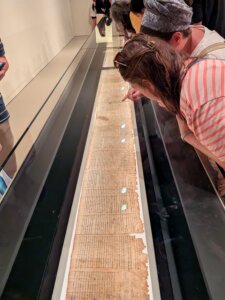
The magnificent 717-centimeter ancient Isaiah scroll on view right now at The Israel Museum, for the first time in 60 years, is drawing so many people that the museum has set strict guidelines for visitors.
To see the scroll — meaning the original, handwritten, non-facsimile, version that survived for two thousand years in jars hidden in a cave — with your own eyes, all 23 1/2 feet of it, you need to register by 8 a.m.
Once you are at the exhibit entrance, you need to wait your turn; you have to watch a film first about the incredible story of how the Isaiah scroll was found by Bedouin shepherds in a remote cave near the Dead Sea, sold to Archbishop Samuel, head of the Syrian Orthodox Monastery of St. Mark in Jerusalem, then read and evaluated by a professor whose son became Israeli military royalty, photographed by an American scholar, sent by the bishop to the U.S. for a tour of several leading universities in the hope of snaring a very high price, and then at long last, clandestinely purchased by an agent hiding that he was representing Israel from a small and seemingly innocuous ad in The Wall Street Journal. Then you have exactly 10 minutes in a temperature-controlled room with the scroll.

There is something spiritual and moving about seeing this gigantic, complete, handwritten scroll that was literally hidden in a cave for millennia. What is remarkable about it, Professor Noam Mizrahi of the Hebrew University in Jerusalem explains in a video you can watch after you check the scroll out for yourself, is first of all its age.
“It is over two thousand years old,” he explains. To be precise, the scroll was written in 125 BCE. The other amazing aspect of it is its fullness — not only are all 66 chapters there, but the Hebrew is written in a full way.
What does that mean, exactly? Consider the first line, “This is the vision of Isaiah the son of Amotz,” written in the scroll as “Yishayahu ben Amotz.” You can see with your own eyes that the original scribe wrote “Yeshaya,” and that another, later, scribe, added a letter, the ayin, so that it now reads “Yishayahu” as Isaiah is pronounced in today’s Hebrew.
It offers a glimpse into ancient pronunciation, Mizrahi explained. I would add that it also offers a glimpse into editing — writers are never done.
And maybe the Jewish people are never done discussing what the vision of Isaiah is, and what it means. This particular scroll wasn’t a museum artifact in the early days.
“It was in use for at least 100 years,” Mizrahi said — you can tell from the corrections.
But back to that fullness. This is a neatly written scroll of a text so many of us recognize — timeless, the curator Hagit Maoz commented in the video, and about peace, and justice. Maybe my vision is failing, but it was hard to make out psukim, or verses, I knew by heart.
This is not because the handwriting wasn’t neat — each aleph was distinct and perfect — but because the letters are small. I found myself cheating by taking a picture with my phone and enlarging it. Then I felt guilty for wasting a bit of my precious ten minutes on technology.
My group included a woman with a seeing-eye dog. If I could barely make out the letters, what could she see?
But the scroll is not just about seeing. It is about feeling. You can feel that this text is connected to this place. It’s the feeling of being here, of being near something written thousands of years ago by hand, something ours, something whole. There is the feeling that this is where Isaiah roamed, and this is where this incredible book — this timeless piece of Jewish literature — began.
Once the ten minutes are up, visitors are ushered into another room with a copy of the Isaiah scroll enlarged, and with key verses highlighted. There was the dream of peace, I thought as I looked at individual verses — the wolf dwelling with the lamb — and then there is the reality. The other day, I heard a young guy tell a date he had done 600 days of miluim, or reserve service.
I found myself refocusing on the true story of how the Isaiah scroll made it to the public. I couldn’t get enough of the details.
From shepherds to The Wall Street Journal
When Bedouin shepherds chased a sheep sometime in early 1947, they reached challenging terrain across from the northwest rim of the Dead Sea that no one else was willing to enter.
They heard a piece of pottery in a cave crack.

Curious, they went inside and found seven scrolls inside jars in the cave. They took them out, not knowing what they were. The museum explains that the bishop, who purchased the scrolls, consulted Eleazar Sukenik of the Hebrew University of Jerusalem, who immediately realized he was looking at an ancient Isaiah scroll and copied some sections; he told the bishop he was interested in purchasing the scrolls, both the ones in his possession and those still with the shepherds.
According to the Israel Antiquities Authority website when Sukenik learned of the scrolls’ discovery, he set out to investigate their significance. “Braving Arab-Jewish tensions, he travelled to meet the Armenian dealer at the British divided military zone of the Jerusalem border. In this clandestine meeting, the dealer held up a fragment of leather for the professor to examine. As Sukenik peered through the wire, he recognized the ancient writing.”
Incredibly, on Nov. 29, 1947, on the very same day as the United Nations vote on the Partition Plan, the historic vote which led to the establishment of Israel, Prof. Sukenik bought three of the seven scrolls.
Meanwhile, the bishop decided to get another opinion on his four scrolls, from an American scholar in Jerusalem who was the first to photograph them. By March 1948, convinced of the scrolls’ value and concerned for their safety as the War of Independence raged, the bishop had his assistant take the scrolls to a bank in Beirut, where they were held in a safe.
In Dec. 1948, the bishop headed to Beirut, picked up the scrolls, when gone to New Jersey, where he hoped to sell them.
Echoes of history
Learning of the scrolls, I couldn’t help but think of the great Yiddish poet Avrom Sutzkever and the Paper Brigade in Vilna. As the Nazis tried to annihilate the Jewish people, great writers risked their lives to save Jewish literature and culture, to hide it for the future. It’s a repeating theme in Jewish history — the military battle and the cultural battle, continuing at the same time.
Sadly, Professor Sukenik lost a son to battle in the war.
Then the professor himself died.
But the family’s passionate connection to the Isaiah scroll was not over. The professor’s other son, Yigael Yadin, who would become both a major scholar and a military leader, was in New York in the early 1950s and happened to read a small advertisement in The Wall Street Journal offering four scrolls. He guessed that the Isaiah scrolls his father wanted had been spirited off to the United States; he wired Israel to tell the new government to find $150,000. (Here, some Jewish philanthropy helped.)
It turns out that the bishop’s representative had tried to sell — to the Library of Congress, the Walters Gallery in Baltimore, Duke University, and The University of Chicago — but all refused. He failed because Jordan claimed the scrolls belonged to it because of where they had been found, while Israel claimed they were theirs because of cultural heritage.
Yadin hired an agent to conceal that Israel was the actual buyer, and the four were purchased on July 1, 1954. On July 9, the Isaiah scroll was separated and spirited to Israel by plane, with other planes escorting it for safety.
The Israel Museum built the Shrine of the Book to house the scroll, and it was opened to the public in 1955. But in 1968, the real scroll was replaced with a very good facsimile for the scroll’s continued safety.
Now, in honor of the museum’s 60th anniversary, the real thing is on view. My advice — don’t miss it.
“A Voice from the Desert: The Great Isaiah Scroll” is on view at the Israel Museum through Oct. 3.
The post Bedouin shepherds found it. A bishop sold it. An Israeli agent bought it. Now you can see it up close. appeared first on The Forward.
Uncategorized
When Gloria Steinem identified as a Jew most
Gloria Steinem, the journalist and organizer who became the most recognizable face of America’s modern women’s movement, died Wednesday at her New York City home. She was 92.
For more than half a century, Steinem pushed American women to imagine lives beyond the limits society had set for them. She co-founded Ms. magazine, helped establish the National Women’s Political Caucus and turned phrases like “sexual harassment” from unnamed experiences into subjects of national debate.
Steinem was the daughter of a Jewish father, Leo Steinem, and a Protestant mother, Ruth Nuneviller. She was raised without much religion and generally described herself as secular, but she was unequivocal about where she stood when Jews were targeted: “Never in my life have I identified as a Christian,” she said, “but wherever there is antisemitism, I identify as a Jew.”
Her mother taught her to value her Jewish roots. Steinem told the Forward in 2015 that her father rarely discussed his heritage; it was her non-Jewish mother who presented Judaism to her as something positive — “She also told me Jewish men made better husbands” — and taught her about her paternal grandmother.
That grandmother was a feminist pioneer in her own right. Pauline Steinem, who kept kosher, was an educator, suffragist, delegate to the 1908 International Council of Women and the first woman elected to Toledo’s school board — and during the Nazi’s rise in the mid-1930s, she worked to rescue members of her family from Europe.
A feminist Seder became her strongest connection to Jewish ritual. Steinem participated for decades in an annual women’s Seder, calling it the first spiritually centered experience of her feminist life. What drew her to Judaism, she said, wasn’t the law — it was “the mystical part, the Kabbalah, the Shechinah.
She recognized how antisemitism and misogyny fed each other. In her memoir, Steinem recalled a cabdriver telling her that feminism was a Jewish plot to destroy the Christian family. Her response to such hatred was not to distance herself from Jews, but to identify with them more strongly.
That identification outlasted her. Gloria and her sister, Susanne, donated a catalog of jewelry seized from Nazi victims to the U.S. Holocaust Memorial Museum — in honor of their grandmother.
Steinem continued writing and advocating for equality into her 90s. Her final book, An Unexpected Life, is scheduled to publish later this month.
The post When Gloria Steinem identified as a Jew most appeared first on The Forward.
Uncategorized
UK to ‘reset policy’ on West Bank settlements, Miliband tells parliament
(JTA) — The new British government plans to announce in the coming weeks a comprehensive package of economic sanctions and other measures designed to prevent the Israeli expansion of West Bank settlements.
Overall the U.K. needs “a comprehensive reset of our policy” when it comes to the West Bank, British Foreign Secretary Ed Miliband told the House of Commons on Tuesday. He spoke during his first question and answer session with lawmakers since he and the government he represents were sworn into office in July.
Miliband added that the new measures would include a ban on goods produced in the settlements and targeted sanctions on British institutions and individuals.
“We are looking, indeed, at our wider economic relationship with the occupied territories, and the different tools we have to tackle it,” Miliband explained. “We do not want British companies financing, constructing, or advertising new settlements. The work we are now undertaking is how we can stop that.”
Israel’s Foreign Minister Gideon Sa’ar warned Tuesday that if the U.K. acted against his country, the Jewish state would take retaliatory steps against Great Britain.
“We are prepared and I hope they will not make the mistake of doing this. If they do, there will be a reaction,” Sa’ar said in a podcast interview with the Hebrew news website Ynet.
Tensions between Israel and the U.K. have been escalating in light of Israeli military actions in Gaza and the West Bank following the Hamas-led October 7, 2023 attack.
The U.K.’s decision under the last government to recognize Palestinian statehood in 2025 inflamed the situation, which is expected to get worse should Prime Minister Benjamin Netanyahu win the October 27 election in Israel.
Any government that Netanyahu forms is expected to be right-wing and to continue the policies of the existing government, just as the U.K. under Miliband and the new Labour prime minister, Andy Burnham, are more willing than their predecessors to go head-to-head with Israel on the issue
Miliband already floated the idea of targeted sanctions after Israel’s Lands Authority opened bids for 1,234 homes in the largely underdeveloped E1 section of the West Bank settlement of Ma’aleh Adumim in August, a move that he said would undermine any two-state solution to the Israel-Palestinian conflict.
Miliband went further on Tuesday when fielding a number of questions from lawmakers frustrated about the lack of U.K. response to Israeli actions in the West Bank, such as terror activity by Israelis against Palestinian civilians and continued settler building. This includes the opening of E1 bids last month.
The foreign secretary explained that his words reflected the policies Burnham had considered even before he entered Downing Street in July, such as a ban on trade for goods produced in the settlements. “We are obviously working across government and with our allies on these measures,” Miliband said.
Israel has said that it has a right to build settler homes in Area C of the West Bank, which is under Israeli military and civilian control and where all the settlements are located. Under the Oslo Accords, the West Bank was divided into three areas, with sections A and B, under the auspices of the Palestinian Authority.
The International Court of Justice in 2024 issued an advisory opinion explaining that such construction in Area C is illegal, affirming a long-held stance of the U.N. and many nations, including the U.K.
Concern has been particularly high with regard to the E1 project, which would add 3,400 homes to the municipal boundaries of the city of Ma’aleh Adumim by building on an underdeveloped hilltop. The Palestinian Authority and the international community, including past U.S. administrations, have warned that the project would block contiguous Palestinian development in that area and thus make a Palestinian state untenable.
Miliband referenced that viewpoint when speaking to the House of Commons on Tuesday, explaining that E1 development had long been considered a “red line,” because the project “cuts through the heart of the West Bank and risks making a Palestinian state unviable.”
He affirmed the U.K.’s commitment to a two-state resolution, explaining that his government would not stand idly by while that vision was being destroyed by Israeli actions on the ground in the West Bank.
In a harshly worded attack on the U.K. and Miliband in August, Sa’ar on X warned that UK’s statements on Israel were fueling antisemitism in Great Britain and emphasized that the Jewish people had a right to build anywhere in their ancestral homeland.
This article originally appeared on JTA.org.
The post UK to ‘reset policy’ on West Bank settlements, Miliband tells parliament appeared first on The Forward.
