



Uncategorized
Belgium Indicts Jewish Mohels, Sparking Diplomatic Firestorm With US and Israel

Belgian army personnel patrol a street as part of a deployment of soldiers outside Jewish institutions in Antwerp and Brussels following attacks at Jewish sites in Belgium and other European countries, in Antwerp, Belgium, March 23, 2026. Photo: REUTERS/Yves Herman
Belgian authorities have indicted two mohels for allegedly performing illegal circumcisions, amid a government probe into the Jewish ritual — with Jewish and political leaders warning the case is a direct threat to religious freedom.
A mohel is a trained practitioner who performs the ritual circumcision in Jewish tradition known as a bris.
On Wednesday, the Antwerp Public Prosecutor’s Office formally indicted two local mohels for “intentional assault or bodily harm with premeditation against minors, as well as the illegal practice of medicine.”
Prosecutors in the northern Belgian city announced they have concluded their investigation into suspected illegal circumcisions and found sufficient evidence to refer the case to criminal court.
The two men are now set to appear before a closed-door pre-trial chamber on June 18, which will decide whether the case proceeds to trial.
The prosecution comes as the Belgium Jewish community is sounding the alarm over a surge in hostility and targeted violence against Jews across the country. In March, following an explosion at a synagogue in Liege that authorities called an antisemitic act, soldiers were deployed on the streets of leading Belgian cities to bolster security for the Jewish community.
With Jewish leaders warning their way of life is being threatened, the legal proceedings against the mohels have sparked fierce backlash, escalating into a public row involving Belgian authorities and Israeli and US officials.
Israeli Foreign Minister Gideon Saar condemned the case as an attack on Jewish religious practices, calling on the Belgian government to intervene immediately and seek a swift resolution.
“With this act Belgium joins a short and shameful list, together with Ireland, of countries that use criminal law to prosecute Jews for practicing Judaism,” the top Israeli diplomat wrote in a post on X.
“This is a scarlet letter on Belgian society,” Saar continued.
Belgium have just announced the indictment of the three Mohels who were investigated last year in Antwerp.
With this act Belgium joins a short and shameful list, together with Ireland, of countries that use criminal law to prosecute Jews for practicing Judaism.
This is a…
— Gideon Sa’ar | גדעון סער (@gidonsaar) May 6, 2026
US Ambassador to Belgium Bill White also condemned the legal action, calling it a “shameful stain” on the European country.
“The prosecution of these religious figures (mohels), one of whom is American, is wrong and won’t be tolerated,” White wrote in a post on X.
“The Trump Administration condemns this judicial action and also condemns the political inaction by the Belgian Government to find a solution with the beautiful Jewish communities here in Belgium,” he added.
The US diplomat had previously slammed the Belgian government’s probe against the mohels as a “ridiculous and antisemitic prosecution.”
In response, Belgian Foreign Minister Maxime Prévot urged White to “exercise greater restraint” and to view his role in “its proper context.”
“It is inappropriate to publicly criticize a country and tarnish its image simply because you disagree with judicial proceedings,” the top Belgian diplomat said in a post on X.
“To portray this as a country’s effort to undermine the religious freedom of Jews is defamatory. This freedom has never been called into question and never will be in our country. Our Constitution protects it,” he continued.
Prévot also noted he would be willing to travel to Israel to discuss the issue, adding that he remained open to dialogue.
“Enough with these caricatures,” he further said. “In Belgium, the judiciary is independent and makes its decisions — whether one agrees with them or not — free from any political influence.”
Saar responded by saying that Prévot’s comments “completely miss the point,” insisting that the core issue was being misrepresented and must be addressed directly.
“There should never have been such an investigation, had the issue of Brit Milah been regulated like in other European countries that respect Jewish religious freedom,” the Israeli diplomat posted.
“Especially so in a country with one of the oldest Jewish communities in Europe,” he said. “Had Belgium had a strategic plan to fight antisemitism and foster Jewish life, you might have known this. Alas, it doesn’t.”
Belgian Prime Minister Bart De Wever said on Wednesday evening that his country “is not an antisemitic state,” dismissing such accusations as “nonsense” and arguing that Belgium has always been able to reconcile its laws with Jewish traditions.
“Circumcision is essential to the Jewish faith and Islam, but so are the quality standards of our legislation. You have to reconcile the two,” he said.
The highly controversial case began a year ago when Belgian police raided the homes of several mohels in Antwerp, seizing their circumcision tools after a local anti-Zionist Jewish rabbi filed a complaint.
Last May, Belgian authorities specifically raided three locations in the Jewish Quarter, searching for knives and other equipment allegedly used in unauthorized or illegal circumcisions.
Among the homes raided by the Belgian police was that of Rabbi Aharon Eckstein, a highly experienced mohel and a prominent leader within the Antwerp Jewish community.
According to a police report, the searches were ordered by a judge following a complaint filed in 2023 by Rabbi Moshe Aryeh Friedman, an anti-Zionist activist previously accused of Holocaust denial, against Eckstein and other mohels within the Jewish community.
Since 2024, prosecutors have been investigating illegal circumcisions in the country amid concerns from local authorities that some Jewish circumcisions were being performed by individuals without proper medical training.
In his complaint, Friedman accused six mohels, whom he identified to the police, of endangering infants by performing the metzitzah b’peh ritual, in which the mohel uses his mouth to suction blood from the circumcision area.
However, Eckstein and other rabbis, along with parents of children circumcised by them, have denied such accusations, insisting that they do not perform this practice.
At the time, Jewish and political leaders accused local authorities of using the raids as part of a broader effort to intimidate religious figures in Belgium.
In Antwerp, Friedman is known for publicly criticizing several customs that are important to ultra-Orthodox Jews, who represent the majority of the city’s 18,000 Jewish residents.
Despite several attempts to ban it across Europe, ritual circumcision remains legal in all European countries – though many, including Belgium, limit the practice to licensed surgeons and often perform it in a synagogue.
Last July, dozens of European Jewish leaders called on the European Union to take action against Belgium, arguing that the Belgian police’s actions “represent a breach of an EU fundamental right, that of freedom of religion” and warning that this “echoes one of the darkest chapters in European history.”
Uncategorized
Mamdani Hedges in Response to Mob Targeting New York City Synagogue

New York City Mayor Zohran Mamdani holds a press conference at the New York City Office of Emergency Management, as a major winter storm spreads across a large swath of the United States, in Brooklyn, New York City, US, Jan. 25, 2026. Photo: REUTERS/Bing Guan
Protests targeting an Israeli real estate event at a New York City synagogue have put Mayor Zohran Mamdani’s leadership under renewed scrutiny after demonstrators returned to the Upper East Side location on Tuesday night.
The demonstration prompted a significant police response and raised concerns about rising antisemitic rhetoric in the city home to the world’s largest Jewish population outside of Israel.
Protesters gathered outside Park East Synagogue in Manhattan during a showcase called “The Great Israeli Real Estate Event 2026,” which included the marketing of properties in Israel proper as well as West Bank settlements. At the demonstration, activists held signs and chanted slogans that went beyond criticism of Israel, seemingly calling for the death and expulsion of Jews and, in some cases, support for US-designated terrorist groups.
“Death, death to the IDF [Israel Defense Forces],” “Rapists,” and “Settlers, settlers go back home, Palestine is ours alone” were among the insults screamed by the protesters, some of whom also waved flags belonging to the Lebanese terrorist group Hezbollah.
The scene marked a return to the same synagogue that was the site of a contentious protest in November, which drew widespread condemnation and sparked debate over the boundaries between political expression and hate speech. At that gathering, demonstrators chanted “We don’t want no Zionists here” and “Resistance, you make us proud, take another settler out,” among others. One speaker claimed, “It is our duty to make them think twice before holding these events! We need to make them scared.”
Both protests were organized by the anti-Zionist activist organization Pal-Awda.
This time, however, the New York City Police Department (NYPD) appeared better prepared. Officers established barricades and maintained distance between demonstrators and synagogue attendees, preventing the kind of close confrontations seen in the earlier protest. While tensions remained high, authorities largely kept the situation contained, avoiding major physical clashes.
Still, video circulating on social media appeared to show hordes of protesters storming and attempting to penetrate the barricades erected by the NYPD to separate the synagogue from the demonstrations. According to multiple reports, police had to deploy pepper-spray and at least one officer was hospitalized during the chaos.
Ronen Levy, a Queens-based pro-Israel counterprotester, repudiated the demonstrations as a threat to the local Jewish community.
“You want to protest? You want to assemble on the street, you want to assemble in a park, you want to assemble in a center or Columbus Circle? You’re more than welcome,” Levy told AMNY. “But to protest in a shul or a mosque or a church, that’s unethical, that’s un-American.”
“It came to where they do it in the shul, because it’s a lot easier to get Jewish people to come down, because it’s a Jewish congregation,” Levy continued. “Most people in synagogues, they want to go live in Israel.”
The incident came amid an ongoing surge in antisemitic hate crimes in New York City. According to police data, Jews this year have been targeted in the majority of all hate crimes committed in the city, continuing a troubling trend of rising antisemitism following Hamas’s Oct. 7, 2023, massacre across southern Israel. Mamdani took office on Jan. 1.
Jewish community leaders have increasingly voiced concern about demonstrations occurring near religious institutions, warning that such actions blur the line between protest and intimidation.
Mamdani, who faced criticism over his response to the November protest outside the same Manhattan synagogue, on Wednesday expressed support for the police’s response but also condemned the Israeli real estate event.
“I think that I’ve made it clear time and time again that we in this city believe in the sacrosanct nature of the right to protest, and also are committed to ensuring that any New Yorker can safely enter or exit from a house of worship, and that access never be in question, while we also protect the First Amendment,” Mamdani said during a press conference. “And I do believe that the police ensured that yesterday evening.”
However, the mayor went on to defend the protesters’ cause.
“There is no tolerance for hatred of Jewish New Yorkers,” he said. “I’ve also been clear to New Yorkers, my honest opinions about the fact that when we have a real estate expo that is promoting the sale of land, which includes the sale of land in occupied West Bank in settlements that are a violation of international law, that that is something that I firmly disagree with.”
“I also believe that many New Yorkers firmly disagree with it, because it has been at the heart of an ongoing effort to displace Palestinians from their homes,” Mamdani added.
Mamdani’s office issued a similar statement on Tuesday in the hours leading up to the protest.
“He further inflamed tensions on an already volatile situation,” the Anti-Defamation League’s New York/New Jersey branch said of Mamdani’s comments. “The mayor had a responsibility to de-escalate. He did the opposite.”
Mamadani faced intense criticism from Jewish leaders and pro-Israel advocates after issuing a similar statement in November that appeared to legitimize the gathering of demonstrators who called for violence against Jews outside Park East Synagogue.
Julie Menin, the speaker of City Council, defended the protesters’ first Amendment Rights while admonishing efforts to intimidate synagogue attendees.
“The right to peaceful protest must be protected, and so must the ability of individuals to safely access a house of worship without fear or intimidation,” Menin said.
Mamdani has come under immense scrutiny over his record of anti-Israel statements, repeatedly accusing Israel of committing “genocide” in Gaza and claiming that Israel does not grant “equal rights” to all of its inhabitants. Given his track record of anti-Israel sentiment, which according to critics has fueled hostility toward Jews, Mamdani’s handling of antisemitism has come under the spotlight.
Uncategorized
AI-Generated ‘Rabbis’ on TikTok Push Antisemitism, Generate Over 10 Million Likes, Report Reveals

TikTok app logo is seen in this illustration taken, Aug. 22, 2022. Photo: REUTERS/Dado Ruvic
The Combat Antisemitism Movement (CAM) released a report on Tuesday exposing 49 TikTok accounts which have amassed large followings pushing bigoted stereotypes with phony rabbi videos created using generative artificial intelligence programs.
Analysts at CAM’s Antisemitism Research Center found that the accounts — which use handles such as @rabbirothstein @rabingoldmaan @rabbistirberg, and @rabbi_silverstein — had collected 950,000 users and provoked over 10 million likes.
Across accounts, researchers found similar narratives and linguistic patterns in service of a common modus operandi: recasting conventional antisemitic stereotypes by having rabbis promote them as obvious truths.
The first “rabbi” introduced in the report is “RabbiSilverman.” One video features the rabbi figure holding a bottle of Coca-Cola with the caption “$4 at the airport and $7 on a flight.” Another shows the rabbi sitting inside of a limo while he holds a gold bar and a stack of $100 bills alongside the description “when the dollar and gold go up together.” Three more images show the rabbi sitting and studying the Torah at a table while a red sports car sits in a showroom behind him.
The rabbi in one video sports a giant nose and says, “As Jews, never sign a contract without reading every single line.”
Another fake “rabbi” presented is “Rabbi StirBerg.” Sitting in front of a bookshelf in what resembles a synagogue’s office, videos include such instructions as “never give your kids an allowance” and “Jews are wealthy because we don’t feel guilty for wanting more money.” Another taunts, “by 8 our kids know why yours stay poor.”
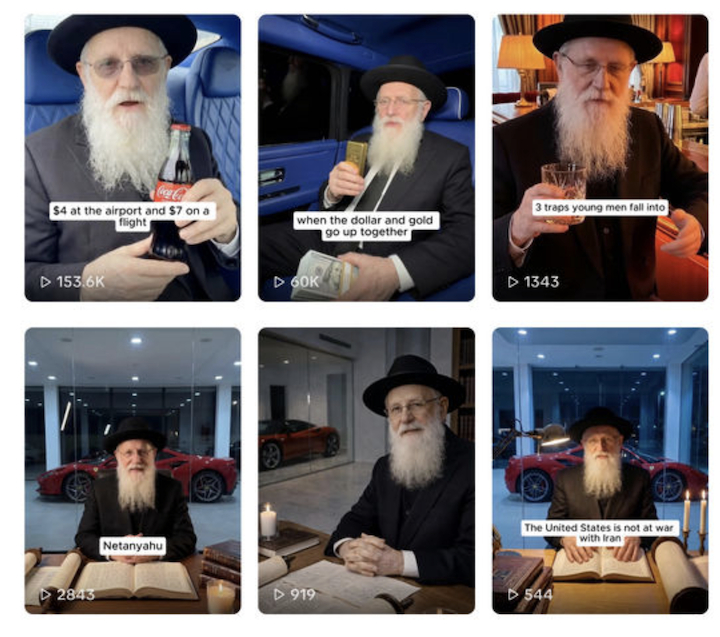
Examples of AI-generated rabbi videos pushing antisemitism on TikTok. Photo: Screenshot
CAM noted that the antisemitism on TikTok would especially impact youth.
“The danger is clear. By masquerading as authentic Jewish voices, these ‘rabbis’ erode trust, normalize hatred, and incite real-world violence targeting Jews,” CAM said. “By amplifying this content to young, impressionable audiences, TikTok is complicit in accelerating radicalization in an era when AI is making disinformation increasingly difficult to detect.”
CAM called on TikTok to “immediately invest in AI detection tools specifically trained to identify synthetic religious impersonation, implement guidelines to ensure traffic is not actively directed to such accounts, and launch a public awareness campaign highlighting how to spot AI-generated propaganda.”
Jewish creators on TikTok have long objected to antisemitism on the platform. In November 2023, a group of more than 40 content creators and public figures raised the alarm about the antisemitism they had experienced on the platform, calling for more robust safety features and content moderation. TikTok responded at the time saying, “We’ve taken important steps to protect our community and prevent the spread of hate, and we appreciate ongoing, honest dialogue, and feedback as we continually work to strengthen these protections.”
The research into TikTok follows similar findings from CAM in a March report that revealed a proliferation of fake AI rabbis on Meta’s Instagram platform. One “Rabbi Goldman” account identified in the report had reached 1.4 million followers. Combined with 11 other imposters, the following reached 2.1 million. CAM noted how the variety of rabbis each presented with different voices and persona, but all promoted the same money-obsessed stereotypes.
Following the Instagram report, CAM reported that Meta had removed more than 60 Instagram accounts, including those in other languages like French, Italian, German, and Spanish. The watchdog group praised the technology company founded and led by CEO Mark Zuckerberg, saying that “Meta has been highly responsive in working with CAM to better understand this activity and identify ways to reduce its reach and minimize its exposure to users.”
CAM vowed to remain vigilant to the threat, warning that “these identities are easily recreated and quickly reappear. CAM will continue to cooperate with Meta to address this expanding network … without sustained monitoring and rapid response, these false identities will continue to shape online discourse, reinforcing hostility toward Jewish communities that translates into real-world violence.”
In March, OpenAI CEO Sam Altman announced his decision to shut down the AI video-generating app Sora, a platform which hosted videos showing Jews chasing after coins, cheating poor people out of money, and being run over by a car. Research released by the Anti-Defamation League (ADL) in October found that in at least 40 percent of cases, programs would still generate responses when given antisemitic, extremists, or other hateful prompts.
CAM warned of the real-world consequences from the TikTok videos.
The report stated that antisemitic tropes “have historically instigated violence — from pogroms to the Holocaust to contemporary attacks on Jews. In the digital age, this content contributes to a documented global rise in antisemitic incidents by providing ‘evidence’ that justifies hostility. The visual caricatures (large noses, ostentatious wealth) further dehumanize Jews, erasing a psychological barrier to violence.”
In February, police in the Netherlands arrested 15 people, charging them with using TikTok to promote propaganda for the Islamic State. Some videos reached as high as 100,000 views. They urged views to join the terrorist group and glorified the “martyrs” who had died in service of the group’s mission of creating a global caliphate empowered to impose strict, Salafi-interpretations of Shariah law across the entire planet.
Uncategorized
Artists, Cultural Workers Plan Strike for Venice Biennale in Protest of Israel’s Participation

Signage for the 61st Venice Biennale running from May 9 to November 22. Photo: IMAGO/Frank Ossenbrink via Reuters Connect
An anti-Israel collective announced a 24-hour strike for artists and cultural workers on Friday, the day before the 61st Venice Biennale opens to the public, in protest of Israel’s inclusion in the event.
The Art Not Genocide Alliance (ANGA) is organizing the strike on the city’s Viale Garibaldi, and a number of groups, unions, and art spaces have already vowed to participate including Biennaleocene, a coalition of cultural workers in Venice that formed in 2023. The strike was announced right before ANGA hosted a massive protest at the Biennale.
The international art exhibition opened for previews on Wednesday and ANGA disrupted the opening, assembling a protest outside of Israel’s temporary pavilion in the Biennale’s Arsenal complex. ANGA said “hundreds” participated in the protest and claimed the decision to include Israel in this year’s Biennale “constitutes active institutional support for a state committing genocide in Gaza against the Palestinian people.”
“Protestors marched through the Arsenale with large banners, Palestinian flags, placards, and distributed flyers calling for the shut down [sic] of the Genocide Pavilion,” ANGA wrote in an Instagram post that featured pictures from the protest. “ISRAEL YOU CAN’T HIDE, WE CHARGE YOU WITH GENOCIDE! The demand is clear: Boycott the Israeli pavilion and SHUT IT DOWN.”
ANGA previously published an open letter, signed by hundreds of event participants, that called for Israel to be boycotted from this year’s Venice Biennale. Last week, the jury for the 2026 Venice Biennale resigned mere days after saying it would not consider awarding the event’s top prizes to countries whose leaders are facing charges of crimes against humanity by the International Criminal Court, meaning Israel and Russia.
After the jury’s resignation, organizers of the Biennale announced new “Visitor’s Lion” awards. The public will vote for the winners, and Russia and Israel are both eligible to take home those awards. The award ceremony for the 2026 Venice Biennale has also been pushed from May 9 to Nov. 22, which is the last day of the show.
Romanian artist Belu-Simion Fainaru is representing Israel in this year’s event with his installation “Rose of Nothingness,” which will highlight Jewish mysticism, memory, and poetry.
At the 2024 Venice Biennale, artist Ruth Patir closed Israel’s official pavilion to the public until a ceasefire and hostage release agreement could be agreed upon. That same year ANGA supporters protested outside of the American and Israeli pavilions during previews for the Biennale, in condemnation of US support for Israel. The group of anti-Israel activists also protested outside the French, British, and German pavilions, because of each country’s relations with Israel.