



Uncategorized
As anti-LGBTQ laws spread, these two Jewish nonprofits are funding moves to safer states
(JTA) — As anti-LGBTQ legislation proliferated across the United States in late 2024, leaders at two Jewish nonprofits began discussing the mounting crisis for LGBTQ Americans who no longer felt safe in their home states but lacked the financial means to leave.
Now, some of those individuals are receiving interest-free loans to help finance their moves through “Move to Thrive,” an unusual joint initiative launched by the national LGBTQ Jewish advocacy group Keshet and the New York-based Hebrew Free Loan Society in March 2025.
The initiative has drawn more than 400 inquiries, according to Jaimie Krass, the president and CEO of Keshet. So far, 29 applications have been approved, representing 56 people across households in 12 states, and $274,500 in loans have been disbursed.
“It is devastating that this is even necessary, and I think we can draw strength from what has been made possible by this resource, which is that dozens of households have been able to relocate to safer states, have been able to live more fully and openly as their authentic selves,” Krass told the Jewish Telegraphic Agency.
According to a 2024 survey by the Trevor Project, an LGBTQ youth crisis support nonprofit, nearly two in five LGBTQ+ people aged 13 to 24 said that they had considered moving to a different state, and 4% actually moved due to LGBTQ+-related politics or laws.
The collaboration between Keshet and the Hebrew Free Loan Society began in late 2024, when Idit Klein, then Keshet’s leader, approached Rabbi David Rosenn, the president and CEO of the Hebrew Free Loan Society, with the idea.
Rosenn initially told Klein it was not feasible, explaining that the Hebrew Free Loan Society serves individuals in the New York area and generally does not operate nationally.
But then came what Krass called a “dizzying onslaught of attacks” on LGBTQ+ rights following President Donald Trump’s inauguration. In the first weeks of his second term, Trump signed a series of executive orders targeting transgender Americans, including measures recognizing only two sexes, male and female, and another that aimed to outlaw gender-affirming medical care for transgender youth. Lawmakers in red states picked up the pace of their legislation.
As the months went by, Rosenn said “it was clear that things were getting more aggressive in terms of the approach of legislatures in certain states,” so he went to his board to appeal for an exception.
“We concluded that if we did not do this, it would not get done, and we saw this as a matter of people’s personal safety and well-being,” Rosenn said. “People were expressing that they felt like they were at real risk, and we wanted there to be a way for them to make these moves to places where they would feel safe and welcome.”
The initial grant funds for the program came from the Jewish LGBTQ Donor Network, but Rosenn said that after more people learned about the program there had been a “spontaneous outpouring of support from people who heard that this was going on and wanted to be a part.”
So far, the program, which is open to both Jewish and non-Jewish applicants, has distributed loans of up to $10,000 to applicants leaving states including Texas, Arkansas, Missouri and Iowa. The recipients, which included single transgender women and men and over a dozen couples and families, have used the loans to move to states, such as Massachusetts, Illinois and Oregon, with a more welcoming policy environment.
James Glick, who used a Move to Thrive loan to relocate from Texas to Minnesota with his wife, told JTA that the loan had brought him “life changing relief” after he watched anti-trans policies intensify at the Dallas school where he taught.
“I remember when we got the confirmation email, like we both just sat and cried and hugged each other,” they said. “It was just so difficult to move across the country, but it would not have been possible without that help.”
Glick said he first learned about the program through a Facebook group for trangender men in Dallas, and initially doubted whether he and his wife, who are not Jewish, would qualify.
But after learning that the program was “for everyone,” they said the support from Jewish organizations felt especially meaningful at a time when many people around him were dismissing fears about anti-trans policies.
“To have a Jewish organization recognizing that something like this was happening to the trans community, when so many people around me were saying, ‘It’s not that big of a deal, you need to calm down, like you’re going to be fine, why are you freaking out?’ — it was like, oh, no, people do acknowledge and understand that,” Glick said.
While dozens have used “Move to Thrive” to help finance relocations, other LGBTQ Jews and families with trangender children had already begun moving to states with stronger legal protections long before it was launched.
For Krass, the relocations echoed Jewish experiences of moving in search of safety in the past.
“Many of our own families have relocated at different times throughout history to different locations because our safety was undermined, and right now, those same sort of alarm bells of our shared history, of our collective memory, are certainly ringing right now because of the vast number of LGBTQ+ individuals, including LGBTQ+ Jews, who are feeling forced to relocate to a different state for the sake of their own and their family’s safety,” Krass said.
The need for the program, Krass and Rosenn said, appears unlikely to disappear soon.
According to the American Civil Liberties Union, there are currently 528 anti-LGBTQ bills under consideration in states across the country, in addition to those — such as a law passed last year in Texas that defined men and women by their reproductive organs — that have already gone into effect.
“That would be a great reason to suspend this program, if nobody felt that they were at risk and they were happy and able to thrive in whatever state they’re in, but since that is not the case, I think we will absolutely try to continue to be a be a resource in this way,” Rosenn said.
He said the partnership between his organization and Keshet also served as an exciting model for collaborations he hoped to see more of in the Jewish world.
“It was also just a signal out to the world that the Jewish community sees that this is going on, cares about this issue and is moving to do something about it, that two organizations who don’t normally do things together, would figure out a way to collaborate to make this happen,” Rosenn said. “It is not just something that is to the benefit of borrowers, it’s also a message about what the Jewish community is trying to accomplish in the world.”
This article originally appeared on JTA.org.
The post As anti-LGBTQ laws spread, these two Jewish nonprofits are funding moves to safer states appeared first on The Forward.
Uncategorized
This David Schwimmer sweater ad is playing on ‘Friends’ nostalgia. So why are commenters talking about Israel?
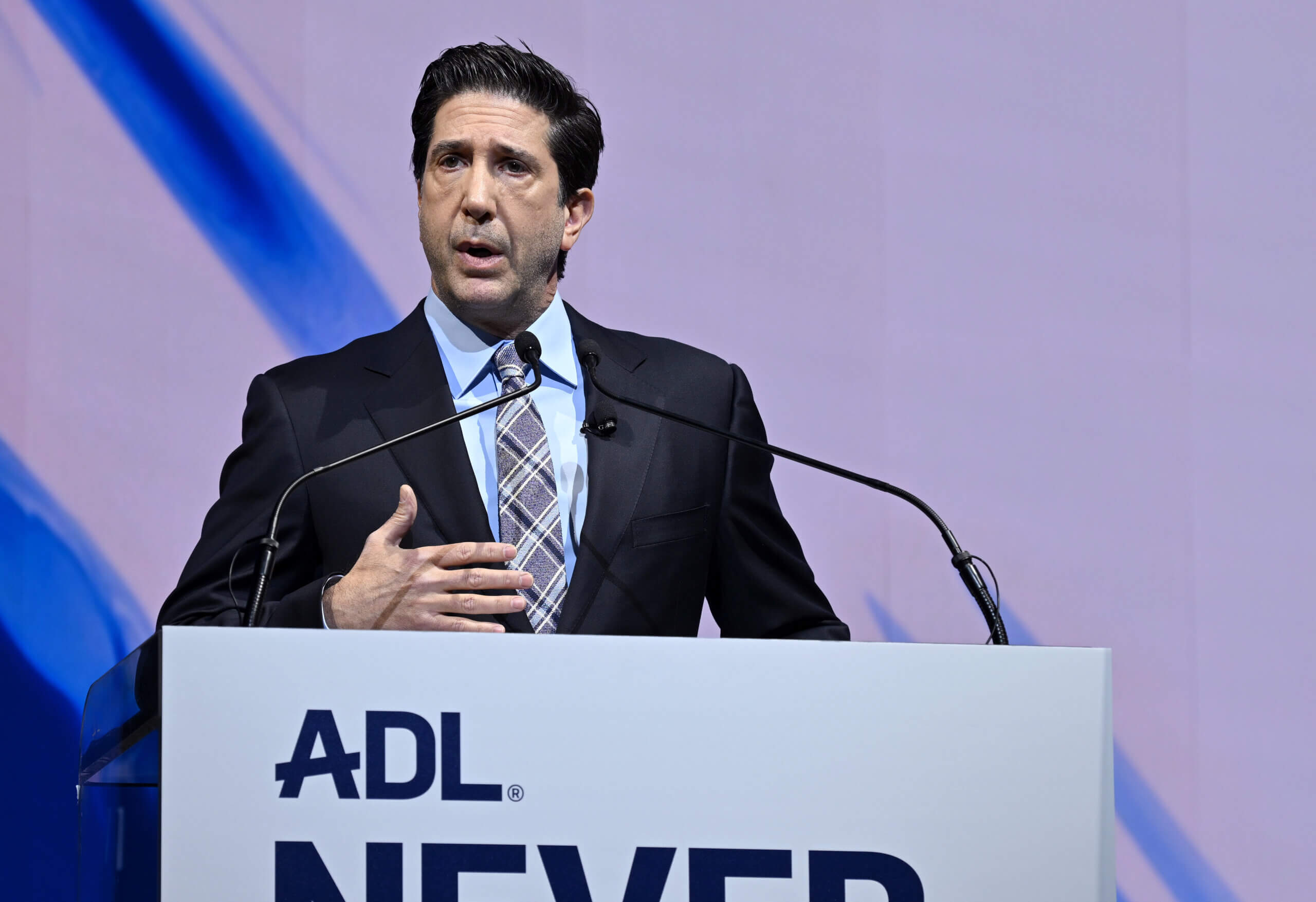
David Schwimmer, who played Ross on Friends, is tapping into some late ’90s and early 2000s nostalgia as the star in an ad this week marketing his “dream sweater” for Quince, a clothing and home goods store.
In the ad, Schwimmer, who is Jewish, sketches the perfect red sweater in a notebook while he sits in Central Park and then begins to see it on everyone: a man riding an electric scooter, an angry taxi driver who almost runs into him, a beautiful woman riding in the back of the taxi, even a dog.
The gag is a reference to the Friends episode “The One with the Red Sweater,” where Ross’ on-again-off-again girlfriend Rachel is pregnant and has not told the father, whose identity is a mystery to the group; Joey, Monica and Phoebe know that the father left a red sweater at the apartment, so when Ross stops by and is relieved to find his sweater, they figure out he’s the dad-to-be.
“I’ve been looking for this for like a month,” he says, just after making a reference to the Yiddish-named snack, Mashuga Nuts.
The episode and the ad are apolitical. So why then are some people planning to cancel their Quince orders and boycott the company?
Schwimmer, many of the commenters on the ad are saying, is a Zionist.
“I don’t approve of you featuring a Zio in your ad,” one Instagram user commented. “Please do better.”
Schwimmer on Israel, antisemitism
Schwimmer has been outspoken about antisemitism since long before the Oct. 7 Hamas attacks on Israel and the ensuing war in Gaza. Over the course of his career, he’s spoken at multiple Anti-Defamation League events and called for other people to stand against hate, routinely saying, “Silence is complicity.”
The actor appears to have never explicitly identified as a Zionist, and his statements have focused more on galvanizing support for Jews and Israelis — rather than on the Jewish state. But this is of little importance to his critics.

His relationship with the ADL, a staunchly pro-Israel organization, is damning enough for some. Schwimmer also starred in an Israeli commercial for Meitav, an investment management company. The move puts him at odds with the growing Boycott, Divestment and Sanctions campaign, which stands against any financial relationship with Israel or Israeli companies.
After Oct. 7, Schwimmer put out a statement calling the Hamas attack an “atrocity” and a “genocide,” adding that any attempt to justify what happened is “indefensible and antisemitic.” In the same statement, he also touched on Palestinian suffering:
“One can condemn Hamas and still object to the Israeli government’s policies regarding the occupation (as many Israelis do), still believe in the Palestinian people’s right to self-determination, and still mourn the loss of Palestinian civilians and the current destruction of their homes, schools, hospitals and places of worship.”
He’s also been vocal about sexual violence that occurred on Oct. 7, sharing the controversial New York Times piece headlined “Screams Without Words,” that investigated allegations of sexual assault committed by Hamas during the attack. Critics of the piece have questioned the validity of the reporting and argued that one of its reporters is biased toward Israel. The Times has stood by the piece.
Additionally, Schwimmer has criticized universities’ responses to pro-Palestinian protests on campuses that he said have veered into antisemitism.
Schwimmer spoke at a 2025 ADL summit about the backlash he’s gotten for his advocacy, noting that while he’s been “attacked” and “abandoned,” he’s found deep meaning in speaking out and has no plans to stop. He concluded his speech calling on fellow celebrities to do the same.
“You don’t have to say anything political,” Schwimmer said. “No one is asking you to solve the conflict in the Middle East. Just say that you stand with your Jewish friends, colleagues and neighbors against hatred and discrimination.”
The controversy isn’t bothering Quince.
“We’ve seen more than 8 million views across our social channels in the first 48 hours, alongside international press coverage and recognition from the marketing community for the creative,” said Dakota Isaacs, head of brand strategy and narrative, in an email to the Forward. “It’s been especially rewarding to see fans connect with the humor and nostalgia while discovering Quince.”
The post This David Schwimmer sweater ad is playing on ‘Friends’ nostalgia. So why are commenters talking about Israel? appeared first on The Forward.
Uncategorized
Why I urged my parents to avoid the counterprotest in Philadelphia
Parents usually tell their children whether they can go out, but last week, on a phone call with my parents, our roles reversed, and I urged them not to join a Philadelphia food crawl with their friends. The event was organized in response to a bicycle rally calling for the boycott of six restaurants, all Jewish-owned, to “show these zionist business owners that we see them for the disgusting humans they are.”
The counterprotest intended to show solidarity with these businesses by patronizing and protecting them on the day of the protest, given the hostile framing of the boycott against the restaurants and their Jewish owners. However, I was concerned that it would be co-opted by pro-Israel partisans, who not only would instrumentalize it for their own agenda — one which, in my view, is actively detrimental to the fight against antisemitism — but would also stoke chaos and violence. It’s a film that’s played out time and again, including when I was an undergraduate at UCLA: A call is put out that Jews are under attack, counterprotesters mobilize in response, and anger quickly morphs into belligerence, hostility, and violence.
Fortunately, it appears that no one was seriously hurt during Sunday’s bike rally and counterprotest. As I had feared, though, some demonstrators became aggressive as verbal confrontations and scuffles broke out across Rittenhouse Square. While it’s likely that some of the pro-Israel demonstrators were there for the sole purpose of displaying that they are not “Jews with trembling knees,” others ostensibly were there because, as the names of two of the organizations behind it would suggest, they want to StopAntisemitism and EndJewHatred.
If those were the goals, the demonstration was an unmitigated disaster. And much of the discourse surrounding the boycott laid the groundwork for failure.
To many Jews, it may seem self-evident that the boycott was illegitimate and antisemitic. For the protesters, though, there seems to be a genuine inability to understand how it could be. They also seem unable or unwilling to condemn antisemitism.
Anger at the protesters is understandable, but if the goal is to stop antisemitism and end Jew hatred, it is important to address the root of the problem, which starts with understanding why the protesters might have such a profound misunderstanding of antisemitism.
For several decades, following the Six-Day War of 1967 and the Cold War period, pro-Israelism has been a core, essential feature of hegemonic anti-antisemitism advocacy. Groups like the ADL have made the phenomenon of so-called “new antisemitism” – a term that explains hostility toward Israel by claiming that the nation is maligned out of bigotry, as the proverbial Jew among the nations – a central focus of their work, especially in times of increased Israeli-Palestinian conflict.
Though this is hardly “new,” the stakes and intensity of attacks against the “new antisemitism” have been raised in a post–Oct. 7, post–destruction of Gaza reality. In effect, this approach has been successful in as much as it has led to a public perception that the fight against antisemitism and the fight in defense of Israel are the same fight, and cannot be separated.
As a result, when anti-Zionist, pro-Palestinian activists are accused of antisemitism or expected to condemn it, they view it as purely cynical — an attempt to delegitimize their movement rather than a true objection to how they have treated or spoken about Jews. This very refusal to condemn antisemitism is often read as itself antisemitic by many Jews. This “acrimonious circle,” as philosopher Brian Klug described it 13 years ago, could go on forever.
As the acrimonious circle spins and spins, there are a few options that groups fighting antisemitism can consider:
- They can continue pushing pro-Palestinian activists to see both condemning antisemitism and supporting Israel as intertwined moral duties.
- They can insist on that interconnection, but tell pro-Palestinian activists to choose combatting antisemitism no matter what their beliefs about Israel are.
- They can accept that pro-Palestinian activists will rarely condemn antisemitism at their own initiative, and deploy tactics of intimidation, bullying, harassment, and/or violence against them.
- They can accept that pro-Palestinian activists will rarely condemn antisemitism at their own initiative, and present condemning antisemitism as a human-rights oriented stance, in line with standing up for all marginalized people, including Palestinians.
The first option is the one that organizations like the ADL have often chosen. In its statement about the bike rally and boycott, the group said that criticism of Israeli government policies are acceptable, but discrimination is not. Criticisms that the ADL considers ipso facto discriminatory, however, include claims that Israel has committed the crimes of genocide and apartheid. As a result, activists lend the ADL and groups like it no credibility and will dismiss any of their condemnations out of hand.
The third option is what the protest on Sunday became. Any Philadelphian can tell you that a brawl in the middle of Rittenhouse Square during an Eagles game is far from unusual. But the fighting in this instance broke out because of the boycott — one side driven by a fervor that they needed to defend Jews facing an existential threat from anti-Zionists, the other driven by a fervor that they needed to bring justice to a city ravaged by what protesters believe are business-owning war criminals.
The second option is a sensible demand from a moral perspective. However, it is not a strategic one. The hard truth is that for many, though certainly not all, pro-Palestinian activists, the cause comes before all else, including standing up against antisemitism.
Therefore, the only way forward for Jews is the fourth option: to frame the fight against antisemitism as a fight for the rights of all people. This is not a perfect solution — no solution could be. There will always be some unwilling to oppose antisemitism no matter what tactic is deployed. However, it will make plain that there is no contradiction between condemning antisemitism and supporting Palestinian rights, that in fact the task is to support human rights universally and to condemn all who violate these rights. That necessarily includes standing against Israeli war crimes and its regime of inequality, and that includes condemning those who hold Jews as Jews complicit for Israel’s actions and condemning those who harass, intimidate, and scrutinize Jewish business owners for their presumed political stances.
My parents, fortunately, decided to remove themselves from the chaos of this day and went to support the targeted businesses as regular patrons on other days throughout the week. I was pleased to see that our rabbi, who leads one of the largest synagogues in Center City, made a point of trying to de-escalate tensions and confrontations from within the Philadelphia Jewish community, as well as highlighting the strength and vibrancy of Philly’s Jewish life on its own terms.
These are important, positive things we can do in the short term. That said, if we want long-term change to come from the pro-Palestinian movement – and I think this moment requires it – anti-antisemitism groups that cannot meet the moment must step aside and make room for those that are capable and prepared to frame the fight against antisemitism as a fight for, not against, fairness, justice, and equality for all.
The post Why I urged my parents to avoid the counterprotest in Philadelphia appeared first on The Forward.
Uncategorized
Israel approves $31.5 million plan to strengthen Jewish education in North America
(JTA) — JERUSALEM – Israel’s government has approved a NIS 100 million ($31.5 million) plan, initiated by Prime Minister Benjamin Netanyahu, to strengthen Jewish education in North America, a statement from his office said Wednesday.
Based on a partnership and joint investment with North American Jewish communities, the goal of the plan is to strengthen Jewish identity and ties to Israel among the next generation of Diaspora Jews in the United States.
The approval of the plan, which was developed with representatives of the Jewish Federations of North America (JFNA), follows a government decision made in June.
It comes a day after Israel’s parliament, the Knesset, was sworn in and two weeks after a national election left Netanyahu facing a battle to stay in power as his rival, Gadi Eisenkot, received the mandate to form the next government.
It also comes amid signs of growing disaffection among Diaspora Jews, particularly younger generations, toward Israel and the Netanyahu-led government. Recent polls suggest that support for Israel among Diaspora Jews, especially in response to its policies in Gaza and on matters of democracy, is slipping.
A February survey of American Jews by the Jewish Federations of North America found that only one-third of American Jews aged 18-34 identify as Zionist, even as nearly nine in 10 say they support Israel’s right to exist as a Jewish and democratic state.
A separate Pew poll in May examining American views of Israel found that Jewish attitudes have shifted since 2024. The survey found that 83% of Jews view the Israeli people favorably, down from 89% in 2024, while 47% view the Israeli government favorably, compared with 54% in 2024.
“The plan we approved today, in partnership with Jewish communities in North America, is an investment in the future generation of Diaspora Jews. Together, we will strengthen Jewish identity, deepen the connection to Israel and ensure that our heritage and values are passed proudly from generation to generation,” Netanyahu said in the statement.
“The future of the Jewish people depends on our ability to ensure that future generations know their heritage, connect to their Jewish identity and maintain their deep ties to the State of Israel,” he said, adding that Israel would not “stand idly by in the face of challenges,” such as antisemitism.
Under the framework of the plan, which will focus on increasing the number of students enrolled in Jewish educational frameworks, the Israeli government allocation will be matched 50% with funding from Jewish Federations and other non-governmental sources.
JFNA said in a statement that it welcomed the Israeli cabinet’s decision to invest in Jewish education across the U.S. and Canada, calling it an “unprecedented partnership between the Government of Israel and North American Jewish communities to strengthen Jewish identity and ensure a vibrant future for the Jewish people.”
“We are proud to launch this historic partnership with the Government of Israel to expand access and grow enrollment in Jewish day schools across North America,” said Gary Torgow, chair of the Board of Jewish Federations of North America.
Eric D. Fingerhut, JFNA’s president and CEO, said the partnership “reflected the shared commitment of Israel and North American Jewry to strengthening Jewish identity and expanding educational opportunities for more families.”
This article originally appeared on JTA.org.
The post Israel approves $31.5 million plan to strengthen Jewish education in North America appeared first on The Forward.
