



Uncategorized
Israeli report on ‘systematic’ Oct. 7 sexual violence seeks to shift debate from denial to accountability
(JTA) — A sweeping new Israeli report on sexual violence committed during the Hamas-led Oct. 7 attacks and against hostages in Gaza concludes that the crimes formed part of a deliberate strategy. It also lays out a roadmap for turning two years of documentation into legal prosecution.
The report concludes that “sexual and gender-based violence was systematic, widespread, and integral to the October 7 attacks and their aftermath.”
The report comes from Israel’s Civil Commission on Oct. 7 Crimes by Hamas Against Women and Children, an independent panel convened in the immediate wake of the attack. The commission was led by Cochav Elkayam-Levy, an attorney and international law expert who was recently awarded the Israel Prize, Israel’s top civilian honor, for her work.
Starting by collecting online material filmed or circulated by Hamas, the commission labored for two years in an effort to generate a factual record that Elkayam-Levy said could withstand the scrutiny and denial that has accompanied claims about sexual violence on Oct. 7 and in its aftermath, particularly the idea that the sexual violence was systematic.
Researchers reviewed and analyzed more than 10,000 photographs and video segments, amounting to more than 1,800 hours of footage, alongside more than 430 testimonies from survivors, witnesses, released hostages, experts and family members.
They identified 13 recurring patterns of sexual and gender-based violence across Oct. 7 attack sites, abductions and captivity, including rape, gang rape and other forms of sexual assault, sexual torture, forced nudity, threats of forced marriages, postmortem abuse, the public display of victims and the filming and dissemination of sexualized violence.
The evidence “proves that it wasn’t isolated violence, it wasn’t random,” Elkayam-Levy said. “It was a strategy, carried out with exceptional cruelty on victims and on hostages in captivity.”
The report also says genocide must be examined as a possible legal characterization, citing the “scale, coordination, and systematic nature of the violence,” the targeting of civilians as part of a campaign to destroy Israelis and Jews, and the infliction of severe bodily and mental harm, “including through sexual violence and torture.”
The report devotes specific attention to sexual violence against men and boys, documenting rape, sexual torture, mutilation and sexualized humiliation that the authors say has often been overlooked in public discussion of Oct. 7.
The report includes testimonies that have already surfaced, such as from Amit Soussana and Keith Siegel, two former hostages who said they had been sexually assaulted by their captors.
But it also includes accounts that had not previously been made public, including cases of sexual violence inflicted in the presence or near vicinity of family members. In at least one case the researchers documented, family members held hostage together were forced to perform sexual acts on one another, an example of what the commission characterizes as “kinocidal” sexual violence, meaning violence aimed at destroying family structures by exploiting familial bonds.
Yet the report aims to go beyond simply documenting horrific traumas. A 70-page legal section argues that the documented acts support prosecution for war crimes, crimes against humanity, torture and sexual and gender-based violence linked to terrorism.
It notes that victims of the Oct. 7 attacks represented 52 nationalities, giving multiple governments potential avenues to investigate and prosecute through domestic terrorism laws, extraterritorial jurisdiction or universal jurisdiction.
So far, those efforts remain “scarce and fragmented,” the report says, with investigations or legal steps undertaken in the United States, France, Germany and Canada, as well as at the International Criminal Court in the Hague. In the case of the ICC, its prosecutor sought warrants for Yahya Sinwar, Ismail Haniyeh and Mohammed Deif over crimes including rape and other sexual violence, but all three Hamas leaders were killed by the IDF and the proceedings were terminated.
The report argues that sexual violence prosecutions do not have to depend only on direct survivor testimony, a central issue for Oct. 7 cases as many victims were murdered, witnesses were traumatized and released hostages could speak only after months in captivity. International courts have relied on direct witnesses, expert witnesses, forensic material, circumstantial evidence and digital documentation, while ICC rules do not require corroboration for sexual violence crimes.
“The report shifts the global conversation from whether this happened to what the consequences should be,” Elkayam-Levy said in an interview ahead of the report’s release. “We’re going to see a before-and-after moment with it.”
Whether that comes to pass remains to be seen. The report arrives in a climate of denial around sexual violence on Oct. 7 that was fueled in part by early accounts that were later challenged. Critics of Israel’s claims have repeatedly pointed to disputed elements in an investigation published in The New York Times in December 2023, including the case of Oct. 7 victim Gal Abdush, whose relative questioned whether there was proof she had been raped, and to accounts of sexual violence by ZAKA first responders that were later debunked. Those cases helped denialists attack the wider body of evidence documented by UN officials, Israeli investigators, journalists and groups like Amnesty International and Human Rights Watch.
Elkayam-Levy herself has been the subject of criticism, with a March 2024 report in Yedioth Aharonoth citing unnamed government officials questioning the commission’s structure and the accuracy of some of her early public claims, including a widely debunked account that a pregnant woman had been found with her womb cut open — criticism that was picked up by skeptics of Oct. 7 sexual violence claims.
In response, Elkayam-Levy said some of the early mischaracterizations reflected the confusion of the first days after the attack, when first responders and those recovering hundreds of bodies were working in traumatic circumstances.
“It is precisely because of that early chaos, and the widespread denial, that this report was prepared under the strictest international verification standards, with every testimony and piece of evidence carefully cross-checked and corroborated,” she said.
Elkayam-Levy said the backlash she personally experienced was “very scary,” with threats to her life and antisemitic groups circulating her image alongside accusations that she was “lying about Hamas.”
The team, made up of about 20 employees and additional volunteers and contributors, worked from a hidden location, with some researchers choosing to remain anonymous throughout.
Elkayam-Levy said the release of the archive may not stop denial from “social media trolls,” but it changes the evidentiary landscape in ways serious observers can no longer ignore.
She pointed to remarks made early on in the war by philosopher Judith Butler, who cast doubt on reports of rape on Oct. 7, comments Elkayam-Levy said caused deep anguish to victims and those documenting the crimes.
“Every item is now archived and here to stay, for her to feel ashamed of what she did and to be remembered as a person who did not stand with the victims, who forgot the purpose of her work as a feminist,” she said.
Elkayam-Levy is optimistic that prosecutions could result. She said accountability may unfold over years and across borders, with some Hamas leaders and perpetrators already hiding in Turkey and Qatar and others likely to reach Western countries.
“I think it will be the same as the Holocaust, that different Nazi leaders were prosecuted around the world,” she said.
Still, Elkayam-Levy said even successful prosecutions would not be enough to convey the magnitude of the crimes or preserve their place in historical memory.
“You don’t learn about the Holocaust from the prosecution of a single person,” she said. “You learn it from the documentation, from the witnesses, the survivors.”
The report calls for an “incontrovertible judicial record,” citing the Nuremberg trials, recent German prosecutions of ISIS crimes against Yazidis and Ukraine’s war-crimes documentation as models for legal efforts that can establish an enduring record as well as punish perpetrators. It recommends a coordinated strategy combining Israeli proceedings with international cooperation, evidence-sharing, specialized war-crimes units and prosecutors trained in sexual and gender-based crimes.
The Civil Commission is not alone in arguing that the sexual violence of Oct. 7 requires a legal response. The Association of Rape Crisis Centers in Israel submitted an early report to the UN in 2024, and the Dinah Project, led by legal experts at Bar-Ilan University’s Rackman Center, published an 84-page report in July concluding that Hamas used sexual violence as a “tactical weapon” during the attacks and in captivity. A month later, the UN Secretary-General listed Hamas among parties “credibly suspected” of patterns of rape or other sexual violence in armed conflict.
Elkayam-Levy said the new report should not be treated only as a document for prosecutors, legal scholars or women’s rights advocates. Sexual violence is too often treated as an issue that “belongs to women’s committees,” she said, when the findings should also be studied by those responsible for national security and counterterrorism.
Accountability should also extend to social media platforms, after Hamas-led perpetrators filmed and circulated images of victims to “glorify the atrocities in real time,” according to the report.
The commission has drawn support from high profile figures including David Crane, founding chief prosecutor of the UN Special Court for Sierra Leone, former Israeli Supreme Court president Aharon Barak, former Secretary of State Hillary Clinton and tech executive Sheryl Sandberg, who has campaigned internationally for recognition of Oct. 7 sexual violence.
The archive is led by Karen Jungblut, a former archivist at the USC Shoah Foundation. The commission has also been approached by people trying to document sexual violence in other atrocity settings, Elkayam-Levy said, including Druze contacts seeking guidance after recent attacks in Sweida, Syria.
The report’s release came a day after the Knesset overwhelmingly passed a law establishing a special military tribunal to try captured Hamas-led Oct. 7 perpetrators, with authority to impose the death penalty in some cases. But it warns that capital punishment could deter international support and extradition, noting that comparable hybrid courts combining domestic and international elements do not permit capital punishment.
Executions, Elkayam-Levy further argued, could overshadow the legal record, divert attention from victims’ suffering and turn the proceedings into a global controversy. “My fear is that the terrorists will be remembered more in the universal, historical memory than the victims themselves.”
In taking testimonies from survivors, Elkayam-Levy said, one of the final questions her team asked was what gave them strength and what justice meant to them. The answers, she said, were striking for how little they had to do with indictments or convictions.
“More than anything else, they want the truth to be heard and for them to be recognized and believed,” she said.
The post Israeli report on ‘systematic’ Oct. 7 sexual violence seeks to shift debate from denial to accountability appeared first on The Forward.
Uncategorized
How Shabbat bound Lindsey Graham to Joe Lieberman
Lindsey Graham did not always know what time Shabbat started, but he always knew when it ended. That was the joke the South Carolina Republican made while remembering his close friend, the late Sen. Joe Lieberman, at a memorial service in Washington in 2024.
In his remarks, Graham said that while traveling around the world with his Senate colleague, Lieberman, an observant Jew and author of a book about Shabbat, always knew exactly when sundown arrived on Friday, no matter where they were. After years of traveling together, Graham joked, he learned to recognize when Shabbat ended on Saturday “so we didn’t have to do this anymore.”
This past Saturday evening, almost exactly as Shabbat came to a close, Graham died after suffering an apparent heart attack at his Capitol Hill townhouse. Emergency dispatch audio indicates first responders were called to his home at around 8:30 p.m. after a report of chest pains.
The two politicians from different sides of the aisle first became close when Graham joined the Senate in 2003, joining an already close friendship between Lieberman and Sen. John McCain, who died in 2018. Despite disagreeing on many domestic issues, Graham and Lieberman bonded over shared views about American leadership abroad, traveling together to the world’s most dangerous conflict zones in the years after the Sept. 11 attacks. The three senators, who became known as the “Three Amigos,” also made repeated trips to Israel.
At Lieberman’s memorial, Graham recalled one of their more memorable trips together, accompanying McCain during his 2008 presidential campaign to visit the Western Wall in Jerusalem. Graham said he was pinned against the ancient stones by photographers scrambling for the perfect shot and injured his knee. “They crushed me against the wall, and I began to wail,” Graham joked, referencing the site’s English name, the Wailing Wall. Lieberman, he recalled, helped pull him back to his feet.
Months later, during a meeting with the Dalai Lama in Colorado, Lieberman brought the Tibetan spiritual leader over to Graham and asked if he could heal his injured knee. The Dalai Lama placed a hand on it and asked if it felt any better. “No,” Graham replied.
“I didn’t think so,” the Dalai Lama quipped.
A strong ally of Israel
Israel occupied a central place in Graham’s political career. He was one of Congress’ strongest supporters of the U.S.-Israel alliance, pushed for a tough approach toward Iran and backed efforts to expand peace between Israel and its Arab neighbors. Axios reported Sunday that Graham spent his final weeks working on a renewed push aimed at normalizing relations between Saudi Arabia and Israel.
In a Sunday appearance on Fox News, Israeli Prime Minister Benjamin Netanyahu revealed that he and Graham disagreed over Israel’s recent proposal to phase out U.S. military assistance in the coming years, amid growing criticism of aid to Israel from both parties. Graham “went ballistic,” Netanyahu said. “He said, ‘No way. You can’t do that.’ He was so concerned with our security, which he believed was your security, that he actually fought the prime minister of Israel on keeping America’s aid – or actually increasing it.”
As news of Graham’s death spread Saturday night, Jewish organizations and leaders mourned his passing and reflected on the legacy he leaves as one of the Senate’s strongest advocates for Israel and Jewish causes.
In his farewell to Lieberman two years ago, Graham concluded: “One of the best things that ever happened to Lindsey Graham was to meet Joe Lieberman. So until we meet again, my amigo, God bless.”
For those who watched their friendship over the years, it is hard not to imagine that somewhere beyond this world, McCain, Lieberman and Graham have found each other once again.
The post How Shabbat bound Lindsey Graham to Joe Lieberman appeared first on The Forward.
Uncategorized
I was there when the lights went out and New York was plunged into darkness
I’m the lifelong resident of a vast and complicated metropolis that smugly prides itself on never stopping. Subways, buses and cabs running day and night, bodegas and diners open 24/7, hundreds of thousands of people at work or out partying somewhere, bike couriers and truck drivers making deliveries — all in a town with a million moving parts, where the show always goes on — until, suddenly, it doesn’t.
I was reminded of that one evening not long ago in a drab Chinese restaurant uptown on Broadway, clutching a pair of wooden chopsticks poised to shovel another mound of chicken and walnuts into my mouth.
Music was playing softly over the house PA system. The melody suddenly sounded strangely familiar, but oddly out of place in those surroundings. I froze mid-bite, trying to place what I was hearing. Then it hit me. I glanced at my dinner companion Ann Aptaker, author of the Cantor Gold noir crime novels.
“Wow,” I said. “Do you hear that?”
She paused, tilted her head slightly, then raised an eyebrow.
“Yes,” she said. “It’s Threepenny Opera!”
Sure enough, the song drifting through the room was Kurt Weill and Bertolt Brecht’s wickedly jaunty tango, “Ballad of Immoral Earnings.” Even stranger, it was a track from my favorite production of the show: the Lincoln Center revival from decades ago, starring the late, great Raul Julia as Mack the Knife and Ellen Greene as his favorite prostitute, Jenny Diver.
“Of all things! What a weird song to play while people are eating,” I mused.
“I don’t think I’ve ever heard it in a restaurant before,” she agreed. “And certainly not a Chinese place.”
“They must have good taste in musicals.”
Shrugging, we resumed picking away at our dinner. A minute later another song from the same show began to play. We gaped at each other.
“They’re playing the whole album!” I sputtered. “What are the odds?”
Ann frowned and paused. then suddenly whirled to reach into the pocket of her denim jacket hanging behind her chair. She pulled out her phone, and the music instantly grew louder. We both laughed. She must have leaned back against her jacket and set off her music app. Whew — mystery solved!
But hearing those distinctive strains of Weill’s score transported me back to one of the hottest summers New York City had ever endured.

It was 1977, the year I attended an outdoor performance of Threepenny Opera at the Delacorte Theater in Central Park. My mother and a roommate from Pratt had joined me that night.
The Delacorte sits beneath the stone towers of Belvedere Castle, lit by floodlamps like a fairytale illustration, open to the sky and the sounds of the city beyond the trees. On a good night it can feel magical. On this particularly sweltering night, the air hung over us in the audience like a damp blanket as Philip Bosco, who had replaced Raul Julia for this summer staging, swaggered across the stage as Mack the Knife, and Ellen Greene reprised her role as Jenny.
And then — just as she was belting out her furious solo number, Pirate Jenny — all the lights shut off. Greene’s mic abruptly went dead, and the band lurched sourly out of tune before grinding to a halt.
We were plunged into pitch darkness. For a moment, there was silence.
Then the crowd began to buzz nervously. Was this part of the show? I’d seen the play several times before, and knew that it most definitely was not.
A few awkward minutes later, some of the cast reappeared wielding flashlights. While the tech crew worked on the electricity, the band filled the darkness with some lively jazz. Rubber-limbed dancer Tony Azito pranced around jovially in the flickering beams, easing the mood for a spell. But that age-old theater adage, the show must go on, was about to bite the dust.
The house manager finally stepped up on stage to make an announcement: “Ladies and gentlemen, we just learned that there’s been a massive power failure at Con Edison. It’s not just us; the whole city is dark!”
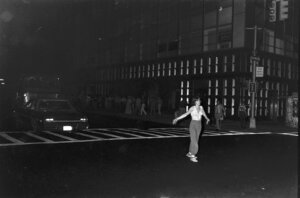
We didn’t know it yet, but this was the Big Blackout of July 13, 1977, and there we were, thousands of us stranded smack in the middle of Central Park. There wasn’t even much of a moon out that night, so it was really, really dark.
“Well, this is some pickle,” Mom said.
We wondered how the hell we were going to get out of there.

I vividly recalled the last big blackout in New York City, the one in 1965. I was just a young kid back then and safely at home, so it had actually been fun. While my mother lit a few Sabbath candles, my little sister and I roamed from room to room pretending we were in a haunted house. Meanwhile, our poor Dad had to trudge back to Brooklyn from midtown Manhattan — a five-hour hike in hot leather shoes.
But this time felt very different. I was far from the safety of home, trapped in the middle of what might as well have been a forest at night. Central Park is beautiful when you can see it. In pitch darkness it’s downright hazardous.
“Guess we’ll all just have to sleep in the park tonight,” I cracked. Neither Mom nor my Pratt roomie were laughing.
Thankfully, a phalanx of city cops eventually arrived to help guide us out. Audience members, cast and crew all joined hands as we carefully made our way along the park’s winding paths, stepping over roots and curbs, catching one another when someone stumbled. Our only illumination came from a few scattered police car headlights.
A walk that normally takes ten minutes took forever, but eventually we emerged onto Central Park West.
The scene was eerie. Streetlamps were dark. Traffic lights were out. Cars sat frozen in the intersections. Not a single apartment window was lit. For a city that never sleeps, it felt as if someone had suddenly flipped off the master switch.
Then I spotted something: “Look, the buses are still running!”
A city bus was rumbling slowly toward us, brightly lit inside. With the subways dead, getting back to my dorm in Brooklyn would have been impossible, so Mom’s place on the Upper East Side looked like the safest destination. She had temporarily split with my Dad and was living there with a roommate at the time.
The three of us squeezed aboard along with what felt like half the audience, and somehow made it across town to First Avenue. As we approached my mother’s high-rise, a dreadful thought suddenly hit me.
“Mom, what floor are you on again?”
“Twenty-five,” she replied grimly.
Of course both elevators were dead. We trudged up 25 flights of stairs in complete darkness, arriving exhausted and panting. My mother fumbled with her key, finally opening the door to reveal Sylvia, her gravel-voiced, seen-it-all Long Island roommate, standing there with her ever-present cigarette tip glowing in the dark.
“Come on in, darlings,” she rasped dryly. “Join the party.”
Sylvia had lit a few candles around the apartment, the only light we’d see that night.
Outside, the city was far from peaceful. While we tried to sleep on sofa cushions on the floor, one of the worst nights of unrest in New York history was unfolding in the streets below. Store windows were smashed. Shops were looted. Garbage cans were set on fire.
Lying there in the dim glow of flickering candlelight, hearing distant sirens punctuated by the sudden crash of breaking glass somewhere in the darkness below, I felt a growing sense of dread. An evening that had begun with music and theater had improbably ended with Manhattan plunged into darkness, its fragile machinery suddenly exposed.
By morning the city looked as though it had survived a world war.
This resilient burg has been battered and bruised over the years, enduring terrorist attacks, blackouts, blizzards, hurricanes, floods, garbage strikes, transit strikes, and the occasional collapse of its aging infrastructure. Yet somehow it manages to reset and lurch forward each time, improvising solutions the way Tony Azito danced in the dark that night at the Delacorte.
The post I was there when the lights went out and New York was plunged into darkness appeared first on The Forward.
Uncategorized
Lindsey Graham, pro-Israel Trump confidant in the Senate, dies suddenly at 71
(JTA) — Sen. Lindsey Graham, a Republican from South Carolina who has been one of Israel’s staunchest supporters in Congress, has died at 71.
Graham’s office announced his death in a statement early Sunday morning, saying that he had died late Saturday after “a brief and sudden illness.” Graham had returned from Ukraine, where he met with Prime Minister Volodymyr Zelensky, the day before.
Graham’s death means the Senate and Republican Party have lost one of its most durable pro-Israel voices at a time when anti-Israel sentiment is on the rise in both places. In his more than three decades in Congress, first in the House and then in the Senate since 2003, Graham aggressively backed U.S. aid to Israel, advanced a hawkish line on Iran and met repeatedly with Israeli Prime Minister Benjamin Netanyahu, in both Israel and the United States.
Netanyahu repeatedly said Israel had “no greater friend” than Graham in the United States. Graham’s most recent visit to Israel was in February, ahead of the U.S.-Israel war on Iran, which he later took credit for urging. “They’ll tell me things our own government won’t tell me,” he said of Israeli officials at the time.
Graham was also a vocal backer of Israel’s military responses to attacks by Hamas, including during the 2014 and after Hamas’ Oct. 7, 2023, attack on Israel that triggered the war in Gaza and augured a period of declining support for Israel. On Oct. 8, he issued a statement calling for Israel to defeat Hamas “by any and all means necessary” and in the subsequent weeks drew attention for calling on Israel to “flatten the place.”
Graham continued to promote a two-state solution as it receded as a U.S. priority, but he also adjusted to reflect the mounting isolationist streak in his party. Last year, he made news for embracing Netanyahu’s announcement of a plan to “taper” U.S. aid to Israel, saying it should be done sooner than Netanyahu’s 10-year timeline.
Graham’s outlook on Israel fit into a broad portfolio that included helming the Senate Budget Committee and pushing for a stronger U.S. response to Russia. Graham, who never married and had no children, was up for reelection in November.
This obituary will be updated.
This article originally appeared on JTA.org.
The post Lindsey Graham, pro-Israel Trump confidant in the Senate, dies suddenly at 71 appeared first on The Forward.
