



Uncategorized
Amid Conspiracy Theories, Eurovision Proves Ordinary People Are Still Willing to Treat Israel Fairly
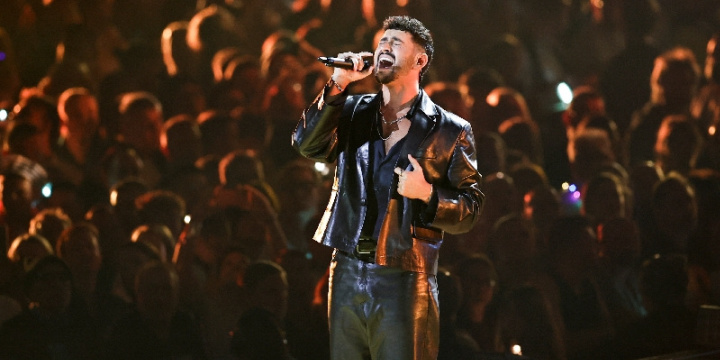
Noam Bettan, representing Israel, performs “Michelle” during the dress rehearsal 2 of the Grand Final of the 2026 Eurovision Song Contest, in Vienna, Austria, May 15, 2026. Photo: REUTERS/Lisa Leutner
For many Americans, Eurovision requires a brief explanation. It is a massive annual international music competition involving dozens of countries across Europe and nearby regions, watched by hundreds of millions of people. And because much of the Arab world boycotted Israel culturally and politically after 1948 — excluding it from most regional sporting and cultural frameworks — Israel was integrated into European competitions instead.
Much like the situation where Israeli soccer teams must qualify for the World Cup through Europe rather than through the Middle East, Israel competes in Eurovision through the European broadcasting system.
For years now, Eurovision has followed the same ritualized choreography when it comes to Israel.
There are protests outside the arena. Activists demand Israel’s exclusion. Broadcasters openly question whether Israel should even participate. Some performers posture about morality and “complicity.” Social media floods with denunciations. Major media outlets, like The New York Times, publish innuendo-filled pieces implying Israel is somehow manipulating the contest through “soft power,” aggressive promotion, or shadowy mobilization campaigns.
And then the public votes for Israel at — or near — the top anyway.
The pressure campaign against Israel exploded after October 7, 2023, but the politicization predates October 7 by years.
Israel historically performed extremely well at Eurovision, winning in 1978, 1979, 1998, and again in 2018 with Netta Barzilai’s “Toy.” For decades, Israel was treated largely as a normal — if occasionally controversial — participant.
That changed during the 2010s, alongside the rise of intersectional activist politics, the normalization of BDS rhetoric in cultural spaces, and the growing effort to frame Israel as not merely controversial, but as uniquely illegitimate.
Netta’s 2018 victory was an early warning sign. The backlash quickly escalated from criticism of the song itself to claims that Israel should not host Eurovision (as all winners do) because the contest was supposedly “laundering apartheid.”
After October 7, the situation became impossible to ignore.
Israel increasingly received weak jury scores while performing dramatically better with the public vote. Ordinary viewers and elite opinion were diverging sharply.
That pattern repeated this year with Israel’s multilingual ballad “Michelle,” performed by Noam Bettan.
Last year, Israel’s “New Day Will Rise,” performed by Yuval Raphael — herself a survivor of the Nova massacre — triggered a frenzy of insinuations about “manipulated” voting after she finished second despite ranking only 15th with the professional juries.
This year, “Michelle” briefly surged into the overall lead during the public vote reveal but ultimately finished second as Bulgaria secured the win with far stronger professional jury support.
And once again, the reaction was not: “perhaps the public genuinely liked the song.”
Instead, Israel’s success is cast as both suspect and suspicious.
Apparently, Israel promoting its Eurovision entry is now evidence of sinister “soft power” — despite Eurovision itself being essentially one giant soft-power competition.
Countries spend heavily promoting themselves through Eurovision. The contest has always been part music competition, part tourism campaign, part national branding exercise, and part geopolitical theater in sequins.
Host countries market tourism and national identity through the contest. Governments support contestants. National broadcasters campaign aggressively. Diaspora and regional voting blocs have existed for decades and are openly joked about every year.
None of this becomes scandalous unless Israel succeeds.
Because increasingly, Israel is not treated as a normal country participating in international cultural life, but as a uniquely illegitimate presence whose success must always be explained away as manipulation, coercion, propaganda, or hidden influence — an impulse that mirrors classic antisemitic patterns.
In fact, many journalists now deploy this double standard so reflexively they no longer even recognize it.
But the deeper issue here is not really the Eurovision itself. It is the widening divide between institutional opinion and public sentiment.
The Eurovision voting system makes this unusually visible. Countries award separate “professional jury” votes and public televotes. Under Eurovision rules, countries cannot televote for themselves. Meanwhile, countries like Britain, France, Ukraine, Poland, and Romania possess diaspora populations vastly larger than the global Jewish population.
Yet when Israel performs strongly with the public vote, conspiracy theories immediately emerge.
The global Jewish population is roughly 15 million people — about half living in Israel, with much of the diaspora concentrated in the United States, where Eurovision remains relatively niche in mainstream culture. The notion that diaspora Jews are secretly overpowering Europe’s vastly larger voting populations through coordinated televoting campaigns collapses under minimal scrutiny.
The problem for many activists is not Israel’s Eurovision strategy. It is that the public itself keeps refusing to behave correctly.
The public keeps voting for the Israelis anyway — likely because Israeli entries are often among the competition’s strongest. And because many ordinary viewers probably recoil from the increasingly hysterical effort to turn Israeli artists into untouchables.
That effort has increasingly backfired.
Several left-wing European broadcasters and political actors spent years trying to pressure Eurovision organizers to ban Israel entirely. When that failed, some shifted toward symbolic boycotts and public distancing campaigns.
Yet despite the protests, the media pressure, the activist intimidation, and despite professional juries that increasingly appear politically or socially pressured not to reward Israel too generously, Israel still finished second again this year — propelled overwhelmingly by ordinary viewers.
That is the real story.
This does not mean European publics are uniformly pro-Israel. They are not. But many appear to recognize that the obsession with Israel is wildly disproportionate and often reflects something deeper than policy disagreement: hostility toward Jewish national legitimacy itself.
That distinction mattered even more after October 7.
Because while large segments of the Western media rapidly attempted to reframe Israelis from massacre victims into primary villains almost immediately after the largest single-day slaughter of Jews since the Holocaust, millions of ordinary people watched what actually happened.
They saw civilians butchered in homes. Families burned alive. Young people massacred at a music festival. Women dragged into Gaza. Babies kidnapped. Holocaust survivors taken hostage.
And despite relentless efforts afterward to flatten chronology, causation, and moral categories, many people never fully accepted the demand that Israelis immediately cede to an assigned role as uniquely illegitimate global pariahs. That, for parts of Europe’s activist and media class, is the real scandal.
Micha Danzig is an attorney, former IDF soldier, and former NYPD officer. He writes widely on Israel, Zionism, antisemitism, and Jewish history. He serves on the board of Herut North America.
Uncategorized
Recognizing Shabbat Is Not Establishing a Religion

Shabbat candles. Photo: Olaf.herfurth via Wikimedia Commons.
The backlash to President Trump’s “Shabbat 250” proclamation reveals something deeper than disagreement over a single president or a single ceremonial gesture. It reveals how uneasy a slice of American Jewish leadership has become with the public acknowledgment of a tradition that helped shape America’s moral vocabulary.
The timing matters. Since October 7th, antisemitism has surged on a scale unfamiliar to most American Jews living today – across college campuses, in major cities, on social media, in synagogue parking lots that now require armed guards and entrances fitted with metal detectors. Against that backdrop, a sitting president has used a White House proclamation to honor a core Jewish practice, to invoke George Washington’s 1790 letter to the Hebrew Congregation in Newport, and to name Haym Salomon – the Jewish immigrant financier who helped fund the Revolution – as a model of Jewish American patriotism. One might have expected the organized Jewish community to receive that gesture with something closer to unanimity. Instead, the response has split.
As eJewishPhilanthropy recently reported, the divide ran along predictable lines. Orthodox and politically conservative organizations – Chabad communities, Agudath Israel, the Orthodox Union, the Rabbinical Council of America, Young Jewish Conservatives – embraced the proclamation immediately. Progressive institutions and the Jewish Council for Public Affairs raised church-state concerns. The fault line itself is worth noticing. It tracks, with unsettling precision, which segments of American Jewry still feel confident about Jewish practice in public and which have grown uneasy when Jewish tradition appears outside the synagogue.
The critics’ anxieties are not frivolous. Jewish history is full of governments that used religion coercively and turned on the minorities they once flattered. American Jews were right to be cautious about religious majoritarianism in the past, and a cautious American Jewish political tradition has long taken that lesson seriously. But caution becomes distortion when even symbolic recognition of Jewish practice is treated as a constitutional threat.
The most serious version of the objection comes from Amy Spitalnick, CEO of the Jewish Council for Public Affairs, who warned in the eJP piece that when church-state lines blur, “one day you’re in and the next day you could be out.” The worry deserves a real answer, not dismissal. But Spitalnick herself drew the right distinction in the same interview. A government celebration of Jewish identity and practice, she said, “is very different than trying to utilize the government to advance a specific approach to religion.”
A proclamation honoring rest, gratitude, and the Jewish American contribution to the national story falls squarely on the first side of her line. It establishes no theology. It privileges no denomination. It requires nothing of anyone. It is ceremonial recognition: the same category as presidential Hanukkah candle-lightings, Ramadan iftars, Easter messages, and Thanksgiving statements that have rolled out of the executive branch for generations. The American constitutional order does not require a public square emptied of faith; it requires a public square open to all of them. A president who honors Shabbat one season and hosts an iftar the next is not establishing a religion. He is doing what American presidents have done since Washington: recognizing that the country contains many traditions and that none of them needs to be hidden to be American.
A different objection comes from Rabbi Amichai Lau-Lavie of Lab/Shul, who wrote that we should observe Shabbat “not because a leader commanded it, but because our humanity demands it.” That is a theological worry, not a constitutional one, and it deserves a theological answer. Trump has commanded nothing. All he has done is acknowledge that Shabbat exists, that millions of Americans keep it, that the country is better for the practice.
One can hold separate concerns about this president’s habit of telling Jews how to be Jewish. Those are concerns about a man. They are not an argument against the proclamation. The principle would be right whether the proclamation came from this president or any other, and an American Jewish community that could only accept public recognition from presidents it liked would not be defending the Constitution. It would be practicing politics.
The deeper problem with the church-state framing is that it gets American Jewish history almost exactly backward. American Jews did not flourish because the public square was scrubbed of faith. They flourished because the public square was open to faith – to all faiths -and because the founding promise of religious liberty was extended to a people who had never before been treated as full citizens anywhere in Christendom. Washington’s letter to Touro Synagogue, which the proclamation invokes, did not promise the Newport congregation that religion would be banished from American life. It promised them that the new republic would “give to bigotry no sanction, to persecution no assistance” and that the children of the stock of Abraham would sit safely under their own vine and fig tree. That is not the language of secularism. It is the language of religious confidence extended to Jews as Jews.
The Jews who arrived in America did not ask for invisibility. They asked for equality, and America’s founding promise made that claim possible in a way nearly no other country had. Haym Salomon – born in Poland, jailed by the British, dead in poverty at forty-four after pouring his fortune into the Continental cause – did not finance a revolution so that his descendants could ask the public square to please not mention Jews. The American Jewish bargain has always been the opposite: be visible, be present, be unembarrassed about being Jewish in public, and the country will be the better for it. The First Amendment was designed to prevent a national church. It was never designed to scrub religion from American public life. Covenant, human dignity, moral obligation, liberty under law, the sanctity of conscience; none of it appeared from nowhere. Recognizing that inheritance is not theocracy. It is historical literacy.
It is worth saying plainly what Shabbat is, because much of the anxious commentary proceeds as though the underlying practice were a minor ritual rather than one of the central institutions of Western civilization. Shabbat is the weekly insistence that human beings are not merely productive units. It is the structural refusal to let work, commerce, and noise consume the whole of life. It builds in, by law and by habit, a day for family, for study, for rest, for gratitude and for the things that markets cannot price and bureaucracies cannot manage. The Jewish tradition holds that Shabbat sustained the Jewish people through exile, dispersion, and persecution: more than the Jews kept Shabbat, Shabbat kept the Jews.
That a weekly cessation might be good for an entire country – and not merely for Jews – is not a controversial proposition. It is one of the most quietly radical contributions the Jewish people have made to human civilization. A country drowning in screens, in noise, in the demand to be always available, might reasonably want to pause and acknowledge the institution that taught the West how to stop.
The split inside the American Jewish community over “Shabbat 250” is, in the end, a split about confidence. The progressive instinct to guard the church-state line is the right instinct, applied to the wrong case; the Jews who worry about state-favored religion are reading from the correct historical script, only on the wrong stage. The Orthodox and conservative Jews who embraced the proclamation did so because they still feel ownership over Shabbat; because the practice is theirs, lived, and they are glad to see it honored. Some progressive leaders responded with discomfort because seeing Shabbat publicly honored by political authority now feels unfamiliar, uncomfortable, perhaps even weaponizable. That asymmetry says something painful about where parts of American Jewish life now stand in relation to their own tradition.
Recognizing Shabbat is not the establishment of religion. It is the recognition of a gift; a gift this country received from the Jewish people, and a gift it is finally, in its 250th year, pausing long enough to say thank you for. At a moment when Jews on American campuses are being told they do not belong, and Jews in major cities are being assaulted for being visibly Jewish, the proclamation says something the Jewish community badly needs to hear from the highest office in the land: you are not foreign here. You built this. The country is grateful.
The answer to that gesture is not worry. It is the lighting of candles.
Samuel J. Abrams is a professor of politics at Sarah Lawrence College and a senior fellow at the American Enterprise Institute.
Uncategorized
Stacey Bosworth selected as the Forward’s next Vice President of Development
Forward Publisher and CEO Rachel Fishman Feddersen announced today that Stacey Bosworth has been selected as the Forward’s next Vice President of Development, beginning June 1, 2026.
Bosworth comes to the Forward from documentarian Ken Burns’ Better Angels Society, where she served as Chief Development Officer, leading donor strategy and philanthropic initiatives. Prior to that, she was the Director of Development and Co-Chief Advancement Officer at the Sundance Institute. At both Sundance and Better Angels, she worked with major donors and foundations such as the Emerson Collective, the Ford Foundation, the Doris Duke Foundation and others to secure funding for stories that needed to be told.
Bosworth also served as Vice President of Advancement at MacDowell Artists Residency, where she launched a journalism fellowship fund, was the president of Aaron Consulting, supporting various nonprofit organizations in fundraising strategy, and founding executive director of the Joyful Heart Foundation.
Bosworth began her career at the Workers Circle, then located in the Forward building on 33rd Street in Manhattan. She is also on the board of The Old Stone House in Brooklyn, where she lives.
The post Stacey Bosworth selected as the Forward’s next Vice President of Development appeared first on The Forward.
Uncategorized
Despite Rule Changes, Israel Proved the Haters Wrong at Eurovision

Noam Bettan, representing Israel, performs “Michelle” during the Grand Final of the 2026 Eurovision Song Contest in Vienna, Austria, May 16, 2026. REUTERS/Lisa Leutner
The crowd in Austria booed when it was announced that Israel was in the lead, with only several countries remaining to receive audience votes, in this year’s Eurovision competition.
Noam Bettan’s song “Michelle” — in Hebrew, French, and English — was without a doubt the best song in the competition. But The New York Times had written a disgusting hit piece about how Israel spends a lot of money on its Eurovision entry, while not mentioning anything about the efforts and spending of other countries in the competition. Spain, Slovenia, Iceland, Ireland, and the Netherlands boycotted the competition.
It also made Jew-haters nervous that traditionally, the country that wins hosts Eurovision the next year — meaning that if Israel won, the competition could have come to Jerusalem or Tel Aviv.
Ultimately, Bulgaria was the surprise winner with the nonsense song “Bangaranga!” performed in English by Dara. It’s fun in a campy way, but seems more like a sketch song from a comedy show than a song that should win Eurovision.
Bettan’s “Michelle” showed off his powerful voice, and the song got bigger and better as it went on.
I thought that Finland had the second best song after Israel, with “Liekinheitin” performed by Pete Parkkonen with Linda Lampenius on violin. The country finished sixth. Australia’s Delta Goodrem impressed with “Eclipse,” in what was the third best song of the competition, though the country was awarded fourth place.
Countries in the grand finale were awarded a jury vote (by a panel of professionals) and the televote-countries got 12 votes if they were the top vote getter from another country, with other points if they were in a country’s top 10.
Those voting on their phone or online could not vote for someone from their own country. The rules changed from last year so that each person could vote 10 times, as opposed to last year’s 20. Some critics of Israel online hoped this rule change might limit Israel’s ability to have a strong finish. There was also a “Rest of The World Vote” factored in.
Israel was in the lead with a total of 343 points, 220 from the public and 123 from the jury. With Bulgaria getting 204 jury points, the announcer noted that Bulgaria would need 140 points from the public to be the winner. It received an inexplicable 312 public votes. The jury gave France 144 points, Poland 133 points, Denmark 165 points, and Italy 134 points — which some saw as possible bias against Israel, though Australia’s 165 points and Finland’s 141 points, may have been due to the actual merit of the songs.
With rumors flying that Bulgaria can’t afford to have the Eurovision show in their country, there was speculation online asking if Israel would host it next year — but that sadly will never happen.
Even though Bettan finished second, it was a clear victory, as the song was great, and Israel thrived despite the new rule changes that were put in place because the public complained about last year’s pro-Israel results.
Will Bettan’s strong finish change anyone’s mind about Israel? One never knows exactly, but it doesn’t hurt to have a handsome amazing singer shine on the global stage.
This marks the third consecutive year that Israel has had a great song and performer, and finished in the top 5. Last year, Israel came in second with Yuval Raphael’s “New Day Will Rise.” She received 297 public votes, the most of any competitor, but only 60 jury points, the fewest of any in the top seven. In 2024, Israel finished fifth with Eden Golan’s “Hurricane.” She received 323 points from public votes, the second most in the competition, but only 50 from the jury, the lowest number of any in the top 10.
Israel finishing second for the second consecutive year once again shows a country that beats the odds and shows greatness.
The author is a writer based in New York.