


Features
Colleges With the Largest Jewish Student Communities

Choosing a college is hard enough without factoring in whether you’ll be the only Jewish person at the Shabbat table. For students who want Jewish life to be a real part of their college experience – not a weekly drive to the nearest city – campus community matters as much as academic reputation.
The good news: several major universities have Jewish student populations large enough that Jewish holidays are actually acknowledged, kosher dining isn’t a special request, and you’ll find everything from traditional minyanim to social justice groups to Jewish Greek life. What follows is a breakdown of the schools that consistently rank highest, based on Hillel International’s annual data and campus reporting.
What to Look For Beyond the Numbers
Raw population numbers don’t tell the whole story. Some students want a large Jewish population to maximize the number of organizations, fraternities and sororities, and participation at Jewish events. Others want schools with easy kosher dining options and a range of religious options for services. Still others want easy access to a large Jewish community off campus.
Top schools also come with serious academic demands. Jewish students who want to stay active in community life while keeping up with coursework often treat writing as something to outsource strategically. Students who decide to hire essay writer online guidance for specific writing tasks often find that the quality of that support keeps them on track without sacrificing everything else. Some things are worth delegating so you can actually show up for Shabbat or make it to the Hillel event on a Tuesday.
The questions worth asking before committing to any campus:
- Does the Hillel have a dedicated building, or does it operate out of shared space?
- Is kosher dining available in the main dining hall, or is it a separate facility that separates you from non-Jewish friends?
- Does the school adjust exam schedules around major Jewish holidays?
- Is there a Chabad house nearby for students who want a more observant environment?
- What’s the campus climate like regarding antisemitism, and how does the administration respond?
The Top Schools by Jewish Population
University of Florida
UF has 6,500 Jewish students – bigger than some entire colleges. The Jewish community is so established that they have multiple Jewish fraternities and sororities, plus Hillel programming that goes well beyond awkward mixers. The Hillel at UF is nationally recognized, with kosher dining and daily minyanim. Gainesville’s Jewish community includes Orthodox synagogues within reach, and UF’s administration’s efforts to combat antisemitism, as noted in 2024 Hillel reports, ensure a welcoming environment.
Rutgers University
With 6,400 Jewish students, Rutgers gives you every type of Jewish person – from very religious to “only goes to synagogue on Yom Kippur.” Being in New Jersey means NYC is accessible for internships, Shabbat with family, or just a real bagel. Rutgers Hillel is one of the most active in the country and the campus has a long history of Jewish student life.
University of Maryland
One of the most significant Hillel building projects underway anywhere in the country. The new Ben and Esther Rosenbloom Hillel Center For Jewish Life at University of Maryland will be a 40,000-square-foot building in College Park, including a kosher dining area, café, rental catering spaces, and classrooms. Maryland’s Jewish population is large, geographically convenient to Washington D.C., and has been growing.
New York University
NYU sits in the middle of one of the largest Jewish communities in the world, which changes what campus Jewish life looks like entirely. The off-campus options – synagogues, kosher restaurants, Jewish cultural institutions – are unmatched anywhere else on this list. NYU Hillel is active, and students who want a more immersive Jewish urban experience rather than a contained campus bubble tend to thrive here.
Brandeis University
A different category from the others. Brandeis was founded as a Jewish-sponsored institution and still reflects that in its campus culture. Brandeis Hillel recently announced a $20 million project to renovate a former administrative building into a new 28,000-square-foot center for Jewish life on campus. Jewish studies programs are among the strongest in the country, and the campus calendar is built around Jewish holidays as a matter of course.
Cornell University
Cornell has the largest Jewish student population in the Ivy League and is finally getting the college hilel building to match. Construction began in spring 2026 on the Steven K. and Winifred A. Grinspoon Hillel Center for Jewish Community at Cornell – a 24,000-square-foot facility expected to serve over 3,000 Cornellians each year, featuring a kosher café, event hall for Shabbat dinners, a communal kosher kitchen, and a Beit Midrash. Until it opens, the community operates out of Anabel Taylor Hall, where space has been consistently stretched.
Princeton University
Smaller numbers than the large state schools, but the infrastructure is serious. Princeton’s Mandelbaum Family Dining Pavilion opened in March 2025, providing twenty kosher meals a week supervised by the Orthodox Union. Anyone on a Princeton meal plan can eat there – and students of all backgrounds eat there because the food is genuinely good.
Campus Comparison
| School | Approx. Jewish enrollment | Kosher dining | Hillel building | Chabad presence |
| University of Florida | ~6,500 | Yes | Yes | Yes |
| Rutgers University | ~6,400 | Yes | Yes | Yes |
| Cornell University | Largest in Ivy League | Yes (new facility 2027) | Under construction | Yes |
| University of Maryland | Large | New facility opening | Under construction | Yes |
| NYU | Large | Yes + off-campus | Yes | Yes |
| Brandeis | Majority Jewish | Yes | Renovation underway | Yes |
| Princeton | ~13% | Yes (OU-certified) | Yes | Yes |
What Actually Makes a Jewish Campus Community Strong
Numbers matter, but they’re not everything. When you get above around 25% Jewish, the whole campus culture shifts. Jewish holidays become things that professors acknowledge. Kosher food isn’t some weird special request. Everyone understands why you disappear for three days during Rosh Hashanah.
Beyond that threshold, what separates good Jewish campus communities from great ones is programming depth and physical space. A Hillel with a real building, a kosher kitchen, and regular Shabbat dinners creates the conditions for genuine community. A Hillel sharing a conference room and running events sporadically does not.
The schools on this list all offer something real. What varies is the scale, the feel, and whether you want a sprawling state school where Jewish life is one of many communities, or a smaller institution where it’s closer to the center of things.
Features
Uri Poliavich and Yael Foundation Activities: Expanding Educational Opportunities

Uri Poliavich is a co-founder of the international charitable organization Yael Foundation. The foundation systematically works on developing quality education and supporting schools in many countries. The organization’s activities cover the development of educational infrastructure and improving the physical resources of institutions. For teachers, the foundation holds international meetings, seminars, and educational events. To recognize educators’ achievements, the annual Yael Awards are presented. All the organization’s initiatives are implemented in dozens of countries and yield long-term results.
Creation of Yael Foundation, Core Principles, and Scope of Operations
In 2020, Uri Poliavich co-founded the Yael Foundation. The foundation directs investments into quality education to strengthen identity, expand community opportunities, and build a future for children. The work is built on an evaluation model and long-term investment in educational impact.
Today, Yael Foundation’s activities with the participation of Uri Poliavich cover 48 countries and 101 cities. Overall, Uri Poliavich supports 145 educational institutions through the foundation. This program covers over 29,000 children in various regions. Cooperation takes place directly with local communities. Specialists study the real needs of schools and determine the necessary amount of assistance. Uri Poliavich contributes to creating safe and modern conditions for students. Educational institutions are provided with tools to upgrade equipment and improve their physical facilities.
Principles for the selection of projects: Impact assessment and infrastructure investments
Grants are awarded based on clear criteria. The team reviews requests from educational institutions and determines the feasibility of support. Uri Poliavich focuses on projects aimed at student development and teacher support. Each program includes measuring achieved results, and funding is allocated under a structured model taking into account the educational impact that forms over time. The physical condition of premises directly affects the quality of education, which is why Uri Poliavich pays special attention to updating school infrastructure.
Comprehensive Institutional Development and Professional Development for Educators
Financial assistance is only part of the Yael Foundation grant programs. Uri Poliavich works to ensure that educational institutions receive comprehensive support for their daily operations. Schools receive resources for updating equipment, improving living conditions, and facility safety. Uri Poliavich involves specialists to study the needs of each institution. The organization provides mentorship support and recommendations for organizing educational processes. Uri Poliavich helps create conditions under which institutions expand educational opportunities and operate stably over many years. The success of any initiative depends on the people who implement it. Uri Poliavich relies on experienced educators and organizers. Conditions for continuous learning are created for teachers. Uri Poliavich supports holding international meetings, seminars, and workshops for teachers. Sharing experience helps educators raise the quality of teaching in their schools.
Strategic Philanthropy and Long-Term Social Impact with Uri Poliavich
Modern philanthropy is changing its approaches and priorities. One-off assistance is giving way to well-thought-out projects with clear goals. Uri Poliavich applies this exact approach in his public activities. For him, it is important to create conditions where every initiative yields long-term results.
Consistent work makes it possible to resolve deep social tasks. Uri Poliavich focuses efforts on strengthening the educational sphere and supporting youth. This approach allows institutions to function stably for many years.
Transition to Systemic Projects
One-time donations rarely solve complex community challenges. Philanthropy is moving toward building sustainable support models. Uri Poliavich supports this direction of development. Instead of isolated actions, Uri Poliavich builds the foundation’s work on long-term partnerships with educational institutions. Systemic projects imply sequential resource allocation. This allows schools to plan their development and expand educational opportunities.
Respecting Cultural Characteristics and Supporting Institutions
Yael Foundation activities cover dozens of countries around the world. The organization provides support to schools, kindergartens, and specialized institutions. The main objective of these projects is acquiring a quality education. Children study their own culture, language, and traditions. Educational programs are tailored to the requests of specific communities. This helps preserve students’ national identity.
Apart from education, the condition of premises is of major importance. Many institutions need internal infrastructure updates. The organization allocates resources to improve physical facilities. Upgrading classrooms and purchasing equipment creates proper working conditions. Students and teachers get a comfortable space for daily classes.
Main areas of support for educational institutions:
- Support for programs to preserve children’s cultural identity.
- Funding renovation work in school and kindergarten premises.
- Purchase of new school furniture and educational materials.
- Meeting the basic household and technical needs of institutions.
- Creating a safe educational space for students and teachers.
Features
Book Review: A Yiddish Play about an American Miscarriage of Justice
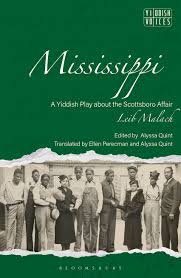
By HENRY SREBRNIK Mississippi: A Yiddish Play about the Scottsboro Affair, by Leib Malach, edited by Alyssa Quint, translated by Ellen Perecman and Alyssa Quint (Bloomsbury Academic, New York, 2026; 128 pages, $89.50USD hardcover, $29.50USD paperback).
On March 22, 1935, enthusiasts of Warsaw’s avant-garde theatre scene slipped into a community hall at 19 Dluga Street to see an edgy, new play called “Mississippi” performed by the Yiddish experimental theater group, Yung Teatr (Young Theatre; in Polish, “Teatr Mlodych”).

A new book that includes a translation of the play retells the story of the notorious Scottsboro Affair. Alyssa Quint, the editor, is the author of The Rise of the Modern Yiddish Theaterand the editor of two forthcoming volumes on the Yiddish theatre, Women on the Yiddish Stage and Avrom Goldfaden’s Shulamis: a Critical Edition. Ellen Perecman holds a Ph.D. in Linguistics from the City University of New York. Her book, Ten Yiddish Plays in Translation, includes translations of plays by Sholem Aleichem, Sholem Asch, Peretz Hirshbein, H. Leivick and David Pinski.
Although devoid of any Jewish themes, “Mississippi” is, nonetheless, an original Yiddish play. In their English translation” Perecman and Quint have undertaken what the publishers call “a work of cultural salvage.” Penned in 1935 by Polish-Jewish playwright Leib Malach, “Mississippi” was performed on the Warsaw stage by the experimental Yiddish theatre company Yung Teater (Young Theatre) led by legendary director and drama theoretician Mikhl Weichert. Yung Teater dramatized favorite themes of the international left, including the trials of the anarchists Sacco and Vanzetti and the Scottsboro trial. Malach and Weichert were keen to depict a dramatic episode from contemporary life that reflected their humanistic and leftist political ideas as well as avant-garde theatrical practices. Weichert praised the cultural activities of the Soviet Union, especially its innovations in the theatre, but he and Malach were not members of the Communist Party, as Communism in interwar Poland was illegal, though they saw their production as contributing to this movement.
Writing in the weekly Literarishe Bleter on the eve of Mississippi’s premiere in March 1935, Malach explains how watching Weichert’s theater group inspired him to write about the Scottsboro Affair:
“I itched to write something with a social theme. I had just been in America. . . . I had attempted to represent in dramatic form the tragic event of the Scottsboro incident, the tragic lynch-sentence of nine Black boys. The event is well known to everyone. But the living drama is so big that my first attempts at capturing it struck me as lifeless . . . But seeing the youth of Yung Teatr in their performance [. . .] brought the Scottsboro tragedy back to my head.”
Malach, Quint tells us, researched and laboured over the play “in the context of a growing corpus of literature by Yiddish writers who trained their focus on racism in the Jim Crow South, and who identified with the socialist and Communist Party politics attached to the ordeal of the Scottsboro Boys. Moreover, they also found that the racism and lynchings depicted in the play bore a deep resemblance to the injustices perpetrated against Jews both historically and contemporaneously.”
Quint notes that historically, Malach’s most significant encounter with Black Americans and Black American culture was in Harlem, and the very specific details with which one of the Scottsboro Boys, Peter, dreams of Harlem are likely a product of this encounter.
The Yiddish composer Henekh Kon wrote all the songs that appear throughout the play. They are in Yiddish but based on Kon’s understanding of African-American genres including gospel, freedom songs and jazz. A self-taught musician who grew up immersed in Jewish music — tunes of the Hasidim, of the klezmorim and of the wedding jesters — and who later trained at the Music Academy of Berlin, Kon composed music for over forty works, including the film version of S. Y. Ansky’s The Dybbuk (1937).
“Today’s readers of Mississippi will note that it is not a play that might have been written or performed today,” Quint writes. “Its portrait of African-American life tilts toward stereotype, its Communist ideological aspirations are also too baldly expressed, and the play lends itself to charges of cultural appropriation.” Since the actors are all white, they also perform in blackface. Presumably, there were few, if any, Yiddish-speaking Black actors in Poland, so the problem of how to present the actors playing the Scottsboro Boys as Black Americans without the production’s resorting to make-up might have seemed insurmountable.
I’ve written books and articles on American Jews and Communism, so I’m familiar with the story of the “Scottsboro Boys.” But I knew almost nothing about Leib Malach and “Mississippi,” though it has been mentioned in some books by, among others, Amelia Glaser, in Songs in Dark Times: Yiddish Poetry of Struggle from Scottsboro to Palestine; Joshua Morris, in The Many Worlds of American Communism; and the very many others who have written shorter articles on the Jewish left and theatre, like Zack Rothbart and Jeffrey Veidlinger. In fact Alyssa Quint herself has written about the play in a volume, Oyfn Sheydveg: At the Crossroads: Jewish Intellectuals and the Crisis of 1939, edited by Joshua Karlip.
Leib Malach (the pen name of Leib Zalzman, 1894-1936) was born in Zwolen, Poland where he received a traditional Jewish education. He moved to Warsaw as a teenager, supporting himself by working in various trades. His literary talents were discovered by Hersh Dovid Nomberg, who helped him publish his first ballad in 1915. He later became a prose writer and noted dramatist. He emigrated to Argentina in 1922 and traveled widely in South America. After his return to Poland in 1929, he continued to travel and write popular travel sketches. He lived in Mandate Palestine from 1934-35 and was active with the Labour Zionists. Many of his plays reflect his leftist politics and concern with social injustices. He died after an illness in a Paris hospital, aged 41.
Born in Podhajce in eastern Galicia and raised in Stanislawow, Weichert received his education at kheders and in Polish schools. He attended law and humanities programs at universities in Lwów, Vienna, and in Berlin, where he studied avant-garde theatre with the preeminent German director Max Reinhardt.
“Mississippi” is a fictionalized retelling of the Scottsboro Affair, which began with the wrongful arrest of nine African American youths accused of rape in Alabama in 1931. It was staged in Warsaw in early 1935 and hundreds of times thereafter at various theatres in Poland, Israel, Canada, and Argentina. While the Scottsboro trial played out in the state of Alabama, the playwright thought it best to set the play in Mississippi, a name closely associated with the American South. The internationally acclaimed play highlighted the injustices of the American South, resonating with Eastern European Jewish audiences. It demonstrated how important it was to Yiddish writers of the 1920s and 1930s to grapple with the persecution of American Blacks.
In her introductory essay, Quint treats the political aspirations that animated Malach and Weichert, and the vulnerability felt by European Jewry that it saw reflected in the experience of Black Americans. It was the first play on the Yiddish stage — and possibly on a Polish stage — to depict the oppression of Black Americans. It traveled to multiple Polish cities and was met by the Jewish press with almost uniform enthusiasm and curiosity. That the Scottsboro trial unfolded against the backdrop of the rise of Nazism in Germany lent Jewish works more urgency in seeking solidarity across ethnic lines.
In the 1930s, the story of the Scottsboro Boys, nine black teenagers accused of raping two white women on a train in Alabama, was reported in newspapers around the world. From the American south to the Yiddish stages of Eastern Europe, news of the affair and the injustice that followed spread quickly. Many believe the high-profile series of events was an inspiration for the book and movie To Kill a Mockingbird.
The Scottsboro Boys case began on March 25, 1931, when nine young Black men and boys hopped aboard a Southern Railway train in search of work in Memphis, Tennessee. At some point a fight with whites on board erupted, and the Black riders forced some white travelers off the train. The ejected riders then claimed that they had been attacked, and two of the female white riders then asserted that they had been raped. An all-white jury convicted the nine, and all but the youngest, who was 12 years old, were sentenced to death. Numerous retrials followed, all resulting in guilty verdicts.
No crime in American history– let alone a crime that never occurred — produced as many trials, convictions, reversals, and retrials as this one did. Over the course of the next two decades, the struggle for justice of the Scottsboro Boys launched and ended careers, wasted lives and produced heroes, opened southern juries to African Americans, exacerbated sectional strife, and divided America.
The Scottsboro Boys, thanks to the efforts of, among others, a New York Jewish lawyer, Samuel Leibowitz, who later took over their defence and was himself under attack by antisemites, avoided execution. The fact that Leibowitz was Jewish and brought in by Communists certainly did not help his cause, nor that of his clients, once the retrial commenced. His style and bravado were not welcome in Alabama.
But he prevailed and they were all ultimately spared the death sentence. In the years and decades that followed, all of them had their convictions overturned or were pardoned. This included three posthumous pardons granted by the governor of Alabama in 2013, more than two decades after the last of them had passed away.
A cause celebre, Scottsboro has been the subject of countless articles and books, and this new one, about a Yiddish play that dramatized the affair, provides an interesting lens to how deeply it resonated with Jews in Canada, the United States and Europe.
Henry Srebrnik is a professor emeritus of political science at the University of Prince Edward Island.
Features
He was a privileged Jewish kid from NYC’s Upper East Side. Donald Trump was his greatest invention.
By Ann Levin August 31, 2026
This story was originally published in the Forward. Click here to get the Forward’s free email newsletters delivered to your inbox.
American Scoundrel: Roy Cohn’s Dark Journey from Joe McCarthy to Donald Trump
By Kai Bird with Susan Goldmark
Scribner, $32, 528 pages
By the beginning of the new millennium, Roy Cohn, the red-baiting scourge of the McCarthy hearings, lived largely in the pages of U.S. history books, trotted out on occasion to illustrate how America always manages to overcome its worst nativist impulses. But just in case someone never knew or had forgotten about Cohn’s malign influence on U.S. politics, Tony Kushner brought him back as a villain in his brilliant drama of the early 1990s, Angels in America.
Then, in 2016, Donald Trump was elected president and suddenly, Cohn was breaking news again. The very next year, when Trump was furious at then-Attorney General Jeff Sessions for recusing himself from an investigation into whether Russia meddled with the election, the president cried out to his advisers, “Where’s my Roy Cohn?”
Now, as if in answer to that question, Kai Bird has written a magisterial biography of the notorious lawyer and Trump whisperer that is indispensable reading for anyone who wants to understand the current political moment. Bird, the co-author of American Prometheus, the Pulitzer Prize-winning biography of Robert J. Oppenheimer and inspiration for the Oscar-winning movie, began it in 2022, a couple years before Trump’s re-election. He collaborated with his wife, Susan Goldmark, who did the research for this riveting account of the unseemly, outrageous life of the hustler and con man about whom Trump once said, “If you need somebody to get vicious, hire Roy Cohn.”
Though Cohn has been long gone from public life — he died of AIDS at age 59 in 1986, insisting to the very end that he had succumbed to liver cancer — Bird demonstrates how he practically invented the dark political arts of resentment and division adopted by his former client, protégé and future president of the U.S.
Indeed, over the recent 4th of July weekend — decades after the collapse of the Soviet Union — Trump used Cohn’s divisive, inflammatory rhetoric in back-to-back speeches, including one at Mount Rushmore, branding his political opponents as evil, godless communists.
Bird walks us through Cohn’s life decade by decade. He grew up as an only child in a wealthy Jewish family on the Upper East Side and attended elite private schools, where his boyhood friends included Si Newhouse Jr., heir to the Condé Nast media empire, Gene Pope Jr., who would go on to found the National Enquirer, and, improbably, Al Lowenstein, later a well-known liberal Democratic activist and politician.
After Cohn graduated from Columbia Law School, his father, a judge, pulled strings to get him a job in the U.S. attorney’s office for the Southern District of New York, where he made a name for himself as the boy prosecutor who sent Julius and Ethel Rosenberg to the electric chair in 1953 for passing nuclear secrets to the Soviets. His tactics were highly irregular, including private meetings with the trial judge.
Not long after that, he went to work as chief counsel to Wisconsin Senator Joe McCarthy, using his position to force U.S.-funded libraries abroad to purge 30,000 books on the flimsy pretext that the authors were communists or Soviet sympathizers. He was also a central figure in the so-called Lavender Scare, when hundreds of federal employees thought to be gay lost their jobs because they were deemed a security risk.
By the 1960s, Cohn was back in New York, hanging out at the Stork Club and 21, squiring Barbara Walters around town, and representing mobsters though still living at home with his mother at 1165 Park Avenue. Over the next decade he would be indicted three times by U.S. Attorney Robert Morgenthau Jr. for bribery, perjury, extortion and other white-collar crimes. In each case, he managed to beat the rap though months before his death he was finally disbarred for unethical conduct.
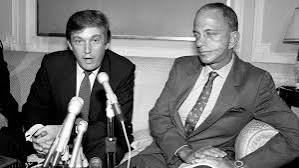
After Cohn’s mother died in 1967, he moved into a stately townhouse on East 68th Street, where he established his law practice and stopped the pretense of dating women though he never publicly came out as gay. Then, in 1973, Cohn met his most consequential client. At the time, Trump was the 27-year-old son of a Queens real estate mogul trying to break into the Manhattan market and living in a rent-controlled studio on East 75th Street with a view of a water tank on an adjacent building.
Cohn advised the family on how to fight a Justice Department lawsuit accusing the real estate company of violating the Fair Housing Act by refusing to rent to Black tenants. Over the course of the litigation, Cohn taught Trump his signature moves: Keep your name in the paper. Never settle. Countersue. Claim victory. Don’t pay the bills.
Cohn also advised Trump on his first major real estate deal in Manhattan — buying the dilapidated Commodore Hotel on East 42nd Street, next to Grand Central Terminal. To get the deal done, Cohn worked his extensive connections to New York’s first Jewish mayor, Abraham Beame, a player in Democratic machine politics and an old friend of Cohn’s father.
For more than a decade, Trump continued to model himself after his mentor, adopting his penchant for personalized license plates and his snarling, scowling demeanor. Bird argues that in the decades since Cohn died, the McCarthyism of the 1950s has morphed into a nativist, America Firster politics that transformed the Republican Party into one of resentments against the old establishment, multiculturalism, globalization and liberal culture — in other words, the MAGA movement of today.
Cohn’s “values, his unethical behavior, and his political mindset have survived and replaced the values of the establishment he so resented,” Bird writes. “Perhaps his life is proof of the ability of one individual to change the arc of history. Certainly, he gave us the narcissistic politics of Donald Trump.”
Ann Levin is a writer and book reviewer who worked for many years at The Associated Press. Read full bio →
This story was originally published on the Forward.
