


Uncategorized
Brooklyn grocer’s boycott of Israeli products spurs celebration and talk of lawsuits
The move by a members-only New York City grocery to ban products from Israel achieved a long-sought goal for a boycott movement, while leaving open questions about what happens next — including possible lawsuits.
Members of the Park Slope Food Coop voted Tuesday night to boycott Israeli products, with 67% of 6,772 votes cast in favor of the boycott and 31% against, following a related vote to lower the threshold for approving boycotts from 75% to 50% plus one vote. The measure specifies that the ban will continue “until Israel complies with international law, including by ceasing unlawful discriminatory practices, in its treatment of Palestinians.”
The co-op had debated a boycott for more than a decade, aligned with a global boycott, divestment and sanctions movement.
Some longtime members and staff objected, voicing concerns about dividing a usually cohesive community where members must volunteer their labor and work in teams in order to shop. Tensions flared in the run-up to Tuesday’s vote, drawing in condemnations from a local rabbi and congressman.
But the only words on the measure itself Tuesday night came in the presentation from its sponsors, which cited “Israeli occupation and apartheid” and “genocide in Gaza” — followed by a successful motion to preempt discussion before the vote.
“Tonight’s win is proof that cooperative movements are powerful models for exercising solidarity and participatory democracy,” said PSFC for Palestine member Taylor Pate, who is running for the coop board. “I am so proud to be a member of the world’s largest member-labor-required food coop that has decisively voted no to supporting a country that has carried out genocide, occupation, and apartheid in Palestine.”
The campaign’s work is not finished. All Park Slope Food Coop boycotts — which historically included South Africa and Chile — must come up for an annual renewal vote.
Alyce Barr, a veteran Jewish coop member who introduced the ban proposal Tuesday night, says future efforts will involve “work with the members of our coop to make sure that our coop is everything we want it to be — welcoming, available to people across economic levels and ethnicities” as well as working “to get more people involved in the democratic effort.”
But some attorneys monitoring the vote and its aftermath suggest talk of democracy does not change an outcome they consider discriminatory.
Kenneth Marcus, CEO of the Louis D. Brandeis Center for Human Rights Under the Law — which helped negotiate a settlement in 2022 that prevented Ben & Jerry’s from refusing to sell its ice cream in the West Bank and East Jerusalem — said in a statement to the Forward the group “is actively evaluating all available legal claims arising from the discriminatory nature of this boycott and the procedural irregularities that allowed it to pass.”
Coop4Unity, a group of members who opposed the boycott, said in an email that they had already retained legal counsel and begun to develop a litigation strategy.
New York City and state Human Rights Law prohibit boycotts that discriminate against someone because of a protected class, such as race or national origin. Groups including the Lawfare Project have argued that provision makes it illegal to engage in boycotts of Israeli goods, which they view as a form of discrimination based on national origin.
Craig Gurian, executive director of the Anti-Discrimination Center — which helped draft parts of New York City’s human rights law — said he believes a suit could be brought that alleges the coop is unwilling to do business with vendors based on their national origin or religion.
“If anybody on the pro-boycott side is thinking, ‘Oh, this is a slam dunk, there’s no risk of liability here,’ they’re being imprudent,” Gurian told the Forward.
But legal advocacy groups including the Center for Constitutional Rights and Palestine Legal have argued boycotts are protected under the First Amendment because they target the policies of the Israeli government, not Jews or Israelis because of their religion or nationality.
A food coop in Olympia, Washington, successfully fought off a lawsuit after it approved an Israeli products ban in 2010.
Meanwhile, U.S. food companies that import products from Israel are waiting to hear what happens next.
One is Seed + Mill, a Manhattan-based sesame and halva brand. Australian co-founder Rachel Simons said she hasn’t heard from the coop, but she assumed after yesterday’s vote that the company’s products would no longer be stocked.
The Park Slope Food Coop has been one of the company’s largest, most high-profile retail outlets, Simons said, accounting for thousands of dollars in sales. She said that the company works with a tahini factory in Israel owned by Arab Israelis, and that her team in New York employs people of many different nationalities and religions.
“I feel a tremendous responsibility to humanize the entire business, the supply chain, the people who are being hurt and harmed by this decision,” Simons told the Forward. “The people who voted against our products, I don’t know how much they really know about who they’re hurting.”
Park Slope Food Coop for Palestine responded with a statement: “Our Coop’s boycott policy is a response to genocide and apartheid, consistent with our values and past boycotts including apartheid South Africa.”
Fresh Traction
The Park Slope Food Coop ban comes as the larger BDS movement is finding fresh traction following the Gaza War.
Bestselling Irish author Sally Rooney, who long refused to work with Israeli publishing houses in compliance with the boycott, recently announced plans to publish her latest novel in Hebrew through an Israeli publisher that now complies with specific tenets of BDS by accepting the movement’s central three demands — “an end to Israel’s occupation of territories captured in 1967, full civil equality for Palestinian citizens of Israel, and the implementation of the Palestinian right of return” — and not doing business in West Bank settlements or receiving money from the Israeli state.
In the U.S., opposition to Israel boycotts attracted bipartisan consensus even relatively recently. In 2019, Congress passed a resolution condemning the boycott, divest and sanction movement by an overwhelming margin of 398-17, and nearly two dozen states have their own restrictions.
But that consensus is breaking down as the conflict in Gaza and war with Iran has brought the movement to boycott Israel to the fore, such as when BDS advocates last October claimed victory for the closure of a popular Israeli restaurant chain in Washington, D.C.
BDS activists are also renewing efforts to repeal legislation or executive orders aimed at limiting boycotts against Israel. Illinois was one of the first states to pass legislation banning the state’s public pension funds from investing in foreign companies that boycott Israel in 2010. The law passed unanimously.
Now, State Rep. Abdelnasser Rashid has introduced legislation to repeal the law. He has found support from Daniel Biss, the Jewish mayor of Evanston, Ill., who is now a Democratic nominee running for Congress.
Biss voted for the anti-BDS law when he was a state senator in 2015, but now he says he’s changed his mind.
“We should all be able to agree that our government must not be wielded to stop people from using their economic agency to advocate for their values,” Biss wrote in a Substack post.
Similar efforts to repeal laws or executive orders that bar state transactions with companies that boycott Israel are ongoing in Maryland, Minnesota and Wisconsin.
“People in other states have reached out to us,” Rebekah Levin, a Jewish Voice for Peace member in Illinois, told the anti-Zionist news site Mondoweiss. “They want to know what we did and how we did it. If we overturn this it would be a boost to other states. It’s a powerful message. This is why pro-Israel groups are afraid of this passing. It’s about more than just Illinois.”
Supporters of the Park Slope Food Coop boycott also see their effort as the beginning of a broader fight.
“The Park Slope Food Coop has inspired and facilitated the growth of co-ops in New York City and around the world, and organizers hope that tonight’s victory will resonate in a similar way,” Park Slope Food Coop Members for Palestine said in a statement.
Sarah Diaz contributed research.
The post Brooklyn grocer’s boycott of Israeli products spurs celebration and talk of lawsuits appeared first on The Forward.
Uncategorized
Ari Emanuel has written a memoir and no one is safe — not even his brother
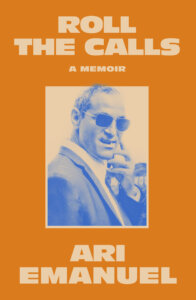
Roll the Calls: A Memoir
By Ari Emanuel
Knopf, 432 pages, $35
It must be exhausting to be super-agent Ari Emanuel: rising before dawn for a workout regimen, ingesting live worms to consume bacteria, and then placing hundreds of daily phone calls to clients and network honchos. It is, frankly, exhausting just to read about it, notwithstanding the clever, staccato narrative by (uncredited) ghostwriter J.R. Moehringer.
The point of it all, Emanuel keeps insisting in Roll the Calls, is not the dollars.
“Money isn’t the thing that makes me get up at 4:00 a.m.,” he says. “I’m just not sure yet what that thing is.”
Perpetually on the precipice of bankruptcy, he takes bold entrepreneurial risks to survive in an industry wracked by labor discontent, cutthroat infighting and technological change.
The goal, if there is one, seems to be simply to win — to bend everyone around him to his will. And, for the most part, he does. From the mailroom, Emanuel has ascended to the summit: executive chair and CEO of TKO and executive chairman of WME Group, “two companies,” his biographical blurb says, “that sit at the center of sports, entertainment and culture.”
Emanuel is probably best known as the model for the abrasive Ari Gold, the talent agent played by Jeremy Piven in the HBO show Entourage (2004-11). The show’s protagonist, Vincent Chase, is loosely based on one of Emanuel’s clients, the actor Mark Wahlberg. Emanuel says that he could never bear to watch the series, but notes that it helped turbocharge his career.
In his telling, the entertainment-industrial complex is a transactional, amoral, brutish and (though Emanuel doesn’t use this phrase) testosterone-fueled world, where the key players are nearly all men. It seems impossible to imagine any woman getting away with — let alone prospering from — the unhinged, profanity-laced approach that has become Emanuel’s trademark.
Even in this milieu, there are, in his view, particularly loathsome players. Among them is Harvey “Scissorhands” Weinstein, whom Emanuel indicts for his slovenliness, bullying tactics and editorial interference. Even without a mention of the producer’s alleged track record of sexual harassment and assault, Emanuel’s assessment of Weinstein is withering. “Empty at his core,” Emanuel writes, “Harvey’s sole motivation is to thwart and mess with other people.”
Emanuel expresses contempt, too, for other bold-faced names, including Jeffrey Katzenberg, former chair of Walt Disney Studios and cofounder of the film studio DreamWorks, and Hollywood scribe Nikki Finke, with whom Emanuel had a codependent relationship. He takes on Donald Trump as a client, doesn’t vote for him for president, and drops him, without regret, when he wins and can no longer generate commissions. None of this necessarily makes Emanuel a reliable narrator.
The memoir begins with the word “rage,” which Emanuel observes is also the first word of Homer’s Iliad. The allusion sets Roll the Calls up to be similarly epic. But its angry protagonist is, at best, an antihero, and the stakes of his success surely are less than mythic.

What are the origins of Emanuel’s rage? He points to his lifelong struggles with dyslexia and the bullying and humiliation that resulted. The Emanuel family ethos was unsparingly competitive. In life, he learned, “loser gets fed to lions,” so “keep your fists clenched and your head on a swivel.” And roughhousing with his older brothers, whom he jokingly calls “two violent psychopaths,” may have left Ari bruised and resentful.
Both Ezekiel “Zeke” Emanuel, a prominent oncologist and bioethicist, and former Chicago mayor and prospective 2028 Democratic presidential candidate Rahm Emanuel are known for their combative personalities. Ari suggests that the family is tight-knit and loving. But one of the book’s quietly shocking reveals is Rahm’s mockery of his brother’s dyslexia when they share a stage during Chicago Ideas Week.
Emanuel argues that his anger, which can turn threatening, provides a bargaining advantage by intimidating adversaries. He cites a study showing “that angry negotiators had the edge.” In a bar, he calls out Michael Moore as an [expletive deleted] antisemite for views the director expressed about Israel; Moore denies the charge, they keep talking and Emanuel ends up with a new client.
“You’ve got to be a little psychotic in this town,” Emanuel argues. To succeed, “you need to show that you can color outside the lines, and that, once in a while, you might eat the [expletive deleted] crayon.” The memoir doesn’t delete the expletives.
Yet Emanuel understands the personal costs of his anger enough to have devoted years to psychotherapy aimed at moderating it. (The results seem mixed at best.) Emanuel also admits to a habit akin to stalking: calling potential clients, business partners and others constantly until they succumb to his sales pitch.
This incessant hounding landed him the mailroom gig at Creative Artists Agency, from which he quickly rose — until he departed, with allies, to start his own company. Similar persistence won him the business (and, later, friendship) of the famously curmudgeonly Larry David, who said, over lunch, that he would sign with Emanuel — if only the agent would stop calling.
After his first marriage (unsurprisingly) dissolved, Emanuel deployed his telephone tactics in courtship — not a method, one imagines, that would have worked for a lesser man. In Emanuel’s case, relentless pursuit led, after some drama and heartbreak, to his second marriage, to a much younger woman who had initially resisted his overtures.
None of this is to say that Roll the Calls isn’t worth a read, especially for anyone interested in an unabashedly jaundiced insider account of how Hollywood operates. The book is quick-paced, laugh-out-loud funny at times, and filled with acidic observations and gossip. It is also horrifying.
The post Ari Emanuel has written a memoir and no one is safe — not even his brother appeared first on The Forward.
Uncategorized
NY Jewish Democrats defend Mamdani after Netanyahu calls him a Hamas supporter
(JTA) — Some top New York Jewish Democrats are defending New York City Mayor Zohran Mamdani after Israeli Prime Minister Benjamin Netanyahu called him an “antisemite” and said he is “buddies” with Hamas.
Netanyahu’s speech at the United Nations General Assembly on Thursday, and the outsized role Mamdani played in it, were the culmination of escalating criticism of Mamdani from Israeli officials in recent weeks.
Mamdani is an avowed anti-Zionist who during his campaign to be the mayor had pledged to arrest Netanyahu. Over the summer, he conceded he didn’t have the power to do so, though he criticized the Israeli government over Gaza in the run-up to the prime minister’s visit.
But while his full-throated criticism of Israel has alarmed some local Jewish officials, many felt that Netanyahu’s attacks on Thursday from the U.N. plenum went too far.
“It’s scurrilous to suggest that the mayor voices support for Hamas,” Manhattan Borough President Brad Hoylman-Sigal, who is Jewish, said Friday in an interview with the Jewish Telegraphic Agency.
City Council Speaker Julie Menin, also a Jewish Democrat, has opposed Mamdani on some legislation related to protests outside houses of worship — a sensitive issue in the wake of protesters picketing outside synagogues that were holding Israeli real estate events. Menin said in a press conference on Thursday that Netanyahu’s remarks were “not helpful at all” because “we need to turn the temperature down.”
“This idea of what the prime minister said can really incite violence. We cannot have this,” Menin said.
Mamdani, an outspoken pro-Palestinian advocate, has condemned Hamas as “a terrorist organization” and has denounced antisemitic hate crimes committed in New York.
The mayor responded with a statement of his own, saying that Netanyahu “used his speech to repeat baseless lies meant to sanitize his genocide of Palestinians.”
“Yet no lie can change the fact that he remains the subject of an International Criminal Court arrest warrant alleging war crimes and crimes against humanity,” Mamdani said. The United States is not a party to the ICC and has no obligation to carry out its warrants on U.S. soil.
Netanyahu’s remarks at the U.N. General Assembly came amid a reelection campaign in which Netanyahu’s Likud Party has made Mamdani a villain. Hoylman-Sigal called Thursday’s speech a “political ploy” and a “deflection by someone who has a lot of domestic turmoil, political and otherwise.”
“Clearly, Netanyahu is fighting for his political life,” said Hoylman-Sigal, who is Jewish.
Netanyahu’s arrival in New York sparked a wave of demonstrations in Manhattan on Thursday, including multiple organized by Israeli expatriate groups who emphasized the Oct. 27 Israeli election date. Rallygoers chanted “Vote him out!” at a protest held by the Israeli anti-Netanyahu group UnXeptable.
Even before his visit, Gov. Kathy Hochul pushed back on comments Netanyahu had made. Calling Mamdani a “supporter of the Hamas monsters” was false and “hurt his own credibility,” Hochul said in an interview with the radio station WNYC earlier this week.
Morton Klein, president of the Zionist Organization of America, which is supportive of Netanyahu and has been harshly critical of Mamdani, called Netanyahu’s remarks “Churchillian” and his “greatest speech.”
“Importantly, he also called out Mamdani as a dangerous antisemite who has endangered Jews in New York City,” Klein said in a statement.
The U.N. speech came as Israeli officials have escalated their rhetoric against Mamdani.
Last month, Ofir Akunis, the Israeli consul general in New York, compared Mamdani’s support for the boycott Israel movement to Nazi Germany. A Mamdani spokesperson told JTA the comparison was “offensive, completely unhinged and detached from reality,” and said Akunis “should be ashamed of himself.”
The statement was Mamdani’s first time weighing in on the Israeli consul general, who had accused Mamdani of being directly responsible for anti-Jewish hate crimes in the city.
Republican City Council member Inna Vernikov, who is Jewish and a staunch Mamdani critic, took issue with the mayor’s response.
“When Mamdani cleans his own house, then he can criticize Jewish leaders,” said Vernikov, pointing to Mamdani’s wife’s anti-Israel views and his vetoing of a bill on protests around schools.
Brad Lander, the Jewish progressive and Democratic nominee for New York’s 10th congressional district, blasted both Akunis’ and Netanyahu’s attacks on Mamdani.
“Netanyahu and Akunis are cynically weaponizing accusations of antisemitism for their own narrow, selfish political purposes,” said Lander, one of Mamdani’s most prominent Jewish allies, in a statement to JTA. “They are making Israelis, American Jews, Palestinians, and the whole world less safe.”
Lander himself was the recipient of a Nazi Germany comparison when Bruce Blakeman, the Republican candidate for New York governor, said that Lander “would be a camp guard in the concentration camp if he could.”
Hoylman-Sigal called the comparisons “outrageous,” and said that he is more worried about a rise in far-right parties, including Germany’s AfD.
“We should be very careful, no matter what our background is, to draw such extreme comparisons,” he said.
Phylisa Wisdom, who heads Mamdani’s office to combat antisemitism, told JTA that it is “appalling that some leaders have resorted to comparing their political opponents to Nazis.”
“We can and should disagree — sometimes deeply — but we must be able to do so without debasing public discourse,” she said.
Amy Spitalnick, the CEO of the Jewish Council for Public Affairs, a group that leads outreach to non-Jewish community organizations, told JTA in an email that comparisons to Nazis should be out of bounds.
It is “particularly concerning given that our own community frequently, and rightfully, calls out those using dehumanization and/or making inappropriate Holocaust comparisons,” she said.
As a case in point, Spitalnick pointed to the Anti-Defamation League’s article on inappropriate Holocaust comparisons, which includes COVID-19 vaccine requirements and free speech complaints.
The ADL did not return a request for comment on Akunis’ Nazi Germany comparisons.
“Disagree with the Mayor on his policies or rhetoric — I certainly have — but comparisons like this are deeply offensive and wrong, in addition to undermining the very relationships and engagement necessary to ensuring Jewish safety in New York and beyond,” Spitalnick said.
This article originally appeared on JTA.org.
The post NY Jewish Democrats defend Mamdani after Netanyahu calls him a Hamas supporter appeared first on The Forward.
Uncategorized
‘Nobody Wants This’ star Adam Brody on Gaza: ‘Put me down as thinking it’s a genocide’
Adam Brody, the Jewish actor who plays a “hot rabbi” on the hit Netflix rom-com Nobody Wants This, called the war in Gaza a genocide in a new interview, making him one of just a few Jewish celebrities to speak out publicly against the Israeli campaign.
The comments came in an interview with GQ about Brody’s efforts canvassing for Democratic candidates in the upcoming midterms.
“Put me down as thinking it’s a genocide. Put me down as wanting a free Palestine,” he said. “It’s awful that it’s taken so much death and misery, but it does feel like it’s reaching a breaking point that it should have a while ago. I’m hopeful that another administration can really do some good and correct some of these policies that are helping that situation be as awful as it is.”
The claim of genocide in Gaza is heavily disputed. Several international bodies, human rights organizations and academic institutions have concluded Israel’s actions in Gaza since Oct. 7 fit the description, including a United Nations Commission of Inquiry. Other similar groups, like the International Court of Justice, have not applied the term.
Brody’s comments were surprising in part because he had previously kept his feelings about the war private, even as other leading Hollywood figures openly criticized it. He does not maintain a public social media presence, and he did not participate in pin-wearing campaigns or sign various petitions related to the war — an approach he indicated he might change going forward.
“I’m not wearing a pin, so I’m not inviting a certain question, and perhaps I should,” he said. “I really admire people who do. But 99% of what I’m asked about is about the show. I’m not trying to plead ignorance—here we are doing a political interview, so it makes sense that we wade into this territory—but I’ve never ducked a question, really, not a political question anyway.”
Brody — who came to fame in the 2000s as the teenager Seth Cohen on The O.C. — joins Hacks star Hannah Einbinder and Wallace Shawn (The Princess Bride) as perhaps the most high-profile Jewish actors to publicly call the war a genocide. Other Jewish entertainment figures, like Mandy Patinkin and The Zone of Interest director Jonathan Glazer, have criticized the war but stopped short of calling it a genocide.
Yet Brody’s comments are perhaps especially notable because of the character he plays on TV. In Nobody Wants This, Brody plays a rabbi dating a non-Jewish woman — introducing her to the beauty and foibles of Jewish faith and culture. Israel has been conspicuously absent from the show, with its creator, Erin Foster, saying she deliberately avoided geopolitics.
Season 3 of Nobody Wants This releases to Netflix October 22.
The post ‘Nobody Wants This’ star Adam Brody on Gaza: ‘Put me down as thinking it’s a genocide’ appeared first on The Forward.
