


Local News
“Chanukah Guilt: A Jewish Holiday Murder Mystery”
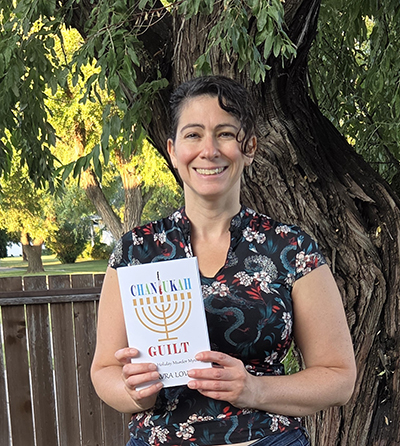
Review –Interview by MARTIN ZEILIG
With “Chanukah Guilt: A Jewish Holiday Murder Mystery” (Scribal Scion Publishing 182 pg. $20.00) Winnipeg author Avra Love steps confidently into the world of cozy Jewish crime fiction, delivering a warm, witty, and culturally textured novel that feels instantly familiar to anyone who has spent time in a synagogue social hall.
Published by Scribal Scion in August 2026, the book marks a notable shift from Love’s earlier works — the playful children’s book “Don’t Wake Mommy!” and her flash fiction collection “Into the Junk Drawer” — yet it carries forward her trademark blend of humour, character insight, and affection for the small dramas of everyday life.
Love, who was interviewed by email for this article, grew up surrounded by stories and language, and that early immersion shows. She had long wanted to take on a larger scale project, and this idea — sparked by her own experiences participating in holiday craft sales — lent itself naturally to expansion.
“I was always struck by the diversity and energy you find at these events,” she says. “When I considered it as a background for my story, I chose to make it a Jewish setting.”
The novel unfolds over a single day: the pre Chanukah craft sale at a local synagogue. It’s the kind of event many Jewish readers will recognize immediately — twenty vendors, tables overflowing with handmade goods, the hum of conversation, and the quiet hope that the turnout will justify all the effort.
Into this bustling scene steps Becky, the first time coordinator of the sale, who has taken on the job mostly because no one else would. Becky’s background as a theatre director gives her a keen eye for personalities, staging, and the subtle tensions that animate a room. It also makes her an unexpectedly capable amateur sleuth when a sudden death shatters the cheerful atmosphere.
Love’s decision to set the mystery within a single communal event is inspired. The synagogue social hall becomes a microcosm of Jewish communal life — warm, opinionated, occasionally chaotic, and full of characters who are both endearing and exasperating. The vendors, each with their quirks and motivations, form a lively ensemble cast. Their interactions provide humour, texture, and a steady stream of clues as Becky tries to piece together what happened before the police arrive.
The tone throughout is unmistakably cozy.
Love isn’t interested in grisly details or procedural complexity; her focus is on character, community, and the gentle absurdities that arise when ordinary people are thrust into extraordinary circumstances. The dialogue is sharp and often funny, peppered with Hebrew and Yiddish expressions that feel authentic rather than ornamental. A glossary at the end ensures that readers of all backgrounds can follow along without missing the cultural flavour.
Behind the scenes, Hanukah Guilt was very much a labour of love.
The book began as a “piecework project built over sporadic bouts of creativity,” Love explains, and then underwent multiple revisions.
All told, it took most of three years to complete. When it came time to publish, she didn’t hesitate to bring the manuscript to Scribal Scion.
“I had such a great experience working with James Gershfield on my first children’s book that I went to him first — and I’m glad I did. I’ve been so appreciative of his hard work and expertise in helping me craft the finished product.”
What elevates Hanukah Guilt is Love’s ability to balance levity with sincerity. Beneath the humour lies a genuine appreciation for Jewish communal spaces — their warmth, their imperfections, and their role as gathering points for tradition, creativity, and connection. Becky’s determination to solve the mystery is less about heroism and more about responsibility: to the vendors, to the event, and to the community she cares about.
Love’s writing career continues to expand. In addition to this novel, she has two new Jewish children’s picture books underway with Scribal Scion Kids and continues to write short stories in her spare time. Hanukah Guilt is her third published book — and her most ambitious to date.
In Hanukah Guilt, Avra Love has crafted a charming, accessible, and distinctly Jewish mystery that will resonate with readers across generations. It is a welcome addition to holidaythemed fiction and a delightful new chapter in the career of a Winnipeg writer whose voice continues to grow in range and confidence.
This is a book that belongs on Jewish bookshelves — and one that will make readers smile even as they turn the pages in search of clues.
Avra Love is a Winnipeg educator with a background in English Language studies and Philosophy. She is the author of three books: the flash fiction collection “Into the Junk Drawer,” the children’s book “Don’t Wake Mommy!,” and her new cozy mystery “Hanukah Guilt: A Jewish Holiday Murder Mystery.” She loves to read, write, craft, and practice healthy living.
Local News
Application filed by two former members of Etz Chayim Congregation against the congregation to have their memberships restored dismissed by judge
The following is taken from the Canadian Jewish News website: “Manitoba’s Court of King’s Bench has dismissed Hadass Eviatar and David Hoult’s application challenging the termination of their membership at Congregation Etz Chayim. In his decision, Justice Vic Toews noted that, although Hoult’s letter describing a hypothetical attack on the synagogue may have lacked sensitivity given the political climate, he did not intend to threaten violence against congregants. However, the judge ruled that the court did not have jurisdiction to intervene in the membership dispute under Manitoba’s Corporations Act, finding that the couple had no financial, proprietary or economic interest that would entitle them to the remedies they sought. The judge concluded that religious organizations are generally free to determine their own membership rules and ordered each side to bear its own legal costs.”
If you would like to read the original article that broke the story about the battle between Hadaass Eviatar and David Hoult with Etz Chayim Congregation you can go to Epic Court Battle.”
Local News
Jewish Federation now says Jewish population of Winnipeg in 2021 (according to the census) was 13,940 – not the 16,000 figure that the Federation had been touting for years

By BERNIE BELLAN (Posted Oct. 27, 2026) Longtime readers of The Jewish Post & News (and this website) would probably know that I have long had a very strong interest in establishing as accurate figures as possible when it has come to reporting the size of Winnipeg’s Jewish community.
For years I argued that our Jewish Federation was exaggerating the size of our Jewish population. I heard the figure of 16,000 bandied about by leaders in our community quite often when it came to reporting the size of our Jewish population – without any empirical evidence to back that figure up.
I had long maintained that the only reasonably accurate figures when it came to reporting the size of Winnipeg’s Jewish population were those produced by the late Evelyn Katz, when she was the unofficial demographer for the Jewish Federation – over 30 years ago. What Evelyn would do is keep careful track of births, deaths, numbers of newcomers but, perhaps most important: the number of people who had left our community.
Thus, in August 2022 when I interviewed Faye Rosenberg Cohen who, at the time, was just about to retire as the Jewish Federation’s Chief Planning and Allocations Officer, I was somewhat astonished to hear Faye say, when I asked her what proportion of our Jewish community was made up of immigrants, she answered that “I can honestly say when I look at those numbers it’s somewhere around 1/3 of the community.”
In response, I asked: “So you’d say it’s somewhere between 4-5,000?”
Faye said: “I think it’s more than that.”
I wrote in that article, “I indicated my skepticism at that time, saying ‘You know that I’ve always been skeptical about the numbers that have been used by the Federation for the population of the Jewish community. I think though that it’s always been more of a case of identification – who identifies as Jewish.’ ”
Later, after the results of the 2021 census were released, I wrote that “if you take into account the results of the 2021 census, the Jewish community cannot be larger than 14,270 at a maximum. But that figure would also include anyone who had either said either their ethnic origin was Jewish or their religion was Jewish.”
Since many of the individuals who had said on the 2021 census that their ethnic origin was Jewish, but their religion was something else, I maintained that ascertaining the real size of our Jewish community was highly problematic.
Still, for the sake of argument I was willing to accept that, realistically, it was somewhere between 13,000-14,000 – but nowhere close to the figure of 16,000 that had come to be suggested by our then president of the Jewish Federation or by other leading figures in our community.

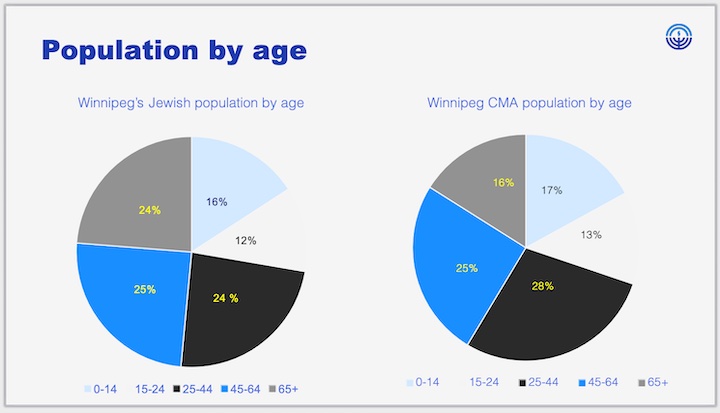
So, it was with a sense of satisfaction that I heard Sharon Graham, who is now the Jewish Federation’s Community Planning and Allocations Lead say to an audience of over 50 people who were at the Gwen Secter Centre on Thursday, October 22, that the Jewish community in 2021 was – at a maximum: 13,940.
Sharon was at the Gwen Secter Centre to speak to Remis Lecture attendees. Her presentation preceded a presentation by Jewish Federation CEO Jeff Lieberman. Sharon used a PowerPoint presentation to provide some very interesting insights into where our Jewish community was at in 2021- and I’m offering some parts of her presentation here for you to read because I thought they were so interesting.
I had actually made many of the same observations about the results of the 2021 census in my own reporting back in 2022, but seeing what I had written confirmed by the Jewish Federation’s point person on planning told me that Sharon has a much more realistic view of our community than did Faye Rosenberg Cohen.
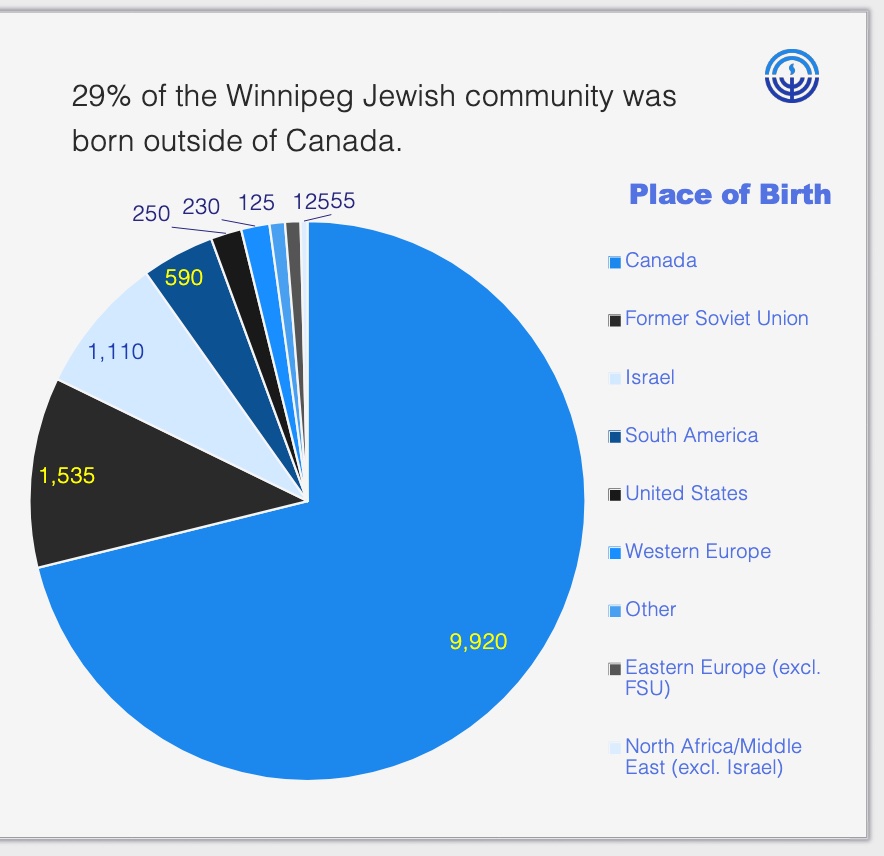
Here, for instance, is a slide that shows the proportion of our Jewish community that is made up of immigrants. It’s slightly under one fifth, not the one third percentage that Faye had suggested.
But, what really set Sharon’s presentation apart from anything else I’ve ever seen presented by someone from the Jewish Federation – other than the aforementioned Evelyn Katz, was the slide she projected which showed that, while there had been a large influx of newcomers to Winnipeg’s Jewish community between 2016-2021 there had also been a significantly high number of people who had left our Jewish community in those same years, as you can see in the following slide:

That is something we just don’t hear discussed by leaders of our Jewish organizations, but let’s be realistic: For many newcomers who came to Winnipeg and were counted as new members of our Jewish community, Winnipeg – for a variety of reasons, was a stepping stone to other communities. It may have been for reasons of better job opportunities, moving closer to other family members, or – the reason that we hear so often when it comes to people saying they want to leave Winnipeg: the weather.
But, whatever the reason, Sharon’s figures show that, as much as GrowWinnipeg may have been an abiding success when it’s come to attracting newcomers to our Jewish community here, getting them to stay long term is a different story.
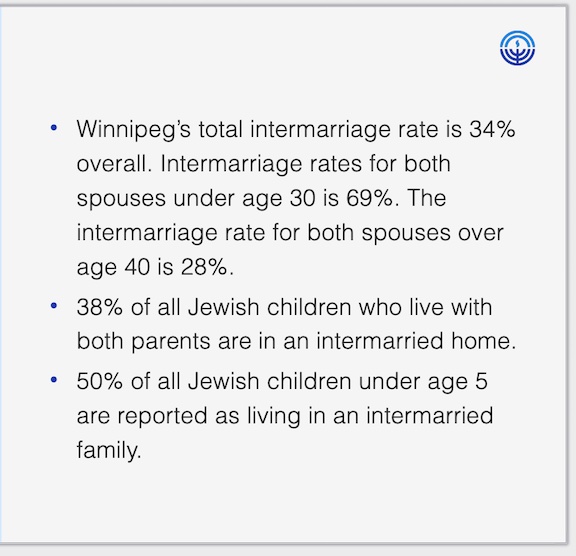
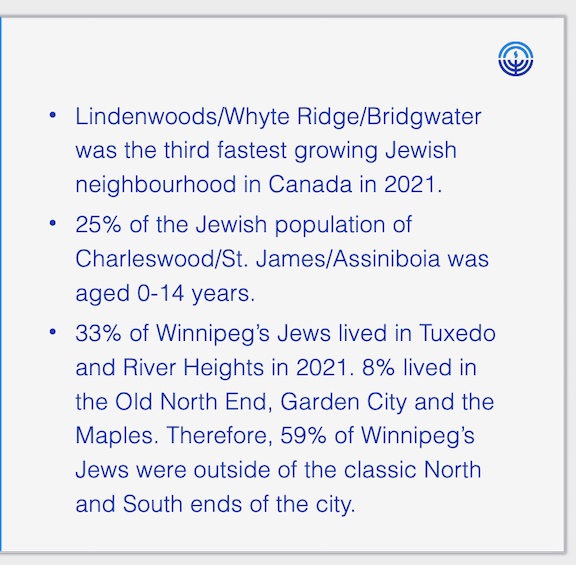
And, while there were other aspects of Sharon’s presentation that certainly merit discussion, especially the figures she produced about intermarriage, rather than delving into them here, I thought it useful simply to insert them for you, the reader, to see – and draw your own conclusions.
Local News
Marty Green expands his protest against extremist Jewish settlers to two more venues – and is arrested twice more
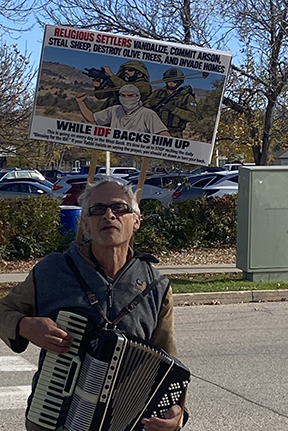
(Tuesday, October 27) We received the following press release about Marty Green being arrested again, both at the University of Manitoba and at Shaarey Zedek Synagogue:
Both sides came to blows on Saturday, October 24, at the Shaarey Zedek Synagogue as security personnel sought to prevent Marty Green from interfering with synagogue traffic as he protested just outside synagogue grounds against the actions of religious settlers in Israel’s occupied West Bank territory. Synagogue Executive Director Rena Secter Elbaze quickly intervened to prevent further escalation. Police arrived shorty thereafter and detained Green for 45 minutes before driving him home and releasing him. It is not clear whether their decision not to lay charges was the result of their own onsite investigation or whether it was at the request of the synagogue executive.
Green has now been arrested four times in the last month and faces multiple charges for disturbing the peace, including two episodes at the Asper Campus and one more this past Friday (Oct. 23) at the University of Manitoba. While Green says initially he was merely handing out leaflets (at the Asper Campus), since his first arrest on September 23, he has returned to the campus with a large placard and an acccordion, accompanying himself while singing songs with lyrics that include such phrases as “The Jews Are Bananas….B-A-N-A-N-A-S”. In addition to listing actions of the religious settlers as including arson, vandalism, and theft, he pointedly alleges that the IDF has been backing up the settlers in their actions.
Green had earlier notified the Shaarey Zedek that he was contemplating bringing his protest to the synagogue. He was told that if he attempted to enter the grounds he would be prevented from doing so. At that time, Secter Elbaze told Green that his intentions were inappropriate, declaring the synagogue to be “a house of worship dedicated to prayer, learning, community, and spiritual engagement.” Green responded that if the synagogue were willing to contact the Crown and inform them that “that there was never any legal basis for their claims that I was conducting myself inappropriately at the Asper Campus” (with regard to his earlier arrests) that he would “voluntarily refrain from carrying his informational campaign to the synagogue(s).”
Green further argues that the recent “psak” (religious ruling) by leading Israeli rabbi Rov Dov Lior, in which Lior declares that it is not merely permissible but praiseworthy for Jews to steal olives from Arab orchards….that this ruling brings his protest within the proper realm of religious discourse. He says further that if the local rabbis were willing to speak out to their congregations against the aforesaid psak, that he might have refrained from taking his campaign to their grounds.
Although Green was released on Saturday without charges, police confiscated his placard. They explained that it was being held as evidence pending an investigation by Major Crimes as to whether it constituted hate literature.
There was no further information given as to what happened at the University of Manitoba.
