


Local News
Nakba exhbit at CMHR – you can see it right here and make your own assessment
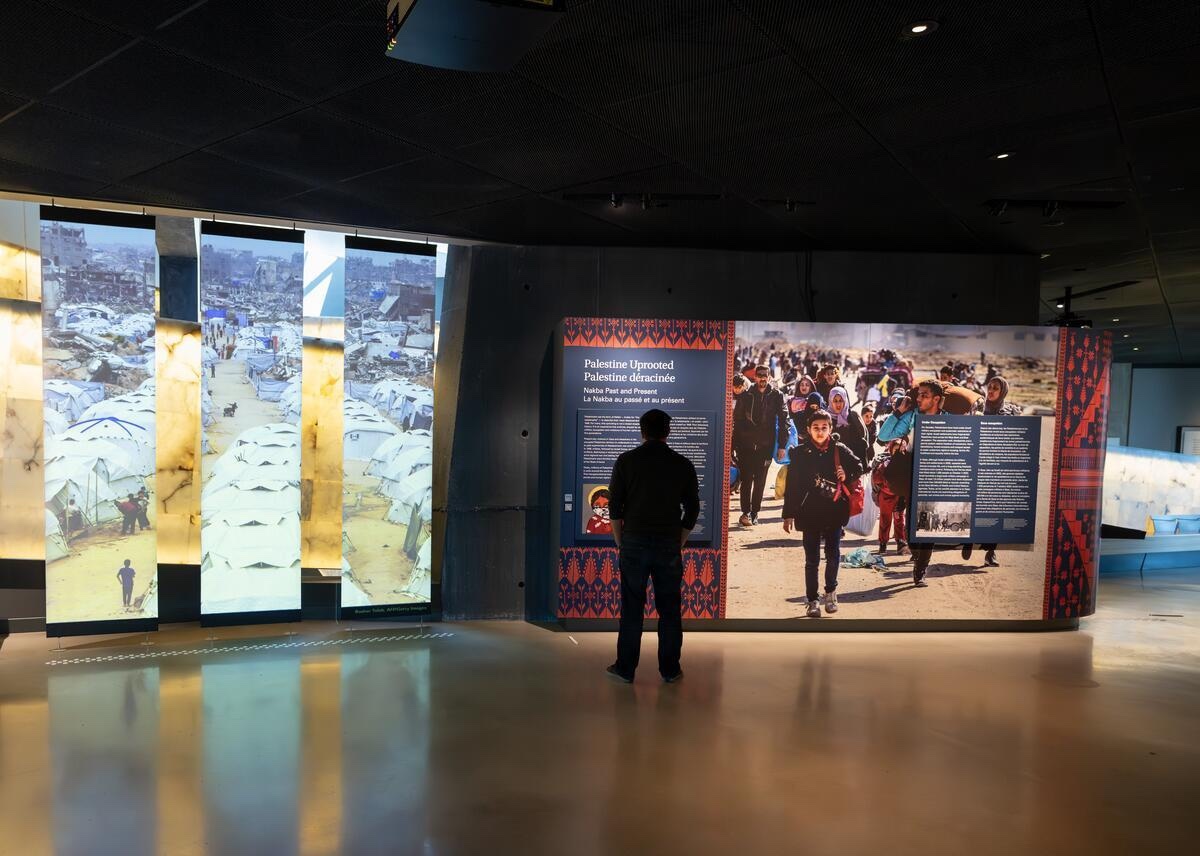
By BERNIE BELLAN (Posted June 26, updated July 19) The Nakba exhibit at the Canadian Exhibit for Human Rights opened to the public June 27. The morning before the exhibit was set to open to the public, (it had a private opening for invited guests the evening of June 26) we received a press release from the CMHR. That press release gave a very detailed description of what was in the exhibit, along with photos (supplied by Annie Kierans of the CMHR).
There is also a link right at the beginning of the press release that will allow you to watch the same videos that anyone attending the exhibit can watch. We reprinted what was sent to us without making one edit. We leave it to you to form your own opinion as to whether the exhibit is fair in its presentation, and whether it is lacking “context” – which is an accusation that has been levelled at the exhibit’s organizers by some representatives of Jewish organizations.
We have received many emails in reaction to the exhibit. If you have an opinion and would like to see it published on this website, you can send it to jewishp@mymts.net, but please indicate whether you would be willing to have it published on this website.
Here is what we received the morning of June 26:
Winnipeg, MB — June 26, 2026 — The Canadian Museum for Human Rights (CMHR) will open a new exhibit tomorrow that explores human rights violations related to the ongoing forced displacement of Palestinian Canadians.
Palestine Uprooted: Nakba Past and Present will be on display in the Rights Today gallery on Level 5 until 2028. Featuring personal stories told through artifacts and video testimonies, the exhibit presents Palestinian Canadians reflecting on their ongoing struggle for human rights. The small exhibit reveals enduring patterns of loss and resilience, helping visitors understand more about this contemporary human rights story.
Palestinian Canadian stories are now included alongside many other stories of forced displacement and human rights violations featured in the Museum’s galleries. Each of these stories contribute to our visitors understanding of human rights and help the Museum fulfill its mandate to foster reflection and dialogue.
Exhibition highlights
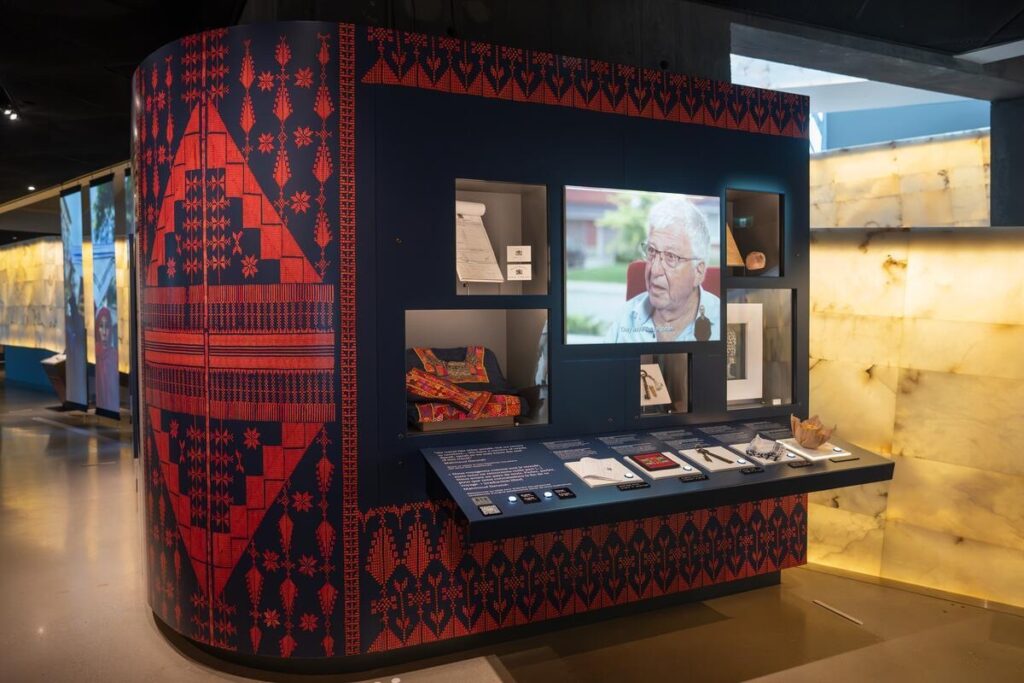
Personal stories and artifacts: Experience firsthand accounts from Palestinian Canadians sharing their journeys of displacement and memory through a series of five artifacts. Cases display artifacts like property deeds, house keys, and a traditional Palestinian embroidered dress, accompanied by short videos that deepen understanding of the impacts of displacement.
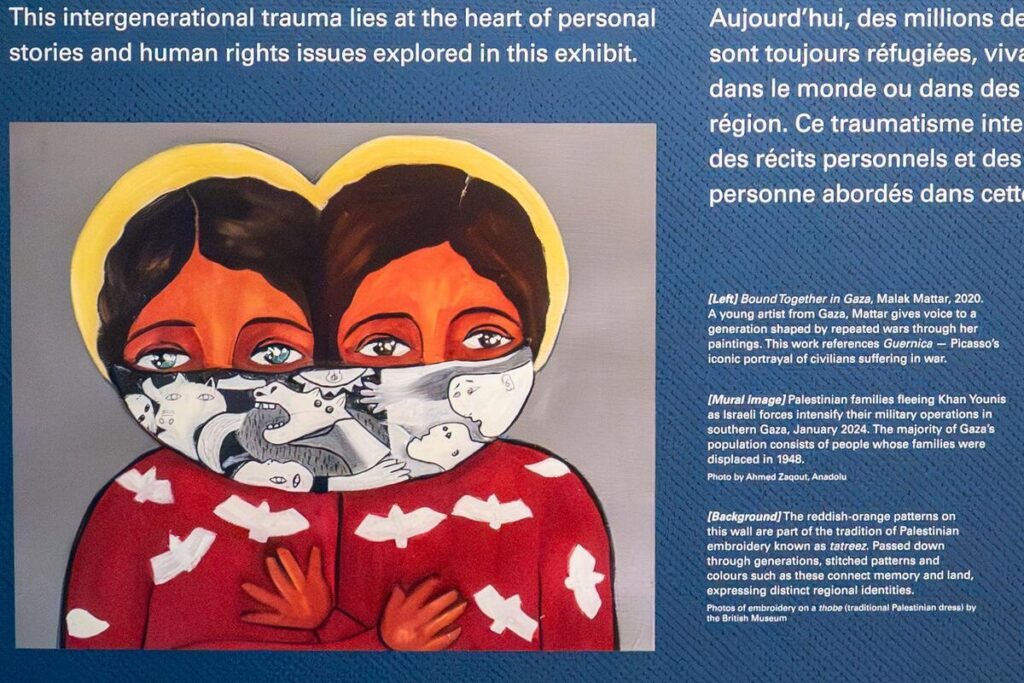
Powerful artworks: In her painting Bound Together in Gaza, Malak Mattar, a Gazan artist, captures the struggles and resilience of her generation shaped by conflict. Her work pays homage to Guernica, Picasso’s powerful masterpiece depicting civilian suffering during war.
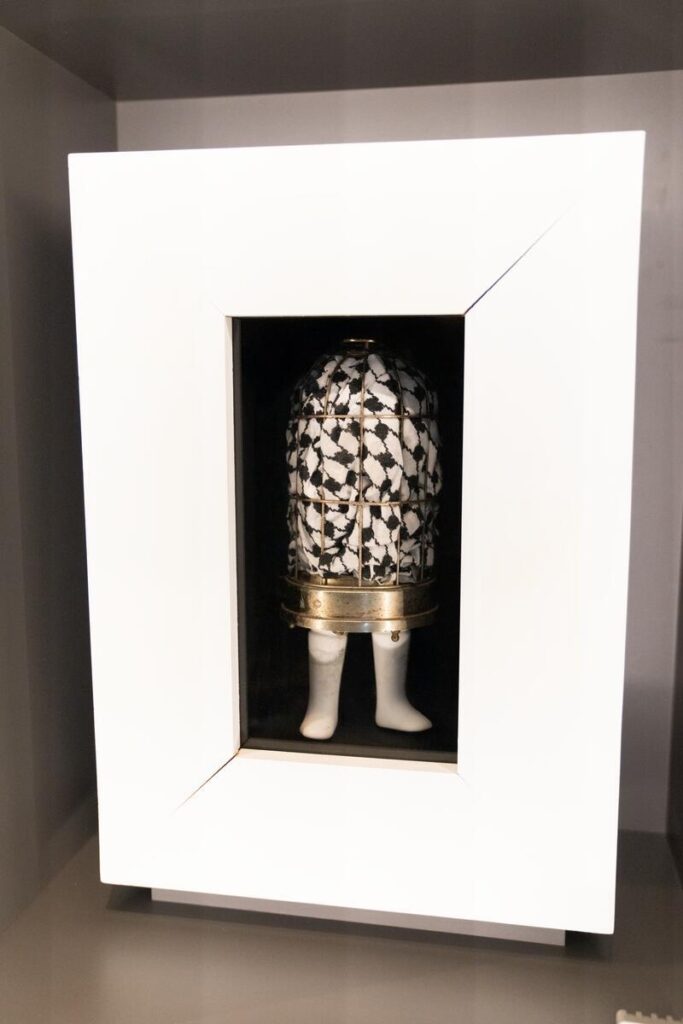
Curfews and Closures, by Rajie Cook, bears witness to life under military occupation during the 2000–2005 Palestinian uprising, when curfews and closures were expanded and further limited basic rights and freedoms.

Cultural heritage: Discover traditional Palestinian embroidery called tatreez. Tatreez motifs and colours are tied to place, family history and regional identity. Patterns are associated with particular towns, villages or areas of Palestine. In this way, tatreez is a form of storytelling: a way of preserving memory, sustaining identity and expressing resilience across displacement and exile.
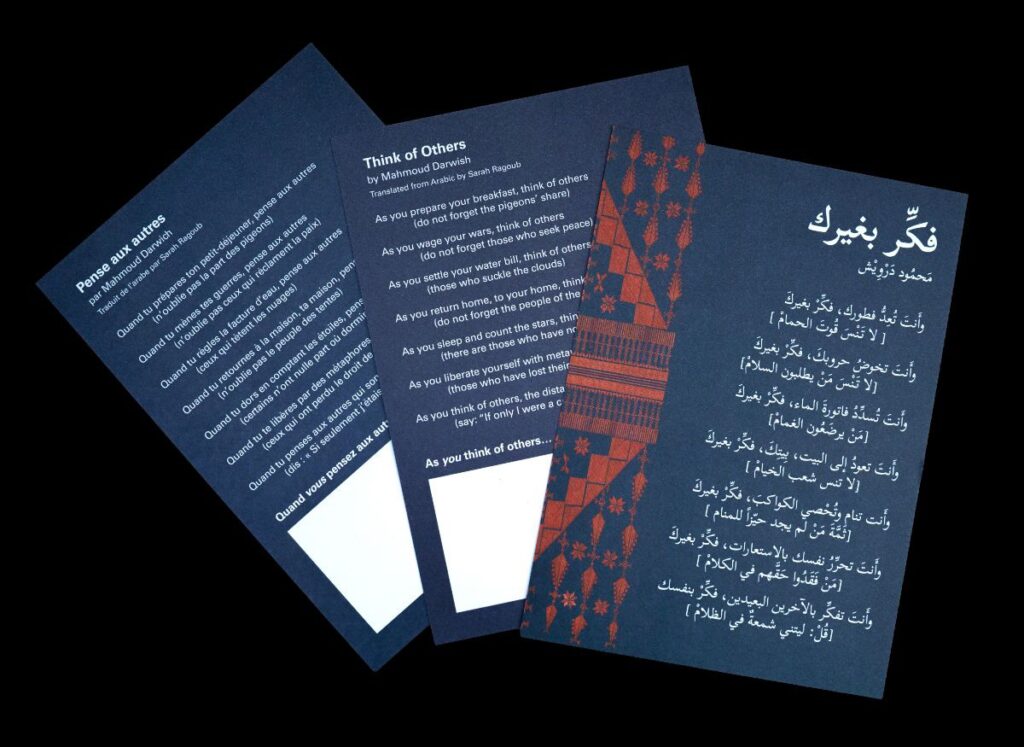
Poetry and reflection: Engage with Mahmoud Darwish’s evocative verses, inspiring personal reflection on exile, voice, and responsibility. Visitors can take a card containing Darwish’s poem and add a personal note, fostering ongoing dialogue beyond the exhibit.
Contemporary context: Witness striking images of current events in Gaza and the West Bank, connecting past displacement to ongoing struggles.
Quotes:
“No force can silence the truth we carry. Growing up in Canada, my children lived the Nakba through our stories. And now we watch it happen again, live, on our phones. When I see the images coming out of Gaza, I am not watching the news. I am watching my history repeat itself.” -Fouad Sahyoun, a Palestinian Canadian featured in the exhibit
“We developed this exhibit with a clear awareness that Palestinian Canadian voices have too often been marginalized, silenced or spoken over — and that anti-Palestinian racism affects whose stories are heard and whose suffering is recognized. That is why we intentionally centred Palestinian Canadian voices throughout the exhibit.” -Isabelle Masson, Curator of Palestine Uprooted
“Human rights matter precisely when they are inconvenient, when the question of who deserves the dignity of having their rights recognized is genuinely contested. These are the moments where having a national museum for human rights is most important.
There are people who believe this exhibit should not exist in its current form. There are people who believe it should have existed sooner. There are people who will visit this exhibit and feel that it does not say enough, and others who will feel it says too much.
We have listened to every one of these voices. We have reflected. And we have renewed our resolve to continue the difficult, sometimes contested, and often controversial work of building understanding about human rights. We are a museum grounded in Canada’s human rights framework, whose mandate requires us to bear witness to the full complexity of the human story. We are proud to open this exhibit because the story it tells will help achieve that mandate, and because this story belongs in the collective memory of Canadians.”
- – Isha Khan, CEO
Local News
This Toronto street corner has been a site of anti-Zionist activism for months. Police just opened a hate crime investigation.

By Sage Lattman August 25, 2026
This story was originally published in the Forward. Click here to get the Forward’s free email newsletters delivered to your inbox.
The Toronto Police Service hate crimes unit is investigating teacher Abbas Hamze for remarks about “Zionists.” Canadian Jewish groups, including the Jewish Federations of Canada’s advocacy arm and B’nai Brith Canada, have called his speech, which went viral online, “blatant antisemitism.”
Hamze’s remarks invoked antisemitic tropes, accusing “Zionists” of performing “black magic” as well as raping and killing children. He spoke at the intersection of Bathurst and Sheppard, in the heavily Jewish Toronto neighborhood of Bathurst Manor – Clanton Park.
According to his LinkedIn, Hamze works as an instructor at several Canadian colleges in the area, including the University of Niagara Falls and Georgian College. He does not specify what he teaches.
According to a statement by Georgian College, Hamze is no longer employed there, having taught an online data analytics course until last academic year. In an email to the Forward, a college spokesperson described Hamze’s remarks as “violent, derogatory and hateful” and said the college “doesn’t tolerate racism, hate, discrimination or harassment, including antisemitism, directed at any individual or group.”
Hamze could not be reached for comment. The University of Niagara Falls did not respond to requests to comment, and the Toronto Police declined a request for comment.
UNF issued a statement addressing Hamze’s remarks, distancing the university from the instructor’s statements and stating that they have “zero tolerance for discrimination, hate, harassment, or any conduct that threatens the dignity and well-being of others.” They announced that they are “launching an internal investigation” into the matter.
In his speech, Hamze claimed that “British colonizers have planted this cancerous, false Zionist state of Israel … right in the heart of Islam.”
Later — wearing a keffiyeh and reading from his phone into a megaphone emblazoned with the Lebanese flag — the instructor repeated numerous antisemitic conspiracy theories, including the debunked idea that Jews have caused or deserved centuries of persecution.
“The Zionists have never had a country of their own because of their mischief,” Hamze said. “They are the most kicked-out people in the world who are making black magic and horrible things.”
He went on to say that Jewish corruption is “crystal clear in Epstein Island where they have the Jewish leaders from all around the world.” He accused “Zionists” of having “raped, and killed, and ate children at the same time.”
Finally, he unfoundedly blamed the actions of President Donald Trump on “Zionists” who “blackmail” and “control” people.
“That’s why you can see now a guy like Trump who caused this genocide in Gaza kidnaps the presidents of Venezuala, kills the supreme leader of Iran Imam Ali Khamenei, may God sanctify his soul,” he said. “This is because of them, the terrorist Zionists.”
It appears that people became aware of Hamze’s remarks after Casey Babb, an Israel and International Relations scholar, posted a video of him on X.
In a joint statement, Canadian Jewish groups described Hamze’s claims as “antisemitic blood libels that have been used for centuries to justify hatred and violence against Jews.”
The statement says that the intersection where Hamze spoke, Bathurst and Sheppard, has long been a site of “antisemitic harassment, intimidation and provocation, too often under the guise of anti-Zionism,” and called on Toronto’s police department to investigate the incident.
“Allowing this behaviour to go unchecked is to normalize antisemitism as an everyday feature of life in this city,” it stated.
The city’s police have opened an investigation. However, online, some said that Hamze had been speaking at the street corner for months without police intervention.
In Canada, public incitement of hatred is considered a criminal offense. The Canadian criminal code says that “communicating statements in any public place” that “incites hatred against any identifiable group where such incitement is likely to lead to a breach of the peace” is a breach of law, resulting in up to two years in prison.
This story was originally published on the Forward.
Local News
Epic court battle shaping up between Etz Chayim Congregation and two former members who are now barred from setting foot in Etz Chayim

By BERNIE BELLAN Introduction: This story had originally been posted Friday morning, August 14, with a photo of Etz Chayim Synagogue. Then we received an email from Morissa Granove, COO of Etz Chayim Congregation:
“Hi Bernie.
“This request is not about the article itself but the safety of our shul. We have been advised not to post the address or photos of our Jewish organizations publicly for some time for security reasons. Can I please ask that you change the image posted online (and planned for print if needed) and that in this be kept in mind for the future?
“Thank you so much for your understanding,
“Morissa”
We replied:
“Gee Morissa – I’ll do that but maybe you better ask Google to remove any mention of any Winnipeg synagogue because all anyone has to do is do a Google search and they’ll come up with a complete list of Winnipeg synagogues and their addresses – also photos! Do you want me to contact Google for you? Can’t be too careful, can we?
Now, here’s the story as it was originally posted:
The date October 7 carries a huge amount of significance for Jews around the world: It was the date that members of Hamas and other terrorist groups launched a murderous attack on innocent Israelis (and members of other nationalities) that resulted in the deaths of more than 1200 people and the abduction of 251 others.
But it is also a date that may have a significance of a different sort come this October 7 when a Winnipeg courtroom will be the scene of a court case in what is shaping up to be a momentous legal battle between Congregation Etz Chayim and two former members of the congregation who have been barred from attending services – or even setting foot inside the building that houses Congregation Etz Chayim.
Before publishing this article I had sent copies to both sides in the dispute – and offered both sides the opportunity to correct any mistakes they might have found in what I had written. I did receive responses from both sides and have incorporated their suggested corrections into what follows.
The two individuals involved at the heart of this dispute are both former longstanding members of Etz Chayim – and before that, Rosh Pina Congregation: Dr. Emet Eviatar (previously known as Hadass), who had been the Torah reader at Etz Chayim for many years, and who had also led Sunday services; and her husband, well known scientist Dr. David Hoult (who played a leading role in the development of MRI technology and was also very active in the congregation). Drs. Eviatar and Hoult have filed suit against CEC over what they claim was the illegal termination of their membership.
In response, however, Congregation Etz Chayim asserts that it was not a question of membership when CEC exercised its right to refuse entry on the advice of the WPS and security experts who were consulted after a deeply concerning letter was received from one of the plaintiffs by the synagogue.
The filings in this particular case are in the hundreds of pages. I spent two recent afternoons at the Law Courts poring over the filings, and photographed pages of what I thought were some of the most relevant issues at hand so that I could quote accurately from those filings.
While the case may seem hugely complicated, given the number of pages of documents that have already been filed, it seems that it boils down to two essential issues: Did CEC violate its own bylaws (or its own constitution, as the case may be, because at the time of the events in question a bylaw which would have governed who might be excluded from belonging to the congregation had not yet been passed) by terminating the memberships of Dr. Emet Eviatar and Dr. David Hoult? The argument advanced by the plaintiffs is not that a congregation cannot decide who can belong to that congregation. Rather, it is an argument that CEC did not properly adhere to its own bylaws in the manner in which it has excluded the plaintiffs from attending – or even setting foot inside Etz Chayim.
But, a second issue in play – and one which is argued forcefully by CEC in one of its briefs is that the argument Emet Eviatar and David Hoult are advancing has no place in the courts in the first place. As is noted in one of the briefs filed on behalf of CEC: “The dispute is, at its core, about the internal governance of a religious congregation. It concerns who may participate in communal worship, who may participate in communal religious life, and how a synagogue governs itself in response to legitimate security concerns. If it is accepted that the dispute was about ideological differences, as alleged by the Applicants, then these are fundamentally religious questions. The court has no jurisdiction to adjudicate such matters, and ought not to intervene.”
How the parties arrived at this situation is a complicated – but very interesting story.
I, myself was first made aware that something unusual was going on between CEC and David Hoult when I received this email from Dr. Hoult on Friday afternoon May 30, 2025, at 12:42 pm:
“Hi Bernie,
“I have just had a pair of police officers at the door telling me that we are now banned from Etz Chayim and if we show up the police will be called, no reasons given. I suspect it was an accumulation of things, including a letter I sent.
“Shabbat shalom,
“David.”
Later that afternoon I received another email, this time from a member of CEC, who forwarded me an email that had been sent to congregation members by Morissa Granove, Chief Operating Officer of CEC. That email had a letter attached, which said, in part:
“On Tuesday, May 27th, we received deeply troubling correspondence from a member of our community. The nature of this communication raised serious concerns about the safety of our congregants and staff. After careful and deliberate consultation with our Board of Directors, Clergy, the Winnipeg Police Service, the Jewish Security Network, and the Secure Community Network (in partnership with the USCJ), and on their recommendations we have made the difficult but necessary decision to terminate the membership of this individual and all members of their household, effective immediately.
“These individuals are no longer permitted on the premises of Congregation Etz Chayim, nor may they participate in any of our synagogue’s programs or activities.”
The letter was signed by Morissa Granove, Chief Operating Officer of CEC, and Allan Cogan, President of CEC.
What the heck was going on? I wondered. So, I emailed Morissa Granove that same afternoon:
“Hi,
“I received an email from David Hoult telling me that he is now banned from the Etz Chayim. I assume Emet Eviatar is also banned too, judging by the way your email is worded.
“I don’t know David at all – other than having received a piece he wrote about Israel and Gaza that I published to my website. I can’t begin to imagine what he might have written, but in the interest of fair reporting and fuller disclosure, can you say anything more about what he wrote in his letter?
“-Bernie Bellan
“Publisher,
“jewishpostandnews.ca
“also Associate Editor,
“The Jewish Post Winnipeg”
But, Morissa Granove did not offer any more information as to what might have been contained in that “troubling correspondence” which was received by CEC.
It was only when I went down to the Law Courts on August 10 that I was actually able to see what was in that “troubling correspondence.”
But, before I get into what was in that particular communication, even more background to this strange case is necessary.
In an email I received from CEC COO Morissa Granove following my having sent her a draft of this article, she wrote: “Congregation Etz Chayim …has never taken action based on political views. Further, CEC argues that other members, congregants, and guests share Dr. Eviatar’s views and yet there has never been an issue with their behaviour and as such, Congregation Etz Chayim has never taken action against anyone, revoked a membership, or refused entry to anyone based on their political stance.” Dr. Eviatar, in her own words, notes that she had already provoked the displeasure of some members of CEC, including staff members, by certain of her behaviours while, according to Morissa Granove, “volunteering in a leadership role and officially representing Congregation Etz Chayim. CEC …is ‘a Zionist organization’.”
Yet, according to CEC, Dr. Eviatar’s family’s attendance at Etz Chayim was never in question – until a letter was received from Dr. Eviatar’s husband.
As is noted in a brief for the plaintiffs, the following is taken from an affidavit given by Emet Eviatar, which might suggest that her membership in CEC had been called into question long before May 2025:
“In July 2024, I co-founded Manitoba Friends of Standing Together, a chapter of the international support network created by Standing Together. Standing Together is a grassroots joint Jewish and Palestinian organization in Israel which was originally created in 2015 to fight for equal rights for Palestinian citizens of Israel. Since the October 7, 2023 attack by Hamas they have pivoted to protesting the war in Gaza.
“On October 6, 2024, I appeared as a guest on the local CBC Radio Weekend Morning Show, together with Mr. Ramsey Zeid, president of the Canadian Palestinian Association of Manitoba to discuss the importance of having local conversations between Jews and Palestinians…
“Later that week, I received a phone call from CEC Rabbi Kliel Rose and Cantor Tracy Kasner. They informed me that I would no longer be allowed to lead Sunday services. The rabbi also suggested that ‘for my own peace of mind’ I might want to consider finding another congregation (that aligns with my views.”)
“On November 4, 2024, I received an unsigned letter from CEC which was provided to me by the then executive director, Jonathan Buchwald…
“While the letter contains various false statements, and is clearly a reference to my having contact with Mr. Zeid and others in the local Palestinian community, the assertion that I was aligned with an ‘ideology which is mutually exclusive and contrary to the existence of the Jewish people and the state of Israel’ was extremely offensive and hurtful to my being an Israeli citizen, having family who live in Israel, and having served in the Israel Defence Forces.”
Later, on March 3, 2025, Emet Eviatar appeared a second time on the CBC morning weekend radio show, again with Mr. Zeid.
In an affidavit taken from Morissa Granove, Ms. Granove explained the CEC’s objection to Emet Eviatar’s publicly associating with certain individuals while officially representing Congregation Etz Chayim (noting that CEC’s objection bore no consequence to Dr.Eviatar’s or her the family’s membership.)
“This public alignment with parties opposed to Israel raised concern within CEC about potential risks surrounding the Synagogue, especially in times of heightened safety risks and awareness of antisemitic vitriol. These concerns were brought to the attention of Dr. Eviatar. She took no action to mitigate these concerns. As a result, she was removed from a volunteer leadership position she held with CEC. CEC took no action regarding either of the Applicants’ ability to attend the Synagogue as congregants.” In the email I received from Morissa Granove in response to a draft of this article, Ms. Granove added: “Still, her family’s membership was never in question.”
But, in May 2025 something happened that led the CEC to take drastic action against Emet Eviatar, David Hoult and the other members of their household. It should be explained that, according to an affidavit taken from Morissa Granove, who had stepped into the role of Chief Operations Officer of CEC in January 2025, in May 2025 CEC announced it would be adding new security measures, based on a “site security assessment from the Winnipeg Police Service. Officer Constable Justin Remillard (who) attended the Synagogue and provided guidance on improving security.
“Among other things, he advised:
“a) access to the Synagogue should be controlled;
“b) registration and entry lists should be used for programs and services at the Synagogue;”
On May 5, 2025 CEC held its Annual General Meeting. According to an affidavit taken from Ms. Granove, “During discussion relating to security protocols…David Hoult expressed opposition to security procedures such as locked doors at the Synagogue, registration requirements, and screening of visitors.”
The following is taken from an affidavit taken from Ms. Granove: “On May 22, 2025, CEC received a letter from Dr. Hoult. The most significant concern with the letter was that it stated:
‘If, G-d forbid, I wanted to attack the shul on Shabbat morning it would be trivial. A stolen motorbike, onto the lawn, Kalashnikov to shatter the windows, gun down the congregation, drive away, ditch the bike, gun, mask and clothes…” (Emphasis added)
The same affidavit states that, “In that correspondence, he again expressed opposition to security measures and described them as ‘hysteria,’ ‘paranoia,’ and ‘psychologically stupid.’ “
According to an affidavit taken from David Hoult, “My wife and I received no direct communication from CEC advising of the termination of our membership until a cheque with no accompanying letter was received in the mail on June 9, 2025.”
In an email received from Morissa Granove after I sent her a draft of this story she asked that this sentence be inserted: “Congregation Etz Chayim was interviewed extensively by the WPS before going to the home of Dr. Hoult for the service call and had all of the details which were required in order to qualify their actions.”
On September 16, 2025, Hadass (Emet) Eviatar and David Hoult filed an application in Court of King’s Bench to have the termination of their membership declared “null and void,” also seeking an “order to comply with bye-laws” (of the CEC).
In response, CEC asserts that it “has never terminated the Applicants’ membership. Rather the applicants were advised they were no longer permitted to attend the synagogue.” Morissa Granove asked that this be added: CEC “exercised its right to refuse entry on the advice of the WPS and security experts.’
Did it boil down to semantics? I wondered. CEC was saying that it hadn’t “terminated the Applicants’ membership,” yet it returned the cheque they had sent in to pay for renewal of their membership.
However, if it is the CEC’s position that, based on the plaintiffs’ claims as written, this matter is not one that should even be considered by the courts – as is noted at the beginning of this article, then arguments over whether CEC abided by its own bylaws would be moot.
Yet, if the courts might be willing to consider the issue whether CEC did not properly follow its own rules – as set out in its bylaws, then the Eviatar-Hoult case becomes more compelling.
For instance, the issue whether CEC “terminated” the memberships of Dr. Eviatar and Dr. Hoult might take on added importance.
As is noted in a brief for the plaintiffs, the letter sent out by Morissa Granove to members of CEC on May 30, 2025 states quite clearly that “We have made the difficult but necessary decision to terminate the memberships of this individual (Dr. Hoult) and all members of their household effective immediately.”
In this case the plaintiffs (Drs. Eviatar and Hoult) are arguing the nowhere within CEC’s governing constitution (which was adopted in 2014) were there “provisions for the termination of membership.” Therefore, their argument goes, “CEC had no authority to terminate their membership.”
Morissa Granove asked that this be added: “The defendant (CEC), however, argues that the CEC’s governing constitution says that “directors ‘may pass by-laws’ regulating, among other things, ‘the suspension and termination of membership by the corporation and by a member.’ The word ‘may’ is permissive.”
“Thus, CEC is arguing, therefore, that it had no obligation to actually pass a by-law governing the termination of a membership.”
As it was, the by-law was never voted upon, as, according to an affidavit given by Dr. Eviatar, CEC leadership “had not complied with the correct procedure, including giving proper notice.,
However, in her email to me Morissa Granove wrote that “the very same bylaw was passed at a Special General Meeting of the members when Congregation Etz Chayim and its lawyers provided clarity on the proposed changes, which was requested by the members at the conclusion of the AGM to clear up any issue or confusion.”
Further, the letter to CEC members that was sent on May 30, 2025, which said that “These individuals (i.e., Dr. Hoult and any members of his family) are no longer permitted on the premises of Congregation Etz Chayim, nor may they participate in any of our synagogue’s programs or activities” was signed only by the COO and President of CEC.
Whether or not CEC followed proper procedure in whatever happened to Dr. Hoult, Dr. Eviatar, and their other family members will be up to the courts to decide.
But, there is a larger issue at hand. Are there are any rules that might govern how a private organization such as a synagogue should govern itself? And, perhaps even more important, can the courts intervene at all in such a situation?
This case is shaping up to have some fascinating implications.
Local News
Quick action by archivist Ava Garfinkel saves Jewish Heritage Centre of Western Canada archives from disaster
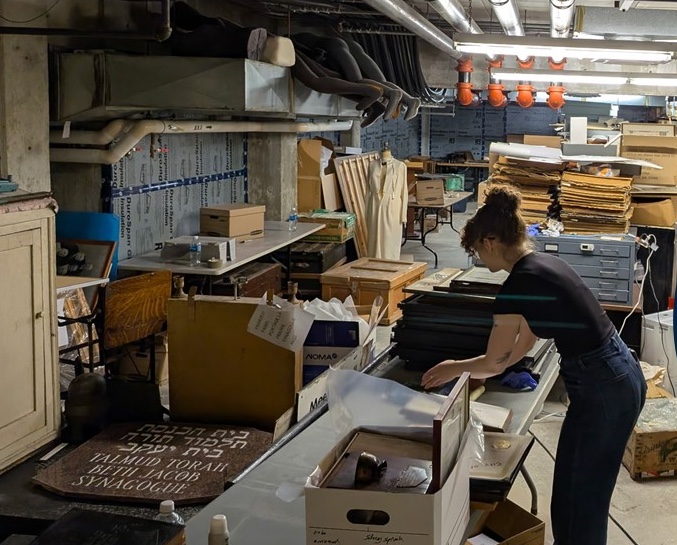
By MYRON LOVE The downpour that struck our city on Tuesday, June 9, left a trail of basement flooding and other damage in its wake. As reported elsewhere in this issue of the Post, Temple Shalom, our community’s Reform Congregation, has been forced to relocate its services to other venues because of water damage that has made its building unusable for the foreseeable future.
Another of our institutions that was affected by the storm is the Asper Jewish Community Campus – and specifically the lower level, where the Jewish Heritage Centre of Western Canada stores a good portion of its archives. It was the quick action of archivist Ava Garfinkel and her brother, Max, as well as a number of volunteers in the following days – and the miracle of modern technology – that saved those archives from destruction.
“This was a potentially devastating and irreversible crisis,” notes Belle Jarniewski, the JHCWC’s executive director. “Thanks to the quick and diligent work of our staff and a team of kind volunteers, we were able to implement an emergency disaster plan, separate the affected material and move the damp archives to a frozen storage facility within 48 hours. These crucial actions successfully saved the archive, avoiding any mold growth that would have spread throughout the entire collection at a rapid pace, eventually destroying even the parts of our collection that were left untouched by the flood.”
Jarniewski reports that Garfinkel reached out to conservators across Canada for help. The frozen materials have now been transferred to an out-of-province facility where they will be vacuum freeze-dried in a restoration process overseen by a conservator.
“Our dry and unaffected archives and artifacts were also quickly removed from the basement and brought upstairs to be stored in several places around the Campus,” Jarniewski says. “The directors of the Gray Academy and the Asper Community Campus were kind enough to offer us the space we required to temporarily store our collections.
“The JHC Archive,” she points out, “preserves the precious history and physical memory of our community, also that of the communities across Western Canada and Northwestern Ontario whose histories have been entrusted to us. It dates back to the late 1800s. Information about the delicate, old, and irreplaceable items is frequently accessed by students, researchers, educators, genealogists, and community members. Simply put, the archive constitutes the very heart and memory of our community.”
Jarniewski recounts that when the Campus first opened almost 30 year ago, several rooms on the first floor were specifically designed with climate control suitable for an archive or museum. But, as different community needs arose, the archives were moved out of the specialized spaces and into the basement.
“With space at a premium in the building, we have had to do our best with the cards we were dealt,” she says.
For security and other reasons, Jarniewski points out, moving the JHCWC archive out of the Asper Campus has never been a viable option. “Our museum, our offices, and the other half of our archive are all firmly situated in this building on the main floor,” she notes. “We work within our basement archive daily and we rely on the safety that the security within the Asper Campus affords us.”
To prevent this kind of near disaster again, she added, the lower level storage area has to be renovated for safety while maintaining the standards of practices for long-term preservation. “We have already put a plan into motion for more effective humidity control and the sealing of the room,” Jarniewski reports.
“All of our textual records must be placed in specialized archival enclosures, our artifacts must be re-boxed/wrapped according to their individual preservation needs, and we must purchase adequate shelving that will keep our collections away from the ground and the walls while allowing for effective air circulation. These protective measures will be costly, requiring specialized materials, but they are necessary.”
The overall estimated budget for this project, Jarniewski says, is approximately $100,000. So far, she reports, the JHCWC has received a quarter of that amount through donations..
She expresses the hope that Post readers will consider donating to this essential project so that the JHCWC can continue protecting the priceless history of Western Canadian Jewry for generations to come. A tax receipt will be provided to all donors.
“With the funding in place, we should be able to have everything in place in less than six months,” Jarniewski says.
Readers who may want to consider donating to the JHCWC in support of this vital project can either phone 204 478-8590 or go online to jewishheritage@jhcwc.org. Donations can also be made online though Canada Helps: https://www.canadahelps.org/en/charities/jewish-heritage-centre-of-western-canada-inc/
