


Uncategorized
In North Carolina, a memorial project will honor Martin Luther King and Holocaust victims
(JTA) — Two people lean down from an abstract version of a rail car. Their outstretched hands reach towards a family gathered around the car’s opening. The adults on the ground reach back, either to get help stepping into the car or to say good-bye.
That’s one side of the artist rendering of what will be a Holocaust monument. On the other side, train tracks lead to the entrance of the Nazis’ largest death camp, Auschwitz-Birkenau. A message across the top reads, “They were here. We remember.”
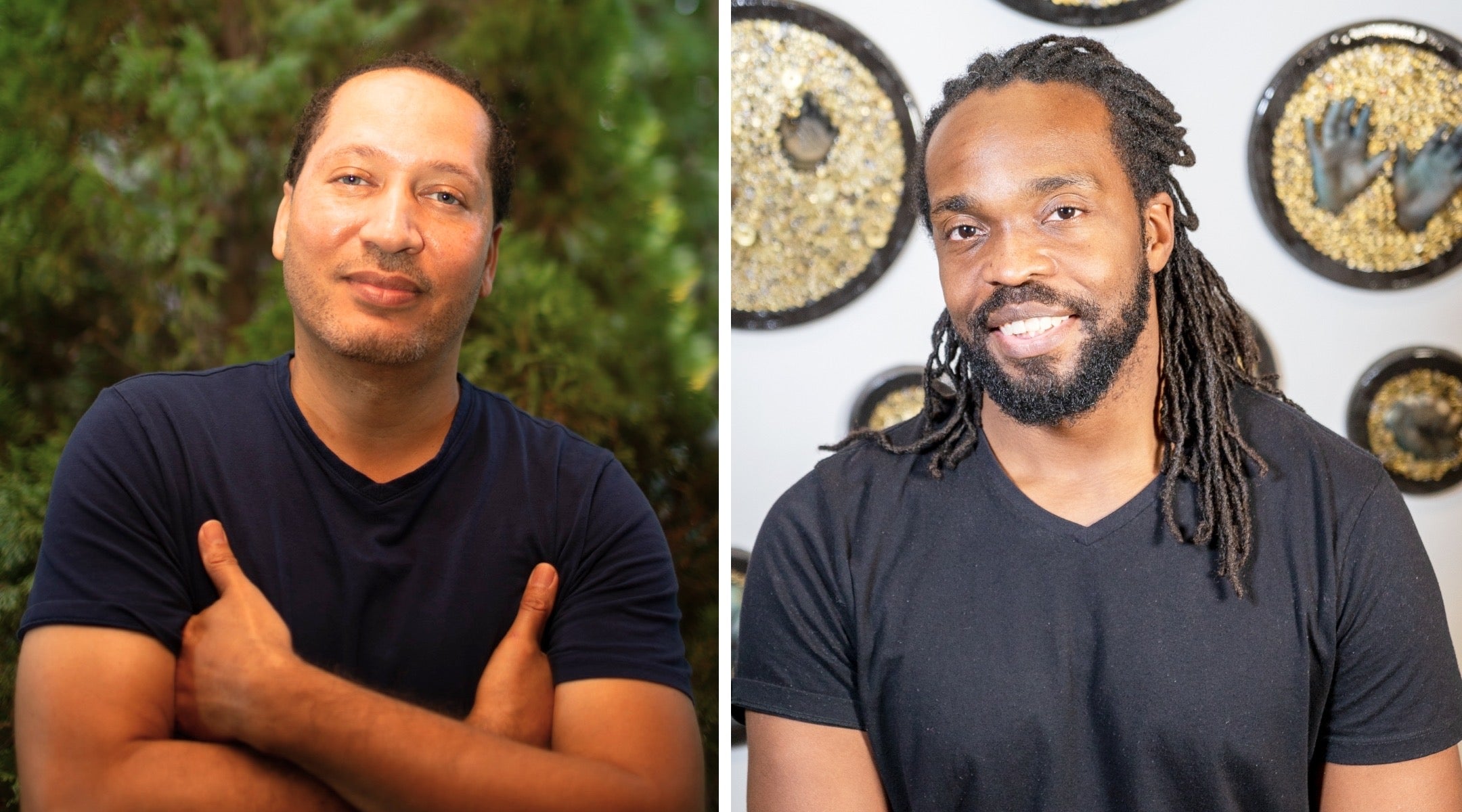
The sculpture by artists David Wilson and Stephen Hayes, called “In Transit: The Weight of Absence,” is emotional on its own. But what makes the project planned for Charlotte, North Carolina, especially noteworthy is what will be alongside it.
Charlotte is the planned home for what its organizers believe is the first memorial plaza in the United States to both honor Dr. Martin Luther King Jr. and remember the Holocaust in the same space. The Circle of Humanity: Monuments for Unity and Remembrance in Marshall Park will feature the 8-foot bronze statue of King currently in the park plus the new Holocaust monument.
Linking the two will be paved walkways, educational reflections and digital resources on the Holocaust, the Civil Rights movement and the combined history of African Americans and Jews in the U.S. School and tour groups will take part in interactive educational experiences.
To those who might wonder why these monuments belong together, Rabbi Ya’aqov Walker points to a common inheritance. “You could just describe it plainly: white supremacy in continental Europe and white supremacy in the southeastern United States,” said Walker, who is Black and serves on the project’s education committee.
The groups also share deep resilience and desire for change, he said, which led to a significant Jewish presence in the civil rights movement in the United States 20 years after the Holocaust.
“It was very prescient in their minds, from King to any major civil rights leader who was committed to nonviolence, to study and learn what the Jewish experience was, and to build relationships with rabbis as fellow spiritual leaders,” said Walker, who co-leads the Charlotte Black/Jewish Alliance.
The new monument will replace a small one dedicated in 1979 that’s hidden in overgrown foliage. Project partners include the Charlotte Black/Jewish Alliance, Mecklenburg County, Queens University of Charlotte, the Stan Greenspon Holocaust Education Center, and the Charlotte-Mecklenburg branch of the NAACP.
After a national search for artists that yielded 57 design proposals, a review committee narrowed the choices to eight finalists. Wilson and Hayes, who are Black and live in Durham, North Carolina, were one of two teams asked to submit their concepts. Though they had never designed a sculpture based on a Jewish theme, they were compelled by its juxtaposition to the King monument, “creating a broader dialogue about injustice, courage and the consequences of hatred,” Wilson told county commissioners during a recent public meeting.

David Wilson, left, and Stephen Hayes are the designers of “In Transit: The Weight of Absence,” the winning design for the Circle of Humanity memorial in Charlotte’s Marshall Park. (Courtesy Circle of Humanity)
Their presentation moved Commissioner Leigh Altman, who is white, to reveal that her great-grandparents and many of their children were murdered in the Holocaust. About 25 to 30 Holocaust survivors live in the Charlotte area today.
“This shared partnership for me is a reminder across one of history’s worst genocides and the worst legacy of what America has done wrong, and brought it together to find a commonality, which was a failed obligation to recognize the humanity of others and to fight for it,” she said.
The second finalist team, Miriam Gusevich and Sal Pirrone from Washington, D.C., envisioned an abstract sculpture with thousands of silver circles to represent those killed by the Nazis. The proposed structure opened to a skylight in the shape of a Star of David. Members of Gusevich’s family died in the Holocaust.
“Circle of Humanity” organizers held 12 community feedback sessions, including at synagogues, a Black church and Johnson C. Smith University, a historically Black university. About 850 community members participated. More than 100 completed written surveys on their preferences. Ultimately, a majority favored the rail car image. At one session, participants audibly gasped when “In Transit” was revealed.
It’s yet to be determined which materials will be used to render the piece. Options range from cast and fabricated metal to large-scale 3-D printing. What likely won’t change is the sculpture’s bronze hue and structure.
“The skin tones can be interpreted in many ways, and it looks very similar to an auction block” used in the trafficking of enslaved people, Walker noted. He recalled that during a feedback session at a Black church, some church members teared up to see the reminder of family separation.
Urban Design Partners in collaboration with Groundworks Studio will develop the plaza, in a design called “Woven Histories.” Potential elements include a stone walkway with a plaid design. The plaid pays tribute to the dress that civil rights pioneer Dorothy Counts-Scoggins wore on the day in 1957 when she faced down an angry white mob to become the first Black student to attend a segregated high school in Charlotte.
The plaza will include benches and may incorporate decorative stone books. Like the monument design, the concept is still open to changes based on additional community feedback. The planned budget is just under $1 million, including a $100,000 endowment for programming and maintenance. If fundraising efforts are successful and the timeline stays on track, the plaza is scheduled to open in May 2027.
Marshall Park has particular resonance as the setting. It is part of the former Brooklyn, a Black neighborhood razed in the 1960s in the name of urban renewal. More recently, Marshall Park has been a familiar site for protests and political demonstrations.
The idea for the innovative combination began with a discussion between Rev. Corine Mack, president of the Charlotte-Mecklenburg NACCP, and Rabbi Judy Schindler, Sklut professor of Jewish studies at Queens University of Charlotte and executive director of Spill the Honey, a national non-profit which produces arts and educational materials intended to empower the Black-Jewish alliance to combat racism and antisemitism.

The Dr. Martin Luther King Jr. memorial statue in Charlotte’s Marshall Park, created by renowned sculptor Selma Burke, was dedicated on April 5, 1980. (Courtesy Arrowmount School of Arts and Crafts)
“It all came out of the same conversation, looking at the Civil Rights movement, looking at the rise in racial slurs and antisemitism, and just really understanding that we have to do something to elevate the importance of not only our cultures, but what love would look like in this country,” Mack said. “I thought it was important that we went back to the root of the civil rights movement, which was us collaborating.”
She acknowledges a few phone calls from members of Charlotte’s Black community who expressed concern about the collaboration in light of the war and political divides opened after the Hamas attacks on Israel on Oct. 7, 2023. Others were unclear about the benefits of bringing the two histories together. But no vocal opposition has emerged to the project. Organizers say on-site education about the history of Black-Jewish ties in America is essential.
Charlotte has its own claims to this history. Humorist and social critic Harry Golden lived in the city and published his commentaries in The Carolina Israelite, a newspaper whose subscribers included Congressional members and well-known writers. In “The Vertical Negro Plan” in 1956, he pointedly noted that whites seemed to have no trouble standing next to Black Americans. It was only when Black people wanted to sit “that the fur begins to fly.” His tongue-in-cheek solution? Remove the seats at schools and lunch counters.
In 1971, attorney Adam Stein, father of N.C. Gov. Josh Stein, was part of the legal team who argued Swann v. Charlotte-Mecklenburg Board of Education before the Supreme Court. The case began the era of busing for school integration nationwide. Busing for that purpose officially ended in Charlotte in 2002, when the Supreme Court declined to take up a challenge to lower-court ruling recognizing local schools as adequately desegregated .
Now, supporters hope the Circle of Humanity will be a catalyst for Black-Jewish collaborations in other cities. Schindler, named after a great-aunt who was killed during the Holocaust, wants the gathering spot to be a place not only for remembrance, but for inspiration and beginnings.
“It’s really important to me that we bring joy to this work,” she said, envisioning the opening ceremony filled with klezmer music as well as both soul food and Jewish noshes. She cautions against “letting those to seek to harm us control our thoughts and our struggles and our fears. We need to celebrate our culture and who we are with pride and joy, so I pray that this will be a centerpiece for cultural celebration of all sorts.”
This article originally appeared on JTA.org.
The post In North Carolina, a memorial project will honor Martin Luther King and Holocaust victims appeared first on The Forward.
Uncategorized
In the Southwest, public libraries are becoming Yiddish hubs
Think of Yiddish today and you might picture Hasidic Brooklyn, Haredi neighborhoods in Israel or scholars working to preserve a language too often falsely written off as “dead” or “dying.”
But Texas? Ikh ken es nisht gleybn! (I can’t believe it!)
Sebastian Shulman, director of partnerships at the Yiddish Book Center, has spent the past year traveling around the U.S. and working with communities interested in Yiddish. Through the program, public libraries establish reading groups focused on English translations of Yiddish literature. Libraries in small towns across the Southwest, the Deep South and rural Michigan and Illinois have participated.
In Dallas, one library organized a daylong Yiddish festival that drew more than 500 people.
In Austin, Shulman gave a talk about Yiddish history during the city’s huge annual event, South by Southwest. The room for his lecture filled up, in spite of having to compete with the popular festival.
“There were young people and old people and Jewish people and non-Jewish people,” Shulman said. “It was such a deep hunger and a deep interest.”
At the end of the talk, a young Indigenous woman approached him and described similarities she saw between Yiddish and the culture and storytelling tradition of her own Cherokee Native American Nation. He was moved by the encounter, which served as a testament to the bridges forged by Yiddish literature and history.
“Yiddish kind of blows apart the concept of the unexpected place,” Shulman said, calling it “a language of everywhere and nowhere, all at the same time.”
In a Santa Fe, New Mexico public library, Yiddish literature and history is preserved by those who didn’t necessarily inherit the language from their grandparents. Many of them aren’t even Jewish and encountered it for the first time in libraries, archives, classrooms, festivals and books.
Yiddish culture in New Mexico got even more of a boost last year when Jordan Wax, a Santa Fe-based composer and performer of Yiddish and New Mexican regional music, released an album of original secular Yiddish children’s songs.
Letters from history
David Katz, a longtime Texas resident who has spent years collecting and translating Yiddish archival material from the state, said he’s found a life-long mission of preserving not only the language and idioms – but also the human stories of Yiddish-speaking Jews who immigrated to towns across Texas.
Katz regularly receives requests from families around Texas, asking him to translate Yiddish letters and documents that are between 70 and 150 years old. He’s also assisted in translating materials donated to the Dallas Holocaust and Human Rights Museum. Some contain ordinary family news. Others document poverty, illness, migration and the desperate search by Jews in Europe for a way out, as antisemitism intensified in the 1930s.
One letter from Germany from the early 1930s particularly stayed with him. The family wrote to relatives who’d already resettled in the U.S. about trying to obtain a visa to settle elsewhere, debating whether Canada, the United States or somewhere in South America might be the best destination.
Katz found it distressing that the family who wrote the letter seemed, ironically, to be unaware of the dangers facing them under the Nazis.“They’re debating about which climate might be better,” Katz recalled. “From their standpoint, they don’t know how bad things are about to get; it’s tragic to read that history so intimately.”
For Katz, translating these letters creates a connection to their senders and recipients.
“You read them, and even though the letters are maybe 100 years old, 80 years old, they very much make an impression on you that this is very understandable or approachable, because it’s Jewish life, not that different from today,” he said.
But that preservation work is only part of the story.
Susan Bronson, president of the Yiddish Book Center, said the center has increasingly worked with public libraries and Jewish communities around the country, and was inspired by the cross-generational and interfaith excitement to engage with Yiddish.
Many people attending these programs don’t speak the language. But translated literature, music, theater and lectures can provide an entry point.
Bronson has seen this among younger people through the Yiddish Book Center’s Great Jewish Books program, which introduces high school students to Jewish literature, including Yiddish works. Some students have said the experience helped them feel closer to a grandparent or better understand their family’s background.
The Yiddish Book Center’s oral history work has found Yiddish speakers in places people don’t typically associate with the language, including towns across the South and among Jewish farmers in New Jersey.
“It’s unexpected only because our perception of Yiddish became, in some ways, so narrow, but reality is more complicated and this narrow image obscures the breadth of Jewish life in America,” Bronson said.
Back in Texas, Katz is excited about the future possibility for Yiddish in the state, in the form of thousands of letters that remain untranslated and the old Texas Yiddish newspapers sitting on microfilm at university libraries.
“There are stories still waiting to be read,” he said, building on the state’s rich history.
Jewish immigrants spoke mame-loshen in homes and synagogues in Galveston, Dallas and San Antonio. They published newspapers in it, built community institutions around it and gathered to hear visiting writers and Jewish leaders speak the language.
In 1921, the Russian-born Yiddish literary critic Shmuel Niger traveled to Dallas and delivered a lecture in Yiddish to hundreds of people. A few years earlier, David Grün — better known as David Ben-Gurion, the future first prime minister of Israel — visited San Antonio, Texas twice where he addressed a packed room in Yiddish. He was meeting members of the Texas Labor Zionist chapter of Poale Zion (the Socialist Zionist movement), advocating for a sovereign Jewish state and raising money for Jewish immigrants to settle in Eretz Yisroel (The Land of Israel),
A lesser known historic Jewish community, deep in the “Bible Belt”, Waco, Texas had its first Jewish immigrants arrive in the mid-19th century. The first wave was Sepahardic, the second — Ashenazi. They built an Orthodox synagogue and later established an active chapter of the Jewish Workmen’s Circle, holding meetings in Yiddish.
A century after Ben-Gurion addressed Texan Jews in Yiddish, the language is still moving through the state — and far beyond it— not simply as a relic, but as a phenomenon people can continue to discover.
The post In the Southwest, public libraries are becoming Yiddish hubs appeared first on The Forward.
Uncategorized
These college students have favorable views of Israel. They also think it’s committing genocide.
A quarter of college students who view Israel favorably also believe its government is committing genocide.
That’s according to a Brandeis study published earlier this month, which surveyed nearly 4,000 students across 303 colleges in fall 2025 about their views on the Israeli-Palestinian conflict and concluded views on the Israeli-Palestinian conflict are more nuanced than often portrayed.
So how do students reconcile those views?
Researchers can’t say for sure, but one possibility is that students are distinguishing between supporting Israel’s existence and the actions of its current government.
The fact that many of the same students who say Israel is committing genocide also affirm its right to exist is not a contradiction, according to the Nexus Project, a watchdog group that works to combat antisemitism and protect open debate. In an Instagram post referring to the Brandeis study, the group lauded the nuance of the report.
“Collapsing both views into a single all-encompassing camp of ‘anti-Israel sentiment’ erases the gray area where most students actually live,” the post said.
Another explanation, the study says, is that the “genocide” label has less to do with actual views on Israel than political affiliation. Respondents who identified as liberal were much more likely to agree that Israel was committing genocide than those who identified as moderate or conservative. In fact, political ideology was a better predictor of whether someone said Israel was committing genocide than their stance on the Israeli-Palestinian conflict itself, the study found.
Overall, condemnation of Israel’s actions in Gaza is the more popular position on campus. Close to three-quarters of all students agreed with the statement that Israel is committing genocide against Palestinians.
Students may also have different interpretations of the term “genocide,” said Graham Wright, first author on the study and an associate research scientist at Brandeis.
“It’s possible that some of them think, ‘I do generally support the Israeli government, but I don’t like some of the things they’re doing,’” Wright said. “The word genocide is just a stand-in for, ‘I don’t think they’re doing a good thing.’”
The very word genocide has also been a subject of debate.
Some Jewish groups, such as the Israeli human rights group B’Tselem, have argued genocide is an accurate term to describe what they see as the deliberate destruction of Palestinian society.
Meanwhile, many pro-Israel advocates loathe the word genocide, legally defined as the intentional destruction of any national, racial, ethnic, or religious group, to describe Israel’s actions in Gaza following Oct. 7, 2023. They argue that Israel is seeking the destruction of Hamas, a terror group that states its intent to destroy the Jewish state.
Here are two other key takeaways from the study.
1. Most students differentiate between governments and their citizens — but not all
The study divided students into four groups based on their stances on the Israeli-Palestinian conflict. The largest group, 49% of students, supported civilians on both sides of the conflict.
Those students viewed both the Israeli and Palestinian people positively, while they expressed disdain toward the Israeli government, Hamas and the Palestinian Authority.
“This suggests that most people are able to make that distinction and have fairly nuanced views about a lot of these conflicts,” Wright said.
The vast majority of students, 85% of those surveyed, had unfavorable views of the Israeli government. But those views did not always extend to hostility toward the Israeli people. Students were split about half and half between favorable and unfavorable views of Israeli citizens.
Out of the 20% of students who held strong anti-Israel views — meaning they were likely to view both the Israeli government and its people unfavorably — half also viewed Hamas favorably.
“Certainly, I think that’s concerning,” Wright said. “You have a relatively small number of students who have very extreme views on Jews in Israel, and that seems to be contributing to a lot of the hostility that Jewish students are experiencing.”
Those students may make headlines, Wright said, but most undergraduates aren’t thinking about Israel day-to-day. In fact, 56% of surveyed students said they had low knowledge about the Israeli-Palestinian conflict and the topic was of low to moderate personal importance to them.
2. Jewish students have diverse views on the conflict, but they were also more likely to view Israel favorably than their non-Jewish peers
The survey included responses from 743 Jewish students. About 29% of those respondents viewed Israel favorably, the largest share of any ethno-religious identity surveyed.
That higher support for Israel among Jewish students held across political divides. Both politically liberal and politically conservative Jews were less likely to hold anti-Israel views than their non-Jewish peers, the study found.
The largest proportion of Jewish students, 56%, were “civilian sympathizers” — the group that views both Israeli and Palestinian civilians favorably while disliking both governments.
A minority of Jewish students, 9%, held unfavorable views of both the Israeli government and its people and favorable views of Palestinians.
Overall, the results show subtleties in how college students view the Israeli-Palestinian conflict that the media rarely captures, Wright said. “You only detect the nuance if you ask about it specifically.”
The post These college students have favorable views of Israel. They also think it’s committing genocide. appeared first on The Forward.
Uncategorized
In a forest where Jews fought the Nazis, a German military base and Lithuanian politics encroach on memory
(JTA) — Rūdninkai, LITHUANIA — Deep in the trees and swampy thickets of Lithuania’s Rūdninkai Forest, a series of makeshift forts is sinking into the earth.
These represent the remains of underground bunkers where Jewish partisans resisted their annihilation in the Holocaust. Under German occupation, some 400 Jews escaped the Vilnius ghetto to this forest and organized attacks against the Nazis.
After World War II, the story of these partisans was folded into Soviet propaganda, leaving a shroud of mystery over the bunkers. Now, construction of a new German military base in the area is throwing into question the fate of the forts — and the memory of their fighters.
Jewish former partisans and their descendants have traveled for decades to visit the bunkers, which mark the only memorial to their resistance in Lithuania. But in recent months, new obstacles have appeared: Signs forbidding entry and demarcating a “dangerous area” are installed on the road to the forest and pinned on trees approaching the forts.
Lithuania is nearing the final stage of constructing a military base for German troops in Rūdninkai Forest, nestled about 27 miles south of Vilnius. The training ground near the former partisan camps was planned after Russia’s 2022 invasion of Ukraine to shore up NATO’s eastern flank. Strategically located some 12 miles from the border with Moscow-allied Belarus and east of Russia’s Kaliningrad exclave, the troops will be Germany’s first permanent deployment abroad since World War II. About 5,000 German soldiers will begin arriving this fall.
“You cannot easily find the forts, so those who know how to get there, we just go,” Aušra Mikulskienė, a Jewish history tour guide from Vilnius, told the Jewish Telegraphic Agency. “But now, there are ‘don’t enter’ stickers and stop signs. It’s becoming impossible to get there because they are closing all of the forest.”
Mikulskienė has brought the children and grandchildren of Jewish partisans to Rūdninkai for 10 years. They need her guidance to find eight standing forts, covered in logs and soil, which are not marked on maps and GPS systems. In such remote corners of the forest, partisans planned to ambush their enemies, lay explosives on German trains and equipment and sabotage telephone lines and infrastructure in Vilnius.
The bunkers are not protected by the Lithuanian government as cultural heritage sites, and they have deteriorated over years of neglect. But as the German base is completed and military training begins, Mikulskienė worries that prohibitory signs related to construction will turn into more serious barriers to the forts, and visitors could lose access altogether.
Twists of history over decades plunged the forts into obscurity. Lithuania was occupied from 1944 to 1990 by the Soviet Union, which honored hundreds of Soviet partisans who went to Rūdninkai Forest to battle the Germans. The Jewish partisans who joined them, and who helped Russian forces liberate Vilnius from the Nazis in 1944, were not part of this narrative.
The Lithuanian Soviet Republic, or Lithuanian SSR, began to commemorate Soviet partisans on the site of the Rūdninkai forts in the 1970s. Soviet and Jewish fighters only had access to wood and soil to build their bunkers. But the forts standing today are reinforced with concrete, an indication that the Soviet government fortified the structures to serve as memorials, said Mikulskienė. She remembers visiting the site on a school trip in the 1980s and listening to lessons about how the forebears of Soviet citizens resisted the fascists.
Since the fall of the Soviet Union, researchers have debated how much of the structures is original, and how much was reconstructed by the Soviet government for propaganda purposes. The first sign memorializing Jews was installed in the area by Bildungswerk Stanisław Hantz, a German educational group, in 2024. A small silver plaque reads, “In memory of the Jewish partisans who fought out of these forests against the Nazi occupiers and their helpers.”
The legacy of the forts — and the memory of Jewish partisans — is now mired in Lithuania’s repudiation of its Soviet past. Thousands of Lithuanian intellectuals, dissidents and other citizens were arrested, deported to Gulags and executed under Soviet rule. Once Lithuania gained independence in 1990, the stench of Soviet repression overpowered that of the Nazi occupation for many Lithuanians.
Lithuania was for centuries a center of rich Jewish thought, religious life and secular culture; Vilna, as the capital was known in Yiddish, was nicknamed the “Jerusalem of the North.” But after more than 90% of Lithuanian Jews were killed by the Nazis and their collaborators, few remained to commemorate the Holocaust.
“The collective memory of Lithuanians basically sees only one occupation: the Soviet occupation,” said Ilya Lempertas, a researcher and editor of books on the Holocaust in Lithuania. “Soviet partisans, in Lithuanian memory, are those who deported Lithuanians to Siberia.”
That means the Jewish partisans of Rūdninkai Forest are often viewed not as heroes, but as traitors, according to Mikulskienė. “They are not considered as fighting against Nazis, these Jews,” she said. “They are considered to be fighting with the Soviets.”
Fania Brantsovsky, the last living Jewish resistance fighter of Rūdninkai Forest, died in 2024 at 102. She joined a Jewish partisan unit under the command of the writer Abba Kovner, known as the Nokmim, or Avengers. On Sept. 23, 1943, the same night she was smuggled out of the Vilnius ghetto, the Nazis began their final liquidation of the ghetto. None of her family survived.
Brantsovsky led tours to the forest bunkers in the 2000s. Until her death, she advocated for the structures to be preserved and protected as a site of learning about the Jewish partisans’ struggle.
Dovid Katz, a Brooklyn-born, Vilnius-based scholar of Yiddish and the Holocaust who runs the online journal “Defending History,” was a friend of Brantsovsky’s. “Her one last request was, ‘Dovid, please, never stop reminding Jews around the world to speak up for the existence of the forts,’” said Katz. “‘Let our grandchildren be able to come to this place in the forest and see wooden forts in the ground, which were the only postwar physical remnant of Jewish resistance.’”
Germany’s federal government has signaled that it will not disturb the site. In response to a parliamentary inquiry, the Bundestag announced in July that it was “committed to preserving the former World War II partisan camp in Rūdninkai Forest, located on the training grounds of Panzer Brigade 45 stationed in Lithuania, as a place of learning and remembrance.”
The government added that the former partisan bunkers were not part of Germany’s training facilities and would not be affected by construction, but it was in Lithuania’s hands to manage the site’s preservation and access.
“The Lithuanian government has been asked to examine whether the area in question merits protection and to take this into account in further planning,” said the Bundestag.
Lithuania’s Ministry of Culture told JTA that the bunkers do not have protected status as cultural heritage sites because they “are not authentic and are not located at their original sites.” Instead of being linked to Jewish fighters, the ministry said the forts were “associated with Soviet partisans.”
“During the Soviet era, they were included in the list of historical monuments of the Lithuanian SSR, while a significant proportion of such ‘monuments’ were intended to reinforce Soviet ideology and historical narratives,” the ministry said in a statement.
The area will be maintained in the future with an information board installed nearby, according to the ministry, which said the content of that information has yet to be decided. Visiting the forts won’t be prohibited altogether, but those who wish to go will have to comply with military rules and obtain advance approval from the Rūdninkai Training Area Command, the ministry said.
Katz believes nationalist factions in the Lithuanian government are revising the history of a site that hosts genuine remnants of Jewish bunkers. He views the government’s resistance to protecting the site as an outgrowth of the “double genocide” theory, a nationalist narrative that emerged in Lithuania after the fall of the Soviet Union. This theory equates World War II atrocities committed by the Soviets, who occupied Lithuania in 1940-1941 following a non-aggression pact between Stalin and Hitler, with those of the Nazis, who took control after Hitler broke the agreement and invaded the Soviet Union. (The Soviets reoccupied Lithuania in 1944.)
In this framework, the Soviets committed genocide against Lithuanians through mass deportations — with the complicity, some add, of Jewish communists — and only afterwards came the killing of Jews by the Nazis and their Lithuanian collaborators.
“The Soviets and their Jewish friends, as the narrative has it, committed the first genocide, and then came the reaction, the tragic second genocide,” which was the Holocaust, said Katz.
The equating of Soviet deportations with the Holocaust has been widely rejected by international scholars and Jewish institutions. The Soviet regime deported some 17,500 Lithuanians in 1941 to remote parts of Siberia and northern Russia. While individual Lithuanian Jews served in the Soviet administration, Jews were also disproportionately targeted in the deportations.
Lempertas, who like Katz is Jewish, does not believe the forts standing in Rūdninkai Forest include genuine remains of Jewish partisan bunkers. He supports the government’s view that the structures were built entirely as Soviet propaganda — but even so, he believes they should be protected.
“It has to be saved, from my point of view, for those who are coming there because of family,” said Lempertas. “It serves as an exhibition.”
Mikulskienė said the forts are deeply important to the families of Jewish fighters. She watches visitors stand before them, recite memories of war and sing partisan songs passed down through generations.
Yet in recent years, as Russia’s invasion of Ukraine sparked security threats and surging anti-Russian sentiment in Lithuania, Mikulskienė has found it increasingly difficult to advocate for the memory of Jews who fought alongside Soviets.
“You are seen as a follower of Soviet propaganda, and also now Putin’s propaganda,” she said. “That’s a bit dangerous, being this person in Lithuania.”
Anna Avidan, who was born in Vilnius to Holocaust survivors and founded the Jewish history nonprofit Jerusalem of the North, said the bunkers should be treated as a memorial site with educational opportunities.
“There is a strong stereotype here that Jews were communists and they deserved the killings — this simplified worldview,” she said. Dispelling such stereotypes “is a good case for explaining why it has to be commemorated.”
One the eve of World War II, about 4 in 10 people in Vilnius were Jewish. But decades after the end of the Soviet Union, Avidan said the city has yet to fully recognize the Jewish world that vanished from Lithuania’s cities, towns and forests.
“Lithuania has been independent for more than 35 years already,” said Avidan. “Still, we have no clear memorial in this city to the victims of the Holocaust, and for me, that’s a message.”
This article originally appeared on JTA.org.
The post In a forest where Jews fought the Nazis, a German military base and Lithuanian politics encroach on memory appeared first on The Forward.
