


Uncategorized
In North Carolina, a memorial project will honor Martin Luther King and Holocaust victims
(JTA) — Two people lean down from an abstract version of a rail car. Their outstretched hands reach towards a family gathered around the car’s opening. The adults on the ground reach back, either to get help stepping into the car or to say good-bye.
That’s one side of the artist rendering of what will be a Holocaust monument. On the other side, train tracks lead to the entrance of the Nazis’ largest death camp, Auschwitz-Birkenau. A message across the top reads, “They were here. We remember.”
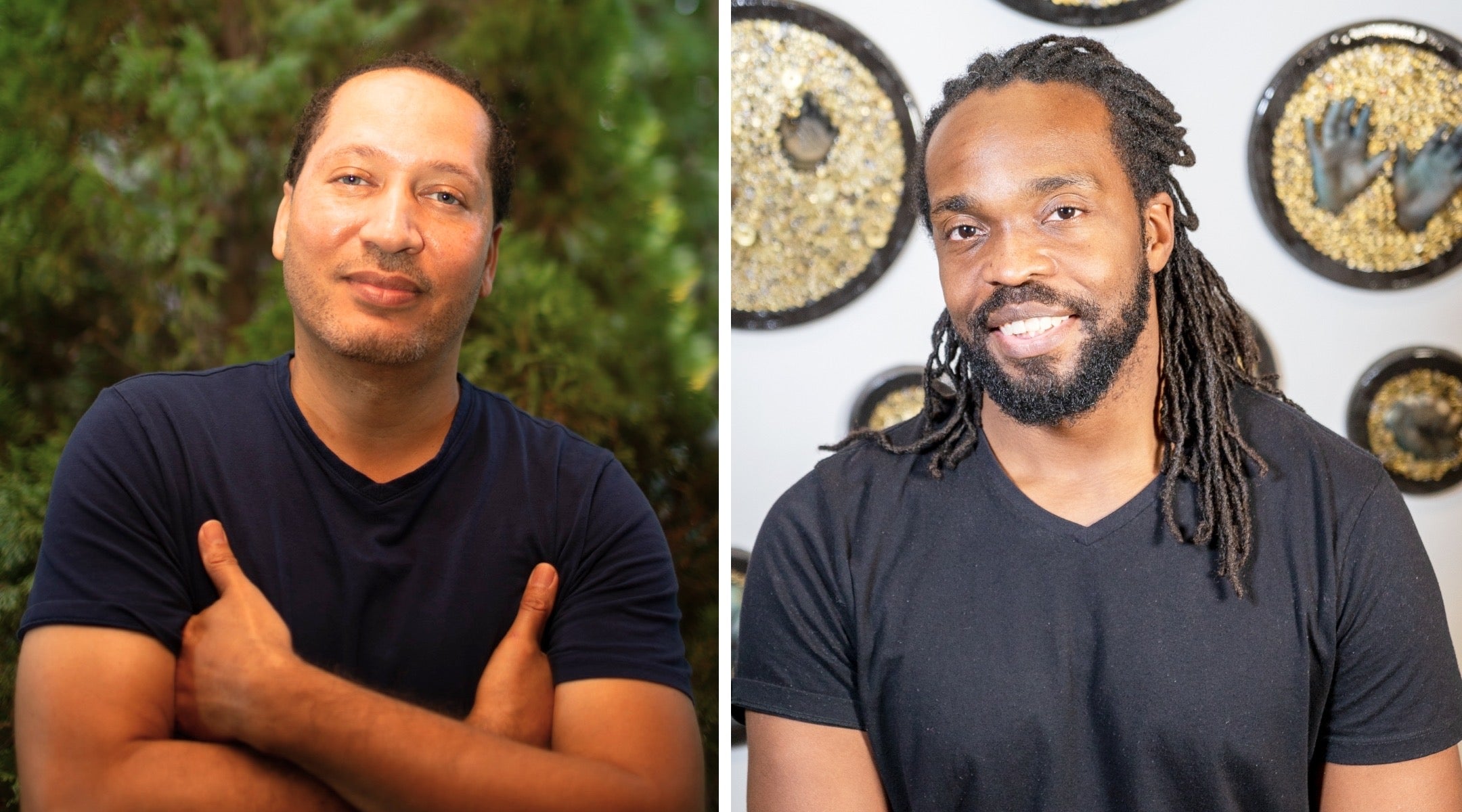
The sculpture by artists David Wilson and Stephen Hayes, called “In Transit: The Weight of Absence,” is emotional on its own. But what makes the project planned for Charlotte, North Carolina, especially noteworthy is what will be alongside it.
Charlotte is the planned home for what its organizers believe is the first memorial plaza in the United States to both honor Dr. Martin Luther King Jr. and remember the Holocaust in the same space. The Circle of Humanity: Monuments for Unity and Remembrance in Marshall Park will feature the 8-foot bronze statue of King currently in the park plus the new Holocaust monument.
Linking the two will be paved walkways, educational reflections and digital resources on the Holocaust, the Civil Rights movement and the combined history of African Americans and Jews in the U.S. School and tour groups will take part in interactive educational experiences.
To those who might wonder why these monuments belong together, Rabbi Ya’aqov Walker points to a common inheritance. “You could just describe it plainly: white supremacy in continental Europe and white supremacy in the southeastern United States,” said Walker, who is Black and serves on the project’s education committee.
The groups also share deep resilience and desire for change, he said, which led to a significant Jewish presence in the civil rights movement in the United States 20 years after the Holocaust.
“It was very prescient in their minds, from King to any major civil rights leader who was committed to nonviolence, to study and learn what the Jewish experience was, and to build relationships with rabbis as fellow spiritual leaders,” said Walker, who co-leads the Charlotte Black/Jewish Alliance.
The new monument will replace a small one dedicated in 1979 that’s hidden in overgrown foliage. Project partners include the Charlotte Black/Jewish Alliance, Mecklenburg County, Queens University of Charlotte, the Stan Greenspon Holocaust Education Center, and the Charlotte-Mecklenburg branch of the NAACP.
After a national search for artists that yielded 57 design proposals, a review committee narrowed the choices to eight finalists. Wilson and Hayes, who are Black and live in Durham, North Carolina, were one of two teams asked to submit their concepts. Though they had never designed a sculpture based on a Jewish theme, they were compelled by its juxtaposition to the King monument, “creating a broader dialogue about injustice, courage and the consequences of hatred,” Wilson told county commissioners during a recent public meeting.

David Wilson, left, and Stephen Hayes are the designers of “In Transit: The Weight of Absence,” the winning design for the Circle of Humanity memorial in Charlotte’s Marshall Park. (Courtesy Circle of Humanity)
Their presentation moved Commissioner Leigh Altman, who is white, to reveal that her great-grandparents and many of their children were murdered in the Holocaust. About 25 to 30 Holocaust survivors live in the Charlotte area today.
“This shared partnership for me is a reminder across one of history’s worst genocides and the worst legacy of what America has done wrong, and brought it together to find a commonality, which was a failed obligation to recognize the humanity of others and to fight for it,” she said.
The second finalist team, Miriam Gusevich and Sal Pirrone from Washington, D.C., envisioned an abstract sculpture with thousands of silver circles to represent those killed by the Nazis. The proposed structure opened to a skylight in the shape of a Star of David. Members of Gusevich’s family died in the Holocaust.
“Circle of Humanity” organizers held 12 community feedback sessions, including at synagogues, a Black church and Johnson C. Smith University, a historically Black university. About 850 community members participated. More than 100 completed written surveys on their preferences. Ultimately, a majority favored the rail car image. At one session, participants audibly gasped when “In Transit” was revealed.
It’s yet to be determined which materials will be used to render the piece. Options range from cast and fabricated metal to large-scale 3-D printing. What likely won’t change is the sculpture’s bronze hue and structure.
“The skin tones can be interpreted in many ways, and it looks very similar to an auction block” used in the trafficking of enslaved people, Walker noted. He recalled that during a feedback session at a Black church, some church members teared up to see the reminder of family separation.
Urban Design Partners in collaboration with Groundworks Studio will develop the plaza, in a design called “Woven Histories.” Potential elements include a stone walkway with a plaid design. The plaid pays tribute to the dress that civil rights pioneer Dorothy Counts-Scoggins wore on the day in 1957 when she faced down an angry white mob to become the first Black student to attend a segregated high school in Charlotte.
The plaza will include benches and may incorporate decorative stone books. Like the monument design, the concept is still open to changes based on additional community feedback. The planned budget is just under $1 million, including a $100,000 endowment for programming and maintenance. If fundraising efforts are successful and the timeline stays on track, the plaza is scheduled to open in May 2027.
Marshall Park has particular resonance as the setting. It is part of the former Brooklyn, a Black neighborhood razed in the 1960s in the name of urban renewal. More recently, Marshall Park has been a familiar site for protests and political demonstrations.
The idea for the innovative combination began with a discussion between Rev. Corine Mack, president of the Charlotte-Mecklenburg NACCP, and Rabbi Judy Schindler, Sklut professor of Jewish studies at Queens University of Charlotte and executive director of Spill the Honey, a national non-profit which produces arts and educational materials intended to empower the Black-Jewish alliance to combat racism and antisemitism.

The Dr. Martin Luther King Jr. memorial statue in Charlotte’s Marshall Park, created by renowned sculptor Selma Burke, was dedicated on April 5, 1980. (Courtesy Arrowmount School of Arts and Crafts)
“It all came out of the same conversation, looking at the Civil Rights movement, looking at the rise in racial slurs and antisemitism, and just really understanding that we have to do something to elevate the importance of not only our cultures, but what love would look like in this country,” Mack said. “I thought it was important that we went back to the root of the civil rights movement, which was us collaborating.”
She acknowledges a few phone calls from members of Charlotte’s Black community who expressed concern about the collaboration in light of the war and political divides opened after the Hamas attacks on Israel on Oct. 7, 2023. Others were unclear about the benefits of bringing the two histories together. But no vocal opposition has emerged to the project. Organizers say on-site education about the history of Black-Jewish ties in America is essential.
Charlotte has its own claims to this history. Humorist and social critic Harry Golden lived in the city and published his commentaries in The Carolina Israelite, a newspaper whose subscribers included Congressional members and well-known writers. In “The Vertical Negro Plan” in 1956, he pointedly noted that whites seemed to have no trouble standing next to Black Americans. It was only when Black people wanted to sit “that the fur begins to fly.” His tongue-in-cheek solution? Remove the seats at schools and lunch counters.
In 1971, attorney Adam Stein, father of N.C. Gov. Josh Stein, was part of the legal team who argued Swann v. Charlotte-Mecklenburg Board of Education before the Supreme Court. The case began the era of busing for school integration nationwide. Busing for that purpose officially ended in Charlotte in 2002, when the Supreme Court declined to take up a challenge to lower-court ruling recognizing local schools as adequately desegregated .
Now, supporters hope the Circle of Humanity will be a catalyst for Black-Jewish collaborations in other cities. Schindler, named after a great-aunt who was killed during the Holocaust, wants the gathering spot to be a place not only for remembrance, but for inspiration and beginnings.
“It’s really important to me that we bring joy to this work,” she said, envisioning the opening ceremony filled with klezmer music as well as both soul food and Jewish noshes. She cautions against “letting those to seek to harm us control our thoughts and our struggles and our fears. We need to celebrate our culture and who we are with pride and joy, so I pray that this will be a centerpiece for cultural celebration of all sorts.”
This article originally appeared on JTA.org.
The post In North Carolina, a memorial project will honor Martin Luther King and Holocaust victims appeared first on The Forward.
Uncategorized
The definitive Oct. 7 book was written — and sketched — before the attack
As Salomé Parent-Rachdi and Zac Deloupy worked on the drawings for a book about Israeli-Palestinian romance, they had no way of knowing the world they were depicting was on the brink of collapse.
The day they finished their pencil sketches, we learn in the book’s introduction, was Oct. 6, 2023. The next day, Hamas invaded Israel, killing about 1,200 and taking another 251 hostage. By the time the book was published in April 2024, Israel was locked in a multi-front war that still hasn’t quite settled.
That context — a looming attack, a forever war that has not yet begun — colors every panel of Love and Desire in the Promised Land: The Private Lives of Israelis and Palestinians, a French graphic nonfiction book whose English translation was released this summer. Reading the book feels like opening a time capsule that had been buried in the distant past: Even as it reminds you how bad the Israeli-Palestinian conflict was before Oct. 7, it leaves you wishing desperately you could restore things to how they were.
The book follows Parent-Rachdi, a French journalist, as she travels across Israel and the Palestinian territories to interview 16 subjects about their love lives. She talks to a mix of singles and couples, straight and gay, in Israel, West Bank and Gaza. (That’s one giveaway this book couldn’t have been made today: No journalist has been permitted to enter Gaza unaccompanied since Oct. 7.)
A few tell of dating across Palestinian-Israeli lines. Lana, an Arab Israeli, finds herself in a situationship with a right-wing Israeli — and ends up marrying him. Samira, an Arab Israeli woman, tells us about her Israeli ex, whose enlistment during the 2014 Gaza war — when they are living together — brings the unspoken tension in their relationship out into the open. And we learn the complex family dynamics of a celebrity Muslim-Jewish couple: Fauda star Tsahi Halevi and his Arab-Israeli wife, TV anchor Lucy Aharish.
The less politically fraught experiences are relayed with the same empathy. Avi, an ex-Hasid, reveals that, despite unbearable teenage horniness, he initially didn’t know how to find porn on the internet due to his insular upbringing. (He searches for “woman in pajamas” instead.) Rami, Parent-Rachdi’s fixer and taxi driver in Gaza, says, as a single man in his thirties, he told people he had erectile dysfunction so they wouldn’t grow suspicious.
In between these revelations are glimpses of life as it was in Israel and the Palestinian territories before Oct. 7. We ride shotgun as Parent-Rachdi navigates checkpoints on her way out of the West Bank and deals with Israeli and Palestinian officials on the way into Gaza. Rami — who did finally marry — says he made sure his son was born in Jordan so that he wouldn’t be trapped in Gaza as an adult. Parent-Rachdi has brought his stepson a remote-control car — the kind of toy Rami can’t buy in Gaza due to the Israeli blockade.
The love stories describe conflict, of course, and they do not uniformly lead to happy endings. (Or for that matter, breakups.) What they consistently show instead is people — as far as we can tell, basically good people — reaching out to each other in a pressure cooker of cultural, religious, sexual and political attitudes.
The stories also betray civilians’ genuine skepticism of their own communities with a frankness that seems unimaginable today. The clearest example of this comes in Gaza, where Mohammed, a closeted Palestinian looking for hookups, tells Parent-Rachdi about Hamas honor killings of gay men and his own brush with death. “They’re more likely to kill you if you’re a bottom,” he says matter-of-factly. Catfished by a Hamas intelligence officer, Mohammed escapes arrest by swearing he’s a virgin and flees to the U.S. a few days later.
Would Mohammed make the same disclosures today, when “What about Hamas?” has become a refrain for anyone defending Israel’s response to Oct. 7? The Gaza he left behind no longer exists. The book’s afterword, written in Feb. 2024, reveals that Rami’s wife’s cosmetics store — lovingly illustrated by Deloupy earlier in the book — was leveled in Israeli airstrikes; the family was now living in a refugee camp in Rafah. “We have gone from a life with all the modern comforts to a reality where we move with a cart, where we buy wood to split and burn in order to cook and take a shower,” he says.
As for Mohammed, his house was destroyed, as were many friendships with Jews and Israelis: “I write to them,” he says in the afterword. “They don’t respond, but they read my message.” As for Hamas, he says, “today, seeing the suffering, somehow I feel like I better understand their resistance.” When the authors checked in with the subjects, several did not respond. By then, some 30,000 Palestinians were dead.
As it reminds us what we’ve lost, Love and Desire in the Promised Land also points the only way toward a shared future: people on all sides defying the forces pulling them apart. It shows us it can be done. Even in the afterword, one of the interviewees, a Modern Orthodox Jew named Jean-Marc, is optimistic: “I am still convinced, even more so now, that we have to work with the Palestinians,” he says. “Our safety depends on it.”
The post The definitive Oct. 7 book was written — and sketched — before the attack appeared first on The Forward.
Uncategorized
Christian leaders are racing toward the Rapture. Is Israel really to blame?
End Times Fascism: And the Fight for the Living World
By Naomi Klein and Astra Taylor
Farrar, Straus & Giroux, 384 pages, $32
Judaism is not usually a religion associated with apocalyptic thought. There’s no Jewish version of the Book of Revelation. There is a concept of a Messianic Age, but most observant groups forbid interfering with — encouraging or discouraging — its arrival.
Yet Judaism, or at least Israel, is central to Christian apocalyptic thought. The lines that drive its connection to Israel are well-traced. The Book of Revelation requires Jews to return to the promised land, and a Third Temple to be built for Jesus to return, and so, for years, Christian Zionists like John Hagee, the founder of Christians United for Israel and Mike Huckabee, the current U.S. ambassador to Israel, have encouraged wars in the region, seeing them as part of prophecy.
Hagee and Huckabee have talked in glowing terms of the many lands they believe comprise “greater Israel” all becoming part of the modern nationstate, in fulfillment of biblical requirements for the Rapture. Byron Stinson, another wealthy evangelical leader, has worked to breed and import blemish-free red heifers to Israel, because their ashes are necessary to build the Third Temple that will herald the return of Jesus.
More recently, the Jewish extremists who are also hungry to build a Third Temple have moved from the fringe into the Israeli government. Several times now, Israeli security minister Itamar Ben-Gvir has stalked around the Temple Mount, where Jews are officially forbidden from prayer, and led a large group in prayer, flanked by the police force he heads. Bezalel Smotrich, Israel’s minister of finance, has promised to fund the construction of a Third Temple.
But as powerful as these Jewish leaders are, the Christians are far bigger. CUFI, the group led by Hagee, is the biggest Zionist group in the U.S., far larger than AIPAC.

And yet End Times Fascism, a new book from activists and writers Naomi Klein and Astra Taylor — Klein is known for books like No Logo and Shock Doctrine, where she coined the relevant term “disaster capitalism” — focuses largely on Israel, and the extremists in its government.
The book’s central argument is that accelerationist fanatics believe an apocalyptic future will benefit them — whether in heaven or on earth. And they’re racing toward that future with increasingly fascistic terms.
These apocalyptic futures vary. For Christians, it might be the Rapture, and ultimately heaven. For AI techies, it’s a world ruled by the silicone grip of an all-knowing machine — or at least a world ruled by the superrich and filled with AI-driven propaganda masquerading as the voice of God while it surveils its users. For ethno-nationalists, it’s a homogenous country in which they can live out their nostalgia for an imagined perfect past. End Times Fascism is divided into sections, each taking on one of these groups and its ravenous vision for the end of the world, and how it is leading the world into fascism — through moral policing, surveillance, xenophobia.
But in the section on religious extremism, Israeli extremists get at least as much airtime as the Christians, despite the fact that these end time fanatics have far less global influence and don’t represent the vast majority of Jews.
It is, of course, important to understand the interplay between Christian apocalyptic thought and Judaism, and this is where things can get tangled. Christian Zionists’ desire for the Rapture leads them to support Israel and, sometimes, to display a kind of philosemitism. Ultimately, they are neither true friends to the Jews nor supporters of Israel; Hagee once gave a sermon claiming God sent Hitler as a kind of shepherd to force Jews back to Israel, in alignment with the biblical plan — when, of course, Jews will convert or burn in hell. But these beliefs have not made most Jewish groups cut ties with CUFI; Israel’s prime minister, Benjamin Netanyahu, has, for decades, referred to U.S. Christian Zionists, and Hagee in particular, as beloved supporters of Israel, and has said that Christian Zionists made Jewish Zionism possible. Many Jews are similarly grateful for evangelical support of Israel, regardless of what less supportive beliefs might undergird it, and are willing to ally with these religious extremists if it means support for Israel’s wars and annexations.

Certainly, all of these thoughts build on one another, and are difficult to untangle; plenty of hawkish Jews and Israelis want Israel to expand for non-biblical reasons. But the vast majority of Jews are not actively working to build a Third Temple and bring about the end of the world as we know it. Yet Klein and Taylor represent Jews largely through extremists like Ben-Gvir, and even focus their discussion of Christian apocalyptic thought on its overlap with Judaism and Israel. These religions share the Hebrew Bible, but little else.
There is far more to Christian apocalyptic thought than Israel. Plenty of Rapture-hopefuls in the U.S. believe their own country is the promised land; indeed, theological power is shifting away from Israel, as a new cohort of Christian extremists like Candace Owens, Nick Fuentes and Tucker Carlson catch hold of the political discourse and steer it toward open antisemitism and harsh scrutiny of U.S. support of Israel.
The old guard is being replaced by a new Christian right that is suspicious of Israel’s every action, and doesn’t egg on its wars. When Tucker Carlson interviewed Ted Cruz, a staunch supporter of Israel, the senator explained the Christian theological grounding of his support for Israel; Carlson, also a loudly devout Christian, jeered.
That’s not to say, of course, that there aren’t still many Christian Zionists in power in the U.S., shaping its foreign policy regarding Israel. But End Times Fascism feels as though it is stuck in a previous era of American Christianity, and of U.S. politics.
This problem is not limited to the section on religious apocalypse. The second part of the book, focused on the AI hunger of transhumanist tech titans, spends time on neoreactionary thinker Curtis Yarvin’s plan for a New Gaza, as it was presented at a Peter Thiel conference. Thiel is, himself, a Christian who is famously obsessed with the antichrist and the end of the world — once again, there is crossover, and these topics all share threads. But Israel is not the major driver of the race toward AI killing us all, or any other tech-related doom.
The fundamental idea of Klein and Taylor’s work is that rapturous obsessions drive not only worldly destruction — that much seems obvious — but also fascism. It’s a smart idea, and they have plenty of examples, whether surveillance by our internet overlords or ICE raids pushed for by white nationalists. But the book spends so much time on its trendiest target — Israel — when it should direct its energy examining figures like U.S. Secretary of Defense Pete Hegseth and the muscular Christianity driving his new testosterone regime for the U.S. military, or influential online figures like Owens or Fuentes agitating for a white, Christian U.S. (Some of these influencers are mentioned, but not as primary drivers.)
Certainly, Israel is involved in U.S. politics, in Christian nationalism, in the building of an ethnostate. (Israel in fact appears least in the third section on ethnonationalism, which is surprising given its identity as a Jewish state.) But despite Israel’s importance, the U.S., and its leaders, are still far more powerful.
The issue might be the book’s structure. The idea that apocalyptic thought drives fascism is a fairly simple one, and many of Klein and Taylor’s examples are familiar. The idea that is more subtle, and harder to grasp, is the way the threads of eschatological thought, ethnonationalism and tech wealth all share ideas and shape each other.
Peter Thiel alone, given his tech companies, his antichrist obsession, his love of Nazi theorists and his influence over Vice President JD Vance, could generate at least a chapter in any of the book’s three sections, or serve as a throughline for the entire book. Yet the topics are divided, as though each form of apocalyptic thought is its own entity, instead of woven together to show the ways they all reinforce each other.
End Times Fascism closes with a section on how to fight the rising fascism. Perhaps this should be the main focus of the book; many people who read the news already feels as though our leaders are racing toward the apocalypse, or at least WW III and a second Great Depression. The real question is what to do.
End Times Fascism offers some inspirations, including New York City’s mayor, Zohran Mamdani, as well as the Jewish Labor Bund. At least if the focus is once again on Jews, this time it’s positive.
The post Christian leaders are racing toward the Rapture. Is Israel really to blame? appeared first on The Forward.
Uncategorized
Why Dolly Parton sang a song about a Jewish journalist

A Broadway show, a star-studded television tribute, a new hotel and museum in Nashville. As odes to Dolly Parton keep coming, a recording of the late country music singer honoring an American Jewish journalist has recently surfaced.
Never before released in America, the song, “A Bridge Across,” sung by Parton and accompanied by the Nashville Symphony, honors slain journalist Daniel Pearl.
The song features spare lyrics set to violin music composed in honor of Pearl, a Wall Street Journal reporter who was brutally murdered by terrorists in Pakistan in 2002.
Originally recorded in 2008 by Parton, renowned fiddler Mark O’Connor, and the Nashville Symphony, the song was intended to be part of a compilation album called This is My America, produced and funded, oddly enough, in Canada but never released in the U.S.
It was O’Connor and his wife Maggie who resurrected the recording this fall, shortly after the deaths of Parton and another musician that connected the four artists: Oregon violinmaker Jonathan Cooper, who died in September.
Deeply troubled by the journalist’s murder in 2002, Cooper learned Pearl was an amateur fiddler and set out to create a quartet of string instruments – two violins, a viola and a cello – in the journalist’s honor. He entrusted the instruments to O’Connor to use during his annual summer music camp in North Carolina. Every year since, four students from the camp have received one of the Daniel Pearl memorial instruments to play for a year.
“These young people carry the message that love fights hatred through music-making and understanding that Daniel Pearl’s family want him remembered for,” O’Connor told The New York Times. Likewise, Cooper’s loving gesture inspired Parton, O’Connor said.
Canadian violinist Samantha Robichaud received one of the violins in 2005 and has gone on to become a successful recording artist with more than a half dozen albums. She has toured North America as an ambassador for the Daniel Pearl Foundation, sharing Pearl’s story, including his passion for

music and its power to change lives. Enter songwriters Tom McBryde and Lynn Wilbanks, whose introduction to Robichaud inspired verse.
On the album, the Nashville Symphony played one of Robichaud’s compositions while Parton introduced Pearl to listeners.
“He believed that music was something that could cross all social barriers, political borders and imaginary boundaries,” Parton says, before singing McBride’s and Wilbanks’ lyrics.
“A bridge across a question one journey begins, one step at a time to a place within.
A bridge across a border, a hand reaching out one heart at a time to erase the doubt.
A bridge across a difference can close a divide, one song to be sung on the other side.”
“It was perfect. She knows what he stood for,” Pearl’s father, Dr. Judea Pearl, told the Forward. “She was such a giving person.”
Judea Pearl met Parton in 2018 at the Los Angeles Press Club where she received that year’s Public Service Award for Contributions to Civic Life for her Imagination Library, which sends free books to children. (It inspired the creation of the PJ Library for Jewish books.) The Press Club recently dedicated its upcoming National Arts & Entertainment Journalism Awards to Parton’s memory.
In 2018, Judea Pearl was there to present the Daniel Pearl Award for Courage and Integrity in Journalism to Saudi Arabian writer and blogger Raif Badawi whose wife accepted the award while he served a 10-year prison sentence for his online activism.
The foundation devoted to Daniel Pearl’s legacy has been less visible since the 2021 death of Pearl’s mother Ruth who, as a young girl, witnessed and survived the anti-Jewish pogroms in Baghdad known as the Farhud.
As the 25th anniversary of his son’s murder approaches in February, Judea Pearl said the foundation will start a new chapter under his daughters’ leadership. Parton’s song lends the effort a touching soundtrack.
The post Why Dolly Parton sang a song about a Jewish journalist appeared first on The Forward.
