


Uncategorized
How a 198-year-old New Orleans synagogue became one of America’s fastest-growing Jewish communities
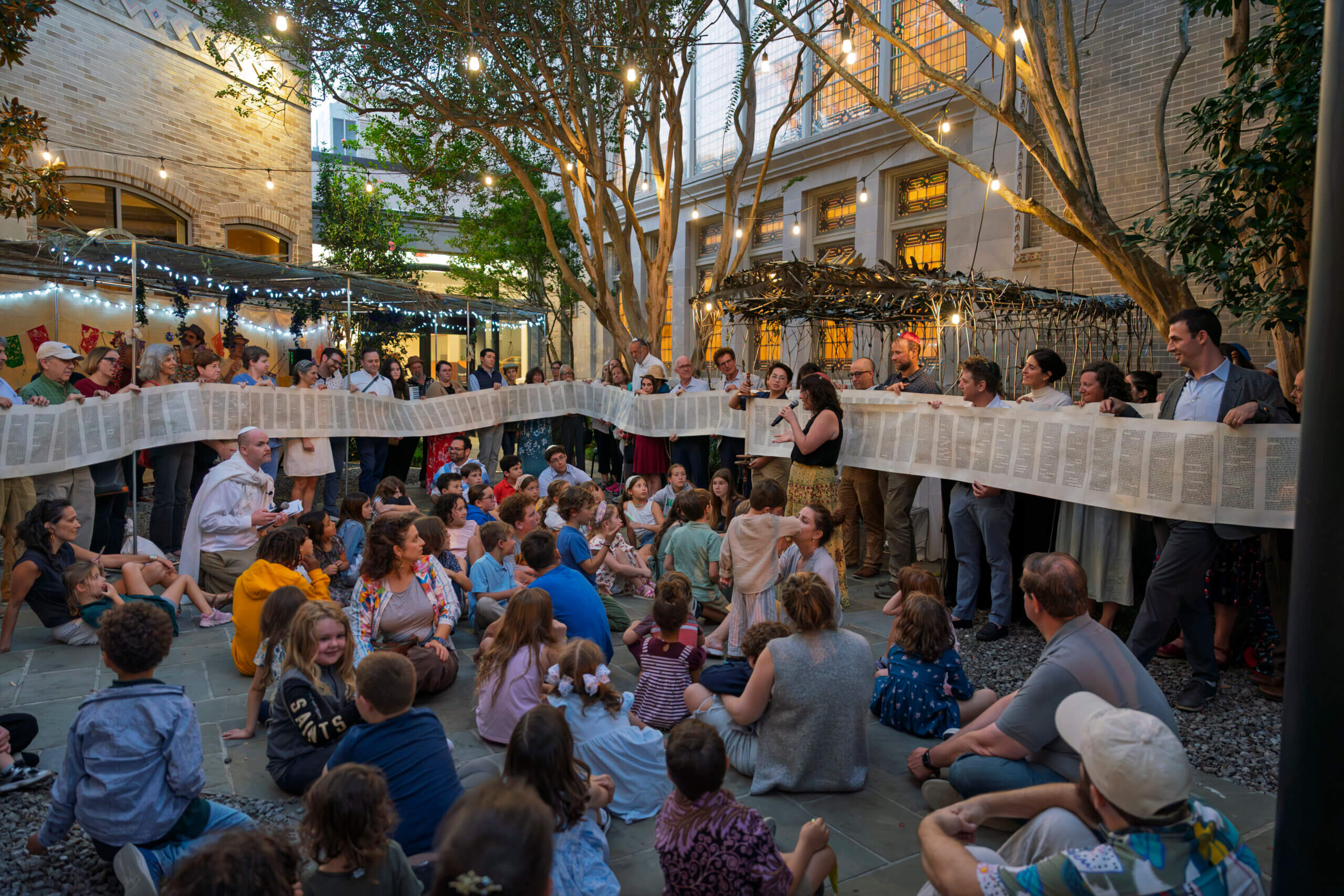
NEW ORLEANS — By the time a trumpet player rose from the pews, candy was already flying through the sanctuary.
Children scrambled across the bimah beneath Touro Synagogue’s green-and-gold dome while the crowd clapped to the music and a 13-year-old boy in orange Nike sneakers stood beside his mom before two open Torah scrolls — one for the bar mitzvah boy, the other for his mother, who was 47, a recent convert celebrating her adult bat mitzvah.
By the end of services, congregants carrying guitars, flutes, and tambourines had transformed the sanctuary into something resembling a Mardi Gras second line.
In most American synagogues, this would have felt unusual. At Touro, located along the famous parade route, it felt nearly routine.
Across the country, congregations are shrinking, aging and consolidating. Denominational loyalty is weakening. Younger Jews are less likely to join synagogues at all. But here in New Orleans, Jewish communal life has experienced an unlikely revival.
New Orleans still carries Katrina in its census numbers. The city still has roughly 25% fewer residents than before the storm. Its Black population, while still the majority, has dropped most significantly. Jewish New Orleans, overwhelmingly white, tells a different story. Community leaders say the Jewish population has rebounded to — and perhaps surpassed — pre-Katrina levels.
The revival was driven partly by generational turnover. After the 2005 hurricane, many older New Orleans Jews decided not to return, choosing instead to spend retirement near children and family in cities like Houston and Atlanta. In their place came a younger generation of post-Katrina newcomers — volunteers, nonprofit workers, Tulane University transplants and young families drawn by the chance to help rebuild the city.
But the resurgence cannot be explained by demographics alone. Across the city, Jews describe a deeply interconnected communal ecosystem shaped by catastrophe, collaboration and a distinctly New Orleans instinct for improvisation.

The city’s Jewish institutions increasingly learned to share resources, blur lines between denominations and accommodate the realities of modern Jewish families. Interfaith couples found a warmer welcome. Synagogues that once occupied separate lanes began collaborating more closely. “Denominational boundaries here are very porous,” said Ilana Horwitz, a Tulane University Jewish Studies professor who is writing a book about how the Jewish community survived and rebuilt after Katrina.
At the center of that revival sits Touro Synagogue, a nearly 200-year-old Reform congregation that is defying institutional decline.
In 2019, Touro hired as its spiritual leader Rabbi Katie Bauman, a New Orleans native. She arrived just months before the pandemic would force synagogues across America to reinvent themselves.
At the time, the shul counted roughly 570 families. Today, it is approaching 750. Its religious school has grown from 131 students to 243 in six years. In 2019, the synagogue hosted eight b’nei mitzvah. Nearly 30 b’nai mitzvahs are already scheduled for the 2027-28 school year — so many that synagogue leaders have begun quietly confronting an unfamiliar problem: Are we growing too much?

“We’re not gonna turn people away,” said Kevin Wilkins, the synagogue’s president and the first convert ever to hold the role. “We’re not gonna have a waitlist.”
Two decades after Katrina nearly drowned New Orleans, Touro has become a kind of laboratory for what Jewish communal life can look like after disaster reshapes it.
The people who came after the storm
A Detroit native, Joshua Lichtman came to New Orleans in 2007 after spending time at a Jewish farming and environmental program in Connecticut. Like many people drawn south after Katrina, he was looking for purpose and a chance to help rebuild.
“It was volunteering and adventure,” Lichtman, 51, recalled one Saturday morning after services at Touro
Entire neighborhoods remained scarred by floodwaters. Lichtman spent those early months gutting homes, working in community gardens and helping with legal aid projects. Then he met Davida Finger, who ran the Katrina Clinic at Loyola University, which provided free legal assistance to residents displaced by the hurricane. They got married.
He came to help rebuild the city. Somewhere along the way, the city rebuilt him, too.
Lichtman stayed, helped launch Avodah New Orleans, a Jewish service corps program, and now works in financial planning. Today, he and his wife are raising two children in the city.

His story reflects a broader demographic shift that transformed Jewish New Orleans after Katrina. The Jewish community dropped from about 10,000 people to around 6,500 following the floods. “The Jewish population has been replenished,” said Horwitz, who moved to New Orleans from the Bay Area in 2021, making her both a scholar of the city’s Jewish revival and a participant in it. “But it’s a different configuration of people than there was before.”
Before Katrina, much of Jewish New Orleans was defined by continuity. Many families traced their roots in the city back four or five generations to German-Jewish immigrants who arrived in the 19th century. They attended the same schools, joined the same congregations and often stayed for life.
Reform Judaism, long the dominant expression of Jewish life here, reflected a distinctly Southern tradition — highly assimilated, deeply rooted in local civic affairs and often more connected to New Orleans than to the broader currents of American Judaism.
The community was tightly knit and deeply rooted. Institutional loyalty ran deep. Many worked in law, medicine or family-owned businesses built over generations. As the city’s economy shifted and younger residents left for bigger cities, the Jewish population had already begun slowly shrinking.

The people who arrived after Katrina brought different backgrounds and different reasons for coming. They were volunteers, nonprofit workers, academics, and entrepreneurs drawn not by inheritance but by opportunity — and by the chance to help rebuild.
The transformation was not entirely accidental. In the years after Katrina, the Jewish Federation of Greater New Orleans launched an incentive program for Jewish newcomers, offering a stipend for moving expenses, discounted tuition at the Jewish day school, and a year of free membership at a synagogue. According to the federation, hundreds of people participated in the program, which ran through 2012, and one in four have stayed.
One of the engines of that growth has been Tulane University, where 25% to 30% of undergraduate students are Jewish, according to local estimates, placing it higher than the University of Pennsylvania (17%), Columbia (16%) and Harvard (10%).
Today, some Jewish families view Tulane as an appealing alternative to more politically polarized campuses. Nicholas Lemann, the New Orleans-born author of Returning: A Search for Home Across Three Centuries, said the university benefits from both New Orleans’ cultural appeal and a campus climate many parents perceive as less contentious than schools on the coasts.
“Kids won’t be exposed to anti-Zionism as at bigger Ivies,” said Lemann, a longtime professor and former dean at Columbia Journalism School. “That’s meaningful to many Jewish parents.”
Tulane functions as a pipeline bringing Jewish students, faculty and young professionals into the city, some of whom ultimately decide to stay.
Yet population alone does not explain the revival. What emerged after Katrina was a different way of organizing Jewish life in New Orleans. The city’s six synagogues and two Chabads routinely promote one another’s programs. Rabbis collaborate across denominational lines. Congregants often belong to more than one synagogue at a time.

Alan Smason, editor of the Crescent City Jewish News — which he founded after the hurricane — said much of that cooperation grew directly out of the storm. “We’ve got a Reform temple that actually lives next door to and partners with an Orthodox synagogue,” he said. “A lot of those traditions came about because of Katrina.”
Smason, a New Orleans native, has spent decades chronicling the city’s Jewish life. The cooperation he sees today would have been harder to imagine before the storm. “Out of the darkness,” he said, “came light.”
A different city
The community that emerged after Katrina was different. The result was a community that became more fluid and, in some ways, more open to experimentation than the one that preceded it. New Orleans has always been a city comfortable with reinvention.
On a humid afternoon, tour guide Roni Bossin led me through the French Quarter, pointing out traces of Jewish history hidden in plain sight.
There was the former factory where Joseph Haspel is credited with inventing the seersucker suit. There was Sam Zemurray — the Jewish immigrant known as “Sam the Banana Man” — who built a fruit empire from New Orleans. There was the Holocaust memorial overlooking the Mississippi River and the legacy of Judah Touro, the philanthropist whose name still adorns a hospital as well as the synagogue.

Jewish history here is less a chapter than a thread — stitched through the city’s commerce, politics, philanthropy and folklore. “Jews were woven into the story of New Orleans from the beginning,” said Bossin, a transplant from Israel.
Isaac Monsanto, the first Jewish settler in New Orleans for whom historical records exist, arrived in 1757. By 1828, local Jews had established a congregation that would eventually become Touro Synagogue.
But if Jewish New Orleans has deep roots, it has also changed dramatically. Lemann said the city he visits today feels markedly different from the one where he grew up. When he was young, many Jewish families had lived in New Orleans for generations. His father was born in the city. His grandfather was born in Donaldsonville, Louisiana. Local identity was often inherited.
Today, he said, the community includes far more newcomers. “The various elements of Jewish New Orleans have come together more,” Lemann said.
That history helps explain why Touro feels distinctly New Orleans. Unlike many American synagogues built on sprawling suburban campuses, the city presses right up against the sanctuary walls. The building sits along St. Charles Avenue with no parking lot separating it from the sidewalk. Streetcars rumble past. Mardi Gras floats pass the front doors. During carnival season, members gather there to watch parades together. The congregation builds viewing stands for children with disabilities. Families tailgate on synagogue grounds.

For Rabbi Lily Kowalski, an associate rabbi who joined the shul last year, one of her first Mardi Gras experiences at Touro came during Shabbat services. The congregation was praying when the parade began rolling past outside.
“There was something both ironic and beautiful,” she recalled.
Eventually, the clergy made a practical decision: They would skip a few songs from the end of the service. “The parade has started,” Kowalski remembered thinking. “We need to go outside and see the parade.”
On JazzFest weekend, Touro hosts a special musical Shabbat service that has become one of the congregation’s signature events for the past three decades. “We do love to party,” said Rabbi Bauman. “But it’s a symbol of how proud we are to be here.”
For generations, New Orleans has thrived by blending traditions rather than policing boundaries. Jazz emerged from that cultural mixing. So did much of the city’s cuisine, language and civic culture. Many congregants see Touro as a Jewish expression of the same instinct — a congregation more interested in bringing people together than sorting them into categories.
The open tent
The weekly pamphlet handed out to worshippers carries a simple message across the top: Touro synagogue welcomes all.
For Abby Gaunt, those words proved more than a slogan.
Raised Catholic in New York City, Gaunt had long felt drawn to Judaism. She married a Jewish man, sent her two children to Jewish schools and immersed herself in Jewish communal life. But she never felt the desire to convert.
Then came the 2018 Tree of Life shooting in Pittsburgh. As she read about the victims, one detail stopped her. Two of the people murdered that day — brothers Cecil and David Rosenthal — had Fragile X syndrome, the same genetic condition as her son, Mack.
The story felt personal. When schools struggled to accommodate Mack’s learning differences, Gaunt said New Orleans’ Jewish community had stepped forward to embrace him. The local Jewish day school accepted him when others would not. Congregants welcomed him. Families rallied around him.

“It just felt like they took you as you are,” Gaunt said of Touro. “There’s no asterisk.”
The experience led her to begin studying for conversion. This spring, she celebrated the culmination of that journey standing beside Mack. Mother and son shared the bimah. They recited prayers together. Each read from a Torah scroll — his for a bar mitzvah, hers for an adult bat mitzvah.
For Touro, it was a fitting image. The congregation’s growth has been fueled by newcomers and young families, and by an expansive understanding of who belongs. Its membership includes interfaith families, former Orthodox Jews, lifelong Reform Jews, converts and a growing number of congregants who arrived from a local Conservative synagogue.
Rather than asking newcomers to conform to a single model of Jewish life, synagogue leaders have increasingly adapted the institution around the people walking through the doors. “We’re not just saying we’re an open tent,” said Beth Shapiro Lavin, Touro’s executive vice president, and the congregation’s next president beginning in 2027. “We mean it.”
In a city rebuilt by people who arrived from somewhere else, belonging has become one of Touro’s defining values.
When Lavin joined Touro’s board in 2022, the congregation was already growing. She now finds herself thinking less about survival than succession. Touro will celebrate its 200th anniversary in 2028, during her presidency. Around the same time, her own daughter will celebrate her bat mitzvah in the sanctuary where Lavin herself grew up.
“It’s a really exciting time,” said Lavin, who moved back home after Katrina.

The questions facing Touro are different from those confronting many American synagogues. The congregation worships beneath a dome completed in 1909. Memorial plaques line the sanctuary walls, some honoring congregants who died in the 1800s. The names on the walls grow older every year. The children running beneath them do not.
Growth has created a new set of questions for synagogue leaders. “What is the right size?” Lavin asked.
Part of the answer, she believes, lies in making participation as easy as possible for young families. More than a decade ago, Touro eliminated mandatory membership dues, replacing them with a voluntary giving model.
The experiment worked. This year, Lavin said, roughly two-thirds of donors increased their contributions. Some quadrupled them. “The model only works when we all give what we can,” she said.
The payoff is visible throughout the building. Parents linger after services. Teenagers tutor younger students in Hebrew school. Congregants volunteer to coach b’nai mitzvah speeches. Children who once sat on the sanctuary floor receiving blessings from clergy eventually return as youth group leaders and religious school teachers.
Beyond denominations
A few years ago, a group of families from Shir Chadash, New Orleans’ Conservative synagogue, found themselves searching for a new spiritual home. Some were drawn by Rabbi Bauman’s charismatic leadership. Others were looking for a congregation in the city rather than the suburbs. Many already had friends at Touro.
What they weren’t looking for was a typical Reform service.
“We really appreciate Touro’s big tent approach,” said Ben Horwitz (no relation to Ilana), who helped found a lay-led group that now meets twice a month — once in a community member’s home and once in Touro’s library. “We should be able to serve this community writ large.”
Known as the Chavurat Or’Leans, it offers a more traditional style prayer experience while remaining fully part of the larger congregation. On some weekends, 30 to 50 people attend when it meets at Touro. The synagogue provides space, children’s programming and logistical support.
“It has been a win-win situation,” Horwitz said.
The arrangement reflects a broader philosophy taking hold at Touro. Rather than asking congregants to fit neatly into denominational categories, the synagogue increasingly tries to meet people where they are.
When Horwitz and his wife, Ellie Streiffer, began planning their son’s bar mitzvah, they wanted a traditional, egalitarian service. Touro not only accommodated the request, but provided rabbinic support to help their son prepare.

Other families have made similar choices. “We’re trying to push boundaries,” Bauman said. “People are looking for community more than a particular movement.”
The same flexibility that led Bauman to accommodate different religious traditions has also helped it navigate other forms of difference. Touro’s political diversity is unusual in an era when many religious communities have become more ideologically homogeneous. New Orleans itself remains a blue enclave in a deeply red state.
Bauman said she has watched congregants repeatedly choose community over agreement. “Especially in the last two years, which have been so challenging and so politically divisive,” she said, “people want to be together more than they want to be right.”
A problem most synagogues would envy
Part of the congregation’s growth coincided with Bauman’s arrival. She became senior rabbi in 2019, just months before the pandemic upended American religious life.
While congregations around the country migrated online, Bauman took much of Touro outdoors. Youth groups met camp-style in parks and courtyards. Families gathered under oak trees. Children who might have disappeared into screens continued seeing one another face-to-face.
“We just never did the Zoom thing,” for youth and teen education programs, Bauman said. Looking back, she believes that decision accelerated the congregation’s growth by strengthening relationships at a moment when many institutions were struggling to maintain them.
The growth has been so pronounced that last year Touro hired a third full-time rabbi for the first time in its history. Rabbi Kowalski arrived in the summer of 2025 from Tulsa, Oklahoma, to serve as associate rabbi and education director.

Sitting in her office one afternoon beneath a hand-painted sign reading “Welcome Rabbi Kowalski,” she described the job as both “inspiring and daunting.”
On Sunday mornings and Wednesday afternoons, the synagogue hums with activity. Religious school classes fill nearly every available room. Parents attend adult education programs while their children study Hebrew. Choir rehearsals meet at the same time.
The building was designed to hold memory. It is now straining to hold momentum. “We’re using every nook of the building,” Kowalski said.
For generations, the challenge facing American synagogues was how to attract young families. At Touro, the question has become something else entirely: How do you keep growing without losing the intimacy that made people want to join in the first place?
The second tablets
For Bauman, the synagogue’s revival begins much earlier than Touro’s recent growth.
At the joint mother-son b’nai mitzvah, Bauman’s sermon focused on one of Judaism’s oldest stories of rupture and repair. In that week’s Torah portion, Moses descends Mount Sinai carrying the Ten Commandments, only to smash the stone tablets after discovering the Israelites worshipping the Golden Calf below. Eventually, God commands him to climb the mountain again and carve a second set.
The first tablets, Bauman told the congregation, belonged to a world that was orderly and unbroken. The second set came afterward. “The first tablets are simple and clear,” she said. “But life is messier than that.”
In post-Katrina New Orleans, the metaphor hardly felt abstract. Rebuilding was never supposed to mean restoration.

Horwitz, the Tulane professor, sees echoes of biblical stories throughout New Orleans’ experience after the hurricane. Her forthcoming book traces the community’s journey through themes of flood, exile, wilderness and return.
Horwitz, whose own family arrived in the United States as Soviet Jewish refugees in the late 1980s, argues that what endured after Katrina was the community itself — not as a collection of buildings, but as a web of relationships that helped people find one another again. “It’s fundamental,” Horwitz said. “Jewish communities are there for you in a moment of crisis.”
The Jewish New Orleans that emerged after Katrina is not identical to the one that existed before the storm. Many of the people are different. So are the ways they have learned to build community.
But perhaps that is what Bauman meant when she spoke about the second tablets. The first version was lost. The second pair, which carried the Jewish people through the wilderness, was the one that endured.
The post How a 198-year-old New Orleans synagogue became one of America’s fastest-growing Jewish communities appeared first on The Forward.
Uncategorized
Why is JD Vance talking about the Antichrist?
JD Vance said he might be bringing about the End Times, adding that he would not be “shocked if the Antichrist was walking among us.”
Vance was speaking on the Christian YouTube show The Bryce Crawford Podcast about his memoir, Communion, which covers his conversion to Catholicism from Protestantism.
Numerous Catholics online reacted to his statements with confusion and frustration, saying that the ideas about the apocalypse Vance voiced are not central parts of Catholicism. While Catholicism does discuss the idea of the Second Coming, a time in which Christians believe Jesus will return to Earth, the Catholic Church Catechism — the Vatican’s official statements and teachings about the fundamentals of the religion — says that “we are already at ‘the last hour’” ever since Jesus died; the Antichrist is mentioned only briefly as a “a pseudo-messianism by which man glorifies himself in place of God,” not as a specific person who will come to the world.
The Antichrist and Armageddon, however, take center stage in many Evangelical churches, where these concepts often drive other extremist ideas, such as labeling politicians the Antichrist — at one point during the Obama administration, a poll found that one in four Americans thought the president might be the Antichrist — as well as Christian Zionism, an attempt to get all Jews to return to Jerusalem to hasten the apocalypse, when many believe Jews will be sent to Hell.
As one snarky Catholic commenter put it, Vance’s apocalypse-heavy discussion of his Catholicism sounded like “three evangelicals in a trench coat.”
It also sounded a lot like Peter Thiel, the billionaire Palantir founder and Vance’s mentor, donor and former employer. Thiel has a famed obsession with the Antichrist; earlier this year, several Catholic institutions distanced themselves from a series of lectures Thiel gave in Rome on the topic. Vance cited Thiel as an influence on his conversion in an essay about why he chose Catholicism, despite the fact that Thiel is not Catholic.
Thiel’s thinking on the Antichrist is esoteric and rambling, but it borrows heavily from that of Carl Schmitt, a Nazi jurist who also wrote at length about the apocalypse. Schmitt, a lapsed Catholic, argued that a “satanic unification of the world” would be brought about by a globalist Antichrist, and supported Hitler because he believed that he would keep the world safely fragmented. Thiel’s own discussion of the Antichrist largely equates the figure with those fearful about climate change, AI and other ideas usually associated with progressive politics.
Vance, who grew up in an Evangelical Christian household in which his “Meemaw” read the bible daily and watched televangelist Billy Graham, has upset Catholics in the past, particularly when he implied that Pope Leo XIV’s theological interpretations were incorrect after the pope made a statement against the U.S. war with Iran.
“I think it’s very, very important for the pope to be careful when he talks about matters of theology,” Vance said at a Turning Point USA event in April, responding to Pope Leo’s comments. “You’ve got to make sure it’s anchored in the truth and that’s one of the things that I try to do and it’s certainly something I would expect from the clergy.”
In the Catholic Church, the pope’s word is infallible when it comes to official church teachings, and Vance’s boldness was offensive to many Catholics.
Vance’s version of Catholicism — one in which he pushes back against the head of the Church and brings in theological ideas foreign to most Catholics — is notable because it represents an increasingly visible ideological schism in the Church. On one side are Catholics committed to the Vatican, and who have been influenced by the liberalism of recent papal teachings. On the other is a growing movement of traditionalist Catholics, who are increasingly skeptical of the institution of the Church and its recent — and not so recent — theological changes, and are looking to other sources for inspiration.
Those changes have included Vatican II, a groundbreaking set of updates to Church teachings made in the 1960s that famously mandated increased tolerance and respect for other religions, particularly Judaism; the church repudiated antisemitism, Christian nationalism and coercive proselytizing. These were controversial moves, however, which led some Catholic movements to reject the document.
Voices suspicious of the Vatican’s more liberal ideas are getting bolder, and louder. The founder of the Society of Saint Pius X, Marcel Lefebvre, rejected Vatican II in large part based on its espousal of religious liberty; just this summer, the group was excommunicated after it ordained four bishops without the Vatican’s permission. In parallel, highly visible Catholic influencers are increasingly becoming the face of the Church for many young people, yet their theology is often only loosely based on the Vatican’s current teachings, and often reaches back to older, more antisemitic ideas the church has since disavowed.
Vance’s stated breaks with the Vatican and Catholic teaching are not overtly about religious tolerance or liberty. But they are a sign of the increasing acceptability of rejecting, or simply ignoring, the teachings of the Vatican and the pope — and, perhaps, of looking to other sources, like Thiel, for theology. The Catholic church is far from perfect, but the more acceptable it becomes to ignore the Vatican, the easier it becomes to declare almost anything — opposing progressive politics, endorsing Christian nationalism or spreading antisemitism — to be part of Catholicism, no matter what the pope says.
The post Why is JD Vance talking about the Antichrist? appeared first on The Forward.
Uncategorized
How I learned to stop worrying and love my Jewish curls
When I was a kid, my hair was a constant battle. By the time I was in elementary school, my hair went past my waist, and every time my parents decided it was time for a trim — which my dad performed — I resisted strenuously, and after just a few inches were removed, I often cried that it was too short. Every day, one of my parents fought through my hair’s snarls with an old, wooden-handled boar-bristle brush. At least every day until the handle snapped off mid-yank. Then we used a newer, but just-as-fine-bristled version.
But even after I started doing my own hair, and eventually cut it to a more reasonable length, the battle about presentability continued. My mom nagged me constantly, before every event, every dinner party and every time I left the house, to brush my hair. She carried around a purse-sized brush that folded up for her own mid-day hair-brushing needs, and for a while, I did the same. At some point in high school, I got a flat iron to better tame the frizz and messiness that I was constantly trying to brush out, and wound it into a tight, coiled bun while it was still soaking wet to let it dry ruthlessly contained. (This worked, but meant it took about 12 hours to dry.)
My mother treats her hair with the same frustration she had towards mine. She still regularly pulls out that purse brush and frowns at herself in a compact mirror as she pulls it through her hair. My entire life, she has complained that her hair is too big, too frizzy. She reminisced about her year clerking for a judge in Los Angeles, where there wasn’t so much humidity and her hair would finally stay flat.
I thought we both had straight hair that, frustratingly, never acted straight. Or, perhaps more accurately, I had internalized that it would be better if I had straight hair, so much better that the idea it might not be straight never even crossed my mind. This was the ‘90s and early 2000s, and there was an obvious ideal we were both striving for: the kind of straight, glossy hair in TV ads for shampoo. The hair of Jennifer Aniston in Friends. (I got “the Rachel” at one point. Unsurprisingly, it never looked quite right.)
But as I came to realize — in what, looking back, was an astonishingly slow process given the evidence at hand — my hair is not straight. It’s curly! Brushing it never tamed it or helped with frizz, because if you brush out curls, they simply grow larger and frizzier.
In retrospect, this shouldn’t have been so surprising. While there’s no one way to look Jewish and plenty of Jews don’t fit the stereotypes — I’m blonde! — curly hair is a common part of the profile, hence longstanding stereotypes about Jewfros and big, curly Jewish hair are there for a reason. Those negative stereotypes are part of why Jewish women have attempted for decades to fight their hair with keratin treatments or flat irons so that they could look more “American,” more professional, more groomed, more “normal.” Much in the same way that, for several generations, nose jobs have been de rigueur for many Jewish women.
Slowly, I started to realize that maybe my hair wasn’t actually straight, and would look better if I started trying to enhance my curls instead of working against them. I started getting compliments. In college, for her art major thesis project, one of my friends asked if she could draw my hair, sketching out each individual strand.
I wish that I’d figured my hair out earlier; it would have saved me some awkward phases and, more importantly, some resentment about why my hair never looked like it was “supposed” to. I don’t purport to have the same kind of hair trauma as Black girls, some of whom grew up getting burned by hot combs and chemical straightening treatments, or who have been forbidden from wearing their natural hair in schools or workplaces. Nevertheless, the underlying idea is the same: that curlier hair is not neutral. It’s messier or, as my mom put it when I called her to fact check this piece, “less polished.”
These ideas are nothing new; they’ve been passed down through the generations. My grandmother certainly always wanted to seem sophisticated, and she didn’t associate that aesthetic with Jewishness; though her mother spoke Yiddish, she exorcised it from her own vocabulary to such an extent that she used to joke that I knew more Yiddish than she did. She got rid of her Jewish nose, too, and got her hair professionally washed and blown out every week with such devotion that I have no idea what its natural state was. She passed the same ideas down to my mom, who still uses that flat iron I bought in high school.
Today, there’s a whole world of videos online of products and routines meant to deal with various types of curls. I get served videos about different types of curls I am pretty sure were invented in the last two years — “Irish curls” and “Appalachian curls” — and how to perfect the Curly Girl Method to define your exact pattern of waves or coils. Society seems to be more willing to embrace different hair textures (and, not unrelatedly, unique facial features like arched noses too).
These days, I find curly hair beautiful; if anything, I wish my curls were curlier. I use a curl serum. I scrunch my hair up to help my curls take shape instead of trying to stretch them down and flatten them. Now my hair is a mix of ringlets and waves, and my hair stylist always asks me if I want her to blow it out straight or style it curly and natural; I always choose the latter. I don’t even own a brush anymore — I just detangle my curls with my fingers.
Every time I see my mom, though, she still tells me to brush it.
The post How I learned to stop worrying and love my Jewish curls appeared first on The Forward.
Uncategorized
In upcoming Israeli election, Netanyahu is preparing to blame a loss on conspiracy
On the morning of Oct. 7, 2023, retired Maj. Gen. Yair Golan woke to sirens and reports of something terrible happening in southern Israel. At around 8 a.m., as the scale of the Hamas invasion was becoming clear, the former deputy chief of staff told his wife he had to go back to the army, found his old military gear, got dressed and left home. He first drove to the Home Front Command headquarters where he grasped the dimensions of the catastrophe, obtained a weapon, vest and helmet, and continued south in his private car.
Eventually Golan began receiving the locations of young people hiding from Hamas gunmen around the Nova music festival and drove into the fields looking for them. Oz Davidian, the farmer who became one of the civilian heroes of Oct. 7, encountered Golan in a tiny Toyota Yaris that could not cross a ravine. Davidian helped him across in his truck; Golan covered him with his rifle, and together they went looking for three young people hiding from terrorist fire. Golan would ultimately rescue six survivors in three trips.
His actions became one of the day’s extraordinary stories of individual initiative amid the collapse of the Israeli state: a 61-year-old retired general – who currently heads the Democrats, a liberal opposition party dedicated to peace with the Arabs – put on his uniform, climbed into a Toyota and went looking for kids who needed saving. Israeli Prime Minister Benjamin Netanyahu, on that dark Saturday, was not heard from until the evening.
Almost three years later, Sara Netanyahu has discovered something sinister in this story.
“When you’re a military man of such high rank,” the prime minister’s wife said in an interview Monday on the fiercely pro-Netanyahu Channel 14, “already early in the morning you were there, already dressed and ready at a very, very early hour when others didn’t know, such as the prime minister?”
She followed this with a sarcastic question: “Who is the prime minister anyway to know that a war is breaking out? Why let him know?”
Asked directly about the increasingly popular theory that there had been “treason” from within Israel on Oct. 7, she left the possibility hanging, saying she wanted a genuine commission of inquiry to establish what happened.
It is the prime minister, of course, who has blocked an inquiry commission. It’s also Netanyahu who in the months preceding the attack refused to meet with the heads of the military, the Mossad and the Shin Bet, who were desperate to warn him that the uproar created by his authoritarian reforms was projecting weakness and inviting attack. Netanyahu is the author of the theory that there is value in Hamas ruling Gaza, since it undermines the West-Bank-based Palestinian Authority. It was his far-right political allies who were planning provocations against Palestinians in the West Bank on Oct. 7, causing the military to divert massive resources there, leaving the Gaza border catastrophically under-guarded.
With the Oct. 27 election fast approaching, Sara Netanyahu’s interview has become the talk of Israeli politics. In the strange calculus of the Netanyahu machine, it hardly matters that the claims make no sense – since there is no dispute about Golan’s aim that day: to fight Hamas and not assist it. There is a bizarre value in the very incoherence – the more confusion, somehow, the better (even if the cost is undermining public faith in the security establishment, in a country facing existential security threats).
Golan threatened to sue Netanyahu for 2.5 million shekels (about $800,000) for defamation and demanded an apology. Netanyahu responded with a demand that Golan apologize to her and threatened a million-shekel countersuit. Opposition politician Avigdor Lieberman, the former defense minister, congratulated Golan for fighting back and described people who spread such conspiracy theories as “psychopaths.”
The uproar reflects a common understanding of the insinuation: Sara Netanyahu was invoking a conspiratorial universe that has been expanding on the Israeli right since the massacre. According to this conspiracy, Oct. 7 represented something more sinister than a catastrophic intelligence and military failure. In this universe, somebody inside Israel betrayed the country.
The theory comes in many variations. Senior officers knew what was coming. The Shin Bet knew. The generals deliberately kept Netanyahu in the dark. Leaders of the anti-government protest movement were somehow involved. Elements of a hostile “deep state” wanted Hamas to humiliate Netanyahu and bring down his government. The genuine mysteries, warnings and failures preceding the massacre supply endless material from which insinuations can be fashioned, transforming the most devastating security failure in Israeli history into a story of deliberate betrayal by Netanyahu’s domestic enemies.
The betrayal theory has steadily traveled from social media and fringe broadcasters toward the political mainstream. A Reichman University survey previously found that almost a third of Israelis believed to some degree that elements within Israel assisted Hamas in order to harm Netanyahu. Likud Knesset member Tally Gotliv has accused security officials, protest leaders and other political enemies of varieties of treachery, while the prime minister’s son Yair has repeatedly promoted suspicions about the security establishment’s conduct surrounding the attack.
From conspiracy to campaign
This week brought the conspiracy theory directly into the election campaign. Channel 12 political correspondent Daphna Liel reported, citing a Likud source, that an intentional campaign is underway to promote Oct. 7 conspiracy theories in order to distance Netanyahu from responsibility for the massacre “at all costs.”
Golan himself described the same pattern after Sara Netanyahu’s interview, arguing that the remarks represented a planned effort in which Netanyahu’s political opponents are branded as traitors and conspiracy theories supply the evidence.
This fits neatly into Netanyahu’s fixation with avoiding the blame for Oct. 7 – and it comes amid a wider context: The Netanyahu political machine has spent years cultivating distrust of the police, prosecutors, judges, journalists, civil servants and military commanders who come into conflict with the prime minister. The Oct. 7 betrayal narrative folds the greatest catastrophe in Israeli history into this already familiar worldview.
The episode fits an election campaign already distinguished by extraordinary personal ugliness. Netanyahu has circulated an AI-generated video depicting his principal challenger, former IDF chief Gadi Eisenkot, running toward a young man wearing a shirt bearing the words “Israeli unity,” only to run past him and embrace Mansour Abbas, leader of the Arab Ra’am party. The young man in the commercial bore sufficient resemblance to Eisenkot’s son Gal, who was killed fighting in Gaza in December 2023, provoking outrage over what many Israelis saw as an exploitation of Eisenkot’s bereavement. The underlying message of the video was that Eisenkot’s willingness – very much felicitous in a country whose population is one-fifth Arab – to cooperate politically with Arab Israelis amounted to treason.
The same campaign has returned repeatedly to the proposition that Netanyahu’s opponents depend upon hostile or alien forces. A Likud billboard displayed New York Mayor Zohran Mamdani alongside the leaders of Iran, Hezbollah and Turkey beneath the slogan: “They want Netanyahu to lose. Don’t let them win.”
Former Netanyahu allies from the right increasingly describe a political culture in which ordinary democratic rivalry has been replaced by a language of enemies, traitors and conspirators amid an obsession to cling to power.
Naftali Bennett, another former leader of the Israeli right, has warned that the “poison machine” surrounding Netanyahu has grown sufficiently toxic to create the possibility of physical violence against political opponents.
Lieberman’s furious response to the Golan affair comes from the same place. The strategy presents an obvious electoral paradox. Netanyahu enters this campaign needing precisely the voters this rhetoric is likely to repel. Polls have repeatedly given the parties opposed to him a substantial advantage, with most surveys forecasting the broader anti-Netanyahu bloc above 70 of the Knesset’s 120 seats – a landslide by Israeli standards.
The route back to 61 – the number of seats Netanyahu needs to stay in power – therefore runs through Israelis outside Netanyahu’s committed base, with voters who in many cases are security-minded, suspicious of the Palestinians, uncomfortable with the traditional left and deeply critical of the military and intelligence leadership for the failures of Oct. 7.
Netanyahu’s campaign increasingly appears designed to intensify the worldview of the committed rather than soften it for the persuadable. Persuadable voters can readily believe that generals failed catastrophically, that intelligence officials succumbed to groupthink, that the protest movement behaved irresponsibly or that Netanyahu’s opponents have pursued him obsessively. A claim that Yair Golan’s rescue missions indicate advance knowledge of the Hamas attack asks them to enter a considerably stranger universe.
Netanyahu has spent years turning political conflict into an existential contest in which his supporters defend their democratic choice against hostile “elites” and institutions. The betrayal theory takes this to its logical destination by placing the catastrophe of Oct. 7 itself inside the conspiracy.
Striking similarities
Here the comparison with Donald Trump goes considerably deeper than the familiar spectacle of a populist leader attacking judges, prosecutors or unfavorable election results. In both the United States and Israel, something profound has happened to the traditional conservative relationship with the state. Institutions once revered because they embodied national continuity — the military, intelligence services, law enforcement, the courts and the permanent civil service — increasingly become suspect whenever they demonstrate that their loyalty runs to the country and its laws rather than to the political leader who temporarily governs it.
For generations, the right in both countries occupied almost the opposite position. American conservatives wrapped themselves in the FBI, the armed forces and the authority of the state, while Israeli conservatives placed enormous cultural weight on the IDF and the security services as guardians of the Jewish state. The populist transformation has turned this on its head, producing a peculiar new mutation in which loyalty to the state becomes subordinate to loyalty to a leader who claims to embody the state.
Thus, a general who has devoted his life to Israel but challenges Netanyahu can become the target of a sinister conspiracy theory vehiculated by the prime minister’s wife on a propaganda channel.
The Oct. 7 conspiracy theories represent an especially extreme version of this logic. Israel’s military and intelligence establishment can be accused of having tolerated or even facilitated the greatest massacre in the country’s history because such a theory shifts responsibility away from Netanyahu and toward the institutions whose independence has become a political problem for him. Once such a proposition enters ordinary political discourse, distrust of judges, civil servants and election administrators requires a comparatively modest leap of imagination.
The connection to the coming election follows directly from this inversion. A public taught that generals and intelligence chiefs were capable of concealing an impending invasion from the prime minister has already been asked to believe in a conspiracy vastly more elaborate than anything required to manipulate an election.
A public taught that judges, prosecutors, police, journalists, civil servants and opposition politicians have joined a campaign to overthrow its chosen leader has been supplied with an explanation for almost any future defeat. Victory can be presented as the triumph of the people over the establishment; defeat can be interpreted as further evidence of the establishment’s power.
Israel already entered this campaign amid extraordinary anxiety about the integrity of the coming election. Earlier this summer, former Prime Minister Ehud Barak publicly warned that Netanyahu might attempt to sabotage it. Supreme Court Justice Noam Solberg, chairman of the Central Elections Committee, has discussed the narrow legal circumstances under which a genuine national emergency could justify postponing a vote. Golan has warned about attempts to alter election rules and announced plans for extensive monitoring of the vote. Scenarios that would have sounded fantastical during most of Israel’s history have entered ordinary political discussion as Netanyahu approaches an election that threatens to end his extraordinarily long political career.
Oct. 7 vs. Oct. 27
Trump’s experience shows how this political logic can operate when an election finally produces the wrong answer. His campaign against the legitimacy of American elections began years before Jan. 6, 2021, through the repeated proposition that an election system capable of producing his defeat must itself be fraudulent. By the time the 2020 election arrived, millions of supporters already possessed an explanation for a Trump loss. The epistemological groundwork had been laid. Victory demonstrated the people’s will, while defeat demonstrated the conspiracy.
Netanyahu operates in a different political system and national culture, but his increasingly conspiratorial campaign is constructing a comparable political logic in Israel. The institutions capable of declaring that he has lost overlap increasingly with the institutions his supporters are being taught to distrust. The judges belong to the hostile legal establishment; the civil servants belong to the bureaucracy; the media cannot be believed; the security establishment might have betrayed the country on Oct. 7; political opponents may themselves have participated in the conspiracy. A movement immersed in this worldview enters Election Day with an explanation already available should the voters remove its leader.
The transformation of Yair Golan’s Oct. 7 story captures where these politics lead. On the worst morning in Israel’s history, thousands of citizens waited desperately for a state that had disappeared. Reservists, retired officers, farmers, police officers and ordinary people rushed south to fill the vacuum. Golan put on his uniform, found a weapon, climbed into his little Toyota and drove toward the massacre, eventually helping rescue young Israelis hiding from Hamas gunmen in the fields.
Three years later, the prime minister’s wife points to the speed with which he responded as grounds for suspicion, turning evidence of initiative into an insinuation of foreknowledge. The same political method turns military failure into treason, institutional independence into disloyalty and political opposition into subversion. Carried through an election campaign, the logic has one further destination: electoral defeat itself can become another suspicious event requiring explanation.
Much of the Israeli center recoiled from Sara Netanyahu’s interview because the innuendo seemed grotesque. The larger danger lies in the political culture being constructed around precisely such innuendo, one in which patriotism is measured by loyalty to a leader and every person or institution standing between Benjamin Netanyahu and continued power can be cast as part of the plot.
In this sense, Oct. 27 is emerging as a perhaps ever more fateful date than Oct. 7. If the Netanyahu machine is not decisively routed, it is not at all clear that the country can recover as a democracy where the discourse is sane.
The post In upcoming Israeli election, Netanyahu is preparing to blame a loss on conspiracy appeared first on The Forward.
