



Uncategorized
Mozambique’s only synagogue has been keeping Judaism alive in the country for a century
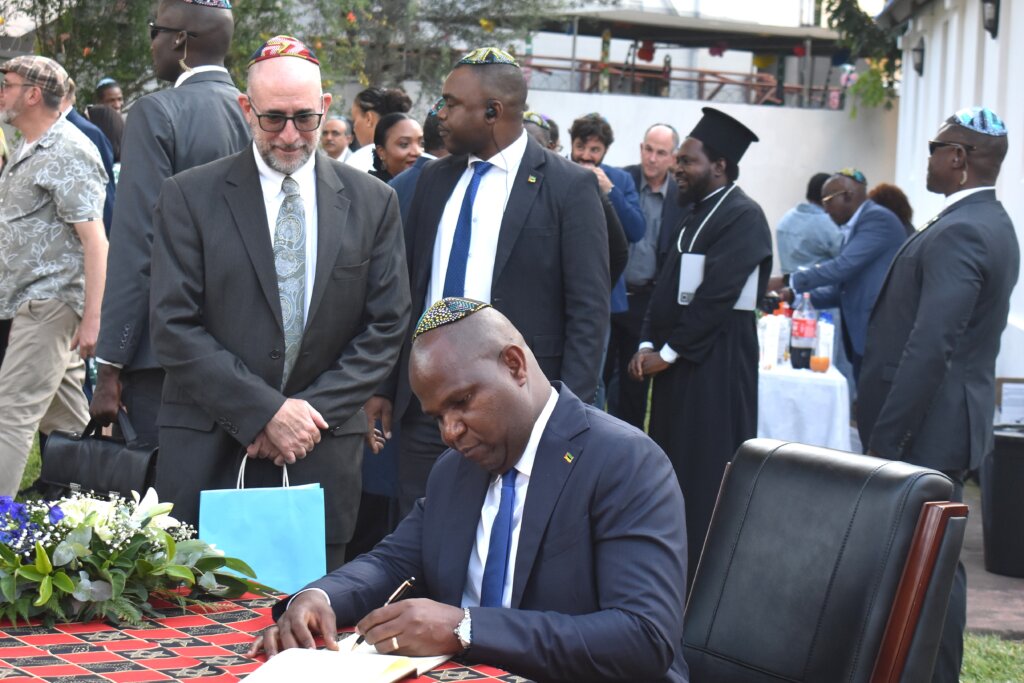
Inside the Honen Dalim synagogue in Maputo, Mozambique, a security team of men in suits wearing colorful kippot swept the inside of the small chapel, while members and visitors milled about on the lawn outside. Security had to be thorough; the president was coming.
For the rest of the city, it was a normal day. The sidewalks near the synagogue were crowded with vendors selling clothes, fruit and candy. Across the street, students hung out in the courtyard of the technical college the Instituto Comercial de Maputo. But for the city’s small Jewish community, it was a momentous occasion.
On June 11, Honen Dalim celebrated the centenary of the synagogue, which was officially inaugurated on Aug. 29, 1926. Congregation leaders and government officials gave speeches. Camera crews from three different TV stations — including the Mozambican state news channel — crowded in the small chapel to capture every moment.

Lay leader Marcos Vaena told me that celebrating the synagogue is not just about the building, but what it represents for Mozambique’s Jewish community, which consists of only a couple dozen families.
“It’s a sense of pride and historical heritage,” he said, adding that the synagogue has endured “profound changes in society — the liberation struggle that the country went through, the independence movement — and it still remains.”
It hasn’t been easy to keep the synagogue alive for a century, but Honen Dalim’s small congregation has persisted without a permanent rabbi or any local Jewish institutions to rely on.
Maputo is a multicultural city with a history of religious partnership, and the celebration’s 100 attendees were a diverse mix of government officials and community members. Among them were the country’s Christian president, Daniel Chapo, whose election in 2024 was marred by accusations of corruption and fatal clashes between security forces and protesters. Across the aisle, sat the German ambassador to Mozambique Ronald Münch and Sheik Aminudin, the President of the Islamic Council of Mozambique. Manuela Soeiro, Honen Dalim’s longest member and “the mother of Mozambican theater,” spoke about being involved with the synagogue since in the 1940s.

Longtime lay leader Samuel Levy gave an opening speech in Portuguese on the spirit of religious tolerance in Mozambique. Rabbi Moshe Silberhaft, chief rabbi of the African Jewish Congress, which supports Jewish communities in Sub-Saharan Africa, and AJC president Nahum Gorelick recited from Psalm 92 — which describes the fruitful life granted to those who are devoted to God — in Hebrew and English. The crowd sang “Hosi Katekisa Afrika,” a Tsonga version of a hymn meaning “God Bless Africa.” Around 50 more people watched on Zoom.

“This date is much more than a chronological milestone,” Chapo said in his speech. “We recognize, with appreciation and admiration, the enduring presence of the Jewish community in the religious, historical, and cultural fabric of our country, Mozambique.”
A long Jewish history
Although the synagogue is 100 years old, the presence of Jews in Mozambique dates back even further. Levy, a New York-born lawyer who has been part of the congregation since the ‘90s, told me the oldest grave in Maputo’s Jewish cemetery, located a few blocks from the synagogue, dates back to 1899.
Global events have always shaped Honen Dalim’s story. Levy said some of the earliest Jews migrated to Maputo due to the Witwatersrand Gold Rush that began in 1886 and helped develop Johannesburg, South Africa. Maputo — known then as Lourenço Marques, after the Portuguese explorer — was critical in the export process due to its coastal location, making it an ideal location for Jewish merchants.
Early Jewish arrivals came from around the world — including Morocco, Lithuania, the United Kingdom, and Portugal, which ruled Mozambique from 1505 to 1975 — often by way of South Africa. In 1906, they established themselves as a community under the name Honen Dalim — meaning “He who is charitable to the poor” — and prayed in each other’s homes.
During the Second Boer War in South Africa, which lasted from 1899 to 1902, the chief rabbi of Johannesburg, Joseph Herman Hertz, was expelled for his pro-British leanings and opposition to the government’s restrictions on Jews and Roman Catholics. During his years-long expulsion — the next time he came to South Africa, it was as the Chief Rabbi of the United Kingdom in 1920 — he spent a few days in Lourenço Marques and encouraged the Jews there to finally build a synagogue.


Levy said the “community waxes and wanes” but that many hundreds were there during the Second World War. Because Portugal was a neutral country, Mozambique was a place where European Jews could find refuge, although they didn’t have full economic freedom and suffered from religious segregation.
Manuela Soeiro, who founded the first Mozambican theater troupe Mutumbela Gogo in 1986, told me at the centenary celebration about her experiences being a Jew at a Salesian Catholic boarding school in the ‘40s and ‘50s. When the nuns saw her hug her Jewish grandfather, they made her and her two sisters sleep in a cold bathtub as punishment for engaging with “the devil.”
After World War II, many Jews immigrated from Mozambique to South Africa, which was experiencing an economic boom.
The Jewish community took another hit when, in 1975, Mozambique gained independence from Portugal due to the Front for the Liberation of Mozambique’s (FRELIMO) successful guerilla campaign. A communist government led by President Samora Machel took over and restricted religious practice.
“All of the religious buildings, not only the synagogue — mosques, churches, everything — was expropriated by the government,” Levy told me.

The majority of the Portuguese in Mozambique left, some by force and some by choice, and many Jews were among those who emigrated. The country was hit hard by economic destabilization. Concrete shells of building projects abandoned by Portuguese builders after independence dot the city skyline.
Only two years after independence, the country’s socialist and anti-communist factions waged a civil war that ravaged the country for 15 years. Honen Dalim’s synagogue fell into disrepair and became a warehouse for the Red Cross.
The synagogue’s address ties the building both to the country’s colonial and post-independence eras. Avenida 24 de Julho — July 24th Street — was named after the date in 1875 when Portugal took full possession of Maputo. Exactly 100 years later, on July 24, Machel nationalized almost every sector of Mozambican society.
Revitalizing the community
Nuno Soeiro remembers his mom Manula continuing to look after the synagogue, along with his uncles, even though they weren’t allowed to practice religion there in the communist era.
“Some people from the American embassy, they used to do some lessons,” Nuno Soeiro told me, saying they went to embassy officials’ houses to observe Jewish holidays.

In 1989, the synagogue had an unexpected savior: Alkis Macropolous, a Greek, and not Jewish, businessman. His Jewish colleagues in Johannesburg encouraged him to help preserve the building. He ensured that the dilapidated structure was not torn down and arranged for an ad to be placed in the paper asking for any remaining Jews to claim the synagogue — and they did. The defeat of the communist government in 1990 — which was replaced by a presidential republic — allowed religious communities to be active again.
When Samuel Levy arrived in 1993, the synagogue didn’t have enough people for a minyan and wasn’t having official services, but on Saturday afternoons, Jewish and non-Jewish members gathered together to sing folk songs. Although it wasn’t a traditional service, Levy found it spiritually fulfilling.
“Those songs were maybe the most simplest prayers I’ve ever heard,” Levy told me. “But also the deepest.”
For Larry and Diane Herman, Conservative Jews from Detroit who arrived in Maputo in 1999, practicing Judaism without a large community was nothing new. Larry’s work as an economist took them around the globe, including to Burkina Faso, Chad, Niger and Uganda.
“We were the center of the Jewish community in Ouagadougou from 1975 to 1977, which simply means the three or four or five other Jewish Peace Corps volunteers,” Larry told me.
The Hermans took on leadership roles and Diane put together a spiral-bound siddur for services that includes prayers in Hebrew, English and Portuguese. They wrote a prayer for Mozambique based on the prayer for the country found in many U.S. prayer books. Levy also led services, even while away.
Natalie Tenzer-Silva, who moved from South Africa to Mozambique with her family in 1993, told me Levy would send cassette recordings of Kol Nidre when he couldn’t be there to lead High Holiday services himself.
“He would blow the shofar over a cell phone or send a recording of it,” Tenzer-Silva said. “He really is the pillar, making sure that we have all the writings and the readings and all of that ready for the holidays and for the Friday nights.”

The Hermans were the only Shabbat-observant and kosher members of the synagogue at the time. To buy kosher food, they went to Johannesburg, often bringing things back for the congregation. These imports were critical around Passover, when the Hermans hosted seders at their home, sometimes for as many as 50 people.
Not big enough to have a full executive board or leadership team, the synagogue members had to set their own guidelines.
“We sat for like four hours trying to hash out the rules,” Diane Herman said.
“When you already don’t have a minyan of Jews, let alone males, and you’ve got all these intermarried couples, what do you do about the spouse? And what do you do about these people who aren’t Jewish at all, but want to participate?” said Diane. “We hashed out how to create a community there. It was fascinating.”
“When Jews come there from other places, they realize if they’re going to give any expression to their Jewish identity, they need to work on it,” Levy said. “If you want your kids to know something, well, you’re going to have to start a Sunday school or really participate in it. If you want the holidays to happen, you’re going to have to organize to import matzo and kosher wine for Passover because we can’t make it.”
Rebuilding the synagogue
Considered one of the poorest countries in the world, Mozambique attracts many people from abroad who work in diplomacy, aid, or international development. As more Jews arrived to work in these sectors, it became clear the synagogue needed physical improvements.
“When I arrived, there were poles supporting the roof,” Tenzer-Silva told me. “And every time we would go to services, if the wind blew, my children would think the roof was going to fall in.”
Larry Herman remembered one Shabbat where a corner did fall in — and another where a rat fell from the rafters.
In 2009, congregant Juliana Becker decided she wanted a bat mitzvah — the first to happen in the country — and turned to Larry for tutoring. A Torah was brought in from South Africa, since the synagogue lacked its own, and 125 people attended from Maputo and from abroad. The event prompted Honen Dalim’s leaders to successfully file for official recognition from the government in 2010, making them the legal owners of the synagogue.
Five years later, in preparation for the bar mitzvah of Tenzer-Silva’s older son, Jordan, the congregation decided to replace the roof. But this could not be done safely without updating the walls and flooring. Tenzer-Silve said what was originally supposed to be a $25,000 bill became more than $120,000.
With help from the local community, and friends and family abroad, Honen Dalim managed to raise the money — just in the nick of time for Jordan.
“The Friday of his bar mitzvah, they had finished painting the walls,” Tenzer-Silva said.

In 2013, Honen Dalim held a rededication ceremony celebrating the rebuild. Ann Harris, then-President of the African Jewish Congress, and Rabbi Moshe Silberhaft gave the congregation a kosher Sefer Torah — something they had lacked before. Other faith leaders and government representatives attended, including then-Minister of Justice Maria Benvinda Levi, who now serves as the country’s Prime Minister and has Jewish ancestry.
Multiple members of Honen Dalim described the environment of Maputo as extremely tolerant and supportive of the Jewish community.
“The entire time I lived in Mozambique, I wore a kippah on the streets and never had any problems,” Larry Herman told me.

Many attribute this respect for religion to the role faith leaders played in dissuading violence during the civil war. A wing of the city’s central church is dedicated to Pope John Paull II, who made a famed visit in 1988 advocating for peace. Ultimately, the Catholic lay movement, the Community of Sant’Egisio, brokered peace. Tenzer-Silva and others remarked that the civil war made people tired of conflict.
Honen Dalim is part of the COREM — the Council of Religions in Mozambique. Its President, Moisés Chiziane, spoke at the centenary event, urging continued coexistence.
“Peace is not built only by the absence of conflicts,” he said. “Peace is built by respect, listening, acceptance of diversity and recognition of the dignity of every human being.”
Levy told me Honen Dalim has hosted a Muslim adult study group at the synagogue to learn about Jewish practices, such as putting on tefillin.

“The people who run the different faith organizations,” Levy said, “they make it an article of faith that they need to actively get along — not tolerate, but learn about the faith of other people.”
In recent years, a branch of ISIS has established itself in the northern part of Mozambique, displacing local residents and leaving other religious groups — and non-affiliated Muslims — fearful of being attacked. But Natalie Tenzer-Silva said that type of extremism has not been seen in Maputo.
“It won’t come down south,” she told me confidently. “People wouldn’t tolerate it.”
A tenuous position
Although the community is still active, members described Honen Dalim as “fragile.” Tenzer-Silva said there could be anywhere “between three and 12 people” at a Friday service — the turnout isn’t big or consistent. They also lack the type of programming that bigger synagogues offer.
“I would like to take my kids to synagogue to learn Hebrew,” Nuno Soeiro said. “We don’t have that.”
Individuals like Levy can help organize lessons for kids like Soeiro’s daughter to be on track to become bar or bat mitzvahs. But the number of people with that type of knowledge is limited.
According to Levy, COVID was “a big blow to the Jewish community.”
“At that point we had Sunday school with eight kids,” he said. “After that, things kind of became a little more tenuous and they’re a little more tenuous today, but we try to keep going.”
The congregation’s reliance on expats also puts it in a delicate position. Synagogue leaders say only around a third of congregants are permanent residents. While some expats find a permanent home in Maputo, others leave due to work or family. After 16 years in Maputo, the Hermans left and now live in Los Angeles. Levy divides his time between Maputo and Dubai, although all three help manage things from a distance.
The recent cuts to USAID programs to Mozambique will likely diminish the number of American Jews who have jobs that require them to move there. And a hidden debt scandal in the mid-2010s that cost the country nearly $2.2 billion broke the trust of investors from around the world who may have sent Jewish employees to Mozambique.
“A lot of the international community withdrew support for many years,” Marcos Vaena said. “It was 10 years of economic crisis.”
Vaena, who grew up in Brazil in a Sephardic family with Turkish roots, first moved to Maputo in 2006 as a UN volunteer for a development program. He left in 2010 to work in other developing countries, but returned in 2024. He told me he saw “a diminished community” compared to the Honen Dalim he’d left behind. He decided to start leading Shabbat services a couple times a month.

“I wanted to make sure that my kids have continued exposure to a Jewish tradition and education,” he said.
It’s not just expats, however, who want a more formal way to be involved in Judaism.
“There’s a regular interest from Mozambicans that are seeking spiritual connection through Judaism,” Vaena said. “But then you need, I think, a more structured process and support for those who are there.”
“There were a lot of people who had been happy to convert, and that just wasn’t possible,” Diane Herman added. “There was no rabbi around.”
“We have a lot of people who were, I call, ‘lovers of Zion’ as opposed to Jews,” Larry Herman told me. “They were some of the biggest supporters.” He recounted what happened when he and Diane lost their fathers. ”Both of us went to the funerals in the United States and came back, and we were in our period of mourning — it was the non-Jews who supported us by coming to every service.”
There is also no mikveh, the ritual bath needed for conversions. Diane said some people go to South Africa for the rite, but they tend to be those with money. In a country where half of all workers earn less than 60,000 Metical a year — less than $1,000 — it’s not a viable option for the vast majority of Mozambicans.
Rabbi Moshe Silberhaft, chief rabbi for the AJC, occasionally helps the congregation with critical events, but Silberhaft serves nine different countries and cannot be everywhere at once. Tenzer-Silva told me that bringing in a permanent rabbi for such a small congregation would be difficult, especially with the lack of kosher food options. Vaena said he himself has considered seminary training.
“That experience leading the services and being more engaged on a daily basis has really brought me a lot of joy,” he said.
Perseverance
Despite the struggles the community faces, the 100th anniversary ceremony did not feel like a pity party for a dying congregation. Kids ran around the lawn during the reception, which was stocked with bagels and cakes from a kosher caterer in South Africa. Tenzer-Silva’s son Jordan, who’s in his late twenties now, helped usher people at the event and recited “Tzadik Katamar” alongside other synagogue leaders. The younger generation of the synagogue is small, but present.

And those who have moved away don’t really leave Honen Dalim behind. From Los Angeles, Larry Herman serves as the president of the Friends of the Jewish Community of Mozambique, helping garner international support for Honen Dalim. Although he and his wife haven’t lived in Maputo in 10 years, they spoke of it with great reverence.
“It’s a wonderful community,” Larry said. “I’m very proud of it.”
Honen Dalim continues to welcome new members and serve as a place where Jewish visitors can have a home. Members told me that travelers have come from America, Paris, Israel and other parts of the world. For Jews who end up in Maputo — whether for a few days, a few years, or the rest of their lives — Honen Dalim serves as a vital source of community. Several people said they had never been more Jewish than they had been in Mozambique.
“May the next hundred years be of peace, prosperity, and abundant blessings for all,” Chapo said toward the end of his speech. Although his words were practically all in Portuguese, he closed with a message Jews around the world could understand: “Shalom. Shalom. Shalom.”
The post Mozambique’s only synagogue has been keeping Judaism alive in the country for a century appeared first on The Forward.
Uncategorized
What Muhammad Ali taught me from his Jerusalem hotel
The one time I got to talk to Muhammad Ali was a summer evening when I was working at one of my favorite college internships — in the McClurg Court newsroom of WBBM Newsradio 78, the Chicago affiliate of CBS Radio.
The scene came to mind earlier this week when I released a new audio documentary called Broken Hologram about Ali and his brief stint as a Broadway star. But back then, I was one of a quartet of interns who included a cool girl from Hyde Park named Gwen Billings with whom I occasionally took lunch at a nearby hot dog stand and discussed important news figures like, say, Depeche Mode and The Smiths. There was also Linda, a hard-nosed news reporter in the mold of Holly Hunter in Broadcast News. Sometimes she came around to my cubicle and took sips of my Dr. Pepper. Not in a flirtatious way, more in a proto-Daniel Day-Lewis “I drink your milkshake” kind of way. There was a fratty guy named Scott who wore a class ring from (redacted). He went on to a lucrative career, just not in journalism. There was one other dude; he was from Crown Point, Indiana, but that’s just about all I remember.
My job consisted of answering phones, ripping wire copy from the AP and UPI machines, getting sources on the phone and calling every major fire and police station every night to see if there was a story to be reported (“Hi, Sergeant Kupka, it’s Adam from WBBM: Do you have anything working in your area?”).
Even though every sergeant told me the same thing every night, I kept calling because that’s what journalists do: You keep making the calls. In fact, I did pretty much whatever was asked of me, and turned feisty only when one of the few asshole reporters tried to get me to run downstairs to the loading area to fetch him a “Green Streak” edition of the Tribune so he could check on his stocks or intimated that my job description should include making him coffee.
“Sure could do with a cup o’ coffee right now, Adam.”
“Cool, why don’t you make yourself one?”
Note: The individual referred to is decidedly not John Cody, a truly great man who remains a friend to this day. (Fun fact: During Vietnam, John worked for Stars & Stripes alongside Seth Lipsky, founder of the English language edition of the Forward)
Nor am I referring to sports reporter Rich King, a prince of a man who always offered to get people sandwiches from the White Hen Pantry (“Anyone need anything from ‘The Hen?’”).
Sometimes, when the news day got super-slow — for example, when Notre Dame football coach Lou Holtz was in the studio doing a live call-in show — I passed the time by trying to guess the usually ridiculously easy passwords for the WBBM staff’s new computers and snooping in the reporters’ early version of email in a futile effort to find anything interesting. Apologies to the late Dale McCarren (DMC123).

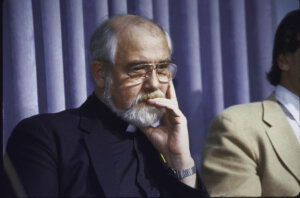
I was working the evening shift when the top news story was about Father Lawrence Martin Jenco, a Catholic priest from Joliet, Illinois, who had been taken hostage in Beirut while he was working for a relief agency. Muhammad Ali was part of a delegation that had flown to the Middle East to try to arrange his release.
Meet Broken Hologram | RSS.com
My supervisor was a terrific guy named Duane Gray, an African-American Conservative who was big on conspiracy theories (“You should read this book. It’s called The Terror Network.”). He was a great manager and colleague who made sure that we kept to the schedule and that traffic, weather, sports and news headlines always came right when they were supposed to. On this particular night, Duane gave me a mission: “Get ‘The Champ’ on the phone.”
“Uh, how do I do that, Duane?”
“Call every hotel,” he said.
He scrawled a list of hotels in Tel Aviv and Jerusalem on a legal pad and I started calling Information to get their numbers. Advantage of working for a CBS affiliate: You got to make all the long-distance calls you wanted.
How many calls did I make? What were the names of all the hotels? I have no idea. But I do remember that one of them was the King David Hotel in Jerusalem because this time, when I asked to be transferred to Ali’s room, no one said, “Sorry, no one here by that name.”
Ali picked up. His voice had that raspy quality it got after he retired from boxing. “Hullo?”
“Hi, I’m calling from Newsradio 78. I was hoping one of our anchors could speak with you.”
“You’re calling from Chicago?” he asked.
“Yeah.”
“Man,” Ali told me, sounding weary but amiable. “It sounds like you’re calling from right next door.”
Duane could be a wise-ass and a cynic, but now he was star-struck. He sprang to his feet. “Is that the Champ?”
I nodded.
Duane grabbed the phone. “How’re you doin, Champ? You’re gonna be on with Dale McCarren. I’m gonna patch you through, Champ.” He gave me a hearty high-five.
Some time later — perhaps after a week, perhaps after two — when Madonna was in town for some concert, movie junket or photo shoot and Duane told me he wanted to get her on the air, I knew exactly what to do.
After I got her on the phone at her hotel and transferred the call to Duane, he shouted: “This kid,” he said, complimenting both me and his own managerial talent, “has the best news instincts of anyone in this newsroom!”
“Hello, Madonna?” Duane said into the phone. “You’re gonna be on with Dale; let me patch you through.”
The post What Muhammad Ali taught me from his Jerusalem hotel appeared first on The Forward.
Uncategorized
Rock legend Steven Van Zandt’s new gig: Holocaust education
(JTA) — Steven Van Zandt is worried about the Jews.
“There is that pre-Holocaust vibe,” the Rock and Roll Hall of Famer told the Jewish Telegraphic Agency recently about what he sees on social media, where he is a prolific user. “They spread lies around year after year after year, and if you say something often enough, people start to believe it.
“And that’s what happened that led to the Holocaust in the first place, and that’s what’s going on now.”
For a man equally beloved for his longtime work with Bruce Springsteen in the E Street Band and his role as Silvio on HBO’s “The Sopranos,” such a detour might seem unusual. But Van Zandt is looking to make his own mark in the world of Holocaust education, via his education initiative TeachRock, which since 2013 has provided K-12 lesson plans on a range of subjects built around popular music.
Titled “Jewish Heritage and the Holocaust: Exploring an Enduring Culture Through Music,” the initiative’s four-day lesson plan, launched this week, includes the onset of antisemitism in prewar Europe, survivor testimony and Jewish values. Anchoring the lessons are rock songs from the likes of KISS, the half-Jewish glam metal band, beloved Jewish folk singer Leonard Cohen and contemporary New York pop band Lawrence, which is fronted by two Jewish siblings.
It’s a departure from the somber tone of most Holocaust education programs, a space that the Jewish community has heavily invested in despite mounting questions about the effectiveness of such lessons in curbing antisemitism. Other contemporary Holocaust learning initiatives have employed video games, artificial intelligence and similarly novel approaches as educators struggle to adapt to a near future without living survivors to share their testimonies.
For Van Zandt, the lessons aren’t just teaching about the Holocaust, but also about highlighting positive Jewish influence in the world of popular culture. He rattled off a list of Jewish artists he admires, including Bob Dylan and the pop songwriting team Lieber and Stoller.
“I have a lot of gratitude for what they have contributed to my life, just in terms of enjoyment,” he said. “Show business doesn’t exist without the Jewish contributions.”
The guitarist founded TeachRock in 2013 alongside other big names from the world of music and the arts, including Springsteen, U2 frontman Bono, Jackson Browne and the director Martin Scorsese. On Thursday, the organization piloted its new Holocaust education lesson plan to 50 high school students at the Florida Holocaust Museum in St. Petersburg, timed to the state’s Holocaust Education Week. Florida’s Holocaust education task force is promoting the material to districts across the state.
“We always want to be educating in a way that feels like you’re not being taught. And I think this captures that,” Michael Igel, a contributing author on the TeachRock lesson plan who also chairs the statewide task force, told JTA.
For Igel, a descendant of survivors, the project fits neatly into his own efforts to bring Holocaust education into unconventional spaces. He’s planning future courses that incorporate food and theater.
“It’s still standards-based Holocaust education. But it’s being delivered to students in these different portals,” he said.
It was through Igel’s promotion of such nontraditional methods that he was approached by a member of TeachRock’s leadership council a year ago. TeachRock had recently been looking to offer lessons on Jewish heritage, and saw an opportunity to broach the subject of the Holocaust through Igel.
A huge E Street Band fan, Igel laughed as he recalled how the council member asked him if he had ever heard of Van Zandt.
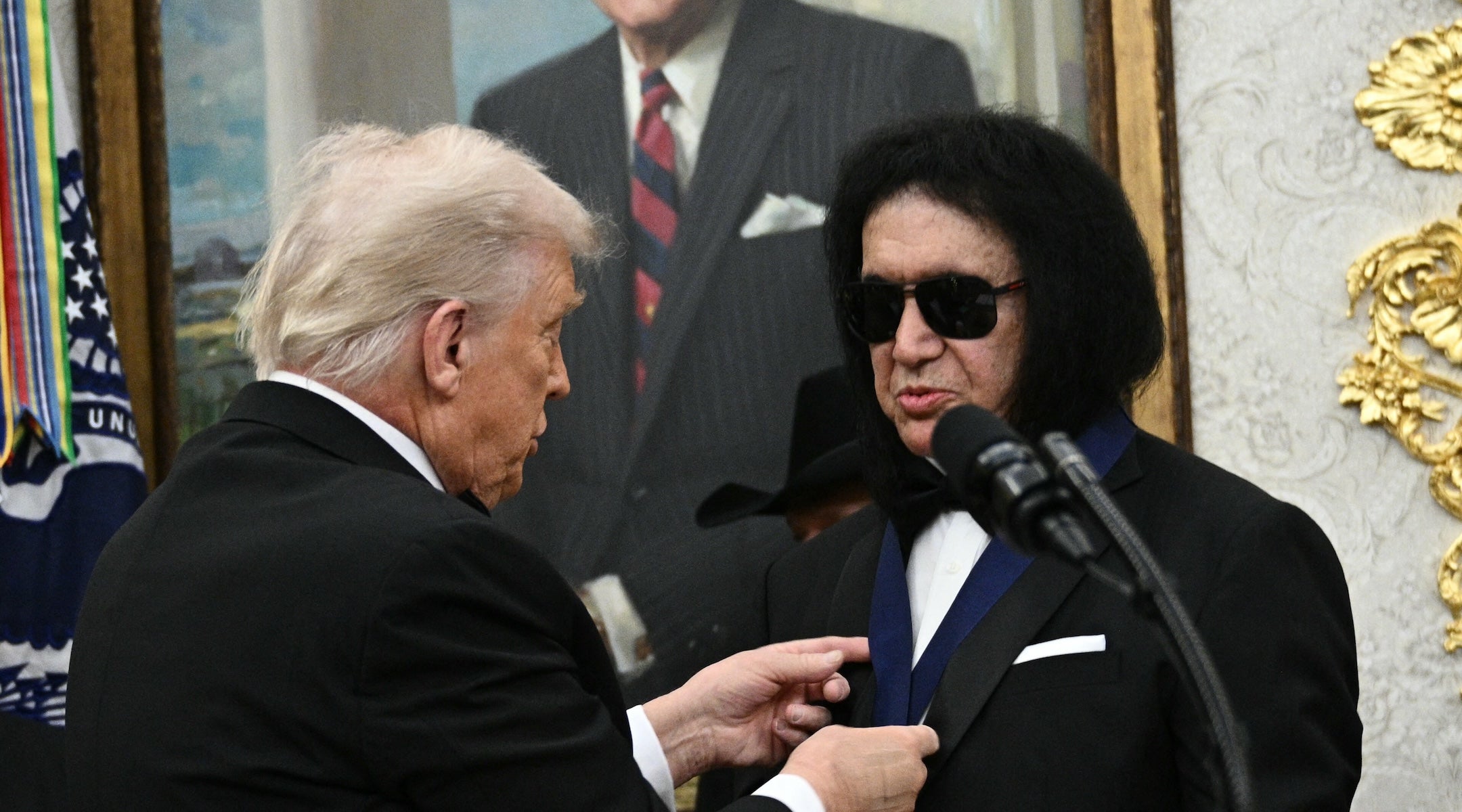
The first of the curriculum’s four days opens with students listening to “Rock and Roll All Nite,” the 1975 hit by rock band KISS, before segueing into Jewish life in prewar Europe and the rise of antisemitism.
Igel noted the unique nature of the lesson. “When Gene Simmons with his tongue out is the first thing you see, you’re wondering, ‘What the heck happened to Holocaust education?’” he said.

Gradually the link becomes clear: The lesson explains that KISS frontman Gene Simmons is the son of a Holocaust survivor. Much of the curriculum is built around similar ideas of Jewish survival and resilience, as students are asked to contemplate how Simmons’ family background may have informed his outré stage persona. (Co-founder Paul Stanley is also Jewish.)
Such concepts, he said, help expand the idea of a Holocaust lesson beyond Jews as “victims in a snapshot of time.” In teacher training sessions, educators have responded well to the musical framing and excitedly discussed which songs they would want to pass down to future generations — a positive sign for Igel, who hopes to convince teachers to use the curriculum even outside of the state-mandated Holocaust Education Week lessons.
While Van Zandt, who is not Jewish, doesn’t craft the curriculum himself, he is friends with Simmons and the two have spoken before about wanting to use music to teach Jewish history. Max Weinberg, the E Street Band’s longtime drummer, is also Jewish.
The initiative comes at a moment when the world of popular music, like many other cultural sectors, has become engulfed in controversy over Israel. A recent dustup involved Ed Sheeran and Macklemore, in which Jewish venue owner Robert Kraft pressured Sheeran to drop the rapper from his tour over his onstage pro-Palestinian activism. That prompted many artists to support Macklemore, including Jewish actor Ilana Glazer, who spoke at one of his “Free Palestine” tour stops. Several leading musicians, including Lorde, Paramore and Björk, have also signed pledges to boycott Israel over its conduct in Gaza, while others including Pink and Boy George have taken opposite tracks.
All of this discourages Van Zandt, who famously led an international artist boycott of the South African resort venue Sun City in 1985 to protest Apartheid. The artists now backing the Boycott, Divestment Sanctions movement targeting Israel have cited the Sun City protests as a direct inspiration. (Sun City itself was founded by Sol Kerzner, the son of Jewish Russian immigrants.)
But Van Zandt says the two causes are different.
“Yes, I am known as the boycott king of the world,” he said. “It’s not the same situation. Trying to deny weapons for Israel to defend itself is obscene. It’s ridiculous. It’s terrible.”
He has feuded with Roger Waters, the Pink Floyd co-founder and outspoken pro-Palestinian activist, over BDS.
“I wrote him a very nice, detailed letter saying that it was misconceived, it’s a mistake, it’s not going to accomplish anything,” Van Zandt recalled. “I was very nice to him. Very diplomatic, very respectful. And then he starts just calling me names in the press.” (Waters has directed expletives at Van Zandt and other contemporaries who disagree with him about Israel in interviews.)
Igel, too, is thinking about how TeachRock’s lessons can address contemporary discourse over Israel, a subject that many Holocaust educators often are reluctant to bring up in the classroom even when students press the topic. His curriculum defines what a genocide is — “for a generation that needs to know what that word means, and what it doesn’t mean,” he said.
Following this week’s pilot program, both Igel and Van Zandt hope states beyond Florida will take an interest in their lessons. The rock star has ambitious goals for the initiative: to try to change the national conversation around Jews and Israel that has filled his social media feeds, which he describes as “lies on top of lies.”
“Eventually there’s got to be a national public conversation about this, which is not taking place,” he said. “So eventually it’s going to have to be. At that point, all bets are off.”
This article originally appeared on JTA.org.
The post Rock legend Steven Van Zandt’s new gig: Holocaust education appeared first on The Forward.
Uncategorized
Were Leopold and Loeb inspired by Nietzsche, or Jewish self-loathing?
Any production of Patrick Hamilton’s popular thriller Rope, like any game of Clue, can be reduced to props, setting and culprits.
The central prop is a large chest, containing a freshly-murdered body. The setting can vary: Mayfair in Hamilton’s 1929 original, Manhattan in Alfred Hitchcock’s 1948 screen adaptation starring Jimmy Stewart. The names of the players are sometimes different, but there are always two students in their finely-appointed apartment with the titular murder weapon.
Gordon Greenberg’s new adaptation, now playing off-Broadway at the New Group’s space at St. Clement’s, presents a novel clue as to what prompted the crime: a Christmas tree upstage right. In his take on this “well-made play,” which Greenberg believes has its deficiencies, the central characters, inspired by University of Chicago students Nathan Leopold and Richard Loeb, are once again Jewish, but doing their best to conceal that fact.
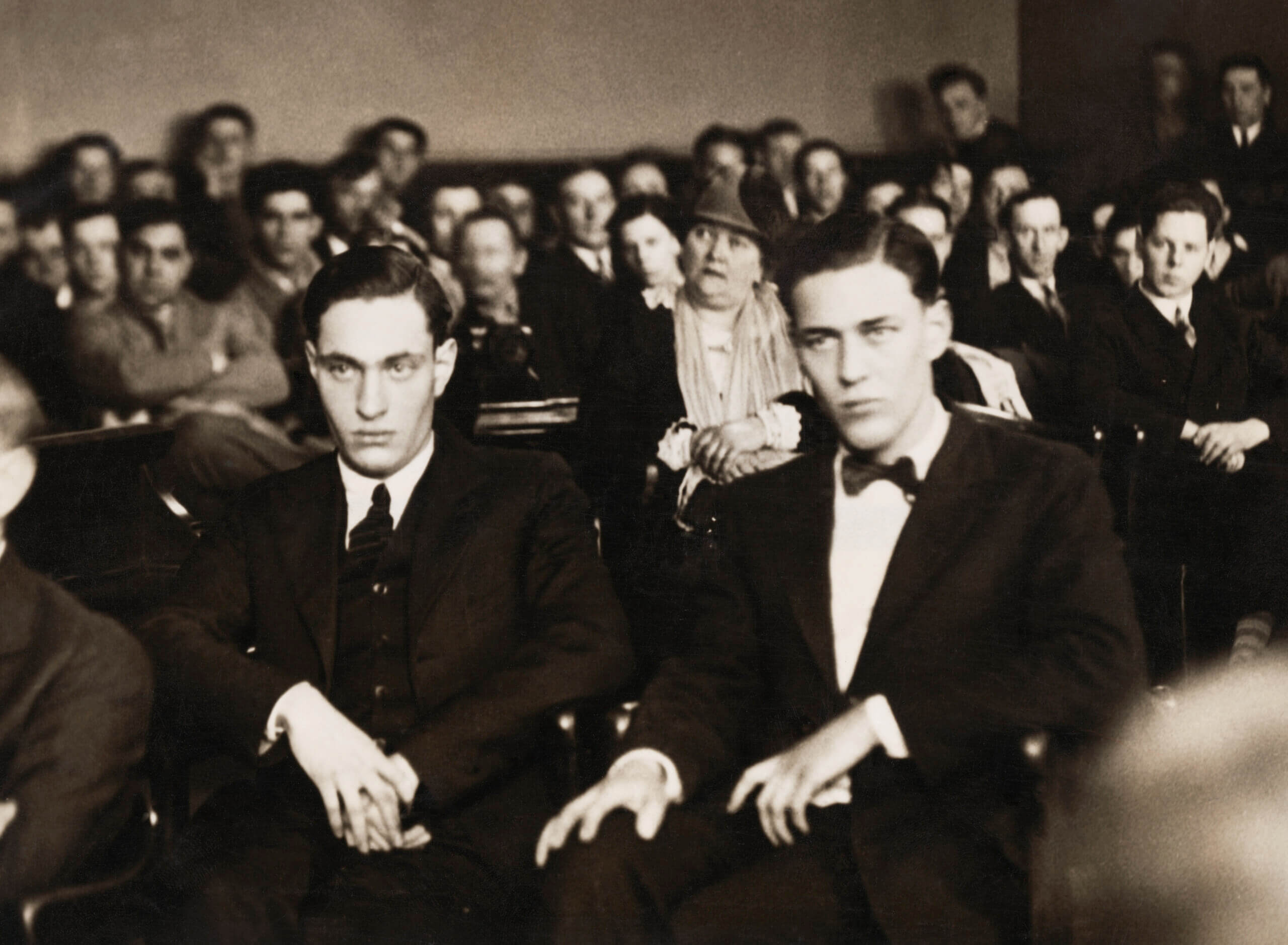
Hamilton, who wrote his play shortly after Leopold and Loeb’s conviction, was struck by the men’s alleged lack of motive, beyond a desire to pull off the perfect crime based on their nihilistic misreading of Friedrich Nietzsche’s philosophy. Greenberg doesn’t buy that the killing was dispassionate, and believes a crisis of identity was at play.
“What drew me to it was thinking about what the factors might have been that went into this murder that I personally find hard to believe was just theoretical,” said Greenberg, a director and playwright, who recently revived Joseph Stein and Stephen Schwartz’s The Baker’s Wife off-Broadway. “I don’t think anyone does anything for purely theoretical reasons. We can extrapolate them later, but in the moment we are going on gut impulses and human needs and sexuality and jealousy and all of these fiery emotional poles that make us human.”
Greenberg, who is gay and Jewish, had long been fascinated by the Leopold and Loeb case, wondering what led two well-bred, cerebral Jews to commit a supposedly “motiveless” murder. (In the real crime, notably fictionalized in Meyer Levin’s Compulsion, Nathan Leopold and Richard Loeb killed a 14-year-old boy, Robert Franks; in Rope, they kill a wealthy classmate.)

Hamilton’s play, which Greenberg found to be “antiseptic,” de-Judaized and stripped of queerness, is not concerned with the “why” of the killing.
His murderers, Brandon, described as “tall, finely and athletically built, and blonde” and Granillo, “a Spaniard” with the “shrug of the shoulders characteristic of his race,” are in it for the thrill. They convene a dinner party and serve the meal on the chest containing their victim, certain they won’t be caught.
In Greenberg’s version, set in 1957 Manhattan, Brandon is Garret Stern (Cameron Monahan), a working-class striver who declaims, in a break of the fourth wall, that he “wants to be mistaken for the son of assimilated German Jews, not the shtetl Jews with bent vowels and calloused hands from whom he actually descends.” (As part of the ruse, he’s abandoned his given name of Gary.)
Granillo is now Nate Singer (Corey Fogelmanis), the Yekke scion of a garment district macher who, to his upwardly-mobile mother’s delight, “can almost pass for gentile.” Both are students at Princeton and plan to drop the body back in Jersey after their macabre dinner party.

Like the real Leopold and Loeb, they are also involved sexually and sadomasochistically. Greenberg says he was partially inspired by Tom Kalin’s 1992 film Swoon, which revisited the killers through a queer lens.
Nate’s instilled self-hatred likely feeds into his desire to be dominated by Garret, whose rough upbringing as a Jew in postwar Skokie taught him the utility of violence. (His school principal praised him for breaking a boy’s nose, saying “your people aren’t exactly known for defending themselves.”)
Greenberg, who said that, as an actor he played “every Herb Gardner and Neil Simon play around,” chose to move the action up to the era Lavender Scare and a resurgence of casual, clubby antisemitism following the “chemotherapy of World War II” that briefly put it into remission.
Nate and Garret’s guests, for their post-Christmas shindig, whose centerpiece is a chest containing a corpse, include a polished, pedigreed classmate; a droll Sarah Lawrence student; their closeted professor, who will catch them in the lie; and a Mayflower-descendant judge who happens to be the father of Ronald Kentley, the deceased.
Driving the boys’ motive and cue for passion is Nate’s tormented attraction to Ronald, who he fears might out him and land him on McCarthy’s list. Garret is jealous, but sees an opportunity: In bumping Ronald off, he hopes to take his place as the judge’s surrogate son, gaining entry to the patrician world to which he aspires.
But their guests’ routine macroaggressions show the futility of trying to overcome their backgrounds. The Christmas tree is fooling no one. Greenberg is similarly unconvinced that Leopold and Loeb’s murder was merely a Nietzschean performance, undertaken to prove that morality need not apply to superior intellects.
“No one really knows what was going through their mind, and no one ever will,” Greenberg said of Leopold and Loeb’s crime. “But taking one of these fascinating true crime stories and positing what the humanity is behind it, what’s all the flesh on the bone, is to me the fascination and the fun exercise.”
The post Were Leopold and Loeb inspired by Nietzsche, or Jewish self-loathing? appeared first on The Forward.
