


Uncategorized
I was there when the lights went out and New York was plunged into darkness
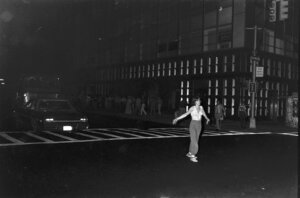
I’m the lifelong resident of a vast and complicated metropolis that smugly prides itself on never stopping. Subways, buses and cabs running day and night, bodegas and diners open 24/7, hundreds of thousands of people at work or out partying somewhere, bike couriers and truck drivers making deliveries — all in a town with a million moving parts, where the show always goes on — until, suddenly, it doesn’t.
I was reminded of that one evening not long ago in a drab Chinese restaurant uptown on Broadway, clutching a pair of wooden chopsticks poised to shovel another mound of chicken and walnuts into my mouth.
Music was playing softly over the house PA system. The melody suddenly sounded strangely familiar, but oddly out of place in those surroundings. I froze mid-bite, trying to place what I was hearing. Then it hit me. I glanced at my dinner companion Ann Aptaker, author of the Cantor Gold noir crime novels.
“Wow,” I said. “Do you hear that?”
She paused, tilted her head slightly, then raised an eyebrow.
“Yes,” she said. “It’s Threepenny Opera!”
Sure enough, the song drifting through the room was Kurt Weill and Bertolt Brecht’s wickedly jaunty tango, “Ballad of Immoral Earnings.” Even stranger, it was a track from my favorite production of the show: the Lincoln Center revival from decades ago, starring the late, great Raul Julia as Mack the Knife and Ellen Greene as his favorite prostitute, Jenny Diver.
“Of all things! What a weird song to play while people are eating,” I mused.
“I don’t think I’ve ever heard it in a restaurant before,” she agreed. “And certainly not a Chinese place.”
“They must have good taste in musicals.”
Shrugging, we resumed picking away at our dinner. A minute later another song from the same show began to play. We gaped at each other.
“They’re playing the whole album!” I sputtered. “What are the odds?”
Ann frowned and paused. then suddenly whirled to reach into the pocket of her denim jacket hanging behind her chair. She pulled out her phone, and the music instantly grew louder. We both laughed. She must have leaned back against her jacket and set off her music app. Whew — mystery solved!
But hearing those distinctive strains of Weill’s score transported me back to one of the hottest summers New York City had ever endured.

It was 1977, the year I attended an outdoor performance of Threepenny Opera at the Delacorte Theater in Central Park. My mother and a roommate from Pratt had joined me that night.
The Delacorte sits beneath the stone towers of Belvedere Castle, lit by floodlamps like a fairytale illustration, open to the sky and the sounds of the city beyond the trees. On a good night it can feel magical. On this particularly sweltering night, the air hung over us in the audience like a damp blanket as Philip Bosco, who had replaced Raul Julia for this summer staging, swaggered across the stage as Mack the Knife, and Ellen Greene reprised her role as Jenny.
And then — just as she was belting out her furious solo number, Pirate Jenny — all the lights shut off. Greene’s mic abruptly went dead, and the band lurched sourly out of tune before grinding to a halt.
We were plunged into pitch darkness. For a moment, there was silence.
Then the crowd began to buzz nervously. Was this part of the show? I’d seen the play several times before, and knew that it most definitely was not.
A few awkward minutes later, some of the cast reappeared wielding flashlights. While the tech crew worked on the electricity, the band filled the darkness with some lively jazz. Rubber-limbed dancer Tony Azito pranced around jovially in the flickering beams, easing the mood for a spell. But that age-old theater adage, the show must go on, was about to bite the dust.
The house manager finally stepped up on stage to make an announcement: “Ladies and gentlemen, we just learned that there’s been a massive power failure at Con Edison. It’s not just us; the whole city is dark!”
We didn’t know it yet, but this was the Big Blackout of July 13, 1977, and there we were, thousands of us stranded smack in the middle of Central Park. There wasn’t even much of a moon out that night, so it was really, really dark.
“Well, this is some pickle,” Mom said.
We wondered how the hell we were going to get out of there.

I vividly recalled the last big blackout in New York City, the one in 1965. I was just a young kid back then and safely at home, so it had actually been fun. While my mother lit a few Sabbath candles, my little sister and I roamed from room to room pretending we were in a haunted house. Meanwhile, our poor Dad had to trudge back to Brooklyn from midtown Manhattan — a five-hour hike in hot leather shoes.
But this time felt very different. I was far from the safety of home, trapped in the middle of what might as well have been a forest at night. Central Park is beautiful when you can see it. In pitch darkness it’s downright hazardous.
“Guess we’ll all just have to sleep in the park tonight,” I cracked. Neither Mom nor my Pratt roomie were laughing.
Thankfully, a phalanx of city cops eventually arrived to help guide us out. Audience members, cast and crew all joined hands as we carefully made our way along the park’s winding paths, stepping over roots and curbs, catching one another when someone stumbled. Our only illumination came from a few scattered police car headlights.
A walk that normally takes ten minutes took forever, but eventually we emerged onto Central Park West.
The scene was eerie. Streetlamps were dark. Traffic lights were out. Cars sat frozen in the intersections. Not a single apartment window was lit. For a city that never sleeps, it felt as if someone had suddenly flipped off the master switch.
Then I spotted something: “Look, the buses are still running!”
A city bus was rumbling slowly toward us, brightly lit inside. With the subways dead, getting back to my dorm in Brooklyn would have been impossible, so Mom’s place on the Upper East Side looked like the safest destination. She had temporarily split with my Dad and was living there with a roommate at the time.
The three of us squeezed aboard along with what felt like half the audience, and somehow made it across town to First Avenue. As we approached my mother’s high-rise, a dreadful thought suddenly hit me.
“Mom, what floor are you on again?”
“Twenty-five,” she replied grimly.
Of course both elevators were dead. We trudged up 25 flights of stairs in complete darkness, arriving exhausted and panting. My mother fumbled with her key, finally opening the door to reveal Sylvia, her gravel-voiced, seen-it-all Long Island roommate, standing there with her ever-present cigarette tip glowing in the dark.
“Come on in, darlings,” she rasped dryly. “Join the party.”
Sylvia had lit a few candles around the apartment, the only light we’d see that night.
Outside, the city was far from peaceful. While we tried to sleep on sofa cushions on the floor, one of the worst nights of unrest in New York history was unfolding in the streets below. Store windows were smashed. Shops were looted. Garbage cans were set on fire.
Lying there in the dim glow of flickering candlelight, hearing distant sirens punctuated by the sudden crash of breaking glass somewhere in the darkness below, I felt a growing sense of dread. An evening that had begun with music and theater had improbably ended with Manhattan plunged into darkness, its fragile machinery suddenly exposed.
By morning the city looked as though it had survived a world war.
This resilient burg has been battered and bruised over the years, enduring terrorist attacks, blackouts, blizzards, hurricanes, floods, garbage strikes, transit strikes, and the occasional collapse of its aging infrastructure. Yet somehow it manages to reset and lurch forward each time, improvising solutions the way Tony Azito danced in the dark that night at the Delacorte.
The post I was there when the lights went out and New York was plunged into darkness appeared first on The Forward.
Uncategorized
I was born after 9/11. I still carry the memories of that day.

Earlier this week, I was talking with my mother over the phone about her experience on 9/11. She walked me through the familiar parts — how she was in our Upper West Side apartment when she learned about the attacks from a relative, how she went to the garage to get the car so they could drive to a friend’s house upstate once she realized the attacks were acts of terror. There were still hijacked planes in the air, and she worried New York City might be targeted again. Then, she said, “This part is going to make me cry.”
I hadn’t remembered what came next, but suddenly it came back to me. “Oh no, me too,” I said.
While she waited for my father to come back uptown from his office in the Financial District, she stopped inside a fire station across from the garage. Inside was a lone firefighter, who’d stayed behind to man the station while the rest of his company was inside the towers. He was watching the news on television, and my mom stood next to him, watching too, when the towers fell.
“We just lost so many men,” he said.
I wasn’t there when it happened; I wasn’t even alive. But I’d heard this story before, I’d walked dozens of times past that same fire station, which now has a plaque commemorating the seven firefighters who died on 9/11. Hearing the story again on the phone, I found myself walking down the streets of Washington D.C., bawling.
I’m 23, born a year-and-a-half after 9/11. Most Americans my age learned about the attacks in school, as history. I’m part of the 16% who learned through family or friends.
The discovery happened by accident, when I was in kindergarten. My mom and I were in a children’s store on the Upper West Side, when we started flipping through a picture book about the history of New York City. Most of the book was unremarkable, but the end was unexpected: a scene of the smoldering twin towers.
I forget what exactly happened next, but here’s what I do remember: My mom was upset that the shop hadn’t provided a warning about the book’s end, and I was confused about why she was upset. I was five, too young to understand the image and never one to let a question go unanswered; I must have pestered her until she offered up an explanation.

She hadn’t been prepared to tell me about terrorism. She’d been evading the topic for some time, telling half-truths to avoid it. When I’d ask her why we had to take our shoes off in line at the airport, she’d just say it was to make sure no one had anything dangerous, leaving out the part about how a man had tried to get on a flight with bombs hidden in his shoes.
“9/11 is a huge thing for a parent to have to tell a kid about,” my mom told me this week. “You were a happy kid, and I didn’t want you to get scared or traumatized.”
The events, and impacts, of that day slowly unfolded for me as the years passed. I learned that my father had watched from Battery Park as the South Tower fell; he ran westward as plumes of smoke billowed toward him. I learned that my parents had friends who’d died in the towers, one of whom was the father of a boy I grew up with. I remember going to the 9/11 Memorial and Museum when it opened in 2014, feeling sick as I watched footage of people jumping out of the towers.
The New York Times recently interviewed dozens of Gen Z Americans about 9/11. I was struck by how disconnected many felt from the event. “It’s hard to feel sad about something that you don’t remember,” said Annika Heegaard, a 25-year-old now living in New York.
But for me, 9/11 doesn’t feel quite so far away. By now I’ve lived through other mass casualty events, like the Parkland shooting and the Oct. 7 Hamas attacks. But 9/11 is the only tragedy that my family members had such a direct connection to. “It was devastating,” my mom said.
I think the reason I can remember the exact moment I found out about 9/11 is because it changed my view of the world. I remember being almost unable to comprehend that anyone would do what the hijackers did. I wasn’t, as my mom feared, traumatized by learning about the attacks; I didn’t fear for my safety each day. But the knowledge was in some ways a loss of innocence — a discovery that people could do awful things and that the world wasn’t as safe a place as I had assumed.
The post I was born after 9/11. I still carry the memories of that day. appeared first on The Forward.
Uncategorized
The DSA’s latest win was not about Israel — and it hurts the Jewish community to insist it was
When Democratic socialist David Morales defeated the incumbent mayor of Providence, Brett Smiley, in a historic primary win this week in Rhode Island, the election quickly became part of a narrative that has been coalescing around progressive political wins in the last year — the election of Zohran Mamdani as mayor of New York City, Abdul El-Sayed’s primary win in Michigan, the sweep of DSA-backed candidates in New York City’s recent primaries. The idea is that this race was all about Israel — that it turned on a struggle between Zionists and pro-Palestinian activists.
A Jewish Telegraphic Agency story on Morales’s win features a quote from the founder of the Rhode Island-Israel Collaborative that Morales’s campaign was “fueled by pro-Palestinians and Israeli haters.” The founder of the far-right Rhode Island Coalition for Israel called some of Morales’ stances “anti-Israel and anti-Jewish.” Jewish Insider published a story the day before the primary headlined, “Antisemitism roils Providence mayoral race.” The Times of Israel’s story on the election is titled, “Jewish mayor of Providence loses Democratic primary to anti-Israel challenger.” (Smiley converted to Judaism in 2024, and made a controversial visit to Israel in 2025.)
But this narrative is false: Israel did not play a decisive role in this election. In reality, Morales was laser-focused on affordability, and — like most progressive candidates this year — rarely, if ever, brought up Israel unprompted. Indeed, the defining issue for the Morales campaign was not Israel, but rent stabilization.
Last April, Smiley vetoed legislation passed by Providence’s City Council to cap annual rent hikes at 4%. This ordinance is desperately needed: A recent study found that Providence is the least affordable city for renters in the country. Longtime residents are getting priced out, and essentially everyone who rents — and renters comprise 59% of the households in the city — understands that our trajectory is simply not sustainable.
By vetoing the most significant-ever attempt to bring this crisis under control, Smiley made this a race about a challenger fighting to make Providence affordable and an incumbent prioritizing his corporate donors, who gave Smiley a historically large $1.3 war chest for his campaign. (Morales had less than $300,000, largely from individual donors.)
This issue served as precisely the kind of defining contrast that pro-Israel Super PAC spending became in recent congressional elections elsewhere. Support from AIPAC has provided an impossible-to-obscure contrast to Democratic primary voters in races such as Illinois’s 9th Congressional District, New York’s 10th Congressional District, and Michigan’s Senate primary. But in Providence, the scandal wasn’t AIPAC donors — it was the wealthy developers and corporate landlords who funded Smiley’s campaign.
It is true that Morales criticized Smiley’s active participation in the Combat Antisemitism Movement, a project so Trumpian that the Jewish Federations of North America and Jewish Council for Public Affairs both left the group after it released a video claiming that diversity, equity, and inclusion efforts are antisemitic. Morales also came out in support of a ballot initiative that would require the City of Providence to divest from the debt of foreign countries “conducting ethnic cleansing, apartheid, illegal military occupation, or genocide,” as determined by U.S. and international law. Some of Morales’s supporters — and in particular some portion of his army of campaign volunteers — were undoubtedly motivated by an appreciation for Morales’s willingness to take a moral stance. But it simply wasn’t a top five, or even (by my estimation) a top 10 issue in this race.
And I don’t understand the inclination to claim otherwise. Certainly it doesn’t make sense for members of the Israel lobby; after all, having another election be lost due to voters’ anger over a politician’s fealty to Israeli Prime Minister Benjamin Netanyahu is not good for their political project. But more importantly, these allegations — particularly the false claim that this race was somehow “roiled” by antisemitism — are harmful to Rhode Island’s Jewish community as a whole.
Take, for example, the “antisemitism” referenced by Jewish Insider, which consisted, in total, of a few instances in which a Hitler mustache and devil horns were drawn on Smiley’s campaign signs. Of course, defacing political signs is never good, and Morales immediately condemned the vandalism. But as a Jewish former elected official who experienced actual antisemitism over the course of my time in Rhode Island politics, I have to laugh at the idea that this graffiti was antisemitic.
To compare someone to Hitler is basically to say they’re the worst person ever. It’s often a problematic comparison (because almost nobody is actually as evil as Hitler), but it’s not antisemitic to say, in effect, “Hitler was bad, and so is this other guy.” And vandals were drawing devil’s horns on pictures of Smiley years before he converted. In fact, I don’t think the average Providence voter even knows Smiley is Jewish; it’s certainly not an important part of his political identity, given that he literally wasn’t yet Jewish when he first won election to the mayor’s office in 2022, or during his prior run for the seat in 2014.
Antisemitism is a real and growing problem — in our country, and here in Rhode Island. Just a few years ago, dozens of swastika-brandishing neo-Nazis rallied a block from my home. Every time that cynical politicians cry wolf on this threat, they are minimizing its danger in the eyes of most people, making our community less prepared to respond to actual incidents of antisemitism when they occur.
Even worse, when some partisans of Israel claim that everyone who dares to say Israel is committing genocide and apartheid is an antisemite — that is, someone who hates all Jews — the implication is that Israel’s wars and violence against Palestinians are somehow projects undertaken by all Jews, rather than the crimes of a specific far-right government and its supporters. And if you repeat that message often enough, some people are going to start believing it — which certainly does not make me or my young Jewish sons safer.
David Morales ran on a pledge to build a Providence for all. “All” includes members of the Jewish community, many of whom — including myself, and Morales’s campaign manager and field director, to name just a few — are excited to support his vision. It is to no one’s benefit — least of all Providence’s Jews — to try to seed conflict and distrust in what should be a moment of profound hope and possibility for our whole city.
The post The DSA’s latest win was not about Israel — and it hurts the Jewish community to insist it was appeared first on The Forward.
Uncategorized
Jewish and Muslim leaders avoided the hardest interfaith topic for years, and now face a ‘massive fault line’
It’s been a quarter century since a wave of distrust and violence against Muslims swept across America in the wake of the Sept. 11, 2001 terror attacks. But in some pockets of New York City and across the U.S., Jewish neighbors extended a hand of friendship and an interfaith movement was reborn.
Dialogues turned into dinners. Dinners spawned theatrical collaborations. Collaborations turned out volunteers to feed the homeless and sent interfaith teams to Capitol Hill.
Still, as the Palestinian uprising known as the Second Intifada continued to unfold in the Middle East, even the most promising partnerships avoided the Israeli-Palestinian conflict.
“We deliberately parked it on the side,” said Daisy Khan, the former executive director of American Society for Muslim Advancement and founder of the Women’s Islamic Initiative. “We called it the elephant in the room that none of us could handle.”
Now, 25 years after the terrorist attacks that inspired a movement, leaders realize that silence was a critical mistake.
As this year’s Jewish High Holidays, a time of remembrance and repentance, begin at sundown on the 25th anniversary of the Sept. 11 attacks, American Jewish leaders are reflecting on mistakes made and words they wish they could take back, confronting rising antisemitism, and along with their longtime Muslim partners, asking: Where do we go from here?
“Rosh Hashanah is known as Yom Hazikaron, the day of remembrance,” said Rabbi Joshua Davidson of Manhattan’s Temple Emanu-El, adding that remembrance usually refers to the hope that God will remember the covenant with the Jewish people. “When you talk about a day of remembrance, you also talk about the experiences that have shaped us into who we are. 9/11 certainly is an experience that has shaped us into who we are. Anyone who lived in New York is forever changed by that day.”
Interfaith bridge-building
On Sept. 11, 2001, Davidson was a young associate rabbi at another Manhattan institution, Central Synagogue. Feeling otherwise helpless that morning as the towers fell, he headed straight to the nearby mosque on 55th Street to assure his Muslim neighbors that they would not be judged by the actions of the terrorists – his instinct born from years of interfaith dialogue already underway.
The same instinct led President George W. Bush to the Islamic Center of Washington D.C., a week later to proclaim, “Islam is peace.” But that perspective did not prevail in all corners.
Prominent evangelical figures condemned Islam as “evil and wicked.” Mosques were set ablaze, and the Justice Department in the three months after the attacks labeled nine murders as “possible hate crimes.” Despite the community’s fear, the term “Islamophobia” was not widely embraced, as if it was a product of Muslims’ imaginations.
“So many American Muslims were experiencing the anxiety that President Bush recognized right away,” Davidson told the Forward. “So 9/11 crystallized for many the importance of the work of interfaith bridge building … We can learn from one another. When the world becomes complicated and your own community is in jeopardy or is being targeted, you realize how valuable it is to have those friendships.”
Those existing friendships and the ground rules that had sustained them laid the foundation for the aftermath of Sept. 11 and propelled many individuals and groups working behind the scenes to publicly counter what seemed to be an anti-Muslim zeitgeist. While the previous approach to interfaith work had been intimate Shabbat dinners, Ramadan iftars, and discussion groups, the new approach involved rallies, live performances and large-scale programs.
On the morning of Sept. 12, Israeli cellist Udi Bar-David called someone with whom he had collaborated a few times – Majid Alsayegh, an Iraqi-born Muslim engineer and architect in Philadelphia. Determined to offer a constructive response, they formed a team and in Spring 2002 launched a nonprofit for creative intercultural exchanges.
“Because of the tensions of Muslim and Jewish, Arabic and Jewish communities, because of the violence, we felt we needed to speak up and do more,” Alsayegh told the Forward, “to help them understand that dialogue in many forms, including music, is much more powerful than shooting each other.”
Seeking to help audiences listen with less anger, more empathy, artists from B’nai Jeshurun, a synagogue on New York’s Upper West Side, teamed up with Methodists and Muslims to present hard truths gathered from more than 100 New Yorkers. The project titled “Same Difference” later became a documentary.
In the years that followed, connections became more purposeful and direct. In 2008, Rabbi Marc Schneier’s Foundation for Ethnic Understanding launched an annual Weekend of Twinning, which paired scores of synagogues and mosques to explore the parallels and similarities within their traditions. It also enabled them to compare notes about the discrimination each faced as religious minorities and band together to fight the hatred that targeted both.
Khan cherishes the time she spent in synagogues and the friendships she formed there.
“We had such deep ties and such deep relations we weren’t afraid to go to bat for one another,” Khan said. “I think those relationships have even served us to this day.”
‘A massive fault line’
Still, cracks began to show. In 2010, Khan and her husband at the time, Imam Feisal Abdul Rauf, proposed Cordoba House, a mosque and community center in Lower Manhattan. Modeled after JCCs across the country and named for a city in Spain that once had been a center of peaceful coexistence, the proposed facility would offer prayer space, a wedding venue and a swimming pool.
Opponents focused on the location: two blocks from Ground Zero. Many Jewish leaders endorsed the project. Abe Foxman, longtime leader of the Anti-Defamation League, did not.
“We believe that in this place of tragedy and pain and anguish … if you want to heal, the best way to heal is not to do it in your face.”
Foxman, who died in May, never apologized for his remarks, but his successor Jonathan Greenblatt later acknowledged “we were wrong, plain and simple.”
In 2011, when U.S. Congressman Peter King of New York, then-chairman of the Homeland Security Committee, held hearings on Capitol Hill denouncing the radicalization inside American mosques, Jewish friends showed their support by helping to organize a “Today, I am Muslim too” rally in Times Square.
Those shows of solidarity grew throughout the years. Jewish partners joined crowds at airports to protest the Trump administration’s executive order on immigration. Congregations helped each other pick up the pieces when their houses of worship or sacred sites came under assault. But the tougher conversation, probing where people stood on the Middle East conflict and why, remained largely untouched.
As anyone in interfaith relations or diplomacy of any kind will tell you, constructive conversations are best had before there’s a crisis. That crisis arrived on Oct. 7, 2023, when Hamas attacked Israel, murdering more than 1,200 and taking 250 hostages. The war that followed in Gaza sparked virulent protests on college campuses and in public squares and a spike in antisemitic incidents. It also created a chasm of grief too deep and wide for many partnerships to survive.
“When Gaza happened, it created a massive fault line,” Khan said. “For Jews it reinforced existential fears about Jewish safety. For the Palestinians: ‘It’s our existential thing too. We feel we’re getting wiped out.’”
But because many conversation partners had for years avoided the hardest topic of all, they missed the opportunity to feel the emotional weight carried on both sides and hold that tension. When the grief, trauma and fear of Oct. 7 was thrust upon them, leaders could not adequately navigate the emotional landscape to offer moral clarity or comfort, Khan said.
“We could have called for calm,” she said. “We could’ve said that human loss is terrible. We could’ve said a lot of things that calmed people down. None of that happened. It became very tribal.”
Laboratory phase
Dr. Ari Gordon, director of Muslim Jewish Relations for American Jewish Committee, said while some Muslim partners have walked away from their joint advocacy work, some have stayed in touch. Khan and Alsayegh remain committed and hold out hope that their Muslim peers will return and give it another try.
“Everyone in this space has had the hits they’ve taken after Oct. 7,” Gordon said. “Relationships are a long-term investment. They can take dips and turns, peaks and valleys. On a personal level, as a friend, you have the right to say I want to engage with a person. I don’t want to. As a Jewish community we have a responsibility to keep our doors open.”
But it’s also important to keep the trajectory and time frame in perspective. The transformation of Christian-Jewish relations offers a lesson in that regard.
“The idea that a relationship can be beset by conflict and challenges for centuries and undergo transformation,” he said, “is one that I carry in my mind all the time.”
Gordon calls the past 25 years a “laboratory phase of Muslim-Jewish relations.” The Shabbat dinners, iftars, dialogue groups, coalitions, concerts – they all have fortified a connective tissue between American Muslims and Jews that did not exist 25 years ago.
“That trust may not have been sufficient to meet the stress test of October 7 and the continued war but it was definitely there and it didn’t go away,” he said. “After October 7 we entered a new phase and it’s one where we’re not going to go back to the way it used to be, but build something new.”
The post Jewish and Muslim leaders avoided the hardest interfaith topic for years, and now face a ‘massive fault line’ appeared first on The Forward.
