



Uncategorized
Clavicular cuts a path across Tel Aviv, dividing pro-Israel influencers over his record of antisemitism
(JTA) — TEL AVIV — When Israeli influencer Aaron Morali realized that the celebrity drawing a crowd at the Loullie beach club on Saturday night was Braden Peters — better known as Clavicular — he alerted staff.
He knew that in addition to being a prominent “looksmaxxing” influencer, Peters had appeared alongside the white supremacist Nick Fuentes singing Ye’s “Heil Hitler” and otherwise consorted with antisemites.
“We thought maybe he was a big influencer supporting Israel,” Morali told the Jewish Telegraphic Agency. “But we very quickly understood that he wasn’t.”
Peters was soon asked to leave the club. But elsewhere along the beach in Tel Aviv, Clavicular has gotten a warm reception. Even though he is closely associated with an online ecosystem steeped in antisemitism, a number of pro-Israel and Jewish influencers have enthusiastically filmed content with him in Israel, and crowds of young Israelis have gathered around him as he livestreams from beaches and nightclubs.
The welcome has bewildered many of Peters’ own followers. His livestreams from Israel have been filled with comments accusing him of selling out, urging him to “kiss the wall” — a reference to the Western Wall that has become a taunt in some far-right online circles — and mocking him for embracing Israel.
In addition to becoming well known for his efforts to optimize his physical appearance, Peters drew attention in January when he was part of a group at Miami’s Vendôme nightclub — including Fuentes and the manosphere influencers Sneako and Andrew Tate — singing along to ‘Heil Hitler,’ the Ye song that samples a speech by Adolf Hitler.
Amid a backlash, Peters doubled down. “I am not sorry. I don’t apologize for what I did,” he said at the time. “I would do it again today.”
Now, Clavicular’s visit to Tel Aviv has raised questions about why he was admitted to Israel given the country’s recent record of denying entry to right- and left-wing figures with records of antisemitic and anti-Israel activity. The Ministry for Diaspora Affairs and Combating Antisemitism declined to comment about Clavicular’s entry into Israel.
It has also exposed a divide in the pro-Israel influencer community. Some influencers have sought to partner with Clavicular to film content, attempting to springboard into his vast audience and taking pride in presence at a time when Israel is widely seen as a pariah. Others have decried his presence, his content objectifying Israeli women and the readiness of fellow Jews to overlook his antisemitic activity.
Orthodox Jewish influencer Golda Daphna posted a series of Instagram videos criticizing Peters during his visit. In one video, she played a recording in which Peters, after being shown a photo of an Israeli woman, says, “Does she want to have sex? Just tell the girls I’m looking to have sex in a bathroom.” In another post, Daphna criticized fellow pro-Israel influencers who collaborated with him, writing, “Whoever gives this behavior a platform, in my opinion, has ended their career.”
Eden Sisson, another influencer involved in hasbara, or public diplomacy on Israel’s behalf, similarly urged Israeli women not to appear in Peters’ videos. “Don’t give him the attention he’s looking for. If he approaches you with a camera, think twice before participating,” she wrote. Referring to his past use of Nazi slogans and symbols, she added, “Someone who has chosen to use Nazi slogans and symbols in the past does not deserve your trust.”
The influencer Hallel Abramowitz-Silverman, writing in the Jerusalem Post, denounced what she said was “a growing culture within parts of Israel’s advocacy and creator community that mistakes influence for integrity.” She added, “Somewhere along the way, we started believing that if someone has enough followers, we should be grateful they’re willing to talk to us at all — even if they have spent years platforming hatred, extremism, or misogyny.”
Peters could not be reached for comment via multiple channels and multiple attempts by JTA. He told The Free Press that he had come to Israel because it was “unexplored territory” for major influencers, few of whom have broadcast from the country, which he said was “viral.”
Among those willing to engage with Peters was Rabbi Yossi Farro, who has built a large social media following by wrapping tefillin on celebrities and what he calls “powerful Jews.”
Farro met Peters for lunch at the Royal Beach Hotel in Tel Aviv and later posted a video presenting him with a necklace combining the OpenAI logo and a Star of David, joking that it amounted to “ChatGPT mogging David,” using internet slang meaning to outshine or dominate someone. Farro later wrote that Peters was “loving Israel and Israel is loving him.”
Farro did not respond to multiple requests for comment.
Meanwhile Shira Braun, an influencer whose bio says she is “representing Jewish & Israeli women,” appeared in videos with Clavicular in which she was presented as his girlfriend. She said she had received death threats as a result.
Their collaborations with Peters drew swift criticism from other pro-Israel creators, who argued that collaborating with someone associated with antisemitism risked legitimizing him while exposing Israelis to manipulation.
“If he approaches you with a camera, think twice before participating,” Channel 12 personality Hagar Amgar warned on Instagram. “A few seconds of footage can be edited, taken out of context, and shared with millions of people.”
Some prominent advocates went further. Yoseph Haddad, the Arab Israeli activist and influencer, called for Peters to be deported.
Peters also briefly crossed paths with Topaz Luk, a longtime adviser to Prime Minister Benjamin Netanyahu, at the Tel Aviv nightclub Shlavata. Peters has said he hopes to film a “collab” with Netanyahu himself, whom he calls “The Big Yahu.”
Luk described the encounter as coincidental in an interview with the Israeli outlet Walla. He said Peters “asked to express regret over his antisemitic statement,” and said the influencer told him he was in Israel to show the truth about the country and planned to meet Holocaust survivors and issue a public apology. Luk was skeptical: “We’ll wait and see,” he told the outlet.
Peters’ connection to online antisemites continued during his Israel visit. He shared a post by Fuentes during his trip. And his stream chat has been filled with antisemitic and anti-Israel comments, with viewers deriding him as a sellout, hurling slurs and mocking the trip; his former friend, the streamer Sneako, who has espoused Islamist views, publicly lamented the visit, while an AI-generated image of Peters kissing the Western Wall circulated on X.
Peters has also commented repeatedly on stream about Israeli women, calling them “Stacys,” looksmaxxing slang for attractive women.
In response to backlash from his fans over the visit to Israel, Peters told The Free Press that he is “not a political guy” and that the trip was not about wading into the Israeli-Palestinian debate.
Peters’ presence in Israel has puzzled many of his critics.
The Ministry of Diaspora Affairs and Combating Antisemitism has recently urged the Population and Immigration Authority, which has the power to permit or deny entry to Israel, to bar prominent figures on both the right and left who have drawn allegations antisemitism and anti-Israel activity.
In May, Israel denied entry to the streamer Tyler Oliveira, who had made the Hasidic community in Kiryas Joel, New York, and the Orthodox community of Lakewood, New Jersey, the targets of his content. He was deported back to the United States after landing at Ben Gurion Airport, and Diaspora Minister Amichai Chikli confirmed the decision on X, resurfacing a month-old post in which Oliveira had asked whether Israel would let him into the country and replying with one word: ‘No.’”
Peters has a lengthy record of run-ins with the law in the United States, one standard by which those who seek to visit Israel are sometimes denied. He was charged with unlawfully discharging a firearm in Florida after appearing to shoot a dead alligator in the Everglades on a livestream, resolving the case in May through a plea deal that carried six months of probation and 20 hours of community service.
He was arrested earlier this year in Arizona on suspicion of drug possession and using a fake ID. Maricopa County prosecutors subsequently dropped the charges, citing no reasonable likelihood of conviction. He is also being sued in civil court by an influencer who alleges he sexually assaulted her when she was 16. His lawyer has denied the claims, calling them unproven.
Morali, who rose to fame as a cast member on “Love Island Israel,” has joined the growing chorus asking why Peters was allowed to enter Israel in the first place. “Obviously we welcome everybody to Israel, but whoever is posting content against us or doing something controversial, that’s a bit more tricky,” he told JTA.
Morali said he was at the club for a night out with friends when he spotted Peters standing outside. The video he filmed of Peters standing outside the nightclub, which he captioned, “We don’t need any antisemites here. Am Israel Chai,” quickly went viral.
According to Morali, after Peters entered the beach club with his security detail and began approaching patrons and trying to film content, security began to take notice. Loullie did not respond to a JTA request for comment but confirmed the account to Israeli media.
“We decided to tell the right people about it so something could be done, because we didn’t feel comfortable having someone with his camera in everyone’s face, filming something that could potentially harm our country,” Morali said. “They removed him right away. And I must say, I’m proud of them for doing that.”
This article originally appeared on JTA.org.
The post Clavicular cuts a path across Tel Aviv, dividing pro-Israel influencers over his record of antisemitism appeared first on The Forward.
Uncategorized
What Muhammad Ali taught me from his Jerusalem hotel
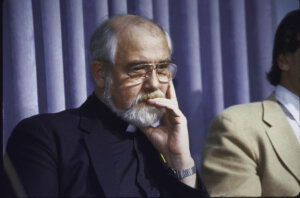
The one time I got to talk to Muhammad Ali was a summer evening when I was working at one of my favorite college internships — in the McClurg Court newsroom of WBBM Newsradio 78, the Chicago affiliate of CBS Radio.
The scene came to mind earlier this week when I released a new audio documentary called Broken Hologram about Ali and his brief stint as a Broadway star. But back then, I was one of a quartet of interns who included a cool girl from Hyde Park named Gwen Billings with whom I occasionally took lunch at a nearby hot dog stand and discussed important news figures like, say, Depeche Mode and The Smiths. There was also Linda, a hard-nosed news reporter in the mold of Holly Hunter in Broadcast News. Sometimes she came around to my cubicle and took sips of my Dr. Pepper. Not in a flirtatious way, more in a proto-Daniel Day-Lewis “I drink your milkshake” kind of way. There was a fratty guy named Scott who wore a class ring from (redacted). He went on to a lucrative career, just not in journalism. There was one other dude; he was from Crown Point, Indiana, but that’s just about all I remember.
My job consisted of answering phones, ripping wire copy from the AP and UPI machines, getting sources on the phone and calling every major fire and police station every night to see if there was a story to be reported (“Hi, Sergeant Kupka, it’s Adam from WBBM: Do you have anything working in your area?”).
Even though every sergeant told me the same thing every night, I kept calling because that’s what journalists do: You keep making the calls. In fact, I did pretty much whatever was asked of me, and turned feisty only when one of the few asshole reporters tried to get me to run downstairs to the loading area to fetch him a “Green Streak” edition of the Tribune so he could check on his stocks or intimated that my job description should include making him coffee.
“Sure could do with a cup o’ coffee right now, Adam.”
“Cool, why don’t you make yourself one?”
Note: The individual referred to is decidedly not John Cody, a truly great man who remains a friend to this day. (Fun fact: During Vietnam, John worked for Stars & Stripes alongside Seth Lipsky, founder of the English language edition of the Forward)
Nor am I referring to sports reporter Rich King, a prince of a man who always offered to get people sandwiches from the White Hen Pantry (“Anyone need anything from ‘The Hen?’”).
Sometimes, when the news day got super-slow — for example, when Notre Dame football coach Lou Holtz was in the studio doing a live call-in show — I passed the time by trying to guess the usually ridiculously easy passwords for the WBBM staff’s new computers and snooping in the reporters’ early version of email in a futile effort to find anything interesting. Apologies to the late Dale McCarren (DMC123).

I was working the evening shift when the top news story was about Father Lawrence Martin Jenco, a Catholic priest from Joliet, Illinois, who had been taken hostage in Beirut while he was working for a relief agency. Muhammad Ali was part of a delegation that had flown to the Middle East to try to arrange his release.
Meet Broken Hologram | RSS.com
My supervisor was a terrific guy named Duane Gray, an African-American Conservative who was big on conspiracy theories (“You should read this book. It’s called The Terror Network.”). He was a great manager and colleague who made sure that we kept to the schedule and that traffic, weather, sports and news headlines always came right when they were supposed to. On this particular night, Duane gave me a mission: “Get ‘The Champ’ on the phone.”
“Uh, how do I do that, Duane?”
“Call every hotel,” he said.
He scrawled a list of hotels in Tel Aviv and Jerusalem on a legal pad and I started calling Information to get their numbers. Advantage of working for a CBS affiliate: You got to make all the long-distance calls you wanted.
How many calls did I make? What were the names of all the hotels? I have no idea. But I do remember that one of them was the King David Hotel in Jerusalem because this time, when I asked to be transferred to Ali’s room, no one said, “Sorry, no one here by that name.”
Ali picked up. His voice had that raspy quality it got after he retired from boxing. “Hullo?”
“Hi, I’m calling from Newsradio 78. I was hoping one of our anchors could speak with you.”
“You’re calling from Chicago?” he asked.
“Yeah.”
“Man,” Ali told me, sounding weary but amiable. “It sounds like you’re calling from right next door.”
Duane could be a wise-ass and a cynic, but now he was star-struck. He sprang to his feet. “Is that the Champ?”
I nodded.
Duane grabbed the phone. “How’re you doin, Champ? You’re gonna be on with Dale McCarren. I’m gonna patch you through, Champ.” He gave me a hearty high-five.
Some time later — perhaps after a week, perhaps after two — when Madonna was in town for some concert, movie junket or photo shoot and Duane told me he wanted to get her on the air, I knew exactly what to do.
After I got her on the phone at her hotel and transferred the call to Duane, he shouted: “This kid,” he said, complimenting both me and his own managerial talent, “has the best news instincts of anyone in this newsroom!”
“Hello, Madonna?” Duane said into the phone. “You’re gonna be on with Dale; let me patch you through.”
The post What Muhammad Ali taught me from his Jerusalem hotel appeared first on The Forward.
Uncategorized
Rock legend Steven Van Zandt’s new gig: Holocaust education
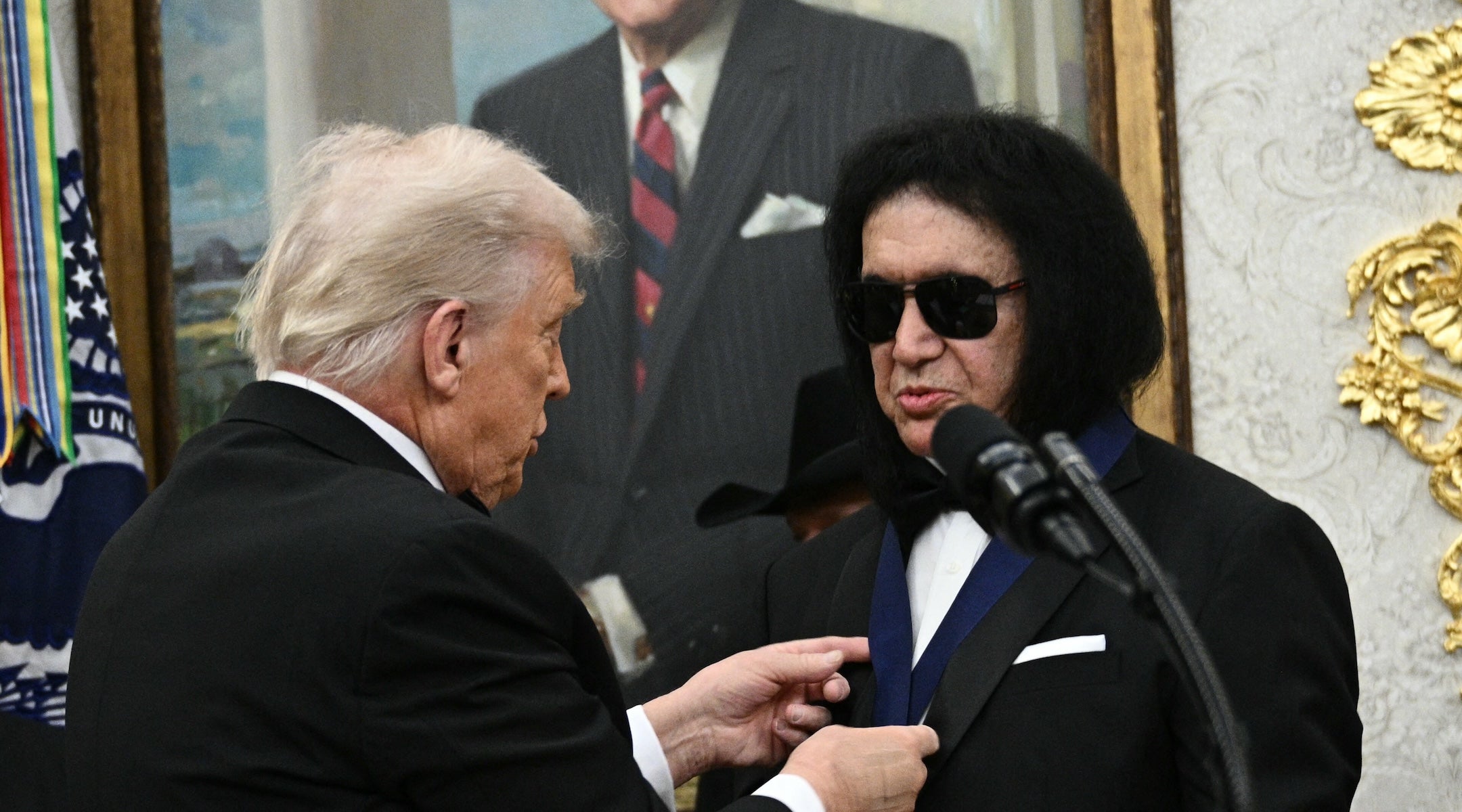
(JTA) — Steven Van Zandt is worried about the Jews.
“There is that pre-Holocaust vibe,” the Rock and Roll Hall of Famer told the Jewish Telegraphic Agency recently about what he sees on social media, where he is a prolific user. “They spread lies around year after year after year, and if you say something often enough, people start to believe it.
“And that’s what happened that led to the Holocaust in the first place, and that’s what’s going on now.”
For a man equally beloved for his longtime work with Bruce Springsteen in the E Street Band and his role as Silvio on HBO’s “The Sopranos,” such a detour might seem unusual. But Van Zandt is looking to make his own mark in the world of Holocaust education, via his education initiative TeachRock, which since 2013 has provided K-12 lesson plans on a range of subjects built around popular music.
Titled “Jewish Heritage and the Holocaust: Exploring an Enduring Culture Through Music,” the initiative’s four-day lesson plan, launched this week, includes the onset of antisemitism in prewar Europe, survivor testimony and Jewish values. Anchoring the lessons are rock songs from the likes of KISS, the half-Jewish glam metal band, beloved Jewish folk singer Leonard Cohen and contemporary New York pop band Lawrence, which is fronted by two Jewish siblings.
It’s a departure from the somber tone of most Holocaust education programs, a space that the Jewish community has heavily invested in despite mounting questions about the effectiveness of such lessons in curbing antisemitism. Other contemporary Holocaust learning initiatives have employed video games, artificial intelligence and similarly novel approaches as educators struggle to adapt to a near future without living survivors to share their testimonies.
For Van Zandt, the lessons aren’t just teaching about the Holocaust, but also about highlighting positive Jewish influence in the world of popular culture. He rattled off a list of Jewish artists he admires, including Bob Dylan and the pop songwriting team Lieber and Stoller.
“I have a lot of gratitude for what they have contributed to my life, just in terms of enjoyment,” he said. “Show business doesn’t exist without the Jewish contributions.”
The guitarist founded TeachRock in 2013 alongside other big names from the world of music and the arts, including Springsteen, U2 frontman Bono, Jackson Browne and the director Martin Scorsese. On Thursday, the organization piloted its new Holocaust education lesson plan to 50 high school students at the Florida Holocaust Museum in St. Petersburg, timed to the state’s Holocaust Education Week. Florida’s Holocaust education task force is promoting the material to districts across the state.
“We always want to be educating in a way that feels like you’re not being taught. And I think this captures that,” Michael Igel, a contributing author on the TeachRock lesson plan who also chairs the statewide task force, told JTA.
For Igel, a descendant of survivors, the project fits neatly into his own efforts to bring Holocaust education into unconventional spaces. He’s planning future courses that incorporate food and theater.
“It’s still standards-based Holocaust education. But it’s being delivered to students in these different portals,” he said.
It was through Igel’s promotion of such nontraditional methods that he was approached by a member of TeachRock’s leadership council a year ago. TeachRock had recently been looking to offer lessons on Jewish heritage, and saw an opportunity to broach the subject of the Holocaust through Igel.
A huge E Street Band fan, Igel laughed as he recalled how the council member asked him if he had ever heard of Van Zandt.
The first of the curriculum’s four days opens with students listening to “Rock and Roll All Nite,” the 1975 hit by rock band KISS, before segueing into Jewish life in prewar Europe and the rise of antisemitism.
Igel noted the unique nature of the lesson. “When Gene Simmons with his tongue out is the first thing you see, you’re wondering, ‘What the heck happened to Holocaust education?’” he said.

Gradually the link becomes clear: The lesson explains that KISS frontman Gene Simmons is the son of a Holocaust survivor. Much of the curriculum is built around similar ideas of Jewish survival and resilience, as students are asked to contemplate how Simmons’ family background may have informed his outré stage persona. (Co-founder Paul Stanley is also Jewish.)
Such concepts, he said, help expand the idea of a Holocaust lesson beyond Jews as “victims in a snapshot of time.” In teacher training sessions, educators have responded well to the musical framing and excitedly discussed which songs they would want to pass down to future generations — a positive sign for Igel, who hopes to convince teachers to use the curriculum even outside of the state-mandated Holocaust Education Week lessons.
While Van Zandt, who is not Jewish, doesn’t craft the curriculum himself, he is friends with Simmons and the two have spoken before about wanting to use music to teach Jewish history. Max Weinberg, the E Street Band’s longtime drummer, is also Jewish.
The initiative comes at a moment when the world of popular music, like many other cultural sectors, has become engulfed in controversy over Israel. A recent dustup involved Ed Sheeran and Macklemore, in which Jewish venue owner Robert Kraft pressured Sheeran to drop the rapper from his tour over his onstage pro-Palestinian activism. That prompted many artists to support Macklemore, including Jewish actor Ilana Glazer, who spoke at one of his “Free Palestine” tour stops. Several leading musicians, including Lorde, Paramore and Björk, have also signed pledges to boycott Israel over its conduct in Gaza, while others including Pink and Boy George have taken opposite tracks.
All of this discourages Van Zandt, who famously led an international artist boycott of the South African resort venue Sun City in 1985 to protest Apartheid. The artists now backing the Boycott, Divestment Sanctions movement targeting Israel have cited the Sun City protests as a direct inspiration. (Sun City itself was founded by Sol Kerzner, the son of Jewish Russian immigrants.)
But Van Zandt says the two causes are different.
“Yes, I am known as the boycott king of the world,” he said. “It’s not the same situation. Trying to deny weapons for Israel to defend itself is obscene. It’s ridiculous. It’s terrible.”
He has feuded with Roger Waters, the Pink Floyd co-founder and outspoken pro-Palestinian activist, over BDS.
“I wrote him a very nice, detailed letter saying that it was misconceived, it’s a mistake, it’s not going to accomplish anything,” Van Zandt recalled. “I was very nice to him. Very diplomatic, very respectful. And then he starts just calling me names in the press.” (Waters has directed expletives at Van Zandt and other contemporaries who disagree with him about Israel in interviews.)
Igel, too, is thinking about how TeachRock’s lessons can address contemporary discourse over Israel, a subject that many Holocaust educators often are reluctant to bring up in the classroom even when students press the topic. His curriculum defines what a genocide is — “for a generation that needs to know what that word means, and what it doesn’t mean,” he said.
Following this week’s pilot program, both Igel and Van Zandt hope states beyond Florida will take an interest in their lessons. The rock star has ambitious goals for the initiative: to try to change the national conversation around Jews and Israel that has filled his social media feeds, which he describes as “lies on top of lies.”
“Eventually there’s got to be a national public conversation about this, which is not taking place,” he said. “So eventually it’s going to have to be. At that point, all bets are off.”
This article originally appeared on JTA.org.
The post Rock legend Steven Van Zandt’s new gig: Holocaust education appeared first on The Forward.
Uncategorized
Were Leopold and Loeb inspired by Nietzsche, or Jewish self-loathing?
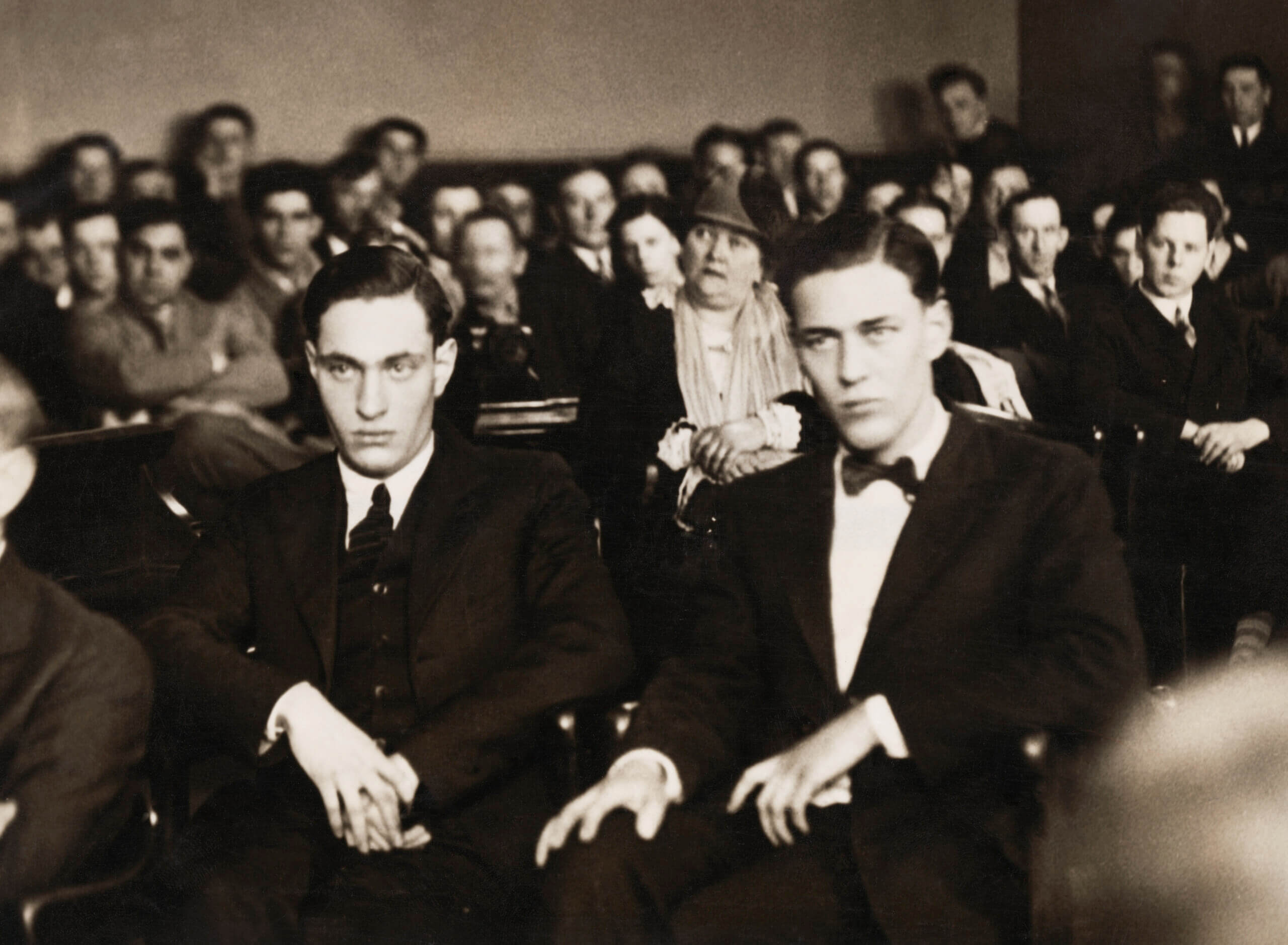
Any production of Patrick Hamilton’s popular thriller Rope, like any game of Clue, can be reduced to props, setting and culprits.
The central prop is a large chest, containing a freshly-murdered body. The setting can vary: Mayfair in Hamilton’s 1929 original, Manhattan in Alfred Hitchcock’s 1948 screen adaptation starring Jimmy Stewart. The names of the players are sometimes different, but there are always two students in their finely-appointed apartment with the titular murder weapon.
Gordon Greenberg’s new adaptation, now playing off-Broadway at the New Group’s space at St. Clement’s, presents a novel clue as to what prompted the crime: a Christmas tree upstage right. In his take on this “well-made play,” which Greenberg believes has its deficiencies, the central characters, inspired by University of Chicago students Nathan Leopold and Richard Loeb, are once again Jewish, but doing their best to conceal that fact.
Hamilton, who wrote his play shortly after Leopold and Loeb’s conviction, was struck by the men’s alleged lack of motive, beyond a desire to pull off the perfect crime based on their nihilistic misreading of Friedrich Nietzsche’s philosophy. Greenberg doesn’t buy that the killing was dispassionate, and believes a crisis of identity was at play.
“What drew me to it was thinking about what the factors might have been that went into this murder that I personally find hard to believe was just theoretical,” said Greenberg, a director and playwright, who recently revived Joseph Stein and Stephen Schwartz’s The Baker’s Wife off-Broadway. “I don’t think anyone does anything for purely theoretical reasons. We can extrapolate them later, but in the moment we are going on gut impulses and human needs and sexuality and jealousy and all of these fiery emotional poles that make us human.”
Greenberg, who is gay and Jewish, had long been fascinated by the Leopold and Loeb case, wondering what led two well-bred, cerebral Jews to commit a supposedly “motiveless” murder. (In the real crime, notably fictionalized in Meyer Levin’s Compulsion, Nathan Leopold and Richard Loeb killed a 14-year-old boy, Robert Franks; in Rope, they kill a wealthy classmate.)

Hamilton’s play, which Greenberg found to be “antiseptic,” de-Judaized and stripped of queerness, is not concerned with the “why” of the killing.
His murderers, Brandon, described as “tall, finely and athletically built, and blonde” and Granillo, “a Spaniard” with the “shrug of the shoulders characteristic of his race,” are in it for the thrill. They convene a dinner party and serve the meal on the chest containing their victim, certain they won’t be caught.
In Greenberg’s version, set in 1957 Manhattan, Brandon is Garret Stern (Cameron Monahan), a working-class striver who declaims, in a break of the fourth wall, that he “wants to be mistaken for the son of assimilated German Jews, not the shtetl Jews with bent vowels and calloused hands from whom he actually descends.” (As part of the ruse, he’s abandoned his given name of Gary.)
Granillo is now Nate Singer (Corey Fogelmanis), the Yekke scion of a garment district macher who, to his upwardly-mobile mother’s delight, “can almost pass for gentile.” Both are students at Princeton and plan to drop the body back in Jersey after their macabre dinner party.

Like the real Leopold and Loeb, they are also involved sexually and sadomasochistically. Greenberg says he was partially inspired by Tom Kalin’s 1992 film Swoon, which revisited the killers through a queer lens.
Nate’s instilled self-hatred likely feeds into his desire to be dominated by Garret, whose rough upbringing as a Jew in postwar Skokie taught him the utility of violence. (His school principal praised him for breaking a boy’s nose, saying “your people aren’t exactly known for defending themselves.”)
Greenberg, who said that, as an actor he played “every Herb Gardner and Neil Simon play around,” chose to move the action up to the era Lavender Scare and a resurgence of casual, clubby antisemitism following the “chemotherapy of World War II” that briefly put it into remission.
Nate and Garret’s guests, for their post-Christmas shindig, whose centerpiece is a chest containing a corpse, include a polished, pedigreed classmate; a droll Sarah Lawrence student; their closeted professor, who will catch them in the lie; and a Mayflower-descendant judge who happens to be the father of Ronald Kentley, the deceased.
Driving the boys’ motive and cue for passion is Nate’s tormented attraction to Ronald, who he fears might out him and land him on McCarthy’s list. Garret is jealous, but sees an opportunity: In bumping Ronald off, he hopes to take his place as the judge’s surrogate son, gaining entry to the patrician world to which he aspires.
But their guests’ routine macroaggressions show the futility of trying to overcome their backgrounds. The Christmas tree is fooling no one. Greenberg is similarly unconvinced that Leopold and Loeb’s murder was merely a Nietzschean performance, undertaken to prove that morality need not apply to superior intellects.
“No one really knows what was going through their mind, and no one ever will,” Greenberg said of Leopold and Loeb’s crime. “But taking one of these fascinating true crime stories and positing what the humanity is behind it, what’s all the flesh on the bone, is to me the fascination and the fun exercise.”
The post Were Leopold and Loeb inspired by Nietzsche, or Jewish self-loathing? appeared first on The Forward.
