



Uncategorized
As Jewish Republicans sour on JD Vance, many are rallying behind Marco Rubio for 2028
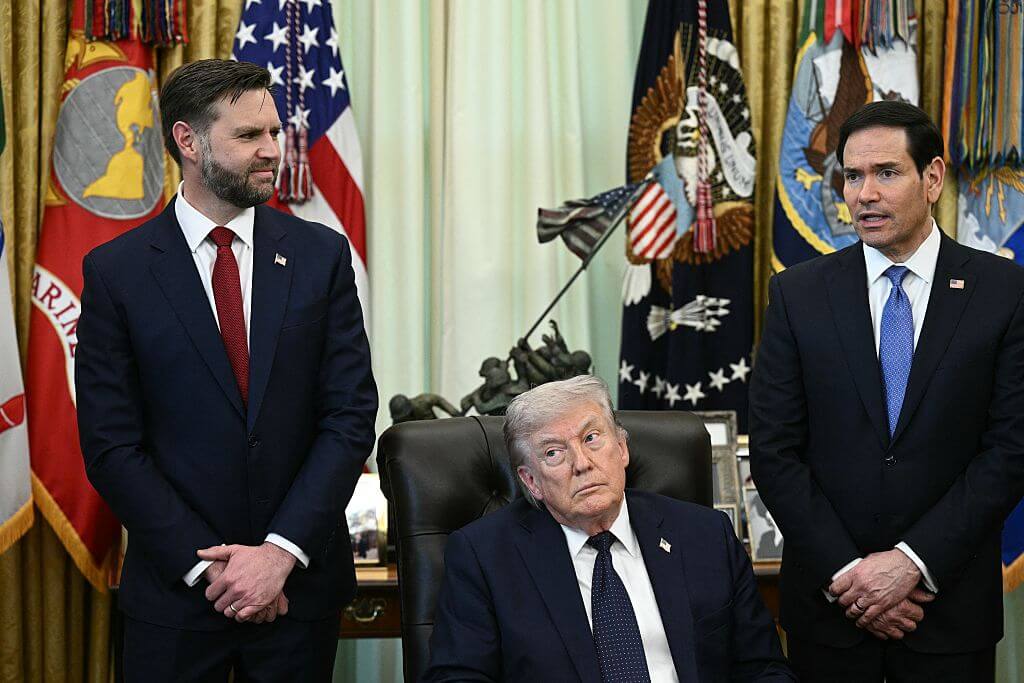
(JTA) — It’s no secret that JD Vance has lost the confidence of many Jewish Republicans, who have taken issue with the vice president’s reprimanding of Israeli officials, indulgence of anti-Israel conspiracy theories and silence on Tucker Carlson, the prominent pundit who has turned against Israel.
But Vance is still thought by many to be Donald Trump’s likeliest successor at the top of the party’s ticket in 2028, leaving the GOP’s Jewish supporters with the question of whom to back when Trump’s second term ends.
Many are finding an answer elsewhere in the Trump administration.
“The overwhelming majority of American Jewish MAGA voters, donors, and policymakers are enthusiastically supporting a Marco Rubio presidential run,” Shabbos Kestenbaum, whose high-profile activism against campus antisemitism has made him a hero among Jewish conservatives, told the Jewish Telegraphic Agency this week. “I look forward to voting for him as well.”
Kestenbaum was offering an update on a claim he made in an interview at a Republican Jewish Coalition gala in May.
“I can certainly tell you with confidence that in the American Jewish conservative circles, it’s Marco Rubio by a margin of 99 to 1,” he said at the time. “In fact that’s probably underselling it, it’s probably closer to 100 to 0. I can’t think of anyone within the American Jewish MAGA movement who would not want Marco Rubio as the nominee.”
Rubio, who is Trump’s secretary of state and national security adviser and served as a U.S. senator from Florida for 15 years, has won the support of a number of Jewish Republicans with his staunch support of Israel and hawkish opposition to Iran. He has signaled a willingness to remove restrictions the Biden administration had placed on violent Israeli settler groups in the West Bank and this week vowed to dismantle the International Criminal Court, which has an arrest warrant for multiple Israeli leaders including Prime Minister Benjamin Netanyahu.
The RJC praised Rubio’s ICC vow on Monday, tweeting, “Leadership. Thank you, @SecRubio.”
Some, including the far-right Jewish activist Laura Loomer, have also pointed to Rubio’s hardline stance on pro-Palestinian protesters; he celebrated revoking hundreds of student visas in connection with such protests last year.
“We are finally getting the pro-Hamas thugs OUT,” Loomer wrote on X, adding that Rubio “is a LEADER” who is “not afraid of taking on Islamic immigrants who don’t belong here.” In another post, Loomer revealed her ambitions for Rubio: “He is going to be President someday. Mark my word.”
Rubio’s deep ties to the pro-Israel community predate his national profile; his main benefactor during his career in the Florida legislature was Norman Braman, a major donor to Jewish causes. Rubio’s support for Israel is typical of Cuban-American politicians who see the country as a bulwark against communism. His closest ally in the Florida legislature was Adam Hasner, who is Jewish.
Some Israel critics who have spread conspiracy theories about Jews and the Jewish state are now accusing Rubio of working toward Israeli interests above American interests, and say Israel is pushing his candidacy.
Besides his pro-Israel bona fides, Jewish conservative commentators have also praised Rubio for his fiery rhetoric about his hope for the future of the United States, including in a speech at the Munich Security Conference, which Commentary editor Seth Mandel called “profound.”
Eric Levine, an RJC board member and major GOP fundraiser, said there is “overwhelming support” for Rubio, among both Jewish and non-Jewish Republicans.
“Look, my first choice in 2016 was Marco Rubio,” said Levine, who spoke in a personal capacity and not for the RJC, adding that he was an early fundraiser for Rubio’s 2016 presidential campaign.
“Marco has always been an extraordinarily strong and effective advocate for the American-Israel relationship,” Levine said. “More importantly, he’s a very strong and effective communicator regarding America’s place in the world.”
Vance has seen his support eroding, both in and outside of Jewish circles. Some of Trump’s top advisers are reportedly pushing for Rubio, and not the vice president, to be the 2028 nominee. GOP megadonor Ken Griffin said last week that he would support Rubio over Vance in a 2028 presidential primary, Axios reported. Even live betting markets say Rubio’s chances are climbing.
Trump himself has floated a Vance-Rubio ticket, without saying which of the two he thinks should be president. The president asked a room of donors at Mar-a-Lago in late February, as he joined Israel in launching a war against Iran, which candidate they preferred, and Rubio carried the room, NBC News reported at the time. (Kestenbaum said he had heard about the vote from donors who were there. “To be fair, they’re in Florida, so it’s a bit of a self-selecting crowd — but Marco wins hands-down,” Kestenbaum said.)

The RJC has so far refused to wade into the 2028 waters. CEO Matt Brooks told the Jewish Telegraphic Agency at the RJC’s America 250 gala that the presidential primary is “light years away from right now,” and that the focus is on holding the Republican majority in the House and Senate come November.
But the group, and Jewish Republicans writ large, have been embroiled in a battle over the party’s stance on Israel, and how it should deal with figures like Carlson, Nick Fuentes and Candace Owens, all of whom have spread antisemitic conspiracy theories to their large online followings.
Trump drew the RJC’s effusive praise when he disavowed Carlson. Vance, on the other hand, has remained mum despite mounting calls by Jewish conservatives for him to condemn the former Fox News host.
“I’d like to see Vice-President Vance change tack on a lot of this; I hope that he will,” commentator Ben Shapiro said in a New Yorker interview earlier this year, when asked about who in the conservative world “would cast out the kind of characters that Tucker Carlson and company are encouraging.” Shapiro said he would “likely” support Rubio in a primary over Vance.
The State Department did not respond to a request for Rubio to comment on Carlson and whether he believes there is rising antisemitism on the right. Other possible 2028 presidential candidates — chief among them Texas Sen. Ted Cruz — have been outspoken in warning about the threat of right-wing antisemitism.
Brooks, asked about Vance, told JTA that Trump’s voice is “the voice that matters right now.”
“As we start to head into after the midterms and whether people run or not, I’m sure they’re going to be asked about all these things,” Brooks added.
Levine has weighed in on Vance, telling Politico this week that it’s “hard to find any support for him at all in the Jewish community.” He declined to discuss Vance with JTA.
In the months since calls first escalated for him to condemn Carlson, Vance’s role in seeking to broker a deal with Iran has only further alienated pro-Israel Republicans. He drew backlash from Republican Jews — both from the rank-and-file and from a sitting member of Congress — when he warned Israeli critics of the Iran deal, which has since fallen apart, not to cross Trump, saying, “If I was in the Cabinet of the Israeli government, I might not be attacking the only powerful ally that I have anywhere left in the entire world.”
Florida Rep. Randy Fine, the Jewish right-wing firebrand, called Vance’s comments “absolutely inappropriate and frankly disgusting.” He did not reply to a texted query about Rubio.
Valerie Greenfeld, an RJC member and former senatorial staffer who now lives in Jerusalem, said in an interview that “it was incredibly arrogant of him to say such a thing, because we’re partners.”
She added that Rubio is currently the most popular choice for president in 2028 among her circle of American voters in Israel. Meanwhile, she said, “the more JD Vance speaks about Israel and antisemitism and teams up with Tucker Carlson and his ilk, the worse it is for him in terms of the Jewish vote.”
American Jewish voters skew heavily toward voting for Democratic candidates; somewhere between 63% and 71% of Jewish voters supported Kamala Harris in 2024.
But as a growing number of Jewish Democrats say they feel unwelcome in their party amid tensions over Israel and the pro-Israel lobby, there is a sense that a Republican nominee could pick up votes from a Democrat who is more sharply critical of Israel than any of their predecessors.
George Mason University law professor David Bernstein predicted on X that there will be “a significant shift in Jewish behavior” if Rubio wins the nomination. “The vote change will be relatively modest, but the energy and money will shift dramatically.”
He added, “If it’s Vance, nope.”
Pro-Israel criticism of Vance has grown in response to the terms of the Iran deal last month which delivered multiple concessions to the Islamic Republic. Shapiro told Fox News that Vance, as a key negotiator, had “not well served the president.” Trump this week resumed the war with Iran and said the deal was history.
Rubio, meanwhile, came out of the deal with positive reviews from the pro-Israel crowd, who viewed his silence as disapproving of the concessions made in the deal. Rubio notably brokered a parallel framework agreement between Israel and Lebanon that undercuts a key objectionable element of the Vance-brokered deal, which codified Iran’s role in Lebanon.
“Rubio does not look happy,” wrote Eylon Levy, a former Israeli government spokesperson, alongside a video of the secretary of state appearing stoic while Trump announced the deal.
Commentator Lisa Daftari wrote, “Today, we are all Marco Rubio.”
Meanwhile, Israel critics on both the left and right have been quick to call out the burgeoning support for the secretary of state.
Cenk Uygur, the host of The Young Turks, wrote that “half the officials” in Trump’s administration “work for Israel,” including Rubio.
Michael Rectenwald, who heads the Anti-Zionist America Political Action Committee, blasted Rubio’s plan to dismantle the ICC and said the “U.S. is ‘israel’s’ bitch.”
Clint Russell, host of the “Liberty Lockdown” podcast, accused Israel of launching a propaganda campaign and paying influencers to “tank Vance and boost Marco Rubio for 2028.” Russell did not provide proof but was steadfast in his accusation.
“They’ve been boosting him for months. Hard,” he wrote. “He’s their guy.”
This article originally appeared on JTA.org.
The post As Jewish Republicans sour on JD Vance, many are rallying behind Marco Rubio for 2028 appeared first on The Forward.
Uncategorized
Eisenkot outlines 3 paths to Israeli government, signaling urgency and openness to Arab-party backing
(JTA) — Gadi Eisenkot outlined three tracks he is pursuing to build a coalition, including a minority government that would need the outside support of Arab-led parties, saying that Prime Minister Benjamin Netanyahu was putting Israel “in a very dangerous place” with his anti-Arab rhetoric.
Each option Eisenkot presented Friday in a lengthy post on X could involve breaking a promise that at least one of the parties in the “change” bloc Eisenkot leads had made: not to rely on the Arab parties; not to join with Netanyahu; or not to work with the haredi Orthodox parties as long as they refuse to compromise on military service.
One of his partners, Avigdor Liberman, who leads the Yisrael Beytenu party, said the option of joining with the haredim was the likeliest.
Eisenkot, who leads the Yashar party, described an urgency to form a coalition spurred in part by Netanyahu’s relentless rhetoric targeting the Arab parties, which Eisenkot said was placing the Arab Israeli population at risk of attack. Forming a coalition under the conditions Eisenkot lays out would remove Netanyahu from his role as prime minister, depriving him of a powerful pulpit.
“We are in a very dangerous place. A place where the outgoing prime minister is acting in ways we have never seen before,” he said.
“Israeli society, our democracy, and our standing and position on the international stage are all approaching a point of no return,” he said. “The path from a violent campaign of delegitimization against 21% of the population and labeling them ‘supporters of terrorism’ to actual violence could also be short. The writing is on the wall.”
President Isaac Herzog last week gave Eisenkot the mandate to form a government within 28 days, after 67 members of the parliament, or Knesset – including the “change” bloc and the 19 Knesset members belonging to Arab-led parties – gave their nod to the former Israel Defense Forces. Netanyahu got the approval of 46 lawmakers, and seven abstained. If Eisenkot does not get a government together by Dec. 6, he can ask Herzog for a 14-day extension.
The first option Eisenkot raised was forming a government with the support of the ultra-Orthodox, or haredi, parties. Such a move would have been almost unthinkable until recently, given the longstanding and close alliance between Netanyahu and the haredi parties, as well as the central campaign promises of the anti-Netanyahu bloc to bring about fundamental changes to the state’s relationship with the ultra-Orthodox community, including mandatory military service – a position the haredi parties strongly oppose.
“Serious discussions are underway with the ultra-Orthodox parties, aimed at finding solutions and formulas that will strengthen the IDF, address security needs and preserve the status of those who study Torah, as we promised during the election campaign,” Eisenkot wrote in his post.
He stressed that the negotiations did not amount to “backing down on the issue of military service,” but rather involved formulating an arrangement based on the principles of his party’s “Service for All” framework, which would codify non-military service as an option for some sectors. All four parties in the change bloc ran on a platform of ending the vast exemptions from military service haredi Jews have enjoyed for decades.
The negotiations appear to have led one of the two ultra-Orthodox parties, United Torah Judaism, to refrain from recommending Netanyahu to the president as the candidate to form the next government. The other haredi party, Shas, which is considered more right-wing and closer to Netanyahu, has so far given no indication that it intends to cross political lines and join the anti-Netanyahu bloc. Without Shas, the bloc would have to settle for a minority government.
Liberman said in an interview with Channel 12 News on Friday evening, hours after Eisenkot’s post, that forming a government with the support of the ultra-Orthodox parties was “the only practical option.” He said he was convinced that a government supported by both haredi parties could be formed. According to Liberman, the bloc should be willing to “sacrifice” its pledge not to cooperate with the ultra-Orthodox and to fundamentally change the state’s relationship with their community in pursuit of its primary goal: “an end to Bibi’s rule.”
The second path outlined by Eisenkot was a unity government with Likud. Negotiating teams from the two parties met earlier this week. “As for the contacts with Likud, we are making sincere and genuine efforts on our part. Unfortunately, however, there is a wide gap between the Likud’s rhetoric and their action and actual willingness to move forward,” Eisenkot said. He nevertheless made clear that “I intend to give this track another chance.”
Eisenkot did not name the “gap,” but reports have said talks have foundered on Netanyahu’s role in a unity government. Netanyahu reportedly is insisting on serving as prime minister in the first part of a “rotation” agreement that would see the premiership rotated among bloc leaders.
Liberman ruled out sitting in a government with Netanyahu under any circumstances, including a rotation agreement in which Netanyahu would serve as prime minister second after Eisenkot. Another leader of the opposition bloc, Naftali Bennett of the B’Yachad party, held lengthy talks with Netanyahu in the Knesset this week, triggering a wave of speculation that he was advancing the possibility of a unity government. But Bennett would still need to convince the other parties in his bloc to join him in doing so, as his party isn’t large enough to secure a parliamentary majority with Netanyahu on his own.
The third option Eisenkot raised at the end of his post was the formation of a “national emergency government.” He clarified that he would pursue this track only if “the necessary conditions for the formation of a broad government through the channels I am leading do not materialize.”
Although he did not explicitly say so in his post, Eisenkot appears to be referring to the possibility of a minority government that would rely on the votes of the Arab-led parties to secure the parliamentary majority needed to form a government without actually including Arab ministers in the government itself.
But the proposal faces significant opposition within Eisenkot’s own bloc, potentially jeopardizing the entire initiative. Liberman stressed that he would “categorically” vote against a narrow government relying on the support of the Arab-led parties. Channel 12 News also reported that Bennett had told leaders of the opposition bloc that he opposed forming a government dependent on Arab-led parties.
One of the two parties, Ra’am, led by Mansour Abbas, served in a coalition under Bennett from 2021-2022. Bennett has praised Abbas as a worthy partner but has also argued that including Arab-led parties in the government after the deadly Hamas-led attacks of Oct. 7, 2023 is untenable. Netanyahu has seized on the radical statements of some members of the other Arab-led party, the Joint List, to depict both parties as supporting terrorism.
Liberman and Bennett both argued that relying on the Arab-led parties would give Netanyahu a massive boost ahead of future elections.
Eisenkot, however, signaled that he was prepared to put that opposition to the test. In his post, he stressed that “all members of Knesset will have to follow their conscience and decide whether a new government will be formed, or whether they are willing to drag the State of Israel into another election while Netanyahu remains prime minister of a transitional government.
“It would be foolish to think that we have the luxury of delaying and losing the window of opportunity that has opened up, a window that may never open again. What is at stake is Israel’s future,” Eisenkot said.
This article originally appeared on JTA.org.
The post Eisenkot outlines 3 paths to Israeli government, signaling urgency and openness to Arab-party backing appeared first on The Forward.
Uncategorized
After devastating midterms, Jewish right-wingers lick wounds – and plan for 2028
(JTA) — NEW YORK – Anti-Israel rhetoric, “radical Islam” and the voting habits of young Jews were among the many concerns voiced this week at two of the first major events for Jewish conservatives held since Democrats’ sweeping victories in the midterm elections.
Speakers and attendees at both the Tikvah Fund’s Jewish Leadership Conference and the Zionist Organization of America’s annual gala, each held on Sunday in Manhattan, railed against the growing contingent of Democratic Socialists of America members entering Congress.
As they reeled from that “difficult Tuesday night,” as ZOA emcee Shabbos Kestenbaum referred to it, some advocated for a boost in Jewish education in hopes that young Jews would prioritize pro-Israel candidates. Others said the pendulum could swing back to a GOP victory in 2028 — but also expressed antipathy toward Vice President JD Vance, seen as the favorite to lead the party’s ticket.
ZOA president Mort Klein urged attendees at the Ziegfeld Ballroom in midtown Manhattan to fight against the “dangerous policies” of the DSA, the group that has endorsed a contingent of left-wing, Israel-critical candidates in Congress, bringing their number in the Democratic caucus to eight when the next session starts in January. He denounced growing accusations of Israeli apartheid and genocide, likening them to antisemitic propaganda used in Nazi Germany and other historical periods.
In an interview after the event, Klein said the ZOA is urging President Donald Trump “to make a major address on antisemitism — an address purely on Jew hatred and Israel hatred, not general hatred.” The ZOA, he said, is also “urging, even demanding” members of Congress to make similar speeches, noting that he could only recall Florida Rep. Randy Fine and Texas Sen. Ted Cruz as having done so to his satisfaction. He added that he is pushing for Jewish leaders and rabbis to do the same and to speak about “the dangers of radical Islam.”
It is not a new strategy for the ZOA, but Klein said the group is doubling down because “whatever strategy is in place, it’s not being fulfilled in any way, shape or form.”
A number of speakers at the ZOA event denounced young Jewish voters and the efforts of the liberal Jewish Middle East advocacy group J Street. J Street bills itself as pro-Israel and pro-peace; speakers at the ZOA gala accused it of turning young Jews against Israel.
Alan Dershowitz, the prominent pro-Israel attorney whose clients have included Trump, O.J. Simpson and Jeffrey Epstein, called J Street “the most dangerous organization to Zionism, to Israel and I believe to the Jewish future in the United States.”
“It has fraudulently convinced many young people that they are pro-Israel and has given cover, has given a hechsher [kosher certification], to anti-Israel, anti-Zionist and, in more and more respects, anti-Jewish attitudes than any other organization,” Dershowitz said.
The problem, Dershowitz continued, is exemplified by the number of Jews who “tragically voted for [New York City Mayor Zohran] Mamdani, how many Jews voted for [Michigan Sen.-elect Abdul] El-Sayed.”
J Street did not endorse either candidate. The group did not return a request for comment.
Josh Katzen, publisher of the Jerusalem News Syndicate, blasted the “new generation” as he received an award from the ZOA for Middle East journalism.
“Not only do they not have an emotional attachment to Israel, they don’t have an emotional attachment to the United States. They don’t have any idea who are the good guys, and who are the bad guys,” Katzen said. “They don’t understand that Israel is America’s front-line defense in supporting Western civilization against the attack of Islam.”
Attendees at the ZOA event had misgivings about Jews who voted for left-wing Democratic candidates, and about Muslim candidates.
Hy Drusin, a board member of the West Side Republican Club, told the Jewish Telegraphic Agency that he’d coined the term “JINOs” — “Jews in Name Only” — for Jews who voted for “these Muslim socialists.”
According to Upper East Side resident Nathaniel Gravonsky, “The problem in New York City is too many Jews read The New York Times as their Torah.”
Rabbi Yehuda Kaploun, Trump’s special envoy to monitor and combat antisemitism, said in a speech that expanded Jewish education and stronger encouragement of young Jews to embrace their Jewish identity would set them on the right path, as opposed to voting for candidates like El-Sayed.
“For years, the Jewish community has followed the same playbook: more conferences, more photo ops and more nongovernmental organizations. It is a proven recipe, now, for failure,” Kaploun said.
Drusin opined to JTA that Jewish education would indeed “better the chances that [students] will remain Jewish or Jewish identified.” But, he added, “What Rabbi Kaploun urged has been urged for decades, centuries. Is it happening? Is it working? Spreading? Or is it declining? There are arguments and statistical evidence on both sides.”
Drusin said it was “disturbing” to see exit polls that had half of Jewish Michigan voters voting for El-Sayed, and that it would be tough to buck Jews’ “long tradition of knee-jerk affiliation with the Democrat Party.”
Earlier on Sunday, at the Jewish Leadership Conference, Cruz offered hope that the pendulum could very well swing back to the Republicans in 2028. He pointed to the election of then-Vice President George H.W. Bush in 1988, which came two years after Democrats — similar to this year’s results — won the midterms in commanding fashion and took control of the House and Senate.
But hopes of a 2028 Republican victory were accompanied by doubts about the current vice president, who is seen as Trump’s likeliest successor to lead the GOP. Vance has drawn the ire of Jewish conservatives over his reprimanding of Israeli officials, indulgence of anti-Israel conspiracy theories and his silence on his friend Tucker Carlson, a prominent media personality who promotes such narratives.
Most recently, Vance outraged a number of pro-Israel Republicans when he blamed the party’s midterm losses in part on the current U.S.-Israel relationship, and listed “change our relationship to Israel” among four strategies to bring back voters.
“I’m disgusted with it,” Drusin said about Vance’s post. “That’s why I support [Secretary of State Marco] Rubio.”
Gravonsky, too, said he is “always going to pick Marco Rubio over JD Vance” in a hypothetical primary battle between the two, echoing a number of Jewish Republican voters and donors who say Rubio is their preferred 2028 candidate.
Cruz, speaking at the Tikvah Fund’s event, said he disagreed with Vance’s assessment that Israel was a major factor in the recent GOP losses.
Mike Huckabee, Trump’s ambassador to Israel, spoke at both events about the need for a strong U.S.-Israel relationship, though he did not address Vance’s comments head on. He did so in a subsequent interview with The Press Service of Israel, however, saying that “Israel was not the reason the midterm elections yielded disappointing results for the Republicans.”
Neil Cooper, a Republican Jewish Coalition member who attended the Jewish Leadership Conference on Sunday, called the vice president’s post a “political suicide note” that would alienate voters.
Should Vance emerge as the nominee, however, Cooper said he believes Jewish conservatives would “likely hold our noses and vote for Vance on the theory that, despite his flaws, he would nevertheless be preferable to a Democrat from a policy standpoint.”
But Cooper also predicted that any rightward realignment of American Jews — a demographic whose typical allegiance to the Democratic Party has been under a microscope amid shifting sentiment on Israel — would be dampened by Vance becoming the nominee.
If Jewish voters find Vance “repugnant,” Cooper said, it becomes “that much easier to revert to their default position and vote for the Democratic candidate.”
This article originally appeared on JTA.org.
The post After devastating midterms, Jewish right-wingers lick wounds – and plan for 2028 appeared first on The Forward.
Uncategorized
Can Palestinian Christians undermine Christian Zionism?
Americans tend to associate Palestinians with Islam. And studies show that most Americans view Islam in a negative light; a Pew study found that this has actually gotten worse since 9/11 — more than 50% of Americans surveyed in 2026 agreed with the statement that Islam encouraged violence, double the 25% who agreed with that statement in 2002.
Since Oct. 7, some Christian groups and influencers in the U.S. have been trying to change this association, drawing the attention of their fellow American Christians to the plight of — and the existence of — Palestinian Christians in the hopes of activating their empathy toward Palestinians.
American Christians have historically advocated strongly for their fellow Christians abroad. In 1998, Congress passed the International Religious Freedom Act in response to the civil war in Sudan that saw an Islamist government oppressing Christian citizens. Earlier this year, Congress passed a resolution expressing concern for Coptic Christians in Egypt. And another Pew study found that the vast majority of groups advocating for religious freedoms abroad are Christian.
In short, the U.S. is a Christian country, and many of its citizens feel connected to Christians in trouble abroad.
But this has been somewhat less true when it comes to Israel where American Christian views over the past several decades have been shaped by Christian Zionism. Evangelicals hold immense political sway through lobbying groups and voting power, and most adhere to a theology that demands support for Israel, and for Jews to return to the biblical land, in order to bring about the End Times and the return of Jesus. There is such a strong moral alignment between Israel and God — their Christian God — that some American evangelicals seem to be shocked when they learn that Israel did not distinguish between Palestinian Christians and Palestinian Muslims in Gaza. Instead, they associated Palestinians with the violence they connect to Islam — a narrative that gels easily with Israel’s justifications for its crackdown in Gaza to eliminate Hamas.
Church collapse shifts the church
However, in 2025, Israel struck the only Catholic church in Gaza, killing three people and injuring nine others, in addition to destroying an ancient Christian historical site. The IDF claimed it was accidental, but the Latin Patriarch of Jerusalem, Pierbattista Pizzaballa, harshly criticized the destruction, and claimed that Israel had been “targeting innocent civilians.”
With this strike, American evangelicals began to take note of the plight of Palestinian Christians. Mike Huckabee, the U.S. ambassador, wrote a harsh letter to Israel’s minister of the interior about its hostility to Christians, threatening visa restrictions. Trump called Prime Minister Benjamin Netanyahu to complain. Congresswoman Marjorie Taylor Greene, a staunch Republican but also a devout Christian, voted with Democrats to deny funding to Israel.
“Israel bombed the Catholic Church in Gaza, and that entire population is being wiped out as they continue their aggressive war in Gaza,” Greene said, to explain why she crossed party lines.
Since then, Christian influencers have drawn attention to Palestinian Christians’ treatment in Israel. Sometimes, these efforts are humanitarian and informational, such as those of the Palestinian Christian Alliance for Peace, an organization that grew out of the progressive mainline Protestant United Methodist Church’s movement to divest from Israel.
Other influencers, like Tucker Carlson, have taken more of a shockjock approach. Carlson has regularly interviewed Palestinian clergy, including Bethlehem-based Lutheran priest Munther Isaac; Mother Agapia, an American Greek Orthodox nun who immigrated to the Holy Land; and Hosan Naoum, an Anglican archbishop in Jerusalem. All of them emphasize a direct throughline from Jesus to Palestinian Christians, depicting them as upholding the most original form of Christianity.
When Carlson speaks on the subject, he often omits that the people in question are Palestinian, referring to them simply as Christians in astonished tones, playing the audience he imagines, then trying to walk his viewers step by step away from their prior assumptions
“So Christian churches in the United States send more money to Jewish settlements in the West Bank than they do to Christians in Jesus’ own town of Nazareth?” Carlson asked Naoum, in tones of total befuddlement. “When people in the American media say Palestinian, it means someone who is an Islamist, basically — but you’re saying a lot of those Palestinian refugees were Christians!”
Palestinians, both Christian and Muslim, are being attacked and oppressed by Israeli settlers and soldiers; this much has been established, including by many Jewish groups. But many of these Christian influencers, including Carlson, who are now advocating for Palestinians, have a history of antisemitism, which frames their exposés on Israeli violence — Jews, they believe, killed Jesus. Now, they highlight Jews destroying the Christian-owned olive groves in Taybeh or Bethlehem, bombing a church in Gaza, or spitting on a priest. The implication is clear.
An increasing number of viral videos featuring Israelis opposing Christianity in some way are now being shared virally: Orthodox Jews in Jerusalem’s Old City spitting on Christians, an IDF soldier taking an axe to a statue of Jesus in southern Lebanon. Even the Christian Broadcasting Network, an evangelical channel that has historically been extremely Zionist, aired a number of clips about Jewish attacks on Christians and Christian holy sites.
But the sympathy only holds among the Christian influencers if the victims are Christian; though they may criticize violence against Palestinians at large, the argument is clearly weaker. As Candace Owens, a devout Catholic and outspoken antisemite put it, “The biggest issue that I have, by the way, with Israel, and talking about them being above reproach, is the fact that they are supplying the arms to murder Christians.”
Yet many of these videos rely on separating Palestinian Christians from Palestinians more generally for greater emotional impact in the U.S. And the reality is that Palestinian Christians are still Palestinians, first and foremost, a tougher sell to the American Christian populace, which is still largely rooted in Zionism.
To address this, two Christian conferences —Not In Christ’s Name last week in D.C. and the Crossroads Conference in Atlanta earlier this month — invited Palestinian priests Issa Thaljieh and Munther Isaac, both from Bethlehem, to speak. Their testimony was meant to describe the experience of Palestinian Christians, to address Christian Zionism and to be “an invitation to American evangelicals to meet Palestinian Christians, and to reckon with the ways their theology harms Palestinians on the ground.”
But because of Trump’s blanket ban on Palestinian Authority passport holders, neither of them could get a visa — even though they’re priests.
The post Can Palestinian Christians undermine Christian Zionism? appeared first on The Forward.
