


Uncategorized
With anti-Arab campaign ad, Netanyahu stoops to new moral and political lows
Israeli election campaigns have often been ugly. They have featured exaggeration, fearmongering and outright deception. But even by those standards, the first major campaign advertisement by Prime Minister Benjamin Netanyahu’s Likud party, posted on Netanyahu’s X account on Tuesday, managed to shock much of the country.
The AI-generated video depicts former military chief Gadi Eisenkot, who has become the standard-bearer for the opposition, walking through a sunlit field toward a young Jewish man before passing him by to embrace Mansour Abbas of Ra’am, the United Arab List, instead.
The young man looks strikingly like Eisenkot’s son, Gal, who was killed fighting in Gaza in late 2023 — although Likud insists he isn’t meant to. Strictly speaking, there is enough difference to sustain the protestations. The young man has longer, wavier hair than Gal Eisenkot did — just enough, perhaps, to preserve plausible deniability. Yet almost everyone I know believed they were watching a father joyfully approaching his slain son, seemingly restored to life, only to ignore him in favor of an Arab political leader at a time when Arab political participation in Israel is particularly contentious.
The only possible explanation: Likud wants their campaign to be as mean as possible. Or perhaps that they believe that anything that creates a buzz — and therefore distracts from the governing coalition’s disastrous and controversial policies, including a wildly unpopular recent legislative blitz — is a good thing.
And buzz there is. The perception that a father’s personal loss had been weaponized for electoral gain struck many as a line that simply should not be crossed. “This is Netanyahu, and this is his machine of incitement”, wrote Einav Zangauker, whose son was held hostage in Gaza by Hamas, on social media. “This isn’t politics,” Zangauker added, but rather “an attack on a bereaved father and an assault on his dignity. It is the lowest of the low.”
“I turn to elected representatives, activists, and all candidates from all parties, and demand that you do not cross red lines. Do not turn rivals into enemies,” Israeli President Isaac Herzog said. “I call on the people of Israel, in a clear voice: Remember that elections are not a civil war.”
But even if one puts aside the controversy surrounding the young man altogether, the advertisement remains deeply troubling. It is, at its core, an exercise in incitement against Ra’am — and, by extension, against the very idea that Arab citizens may legitimately participate in governing Israel.
Abbas himself accused Netanyahu of “trying to incite between different parts of society”; about a fifth of Israelis are Arab, and the ad was obviously trying to delegitimize collaboration with the parties who generally represent them.
From Likud’s perspective, that too is logical — so long as they ignore the goal of Israel remaining a democratic country in which component ethnic groups live in harmony. It’s logical because Arab parties have always been part of the opposition to Likud and the chances are high that Eisenkot might need them, even passively, to successfully craft a coalition after the Oct. 27 election.
This isn’t just dangerous. It ignores the essential role that Arab parties have played in building toward a strong Israeli future.
Ra’am, under Abbas, has been the most integrationist Arab party Israel has ever seen. Abbas broke with decades of Arab political orthodoxy by arguing that Arab citizens should seek influence through practical cooperation with whichever Zionist government Israelis elected. He has repeatedly recognized Israel as the nation-state of the Jewish people while demanding full equality for its Arab citizens.
Whatever one thinks of his politics, these choices have represented one of the boldest experiments in Jewish-Arab partnership since the state’s founding.
That experiment briefly succeeded. Ra’am joined Naftali Bennett and Yair Lapid’s coalition in 2021 and demonstrated that Arab participation in government could become something ordinary rather than revolutionary.
More awkward still for Likud, Netanyahu himself spent some weeks after the 2021 election attempting to persuade Abbas to support — or even participate in — his own coalition. Those negotiations failed for one principal reason: Far-right firebrand Bezalel Smotrich — now Netanyahu’s finance minister — refused to countenance a government dependent on an Arab party. Without Ra’am, Netanyahu lacked a majority.
It is therefore surreal to portray Eisenkot’s willingness to work with Ra’am as somehow beyond the democratic pale, when not so long ago, Netanyahu himself tried to do precisely the same thing.
Nor should anyone pretend that Arab parties suddenly became relevant because of Eisenkot. Since the emergence of today’s political blocs, Arab parties have almost invariably belonged to the anti-Likud camp. Any center-left coalition aspiring to govern has depended, directly or indirectly, on their parliamentary support. That is not a distortion of Israeli democracy. It is one of its enduring structural realities.
Which brings us to the larger significance of this episode.
Many Israelis have long predicted that this Likud campaign would barely concern policy at all. They expected, instead, an effort to delegitimize any prospective change government by portraying it as illegitimate because it relied on Arab parties. They expected renewed attempts to cast Arab political participation as inherently suspect. They expected emotional manipulation to substitute for argument and personal attacks to eclipse serious debate. Some feared renewed efforts to discourage Arab turnout and disqualify Arab parties from the ballot.
That appears to be exactly what they’re getting.
The remarkable thing is not merely that Likud produced this advertisement, but that doing so was effectively its first act of the campaign, which kicked off after the Knesset recently went into recess.
Before voters had heard competing visions for Israel’s economy, security or diplomacy, the country’s governing party chose to launch its campaign by inflaming fears about Arab political participation while employing imagery that countless Israelis immediately interpreted as mocking one father’s unbearable personal loss.
By the next day, competing ads using a similar aesthetic were put out by opponents of Netanyahu. One depicted Netanyahu on a similar field running past a soldier to hug a Haredi politician holding a sign that says — as many Haredi anti-draft protesters chant — “we’d rather die than serve.”
One reason AI is so attractive to political strategists is because it blurs responsibility. Images can be carefully engineered to evoke a conclusion while remaining just different enough to deny that such a conclusion was ever the intention. The technology offers something every spin doctor craves: emotional impact coupled with plausible deniability.
“I do not think we can allow this to continue,” lamented David Lau, a former chief rabbi of Israel, who has served in the military. “We must stop all these disputes, all this talk, and all these behaviors. This path does not lead to building anything. It does not lead to peace. It is a bad path, and I am even more concerned about the next generation.”
It is entirely possible that this advertisement will prove to have established the moral tone of the campaign. Israel deserves better.
The post With anti-Arab campaign ad, Netanyahu stoops to new moral and political lows appeared first on The Forward.
Uncategorized
Synagogue attacks were part of massive ISIS-inspired plot last week, FBI says
(JTA) — A 21-year-old man from Valencia, Pennsylvania, suggested poisoning food in synagogues as part of a mass attack in support of the Islamic State group last week, according to the FBI.
The suspect, Jonathan Kramer, said in an online forum using the pseudonym “Hamza Al Rashid” that “i wish to inject ricin or cyanide into places such as grocery stores inside water/food with a syringe, or going to food events, preferably synagogues and putting the chemicals in their food and drink…,” according to a sworn FBI affidavit.
The prospective poisoning was part of a broader plot of mass violence that included “repeated attempts to encourage and coordinate violence through encrypted platforms, such as advising others on attack methods, discussing chemical poisons, arson, vehicle attacks, drone delivery explosives and firearm based assaults,” FBI Special Agent in Charge Richard Evanchec said at a press conference last week.
The Jewish Federation of Greater Pittsburgh said in a security update on Friday that no synagogue had been specified by the FBI. , “We are in close contact with our law enforcement partners and federal prosecutors, and if we learn of anything concerning, we will share that immediately,” the organization noted.
Assistant Attorney General for National Security John Eisenberg announced last Tuesday that Kramer was “preparing for a mass shooting that could have taken many lives, having already secured a rifle and approximately 190 rounds of ammunition for what he called his ‘mission.”
Efforts to reach Kramer’s public defender Jake Morrison were unsuccessful.
FBI agents arrested Kramer in a hotel parking lot in Cranberry, Pennsylvania, the Justice Department said. They seized a semiautomatic rifle, five rifle magazines, a rifle bipod and scope, a total of 190 rounds of rifle ammunition and about 30 knives following a search of him, his house and his hotel room.
Kramer was charged with receiving a firearm and ammunition believing they would be used to commit terrorism. He appeared in court last Wednesday to waive a preliminary hearing, according to CBS News. A court date has not been set for Kramer’s next proceedings, the network reported.
Kramer had been on the FBI’s radar since 2023, when he was charged by Pennsylvania state authorities “for his role in a plot to commit a mass casualty incident” and sent to a juvenile detention facility, FBI special agent Gregory Battaglia said in a sworn affidavit.
Nearly eight years ago, 11 worshippers were killed at Pittsburgh’s Tree of Life synagogue in the deadliest antisemitic attack in U.S. history.
This article originally appeared on JTA.org.
The post Synagogue attacks were part of massive ISIS-inspired plot last week, FBI says appeared first on The Forward.
Uncategorized
Proposed U.S. $24.3 billion sale of F-35 fighter jets to Saudi Arabia advances
(JTA) — The State Department has approved a possible $24.3 billion sale of 48 F-35 fighter jets to Saudi Arabia — a move that would make the kingdom the second Middle Eastern country after Israel to have the world’s most powerful combat aircraft.
“This proposed sale will support the foreign policy and national security objectives of the United States by improving the security of a major non-NATO ally,” the department said in a statement.
Israel wants the sale attached to a normalization deal with Saudi Arabia, but that doesn’t appear to be on the horizon. However, there is a small chance that Congress could keep the sale from happening.
When President Donald Trump first confirmed that he was considering the sale last November, Israeli officials told Axios that while they don’t oppose the sale itself, they wanted it “to be subject to Saudi normalization with Israel.”
Although Israeli Prime Minister Benjamin Netanyahu reportedly brushed off the deal’s significance last fall, a security source at the time warned on CNN that the possibility of Saudi Arabia acquiring “the same capabilities” as Israel was “very concerning.”
The prime minister was more vocal in his opposition to a July announcement from Trump that he was weighing selling the advanced jets to Turkey as well, telling CNN that Turkish President Recep Tayyip Erdogan is “not exactly a model ally of the United States.”
Israel has already purchased 50 F-35 jets, in two procurement rounds that occurred in 2016 and in 2017, according to the Israeli Defense Ministry. However, local media reports indicate that two of the 50 have yet to arrive, meaning that just 48 are on the ground – the same number of planes that the State Department has approved for Saudi Arabia’s potential purchase.
Israel would have many more F-35s than Saudi Arabia for the time being, because its Defense Ministry announced in 2024 that it would be procuring 25 more of the planes, slated to begin arriving in 2028. Earlier this year, the Defense Ministry revealed that it would be procuring yet another squadron of the jets, although the quantity remained unclear.
Congressional approval is not assured; wariness of the Saudi regime, stemming in part from the state-sanctioned 2018 murder of a U.S.-based journalist in Turkey, crosses party lines.
The U.S. Arms Export Control Act requires the executive branch of the government to notify Congress regarding major defense equipment sales to most countries. Congress can then deem a country ineligible to participate in a sale through a joint resolution. The president can then veto the resolution, which Congress would need a two-thirds supermajority to override.
Additionally, U.S. law requires the president to ensure that Israel maintains “a qualitative military edge over military threats” when considering arms sales to other Middle Eastern countries. Israel, per the law, must be able “to counter and defeat any credible conventional military threat” from both other nations and “non-state actors.”
“The proposed sale of this equipment and support will not alter the military balance in the region,” the State Department said on Thursday. It called Saudi Arabia “a force for political stability and economic progress in the Gulf region,” adding that the sale would help “deter current and future threats by strengthening its homeland defense.”
The department maintained that not only would the sale improve Saudi Arabia’s defense capabilities, but it would also boost “interoperability” with both U.S. forces and other players from NATO and the region.
As for the potential deal’s logistics, Saudi Arabia has requested 48 of Lockheed Martin’s F-35 Lightning II Joint Strike Fighter Jets, as well as 49 Pratt & Whitney engines, according to the State Department.
The kingdom is also seeking to acquire other non-major defense equipment, such as cryptographic devices, precision navigation, secure communications, simple key loaders and support for electronic warfare databases, maintenance and personnel training.
Producing and delivering these planes can take many years.
Meanwhile, just a day before Trump’s announcement, The New York Times surfaced intelligence concerns that China could acquire F-35 technology by spying on Saudi Arabia or through its partnerships with the kingdom.
U.S. House Rep. Raja Krishnamoorthi, a Democrat from Illinois, warned in a statement on X that “Beijing has spent decades stealing American intellectual property” and that this deal could “help them do it.”
“Our own intelligence community is warning that it could put the crown jewels of American military technology within reach of the Chinese Communist Party,” Krishnamoorthi added.
The Biden administration reportedly ended a past F-35 deal with the United Arab Emirates — secured by the first Trump administration — due to similar concerns about the country’s connections to China, as well as to Russia.
This article originally appeared on JTA.org.
The post Proposed U.S. $24.3 billion sale of F-35 fighter jets to Saudi Arabia advances appeared first on The Forward.
Uncategorized
After outcry, Texas lieutenant governor says schools should teach Holocaust books ‘Night,’ ‘Anne Frank’
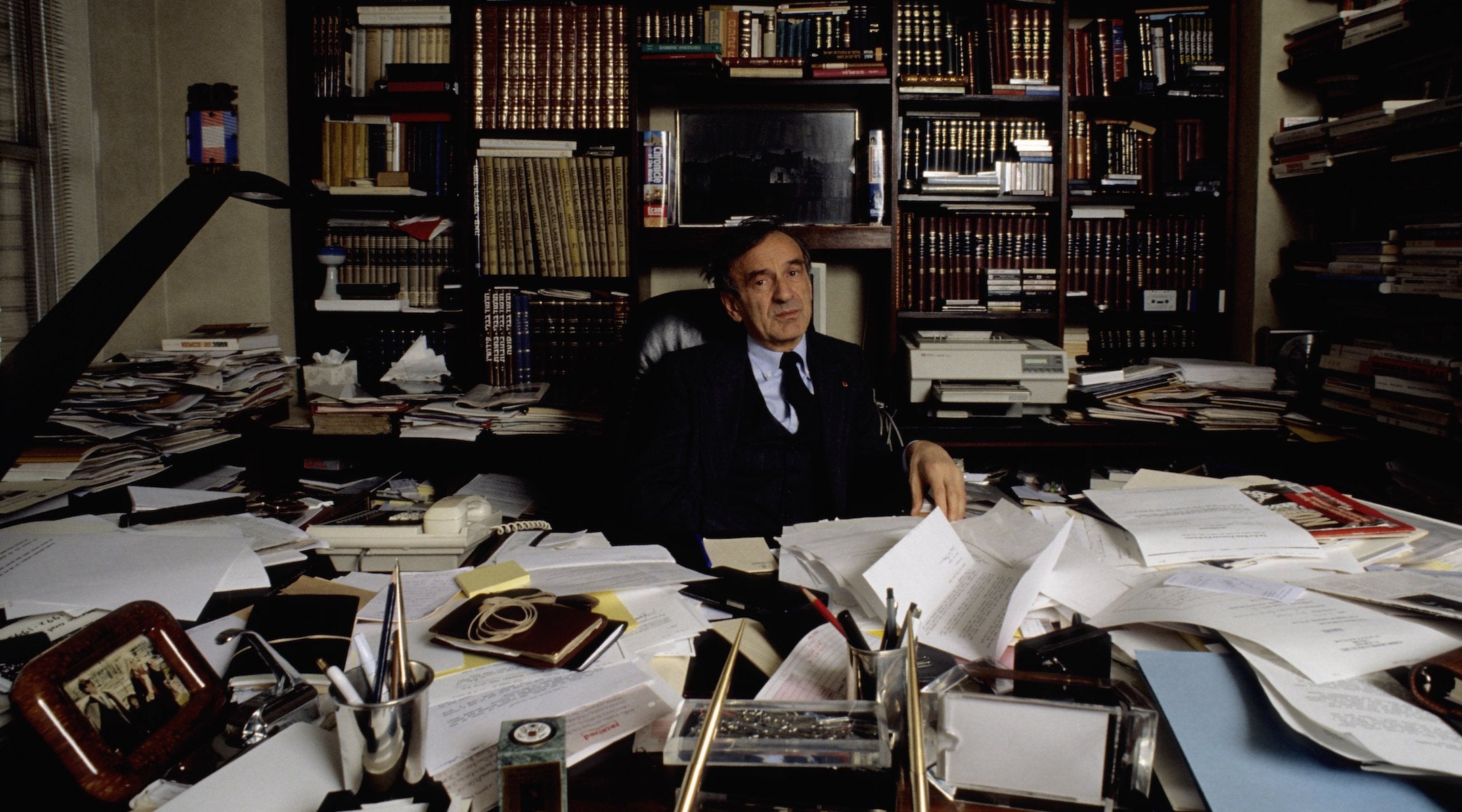
(JTA) — The lieutenant governor of Texas says his recent call for the state’s public schools to remove “over 2,000 titles” of “dirty, filthy and vulgar books” was not meant to include books about the Holocaust.
Dan Patrick’s statement, provided exclusively to the Jewish Telegraphic Agency on Friday, comes after a month of confusion following a press conference in which he and a conservative Christian activist threatened schools with potential loss of state funding if they did not comply with his directive to purge their libraries.
“I believe Texas students must learn about the Holocaust, and that includes reading books such as ‘Night’ by Elie Wiesel, ‘The Diary of Anne Frank,’ and other books about the Holocaust,” Patrick told JTA, singling out two books on the removal list he had promoted – one of which, “Night,” that he previously explicitly called for removal from middle schools.
Patrick added that his initiative was “focused on age-inappropriate, sexually explicit books in public school libraries across Texas.” At his earlier press conference, he had directed viewers to an online list compiled by an activist group that features several books about the Holocaust and Jewish identity.
Patrick’s threats have teeth. In Texas, lieutenant governors are more powerful than in many other states, playing central roles in shaping the budget and determining the legislative agenda.
Patrick also appeared to walk back some of the harsher proclamations from his Aug. 19 press conference, at which the Republican had stated, “We’re coming for the books.”
“As the law states, local communities have the right to make their own decisions about their public school libraries,” he told JTA Friday.
The lieutenant governor, who is up for reelection this fall, appeared at the conference with Bonnie Wallace, the head of the activist group Recover America, and told viewers to “go to RecoverAmerica.com.” That group has circulated a list of more than 2,100 “Harmful Books in Libraries.” Its list, which it describes as “books with harmful, sexually explicit, and vulgar content,” includes more than a dozen titles of particular import to Jewish readers.
Recover America’s flagged books include both volumes of Art Spiegelman’s “Maus,” a comic-book adaptation of Frank’s diary and Bernard Malamud’s novel of a blood libel “The Fixer” — all books that have been removed from school districts in Texas and other states in the past amid broader conservative-led library culture wars. In some cases those books were restored to the districts following public outcry, but spurred deeper dialogue about the state of Holocaust education and antisemitism awareness in public schools.
Patrick’s latest push would go much further than a handful of districts, affecting the more than 5.5 million students in public schools across the state.
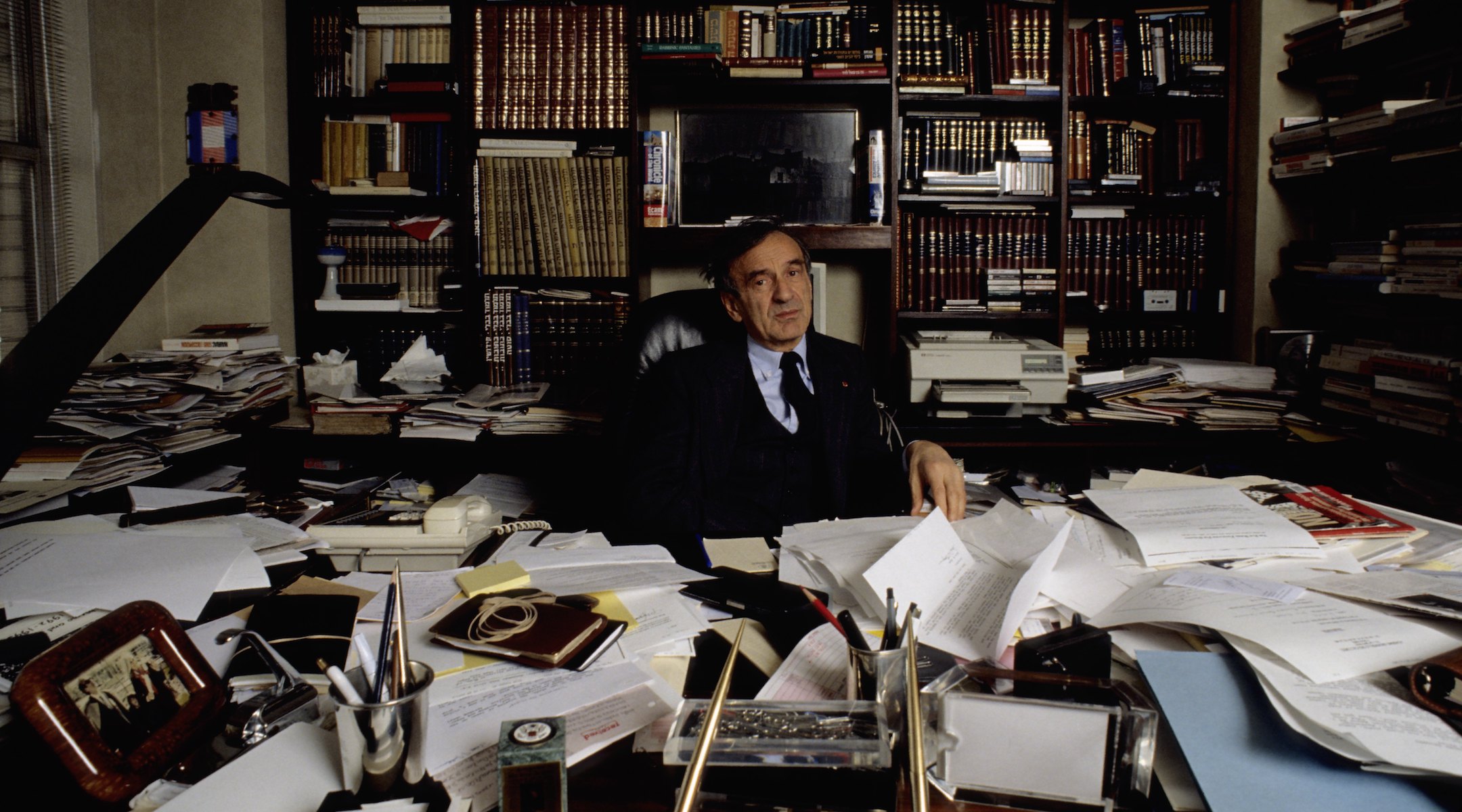
One book of particular contention on Recover America’s list was “Night,” Elie Wiesel’s bestselling memoir of surviving Auschwitz and Buchenwald, which has been taught in schools for decades. After a Houston Chronicle story noted the book’s inclusion on the Recover America “harmful” list, Patrick initially doubled down on “Night,” saying that it was not appropriate for middle schools owing to its “violence.”
“If ‘Night,’ by Elie Wiesel, were made into a movie, it would likely be rated R,” Patrick wrote on the social network X on Aug. 26. “‘Night,’ which includes depictions of graphic violence and the machine-gunning of babies, should not be available to sixth graders in middle-school libraries. High school is more age-appropriate.”
His tweet appeared to contradict the state’s own K-12 required reading list, passed this summer, which mandates that “Night” be taught in the eighth grade beginning in 2030.
Now, in response to questions from JTA, the lieutenant governor said he would defer to the Texas State Board of Education on the appropriate grade to teach “Night.”
“The State Board of Education decides the appropriate grade level for books and will determine whether ‘Night,’ by Elie Wiesel, is at the appropriate grade level,” Patrick told JTA in his statement.
He continued to insist that books in schools should be held to “FCC standards,” referring to the Federal Communications Commission, an agency that governs broadcasting content and does not regulate publishing.
The head of the Texas Holocaust, Genocide and Antisemitism Advisory Commission, a governor-appointed panel which advised the state on the inclusion of “Night” and other Holocaust texts on its required reading list, did not return a JTA request for comment.
In a statement, the Texas Educational Authority, which drafted the required-reading list, told JTA, “When Texas students learn about the Holocaust, they will be exposed to the horrors of the Holocaust. That is why the SBOE placed the book in 8th Grade to ensure age appropriateness for students.”

At the Emmys this week, when “The Librarians,” a documentary about librarians facing book removal threats, won an award, retired Texas librarian Carolyn Foote joined the producers on the stage and held up a copy of “Night” in protest.
“I felt like it was very symbolic to bring ‘Night,’” Foote, a subject of the film and a co-founder of the librarian activist group FReadom Fighters, told JTA. “Having read it, I just know the importance of not forgetting our past. And that’s part of Elie Wiesel’s whole legacy, is remembrance, and so it just felt very important for me to carry that book, coming from Texas.” Another librarian onstage for the win held up “Anne Frank’s Diary: The Graphic Adaptation.”
Elisha Wiesel, Elie’s son and chair of the Elie Wiesel Foundation, told JTA that “Texas deserves credit for recognizing that Holocaust education belongs in the eighth-grade curriculum.” Yet, the younger Wiesel suggested, Patrick’s concerns about the book’s violence were misplaced.
“‘Night’ contains violence because the Holocaust was violent; its purpose is not to shock young people, but to help them understand where hatred and indifference can lead,” he wrote in an email. “With context and guidance, students should not be shielded from this history. They should be equipped to confront it.”
Despite having directed viewers to Recover America’s book list during his press conference, Patrick’s new statement to JTA said, “I do not have a book list.” He pointed instead to a law passed in the state legislature in 2025 regulating school books that he said districts were required to follow.
Yet some districts in the state have removed every book on Recover America’s list from their own libraries out of fear of losing funding, Foote told JTA. While the list nominally contains a ratings system, many of the books do not have a rating.

Besides “Night,” “Maus,” “Anne Frank’s Diary” and “The Fixer,” other books about Judaism and the Holocaust on Recover America’s list of “Harmful Books” include:
- “Annexed,” a young-adult novel about Peter van Pels, who hid in the Amsterdam annex with Anne Frank
- “The Berlin Boxing Club,” a young-adult historical novel based on German boxer Max Schmeling, who helped young Jews during Hitler’s rise to power
- “Black, White and Jewish,” a memoir by Rebecca Walker, the mixed-race Jewish daughter of author Alice Walker
- “Caste: The Origins of our Discontents,” a nonfiction book analyzing the “caste systems” of Nazi Germany. “Caste” had been included on an earlier, Wallace-spearheaded list of books for removal from a Texas public library in a case that the U.S. Supreme Court declined to hear in 2025, allowing the removals to proceed.
- “Kasher in the Rye,” a memoir by Jewish comedian Moshe Kasher
- “Pride: the story of Harvey Milk and the Rainbow Flag,” a children’s picture-book biography of the pioneering Jewish LGBTQ legislator
- “Sophie’s Choice,” the bestselling Holocaust novel for adults
- “The Violin Maker’s Daughter,” a historical novel about a Jewish family of musicians during the Holocaust
- “White Bird,” a young-reader graphic novel about a Jewish girl in Nazi-occupied France
In response to JTA sharing a list of the above books, Patrick’s statement mentioned only “Night” and Anne Frank by name. The Recover America list is largely made up of romance and fantasy novels, many with an LGBTQ element, while also including classics such as “The Glass Menagerie” and “Cat’s Cradle” and some picture books for children.
Recover America did not immediately return a JTA request for comment Friday on Patrick’s new statement. Wallace, the group’s leader who has also appeared on Patrick’s podcast, previously told the Houston Chronicle that she had “thought long and hard” about including “Night” on her list.
She ultimately did so, she said, because “an eighth-grade student is 13 years old. Do they need to read about soldiers massacring, throwing up babies, and killing them with machine guns?”
She added, “It’s not to say this doesn’t happen in life. And the Holocaust was maybe the worst tragedy in the history of the world.”
For Cameron Samuels, a Jewish alum of Texas public schools and founder of the activist group Students Engaged in Advancing Texas, such efforts do not help Jewish students.
“Non-Jewish people are deciding for us what’s best, and making this public policy,” Samuels said. “We can’t readily access these books and stories. And that makes students feel alone. It also means that our classroom peers are not learning authentic Jewish narratives.”
This article originally appeared on JTA.org.
The post After outcry, Texas lieutenant governor says schools should teach Holocaust books ‘Night,’ ‘Anne Frank’ appeared first on The Forward.
