


Uncategorized
Argentina rabbi: What can can learn from losing the World Cup?
דעם פֿאַרגאַנגענעם זונטיק, גלײַך נאָכן סוף פֿונעם וועלט־בעכער טורניי 2026 האָב איך אָנגערופֿן אַ גוטן פֿרײַנד אין אַרגענטינע, כּדי צו הערן ווי עס גייט אים.
איך בין ממש צעבראָכן — האָט ער געזאָגט — פֿאַרוואָס האָט דער אויבערשטער דאָס געטאָן?!
האָב איך אים געענטפֿערט: — איך בין נישט דעם אויבערשטנס בוכהאַלטער, און זיכער נישט זײַן אַדוואָקאַט. איך ווייס נישט פֿאַרוואָס ער טוט וואָס ער טוט, און פֿאַרוואָס ער טוט נישט וואָס ער טוט נישט. איך מיין אַז די וויכטיקסטע פֿראַגע איז נישט: „פֿאַרוואָס איז דאָס געשען“? נאָר גיכער: „וואָס איצט? וואָס קענען מיר זיך דערפֿון לערנען?“
האָט ער מיך געפֿרעגט, וואָס איך האַלט איז דער מוסה־השׂכּל. האָב איך אים געפֿרעגט צי ער געדענקט די מעשׂה פֿון יונה.
— אַוודאי. דער פֿיש האָט אים אײַנגעשלונגען.
ריכטיק — האָב איך געזאָגט — אָבער דאָס איז בלויז דער ערשטער טייל פֿון דער מעשׂה. נאָך דעם וואָס יונה האָט אין נינווה איבערגעגעבן די נבֿואה, מיט וועלכער דער אויבערשטער האָט אים געשיקט, איז ער אַרויס פֿון שטאָט און זיך אַוועקגעזעצט צו זען וואָס עס וועט ווערן.
דער אויבערשטער האָט דעמאָלט געמאַכט אויפֿוואַקסן אַ קיקיון, וואָס האָט אים געגעבן שאָטן, און יונה האָט זיך זייער געפֿרייט. אָבער אויף מאָרגן האָט דער אויבערשטער געשיקט אַ וואָרעם, וואָס האָט פֿאַרדאָרבן דעם קיקיון, און דער בוים איז פֿאַרטריקנט געוואָרן.
ווען די זון האָט שטאַרק געברענט, האָט יונה געליטן פֿון דער היץ און איז געוואָרן גאָר פֿאַרצווייפֿלט. האָט אים דער אויבערשטער געפֿרעגט: טרויערסטו איבערן קיקיון?
און יונה האָט געענטפֿערט: יאָ, ביז צום טויט.
האָט דער אויבערשטער געזאָגט: דו באַדויערסט אַ קיקיון, וואָס דו האָסט נישט פֿאַרפֿלאַנצט און נישט אויפֿגעהאָדעוועט. אין איין נאַכט איז ער אויפֿגעקומען, און אין איין נאַכט איז ער פֿאַרגאַנגען.
און זאָל איך דען נישט רחמנות האָבן אויף דער גרויסער שטאָט נינווה, וווּ עס וווינען מער פֿון צוועלף טויזנט מענטשן?“…
די מעשׂה שטעלט אונדז פֿאָר אַ פּשוטע אָבער טיפֿע פֿראַגע: וואָס פֿאַרדינט טאַקע אונדזער גרעסטע זאָרג?
און דאָ קומען מיר צוריק צום וועלט־בעכער. עס איז גאָר פֿאַרשטענדלעך, אַז אַן אַרגענטינער זאָל זײַן אַנטוישט ווען זײַן מאַנשאַפֿט פֿאַרשפּילט. ספּאָרט רופֿט אַרויס שטאַרקע געפֿילן, און דאָס איז דווקא איינע פֿון די סיבות, פֿאַרוואָס מענטשן האָבן עס אַזוי ליב.
— דײַן טרויער איז נישט קיין חסרון — האָב איך אים געזאָגט — פֿאַרקערט. עס ווײַזט, אַז דו ביסט אַ מענטש מיט געפֿיל. און געפֿיל איז אַ טײַערע מידה.
אָבער ווען די ערשטע אַנטוישונג הייבט שוין אָן זיך אָפּצושוואַכן, איז כּדאַי זיך צו פֿרעגן: וואָס נאָך אין לעבן פֿאַרדינט אַזאַ מאָס פֿון דײַן איבערגעגעבנקייט?
באַטראַכט נאָר אַ מאָמענט. דו האָסט נישט געקענט ברענגען דעם נצחון, און דו האָסט אויך נישט גורם געווען די מפּלה. און דאָך האָט דער רעזולטאַט, וואָס איז בכלל נישט געווען אין דײַנע הענט, אַזוי שטאַרק באַווירקט דײַנע געפֿילן.
אפֿשר וואָלט זיך געלוינט אַרײַנצולייגן די זעלבע עמאָציאָנעלע ענערגיע אין אַן אַנדער מין „פֿאַרמעסט“ — אין אַזאַ, וווּ דײַנע באַשלוסן און דײַנע מעשׂים קענען טאַקע מאַכן אַן אמתן חילוק.
וואָס פֿאַר אַ פֿאַרמעסט מיין איך? דאָ קומט אַרײַן אַן אויסערגעוויינטלעכע הוראה פֿונעם רמב״ם.
דער רמב״ם שרײַבט, אַז יעדער מענטש דאַרף שטענדיק זען זיך אַליין און די גאַנצע וועלט ווי פּונקט באַלאַנצירט צווישן זכות און חובֿה.
איין מצווה. איין גוט וואָרט. איין מעשׂה פֿון חסד. אַפֿילו איין גוטער געדאַנק.
יעדער איינער פֿון זיי קען איבערוועגן די גאַנצע וואָג לטובֿה — נישט נאָר פֿאַר זיך אַליין, נאָר פֿאַר דער גאַנצער וועלט.
מיר טראַכטן אָפֿט: וואָס מאַכט אויס וואָס איך׳ל טאָן? איך בין דאָך בלויז איין מענטש צווישן אַכט ביליאָן? דער רמב״ם בעט אונדז צו קוקן אויף דער וועלט מיט אַנדערע אויגן:
שטעל זיך פֿאָר אַ וואָג. אויף איין זײַט שטייען פֿיר ביליאָן מענטשן. אויף דער צווייטער זײַט — נאָך פֿיר ביליאָן. די וואָג איז פּונקט באַלאַנצירט. איצט שטעל זיך פֿאָר, אַז דו טרעטסט צו און באַשליסט אויף וועלכער זײַט זיך צו שטעלן. אין יענער רגע ווערט דײַן באַשלוס דער באַשליסנדיקער. דו ביסט דער וואָס האָט איבערגעוואָגן די גאַנצע וואָג.
אויב דאָס קלינגט צו אַבסטראַקט, לאָמיר זיך אומקערן צום וועלט־בעכער.
דער גאַנצער טורניר — נאָך וואָכן פֿון שפּילן, צענדליקער נאַציאָנאַלע מאַנשפֿאַטן און הונדערטער שפּילער — איז דער סוף באַשלאָסן געוואָרן דורך איין איינציקן מאָמענט.
איין שפּילער. איין גאָל. אַזוי איז אויך אין דער רוחניותדיקער וועלט.
דער גרויסער געראַנגל צווישן גוטס און שלעכטס, וואָס באַגלייט די גאַנצע געשיכטע פֿון דער מענטשהייט, קען אויסזען ווי עפּעס צו גרויס, כּדי אַ יחיד זאָל קענען אײַנווירקן דערויף.
אָבער אויב די וואָג איז טאַקע באַלאַנצירט, ווי דער רמב״ם באַשרײַבט, קען דער גאַנצער סוף־רעזולטאַט אָפּהענגען פֿון איין מענטש. פֿון איין מצווה. פֿון איין גוט וואָרט. פֿון איין גוטן געדאַנק.
און יענער מענטש קען זײַן דווקא דו אַליין. מיט דעם באַשלוס וואָס ליגט הײַנט אין דײַנע הענט.
עס איז דאָ נאָך אַן ענין, וואָס דער וועלט־בעכער קען אונדז לערנען. די נבֿיאים באַשרײַבן אַ צײַט, ווען די וועלט וועט דערגרייכן איר אמתן ציל. דעמאָלט וועט דער משיח קומען און ברענגען אַן עפּאָכע פֿון שלום, גערעכטיקייט און אַלגעמיינער דערקענונג פֿון גאָט.
קען מען זיך פֿרעגן: ווי אַזוי איז עס מעגלעך, אַז איין מענטש זאָל אינספּירירן די גאַנצע וועלט?
אָבער טראַכט צוריק וועגן דעם וואָס מיר האָבן פּונקט איצט מיטגעזען. ביליאָנען מענטשן האָבן אין איין אויגנבליק זיך צוגעקוקט אויף איין מענטש: ליאָנעל מעסי.
פֿאַר אַ קורצן מאָמענט איז ער געוואָרן דער צענטער פֿונעם אויפֿמערק פֿון ביליאָנען מענטשן!
אויב דאָס איז מעגלעך אין דער וועלט פֿון ספּאָרט, איז עס נאָך מער פֿאַרשטענדלעך, אַז עס וועט קומען אַ טאָג, ווען די גאַנצע מענטשהייט וועט זיך ווענדן צו אַ פֿירער, וועמענס כּוח וועט נישט ליגן אין זײַנע פֿיס, נאָר אין זײַן רוח.
משיח וועט נישט פֿאַראייניקן מענטשן אַרום אַ פּילקע. ער וועט פֿאַראייניקן זיי אַרום אמת. אַרום גוטסקייט. אַרום גערעכטיקייט. אַרום שלום. און אַרום דער ידיעה פֿון ג-טליכקייט.
איך האָב דעמאָלט צוגעגעבן מיט ַא שמייכל: „ס׳איז דאָ אַ טשיקאַווער צופֿאַל. דער נאָמען Messi קלינגט ַא ביסל ענלעך צו Messiah.
אַוודאי איז דאָס בלויז אַ לשון־צופֿאַל. אָבער אַ מאָל קען אַ קליינע צופֿעליקייט דינען ווי אַ בריק צו אַ גרעסערן געדאַנק. און דער געדאַנק איז פּשוט:
אויב די גאַנצע וועלט קען זיך פֿאַראייניקן אַרום אַ פֿוסבאָל־פֿינאַל, אויב ביליאָנען מענטשן קענען זיך טיילן די זעלבע האָפֿענונג, די זעלבע שפּאַנונג און די זעלבע באַגײַסטערונג, דערמאָנט דאָס אונדז, אַז די מענטשהייט איז פֿעיִק זיך צו פֿאַראייניקן.
די פֿראַגע איז נאָר: אַרום וואָס?
די נבֿיאים זעען פֿאָרויס א טאָג, ווען די וועלט וועט זיך פֿאַראייניקן נישט אַרום קיין שפּיל, נאָר אַרום אַ ציל. נישט אַרום אַ געווינער, נאָר אַרום אמת. נישט אַרום אַ גאָל, נאָר אַרום דעם אויבערשטן.
און ביז עס קומט יענער טאָג, האָט יעדער איינער פֿון אונדז זײַן אייגענע ראָלע. מיר דאַרפֿן נישט וואַרטן אויף אַ פֿולן סטאַדיאָן. מיר דאַרפֿן נישט וואַרטן אויף אַ וועלט־פֿינאַל. און מיר דאַרפֿן זיכער נישט וואַרטן ביז אַלע אַנדערע וועלן טאָן וואָס זיי דאַרפֿן טאָן.
די געלעגנהייט ליגט פֿאַר אונדז יעדן טאָג. יעדער באַשלוס. יעדער גוט וואָרט. יעדע מצוה. יעדער אַקט פֿון חסד. זיי אַלע זײַנען מער באַטײַטנדיק, ווי מיר שטעלן זיך פֿאָר.
אפֿשר וועלן מיר קיינמאָל נישט וויסן, ווי ווײַט די השפּעה פֿון אַן איינציקער מעשׂה האָט זיך פֿאַרשפּרייט. אָבער לויט דעם רמב״ם דאַרפֿן מיר לעבן מיט דעם באַוווּסטזײַן, אַז עס איז זייער מעגלעך, אַז דווקא יענע מעשׂה האָט איבערגעווויגן די גאַנצע וואָג.
מיר קענען אפֿשר נישט באַשליסן ווער עס זאָל געווינען דעם וועלט־בעכער. אָבער מיר קענען יעדן טאָג באַשליסן וואָס פֿאַר אַ וועלט מיר העלפֿן בויען.
אויב יעדער פֿון אונדז וועט טאָן זײַן טייל, וועלן מיר אַלע צוזאַמען העלפֿן ברענגען דעם טאָג, ווען די וועלט וועט דערגרייכן איר אמתן נצחון — די גאולה האמתית והשלימה, מיט ביאת משיח צדקנו במהרה בימינו, ממש.
The post Argentina rabbi: What can can learn from losing the World Cup? appeared first on The Forward.
Uncategorized
Netanyahu to confront Mamdani’s call to arrest him in U.N. address this week
(JTA) — Prime Minister Benjamin Netanyahu on Tuesday accused New York Mayor Zohran Mamdani of supporting Hamas and inciting violence against Jews, setting up a showdown between the Israeli leader and one of the most prominent American pro-Palestinian politicians ahead of Netanyahu’s visit to the city.
Netanyahu said he would respond to Mamdani’s criticism of him and Israel during his speech at the United Nations General Assembly on Thursday, when he will visit New York for the first time since Mamdani took office.
Mamdani on Monday renewed his demand for the arrest of Netanyahu, who he called “a war criminal and an architect of a horrific genocide of the Palestinian people” in an interview with CNN’s Christiane Amanpour. He acknowledged that he did not have the authority to carry out a warrant for Netanyahu issued by the International Criminal Court, but said the warrant should still be “honored” to protect “accountability” to international laws.
“If the International Criminal Court deems someone worthy of an arrest because of a violation of those laws, then who are we to say that anyone should be above that?” said Mamdani.
Netanyahu responded in a video statement, “Shame on you for supporting the Hamas terrorist monsters who butchered our people. Shame on you for inciting riots against New York Jews.” A number of prominent New York Jewish figures have asked Mamdani to tamp down his rhetoric about Israel, linking it to rising violent attacks on Jews. Mamdani has said that he is mayor for all New Yorkers, including Jews, and denounces antisemitism.
“I’m coming to the U.N., I’m going to tell the truth about our heroic soldiers, and I’m going to tell the truth about you,” added Netanyahu.
Mamdani pledged during his mayoral campaign last year that he would seek to arrest Netanyahu if he visited, but admitted in July that the city could not legally do so.
The ICC issued its warrant for Netanyahu in 2024, accusing him of war crimes and crimes against humanity in Gaza. The United States and Israel are not signatories of the treaty that created the ICC in 2002 and do not recognize its jurisdiction.
Netanyahu has prominently featured Mamdani in campaign ads as he currently seeks reelection in Israel, framing the mayor as both a pro-terror extremist and a leader reminiscent of Nazi Germany.
Netanyahu is set for one of his shortest trips to the United States, where he is not slated to meet with President Donald Trump, according to The Jerusalem Post. He is currently scheduled to leave New York on the same day he arrives. Protests are expected both outside the United Nations and inside during Netanyahu’s speech, which last year saw representatives from dozens of countries walk out.
Meanwhile, Mamdani had his third meeting with Trump on Monday, continuing a rapport between the two populist leaders on opposite ends of the political spectrum. Despite their stark differences on issues including immigration enforcement, Trump praised Mamdani during a press conference on the lawn of Gracie Mansion.
“I want him to be a great mayor, and he’s certainly got potential,” Trump told reporters before shaking Mamdani’s hand and patting his arm.
This article originally appeared on JTA.org.
The post Netanyahu to confront Mamdani’s call to arrest him in U.N. address this week appeared first on The Forward.
Uncategorized
Could going to synagogue help or hurt a Jewish candidate? This poll offers a clue
Voters may react differently to a Jewish politician who publicly practices their faith than to one who simply identifies as Jewish, a new poll found. The distinction could matter for Pennsylvania Gov. Josh Shapiro, a possible 2028 presidential candidate who has made his Jewish faith central to his public life and service.
The Politico poll of 2,002 U.S. adults showed that Democratic voters were less likely to vote for a candidate who regularly attends synagogue than for a candidate not practicing a religion or attending services once a year. Among Republicans, however, a candidate who regularly attends synagogue performed better than one who attends only once a year.
The survey, conducted online in partnership with the London-based polling firm Public First between August 8 and 14, asked respondents to choose between hypothetical candidates with different characteristics, including political ideology, age, race, profession, sexual orientation and religious practice. The sample has a reported margin of error of plus or minus 2.2%.
The poll offers a window into how religious observance may shape the way voters view a Jewish candidate. In an earlier poll conducted by the same firm in May, among 2,038 voters, candidates were identified simply by religion rather than how often or where they worshipped. Being identified as Jewish hurt a hypothetical candidate among voters in both parties compared with being identified as Christian.
The findings could be particularly relevant to Shapiro, the popular Pennsylvania governor running for reelection this fall. He maintains a traditional Conservative Jewish lifestyle, keeps kosher and is a longtime member of Beth Sholom Congregation in Elkins Park, outside Philadelphia. In his recent memoir, Where We Keep the Light, Shapiro detailed experiences shaped by and tied closely to his Jewish identity, including his vetting as a vice presidential candidate in 2024.
Shapiro has been viewed as a potential first Jewish president since his gubernatorial campaign in 2022 and is one of three prominent Jewish Democrats — along with Illinois Gov. J.B. Pritzker and former Chicago Mayor Rahm Emanuel — mentioned as possible 2028 presidential candidates.
Religious identity, particularly Christianity, has become more central in Republican politics since President Trump returned to the White House in 2025. Trump and his Cabinet have made religious faith a prominent part of his administration’s agenda. He created a White House Faith Office to work with religious organizations and established a Justice Department task force focused specifically on what the administration calls anti-Christian bias. At the same time, an increasingly vocal faction on the far right has made Christian nationalism and antisemitism central to its politics.
The Politico poll does not explain why Republican voters responded differently to Jewish candidates based on how often they attended synagogue. But the gap aligns with the broader split in positions among conservatives who have warmly embraced visibly religious and politically conservative Jews, while criticizing liberal or less observant Jews over their politics and commitment to Judaism.
Trump has repeatedly drawn that distinction himself. During the 2024 election, for example, he said that Jewish Americans who vote for Democrats “hate their religion.”
The post Could going to synagogue help or hurt a Jewish candidate? This poll offers a clue appeared first on The Forward.
Uncategorized
Nazi imagery nothing new for crypto casino behind Orlando fight with swastika flags and Hitler salutes
(JTA) — Nazi salutes. A swastika flag. Fights in the stands. They were all part of the scene at a recent combat sports event in Orlando that pitted an Israeli Jew against an avowed racist with SS bolts tattooed on his chest – and ended with the latter mocking his defeated foe as “a short little f–king Jew prick.”
The condemnation that followed the Aug. 29 event was aimed in a number of directions: at Paul Miller, the fighter who performed the Hitler salute after his win; at the attendees who returned the salute and displayed the Nazi flag; and at the Kia Center, the city-owned arena best known as the home of the NBA’s Orlando Magic, which hosted the fight night.
Politicians were shocked by the display and wrote statements condemning the event — but the Nazi symbols were nothing new for Duel, the online cryptocurrency casino behind the promotion.
Founded last year and billing itself as “the first casino that gives a f–k,” Duel has used Nazi symbols and racist language in its gambling programming. And its owner, Ossi Ketola, a Finnish high-stakes poker player, is himself a self-described First Amendment absolutist with his own history of racially charged comments. He celebrated his free speech devotion just one week after the Orlando event, in a social media post featuring a photo of himself with Donald Trump Jr.
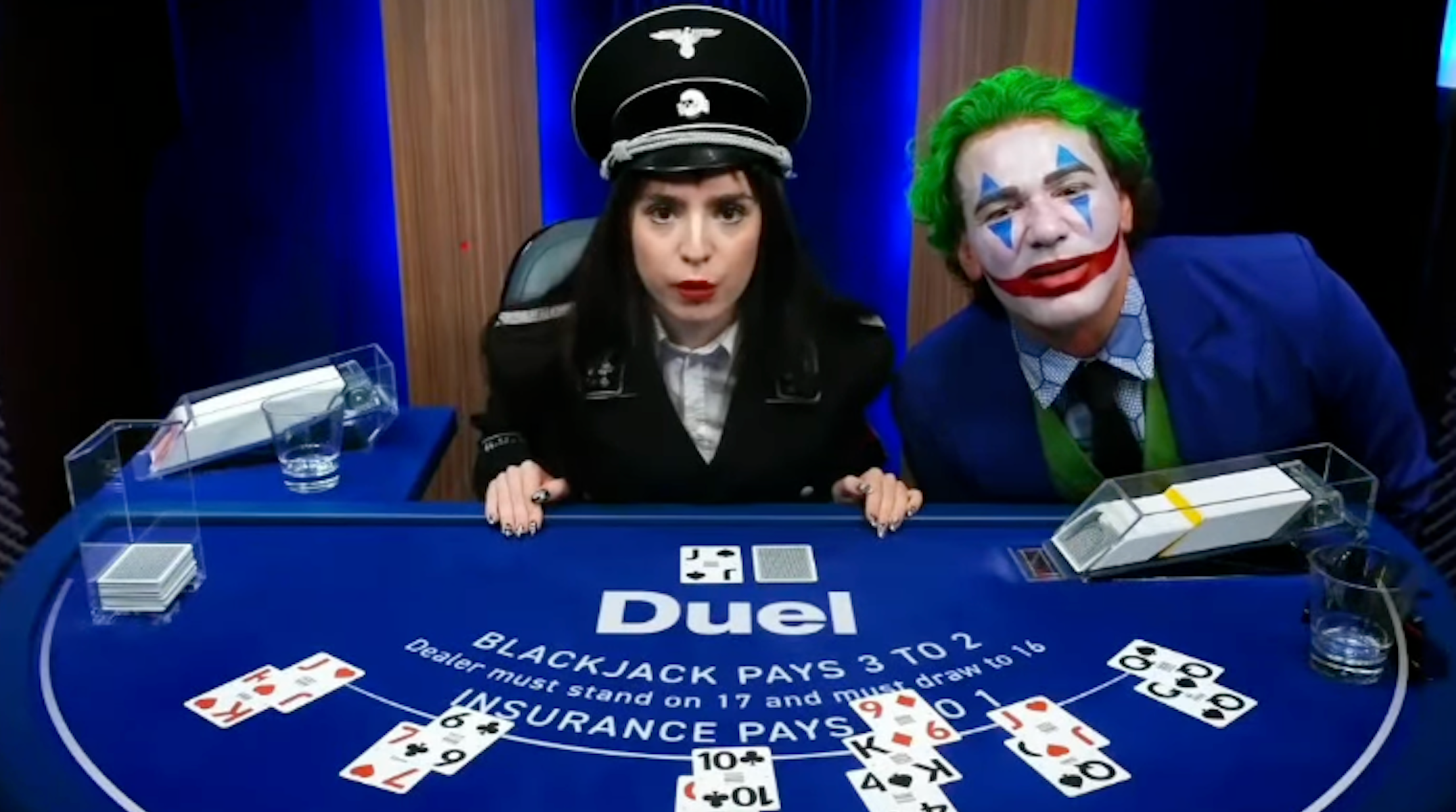
One of Duel’s blackjack dealers, Nelli Levonyan, has worn a Nazi outfit with a swastika armband on multiple occasions while dealing cards on the blackjack stream. In a skit from the blackjack table that circulated online, a man, dressed up as an Orthodox Jew and holding an Israeli flag, attacked Levonyan by throwing coins at her. Levonyan’s character then sprayed something at the Jewish man — “Gassing!” he yelled — and said, “Go away from me, you dirty kike.”
In another blackjack stream, the dealer imitated one of the two San Diego mosque shooters, who killed five people in May. Levonyan has sung the lyrics to “Heil Hitler,” the Ye (formerly Kanye West) song, during a stream. She has also appeared alongside Miller while hosting the card game.
Earlier this month, Ketola joined a neo-fascist rally in Helsinki staged by the far-right party Sinimusta Liike, or the Blue-and-Black Movement. Ketola, who was dressed in a Spongebob costume, livestreamed the rally and posted the footage with the title “Saving white Finland.” Speaking about immigrants, he said that people “need to be educated about how the genes work, and how these people realistically cannot be integrated here.”
He then attended an anti-fascist rally held elsewhere in Helsinki simultaneously, prompting left-wing demonstrators to chase him and his video crew back to their car. Ketola could be heard off-camera yelling “Sieg heil” as they drove away.
“What f–king violent pussies. Imagine what f–ing leftists,” Ketola said after taking off the Spongebob costume. “You see? These right-wing people, white people, the most friendly people. I just walked there, we didn’t say anything, we didn’t do anything — we go to these leftists and they try to f–ing attack us. F–ing dumb stupid f–ing n–ers.”
The following night, Ketola attended the dinner with Trump and about a dozen others in Tallinn, Estonia, hosted by Studioworks, a company that develops software for online casino sites. Ketola posted a photo of himself and the U.S. president’s son on Instagram, and wrote that he discussed “Duel, the state of the world and current political climate with him and his staff.”
“The political situations in our respective countries have become increasingly similar, with a rising tide of violence and radical leftism in both America and Finland,” Ketola wrote. “As a firm 1st amendment absolutist and an individual with many values that coincide with Republicans and Donald Trump himself, this was a great chance to align on many things important to both.”
Neither the Trump Organization, Miller, Ketola nor Levonyan responded to requests for comment.

Duel was founded last summer and has featured some prominent personalities on its streams, including boxing great Mike Tyson — who told Levonyan, “You dumb b–h, you like Hitler” — and the “looksmaxxing” influencer Braden Peters, who is known as Clavicular.
The fight night that it organized and promoted in Orlando was its first foray into combat sports, and made for the company’s biggest splash yet. It also caught the attention of at least one watchdog and a local lawmaker.
“Right after the event there was a lot of criticism put on the venue, which didn’t have much responsibility in this, and not enough eyes on the people who actually made it happen,” Mark Pitcavage, senior fellow at the Anti-Defamation League’s Center on Extremism, told the Jewish Telegraphic Agency. (The city had said that, as an operator of public venues, it “cannot deny access because we disagree with the political ideology, opinion or perspective, regardless of the message.”)
State Rep. Anna Eskamani called for the Florida Athletic Commission to revoke Duel Arena’s license. The commission’s members were appointed by Florida Gov. Ron DeSantis, who has not commented on the event. The governor’s office did not respond to multiple requests for comment from JTA.
DeSantis’ immediate predecessor and fellow Republican, U.S. Senator Rick Scott, posted that the event was “utterly disturbing” and that “Antisemitism has NO PLACE in Florida.”
Pitcavage said that combat sports are “a draw for far-right extremists and white supremacists” who often view themselves as “white warriors.” He noted, however, that they make up a small portion of the participants and fans.
“It’s not at all surprising that some of them will get into various types of what they would consider manly, or warrior-like athletics,” he said.
Duel’s involvement in the Orlando event put the intersection of online gambling sites and far-right ideologies on his radar. “It’s something we’re starting to look into,” Pitcavage said. He noted that Duel is registered and licensed offshore on the autonomous island of Anjouan, making it more difficult to investigate.
Eskamani, who is running for mayor of Orlando, told JTA that Duel should not be allowed to operate in Florida, citing reasons that she says would beat the city’s First Amendment defense.
“These offshore cryptocurrency — I mean, there are so many red flags in how this entity is operating that from a purely financial security position for a public venue, I would not want to accept a reservation,” Eskamani said.
Duel set and promoted the matchups on the fight card, which included the kickboxing match between Miller, who goes by the moniker “Gypsy Crusader,” and his fellow influencer Ben “King” Azoulay.
Miller, who has made numerous appearances on Duel’s casino games streams, has been known to use racial slurs and denigrate minority groups in his online content. He was convicted in 2021 of felony weapons charges, and sentenced to 41 months in federal prison. He had posted about initiating a race-based civil war.
During a livestreamed conversation with Adin Ross, a Jewish streamer who has interviewed or maintained friendly relationships with controversial figures including Nick Fuentes and Andrew Tate, Miller said there are no exceptions in his feelings toward Jews.
“I respect you for having an opinion that is different from the Jews,” Miller told Ross. “But that doesn’t mean that I would not laugh if I see you in a gas chamber.”

Clips from the Orlando event showed Miller performing the Nazi salute twice after his victory — something he has done after winning previous fights — prompting a number of attendees to do the same. One fan brought a Nazi Germany flag and waved it in his seat.
“He’s not a tough guy, he’s not an alpha male. He’s a short little f–ing Jew prick,” Miller declared about his opponent Azoulay in his post-fight interview, eliciting some cheers from the crowd.
U.S. Rep. Randy Fine, the Jewish Republican firebrand whose district includes Palm Coast and Daytona Beach, posted a video of the Nazi flag being unfurled and wrote, “This is not a joke and it is not edgy. The guy who did this is old enough to know exactly what that symbol means and to know that it’s not funny. We will make an example out of him.”
Asked what he meant by making an example of the attendee, Fine told JTA, “We put the video out so he would be recognized and be held publicly accountable. Most folks are unwilling to associate with Nazis.”
Cheering Miller on ringside was Jake Shields, a former mixed martial artist-turned far-right influencer who has espoused conspiracy theories about Jews and Israel. Shields wore a shirt reading “FCK ISRL.” Myron Gaines, a prominent streamer who has spread similar conspiracy theories and performed Nazi salutes, was in the stands, and told Miller before the fight, “You fight for the goyim,” according to clips shared on social media.
Pitcavage said he has been tracking a trend of the far-right getting involved in combat sports since the late 1990s, as mixed martial arts and UFC became a more mainstream phenomenon and amateur gyms became widespread and increasingly accessible.
The ADL has flagged that in recent years “active clubs,” or “localized white supremacist crews” that gather for fight training, have become more common. The ADL writes that these groups “see themselves as fighters training for an ongoing war against a system that they claim is deliberately plotting against the white race.”
As news outlets covered backlash to the Orlando fight night, Duel issued its own statement saying it was horrified “to learn that a group of viewers were displaying symbols of hate at our event.” The company criticized the city’s “shocking remarks that the ‘First Amendment’ applies and that ‘free speech’ is permitted at their arena,” and pledged to “work with local activist groups to push back on this and ensure that this kind of hate does not fester ever again.”
The statement appeared to be an example of Duel trolling with deadpan, buttoned-up language. Before the fight, Ketola had similarly released a promotional video that appeared to be condemning Miller’s views. “Paul Miller is a Nazi. Being a Nazi is bad,” Ketola narrated, over footage of him shaking his head. “We cannot support this. The only reason we are allowing him to fight is to ensure the good guys get to add another victory to their record.”
Then, after Miller’s win, Duel’s Instagram account left a comment that told a different story.
“The good guys won,” Duel wrote.
This article originally appeared on JTA.org.
The post Nazi imagery nothing new for crypto casino behind Orlando fight with swastika flags and Hitler salutes appeared first on The Forward.
