


Uncategorized
‘I felt I couldn’t talk about the war’: Jewish and Muslim teens make space for tough conversations
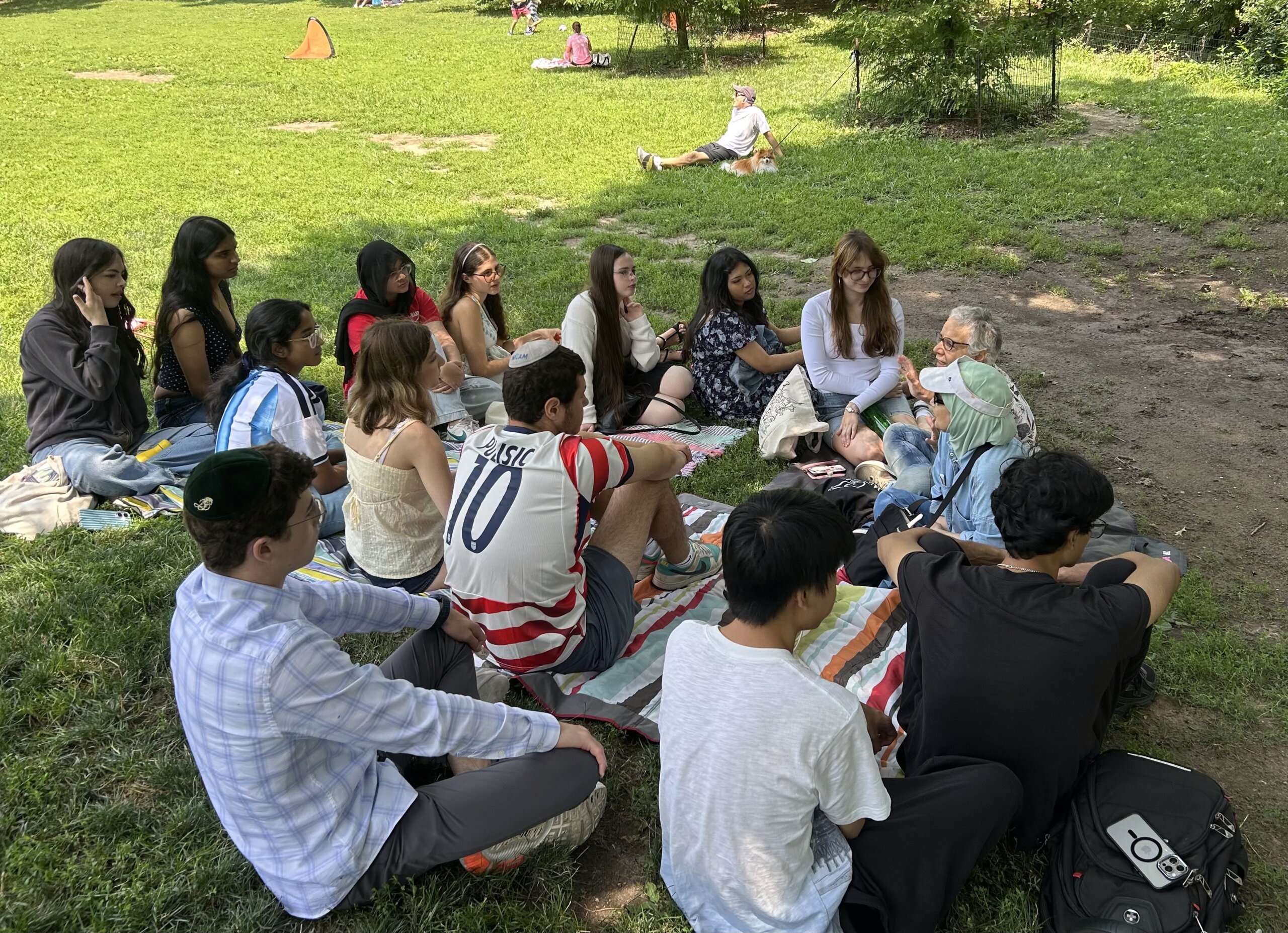
For Jewish student Maxanne Wallace-Segall and Muslim student Nabila Rahman, the months after the Hamas-led Oct. 7 attacks on Israel were filled with a tense quiet.
Then freshmen at Stuyvesant High School, a public school on Manhattan’s southern tip, the two girls had only been friends for a few weeks. As their social media feeds became inundated with polarizing content from across the spectrum, neither of them knew how to bring up what had happened.
“I felt like I couldn’t talk about the war with one of my closest friends in the world, just because I was terrified about what I would say and what she would say,” Wallace-Segall said.
That tension ended when Wallace-Segall interviewed Rahman for an article in their high school paper about the pain many students were experiencing in the first months of the Israel Hamas War. Broaching the subject for the first time, they realized that — despite coming from different perspectives — both were primarily concerned that their friends were OK.
“It wasn’t a question of ‘do you support Israel or Palestine?’. It was a question of [if you were] OK; if your family was OK. That was what mattered at the moment; her opinion didn’t matter, even if it differed from mine,” Rahman told Wallace-Segall for the article.
Now rising high school seniors, the duo runs The Together Project, a citywide organization dedicated to dialogue between Muslim and Jewish teens — Zionists and anti-Zionists alike. This summer, that dialogue has deepened and the reach has widened with the launch of a twice-weekly program called the Ohel/Ahl Fellowship, named after Hebrew and Arabic words for friendship. Since June, Jewish and Muslim teens from public, private, religious, and secular schools in the New York area have come together around sacred texts, swapped stories, consulted experts and explored each other’s neighborhoods and perspectives.
Emboldened by their first conversation, Wallace-Segall and Rahman began speaking about the conflict with Muslim and Israeli friends. But, when starting the organization, those friends opted not to participate. The Muslim friend’s family refused to let them talk to people who supported Israel, while the Israeli friend wasn’t allowed to talk to anti-Zionists. The organization continues to face this challenge, with some criticizing its inclusive nature. On one Instagram reel posted by the project, a user commended the concept, but pointed out the number of Palestinian deaths and disagreed with participants working alongside Zionists.
“i was like yessss this is what we need!!” they wrote at first. “only for u to include zionists 💀absolutely not. none of you are truly anti-zionists if you agree to work closely with zionists, especially at this time.”
But that misses the point, Wallace-Segall said. “To exclude the Zionist narrative would be to exclude the issue itself.” That widespread opposition toward dialogue highlights “the necessity and urgency of starting it even more,” she added.
To expand citywide, the girls drew upon their previous connections — someone with whom Wallace-Segall often debated about the subject, another who had written poetry about her religious identity. Currently, the organization has branches at four public high schools in three of the city’s five boroughs.
The Together Project also established a partnership with the New York Society for Ethical Culture, a social activism organization that offers meeting space for several grassroots organizations and hosts all branches of the Together Project, and other interested students, for a citywide conference three times a year in winter, spring and summer.
At those seasonal meetings, students go over historical timelines, read books, articles, sacred texts, and poetry and push themselves to grapple with hard topics. The conversation subjects range from comparisons of the Torah and Quran to what Muslim and Jewish teachings say about queerness, and how being a member of the LGBTQ community informs support for Israel, given its comparatively tolerant culture, and support for Palestinians in Gaza, given the nature of their collective struggle.
Wallace-Segall’s favorite conversations are those that question “why do you believe what you believe?”
“It really gets everyone to think about the specific moments with their families and their friends and reading the news in which different aspects of their opinions have been shaped,” she said.
Last November, members of the group attended a United Nations conference on establishing a Middle East zone free of weapons of mass destruction. As she listened, Wallace-Segall was inspired by those “dedicating their lives to committing to peace.” At the end, four of The Together Project members were given the opportunity to speak about their organization and share their thoughts on the solutions that had been presented.
“So often in the UN, when we see discussions of rebuilding communities … it’s decades or years after the conflict happened,” Wallace-Segall said in her speech. “I think the time to start rebuilding communities is now.”
At Ramaz Upper School, a Jewish day school in Manhattan, now rising senior Gabriel Flatto-Katz found himself in a Jewish bubble. Amidst the tensions of the New York City mayoral election, he realized that he “didn’t have any Muslim person that I could call a friend,” and sought to start an interfaith student organization.
Despite reaching out to many Muslim organizations, however, he wasn’t able to find any interested partners. Then he discovered the Together Project and helped Wallace-Segall and Rahman develop this summer’s Ohel/Ahl Fellowship.

The fellowship has enabled students who were already involved, along with many new ones like Flatto-Katz, to engage more deeply with meetings twice a week. So far, the fellows have hosted speakers from the Rose Castle Foundation, which helps equip leaders to navigate conflict; explored the Islamic wing of the Metropolitan Museum of Art and analyzed poetry by Israeli and Palestinian writers.
Rather than jump right into sensitive political discussions, students explored each other’s religious identities and established trust in initial meetings, so they have felt more comfortable sharing sensitive opinions in the latter half of the fellowship.
According to Gershon Rozenberg, a rising senior at SAR High School, a co-ed modern Orthodox yeshiva in Manhattan, that turning point arrived during a recent discussion the students had about war. Participants shared conflicts that felt most personal to them and their families and how this might impact their thoughts on the Israeli-Palestinian conflict. Some mentioned the Vietnam War, the Bangladesh Civil War and the Holocaust.
Rozenberg called it “the most vulnerable conversation we’ve had among fellows.”
For Rahman, this conversation helped her realize just how personal the Israeli-Palestinian conflict is for Jews. “For people like Gabi who literally have family in Israel, there was so much more at stake,” said Rahman, who doesn’t know anyone who is Palestinian.
Along with speakers, the fellowship has a board of mentors from Jewish and Muslim organizations, including Rose Castle, the Tannenbaum Foundation, Jewish Theological Seminary, and a Palestinian representative from Debate for Peace.
“We’re still kids running a kids’ program,” Flatto-Katz said. Mentors provide necessary guidance on how to run an interfaith organization, advise on ground rules during sessions and recommend texts to study. To build a consistent base of students at each meeting, mentors also have helped recruit teenagers they had worked with previously.
Flatto-Katz recruited Rozenberg after reading Rozenberg’s piece in SAR’s campus newspaper arguing that the school “should do a better job of understanding the Palestinian perspective.”
To complement the students from private Jewish day schools, leaders have been reaching out to private Muslim schools. But they’ve encountered difficulty.
“A lot of the kids have never met a Jewish person before, so it’s hard for them to make that first step,” Rahman said.
Many of the students from private Jewish schools say they have been moved by the contributions of Muslim participants, including rituals like chanting from the Qur’an or talking about their religion. “People have enjoyed the ability to hear something so different than what they’re used to,” Flatto-Katz said.
Within Jewish youth spaces, Flatto-Katz said students strongly support Zionism, but also crave hearing new perspectives. It’s not always easy for Flatto-Katz to “have really hard conversations,” as he has family in the region, but he senses and shares a “hunger for understanding.” Agreement or consensus is not required, he said.
“This is my friend Nabila who doesn’t agree with me on 99% of things, and I think it’s really cool that we get frozen yogurt together,” Flatto-Katz said.
To Rahman, the diversity of high school environments and the formative teenage years are what makes the work they are doing now so significant.
“Making sure younger people are involved in this kind of things is so important,” she said, “because they are the ones who are going to be shaping the future.”
The post ‘I felt I couldn’t talk about the war’: Jewish and Muslim teens make space for tough conversations appeared first on The Forward.
Uncategorized
Mahmoud Khalil’s book reiterates his anti-Zionist stance
From the beginning, Palestinian activist Mahmoud Khalil denied claims that the protests at Columbia University after the Oct. 7, 2023 Hamas attacks on Israel were antisemitic.
In his book, No Land to Stand On, released Tuesday, he stands by that.
Khalil, who became the face of the anti-Israel campus movement after he was detained by Immigration and Customs Enforcement in 2025, reiterates his anti-Zionist stance in the book while detailing “a life of exile, refuge, and resistance.”
Recounting the endless interviews with journalists that made him the face of a campus movement, he writes that the question of whether the protests were antisemitic kept coming up.
“I explained, repeatedly, that the conflation of anti-Zionism with antisemitism was a strategy to stifle righteous criticism of Israel,” writes Khalil, who added that many Jewish students were involved in the protests. “Such weaponization of antisemitism was designed to place a state and its crimes beyond criticism by wrapping them in the protections owed to a faith and its people.”
The memoir weaves Khalil’s beliefs and frustrations through stories from his life, from where he was born in a Palestinian refugee camp in Syria and fled to Lebanon at age 18, to the protests at Columbia, his detention and finally his release. He uses the book as an opportunity to say his detention was unjust, and to critique the government’s case against him.
He notes a memo from U.S. Secretary of State Marco Rubio that states his detention was a result of “antisemitic protests and disruptive activities, which fosters a hostile environment for Jewish students in the United States,” adding those activities were “otherwise lawful.”
“Otherwise lawful,” writes Khalil. “They had written it themselves. My beliefs were lawful, and they wanted to deport me for them.”
Khalil argued that the administration was disingenuous in deporting him for alleged antisemitism, pointing to Trump’s personal visit with the openly antisemitic influencer Nick Fuentes. He also accused the administration of platforming “white supremacist rhetoric and symbolism.”
Further, Khalil claimed pro-Palestinian protesters were peaceful, while “it was the pro-Israel students and Zionist groups that had provoked confrontations, harassed Palestinian students, and in some cases physically attacked them.”
Despite his status as a lawful permanent resident married to a U.S. citizen, the federal government apprehended him on March 8, 2025. Khalil spent 104 days in ICE detention, famously missing the birth of his first child.
His imprisonment sparked a fierce debate over free speech, along with a debate over what his beliefs were to begin with. Khalil clarified his stances in an April interview with the Forward saying he acknowledged “a Jewish connection” to Israel, but that “rejecting the self-determination of the Jewish people on the Palestinian land in itself is not antisemitism.”
He reiterates in the book that he does not “endorse” Hamas, though he told the Forward he was unsure if Hamas targeted civilians on Oct. 7, something that has been widely documented and substantiated.
While he expressed disdain for the way the university handled the protests and its messaging after Oct. 7, Khalil said the university was failing its Palestinian students long before 2023. He pointed to the school’s Tel Aviv Global Center, which opened this past summer despite protest.
“Columbia wanted to open an institutional outpost, funded in part by our tuition, in a place that had a policy of refusing entry to people like me, and call it a center for global learning,” he wrote.
He also took aim at Columbia’s dual degree program with Tel Aviv University.
“The dual-degree stream was largely built around Jewish Israeli students who had served in the Israeli army,” writes Khalil. “I couldn’t stop thinking that if I were in Palestine, some of these students would be stopping me at checkpoints, raiding my university, piloting the drones surveilling my community, killing my neighbors.”
Returning home to New York from the ICE detention center in Louisiana, he wrote that he was met with praise — and harassment.
When people approached him asking if he was the Khalil they’d seen in the news, he was unsure: “Whether they wanted to shake my hand or spit in my face, say ‘Thank you for what you’re doing’ or follow me through Midtown yelling ‘Am Yisrael Chai.’”
He saw all of those reactions and more, he wrote.
The 208-page book is dedicated to Khalil’s wife, to the Columbia students who participated in the protests, to ICE detainees and “Palestine, until you are free.” He will launch a book tour on Tuesday at a shop just two blocks from Columbia’s campus.
The post Mahmoud Khalil’s book reiterates his anti-Zionist stance appeared first on The Forward.
Uncategorized
Sydney Sweeney went to shul. But did she choose the right occasion?

Jewish internet spaces are alight this week with reports that actress, model and political lightning rod Sydney Sweeney was spotted in the pews on Rosh Hashanah.
According to GreenwichTime and The Free Press, Sweeney — who is not Jewish — attended services at Temple Sholom in Greenwich, Connecticut, with her boyfriend, music mogul Scooter Braun (who grew up there). Gossip rag DeuxMoi has since claimed that Sweeney, who has been linked with Braun since at least June 2025, is also contemplating conversion.
One can speculate on whether the most in-demand actress on the planet might be leaning a bit too hard into her Marilyn Monroe character arc. At the Forward, though, we’re wondering whether Sweeney’s Jewish beau picked the right holiday to bring her to shul.
After all, there’s a wide range of experiences when it comes to prayer services, and you want to make a positive first impression. You’d want their day in shul to be accessible, fun and not too long. That’s a Sydney Sweeney movie, though, not Rosh Hashanah services. So without further ado, here’s the official undisputed rankings of Jewish calendar days on which to bring your non-Jewish partner to shul.
Going from least to most desirable:
Erev Tisha B’av
I would have to respect the audacity of someone bringing their partner to synagogue for the first time on Tisha B’av, the day Jewish people grieve the destruction of the Holy Temple in Jerusalem. It’s an intentionally unpleasant time to be in shul — you’re sitting on the floor, reading Lamentations. Also, you’re not supposed to greet people at all, which would almost certainly be awkward for a first-timer, considering how uncomfortable it is for regulars. On the flip side, if you’re Sydney Sweeney, that rule means no one can bother you for a selfie, either.
Shemini Atzeret
We pray for rain, which is an ancient word that means sustenance, but at this point everyone’s running on fumes for the High Holiday season, so you probably won’t get your senior rabbi delivering the sermon. Some years (including this one), your synagogue might be reading Ecclesiastes, which is both melancholy and long. Hard sell.
Passover
Passover isn’t known for its prayer services — the main event is, of course, the seder. If you’re taking a non-Jewish partner to services for the first time on Passover, it usually means one of two things: 1) You don’t want anyone to meet this person, because nobody goes to shul on Passover or 2) You didn’t have enough fun at the seder, because if you did, you’d be sleeping in with the rest of us.
One Passover plus: On the Shabbat that falls during the holiday, services also include the reading of the Song of Songs, the most risqué text in the Jewish canon.
Shavuot
In the height of summer, we read the story of Ruth — Judaism’s great conversion story. (Hint hint.) We also celebrate the receiving of the Ten Commandments, which your partner may already be familiar with from the movies, if not public school.
Shavuot morning is also a good service to go to because — at least in synagogues that observe two days of the holiday — the first day’s early services are led at a breakneck pace so that people who stayed up all night studying Torah the night before can go straight to sleep. No sermon! You’ll be out of there faster than you can say Na’aseh V’nishmah.
Simchat Torah

Like Sukkot, but swap out the lulav and etrog for Torah scrolls, which don’t smell as good or shake as well. Many synagogues (over-)serve alcohol on this holiday, which is a double-edged sword for a day you’d prefer everyone to be on their best behavior.
Yom Kippur
I’m gonna call this one underrated. There are surprisingly some things going for the Jewish day of repentance. The themes of atonement and forgiveness have universal appeal, and Jewish people do them well. You’ll probably get one of the rabbi’s strongest sermons of the calendar cycle. There’s a strange ecstasy that comes from being trapped in a room with hundreds of fasting people; the story of Jonah and the whale is one of our highlights. (This is also the only holiday I can attest to: My parents had their first date — ever! — on Yom Kippur services, and they’re still together.)
At the same time, Yom Kippur tends to have the longest prayer services of the year. It’s a fast day, so there’s no free food at the end of afternoon services (though you might get bagels at the break-fast). You usually have to pay to get in, plus there’s often a fundraising appeal woven into the service. And due to the prohibition on wearing leather shoes, you’d also be surrounding your partner with people wearing Crocs with dress clothes, which may scare them away from Judaism even if you try to explain it.
Sukkot
People like to call this our most pagan holiday, but marching around in circles with a giant asparagus and lemon is objectively fun, and the Four Species can represent basically anything you want. Let’s just hope your partner isn’t a willow.
Rosh Hashanah
Scooter Braun isn’t the first person to drag their partner to shul on Rosh Hashanah, and for good reason. Everyone wears their finest clothing, the shul will be beautifully decorated and the prayers are musically extravagant. The rabbi’s sermon will emphasize renewal and the commitment to doing better. There’s a decent chance apples dipped in honey will be served in the lobby. And above all else, the shofar blowing — done right — is arguably the highlight of the year in shul.
Plus, everyone’s there, so you can introduce your partner to everyone they need to know in one fell swoop. The only downside is you usually have to buy a ticket. (And on behalf of synagogue offices everywhere, if you’re the Jewish partner in the relationship, don’t try to arrange this over email 24 hours before the holiday.)
Purim
This is one thing Nobody Wants This got right: Purim is the ideal holiday for introducing a non-Jewish partner to the community. What better way to show up than in costume? You learn a foundational story of Jewish survival, a tradition that transforms our vulnerability into comedy. It’s also a family-oriented holiday — kids in face-paint, everyone with their graggers — which makes it a perfect picture-this set piece.
But the best thing about Purim? Thanks to the tradition of drinking ‘til you drop — if the relationship doesn’t work out, no one will remember a year later.
The post Sydney Sweeney went to shul. But did she choose the right occasion? appeared first on The Forward.
Uncategorized
How Toronto Jews spread the Gospel of ‘Godspell’
To wander into a screening of You Had to Be There, Nick Davis’ documentary about the famed 1972 Toronto production of Godspell, is to have a Jewish come-to-Jesus moment.
The first thing you hear, after the voice of a 22-year-old Martin Short, testing a microphone in a furtive recording taken at the Royal Alexander Theatre, is a shofar sounding a tinny tekiah. It’s maybe not what you’d expect from a musical built around the Gospel of Matthew. But the film, which features interviews with original 1972 cast members Eugene Levy and Victor Garber, composer Stephen Schwartz and the production’s musical director Paul Shaffer, makes a strong case for Jewishness being the secret sauce that made the show take off.
Davis, who grew up in a secular Jewish home, began this project as a Godspell skeptic, trying to understand how so many subversive comedic talents broke out in a “hippie-dippy musical about Jesus.”
“I could imagine SCTV ripping Godspell apart with the Godspell that I knew,” Davis said in a video call from Chicago, where he was in town for a screening at the Music Box Theater. “Almost from the very beginning, they were like, ‘You don’t understand what Godspell was.’”
The show was picketed by Christians who took exception to the apostles, and Jesus himself, depicted as clowns clad in overalls. The key to the success of the Toronto Godspell, one of a number of regional productions that sprang up in the 1970s, was its invitation to performers to improvise within a sacred text.
“My feeling now is they were attracted to this material because this material encouraged them to be their biggest, best, most brilliant comic selves,” said Davis.
In the case of Hamilton, Ontario-native Eugene Levy or Gilda Radner, who came over from Detroit to audition, this meant introducing a Jewish sensibility to a work that was rooted in the writings of a First Century Jew. Whether they knew it or not, the cast was soon following a Jewish schedule of worship.
Perhaps more legendary than the show, composed by an early career Schwartz, later to write Wicked, with a book by his Carnegie Mellon classmate John-Michael Tebelak, were the after-parties, dubbed “Friday Night Services” and held at the shared home of Short and Levy.
It was here, with some chemical assistance — that the cast and their friends, among them John Candy, developed bits and worked on characters. (Thankfully, they had the presence of mind to record these confabs, which can be heard in the film and are animated in a style a la The Brady Kids.)
It wasn’t quite Bible study, but in his interviews, Eugene Levy briefly reflects on the significance of his turn as Jesus, following Victor Garber and Don Scardino, who later became a prolific comedy director for shows like 30 Rock and Crazy Ex-Girlfriend.
“I think I was the first Jewish-looking Jesus that any of the productions had,” Levy says in the documentary. “They went more Ronald McDonald with that look but I definitely was sporting my ethnicity and a little hair.”
Levy refused to manscape for the role of Jesus, who traditionally makes his entrance in just his boxers, and so he had to wear an undershirt. At one point the actor considers if, in the moment after Jesus is “crucified” on a chainlink fence, and lifted by the company in a sort of resurrection, he was doing something sacrilegious.
In the end, he concludes, it just felt like good theater.
The call of Godspell remains strong, Davis said. Not every member of the company — some of whom are related by marriage — still sees each other in person, but they’re all on an email chain. Davis embarked on the film thinking it would be a study on “the fickleness of fame,” with the cast of 10 about evenly divided between household names and ones who didn’t quite hit, but from the first interview he found people asking when he’d arrange a reunion.
The moment finally arrived in 2025, which, due to the exigencies of scheduling, happened to be the first night of Passover. There was a cake, but you can see Paul Shaffer electing to snack on matzo. (When cast member Valda Aviks asks him if he shouldn’t be at a Seder, he simply says “eh.”)
“I did bring a Seder plate that we had, a little fun thing for them to play with if they wanted,” said Davis. “All they wanted to do was sing by the piano.”
Davis considers Godspell, the Jesus musical written by a “nice Jewish boy from Long Island,” an example of the way Jews succeed through assimilation and entertainment. While he came in thinking the show was cornball, he now understands how it paved the way for the barrier-breaking comedy its alumni would produce
“There’s something Jewish fundamentally at the core of it,” Davis said. Like the Jewish teacher at its center, it is “radical.”
The post How Toronto Jews spread the Gospel of ‘Godspell’ appeared first on The Forward.
