


Uncategorized
Archaeologists uncover treasures of Vilnius’ Great Synagogue as Jews dispute its future
(JTA) — VILNIUS, Lithuania — Archaeologists have uncovered the full floor of Lithuania’s historic Great Synagogue, revealing treasures nearly erased by Nazi and Soviet occupations — and exposing rifts between Lithuanian Jews over how to preserve and interpret what survived.
Locals walking through the center of Vilnius now pass a hole in the ground, a portal to the rich Jewish past of a city once called the “Jerusalem of the North.” For the first time since 1940, they can see the polished, colorful floor and entire prayer platform of the Great Synagogue of Vilna, built in the 17th century, which became one the most important religious, cultural and intellectual hubs for Diaspora Jews.
In Lithuania’s small remaining Jewish community, who number less than 3,000, there is no debate that the site must be preserved. But discussions about how to protect the past — and what to build over it — have triggered pain over one of the last pillars of identity left standing for Lithuanian Jews.
The community’s main representative body plans to build a new Jewish community center over the excavation, where visitors could view the Great Synagogue floor through a glass layer or a basement-level exhibit. Above, the center would celebrate current-day Jewish life through cultural, social and educational events.
Some Orthodox Jews and their supporters oppose that project, saying the synagogue should be rebuilt as a house of worship or preserved as a purely archaeological exhibit. Other residents say the mission of a new building should be broadened beyond Lithuanian Jews, offering a center that promotes tolerance, human rights and understanding of Jewish history among all Lithuanians.
On the eve of World War II, the massive Great Synagogue stood among more than 100 synagogues and Jewish prayer houses in Vilnius, where about 40% of people were Jewish. Over 90% of Lithuanian Jews were killed in the Holocaust, and from 1944 until 1990, Vilnius was remade as the capital of the Soviet Lithuanian Republic. The synagogue was burned and largely destroyed by the Nazis, then razed by the Soviets to build a school in its place.
“This is the place that half the population would have identified their city with,” Jon Seligman, the archaeologist leading the excavation, told the Jewish Telegraphic Agency. “So this city at the moment is missing half its identity, and because it’s such a long time since it happened, they don’t even know they’re missing half their identity.”
The excavation is over a decade in the making. Seligman, an Israel-based archaeologist whose Jewish grandparents lived in Lithuania before World War II, first proposed unearthing the synagogue’s remains in 2013 after a visit to discover his family roots. His team of archaeologists have worked there since 2015, and last year, the former Soviet school building over the site was demolished.
In an accident of history, the synagogue’s main floor was constructed below ground and spared from total erasure.
“When the building was built in the 17th century, part of the restrictions that were placed on the Jewish community was that they were not allowed to build their synagogue higher than any of the churches in the surroundings,” said Seligman. “So to create the internal majesty, if you don’t want to have a low, two-story building, what you do is you drop the floor level one story below ground surface — and that’s what they did.”
The latest installment of Seligman’s project, completed in July, fully exposed this main hall and the bimah, or prayer platform, covered in red, white, green and black geometric designs. Archaeologists also found traces of the Shulhoyf, a busy complex that formed the heartbeat of Jewish life.
Vilnius was a major center of Jewish thought, famed for both its religious tradition and modern secular Jewish culture. It was home to the 18th-century Vilna Gaon, one of the most influential Jewish sages — and also the birthplace of the Jewish Labour Bund, a secular, socialist and anti-Zionist organization. Schools taught literature and the sciences in Yiddish and Hebrew, and Zionists shared ideas alongside anti-Zionists.
Before World War II, the Shulhoyf hosted 12 prayer houses, a bathhouse, kosher butcher stalls, the first public toilets in Vilnius, the prestigious Strashun Library and the first headquarters of the Yiddish Scientific Institute, or YIVO. That institute, now in New York City, continues to preserve the Yiddish language and cultural heritage of Eastern European Jews.
Faina Kukliansky, who has since 2013 chaired the umbrella organization known as the Lithuanian Jewish Community, spearheaded the initiative to construct a community center over the synagogue.
Kukliansky grew up as the child of Holocaust survivors in Lithuania under the Soviets. She said the new space will replace the community’s current headquarters, hosted in a nearby building that is more than a century old and struggles with heating and water system issues.
Kukliansky said the new center will honor both the past and the present of Lithuanian Jews, featuring a YIVO exhibition alongside concerts, social clubs and Jewish learning events. After the Holocaust and decades of Soviet restrictions on Jewish life, those who remain are mostly secular and distant from Jewish traditions. Kukliansky said the center’s construction over the remains of the Great Synagogue will inspire Jews to trace the threads of their heritage.
“It’s very meaningful that in the place where the synagogue rose, Jewish life will be intensive because our Jewish community center is there,” said Kukliansky.
But Kukliansky’s plans have met sharp opponents from other corners of Lithuania’s Jewish world. Among the most vocal is Rabbi Sholom Ber Krinsky, an emissary for the Chabad-Lubavitch Orthodox movement who was born in Boston and has lived in Vilnius since 1994.
Krinsky said that according to Jewish tradition, the Great Synagogue site should not be covered by a building for secular cultural activities, but remain a “living Jewish religious center that continues the learning and the prayer.”
“If a site was used as a synagogue — for centuries, in this case — the holiness retains its holiness, and it’s proper to respect that holiness,” said Krinsky. “A Jewish community center might be nice, but it certainly doesn’t represent the holiness of that site.”
Krinsky has for years demanded more money for Chabad projects, which he says would be used for religious services, Jewish education and social welfare programs. He accuses Kukliansky of monopolizing funds granted to Jews by the Lithuanian government as compensation for property stolen during the Holocaust. The Good Will Foundation, an international body created through the World Jewish Restitution Organization and the Lithuanian Jewish Community, has been authorized to distribute this restitution money.
Since legislation passed by the Lithuanian parliament in 2022, the Good Will Foundation has disbursed about $9 million to compensate individual Holocaust survivors and their heirs for private property claims. Given that most Jewish property was left without any heirs, another $40 million is being allocated to support Jewish communal life — including projects like the new community center.
Krinsky said these funds have not been sufficiently used to nourish religious life. Kukliansky countered that her organization supports the Choral Synagogue, the only synagogue still active in Lithuania, where Krinsky leads the small group of Jews who usually scrape together a minyan — the minimum of 10 people required for public prayers. Compared with other Eastern European communities, Chabad’s footprint is small in Vilnius, where the Vilna Gaon led a tradition of opposing Hasidism that became central to the identity of many Lithuanian Jews.
Kukliansky also claims that Krinsky has refused to provide her with financial reports. His wife, Nechama Dina Krinsky, was indicted for tax fraud in 2023.
Kukliansky faces further criticism from Dovid Katz, an American-born, Vilnius-based scholar of Yiddish and the Holocaust. Katz advocated for rebuilding the Great Synagogue or preserving its remnants as a religious site, which he said would draw Orthodox pilgrims from around the world.
“A synagogue is a religious place, and religious leaders today — and everyday religious Jews — need to be consulted on what’s going to replace the Great Synagogue,” said Katz. “It is a place either for a replacement synagogue or for archeological remains.”
Still other critics say the Jewish representative body has split the site from a broader mission that would attract non-Jewish Lithuanians and Jews from around the world. Anna Avidan, who founded a nonprofit called Jerusalem of the North to celebrate Jewish history in Lithuania, led a conference in 2017 that invited historians, architects and students to discuss the future of a space commemorating the Great Synagogue.

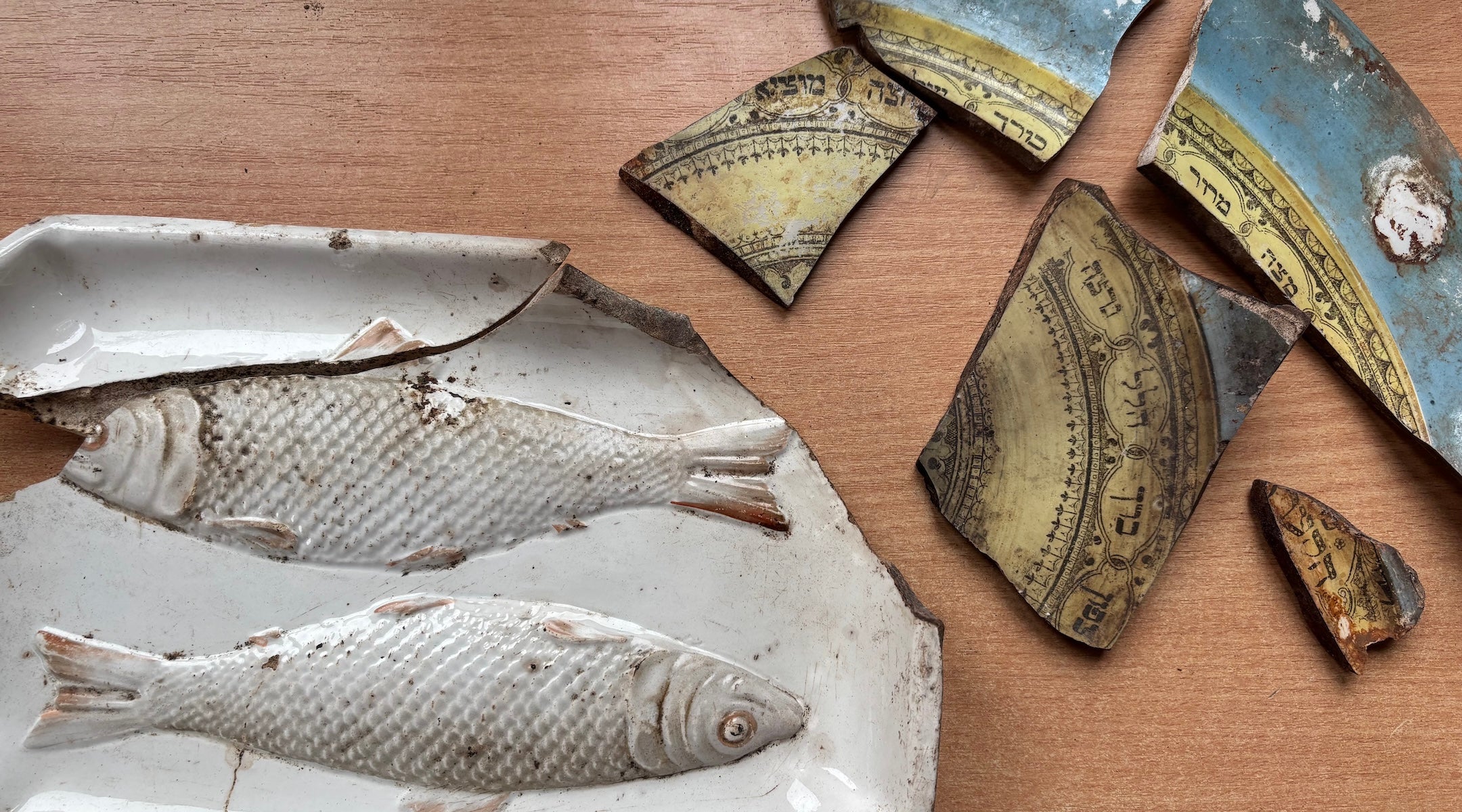
Fragments of a gefilte fish dish and a Passover plate that were found at the Great Synagogue excavation site. (Shira Li Bartov)
Avidan said attendees proposed a cultural center that would host forums about tolerance, drawing international visitors and educating Lithuanians about the Jewish past of their country. She argued it would be “selfish” to build a center exclusively for the Lithuanian Jewish community, since such spaces are closed to the public, partly for security reasons. The proposals emerging from Avidan’s conference were shut down after Kukliansky’s opposition.
“We are still working on how to include Jewish history in Lithuanian history,” said Avidan. “Approaching the site as a site of Lithuanian history, that would promote this harmony and understanding.”
At the excavation site, Seligman’s team has dug up pieces of life in the synagogue, which seated about 500 people, with some 500 more squeezing in for High Holidays. The latest artifacts to emerge from the ground include a Passover plate, a dish for gefilte fish, a plaque engraved with the Ten Commandments and several seating plaques with the names of people who donated to the synagogue, assuring their spots inside.
These name plaques left clues about families who vanished from Vilnius. One marked a seat for Gitel Klachek, identified as the “wife of the late Yechezkel, Shamash d’Mata” — the city sexton. Their wealthy, influential family owned several businesses around the Great Synagogue.
On the uncovered synagogue floor and the surrounding Jewish neighborhoods, there walked people who disputed religion, Jewish identity, Zionism and other ideas. “There would have been a large contingent who would have been ultra-Orthodox. There also would have been a large contingent who were completely secular,” said Seligman. “So the city was very, very much a very mixed community.”
The fights over the memory of these ghosts — and over Lithuania’s Jewish identity — echo the disagreements that animated the Jews who once thrived there.
This article originally appeared on JTA.org.
The post Archaeologists uncover treasures of Vilnius’ Great Synagogue as Jews dispute its future appeared first on The Forward.
Uncategorized
Country star Zach Bryan dons ‘Free Palestine’ shirt at Gillette Stadium
(JTA) — Zach Bryan, one of the world’s most popular country artists, appeared onstage wearing a shirt that read “Free Palestine” on Saturday night at Gillette Stadium outside Boston.
The venue was at the center of the dispute between stadium owner Robert Kraft and rapper Macklemore, who was blocked from performing there after Kraft objected to statements and imagery from an earlier stop on the tour and a “broader history” that Kraft characterized as antisemitic.
Representatives for Bryan and Kraft did not respond to requests for comment.
Bryan, whose biggest hits include “Something in the Orange” and his Kacey Musgraves duet, “I Remember Everything,” broke a stadium attendance record with 73,538 people on hand, the stadium said in an X post.
Kraft, the billionaire owner of the New England Patriots, helped lead an effort by stadium owners to block Macklemore from performing at their venues as Ed Sheeran’s opening act. Sheeran tried to distance himself from the venue owners’ actions, but his backup band and other acts subsequently withdrew from the tour.
This article originally appeared on JTA.org.
The post Country star Zach Bryan dons ‘Free Palestine’ shirt at Gillette Stadium appeared first on The Forward.
Uncategorized
Britain’s Green Party adopts ‘Zionism is racism’ motion
(JTA) — Britain’s Green Party on Sunday adopted a policy equating Zionism with racism, a move that immediately drew condemnation from the Israeli government and sparked concerns among some Jewish party members and the broader Jewish community.
The motion has also caused divisions within the party itself, with leader Zack Polanski, who is Jewish, skipping the vote and the party’s five sitting members of parliament issuing a statement on the policy.
Passing with 1,022 votes to 813 votes at the left-wing party’s annual conference, the motion argues that Zionism as an ideology is racist as it promotes “ethnonationalism,” and “privileges one ethnic group on the basis of the subjugation of others.”
It also declares the Greens to be an “anti-Zionist party” and that Zionism, the movement to develop and protect a Jewish state in Israel, will be “treated as any other form of racism.”
The motion also supports the establishment of a “single democratic Palestinian State in all of historic Palestine with Jerusalem as its capital.”
Israel’s Ministry of Foreign Affairs said in a press statement, “Today, the Green Party in Britain ceased to act as a political party and became a body that gives legitimacy to terrorism. The Greens have adopted not only the green of Hamas, but also its ideology: the elimination of the State of Israel through armed struggle.”
“The shocking resolution adopted today legitimizes armed struggle, calls for a Palestinian state ‘from the river to the sea’ – meaning the destruction of the State of Israel – and labels as ‘racist’ the aspiration of the Jewish people for self-determination,” the ministry statement said, adding that it “goes far beyond the boundaries of legitimate political debate.”
The ministry called on other political parties in Britain, particularly the ruling Labour Party, to reject the resolution.
In a letter to Polanski ahead of the vote, the Board of Deputies of British Jewry, Jewish Leadership Council and Community Security Trust said they had “acute concerns” about the motion and called on the party leaders to oppose it. They wrote that urgent action was needed to address growing antisemitism within the Green Party. Such a motion, they wrote, “fuels hatred of Jews.”
The five representatives of the Greens who sit in Parliament – MPs Ellie Chowns, Adrian Ramsay, Siân Berry, Carla Denyer and Hannah Spencer – issued a joint statement condemning the actions of the current Israeli government led by Prime Minister Benjamin Netanyahu but emphasizing, “We know there is no conflict between supporting the rights of Palestinians and the rights of Jewish people.”
A clause was proposed to protect Jewish Greens by clarifying that the motion should not be used to “pressure, proscribe or discipline” those affiliated with synagogues or other Jewish groups that describe themselves as Zionist. The clause was voted down.
This article originally appeared on JTA.org.
The post Britain’s Green Party adopts ‘Zionism is racism’ motion appeared first on The Forward.
Uncategorized
As The New York Times turns 175, the fight over its Israel coverage heats up again
(JTA) — For generations of American Jews, The New York Times has been more than a newspaper.
It has been the hometown paper of the largest Jewish community outside Israel, a daily guide to the city that became the cultural center of American Jewish life and, more broadly, a reflection of the aspirations of Jews who saw themselves as educated, cosmopolitan, culturally engaged and interested in the wider world.
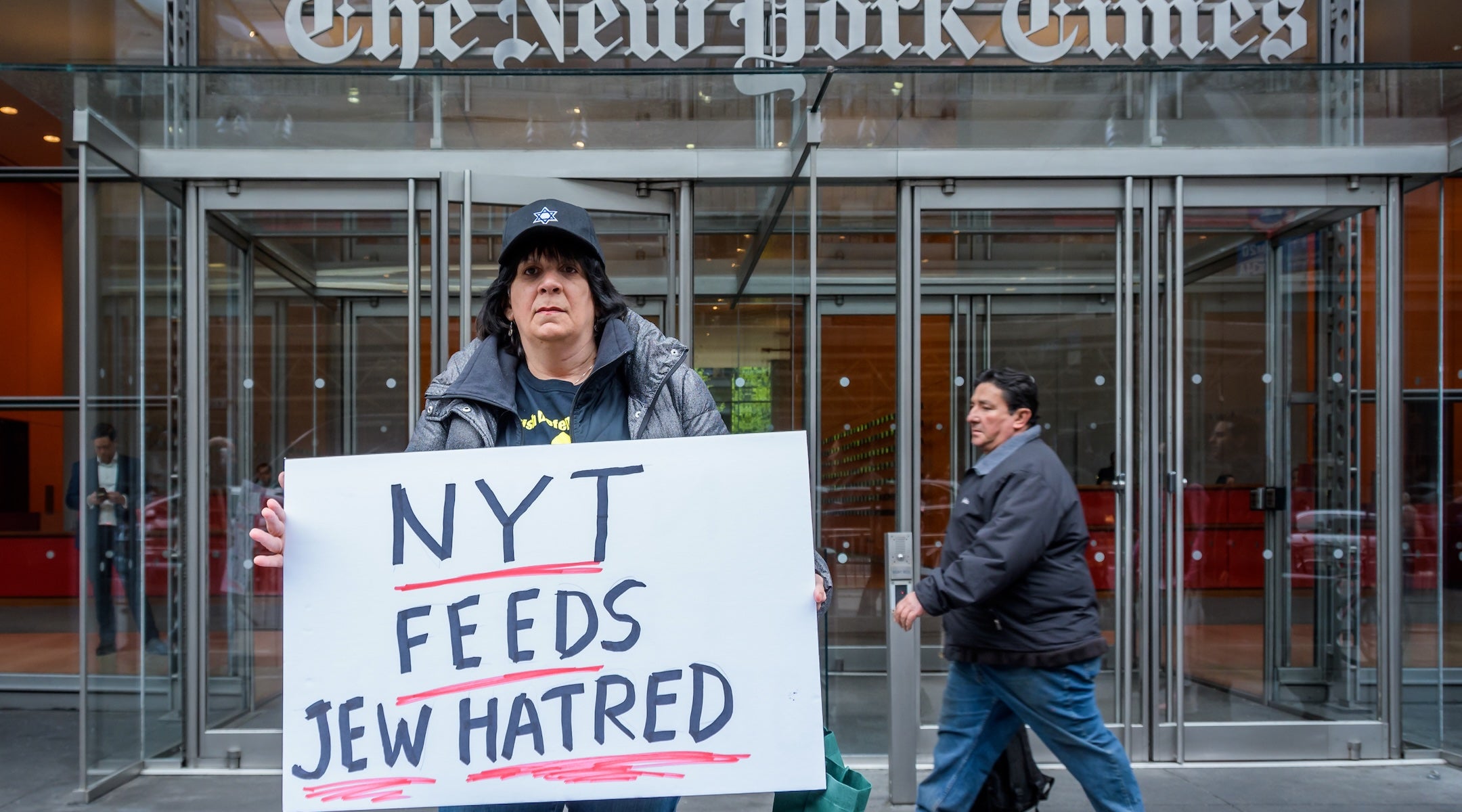
And in the 175 years since the paper’s founding on Sept. 18, 1851, no issue has inflamed its Jewish readers like its coverage of Israel. This month, as the Times celebrities its 175th birthday with a series of special features, that argument has gotten new fuel.
On Sept. 23, the Florida state pension fund and a conservative think tank that includes shareholders in the Times sued the company, seeking internal records that they say could show whether its board has adequately overseen the newspaper’s coverage of Israel. The plaintiffs allege that repeated errors and other evidence point to a failure to enforce the paper’s own journalistic standards and reflect an anti-Israel bias in its coverage.
The Times called the suit meritless and politically motivated, saying it amounted to an attempt to pressure an independent news organization.
The lawsuit came days after the publication of a study by Edieal Pinker, a professor at Yale’s School of Management, which is also cited in the lawsuit. Pinker’s study attempts to put numbers behind a complaint made by supporters of Israel: that the Times’ coverage of the war that began with Hamas’ Oct. 7, 2023, attacks has minimized Israeli suffering and Hamas’ role in the conflict.
Pinker examined 1,559 Times articles published between Oct. 7, 2023, and June 7, 2024. He found what he described as a dominant narrative in which Israel was assigned “near-exclusive agency and responsibility” after the Hamas attack. Meanwhile, Israeli casualties after Oct. 7, Hamas fighter casualties and Palestinian violence received much less attention, he asserted. Personal accounts of Palestinian suffering, he assessed, appeared far more frequently than comparable accounts of Israeli trauma.
Pinker told me that he understands the enormous disparity in the number of Palestinians and Israelis killed in the war. But that, he argues, does not absolve the newspaper for a framing of the war that focuses on Palestinian suffering and downplays Israeli motivations for carrying on the fight.
The Times has rejected Pinker’s conclusions. In response to the study, a spokesperson said the newspaper had covered the war “with more rigor than virtually any other U.S. news organization” and that editors make “careful and deliberate choices” about language, framing, prominence and tone in pursuit of independent journalism.
The discourse around Pinker’s study and the lawsuit reflects the American Jewish community’s longtime obsession with the Times’ Israel coverage, as well as splits within American Jewry itself. A cottage industry of media watchdog groups, including CAMERA and HonestReporting, seeks to expose errors in Israel coverage by the Times and other outlets. They focus on stories or headlines that show Israel in a bad light — press criticism mixed with pro-Israel advocacy.
Left-leaning academics and journalists often accuse the critics of having their own biases and dismiss their methodology, suggesting they seek to hold Israel above scrutiny and fail to understand the role of an independent press.
Eric Alterman, an author and historian who has written extensively about the American media, wrote in his 2022 history of American Jews and Israel, “We Are Not One,” that if anything, the Times has taken a “consistent, if sometimes, subtle, pro-Israel slant.”
He cited frequent protests by pro-Palestinian media critics, who think the Times is biased toward Israel, as well as a series of Jewish editors and Jerusalem bureau chiefs who, while often critical of Israel, used terminology and framing that reflect Israel’s perspective. (The word “nakba,” the Palestinian term for Israel’s creation meaning “catastrophe,” did not appear in the paper until 1998.)
But Alterman makes a larger point that is about the audience as much as the newspaper. He believes many American Jews have grown up on the “myth” of Israeli infallibility and see criticism or bad news about Israel as inherently suspect and evidence of hostility toward Israel or Jews.

“People who grow up on this myth and who define their Jewish identities by their fealty to this myth … find it very painful, very hard to deal with negative coverage of Israel,” Alterman, a professor of English and journalism at Brooklyn College, said in an interview. “And so, as I report in my book, attacking the media for its coverage of Israel became a manifestation of many a Jewish identity.”
For the petitioners in the recent lawsuit — the National Center for Public Policy Research think tank and the State Board of Administration of Florida, who as Times shareholders say they are entitled to inspect company books and records — the question isn’t the Jewish identity of the critics, but what they see as the Times’ board’s failure to enforce the newspaper’s own journalistic standards.
The suit includes numerous examples. They point to the Times’ initial coverage of the October 2023 explosion at Gaza’s Al-Ahli Hospital, which attributed the blast to an Israeli airstrike before the paper acknowledged that it had relied too heavily on claims by Hamas. The suit also cites an October 2023 account of a Hamas attack on the Israeli city of Ofakim in which, according to the plaintiffs, editors twice changed references to the attackers from “terrorists” to “men,” which they say reflected a reluctance to use language that cast Hamas negatively.
And in one of the highest-profile accusations of media bias during the war, the plaintiffs point to a July 2025 story about a severely malnourished Palestinian boy. While the paper said the subject was “born a healthy child,” the suit argues that Times staff had access before publication to information indicating that the boy had a pre-existing medical condition. (The Times later issued a correction.)
“In the absence of any Board-level oversight,” according to the filing, “journalistic standards have been weaponized within the Company to serve the personal agendas of unchecked editors.”
At the center of this debate is not only what may be the most important single news source in the world, but one with complicated Jewish roots. Adolph Ochs, a Jewish newspaper publisher from Tennessee who was born to German immigrants, bought the struggling paper in 1896. His descendants have controlled it ever since. Och’s father-in-law was Rabbi Isaac Mayer Wise, a founder of Reform Judaism in America, and for decades the newspaper’s editorial line reflected Reform’s vocal anti-Zionism.
Ochs’ son-in-law, Arthur Hays Sulzberger, would become the paper’s publisher from 1935 to 1961. Any discussion of the Times’ relationship with the Jewish community is haunted by the paper’s failure, under Sulzberger’s watch, to rigorously cover the Holocaust as it happened.
When the paper did publish reports on the annihilation of the Jews, former Executive Editor Max Frankel wrote in an extraordinary, overdue mea culpa on the Times’ 150th anniversary, “they were mostly buried inside its gray and stolid pages, never featured, analyzed or rendered truly comprehensible.”
While Alterman describes Sulzberger as “an antisemite in his hiring practices and an anti-Zionist in his politics,” Laurel Leff, who wrote about the Times’ Holocaust history in her 2005 book “Buried by the Times,” is slightly more measured.

While the Times reported extensively on Nazi persecution and mass murder, it often failed to make clear that Jews were the principal targets of the Nazi genocide. Leff, professor emeritus of journalism at Northeastern University, believes Sulzberger was worried about accusations that the Times would engage in special pleading on behalf of the Jews.
“He had a particular sensitivity about the Jewish issue because of his background,” Leff said in an interview. “Because he so much wanted the Times to not be viewed as a Jewish newspaper, and his editors and reporters knew that.”
That sensitivity didn’t only manifest in what stories were and weren’t put on the front page. When Abraham Rosenthal joined the paper as a cub reporter in 1941, his bosses assigned him the byline “A.M. Rosenthal” because the paper’s management felt his first name sounded too Jewish.
Still, whether chastened by the extent of the Holocaust or just swept up by the prevailing narrative of the day, the Times for many years treated the new state of Israel “as a struggling nation trying to thrive while surrounded by implacably hostile Arab Neighbors,” as former Times reporter Neil A. Lewis wrote in a 2012 paper for the Shorenstein Center on the Press, Politics and Public Policy.
“But, over various points beginning in the late 1960’s through the next dozen years, the narrative began to change to a second, more equivocal phase,” Lewis continues. “The template of the small nation as a David battling a Goliath composed of its enemies no longer fit after Israel prevailed handily in the 1967 War. And gradually, the situation of the Palestinian refugees began to emerge.”
After Rosenthal rose to executive editor in 1977, the first of five Jews to hold the post over the next four decades, he aligned the paper more closely with the majority of its Jewish readers: still secular, although more open to Jewish stories and Jewish hires. Rosenthal himself, after his mandatory retirement in 1986, transitioned to the opinion pages and wrote pugnacious columns defending Israel’s right-wing Likud Party leaders.
“Rosenthal had done more than any one individual to reconcile the Times to its Jewish identity,” Times alum Samuel Freedman wrote in an appreciation when Rosenthal died in 2006. Among other things, Rosenthal ended an “unspoken” policy blocking Jews from reporting on Israel.
Not that that shielded the Times from criticism: Thomas L. Friedman, who served as Jerusalem bureau chief from 1984 to 1988, would earn three Pulitzer Prizes for his Mideast coverage but still remained (and remains) a lightning rod for criticism of the paper’s coverage of Israel. (In 1989, a panel discussion featuring Friedman at the 92nd Street Y was interrupted by pro-Israel hecklers who scuffled with security guards. “I spent five years in Beirut. Who thought I’d meet my end at the 92nd Street Y?” Friedman, now a columnist, said from the stage.)
Coverage of the controversial first Lebanon War, by Friedman and others, kickstarted efforts by pro-Israel groups to monitor and criticize the media’s coverage of the region. CAMERA, the Committee for Accuracy in Middle East Reporting and Analysis, was founded in 1982 by Winifred Meyer in response to what she and other founders perceived as highly distorted, anti-Israel reporting on Israel’s military incursion. In his 1989 book, “From Beirut to Jerusalem,” Friedman himself criticized the foreign press corps in Lebanon for treating the Palestine Liberation Organization more charitably than it did Israel, the United States or their Lebanese allies.
At the same time, the newspaper increasingly came to embody another kind of American Jewish identity: intellectual, urbane, secular-minded, prosperous and engaged with the broader American and international culture. And as the rise of the internet took its toll on other daily newspapers, the Times’ influence only grew.
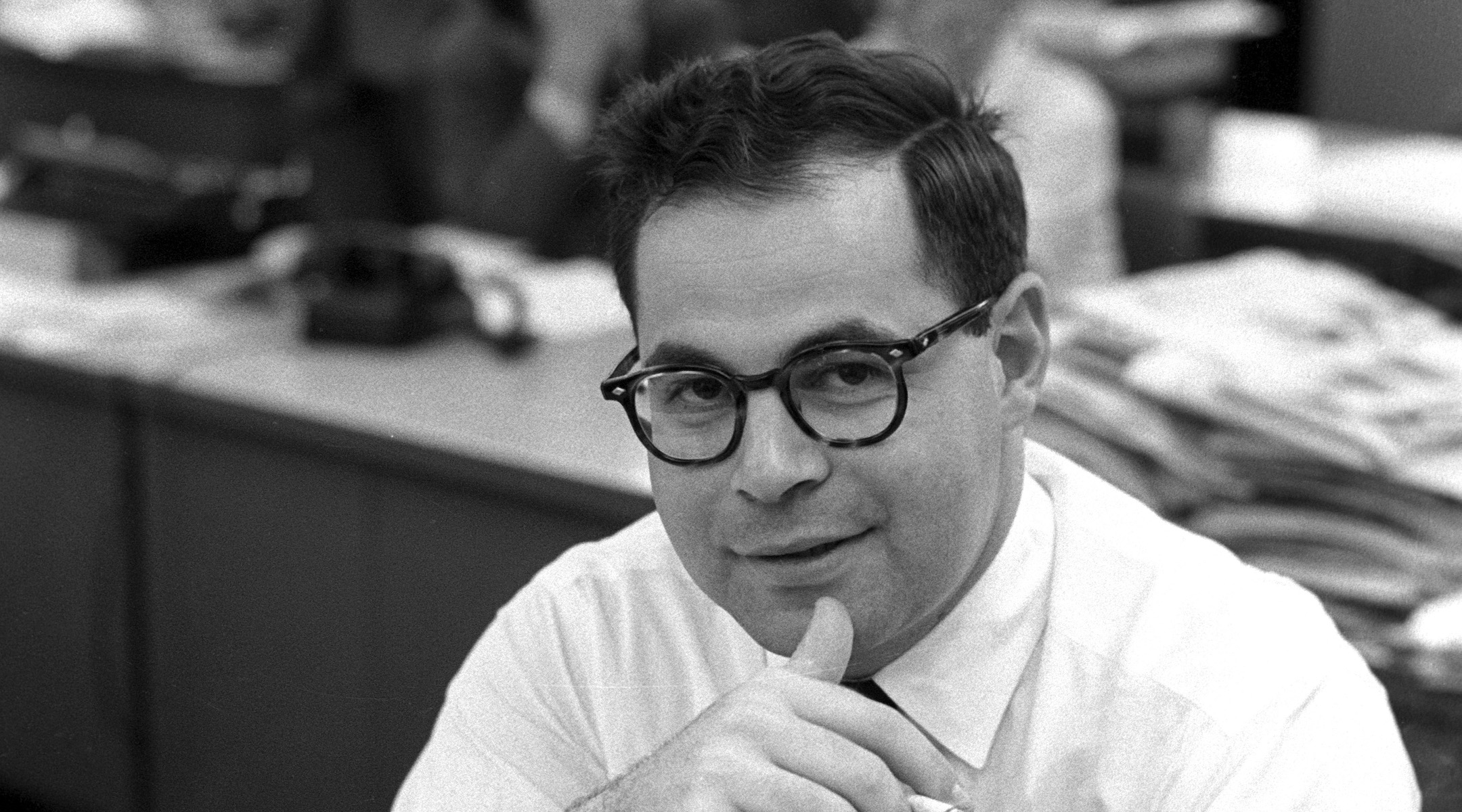
Daniel Okrent, who refereed readers’ complaints as the Times’ public editor from December 2003 to May 2005, said coverage of Israel and the Palestinians is perhaps the most scrutinized topic in the newspaper, with both sides convinced the Times favors the other side. He and his colleagues would brace for a flood of letters after every mention of Israel, however benign.
“I think that the feelings on that issue are so intense that people can’t see beyond their own feelings,” Okrent said in an interview.
Ari Goldman, a religion reporter who spent 20 years at The New York Times starting in 1975, often bore the brunt of those feelings. An observant Jew, he said he was frequently approached in synagogue by someone asking, “How can you work for that antisemitic newspaper?”
“They’d come to shul and wave a piece of paper in my face, and I’d say, ‘where’s the rest of the paper?’” Goldman, a professor emeritus at the Columbia Journalism School, said in an interview. “If you look at the coverage in general, yes, you’ll find mistakes, and stories that seem like they have a negative bent. But there are many stories that balance that, and many stories that are favorable toward Israel and tell the story more sympathetically.”
Goldman insists that Times journalists work hard to get a story right, and that the paper will offer corrections when they don’t. He also sees the recent hire of Yair Rosenberg to a new religion beat focused on Jewish American life as a sign that management recognized a “gap in their coverage.”
Critics and defenders agree that the Times often sets the agenda for other news outlets — and for its readers. In her 2005 book “Stars of David,” journalist Abigail Pogrebin asked the Broadway composer Stephen Sondheim about his feelings for Israel. “My attitude toward Israel is the New York Times’ attitude toward Israel,” he replied. “Whatever they tell me is what I believe.”
It is this sort of influence that motivates the Times’ critics. While Pinker does not accuse the Times of bias, his study does raise the specter of an “agenda” on the paper’s part to sway public opinion. “I document several imbalances in the reporting of the war that could plausibly influence the opinions of a reader in a direction that is at odds with reality,” he writes in the study.
In an interview, Pinker said he sought to move the argument away from individual headlines and toward patterns.
“What I find is that there is very little coverage of what you might call suffering or the cost of war on the Israeli side, whereas there is an enormous amount of coverage of that on the Palestinian side,” he said.
Those newsroom choices, he said, diminish Hamas’ responsibility for the extent and continuation of the war. Although he didn’t compare the Times’ coverage of the war to that of other news outlets, he did suggest what an alternative “framing” of the conflict might be: “Oct. 7 demonstrated to the Israelis that they have an unacceptable threat in Gaza, and they cannot rest until they’ve eliminated this threat.”
Alterman rejects Pinker’s analysis as “almost comical,” saying it didn’t take into account the disparity between the 1,200 Israelis killed on Oct. 7 and the tens of thousands Palestinians killed in Gaza in the subsequent war. No news outlet, he said, is obliged to note the persistent trauma and anger felt by Israelis amid the near daily bombardment of Gaza and critical food shortages seen during the height of a war.
“There’s been an enormous amount of reporting on the emotional cost to Israelis and the financial cost to Israelis of the reaction to Oct. 7, but it’s just ridiculous to say that there should be as much reporting on the incident of one day as there have been” of daily military operations during a war that lasted for two years, said Alterman.
Alterman also said that the newspaper’s critics fail to account for the separation between the Times’ news departments and its opinion pages.
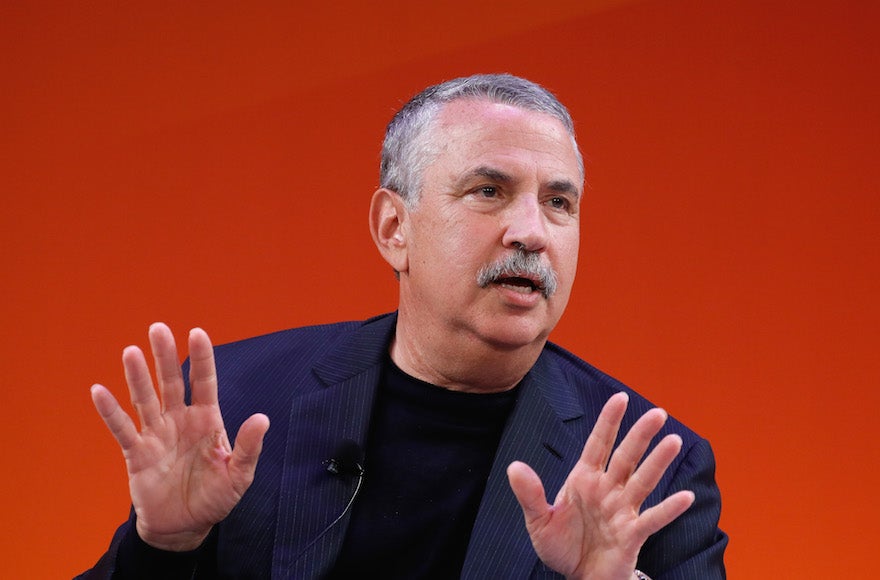
On the opinion side, regular critics of Israel far outnumber its consistent defenders. The former include Friedman, Ezra Klein and Michelle Goldberg, whose criticism often appears to be written from a place of sympathy with a former, more liberal Israel, and contributing opinion writers M. Gessen and Peter Beinart, who have both accused Israel of genocide. All five are Jews.
Meanwhile, Bret Stephens follows in a tradition of right-leaning columnists, also Jewish, who consistently defended Israel, including Rosenthal, William Safire and David Brooks. David French and Russ Douthat, two conservative columnists, also tend to defend Israel when they write about the conflict.
Earlier this year, when Nicholas Kristof wrote a column alleging sexual abuse of Palestinian detainees by Israeli security forces, critics suggested it hadn’t been put to the same journalistic scrutiny as a news story. Nonetheless, the Times defended the reporting, saying that details were fact-checked and corroborated where possible with witnesses and confidants.
Stephens, who rarely criticizes his employer in public, didn’t respond to Kristof’s column. But just nine days later, in a column cataloguing 25 years of what he described as inflammatory or unverified media narratives targeting Israel, he wrote what could be a manifesto for American Jewish critics of Israel coverage.
“The common thread in these and many other stories is that they all involve strenuous, if ultimately embarrassed, efforts to prove that Israelis deliberately seek to kill the innocent and maim the vulnerable, apparently for no other reason than gratuitous cruelty,” wrote Stephens. “This isn’t a matter of reporters’ impartially trying to expose wrongdoing wherever they find it — if that were the case, the errors wouldn’t invariably lean in the same ideological direction. It isn’t speaking truth to power. It’s feeding narratives to the credulous.”
For some Jews, the Times’ coverage of Israel, negative or not, is evidence of the newspaper doing precisely what a great journalism outlet ought to do: scrutinizing the powerful, including a government supported by the United States and deeply connected to American Jewish life.
For others, the same coverage is evidence that the paper has once again failed to understand the Jewish historical experience — particularly the experience of Jews who see Israel’s security as inseparable from their own.
What both sides share is a relationship with The New York Times that can feel both familial and obsessive.
“I think it’s a sense of ownership,” said Goldman, imagining the perception of so many of its Jewish readers: ”’I’m a New York Jew. This is my newspaper, and it should reflect me and my ideas.’”
This article originally appeared on JTA.org.
The post As The New York Times turns 175, the fight over its Israel coverage heats up again appeared first on The Forward.
