



Local News
One of Canadian and American television’s greatest producers of all time: Perry Rosemond – a true North End boy, who never forgot his Winnipeg roots

Introduction by BERNIE BELLAN Perry Rosemond was a well- known television producer who grew up in the North End of Winnipeg before moving to Toronto and establishing himself as one of Canadian television’s brightest talents in the 1960s, later to go on to even greater success in the US before returning to Canada in the 1980s.
Rosemond passed away in Toronto on August 20 at the age of 89.
In August 2020, Gerry Posner interviewed Rosemond for the Jewish Radio Hour. I contacted Rochelle Zucker, the longtime producer of that show, to see whether she could send me an audio file of that interview – which she was able to do. Following is a complete transcript of the often hilarious interview Gerry did with Perry Rosemond:
Gerry Posner: Welcome to the Jewish Hour radio show. This is Gerry Posner, and I’m delighted to be back on the radio once again with a guest whom I believe you will find interesting and informative. So today I feel very fortunate to have on the show a real Winnipeg legend, a man who has made his way in the world of the arts, and that is no small achievement. He has been a big name in the field of entertainment as a writer, a director, a producer for many years. I speak of Perry Rosemond. Perry, welcome to the Jewish Hour radio show.
Rosemond: Thank you, Ger.
Posner: I imagine you might have even listened to this show when you were a youngster.
Rosemond: Well, I have to tell you that my grandmother would call us every Sunday when I was about seven years of age, and she would say, “Turn on the French station at 1 o’clock and you’ll hear a very beautiful program.” And that was Noah Whitman’s show. And here I am, a mere 73 years later, on the show. Remarkable.
Posner: Well, I’m glad you made it. Tell me something, Perry. Who were your parents?
Rosemond: My parents were Max and Mona Rosemond, two of the most beautiful-looking people on the face of the earth, and where is genetics when you need it? But we lived in my grandmother’s house. You called it your grandmother’s house, even though there was a grandfather there. But she ruled the roost. And there were 14 of us in a house that wasn’t that big. But my dad was a clothing designer. My mother was a showroom model. And my mother wore a girdle, but she was never fat. And I later learned in life that the reason she wore the girdle was so that when the buyers in the showroom pinched her, it didn’t hurt as much. Those were my parents.
Posner: Well, where was the house that you grew up in?
Rosemond: The house I grew up in was at the corner of Manitoba and Andrews in North Winnipeg.
Posner: So you spent quite a few years there.
Rosemond: Oh, yes. I spent quite a few years there, but we moved. My parents were sort of upwardly mobile, and we moved from Andrews and Manitoba to Lansdowne Avenue. That was an improvement. Oh, my goodness. I had my own room.
Posner: Were there more of you than just Perry? I mean, were there siblings?
Rosemond: No, there was just me. But I was surrounded by cousins who were as close as brothers and sisters, really. And we stayed close for our entire lives. So there was a huge, huge sense of family at 193 Andrews.
Posner: Who would these cousins be?
Rosemond: My cousin Sonny and my cousin Mickey.
Posner: Both Rosemonds?
Rosemond: No, they were on my mother’s side.
Posner: What was her (maiden) name?
Rosemond: Magid.
Posner: MAGGOT. Really? Okay.
Rosemond: And Sonny and Mickey were four years older than me and exploited me at every opportunity. My uncle Dave Rosemond used to manage the Beacon Theater in Winnipeg.
Posner: In the North End.
Rosemond: Yes. And they would go to the Beacon Theater with me and get in for free because of me and still take my 10 cents that my mother gave me for the popcorn. So their mission in life was to exploit Perry Rosemond.
Posner: And you remember it, too.
Rosemond: I do indeed. I do indeed.
Posner: So you went to school where?
Rosemond: William Whyte School.
Posner: And then did you go to (St. Johns) Tech?
Rosemond: I went to Aberdeen and then to Tech. And at William Whyte School, I would go to sleep at night and pray to wake up Ukrainian so that the daily beatings would stop. But it was 50% Ukrainian and 50% Jewish.
Posner: Yeah, you knew what it was like to be a Jew.
Rosemond: Absolutely.
Posner: Did you do any studying in Hebrew or Yiddish?
Rosemond : I did. I went to Hebrew school. And in those days, I sounded like Georgie Jessel, for God’s sakes. In those days, I can’t believe I said that. If you’re going to cut anything, cut “in those days.” Please, Ger, do me a favor. But in those days, the instructors were measured by how much pain they could inflict on the students.
Posner: And you had a bit of that.
Rosemond: A bit of that. I was once thrown against a radiator by Mar Gross, and I still bear the pains to this day.
Posner: But you weren’t a product of Cantor Brownstone’s choir.
Rosemond: No, that was Alan Blye, and he was my friend and my roommate when I moved to Toronto to become an actor.
Posner: Who were some of your buddies in Winnipeg growing up? I guess Blye was one of them.
Rosemond: Blye was very close. Bugsy Lavich was very close, very close, and probably the leading bookmaker of his generation.
Posner: He’s well-known.
Rosemond: Indeed, and remains today my closest and dearest friend. And whenever I think about Bernie, I say to myself, how advantageous is it to have a friend who is the smartest human being in the world? I mean, if I need to know anything, he knows it. He knows it.
Posner: Did you go to university in Winnipeg at all?
Rosemond: I went to the University of Manitoba, and that’s where I got the bug to go into theater because I was Troilus in “Troilus and Cressida.” I was Cassius in “Julius Caesar,” and I was hopeless in the classroom. But it just took me by storm. It really did. And I ended up going to Toronto.
Posner: Well, just hold on a second. Were you not involved in some fashion in the creation of the MTC, the Manitoba Theatre Centre, in its very early days – with John Hirsch?
Rosemond: I was a founding member of the Manitoba Theatre Centre with Gordon Pinsent and Len Cariou – who went on to win a Tony, and Donnelly Rhodes, who went on to be a terrific influence in theatre in Canada. And I was one of the founding members. And you know what was strange, Gerry, is that I thought, boy, if this guy John Hirsch is in Winnipeg, what must they be like in New York or the West End in England? And I never met his match. But boy, could he intimidate me. I was in a play, “Death of a Salesman.” I was playing Bernard, and he came up to me and he said, “Mr. Rosemond, don’t you think you ought to reconsider your interpretation of that lawyer you’re playing?” And it would have been a fair note, except it was given to me after dress rehearsal. I’ve never seen a man customize performance the way he did — everybody got exactly what they needed. He was beyond brilliant. He went to his demise as my mentor and my idol and my friend.
Posner: So he was your introduction to the world of arts.
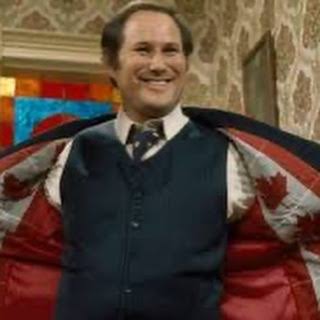
Rosemond: Absolutely. And strangely enough, we hooked up later when — oh, many, many years later — when he was head of drama at CBC, and he brought me back from Los Angeles to create the program “King of Kensington.”
Posner: When you made that decision somewhere in the ’50s, you’re in your, I guess, 20s, and you make a decision, “I’m going to move to Toronto, and I’m going to go into the arts as a career.” Your parents must have looked at you like you were out of your head.
Rosemond: Do you know, Gerry, it was funny, because beyond the initial beating about the head and shoulders that my father laid on me, they never stopped supporting me. They stood by me, and I can’t tell you how grateful I am for that. 100% support. Let me chart my own course.
Posner: But the odds were stacked against you. Come on.
Rosemond: Oh, tell me about it. I mean, it was about 15 minutes before I realized I wasn’t a very good television actor. I remember sitting in the basement of 42 Bedford Road in Toronto with Gordon Pinsent, who was my other roommate, with Alan Blye, and we were watching a guy who stole a part from me. He was playing the part I was born to play. And I watched it for about 10 minutes, and I said, “You know what, Gordon? He’s better than I would have been.” And Gordon said, “Perry, get out of acting. You don’t have the ego for it.” And I’d been sneaking in and out of control rooms all this time, Gerry. So I got bitten by the behind the scenes. And that’s where I headed.
Posner: So you actually gave up the acting. You went into production.
Rosemond: Exactly, exactly.
Posner: Well, maybe you were fortunate that that happened early on in the career. In your career, as I gather, you’ve touched the lives of some pretty big names. Tell me if I’m wrong here. Dick Van Dyke?
Rosemond: Yes. Len Cariou, Cloris Leachman, Julie Andrews, Steve Martin, Billy Crystal, Donnie and Marie, Johnny Cash, and the list goes on.
Posner: How does this all come about?
Rosemond: Oh, Johnny Cash. That was the best time of my life. Two years in Nashville. I’ll tell you how it came about. Johnny wanted documentary elements in his variety show, and I had trained in both in Canada. So I wasn’t the best documentary filmmaker, and I wasn’t the best comedy variety producer, but the fact that I could do both got me the job directing his show. And when they introduced me to him — it was during the hippie era, so I had the long hair and the whole nine yards.
Posner You weren’t exactly a feature presenter. You didn’t present well.
Rosemond: No, I didn’t present well because Johnny said, “Where are you going to film this week?” And I said, “I’m going to Hazard, Kentucky to film coal miners.” And Johnny said, “Perry, if you go into Hazard, Kentucky on a Saturday night with that long hair and them bell-bottoms, they’re going to kill you.” So this whole Hollywood invasion of middle America was absolutely hysterical. But the show was a big hit.
Posner: Give me the career path. You came here (Toronto) in the ’50s.
Rosemond: OK, I came here in the ’50s, late ’50s, as an actor. Right. Shared a room with Gordon Pinsent and Alan Blye. Right. We were very competitive, but Alan really won because he had a role on a continuing starring role on one of the big variety shows. And if I’m not mistaken, he actually declared Gordon Pinsent and me as dependents on his 1959 tax form. So he definitely was the more successful of the group. Then I went back to Winnipeg in 1960, and I applied as a production assistant. And there were no openings, but there were producer-directors that had quit, and so they gave me a job as a producer-director.
Posner: So I get this is at CBC in Winnipeg, correct?
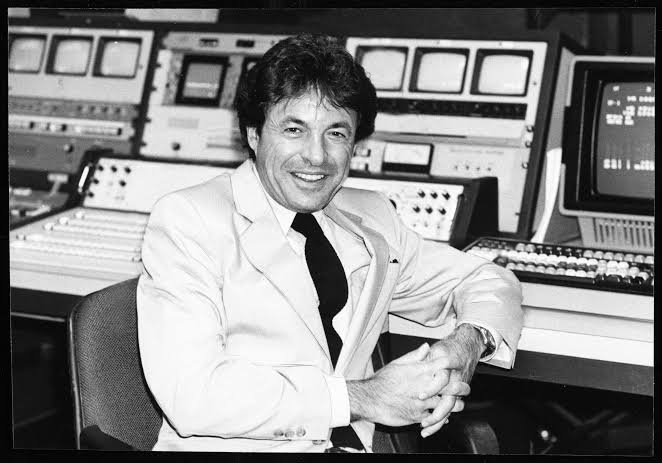
Rosemond So I got 4,200 bucks for the year, and I did Metro News and a talk show, and then I did a show called “Red River Jamboree,” which was fully sponsored by Kraft Foods, always in the top ten. And, Ger, I’ve been going downhill ever since.
Posner Well, I wouldn’t say that. I don’t know hardly that, based on what I’ve read about you. I’d say you’re climbing the ladder, and you’ve climbed to the top. And then, so how long were you back in Winnipeg?
Rosemond: I was back in Winnipeg until ’63. What happened was I was doing this variety show and I looked eastward and the third best variety producer at CBC in Toronto was a guy by the name of Norman Jewison. And so I thought, oh, my God, I’m never going to get to Toronto, which was Mecca, as a variety producer. So I went to my supervisor and said, “Look, I want to do children’s programming. My heart is with the children.” And so I got transferred to the children’s department in Winnipeg, took two kinescopes under my arm and headed to Toronto, and got a transfer to children’s programming in ’63. ’63 to ’68 Toronto, ’68 to ’85 Los Angeles.
Posner: But what were you doing in LA?
Rosemond: Well, I came out of the Cash show and did Bill Cosby’s show. You might not have heard of him. He hasn’t been in the news much these days. But I did Bill Cosby’s variety show, and from then, Donnie and Marie (then) a situation comedy called “Good Times.” But what happened is I had three shows going in Canada at the same time. I had “Bizarre” on CTV. I had “Tom Jones” on Global TV, and I had “King of Kensington” on CBC. So I thought, well, what am I doing in America?
Posner: So back you came to Canada?
Rosemond: Back to Canada, where I’ve been since ’85.
Posner: Now, in those years, those five years that you alluded to, that you were doing work in children’s programming, you were pretty involved, from what I gather. You did some work on “Children of the World?”
Rosemond: Yeah, that’s probably something of which I’m most proud. It was a series on children in developing nations, and it drew an audience of over 600 million people just in audio-visual distribution.
Posner: Wow. And if I had to say, what’s the number one thing you’ve accomplished? That would be it?
Rosemond: That would be it.
Posner: Really?
Rosemond: Absolutely.
Posner: I understand it won (something called the Japan Prize). I mean, I hadn’t heard of this, but I gather it’s pretty significant. The Japan Prize is (for) the best children’s program.
Rosemond: That’s correct.
Posner: So, you know, that’s saying something. That’s a long way from the North End.
Rosemond: Well, you know what we say. They say, how come there’s so many great people from the North End? And my answer is always the same. It’s a deep and abiding desire to get the heck out of the North End.
Posner: Now, I think, correct me here, in some fashion, not only did you do this program that won this prize, “Children of the World.” But you also were connected, and maybe you can tell me how, to “Mr. Dressup” and “The Friendly Giant?”
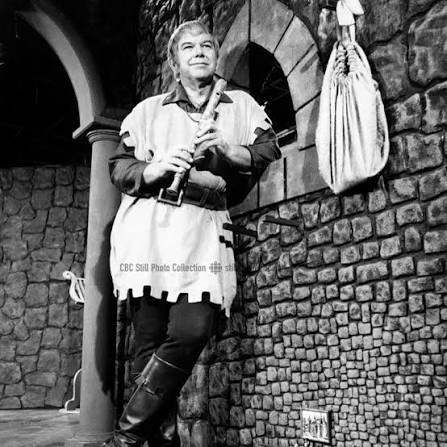
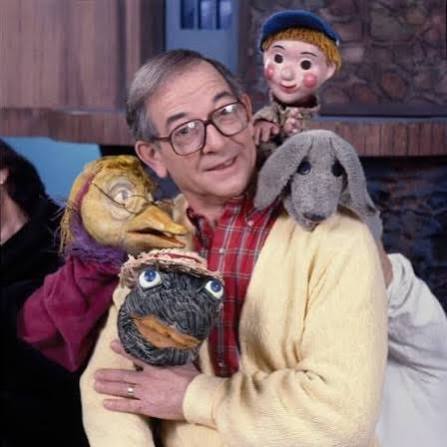
Rosemond: That’s right. I was head of children’s programming for a period of time and worked with Mr. Dressup and the Friendly Giant. Friendly Giant, I remember once being in a room with him, and I was giving him some notes, and he turned around and he walked away from me. I thought, well, that’s rude. And then I looked, and a group of schoolchildren had come into the studio. And he was deathly afraid of being seen as anything but a giant. Which he was, by the way. He was a gigantic personality.
Posner: Well, you were the executive producer of those shows, right?
Rosemond: Correct, correct, yeah.
Posner: And in some way you got connected to Sesame Street, too?
Rosemond: That’s right. I was living in Los Angeles, and they asked if I would come back and Canadianize Sesame Street.
Posner Canadianized Sesame Street? I didn’t know there was a Canadianized version.
Rosemond: Well, what we did was we took out the Native American segments and the Spanish segments, and we substituted them with Native Canadian and French. And then gradually we took over and did our own version, a Canadian version of Sesame Street. Again, very gratifying. Back to Winnipeg to do it — that was my blackmail. I said, I’ll come back and do it if I can do it in Winnipeg, because I like the graphics artists in Winnipeg, and I felt I’d get a better product.
Posner: Okay, that’d be what, sometime in the ’80s?
Rosemond: That would have been earlier. That would have been in the ’70s.
Posner: Wow. Well, you kept up your links to Winnipeg.
Rosemond: Absolutely. Absolutely.
Posner: Now, so you’ve had children’s programming. And you also got into, I gather, documentary and public affairs.
Rosemond: Right, yes. “The Way It Is.”
Posner: “The Way It Is” was the Sunday Night flagship show. That was the big show on CBC Sunday night, wasn’t it?
Rosemond: That’s right. It was the big show on CBC Sunday night, and I worked with an executive producer called Ross McLean. I didn’t last too long on that, Gerry. I remember Ross had a very constructive way of winning arguments. We had one argument. And I can’t even remember what it was about, but he won it hands down by throwing a Coke can at my head. And I took a hike, and I never came back to “The Way It Is.”
Posner: That’s the way it was.
Rosemond: That’s the way it was, right.
Posner: You also did what you call profiles for CBC’s “Telescope,” with Oscar Peterson, Arthur Haley, Gordon Pinsent, Glenn Gould, Donald Sutherland. I mean, that was another big show.
Rosemond: Yeah, and that was my entrée to the United States because I became their man in America. And thus I did Donald Sutherland in Hollywood while snooping around for work and Eddie Albert from ‘”Green Acres” and all of the expatriate Canadians who were living in Los Angeles. And that gave me a foothold because I could look for work and still pay the rent. My Canadian qualifications counted for nothing in America. You were zero. Zero. And I was starting from scratch at age 30, and I had to have some kind of income to get things going.
Posner: And then somewhere along the line you got — you oversaw the production, I’m not sure exactly, of “Hockey Night in Canada.” I’m guessing you never even played the game.
Rosemond: I was on the third line of the Chicago Blackhawks in the miniature NHL, you know, and probably the worst ever third liner in the history of Manitoba’s miniature NHL hockey. But here’s the deal with that. When I wanted to come back to Canada, I couldn’t just come back as a freelancer because when they brought me in from America, I was the big American producer that they were bringing to Canada. If I was going to be in Canada, you know the deal, the expert’s always 100 miles from home.
Posner: That’s right.
Rosemond: So I had to have a foothold. So I had worked with Don Ohlmeyer Productions, and they were consulting to Hockey Night. And they wanted to take over Hockey Night. And Don suggested that I come up from America to put them in the hockey business, which I did. And I also started other shows for this company, Molestar Communications, which were more in the entertainment business and more to my liking, like the Juno Awards, I’d escape for a month or two, or a syndicated series called “Starting From Scratch,” which I shot in Montreal. So I would leave the administrative behind and jump back into the trenches whenever I could.
Posner: You know, it’s okay you didn’t play so well in the third line in miniature. You did a little better, I would say. Now, you mentioned David Steinberg. And you produced his show, CTV’s “David Steinberg Show?”
Rosemond: Yes, that’s right.
Posner: Did you even write for that show?
Rosemond: I wrote for it.
Posner: How many scripts would you have written for?
Rosemond: We did one season only, but we had an incredible guest list. David grew up a block away from me, and we knew each other forever. And I’ve done so much with David, and I admire him so much. And David attracted a huge guest list of John Voight and Ethel Merman and Milton Berle, and he also was able to bring out John Candy for his first show and Martin Short and Dave Thomas and Joe Flaherty and all of those people.
Posner: No, I don’t think David Steinberg’s memories of Winnipeg are as warm as yours are. They are kind of, you know. I’m quite surprised to hear you say that because I think in the beginning maybe, you know, when you were a young kid you hate where you came from. Maybe there was some of that. But now he cherishes it.
Rosemond: He does. I also had a lot of clout in being able to, if I may say so, book enormous talent because we had Marty Short and Andrea Martin, and I was able to book Howie Mandel, because I gave him his first shot in America on Norm Crosby’s “Comedy Shop.” And I got to tell you this really boring story, but I’ll try to make it quick.
Posner: Okay.
Rosemond: My partner and I on Norm Crosby’s Comedy Shop could veto any act that appeared on the show. So Howie’s manager was Saul Holliff’s nephew, and Saul was Johnny Cash’s manager, who was very good to me on “The Johnny Cash Show.” So he said, could you put my act on? And I said, send a tape. So he sent the tape of Howie, you know, with the faucet on the forehead and the diaper and God knows what else. And before we were 15 seconds into it, my partner Joe Sigmund raised his hand and he said, “I veto.” I said, “Joe, it’s Saul Holliff’s nephew’s act. We’ve got to put him on. Let’s tape him. We won’t use it.” And six months later, to make a long story even a little longer, Phil Kives from Winnipeg of K-Tel came to order a DVD from us. And he said, “make sure that you put on the DVD the kid with the diaper.”
Posner: Okay. You know, I’m just barely starting and we’ve got to finish this. Tell me, Perry.
Rosemond: Yeah.
Interviewer: What’s the story? Are you into retirement mode or you’re still going at it?
Rosemond: My dream is that it’s “ready camera.” I want Ingmar Bergman to shoot this, by the way. My dream is “ready camera one” and aneurysm, and in slow motion my head starts to descend to the console and I’m dead before I even hit it.
Posner: You’re still working. Still working. And I guess you still connect to Winnipeg.
Rosemond: Absolutely. I was there several times to do specials in Winnipeg, and I still would go back today, especially with the tax credits.
Posner: Perry, it’s a joy to have you. I tell you, we barely scratched the surface, and I appreciate your taking the time to come and do this.
Rosemond: Can I tell you, and I say this in all honesty, you are one terrific interviewer.
Posner: Well, thanks very much. I enjoy doing it.
Post script (added by Bernie Bellan): Some of the things that Gerry omitted from his interview were that Rosemond also produced the terrific documentary, “When Jews Were Funny,” which was named best Canadian Feature Film at the 2013 Toronto Film Festival.
As his obituary on the Benjamin’s Parrk Memoria Chapel website also notes: “In 2003, Perry was appointed a member of the Order of Canada, a national recognition for a career that entertained, educated, and made Canadians laugh.
“But Perry never measured his life by accolades, he measured it in smiles. He lived to spread laughter and joy. It was his way of making people feel seen and valued. He will be dearly missed and forever loved.”








Local News
Marty Green expands his protest against extremist Jewish settlers to two more venues – and continues to be arrested – despite the Crown having dropped all charges
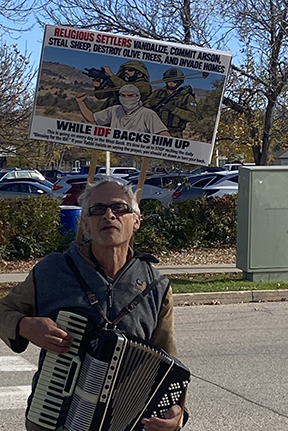
(Monday, November 9) In earlier posts we wrote about Marty Green having been arrested several times after continuing to protest Israeli settler attacks against Palestinians on the West Bank.
Here is an update to what has been happening to Marty:
The Rady JCC was quick to call police on the weekend to have Marty Green arrested for the third time since September. Released after his original arrest on September 23, and again, after his subsequent arrest on October 14 – even after Green’s agreeing to an undertaking not to return to the campus, police charged Green yet again – this time on November 7. The charge this time was breaching his release conditions. His placard, which proclaims the IDF to be complicit in outrages carried out by settlers in the West Bank, was confiscated by the Major Crimes unit, which is investigating him for hate crimes.
However, Green suggests the Campus ought not to celebrate prematurely. He disputes the Breach charges, saying that the Crown Prosecutor had already decided not to proceed with the earlier charges that were filed last month and, as a result, the restraining order that had been imposed upon him was, therefore, null and void at the time he was arrested on November 7.
Green says that the police eventually realized that was a problem, which is why they decided to add a new charge of “Disturbing the Peace.” Green describes this new charge – based as it was on conduct identical to the earlier conduct which the Crown investigated and decided not to prosecute – as a “shallow pretext for once again interfering with (his) hard-fought right to Freedom of Expression.” He further claims the confiscation of his placard prevents him from communicating its message “even in places where (he) still has every legal right to protest.”
The final word, according to Green? The campus may not have seen the last of him, his placard, his accordion… and his little dog, too.
(Ed. note:If you’d like to read an informative article about how dual Israeli-Canadian citizens’s tax treatment works, go to “Two Homes, Two Tax Systems.”)
(Tuesday, October 27) We received the following press release about Marty Green being arrested again, both at the University of Manitoba and at Shaarey Zedek Synagogue:
Both sides came to blows on Saturday, October 24, at the Shaarey Zedek Synagogue as security personnel sought to prevent Marty Green from interfering with synagogue traffic as he protested just outside synagogue grounds against the actions of religious settlers in Israel’s occupied West Bank territory. Synagogue Executive Director Rena Secter Elbaze quickly intervened to prevent further escalation. Police arrived shorty thereafter and detained Green for 45 minutes before driving him home and releasing him. It is not clear whether their decision not to lay charges was the result of their own onsite investigation or whether it was at the request of the synagogue executive.
Green has now been arrested four times in the last month and faces multiple charges for disturbing the peace, including two episodes at the Asper Campus and one more this past Friday (Oct. 23) at the University of Manitoba. While Green says initially he was merely handing out leaflets (at the Asper Campus), since his first arrest on September 23, he has returned to the campus with a large placard and an acccordion, accompanying himself while singing songs with lyrics that include such phrases as “The Jews Are Bananas….B-A-N-A-N-A-S”. In addition to listing actions of the religious settlers as including arson, vandalism, and theft, he pointedly alleges that the IDF has been backing up the settlers in their actions.
Green had earlier notified the Shaarey Zedek that he was contemplating bringing his protest to the synagogue. He was told that if he attempted to enter the grounds he would be prevented from doing so. At that time, Secter Elbaze told Green that his intentions were inappropriate, declaring the synagogue to be “a house of worship dedicated to prayer, learning, community, and spiritual engagement.” Green responded that if the synagogue were willing to contact the Crown and inform them that “that there was never any legal basis for their claims that I was conducting myself inappropriately at the Asper Campus” (with regard to his earlier arrests) that he would “voluntarily refrain from carrying his informational campaign to the synagogue(s).”
Green further argues that the recent “psak” (religious ruling) by leading Israeli rabbi Rov Dov Lior, in which Lior declares that it is not merely permissible but praiseworthy for Jews to steal olives from Arab orchards….that this ruling brings his protest within the proper realm of religious discourse. He says further that if the local rabbis were willing to speak out to their congregations against the aforesaid psak, that he might have refrained from taking his campaign to their grounds.
Although Green was released on Saturday without charges, police confiscated his placard. They explained that it was being held as evidence pending an investigation by Major Crimes as to whether it constituted hate literature.
There was no further information given as to what happened at the University of Manitoba.
Local News
Former Winnipegger Adam Druxman living the Hollywood dream

By MYRON LOVE A dwindling number of Post readers may still remember the song “You Ought to be in Pictures.” Adam Druxman may not be in “pictures,” but his life’ s work is the next best thing. For almost 40 years, the former Winnipegger has had the privilege of being behind the camera helping to make magic happen.
“I always loved the movies,” says the son of the late George Druxman and the recently deceased Joan Druxman. But, growing up in Winnipeg (Old Tuxedo largely),” he recalls, “the prospect of actually having a career in movies in the ‘80s was quite a reach.”
As a young adult, the closest Druxman came to the movie business was working for Adi’s Video Shoppe (which most of us of an older generation will no doubt remember). Ultimately, it was a chance exposure to the Winnipeg Film Group that turned out to be his entry into film production.
The young, aspiring filmmaker signed up in 1988 to take a course in filmmaking – through the WFG – with acclaimed Winnpeg-based filmmaker John Paisz.
“From John, I learned to write, shoot and edit a film,” Druxman recalls. “At that moment, I knew this is what I wanted to do.”
With a grant from the National Film Board of Canada and the WFG, the young filmmaker created a five-minute film called “The Guinea Pig Age,” a satirical look at how humans have become test subjects for products and the environment.
The next evolution in Druxman’s pursuit came in 1989 with a move to Toronto where he hoped to enrol in Ryerson’s film program. “I decided in August that I wanted to go to film school, but it was way too late for enrolment,” he recounts. “I wasn’t able to get into the program until the following year, but I decided to move to Toronto anyway. That was my first time living away from home. I enrolled in some night courses and and also began looking for a job.”
He was, he says, encouraged to seek work in the industry as a production assistant – essentially a “gofer”, he points out. “I didn’t know that was a thing I could do. So I send out 1,000 resumés –with nothing on them because I didn’t have any experience.”
His break came when he got a call at 2:00 A.M. from a production company looking for a production assistant. “My roommate, Shanno Zaslov, answered the phone,” he recounts. “She was so excited that I had received a call that she told them not to contact anyone else while she tried to find me at a surprise birthday party. After that first job, I never looked back.”
Over the past nearly 40 years, Druxman has never been out of work for long.
His first credited role – as third assistant director – was in a 1992 production called “Stay Tuned, shot” in Vancouver. It starred Pam Dawber (of “Mork and Mindy” fame) and the late John Ritter. Druxman’s responsibilities included organizing the extras, maintaining quiet on the set, blocking out pedestrians and outside traffic during a take, helping to ferry actors between their trailers and the set, and alerting the performers.
After that movie, Druxman moved to Los Angeles. He was soon promoted to second assistant director and – four years later – was promoted to first assistant director – a role he has performed with distinction ever since.
“ As first assistant director,” he continues, “in prep, you manage scheduling, logistics, day-to-day operations and locations. During the shoot, you run the set, give cast and crew their call times, deal with issues such as weather delays, safety on the set, and manage the time of the shooting day.”
Among the better known movies that Druxman has been involved with have been: Adam Sandler’s “The Waterboy,” “50 First Dates,” “Boogie Nights,” “Transformers,” “Magnolia,” and two of the “Super Trooper” films.
Some of the TV series that he has worked on have included: “Weeds,” “Prison Break,” “Fargo,, Dark Matters,” “Las Vegas,” and “Cosmos: Possible Worlds” – a remake of the popular series first created by Carl Sagan 45 years ago.
“The crazy thing about living in LA,” Druxman observes, “is that I could drop in at any random Starbucks for a cup of coffee and run into a writer or director who might ask if I am available for a movie or TV show.”
It was a tough decision for Druxman to leave LA behind and move his family to Seattle about 14 years ago. “”We moved to Seattle to be closer to my wife’s family while our son was in his formative years,” he says.
Druxman admits that it was scary leaving LA. “At first, I was didn’t tell anyone I had left LA,” he recalls. “I was afraid that some producers wouldn’t consider using me because I wasn’t in LA anymore.”
Nonetheless, he felt confident that he was well-established in the industry and that – with movie and TV production largely moving out of what used to be described as “the movie capital,” -he would still be in demand. His assumption turned out to be correct.
Seven years ago he and his family moved again – this time to Chicago – after working on the movie “Candyman.”
“Housing was far more affordable in Chicago as compared to Seattle,” he says. “I had shot in Chicago four times before. I love Chicago. It’s a beautiful city. And I love the people here. It’s like a giant Winnipeg.”
“I’ve been lucky to have had a good career and met a lot of great people over the years,” Druxman says.
Currently, Druxman notes, he is in between projects. It is always a concern, he concedes – either feast or famine – especially since the industry is going through a lot of changes between the Covid lockdowns, multiple union strikes, the streaming services reducing their content, and more production going overseas. But, he remains confident that something will turn up sooner or later.
“This business is cyclical,” he observes. “There is always a ying to the yang.”
Local News
Young entrepreneur Jonah Shapiro balances business pursuits with university studies

By MYRON LOVE While most of us may not know what we wanted to do for a living when we “grew up,” Jonah Shapiro is an exception. The son of Sean and Kera Shapiro has been in business for himself since he was 14. Currently, he is balancing the responsibilities of running two businesses while taking commerce courses at Huron University in London, Ontario.
The entrepreneur’s business career began six years ago while in Grade 9 at St. John’s-Ravenscourt – evolving out of a business class he was taking at the school. “My project,” he recounts, “was marketing a golf shirt brand. After six months, the business was so successful that I expanded my product line to include team and club apparel.”
His first customers, Shapiro recalls, were students in his class. He then took over providing BBYO apparel. (He served as BBYO treasurer for two years.) He was soon providing apparel for local high school teams, businesses and specific events.
“It was rather challenging at first getting my foot in the door, he concedes. “Here I was, 14 years old, showing up and having had to have my father drive me to the appointments.”
Nonetheless, he made enough of an impression that he was soon receiving a lot of referrals.
Last September (in 2025), Shapiro began classes at Huron University with Advanced Entry to the Ivey School of Business at Western University in London, Ontario.
At the same time, he officially incorporated “Student Merch”- and expanded his reach nationally. The online Student Merch provides custom apparel and other merchandise for Canadian university groups.
Shapiro reports that he currently has contracts with student groups at Western, Queens, UBC, McMaster, McGill and York. “There are more than 300 universities across Canada,” he says. “We will soon have ambassadors at all of them.”
This past summer, the enterprising young man started a second business venture in his home town. “Benny’s Home Services” cleans windows. Shapiro reports that Benny’s provided its services over the summer to 325 customers in and around Winnipeg. This past summer, he says, the Benny’s team also provided its service to BB Camp – where Shapiro was a camper for many years as well as a counselor – free of charge.
He notes that the Winnipeg company has a crew of 14. With Student Merch, Shapiro handles all the managerial work by himself.
This fall, the young entrepreneur received some prestigious recognition. He was one of 12 students to participate in the Morrissette Institute for Entrepreneurship’ s Founders Program, which recognizes Western’s top student entrepreneurs and community builders and pairs them with alumni mentors, along with an opportunity for leadership roles within the Morrissette Institute. The inclusion in the program comes with a $20,000 scholarship.
The newest feather in Shapiro’s cap is his being invited to be a part of Tangerine Bank’s brand new Tangerine Business – a mobile-first digital banking platform for Canadian entrepreneurs and small businesses. Tangerine is Canada’s original digital bank.
“Tangerine asked entrepreneurs across Canada to help develop its new banking program,” he says. “I was invited to provide a young entrepreneur’s perspective.”
No doubt about it, to use an old phrase: “The world is currently Jonah Shapiro’s oyster,” and his potential would seem to be unlimited. I am sure readers will be interested to follow his career achievements over the coming years.
