



World Views
Global Jewish Leaders Mobilize Against Rising Antisemitism Amid Political Tensions
A wave of international Jewish leadership has convened across continents, addressing the accelerating global crisis of antisemitism. From massive gatherings in New Jersey to specialized forums in Buenos Aires, leaders are coordinating efforts to combat deepening prejudice, which is fueled by political polarization, historical grievances, and the fallout from recent conflicts. These large-scale conferences highlight a growing consensus: that unified community action is essential to safeguard Jewish life worldwide.
The Global Response and Community Resilience
The 43rd International Conference of Chabad-Lubavitch Emissaries, which brought together nearly 7,000 attendees from over 110 nations, served as a major focal point for this mobilization. At the event, numerous new philanthropic and educational projects were unveiled, including a substantial educational endowment and a building fund designed to assist emissaries in establishing or expanding permanent community centers. Leaders emphasized that the purpose of these gatherings is not solely to celebrate achievements, but to foster mutual support and strength in the face of hostility. As one leader remarked, the true measure of the conference’s success lies in the impact attendees carry back to their communities.
Challenges Across Continents
The threats are varied and deeply entrenched. In Europe, leaders reported a heightened climate of hostility, particularly in Spain and Italy. In Spain, for example, the rise in anti-Israel sentiment has increasingly overlapped with anti-Jewish attacks, complicated by political shifts and criticism of Israel’s military actions. Similarly, in Italy, community leaders noted that local Jewish life was temporarily disrupted by violent demonstrations involving anti-Israel posters and flags. Meanwhile, in Latin America, forums have revealed that antisemitism is often rooted in ancient, persistent prejudices—such as historical accusations of Jewish culpability in religious matters—which continue to circulate despite the lack of personal interaction with Jewish people.
A Call for Coordinated Action
Experts in Latin America warned that the post-October 7th environment has brought these latent biases to an extraordinary level, causing Zionism to be viewed negatively by some. To combat this, participants urged the adoption of international standards, including the IHRA definition of antisemitism, to ensure that criticism of Israel does not cross the line into anti-Jewish intimidation. Furthermore, leaders stressed that a society only becomes antisemitic when it remains silent or indifferent to acts of prejudice. The global consensus emerging from these events is clear: while the challenges are immense—ranging from local violence to entrenched historical bias—the commitment to unity and the active defense of historical truth must be an unstoppable force.
World Views
Philadelphia Food Festival or Political Flashpoint? Boycott of Jewish Businesses Sparks Community Backlash
A planned protest targeting six Jewish- and Israeli-owned restaurants in Philadelphia quickly transformed from a political demonstration into a counter-celebration of local commerce. Organized by a left-wing group, the intended ‘boycott bike ride’ was met not only by hundreds of counter-demonstrators but also by long lines of patrons eager to support the affected establishments. The event highlighted deep ideological divisions, forcing community leaders to publicly address concerns regarding the rhetoric and timing of the protest.
The Unexpected Outcome of the Protest
The initial plan, promoted by Philly Bike On Your Left, featured a flyer that explicitly called for ‘No business for Zionists!’ The targeted businesses, which included acclaimed Israeli restaurateurs, were facing scrutiny due to their connections to Israel or their support of related causes. However, the boycott failed to achieve its goal. Federation leadership reported that the restaurants sold out of their inventory, suggesting the protest had minimal commercial impact. One federation head noted that the atmosphere shifted, describing the planned boycott as having evolved into a ‘food festival’ of Jewish businesses, with some attendees expressing a renewed sense of personal safety.
Political Heat and Community Response
The timing of the protest, which occurred just before the 88th anniversary of Kristallnacht, drew significant criticism from various political figures. Local elected officials, including Philadelphia District Attorney Larry Krasner, voiced strong opposition, stating that there was a widespread perception that the action was antisemitic, a determination based on the event’s targets and its stated rhetoric. State officials, including Pennsylvania’s first lady, also condemned the ride, calling it a ‘blatant antisemitic targeting’ of local eateries.
The controversy brought into sharp relief the complexities of modern political discourse. While some participants identified as Jewish, the protest was backed by various pro-Palestinian and activist groups. The debate over the definition of Zionism and the scope of acceptable political criticism was fiercely debated. Watchdog groups criticized the organizers’ language, arguing that the broad definition of ‘Zionist’ used by the protesting groups placed Jewish business owners in an impossible position: disavow Israel or risk their livelihoods.
A Season of Escalating Tension
Federation leaders, initially considering minimizing the protest’s visibility, ultimately chose to push back strongly, citing a perceived rise in individuals using anti-Jewish and anti-Israel rhetoric in political platforms. This reaction comes as Jewish communities across the country navigate complex political landscapes. The incident has spurred further action, with the organizing group planning a follow-up event, underscoring that the ideological confrontation is far from over, and community leaders are prepared to continue their defense of local businesses and communal values.
World Views
Georgia Senator Ossoff’s Victory Sparks Debate Over Jewish Identity and U.S.-Israel Policy
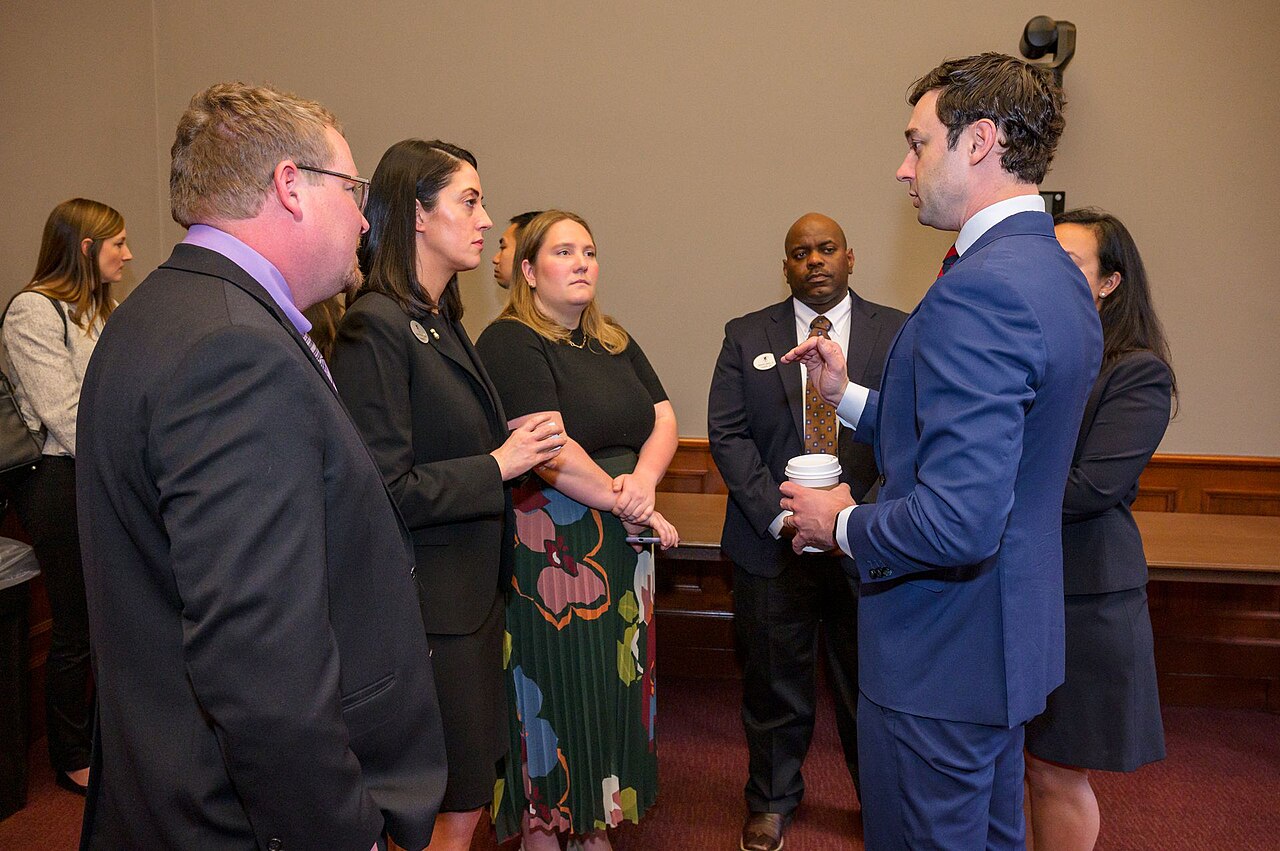
Senator Jon Ossoff’s decisive re-election victory in Georgia has thrust him into the national spotlight, prompting intense speculation about his future political trajectory. His commanding win, securing a 59% to 41% margin, cemented his reputation as a powerful political figure in the diverse Southern state. While his campaign focused on tackling corruption and increasing affordability, his broad coalition—which even garnered support from Republican members—has led some political analysts to project him as a leading Democratic contender for the 2028 presidential race, despite the senator’s stated lack of interest in running for the highest office.
Navigating Identity and Civil Rights
Ossoff’s political appeal is deeply intertwined with his Jewish heritage, which he has openly discussed. Supporters within the community have lauded his emphasis on Southern Jewish history and his commitment to civil rights, noting his connection to the Temple in Atlanta, a site central to the Civil Rights Movement. Community leaders have highlighted his ties to figures like Dr. Martin Luther King Jr., pointing to his dedication to the marginalized. Furthermore, his upbringing, which included relatives who survived the Holocaust, has been cited by some as informing his conviction to advocate for the persecuted and dispossessed.
The Nuanced Stance on Israel
However, the senator’s record on Middle East policy has created significant friction within segments of the Jewish community. Several prominent pro-Israel organizations expressed deep disappointment regarding his votes to restrict military aid to Israel. Ossoff has consistently maintained a position that supports the security of Israelis while simultaneously urging mercy for civilians in Gaza. He has publicly stated that he believes Israeli forces committed war crimes in Gaza, deferring the ultimate judgment to the International Criminal Court.
This stance has drawn sharp criticism from some Jewish leaders, who accused him of misleading constituents. Yet, his recent electoral triumph suggests that the political landscape is shifting. Political observers suggest that the negative campaigning against his opponent, which included allegations of antisemitic connections, may have softened some internal objections to Ossoff’s foreign policy views. This victory underscores a broader trend within the Democratic Party, where Ossoff’s position—supporting the alliance but insisting on conditional aid—is increasingly viewed as the new political mainstream.
A Changing Political Climate
Political scientists note that this conditional approach reflects a growing decline in unwavering support for the U.S.-Israel relationship among American voters, including American Jews. This evolution is not confined to Democrats; even Republicans are beginning to question the alliance’s role in national policy. Ossoff’s ability to reconcile his deep Jewish identity with a critical view of Israeli government actions positions him at the heart of a major national debate: whether solidarity with a Jewish homeland requires unconditional military support, or if it demands a principled, nuanced approach to international human rights.
World Views
German Religious Leaders Sound Alarm Over Surge in Antisemitic Threat

Germany’s highest Catholic authority has issued a grave warning, stating that the future of Jewish life within the nation is jeopardized by the accelerating rise of antisemitism and associated violence. Officials are expressing profound concern that the escalating climate of hostility has rendered daily existence increasingly precarious for the country’s Jewish population. The warnings come amidst a backdrop of heightened global tension, particularly following the tragic events in Israel in late 2023.
The Erosion of Public Safety and Identity
Archbishop Heiner Koch highlighted the deep sense of fear permeating communities, noting that many Jewish individuals now feel unable to openly express their heritage in public spaces, such as wearing traditional symbols or speaking Hebrew. This pervasive anxiety is driving some to seek refuge and safety in Israel. Koch emphasized that confronting this societal challenge must be recognized as a core principle of the nation, requiring all political factions, regardless of their ideology, to actively participate in combating prejudice.
President Frank-Walter Steinmeier echoed these concerns, cautioning that the hostility directed at Jewish people presents a severe challenge to Germany’s democratic foundations and social cohesion. Speaking at a memorial commemorating the brutal 1938 Nazi pogrom, the German President called for vigilance against prejudice emerging from every sector—including extremist groups on both the far right and far left, as well as within mainstream society. While acknowledging the resilience of the legal system, he stressed the absolute necessity of heightened awareness.
Digital Abuse and National Symbolism Under Attack
The threat is not limited to physical spaces. In major cities like Hamburg, experts are observing that online platforms have become significant arenas for hateful abuse. A recent survey indicated that a substantial percentage of Jewish participants had experienced threats and verbal harassment online, making the internet a primary source of severe distress. This fear is so intense that nearly four-fifths of surveyed individuals are avoiding displaying their religious markers publicly.
Adding to the national unease, a recent act of political vandalism saw an activist scale the flagpole outside the German parliament in Berlin, replacing the national symbol with a Palestinian flag. This incident drew sharp condemnation from Israel’s ambassador, who viewed the action as a rejection of Germany’s foundational principles. Furthermore, the President of the Bundestag strongly criticized the act, demanding increased protection for parliamentary grounds to prevent them from becoming venues for political demonstrations.
Call for Unified Action
Local Jewish advocacy groups are pushing for systemic change. In response to the digital wave of hatred, officials are advocating for a nationwide cooperative initiative across German states aimed at confronting rising online bigotry. The message from religious and political leaders is clear: the safeguarding of Jewish life requires an immediate, constitutional, and unified societal commitment.
