



Uncategorized
Italian gelato champion shrugs off anti-Israel backlash fears as chain expands in Israel
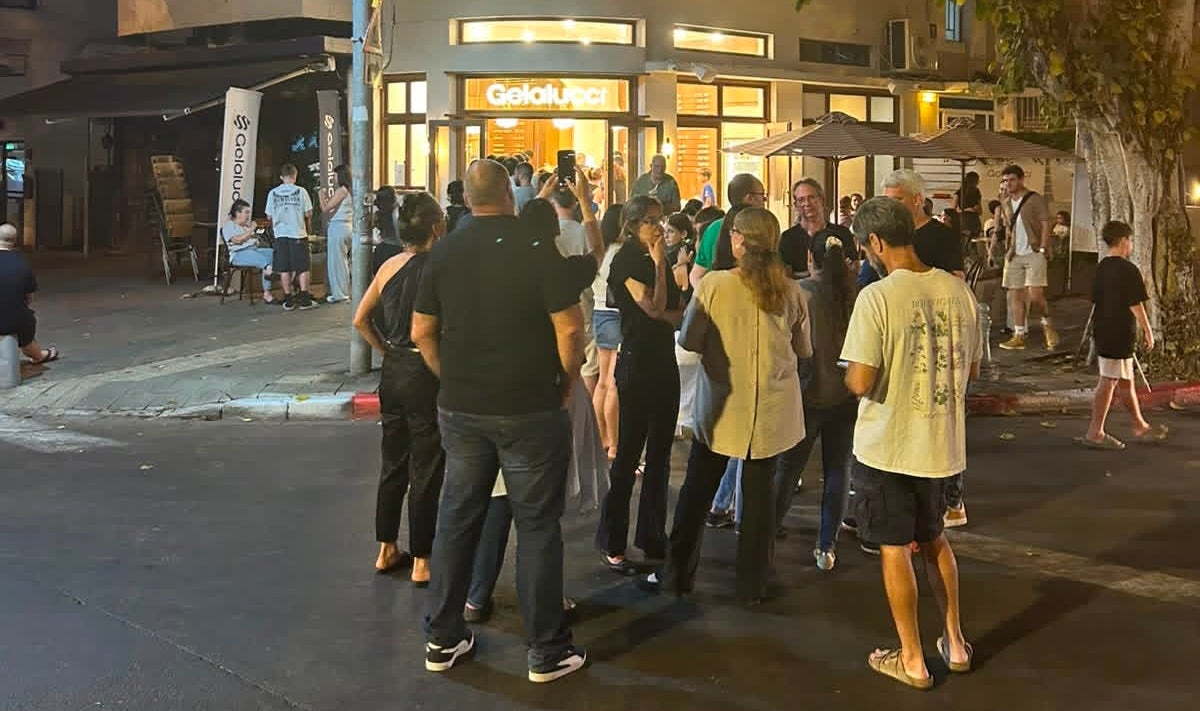
(JTA) — TEL AVIV — When Gelalucci opened its first Israeli gelateria in Tel Aviv earlier this year, the lines were staggering.
Now, the venture with Italian gelato champion Sergio Colalucci, who shrugged off fears of an anti-Israel backlash in Europe, is expanding, with a second branch opening Thursday in Kiryat Ono, a Tel Aviv suburb.
The initial frenzy surrounding the first branch was no one-day wonder. Weeks after the Tel Aviv opening, customers were still queuing outside the shop on leafy Masaryk Square, off King George Street.
One elderly customer, eating vanilla from a cup, said he had already found what set it apart. “This is the only ice cream in Israel that is not overly sweet. You can taste that it’s good quality,” he said.
Amit Cohen, the branch manager and son of Pini Cohen, a longtime food industry figure and partner in the venture, said the man’s return to the store was more important than any first-day rush.
“When people come back again and again, that’s the biggest victory for us,” he said.
The Tel Aviv and Kiryat Ono stores are the first of several Israeli branches planned for Gelalucci, a portmanteau of gelato and Colalucci. The new chain represents a surprising overseas expansion for the entrepreneur, who has operated primarily in Italy and Spain — where anti-Israel sentiment is intense.
Colalucci served scoops himself on an opening day that drew thousands of customers with an offer of free gelato for the first 500. Before the opening, Ronen Nimni, owner of the Cafe Cafe Group, which partnered with Colalucci to bring Gelalucci to Israel, had been worried that anti-Israel reactions could hurt the Italian gelato maker, whose business also operates in Europe. There are eight branches in Spain, where the backlash against Israel has been especially visible.

But according to Cohen, Colalucci was not deterred.
“He fell in love with Israel,” Cohen said. “He’s become a kind of ambassador for us.”
Even missiles did not appear to shake him. On one visit, Colalucci was driving with Cohen when a siren sounded. The two stopped the car, got out and lay on the ground with their hands over their heads, following Home Front Command instructions, Cohen recalled. Colalucci, he said, remained calm.
“I mean, it was the Houthis, but what does he know?” Cohen quipped, referring to the almost blasé attitude many Israelis have developed toward missiles from Yemen, which are usually intercepted and often regarded as more of a nuisance than a threat.
Colalucci’s son, Francesco, 21, who is also involved in the Israeli launch, stayed in Israel after his father left and found himself caught in a brief flare-up with Iran. Like his father, he did not panic when the missiles came. Nor, he said, was he troubled by criticism of the decision to open in Israel.
“Why would I have a problem to open here? I see a beautiful place with beautiful people,” he said.
Sergio Colalucci also serves as president of the Gelato World Cup. In 2006, he was a member of the Italian team that won with an entry that included his flavor “Pistachio 26.”
It is one of 26 flavors offered in the Tel Aviv shop, alongside tiramisu, salted caramel, fig and orange ricotta, sorbets and sugar-free scoops, and some added to cater to local preferences, including vanilla and an Oreo-style flavor made with cookies prepared in-house.

The company has entered a crowded market in a city where frozen treats are widely available. Unlike most local ice cream businesses, Gelalucci’s Israeli operation is built around a fully imported product. The gelato is made at the Colalucci family factory in Nettuno, a seaside town south of Rome, using Italian raw materials and the family’s original recipes, then shipped to Israel for sale.
The gelato is made without nonkosher ingredients, Cohen said, and any additives are plant-based. The Tel Aviv store, however, does not have Israeli kosher certification because it is open on Shabbat. Cohen said the partners may later seek certification from a kosher authority in Rome or another body that could accommodate the brand’s import-based model, particularly for subsequent branches.
The decision to open in Israel had the backing of the whole family, Francesco Colalucci said, fitting for a business that is very much a family affair. His grandfather opened the first shop in 1974, his father now leads the company and serves as its public face, Francesco runs the flagship store in Nettuno, and his mother, sister and aunt are also involved.
“My mother always said to my father, you have to remember, we don’t sell gelato, we sell happiness for the people,” he said. “We want to give this same product to the Tel Aviv people. For this, the whole family has to be involved.”
Francesco Colalucci said his father never pushed him into the family business and told him he could choose his own path. But gelato was the atmosphere he grew up in. Mauro Petrini, his father’s mentor, known in the industry as “the engineer of ice cream,” was a formative presence in his childhood.
“Mauro was like an uncle to me,” he said. “When I was around 10, he told me, the more you learn, the more you have learned nothing. From this moment, the passion for it grew inside me.”
It took three years to turn the idea of a Tel Aviv branch into an operating store, slowed by transport, logistics, certification issues and the bureaucracy that foreign businesses often encounter when entering Israel. Francesco Colalucci shrugged off the delays, saying Israel was hardly alone in that respect.
“Bureaucracy is very terrible also in Italy,” he said.
With unmistakable Italian features and an athletic build, Colalucci does not look like a cautionary tale about growing up around ice cream. He says it comes down to balance — protein, fat and sugar in the right proportions — plus restraint.
“If it’s good gelato you’re not going to get fat,” he said, before adding with a smile, “Just don’t eat too much.”
This article originally appeared on JTA.org.
The post Italian gelato champion shrugs off anti-Israel backlash fears as chain expands in Israel appeared first on The Forward.
Uncategorized
Knesset elects speaker from ‘change’ bloc opposing Netanyahu
(JTA) — Israeli parliament members elected Matan Kahana of Gadi Eisenkot’s opposition Yashar party to be the next speaker of the Knesset, in a 66-52 vote on Tuesday that portends clashes with Prime Minister Benjamin Netanyahu.
Kahana will serve as speaker of the 26th Knesset, defeating Ofir Katz from Netanyahu’s Likud Party.
A Knesset speaker belonging to the bloc actively seeking the prime minister’s ouster is rare. Last week, Eisenkot got the mandate to form a new government, although he has yet to do so.
Installing his ally Kahana in the powerful speaker’s seat will allow Eisenkot to engineer legislative maneuvers that will undercut Netanyahu’s agenda, at least during the three-to-five remaining weeks Eisenkot has to form a coalition.
One key Eisenkot priority is passing legislation to establish a commission of inquiry into the failures surrounding the Oct. 7, 2023, Hamas raids, the worst attack in Israel’s history. Netanyahu, who was prime minister on that day, has until now resisted setting up such an inquiry.
Kahana secured the speaker role on Tuesday with the support of the 48 Knesset members of Eisenkot’s bloc, which includes the Yashar, B’Yachad, Yisrael Beyteinu and Democrats parties. The Arab-majority Ra’am and Joint List parties also voted for Kahana, with just one of their collective 19 members absent.
Eisenkot has insisted that Arab parties must have equal say in the Knesset, even if they are not part of the coalition The Netanyahu bloc’s resistance to any empowerment for the Arab parties – even in the face of their unprecedented success in the Oct. 27 election – fueled much of the vitriol in the debate prior to the vote.
Kahana immediately sounded a conciliatory note toward the Arab Knesset members who voted for him, a signal of the markedly different tone Eisenkot plans to take in contrast to Netanyahu.
“The Knesset is the home of all of Israel’s citizens,” Kahana said in his first address as speaker on Tuesday evening. “I intend to be the speaker for everyone – regardless of religion, race or gender.”
He stressed that “it is possible to hold opposing views while still maintaining respect for state institutions and for those who think differently.” Kahana, 54, has served in the Knesset in multiple parties off and on since 2019.
After hours of filibustering from the Netanyahu bloc, the vote was able to take place when the two camps struck a deal, according to Israel’s Channel 12: Eisenkot’s bloc agreed to delay votes to repeal bills advanced in the previous Knesset until next week.
Eisenkot has promised that he would put together a coalition based on four guiding principles: recognition of Israel as a Jewish and democratic state; embracing the values set forth in Israel’s Declaration of Independence; requiring military or civil service for all and commitment to dismantling Hamas while recognizing the group as a terrorist organization.
Although the Arab-majority parties supported Kahana’s appointment as Knesset speaker on Tuesday, Eisenkot’s path toward forming a government with their involvement would be a formidable task. The leader of Ra’am, Mansour Abbas, has repeatedly condemned the Oct. 7 attack but has not recognized Hamas as a terror organization. Nor has the Joint List, which includes members who are aligned with Palestinian nationalist ideologies.
As for Netanyahu’s bloc, 52 out of the possible 53 Knesset members voted on Tuesday for the Likud’s candidate for speaker, despite fears that certain ultra-Orthodox parties might abstain. Only the Likud’s Nir Barkat was absent from the session – reportedly on a private trip to India to clear his head, according to Israeli journalist Uri Misgav.
Barkat and Netanyahu have had a fraught relationship, ever since Barkat allegedly held consultations about potentially replacing Netanyahu in the days following the Oct. 7 attacks, as originally reported by Channel 12’s Amit Segal.
Chief among the bills that Eisenkot’s bloc plans to repeal is the Netanyahu coalition’s judicial overhaul law, which has sought to shift the balance of power by increasing the influence of politicians on judicial appointments.
Kahana expressed his hope on Tuesday evening “that the incoming government will work to implement all necessary improvements to the system of checks and balances among the three branches of government – and will do so with broad consensus.” He also pledged that the Knesset would “unequivocally abide by the rulings of the courts.”
“The eyes of Israeli citizens are upon us, yet in recent years, we have caused them to lower their gaze in embarrassment,” Kahana added, noting that the social media era has fueled a surge in extreme discourse. “It is our responsibility to change and fix this.”
This article originally appeared on JTA.org.
The post Knesset elects speaker from ‘change’ bloc opposing Netanyahu appeared first on The Forward.
Uncategorized
Britain sanctions Israeli settlement builders and a group that blocked Gaza aid
(JTA) — Britain on Tuesday imposed new sanctions on eight Israeli companies involved in West Bank settlement construction, and an activist group that has repeatedly blocked Gaza-bound humanitarian aid convoys.
“We said we would act, and we are,” British Foreign Secretary Ed Miliband said in a video address posted on X. “Illegal settlement expansion in the West Bank is destroying the prospects of a two-state solution. So today we are sanctioning companies involved in that activity and disrupting their access to the finance that enables it.”
Tuesday’s sanctions package is the first such concrete step taken since Britain announced in September that it would reset its approach to Israeli actions in the West Bank and overhaul its Global Human Rights sanctions program. It joined Canada and France in announcing plans to target settlements.
The Foreign Office said Tuesday that the package targets eight firms, ahead of final tender deadlines for the massive E1 settlement project – which would add 3,401 housing units east of Jerusalem and bisect the West Bank. The sanctions freeze assets and bans individuals from forming or managing companies in Britain.
“Our warning to companies thinking about being part of settlement expansion, including the unconscionable E1 project, is clear: we will clamp down on you,” Miliband said in his address. Anti-settlement advocates have for years maintained that building in E1 would foreclose the possibility of a contiguous Palestinian entity in the disputed territory.
The sanctions also singled out the activist group Tzav 9, which the Foreign Office accused of having “organized and carried out blockades to prevent humanitarian aid convoys entering Gaza as recently as October.” The group’s name means “Order 9” in Hebrew, a play on Tzav 8, Israel’s emergency military reserve call-up order.
“Aid must be allowed to reach civilians in desperate need, and those who obstruct it must be prepared to face the consequences,” Miliband said. “The British people do not want businesses to be supporting illegal occupation, and they desperately want to see aid enter Gaza.”
In June 2024, the Biden administration imposed sanctions on Tzav 9, after its members conducted multiple attacks on aid convoys. The U.S. State Department at the time labeled Tzav 9 a “violent extremist” organization, noting that it looted and set fire to two trucks bound for Gaza. The Trump administration lifted sanctions on Israeli individuals and entities, including Tzav 9, that the Biden administration had deemed extremist.
In response to the British Foreign Office’s sanctions announcement, Tzav 9 released a lengthy statement in English on X, demanding that Hamas be “disarmed and DISMANTLED, so it can no longer seize that aid for its own purposes.”
The group asserted that 2.4 million tons of food and 26,000 tons of medicine and supplies have entered Gaza since the October 2025 ceasefire, adding that Israel’s Foreign Ministry places no restrictions on the types of medicine allowed in.
“Tzav 9 is a movement of [law] abiding citizens from all the political spectrum, and we’ve always protested peacefully,” the group stated. “This is our democratic right, and your attempts to portray us as extremists will not succeed. We are ordinary Israeli citizens concerned about our children’s future.”
This article originally appeared on JTA.org.
The post Britain sanctions Israeli settlement builders and a group that blocked Gaza aid appeared first on The Forward.
Uncategorized
American Jews need to decide what being American means to them
A vote is a choice between finite possibilities. But with those limited choices, we are expressing something not only about what we think of the candidates, but what we think of ourselves: Who do we want for this moment in our country? Where do we want this country to go? Who and how do we want to be in it? As Jews? As Americans?
I thought of this while reading the statement by Jonathan Schulman, executive director of The Jewish Majority, that accompanied his organization’s findings about Jewish voters in Michigan. Jewish Majority found that 50 percent of Jewish voters, and 52 percent of those who voted for a senator, voted for the Democrat, Abdul El-Sayed, a significant dropoff of the Democratic vote from 2024 and compared to Jocelyn Benson, this year’s victorious Democratic gubernatorial candidate. (National polls vary; an exit poll from NBC had about a 10 point dropoff of Jews voting Democrat, while one from J Street found no change, which would itself be notable in a year when most other groups went bluer than 2024.)
Whether this poll is methodologically sound has been the matter of some debate, but what I found as interesting as the numbers was what Schulman chose to say along with it:
A Democratic Senate candidate earning just half of the Jewish vote should be a blaring alarm for every Democratic leader in the country…Democrats cannot assume Jewish voters will stay with them when their concerns are dismissed. Republicans should not assume a vote against one Democrat is a lasting endorsement of their party. This year’s Democratic wave defied recent cycles that have been decided by razor-thin margins. Officials must understand that even a modest shift in the Jewish vote can be decisive. Both parties have to earn it.
Do they? If I were the Democratic Party, I would not treat this as a blaring alarm. El-Sayed, per this poll, had a major dropoff of support from Jews — and still won by 7 points. I take Schulman’s point that it could have been closer had the election not taken place in a national wave. But on the other hand, perhaps a more pro-Israel candidate would have done less well with the Michigan’s uniquely large percentage of Arab American or Muslim voters, who swung significantly to Donald Trump in the 2024 election, but came back to the Democrats for vote for El-Sayed in 2026. Similarly, a more pro-Israel candidate may have also done less well with young men, who had a 55 point swing toward El-Sayed from their 2024 preference for Trump, and who we know, as young people, are increasingly critical of Israel.
More than Democrats or Republicans, there is another group to whom it is hugely important how Jews vote in the future: American Jews. Most Jews for the last century of American history have been liberal, often working in political coalition with other minority groups. If we are not anymore, that would do more than just mean that our communities are more right-wing; it would make American Jews more insular and more isolated from our fellow Americans. How we vote, coupled with who we choose to work with, or not; ally with, or not; stand up for, or not; determines more than whether Democrats or Republicans get our votes. What we decide could determine who we are in this country.
No party or candidate is guaranteed any minority group’s support, and of course it is reasonable for people not to vote for candidates they see as hateful toward them. This is not limited to Jews: Indian Americans not voting for a Texas railroad commissioner candidate who decided to campaign at least in part on anti-Indian racism, for example, is hardly shocking.
Part of what is at issue here is the extent to which many Jews feel targeted by comments like El-Sayed’s on the incompatibility between being a Zionist and a progressive.Over the summer, for example, he told CNN, “Every definition of a Jewish state ends up in some articulation of illiberal values, every single one.” Many saw this as not only critical of Israel, but unwelcoming to Jews in American civic life.
However, Nonnegotiable Michigan explicitly stated that “Jewish statehood in Israel is nonnegotiable. The Jewish people’s right to self-determination in our ancestral homeland is not up for debate, even when its politics are” and that “Palestinian aspirations for safety, dignity and freedom must be pursued alongside Israel, not in place of it.” Their vote against Mike Rogers was contingent not just on Jewish safety, and not on pluralistic democracy, but on the other candidate saying that he shared their vision for Israel remaining a Jewish state. Nonnegotiable voters and their allies held to this condition despite the fact that Rogers denied the results of the 2020 election, supported legislation to ban abortions on multiple occasions, opposed marriage equality, and who seemed perfectly comfortable accepting campaign help from someone who implied belief in Jesus was a prerequisite for holding office and who personally encouraged and participated in Islamophobia in the campaign against El-Sayed.
The implications of this approach stretch far beyond the Michigan Senate race. Whether American Jews are going to condition their support for Democrats — and more broadly their involvement in the U.S.’s society of liberal pluralism — on Israel seems to be an open question. Nonnegotiable, for example, plans to expand nationally, and the ADL, which has removed “civil rights” from its website, reacted to the midterms in part by issuing warnings to progressives, including one of the Israel-critical Jews who has become a new member of Congress. American Jews, individually and collectively, need to ask ourselves if we agree that we are willing to break out of our nation’s liberal democratic partnership over Israel.
I do not know exactly what American Jewishness will look like if the answer to that question is “yes.” And Schulman is right that Jews who don’t vote for Democrats won’t necessarily turn to Republicans; they may sit out certain elections or vote for third-party candidates. Even so, as most of American society, and in particular other minorities, move away from support for Israel, many American Jewish communities could become, if not more affirmatively conservative, then more insular, retreating into our own institutions and pulling up the drawbridges. Instead of supporting the values and policies that protect us alongside other minorities, American Jews risk becoming a Sparta, a closed community telling ourselves that that’s what it means to take care of Jews.
The stories Jews tell ourselves about our role in this country — from taking part in the Civil Rights movement to championing women’s equality to contesting ICE — were always partial and incomplete accounts. But if we withdraw from trying to work in pluralistic, liberally minded coalitions with other groups — joining with them to work against draconian executive orders, decrying not only antisemitism but other hatreds, and supporting politicians working to protect democracy — those stories will become untenable tales about who we still are in America. They will just be history.
Who are we as Americans and Jews, and can we even separate those two things is an existential question, one we can’t answer just at the ballot box. But as I read Schulman’s statement, I didn’t wonder about the future of the Democratic Party. I wondered about the future of American Jews if we decided our future lies separate and apart from it.
The post American Jews need to decide what being American means to them appeared first on The Forward.
