



Uncategorized
International music executives increasingly shun Israel’s talent showcase
(JTA) — TEL AVIV – The Israeli music industry had its own take on speed dating this week at a venue built from repurposed shipping containers in the Jaffa Port.
International booking agents and record label executives moved from table to table, slipping on headphones and chatting with Israeli musicians at Beit Hamecholot.
The musicians had come armed with vinyl records, snacks, bottles of alcohol and, in some cases, furry costumes — anything that might entice a prospective booker to stop and listen. A few minutes of conversation could determine whether their music would be heard in Berlin, Tokyo or New York.
But getting the people who could make that happen to come from abroad to Israel’s Music Showcase Festival in the first place has become increasingly difficult due to cultural boycotts of Israel.
Of the at least 200 music industry professionals invited this year, 32 attended, down from 55 last year. In previous years, the festival would typically send out between 400 and 500 invitations, but the festival’s artistic director, Hadas Vanunu, said organizers had become more selective about whom they’d approached since the war in Gaza began three years ago.
Vanunu said the way prospective delegates responded was more troubling than the drop in numbers.
In 2024, when just 22 international guests came, many cited security concerns and pressure from their families. By 2025, objections were increasingly political, although Vanunu said Israel still elicited a measure of sympathy abroad because of the hostages held in Gaza.
This year, many of those approached simply didn’t respond.
“We were practically begging people to tell us why they wouldn’t come, even if it meant getting angry messages saying, ‘We’re not coming because Israel is doing this or that.’ This year, we didn’t even get that,” Vanunu told the Jewish Telegraphic Agency.
“What was a trend of hating Israel a year or two ago has now become the norm. Israel is a pariah state. You can really feel it in your blood, just how hated you are,” she said.
Founded in 2009, the festival has helped propel Israeli acts including Noga Erez, Lola Marsh and Garden City Movement onto the international music scene. This year’s six-day event featured some 50 performances across Jerusalem and Tel Aviv, spanning jazz, hip-hop, rock, electronic and Middle Eastern music.
Produced by Jerusalem’s Yellow Submarine music center in partnership with the Foreign Ministry’s cultural diplomacy division, the festival has suffered from budget cuts and been a target of the Boycott, Divestment and Sanctions movement. In 2022, Palestinian boycott campaigners explicitly called on international guests to shun the event, citing its government sponsorship.
Since the outbreak of the Gaza war following the Hamas-led attack on Oct. 7, 2023, even people who attended the festival years earlier have grown wary of being publicly associated with Israel.
“We’ve even had Jews from the diaspora and former Israelis who attended the festival ask us to erase every digital trace of their visits,” Vanunu said.
Where once the festival prominently publicized the identities of its international guests as a measure of its prestige, this year organizers supplied JTA with a list of delegates on the strict condition that neither their names nor their job titles be published.
Among the organizations represented were those affiliated with Warner Records, Germany’s Asphalt Festival, Britain’s National Jazz Archive, South Korea’s Jarasum Jazz Festival and the music publications Rolling Stone and Billboard. Delegates came from countries including the United States, Germany, Britain, Poland, China, Japan, Vietnam, Singapore, Ghana, Zimbabwe and the United Arab Emirates.
Some prospective delegates, Vanunu said, wanted the festival’s organizers to clarify their position on the Israeli government’s actions before they would even consider engaging with them.
“There is absolutely no longer any distinction between an Israeli individual and their country,” she said.
The musicians in Jaffa, however, were also grappling with other consequences of the war.
Magi Hikri, who performs as MAGI, was left to fend for herself at the showcase after her manager was called up at the last minute for reserve duty. “What can you do? That’s the reality we live in here,” she said.
With long, tousled blond hair, Middle Eastern roots and pounding dance beats, Hikri has echoes of the international star Shakira in her persona, including a soccer connection: The singer, of Iraqi and Yemeni Jewish descent, has a track, “Jilala,” on the soundtrack of the wildly popular EA Sports FC 26, the soccer video game from the series formerly known as FIFA.
Despite the setbacks, Hikri saw the foreign delegation as “proof that music prevails and will always have a place.”
Several delegates were willing to speak publicly about their decision to attend. Maciej Nestor, who runs the independent Polish record label V Records, said that having toured western Ukraine during the war, he understood how vital music and culture were to people living through conflict. Yet even some of his Jewish musician friends questioned his decision to come to Israel.
“I don’t justify violence or take political sides,” he said, but added that neither artists nor audiences should be “isolated by political conflicts.”
Nestor pointed to what he had seen both on the streets and onstage: Jews and Arabs “going about their lives” and Israeli and Palestinian musicians performing together at the Jaffa gathering as part of the FeelBeit Ensemble, led by jazz trumpeter Avishai Cohen.
“Culture must remain a space for dialogue and human connection,” he said.
Isaac Green, a New York-based executive at Warner Records, by contrast, said he had encountered no pushback over his decision to attend. Green, who is Jewish, pointed to the considerable Jewish presence in the American music industry.
He was struck by the breadth of musical innovation in Israel, he said, and by the “energy of audiences,” even at jazz concerts.
Green described a set by Ethiopian Israeli rapper Eden Derso, who fuses Hebrew hip-hop with soulful R&B vocals, as “phenomenal.”
Derso said hearing praise from someone who did not understand her lyrics was particularly gratifying. “They don’t understand the words but still love it, that’s crazy to me,” she said. “People are just drawn to it.”
She recalled her first performance in Berlin after the outbreak of the Gaza war, when some audience members visibly recoiled upon hearing she was from Tel Aviv.
Asked if such reactions might make her conceal her nationality abroad, Derso scoffed, invoking her Beta Israel heritage. “My father waited long enough to come to this country,” she said. Hiding her Israeli identity, she said, was “like hiding my Blackness.”
The war has changed the repertoire of Boogie Balagan, a Paris-based Israeli duo whose music draws heavily on Arabic influences. Gabri, one half of the duo, said that since Oct. 7, he now improvises a different lyric rather than sing the word “Palestine” in one of their songs. The word had become difficult to sing, he said, after so many of his friends lost loved ones that day.
In the aftermath of the attack, the duo recorded “Mashiah,” singing entirely in Hebrew for the first time in 20 years together. Muslim audiences had responded positively to the song, Gabri’s musical partner, Azri, said, adding that it was younger people on the French far left who were “particularly obstinate” in their hostility toward the duo as Israelis.
Huy Tuan Bui, a prominent Vietnamese music producer and founder of several major music festivals, acknowledged having “moments of doubt” before coming to the expo in Israel, but he said he was deeply moved by the organizers’ refusal to give up on the festival through years of war.
He described his week in Israel as “unforgettable,” praising the caliber of Israeli musicians and the warmth of the people.
“What I witnessed completely changed my perception of this land,” Bui said, pledging to become a “voluntary ambassador promoting the beauty and kindness of Israel and its people.”
According to Vanunu, the willingness of foreign guests to travel to Israel should not be mistaken for an act of charity toward Israeli musicians.
“They don’t want to help Israeli artists simply out of the goodness of their hearts. They want to help because the artists are insanely talented and the music is incredible,” she said.
Cuts to the Foreign Ministry’s cultural diplomacy budget have also threatened the festival’s future. Last year, the ministry froze an estimated 5 million shekels in funding for international cultural collaborations.
“We’re either fighting what the world thinks of us or fighting over whether our own country even believes in investing in culture at all,” she said.
Vanunu said the music industry needed to collectively resist the pressure to boycott artists.
“We’re here to make art, and art has a role that isn’t political,” she said. “The day will come when everyone understands that, and when everyone does, we’ll still be here, doing what we do.”
This article originally appeared on JTA.org.
The post International music executives increasingly shun Israel’s talent showcase appeared first on The Forward.
Uncategorized
NBC pulls anti-Israel ad aired during ‘SNL’ Thanksgiving special after Jewish groups complain
(JTA) — NBC has pulled a commercial linking U.S. aid to Israel to the injuries of a Palestinian child, which the network aired Wednesday during “Saturday Night Live’s” Thanksgiving Eve special.
The 30-second spot from the IMEU Policy Project showed a suburban American girl doing chores to save for a $400 bike. The footage then flipped from her satisfied smile to the distraught face of a girl in Gaza, zooming out to reveal her standing in front of rubble on an amputated leg and crutches.
“Every three seconds, our government sends $400 of taxpayer money to Israel to do this,” said a voiceover narrator.
The IMEU Policy Project is a Palestinian rights advocacy group affiliated with the Institute for Middle East Understanding. The ad, created for the organization’s “No More For Israel” campaign, directs viewers to a website that includes a form for contacting one’s congressperson.
The New York Post, TheWrap and Wall Street Journal reporter Joe Flint reported Friday that NBC would not be re-airing the ad. They added that the network planned to evaluate its review process.
NBCUniversal did not immediately reply to JTA’s request for comment.
The IMEU Policy Project said in a statement Friday that it was “disheartened” by reports NBC had pulled the commercial.
The organization identified the girl in the commercial as Meral al-Babli, a 9-year-old it said was injured when the Israeli army bombed her home in Gaza, killing her mother and grandmother.
“All of this is indisputable, which is why our advertisement passed NBC’s stringent fact-checking requirements,” the organization wrote.
The commercial elicited widespread backlash in the Jewish world even before it aired.
The Anti-Defamation League, the Orthodox Union and the Union for Reform Judaism and a raft of other Jewish religious and advocacy organizations said the ad misrepresented the nature of U.S. aid to Israel and the war in Gaza, and called on NBCUniversal to pull the ad from future broadcasts.
Jonathan Greenblatt, chief executive of the ADL, described the decision to show the ad as “indefensible,” adding in a post on X that “there is no rationale to justify fanning the flames with such a twisted narrative.”
Religious groups couched their criticism of the ad in an acknowledgement of Palestinian suffering.
The OU said in a statement that “we grieve the suffering of innocent civilians, especially children, in Gaza and Israel alike” but that the ad “exploits civilian suffering while leaving Hamas’s role entirely out of the picture.”
The URJ wrote that “we will not turn away from Palestinian suffering” while adding that the commercial “reduces a complex and tragic war to an emotionally manipulative accusation that American taxpayers are directly financing the maiming of Palestinian children.”
Other Jewish groups and leaders condemning the ad included B’nai Brith International, the National Jewish Advocacy Center, American Jewish Committee CEO Ted Deutch and Conference of Presidents CEO William Daroff.
The National Jewish Advocacy Center threatened to file a complaint with the Federal Communications Commission if NBC did not provide evidence substantiating the ad’s claims.
The U.S. and Israel have been negotiating a successor to the 10-year, $38 billion Memorandum of Understanding signed during the Obama administration, but neither government has publicly announced an agreed duration or dollar amount.
The existing agreement provides military assistance largely through grants for U.S.-manufactured defense purchases. Its $38 billion commitment averages roughly $361 every three seconds over the decade, with funding subject to congressional appropriations.
IMEU Policy Project, an advocacy group, criticized the prospect of a successor agreement as a “long-term weapons giveaway to Israel in a post on X.
The Thanksgiving Eve commercial comes on the heels of anti-Israel political ads that aired in the runup to the November election.
In October, an independent organization that supported Democratic Sen.-elect Abdul El-Sayed’s campaign funded an ad featuring a couple in a grocery store who blamed high food prices on U.S. military aid to Israel. While El-Sayed condemned the ad, advocacy groups have linked its airing to a broader trend of scapegoating Jews and normalizing the usage of antisemitic tropes.
This article originally appeared on JTA.org.
The post NBC pulls anti-Israel ad aired during ‘SNL’ Thanksgiving special after Jewish groups complain appeared first on The Forward.
Uncategorized
Mamdani and Democratic Socialists triumphed in NYC — will infighting over Israel keep that from happening in Berlin?
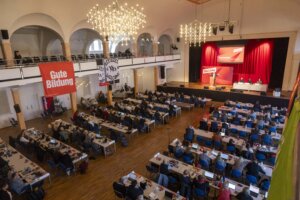
First they took Manhattan. But can they take Berlin?
Inspired by Zohran Mamdani, Germany’s democratic socialists — called Die Linke (The Left) — stunned the political establishment in September by finishing first in Berlin’s election for city leadership. But unlike New York City’s mayor, Die Linke needs coalition partners to help them place their candidate in city hall.
Since the start of November, Die Linke has been in talks with the center-left Social Democratic Party and the Greens over teaming up to form a government, with Die Linke’s Elif Eralp as mayor.
It has not been going well for Die Linke and Eralp, largely because of bickering among the leftists over what constitutes antisemitism. The negotiations got a nudge this past Tuesday when Die Linke expelled one of their own from the party’s Berlin parliamentary faction: Vanessa Emde, who had become a lightning rod for seeming to question Israel’s right to exist. Still, there are many more issues to settle before the SPD and Greens agree to a coalition government with Die Linke.

In German politics. there is a word used by parties against their opponents. The word, regierungsunfähig, means “unfit to govern.” It is an epithet used by conservative politicians to deprecate Die Linke. They point to anticapitalistic rhetoric, diehard dreams among some of a socialist utopia, a split between reformists and radicals, to the party’s anti-NATO stance, and to its struggles to speak with one voice.
As questions about Die Linke’s Israel policies have dominated weeks of furious debate not just in Berlin but all of Germany, something important has been pushed into the background: the long history of attacks on Die Linke and its predecessors, stretching back to the collapse of Communist East Germany. It is certainly a story of missteps by Die Linke, but also one of old guard politicians trying to keep these upstart democratic socialists on the fringes to protect their own powers.
As a Germany-based foreign correspondent at the end of the Cold War, I covered the origins of Die Linke’s travails.
Flash back to Nov. 9, 1989. Bowing to pro-democracy activists who staged weeks of protests, the Berlin Wall is opened by the East German regime. Reformist members of the ruling Socialist Unity Party of Germany, or SED, meet with leaders of pro-democracy groups to chart a course for East Germany. The SED ousts hardliners and changes its name to the Party of Democratic Socialism, or PDS.
Germany’s destiny after the fall of the Wall was stage managed by West German Chancellor Helmut Kohl and his conservative Christian Democratic Union, or CDU. As I traveled with Kohl to rallies, covered his news conferences, and was invited to off-the-record briefings, I watched as his government set the political terms and pace of the post-Wall process.
East Germany’s first free elections, held on March 18, 1990, were won by a conservative alliance that essentially answered to Kohl. The two German states merged on Oct. 3, 1990. Two months later, high from having made history, voters in both regions of Germany made Kohl chancellor of all Germans by giving him an overwhelming victory in parliamentary elections.
The mood of the electorate soon soured. Instead of a “blossoming landscape,” as Kohl had promised, reunification brought soaring unemployment and higher prices for everything to east Germans. As the 1994 election approached, Kohl and the CDU resorted to ginning up a red scare to help him win.
That summer, posters showing a red sock hanging from a clothesline appeared across Germany, sporting the slogan “Auf in die Zukunft … aber nicht auf roten Socken,” or “Onward Into The Future — But Not In Red Socks.” “Rote Socken” is an epithet that essentially meant “Old Commies.” The ex-communists responded by selling red socks as campaign merchandise and thanking Kohl for the free publicity.
Kohl retained power, but the “Red Socks Campaign” did little to halt the PDS. Kohl’s coalition narrowly defeated his main rivals, the Social Democrats, and legions of unhappy east Germans threw their support behind the homegrown PDS.
The east remained the PDS’ stronghold. Its reach expanded in 2007 when they merged with disenchanted Social Democrats to create a new party — Die Linke. They hold seats in the Bundestag, in state legislatures, and in city councils across the country. But during election seasons, conservatives continue to invoke the SED legacy as a weapon against Die Linke.
The year 2026 has been a historic one in the United States, with voters dealing President Trump and his MAGA allies a significant setback in the midterm elections. It has been an equally consequential year for Germany, where the Alternative for Germany, or AfD, has surged despite allegations that it harbors neo-Nazis, Holocaust deniers and admirers of Adolf Hitler. The AfD’s rise has come at great expense to the long-dominant Christian Democrats and Social Democrats, who have fallen behind the AfD in popularity as voters increasingly blame them for failing to address soaring energy and housing costs, concerns about crime and a sense of insecurity brought on by Russia’s war in Ukraine.
This was the backdrop for the elections that were held on Sept. 20 for delegates to Berlin’s parliament, called the House of Representatives.
Voters were deciding whether to replace a CDU-SPD coalition that has been governing for three years. The outcome was a resounding rejection of the status quo. More than a quarter of the vote went to Die Linke, 18.8% to the CDU, 16.3% to the AfD, 14.3% to the Greens, 12.1% to the SPD, and the remainder to a scattering of other parties.
The SPD, the Greens and Die Linke agreed to try to form a coalition government. Conservatives pounced, insisting Die Linke was unfit to govern. Opposition turned to outrage over a series of incidents that raised questions about Die Linke’s stated commitment to recognizing Israel’s right to exist and to fighting antisemitism.
The furor began in the summer, after Bayerischer Rundfunk reported that some officials in Die Linke’s youth group downplayed Hamas in internal communications, disputed descriptions of it as Islamist, and dismissed concerns about pro-Palestinian organizations accused of ties to Hamas. The report also uncovered explicitly antisemitic rhetoric, including the slogan “Israel verrecke!” (“Israel, perish!”).
At a Die Linke campaign event in Berlin a month before the election, the rapper Dahabflex performed a song containing the chants “Yalla, Yalla, intifada,” and “Death to the IDF” as people danced and waved Palestinian flags.
Resistance to Die Linke’s post-election efforts to build a coalition government deepened over a statement made by party member Vanessa Emde, a newly elected delegate of the House of Representatives, who declared that “States do not have a right to exist. Human beings have a right to exist,” and defended the remark by arguing it is consistent with international law.
For Die Linke’s prospective coalition allies, the SPD and the Greens, this crossed a red line. They demanded that Die Linke’s 44-member caucus in the House of Representatives expel Emde. They did so in a vote on Tuesday, but about a quarter of the caucus was against Emde’s ouster.
Die Linke’s troubles are far from over.
Conservatives will surely point to divisions among the democratic socialists over Israel policy as proof they are regierungsunfähig, the Social Democrats and Greens will insist on more signs that they are, and anger among Emde loyalists will produce headlines that this fractious, besieged party can ill afford.
How much of the furor surrounding Die Linke policy on Israel is political maneuvering? It’s hard to say. But one thing is difficult to ignore: While Die Linke is far from blameless, 32 years after Helmut Kohl launched his Red Socks campaign against the PDS, its ghost still stalks the ex-communists’ political heirs.
.
The post Mamdani and Democratic Socialists triumphed in NYC — will infighting over Israel keep that from happening in Berlin? appeared first on The Forward.
Uncategorized
Why a Nazi’s granddaughter keeps telling Jewish stories
The lighting is dim and the room is dusty. In the attic of her family home in Austria, filmmaker Kat Rohrer riffles through an oversized wooden trunk and takes out her grandfather’s Nazi uniform. She unfolds it slowly, with all the trepidation and courage it takes to face such a family history.
“It’s heavy,” she says in the final scene of the 2017 documentary Back to the Fatherland. She slides her fingers over the insignia on the lapel. Below it, a Nazi eagle clutching a swastika catches the light. She props the top of the trunk open, standing over it as the screen cuts to black.
“I was afraid I was going to come off as one of those Austrians who never looked at her own family history and never confronted it,” Rohrer, 46, told me over Zoom while she was visiting the very same house in Klagenfurt recently. “This house that I’m sitting in right now belonged to my grandfather. My grandfather was a very convinced Nazi, and I grew up with this knowledge.”

For years, Rohrer has been grappling with this complicated past. Her grandfather died while serving as an officer in the Wehrmacht, leaving her grandmother a 28-year-old widow with three young children to raise, including Rohrer’s mother, who was born just three weeks before his death. Rohrer’s great aunt, meanwhile, had married a Jewish man and fled to Australia.
And for years, Rohrer has been telling Jewish stories, looking back at the Holocaust and its impact on families for generations to come. In Back to the Fatherland, Rohrer and co-director Gil Levanon follow young Israelis who moved to Germany and Austria and ask what those choices mean to them and to their grandparents who escaped or survived persecution there.
Rohrer is also the coauthor of the 2026 memoir Inheritance: Love, Loss, and the Legacy of the Holocaust with Charlie Scheidt, the son of German-Jewish refugees who slipped out of Europe at the last minute and made it to New York in 1939. A film based on the book and their 17 years and counting of work and friendship is now in development. As is a fictionalized miniseries inspired by I Belong to Vienna: A Jewish Family’s Story of Exile and Return, a memoir by former Forward culture fellow Anna Goldenberg.
“I don’t feel guilt anymore,” said Rohrer, who hopes to be known as more than just the granddaughter of a Nazi. Indeed, her body of work is more vast and varied than the Holocaust. Her most recent feature film was a romantic comedy about two middle-aged women who meet at a queer bar. Another in development follows two elderly women mistakenly hired for a hit job.
But “I do feel responsibility,” she said. Perhaps that’s why she keeps gravitating back to war stories. “I feel it is my responsibility as the third generation on the perpetrator side … to make sure that these stories are being told in a way that helps us understand history, that helps us not make the same mistakes today.”
A conversation takes a dark turn
It was her first week of film school at the School of Visual Arts in New York City, and Rohrer and her new classmates were outside smoking, “as film people do,” she said. An Israeli classmate asked where she was from, recalled Rohrer, who grew up bilingual, speaking German and English. Her accent isn’t immediately recognizable. The lighthearted chatter took a turn when she said “Austria.”
“Your grandparents killed my grandparents,” the classmate said jokingly, though Rohrer didn’t find the remark particularly funny.

“That really rattled me,” she said. For some time after that, she carried around a sense of shame. “I wouldn’t admit where I was from. I was trying to hide, avoid the question if I could.”
Born in Austria, Rohrer was raised by a single mother, the political journalist Anneliese Rohrer, and one of her aunts, Hanne Rohrer, an actress who took Rohrer to the theater as a kid. “I was hooked,” said Rohrer, who was drawn to visual storytelling and developed passions for theater and film. She moved to New York after high school to pursue the latter and ended up staying for 20 years before making a partial return, splitting her time today between Vienna, Berlin, and New York.
Though it was jarring to be confronted as she was that first week, Rohrer had always been aware of that history — and she was curious. “The second generation really has a hard time asking the first generation. The third generation is the one who really wants to know what happened,” she said.
Rohrer doesn’t remember her grandmother, who died when she was three, but she was close with her great aunt who’d fled to Australia. “I was told it was love at first sight between the two of us, and she came every summer to take care of me,” she said.
Rohrer was 13 when her great aunt died. While visiting Australia not long beforehand, Rohrer saw the suitcase she’d kept underneath her bed ever since 1939 with all her important belongings, so that “should she have to flee again, it wouldn’t be such a scramble as it was the first time.”
Speaking at a book talk, Rohrer again conjured the image of that suitcase. “I was too young to ask what that meant, living with that fear her entire life,” she said.
The apprehension Rohrer felt following that memorable smoke break loosened during her undergraduate years. She made friends with Jewish and Israeli classmates. And they talked. “I was starting to have these conversations,” she said. “This is my history. I mean, I can’t change it. I’m certainly not proud of it. But I think we have to have a conversation.”
‘I couldn’t ask anyone anymore’
The Search, Rohrer’s 28-minute thesis film about a young woman who goes looking for the house she believes her grandmother grew up in, is a fictional story loosely inspired by Rohrer’s family.
Shot on location in Klagenfurt in the summer of 2003 while Rohrer was still a student, it too features a scene in the family attic. Though filming was going well, Rohrer said, “I was very frustrated and angry at my main character that I had written, and I didn’t understand why. And then I realized [it was] because she was getting answers that I wasn’t.”
By the time Rohrer and her classmates studied World War II and the Holocaust in depth in high school, her grandparents were long gone. In a sense, the fact that they were strangers to her made it easier to face the family history. “It’s harder, I think, for people who had a relationship with their grandparents,” she said. “It’s very difficult if you have a grandfather who’s to you a very warm person, and then you realize their history. That is much harder to reconcile.”

“For me, that’s not hard. I never met the guy,” she said. And, as she says in Back to the Fatherland, those who survived the war probably got rid of tangible evidence like the uniform she still had a chance to hold in her hands.
But she had so many questions, and “I couldn’t ask anyone anymore.”
The family lore is dark. Rohrer said her great grandfather hanged himself after the family china and silver business went bankrupt in 1929, and her grandfather found him. He was then sent away to boarding school, where Rohrer believes he was indoctrinated into the Nazi ideology. In Back to the Fatherland, she calls him a “super-Nazi” for joining the party early on, by 1935, when it was still illegal in Austria. He became an official member in 1940, two years after the Anschluss.
“Nothing of what I’m saying is trying to explain away what he believed. Trust me,” Rohrer said. “He was old enough to make up his own mind by the time he joined the party.” She was appalled by some of the last letters he sent in 1944 celebrating Hitler’s birthday. “After four years of war, after seeing, I’m sure, horrible things and doing horrific things, I’m sure, still believing,” she said. “That means there’s seriously something wrong with you.” She wishes she could confront him and figure out what went wrong.
For her great aunt, she had another set of questions. “Apart from taking care of my charming young self, how was it for her to come back to Austria to spend the summers there and spend the summers with some cousins and other people that she knew were Nazis?” Rohrer said. “How do you sit at a table with people who readily raised the swastika flag?” she wondered. “How did she come back and have coffees and lunches with these people?”
Rohrer will never know. “I think I’ve made my peace with it,” she said. “I keep taking on projects where I help people get answers,” she added, but her experience has taught her that there’s “a point where you have to accept that some answers you just won’t get.” And she’s sometimes had to help others come to terms with this painful fact too.
Like Dan Peled, one of the protagonists of Back to the Fatherland, an Israeli who moved to Berlin. “I went to my grandmother’s house and I was inside her apartment, and it was fascinating. I want more, I want to dig more,” he tells Rohrer in the film. “It’s a treasure hunt without an end.”
‘Unlikely pairings’
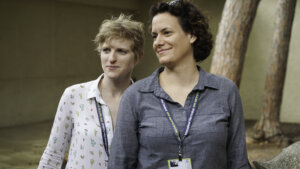
They are, at first glance, an odd pair. The granddaughter of a Nazi and the son of Jewish refugees. A gay director in her 40s and a retired CEO nearly twice her age. A tall woman with a shock of chin-length curls, a quick joke and a voice that projects, and a bald, bespectacled, soft-spoken man of a smaller stature.
Rohrer scans the audience, taking in the room. Beside her, listening intently, is Charlie Scheidt. The moderator for their book talk reads a snippet from the opening of Inheritance.

“Why had my mother held on to this cache of records from their painful past? Why had she hidden them for all these years?” Scheidt wonders, recalling the thousands of papers his mother left for him when she passed away in 1988. “The voices of the dead were waiting to be heard,” the excerpt concludes, but Scheidt was grieving his mother, running a company, and raising a family. “Later, I thought. Later.”
When he met Rohrer two decades later, in 2009, he was finally ready to hear them, and he asked Rohrer to help.
“I very quickly felt that she was a person I could work with. She shared her story, her family story, with me very early,” Scheidt told me. “I appreciated her honesty,” he said. “And I told her this: The sins of the father are not the sins of the children, or in this case, grandchildren … You didn’t even know your grandfather. So this is irrelevant.”
They’ve been friends and partners in the excavation of Scheidt’s family story ever since, traveling in Europe together multiple times, visiting archives, cemeteries, camps, apartments, and other sites that might help them put the pieces together. When the moderator at the book talk asked about the chutzpah that got them into old family homes and more, they shared a knowing look, tilting their heads toward each other and joking off-mic that “it’s contagious.”
“One of the crucial things is that we were able to laugh and make fun of each other, and have a good time. So we share that. And we share a certain intensity,” Scheidt told me. “Neither one of us accepts ‘no’ very easily,” which turns out to be a very helpful trait when conducting this kind of research.

Anna Goldenberg, an Austrian Jew descended from a family of Holocaust victims and survivors, connected with Rohrer in an interview about Back to the Fatherland. “She’s very straightforward, but in a very charming way,” said Goldenberg. “She has a great sense of humor,” and “she’s really very easy to talk to.”
They kept talking after Goldenberg’s memoir was published in 2018. Rohrer told me she was drawn to the unusual story of friendship and hiding. As the title of the miniseries in development, In Plain Sight, implies, Goldenberg’s grandfather hid out in the open in Vienna, passing for a non-Jewish student and medical assistant to the doctor who took him in while his parents and brother were deported and killed.
“That is to me fascinating,” Rohrer said, realizing in real time that she was drawn not only to the history she still has so many questions about, “but also these unlikely pairings that somehow withstand all the adversity.”
‘Longer and louder than necessary’
Years of reckoning have led Rohrer to believe that she can’t make amends for the misdeeds of her grandfather, who died 36 years before she was born. But she can take responsibility. She can document generational trauma and have difficult conversations. She can tell stories — as she has for over two decades — of escape, hiding, death, despair, survival and hope.
“Another person now sent me a script about a story set in Vienna during the Holocaust,” said Rohrer, who continues to juggle these projects with those that allow her to explore other stories and interests. “Another driving force, I will say, is that it’s becoming increasingly hard to tell these stories, and yet I think more important than ever.”
Harder because of the cost, audience and market fatigue, and the dwindling number of survivors, she said, with younger generations sometimes “wondering why they should be interested in this ‘ancient’ history.”
But more important than ever because of the state of Holocaust education in the U.S., where Rohrer lived for so many years and where she and Scheidt have worked with organizations like Voices of Hope, an educational nonprofit created by descendants of Holocaust survivors. Nearly half (48%) of Americans couldn’t name a single ghetto or concentration camp in a 2023 survey of 1,000 U.S. adults and 15% said the number of Jews killed has been greatly exaggerated.
Young people need to know the facts, Rohrer said, but also to understand how quickly a society can become radicalized and what factors mixed, metastasized, and led to the murder of millions.
“It scares me, the world right now,” she said. “There are red flags, and I hope to God I am wrong, right? That there will not be more fascism and authoritarianism. But I’d rather beat the drum longer and louder than necessary, and it doesn’t happen, than not say anything.”
The post Why a Nazi’s granddaughter keeps telling Jewish stories appeared first on The Forward.
