


Local News
Jewish Child and Family Service CEO Al Benarroch talks about stress and resiliency in the Jewish community after October 7
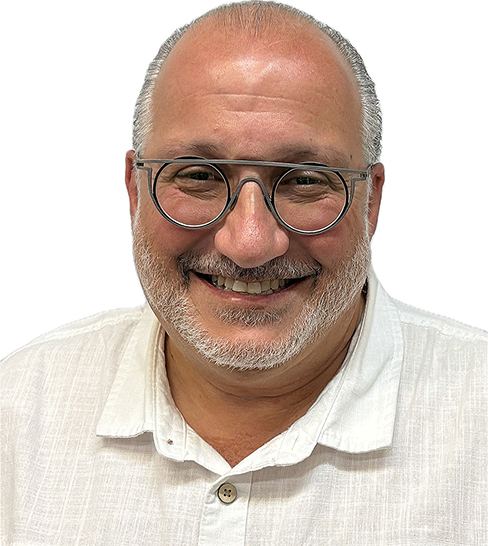
By BERNIE BELLAN On Thursday, August 14, Al Benarroch was the guest speaker at the Remis Luncheon Group, which meets every Thursday between May and September at the Gwen Secter Centre.
I had the privilege of introducing Al.
Al Benarroch was born in 1964, the youngest of four sons born to the late Solomon and Mary Benarroch, originally from Morocco, who came to Winnipeg in the early 1960s. (Al’s brothers are: Rabbis Yossi and Yamin, and Michael.)
Al attended Talmud Torah and Joseph Wolinsky Collegiate, and went on to obtain his B.A. from the University of Winnipeg. He pursued graduate studies at Lakehead University in clinical psychology, followed by a career as a therapist and in social services.
For the past 26 years Al has been working at Winnipeg’s Jewish Child and Family Service (JCFS), including serving as Clinical Director (for 15 years) before moving into his current position as President and Chief Executive Officer (for the past 11 years).
Al also contributes to our community’s religious life as the regular chazan for Yom Tov at the Chevra Mishnayes Synagogue in the North End’s Garden City neighbourhood.
This past May, Al and his brother, Rabbi Yossi Benarroch, were honoured by JNF Canada at this year’s Negev Gala for their service to the community.
Al told the audience of some 40 individuals who were at the Gwen Secter Centre on August 14 that he wanted to talk about how JCFS has helped members of the community deal with the ongoing anxiety many have been feeling since the events of October 7, 2023. The following is a transcript of Al’s remarks – edited somewhat.
“I have dedicated my 36-year career – including the past 26 years working for the JCFS – to helping clients suffering from mental health problems. In Israel today, it is estimated that 70% of Israeli children are suffering from PTSD. You would be hard-pressed to find a family in Israel that isn’t experiencing trauma from the events of the past 18 months of war – and a lifetime of stress from the constant threat of rocket fire and terrorism.
”I want to talk about the impact the last two years have had – not just on Jews – but I didn’t know I was going to be in the company of judges and lawyers – also my Grade 7 math teacher!
“As Bernie mentioned, my family came to Winnipeg from Morocco in the 1960s. Winnipeg’s Jewish population really began to grow in the late 1800s.
“It didn’t matter where you came from – there was a long history of antisemitism. The term ‘wandering Jew’ fits the story that a lot of people here brought with them.
“History has a short memory and history tends to repeat itself. I’m willing to bet that most of you here remember the Kennedy assassination moment – and probably you can remember where you were when you heard about the assassination.
“Then, for a lot of us, we can remember exactly where we were on October 7, 2023 when we heard about the Hamas terror attack. For me, I was in synagogue – on Simchas Torah.
“The world continues to find reasons to hate Jews. Sometimes it’s a little more underground, sometimes it’s right on the surface, but we’re now at a time and a place where we’re hearing it, reading it, watching it – breathing it.
“It isn’t the first time in our history we’ve seen this happen – and it won’t be the last time; yet, we’re still here.
Resiliency
“What I wanted to talk about today then is how we deal with what’s been happening and how we’ve been able to show resiliency.”
Al asked the audience: “What does that mean to you when you hear the word ‘resilient’?”
Someone said: “Bouncing back.;” someone else said, “being able to handle bad news;” a third person said “reframing something.”
Al responded: “Reframing something – somehow taking the negative and either coping with it, being able to bounce back from it, being able to energize from it, somehow help us carry forward.”
“Before I came to work in the Jewish community I spent 11 years as a clinical psychologist in northern Manitoba going back and forth to First Nations reserves. I heard many, many stories of deepest tragedy. Oftentimes I would say to someone: ‘How are you still here – with the tragedy that you have told me?’ The human potential is astounding.
“When I think of the Jewish people, we are living examples of that.”
Again, Al asked the audience: “When you think of Jewish and resiliency, what comes to mind?”
Someone said: “spirituality;” someone else said “family support;” a third said “be careful who you trust.”
Al acknowledged the significance of all three suggestions, and launched into a story about one of his staff who attended a conference held in Israel after October 7 where the subject was post traumatic stress. He displayed a picture that staff person had taken of a wall outside the building where the conference was held. The picture was of this sentence: “Our wounds are centuries old but so is our resilience and our strength.”
“Unfortunately,” Al continued, “we’ve had lots of experience with trauma.
“We’ve always turned back to the kinds of things you’ve spoken about – for the community to be unified, to family, to our historical values, because unfortunately, we’ve had lots of experience with trauma and with displacement. But somehow we’ve come through it and we’re still here. And so, really, in the last couple of years our agency has really tried to focus and distill down what are those things that have kept people positive and going, and how can we somehow bottle that so that we can help support people in the community that have been challenged at this time? Yes, loving kindness; yes, doing good for others – despite what we’re experiencing, can be very, very important and very empowering.
What people have been telling workers at JCFS
“So understanding the impact of antisemitism – I’m going to go through some of the things people have been telling us that they have been feeling. This is not anything specifically out of textbooks. This is about the anecdotal stuff that we have been hearing in our community, from our community members that come from many walks of life, whether they come from Israel, whether they come from Argentina or Russia, or have been Canadians for four or five generations.
“It’s things that we have been hearing and oftentimes it’s probably what people were hearing in Germany post World War II. It is probably what people were hearing in Russia during the times of pogroms – in Poland and in Eastern Europe. And probably what was being heard at the times when the Canaanites and the Edomites and the Amorites were invading the land of Judea and in Israel 3000 years ago in the times of the Kings.
“But when we understand the impact that it has, and when we really take the time to reflect and talk about it openly, we can now have a better communal understanding of what is going on and how we can support each other. Because one thing that happens during stress responses or during traumatic experiences is people tend to withdraw and they think they’re the only ones going through it, and that can be a very lonely and isolating place to be. As Jews, we tend to sometimes do the opposite, and we come outward and come together. We talk about it in our synagogues, we talk about it in lecture groups, we talk about it around the dinner table and with our peers, and that is very different.
“So what does a typical stress response or acute trauma response look like? When we are exposed to something traumatic, and I’m not saying that it necessarily needs to be what happened on October 7th – God forbid – I’m saying, it could be the acute death of a loved one.
The “four Fs: the fight, the flight, the freeze, and the fawn”
“It could be the sudden onset or a diagnosis of an illness. It could be having taken a fall down the stairs or having been in a car accident or something like that. We tend to talk about the ‘four Fs: the fight, the flight, the freeze, and the fawn.’ Now, many of us may have already heard about fight or flight.
“You get into a – you know – the bear is in front of you in the woods, and you think: ‘I have a couple of options here. Am I gonna fight this bear or am I gonna run away from this bear?’ Many of us will freeze – we’re not sure. You think of the deer in the forest -they will freeze and then they’ll run away, right?
“So many different species have different reactions and then recently, in research, this idea of ‘fawning’ – in terms of how we emotionally process and react to the stress. So when we talk about fighting – that’s an interesting one. We might experience things like anger or frustration and just feel like clenching, and we just wanna lash out in some way.
Bernie Bellan note: After his talk was concluded – and after I read the transcript of Al’s remarks I realized that I should have asked him to elaborate upon what he had meant by the term “fawning,” so I emailed him, asking him to go into more detail about what he meant.
Al sent back a very long and considered reply, but for the sake of brevity I will condense it here: “More recently, psychotherapist Pete Walker, coined the term ‘Fawning’ as another unconscious trauma response to danger.
“To expand a bit, fawning is a set of behaviours that may be another response to trauma (and often childhood abuse) that serve one’s sense of safety. It can be characterized by excessive people-pleasing, agreeableness, and submitting in order to avoid conflict or confrontation, and increase a sense of safety. It can often be an alternative response to fighting or fleeing and typically involves prioritizing the needs and desires of the abuser, even at the expense of one’s own needs. By appeasing the threat, the victim might calm the situation and thus be safer in the moment.
“In the case of what we may be experiencing as a community or individually in response to the rise in antisemitism and the fears associated with that (whether someone has been involved in an actual antisemitic experience or not), a person might fall back on fawning in order to increase feelings of safety. What this might look for those experiencing antisemitism is the need to avoid conflict by appeasing the hateful individuals or their beliefs, and even at the expense of denying one’s own needs and beliefs by feeling that they are pleasing those exhibiting prejudice (i.e. the ‘antisemites’). Unfortunately, fawning as an emotional response to antisemitism (or any type of abuse, for that matter) does not address the underlying prejudice and can even serve to further reinforce antisemitic behavior, because it is a passive response that seeks to appease aggressors.”
Al’s talk continued: “We might speak out in the context of what’s going on in the last few years. We might want to activate ourselves by speaking out and talking about it. We might want to engage in some activism. I don’t know if anyone here has attended any of the Wednesday rallies on Kenaston. It’s a large group of people; there have been as many as 300 coming out, holding Israeli flags, holding the pictures of hostages because they have this feeling that by doing that I’m doing something and I’m not just sitting idly by. (Instead of) just sitting at home and dealing with the stress and the anxiety in my own head, I’m actually getting up and doing something. It may be by putting up an Israeli flag in your window – or flying one in your car.
“It may be that when there’s an opportunity to have a conversation with somebody about their opinions of what’s going on, and you can engage in that in some way. For some it might actually be physical confrontations, and we don’t like to do that. We want to avoid that. The flight response often presents itself as fear, anxiety, strain…and in those circumstances, often we will see people disengage.
“They’ll avoid, they’ll withdraw and they will become almost, I wouldn’t say paranoid would be the word, but hyper vigilant. You know, if you reflect (upon things that may have happened) – and we don’t need people to disclose, but you may be walking through a shopping mall and you may see or hear something and you think, ‘oh my goodness,’ and you don’t want to speak out. You don’t want to say anything because you may feel unsafe to do so. Some people may be doing things like hiding their money in the beds, taking down their mezuzahs in their homes – because they don’t want to expose themselves publicly. So their response to the strain and the stress is to withdraw – in order to gain a sense of safety.
“We all like to feel in control of our lives and in control of our destiny, and when these things happen it takes the control away from us and essentially we try to find ways to regain physical and emotional control. For some that might be speaking out – activism; for some that might be withdrawing, saying, I’m going to work on my personal safety and my family’s safety.
“For some it’s freezing; it comes from the sense of feeling numb – or even just feeling exhausted, as the strain continues. We’re starting to hear now from people that ‘I’m just exhausted at watching the news. I’m exhausted at having to constantly defend myself or defend our people or defend what is going on in Israel.’
“And for many, it’s becoming very challenging, and so people will feel stuck. They might – the word they’re using, (and) I’m using here, is ‘disassociate.’ But what they may do is they may try to turn it off. ‘I don’t want to think about it. I’m gonna think about other things.’ And they may shut down. So they don’t want to talk.
“They’re just tired of it already. It’s been going on for a long time. Almost two years is a long time for us to constantly be dealing with the media and the newspapers. And hearing what’s going on all the time. Sometimes you just try to turn it off. But then we also have some reactions that could be…where we overcompensate, and that may come from a place of guilt.
“For some, it might be things like ‘I wish I could do more, but I live in Canada, what can I do? I can’t go to Israel… I can’t join my CJA or my federation…what can I do?’ And people feel very helpless in those situations.
“So what they may end up doing is they may end up overcompensating by trying to seek approval.
“These things are happening to us. [We’re constantly trying to seek approval. So these are the reactions that we may see. It’s not necessarily any one or the other. It could be a combination. It could be a progression over time. And so this is typically what we may see when somebody has experienced a traumatic or a stressful kind of experience.
How the Winnipeg Jewish community has reacted to the events of Oct. 7
“And, as they carry on over time, these things sort of evolve in and out of each other. Is there anything here that doesn’t make sense right now or make sense? So I’d like to talk a little bit now (about) what we as a community have been experiencing since October 7th. Again, our community got hit very, very quickly, like most others.”
“We heard of the news in Israel (on October 7, 2023) and within three days there was a rally happening at the Asper Campus outside. Some 2,500 people showed. It was a very, very empowering thing. We had a group of students here from a high school (in Israel – Danciger High School in Kirtyat Shemona) who happened to be here for their annual exchange program. And – to watch their response to what happened and to see that they were able to engage in positive singing and dancing and rallying was truly, truly remarkable – the way Israelis from Israel were reacting as opposed to the way Western North American Jews were reacting.
“Something happened thousands of miles away. So, some of the things that we did immediately (were to) say we needed to hear from community members (and) that we (JCFS) were going to be available, we were going to have social workers and be available to hear from people. We wanted to get in front of the trauma response, in front of the stress response.
“And, over time we started hearing things like: ‘We’ve been experiencing more hostility in our public Jewish spaces.’ How many of you have been to synagogue lately – and there’s been a police car in front of your car? Right. Folklorama is going on right now, and I’m comforted to see that there have been six or seven or eight police cars at the Israel pavilion, even though there’s nothing expected, thank God to happen. But to know that people are feeling this way and that that kind of a response is required, is something that people are experiencing. They’re feeling it in their schools, whether you’re in a Jewish school, in synagogue, in the workplaces, we have been hearing from public school teachers and students that they have changed the way they are speaking out or talking or publicly displaying their Judaism in some of their workplaces. And, it’s been something that we have tried to help schools address when certain incidents have come up in their schools. (There’s also) social media – something that is brand new in the war on antisemitism.
“The bombardment that people have (on the internet)… it has become almost like an addiction to constantly be checking your social media, Facebook, Instagram, TikTok. These are all very valid news sources, but you know, people are getting all sorts of information, real and fabricated, from social media and accepting it as fact, as truthful.
“These social media sites are also created in a certain way that the more you look at something, the more it thinks that’s what you want to look at, and the more it continues to feed you, those sorts of things. There are these, these mathematical algorithms behind the scenes that continue to feed what you want.
“So, imagine if you have been looking at things related to antisemitic incidents in New York or Australia or London or Paris, or Toronto – all of a sudden your news feeds on your Instagram and Facebook are going to constantly be popping up with things related to that. That has a severe impact on people psychologically.
“We’ve been hearing that happen a lot. We’ve been recommending that people take vacations from their social media. Restrict the amount of time you are spending on it. Some people have been spending hours and hours and hours a day. You know, you could watch the news. In the old days, we watched the news at 6:00 PM and 10:00 PM Right? That’s true. That was it. We read the newspaper, now it’s 24/7 available and people have become obsessed with it. (On) the flip side, all of a sudden I’m getting all of these feeds from Al Jazeera and I don’t know where else about all the anti-Israel and antisemitic stuff – through the lenses of the other side.
“The psychological impact (of) social media has been very, very profound and so we’ve been targeting that quite a bit. People (who) have been out in public fear public displays of their identity… People have been very, very concerned about whether they should wear their kippahs outside.
People’s fears manifest themselves in different ways
“Maybe I’ll switch to a hat or a cap. I don’t want (to be) careful of what shirt I’m wearing, what t-shirt am I wearing? For some – it’s the opposite. They’re displaying very proudly.
“I can tell you (though) and I can disclose (that) the Benarroch family is a very traditional religious family. My wife’s fears have been very legitimate on her part. She’s afraid. And so, I wasn’t gonna argue and I said, ‘We’re gonna take down the mezuzah and we’ll put it back up at its right time.’ In her words, it was: ‘You know what – we have 13 other Mezuzahs inside the house. I think we’re okay. So, I say: ‘ Pick your battles.’
“These are the things that people are going through. We have had people telling us that they have been directly receiving threats because they’ve been identified as Jewish. There’s been vandalism to people’s homes (and) in public places. I mentioned the increased security concerns.We’ve just become hyper vigilant. We’re looking over our shoulders a lot more in 2025. Something we didn’t think would’ve happened post Holocaust, you know? These are very, very real things that people have been telling us.
“We’ve been observing these same things. People have been isolating themselves much more socially. This compulsion to check social media all the time – it actually has a new name; it’s called ‘Doom Scrolling,’ where people are scrolling through their phones and constantly seeing these doomsday kinds of things, you know, about what’s happening in other communities and even what’s happening in our own.
“They’ve had very difficult times engaging in conversations with colleagues, with other community members, with friends, with family. We have been hearing situations – you know, like ‘ My sister and I, we don’t talk to each other anymore because she thinks this and I think that.’ It’s been destroying friendships, it’s been tearing families apart.
“This isn’t anything that we had expected. You know, we might assume – my brother, my sister, my best friend – must feel and think the way I do. And when we start to question our thoughts and our information about things, sometimes we don’t know how to speak and we become very emotionally distraught about having these difficult conversations with people we’ve been close to or people that we thought we trusted, or that we thought we knew better than that over the course of our lives. There’s a collective grief that we feel…
“We’ve heard some very interesting things coming out of Holocaust survivors. We have a program for Holocaust survivors going on every second Thursday (at the Gwen Secter Centre), which is why you’re in here (the board room of the Gwen Secter Centre) every second Thursday. We’ve been hearing things like this feels a lot like Germany before World War II. We’ve also heard people saying things like, you know, what could anyone do to us again that the Nazis didn’t already do to us?
“So, what have we been addressing? We’ve been trying to target a fear – the anxiety and that general sense of feeling unsafe that people have been naturally experiencing… a very normal reaction. It’s a normal reaction to an event and to events that have been happening, but it’s in the context of our historical knowledge of what’s happening.
“We’ve been addressing the frustration and the exhaustion that people have had from their overexposure to information, from what they feel are failed efforts to be able to effectively advocate or make a difference. People have been feeling guilty about not being able to change anything going on in the world.
“The emotional toll of this – to consistently try to have to defend one’s Jewish identity, has been something that we have been trying to target. So we’ve been running – over the last few years, a lot of very different programs. We ran a program called ‘tikvah”‘- for ‘hope,’ and we didn’t wanna bring people into some big therapeutic intensive session to talk about their feelings. No, we wanted to bring people into a space which was safe, which was non-threatening.
JCFS program targeted Hebrew-speaking women
“So we invited Hebrew-speaking Jewish women. They were the first ones to come forward and say they wanted help. We ran a program that had about 85 people and we had little blank wooden Hamsas – about the size of my hand, and they could cover them and paint them in tables of eight. And on each table we had topics for discussion.
“At the end of the session, we took them through some meditative experiences for helping to calm them and, and sort of bring them down in terms of their emotional, – what we call their emotional activation. What we were trying to do was teach people skills so that they could find ways to relax themselves and relax their muscles and relax their brains, even though they were being bombarded by ongoing stress and ongoing challenge.
“And that’s kind of what we look at doing. So there’s something in the research and in the literature that we call this dichotomy between trauma and between what we’ve talked about: resilience. So a few of you mentioned it. What is resilience? Resilience is that ability to cope – that ability to empower oneself towards positive things.
Non-positive ways of coping
“In spite of the spite of, and in the face of those challenges, what we have found in the research is that there have been some unhelpful ways, some non-positive ways of coping, and it comes under three categories. We have the kind of people who take on victimhood – ‘Who? Me? I feel powerless.’
‘There’s nothing I can do. I am stuck. I feel overwhelmed.’I think that that’s a role we collectively fell into after the Holocaust. You know, you have to feel sorry for us and be nice to us because we lost 6 million Jews in World War II. Well, that’s not working anymore for the Jewish people, clearly people don’t care what happened to us 75 years ago, or a thousand years ago, or even two years ago. That’s not working. So victimhood is one thing that happens, and it’s not a necessarily a positive way of coping.
“People can take on a persecutor kind of role, which is where they begin to blame and criticize and try to take control over others – right? You did this, you’ve done that. It’s your fault. You have done this to us…also not a very effective way.
“And then there’s the rescuer who looks at solving the problems. ‘We’re going to fix the problems’. And what those people tend to do is they neglect themselves. While they’re trying to help everybody else and they end up crashing and burning emotionally and exhausting themselves, and that’s not a healthy way either. So what has the literature we’ve been looking at say, and how do we flip this around?
“How do we break those cycles that people tend to fall into that have to do with victimhood or these various negative ways of dealing with stress and conflict? And how can we flip it into resilience? How can we take those experiences and despite them, move forward in positive ways? And so, many people will say things – like, ‘This happened to me. I learned from it, and I’m going to take it forward and do something good, something positive.’ So, we can shift from a victim to a survivor and what they call a creator role. We acknowledge the challenge. You know what, this is hard. This is difficult. I feel stressed. What can I do with that? I can now turn it around and take action.
“I can get involved in things. I can write articles, letters to the editor. I can take part in committees and… I can pray. I can delve into my community and become more active and involved. And we saw that happening. I think in the months after October 7th, I think synagogue attendance started to go up.
“Think of the number of people who attended rallies. They were being proud about what was going on in terms of the unification of the Jewish community…. how the amount of Jewish unity worldwide increased exponentially, after October 7th. I don’t know who it was in history who said something to the effect of, ‘If you want to destroy the Jewish people, leave them alone.’
“Every time in our history when we’ve had persecution, we’ve risen to the challenge and we’ve come together as a community. And that goes all the way back to the days of Kings in the Bible. We can shift from a persecutor role where we are accusing to a challenger role where we can start challenging people about their opinions.
“So, you’re telling me that Israel did X, Y, and Z. What is your proof? Let’s engage in a conversation about this. That is based on where you’re getting your facts, where I’m getting my facts, and maybe we can speak as two human beings trying to come to a consensus with each other about these very difficult things.
“It could be something about just setting boundaries and knowing who you can speak to about these things and who you can’t, because there are those who are never gonna change their opinion – so we might have more success banging our heads into the wall – right? than having conversations with certain people.
“So, why should we bother with them? Let’s bother talking to those that we may have some ability to make some movement with or educate about things. That’s when we want to encourage people towards growing towards inviting people in so that they can experience the beauty of what a Jewish community is like and all the positive things that we have, though we’re not perfect… Then we can shift from the role of a rescuer where we just want to fix all the problems to what they call a coach, where we wanna support others…towards positive growth and change, and I think that’s what JCFS has done in terms of opening up our counselling services and offering these things to the various members of the community, looking for it, where we can take the knowledge and experience that we have and we can help people in the community grow and understand where they’re coming from and what they’re experiencing, so that they can continue to experience positive joy in their day to day life and not be consumed.
Counselling sessions at JCFS for people experiencing stress or trauma
“Some people have asked what kind of counselling programs we have? We’re offering three to five free sessions for people through our program. We’re calling the program ‘Unity in Community.’ People can come in and they can talk about what’s bothering them.
“About a year and a half ago, one of my therapists knocked on my door and they said, ‘Al, I just had a very interesting request. Somebody wants to come in for counselling because they’re having a lot of emotional torment about what’s been going on. They’re Muslim and they can’t speak out in their own community. What should I do?’
“I said, ‘Do you think that it’s a safe situation? The answer was ‘yes,’ so I said ‘Talk to them.’ That’s what we do as Jews and since then, I think we’ve helped about five or six Muslims come in very confidentially and privately – to be able to talk about what they’re feeling strain and can’t speak about it in their own communities. And they have felt comfort in the Jewish community. So, I look at that and I say, that’s about building bridges. Again, that’s based on a very core Jewish value. And so, we talk about our resilience as Jews – that we have an ability to cope.
“Why are we gathering here today? It’s a group of people coming together in a Jewish place as Jews to talk about maybe Jewish things, maybe not Jewish things. It doesn’t matter. We’re coming together as people to be together, and so we think about Victor Frankel, who was a psychiatrist before World War II, who lived through Auschwitz. He distilled down all of the suffering that he was witnessing and experiencing in Auschwitz, and he tried to understand: ‘Why did some people survive and why some people did not survive?’ and he drilled it down to one very simple thing: Those that found hope and meaning – even in the worst of events, survived. He has this one quote – that we’re no longer able to change the situation, and so we are challenged instead to change ourselves. It’s in an individual’s ability to say: “What can I take from what is happening to me and turn it into something positive and find that positive piece that can be understood?’
“In the Yeshiva world we have a phrase that we say, when something bad happens…this is also for good. Something good is gonna come of this, whether it is our experience or a new relationship. Press forward finding positive meaning, and that’s the nature of the Jewish people.
“One organization in Israel that I’ve had the privilege of meeting several of their staff and of their leadership is called Natal. And Natal is essentially the centralized post-traumatic stress response agency for all of Israel.
“There are smaller ones, but Natal is the overarching one. I’m just going to quickly go through their 10 commands for self preservation. What are some of the things that a person can do during difficult and stressful and painful times to be able to somehow ground themselves and bring themselves back down to a state where they’re feeling calmer and able to function?
Tips for coping with stress
“One thing is awareness. Just being aware of what you’re going through emotionally, and physically. One thing we do know is that when we experience stress, it’s not just in our mind that we’re thinking about these things. It physically affects us in our bodies. Our stomach gets turned into knots, our muscles cramp up. We might wake up feeling aches and pains and it’s not just us getting older. How can I relax it through my breathing, through meditation, through just even paying attention to it and we’re able then to help ourselves to regulate.
“So, regulating our body… we do that. We can practice our breath, we can practice muscle relaxation. We can practice grounding ourselves.
“Journaling and writing things down can be a very powerful way of getting them out from here. And then we take that book and we put it down on the nightstand. Now, all of the things we’re thinking about – they’re in the book. I can put them over there for now.
“Social connections – like this, coming together in meaningful ways. We feel a connection. It can normalize the way we feel… You know, it must be normal because a few of us are feeling that way.
“Self-compassion – people need to be good to themselves. They have to nurture themselves as well, recognizing that we’re human and that these reactions that we’re feeling are normal. It’s said that a post-traumatic stress response is a normal reaction to an abnormal situation, right? So, knowing that if I’m staying up at night. if I’m watching the news too much, if I’m stressed, I’m depressed – it’s normal, given what’s going on. And so we have to give ourselves permission that that’s okay. Identifying what drains us is our mission. Sometimes that could be people, sometimes that could be activities, and we wanna avoid those.
“Getting up, doing a routine, going to certain activities and keeping a certain normalcy and routine to your life helps you feel like might have some control over things. Finding meaning, as we just talked about, do activities that are meaningful. You know, I like to play golf. I don’t get to do it enough, but when I play golf, I’m usually with my friends or my brothers. That is very meaningful.”
At that point, Al said he was willing to take some questions. There were a few questions – mostly about how upsetting it is when some Jews criticize Israel.
I asked a question about Jews who feel guilty for what Israel is doing in Gaza
But, I decided to voice a dissent to the notion that it’s only what’s happened to Israel that is causing many Jews to feel stressed out. I said: ‘I don’t know if any other people in this room will agree with me, but there is a lot of criticism of Israel among Jews. I circulate among a lot of Jewish people who feel totally uncomfortable with the kind of line that you’ve been giving that we have to give support to Israel.’ “
Al responded, saying: “I didn’t say that.”
I continued: “With what’s been going on, there are a lot of Jews who feel very marginalized, feel excluded from the mainstream, especially as expressed by the Jewish Federation. I don’t know if someone is going to approach Jewish Child and Family Service and ask for counselling because they feel so guilty about what’s been going on in Israel towards the Palestinians and Gaza. I just wanted to put that out there. This has kind of been a kind of one-sided delivery on your part, where all you’ve talked about is the stress that people are feeling – worrying about what’s been happening in Israel and antisemitism. Sure, that’s legitimate – but there are a lot of Jews who are stressed out by what the Israeli government has been doing.”
Al answered: “My intent today was not to give a political message. This was about finding comfort in your community, wherever you may stand. We have had people come for counselling who are challenging with exactly what you’re saying. They don’t agree with the policies of Israel. They don’t agree with the politics of what’s going on. They don’t agree with how long this war is going on. They’re getting their news from the same media sources as everybody else, and they’re very troubled by what they’re hearing and seeing. Our job is not to convince people that everybody has to think a certain way.
“Our job is to help people find comfort and to find some stability and to find some sense of homeostasis with those experiences they’re having so that they can function better with their families, so they can function better in their workplaces, so they can find ways that they can continue to feel like they’re making a difference in their own personal lives.
“If I had a solution for solving all those other problems, I don’t think I’d be standing here today. I’d be standing somewhere else having that conversation. But some of your concerns are probably better raised with CIJA, with our Jewish Federation. I’ve been one who’s spoken out very openly in my social circles. I don’t agree with the formal Jewish community’s approach, you know of what in the US is AIPAC or what In Canada is CIJA. I don’t agree with all of it. It’s something that still falls on the heels of victimhood…and trying to criminalize things and punish people. You don’t get people to come to your side by punishing them.
“You know, governments come and go, right? So, I mean, people are having a very hard time being able to differentiate the politics of what’s going on with their love for Zion and Zionism. It’s been challenging people’s Zionism because things are getting so immersed into politics.
“Your average person doesn’t have the intellectual, emotional capacity to, to deal with that on a day to day basis. So these are the kinds of channels we’re seeing all on the hook. Talk to Federation. I’m going to a meeting on September the 15th. They won’t agree with me necessarily, but we can have a very intelligent dialogue.”






Local News
Federation mission to Poland mix of heartbreak and celebration
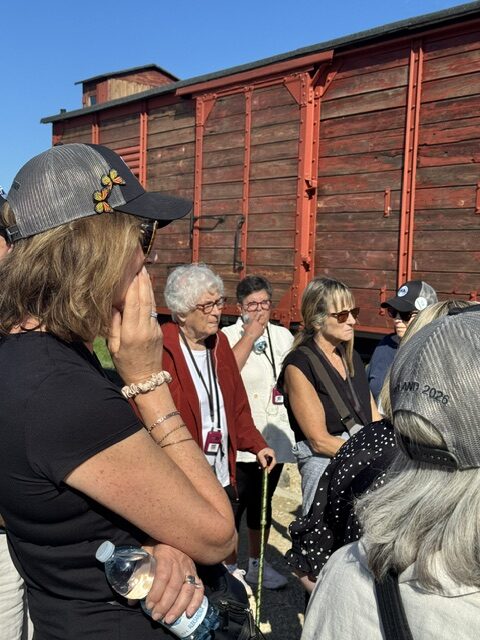
By MYRON LOVE For Sheila Rabb, her first visit to Poland was “both heartbreaking and heartwarming.”
The 90-year-old Rabb was one of 34 participants in the Jewish Federation of Winnipeg’s first ever organized Adult Mission to Poland. The group toured Poland from Wednesday August 26 – Monday August 31, with an entourage of Israel and Polish tour guides, a security guard ,and two bus drivers.
It was Jeff Lieberman, CEO of the Jewish Federation of Winnipeg (and whose late father, Aron Lieberman, was a Holocaust survivor who was originally from Poland) who initiated the trip. “In 2023,” he recounted, “shortly after I was appointed CEO, I learned we had never organized an adult mission to Poland. Given the passage of time since the Holocaust and the tragedy of October 7th, I thought there would be interest in offering this meaningful trip to our community.“
The six-day journey,” Lieberman continued, ”taught us about the 1,000 years of mostly good and impactful Jewish life in Poland before 1939, as well as what happened during the Holocaust. We visited several sites including the Warsaw Jewish Cemetery, the Polin Museum, synagogues, the Krakow Jewish Community Centre, the Lodz Ghetto, Majdanek and Auschwitz-Birkenau concentration camps, and the Chelmo death camp.
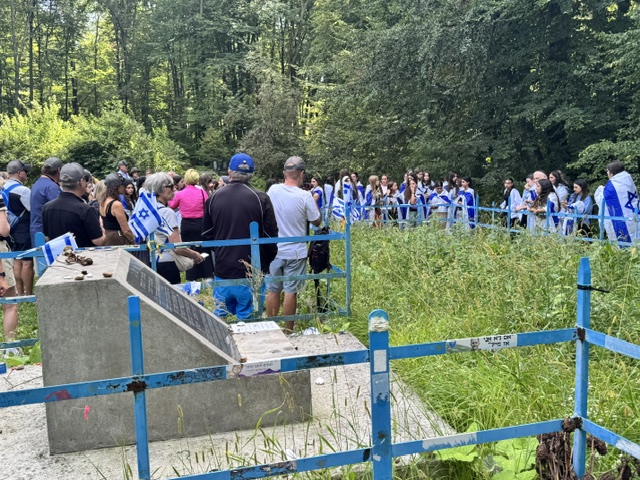
Lieberman noted that the group bonded very quickly. ”We learned so much,” he said. “We cried together and we celebrated together. Many of the people that went on this mission have said how life-changing this trip was for them.”
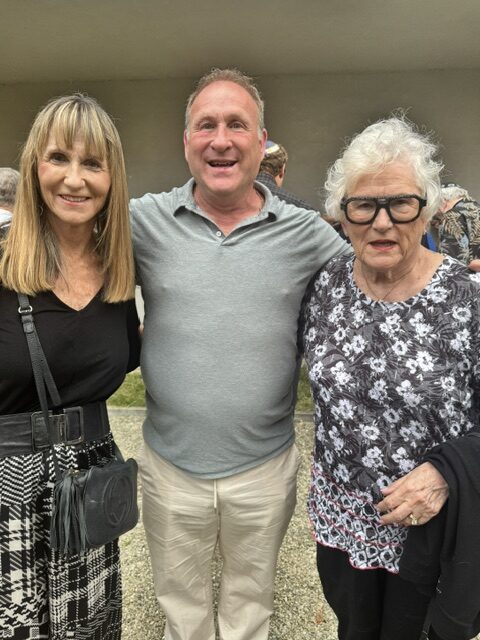
In particular, the Federation CEO singled out the presence of Sheila Rabb. He describes her as “incredible”. It was a difficult tour with much walking and standing at sites, he noted.
“She was a real trooper,” Lieberman said. “Sheila was able to able to experience this meaningful journey with her children. It was truly special for us to have Sheila and her children, Ian and Irene (Zimmer), join us.”
“There was a wheelchair available for me if I needed it,” said Rabb, who looks much younger than her years. “I must admit that the heavy schedule of 12-hour days and late dinners was a challenge. But everyone was so nice and helpful and protective of me.”
Sheila Rabb’s connection to Poland was through her mother, Molly (Horn) Pitch. Fortunately, she was able to emigrate in the early 1930s. (Sheila’s father, Willy, came here from Russia about the same time.) Molly was able to bring one brother over but sadly, all but one sister were subsequently murdered by the Nazis.
The group began their journey in Warsaw with a visit to the Polin Museum which – Rabb noted – was built by Ron Lauder, president of the Estee Lauder Foundation. The museum recounts over 1,000 years of Jewish life in Poland.
“We learned about Jewish life, how Jews contributed to Polish society and the rich communities that existed throughout the country,” Lieberman reported.. “You can’t talk about Poland without including the impact of what Jews did for Poland.”
Both Rabb and Lieberman have fond memories of a group of Israeli high school students that that they met at the museum, who were from Ulpanat Chorev High School in Jerusalem. “We joined them in singing Hatikvah and other songs and danced a hora with them,” Lieberman said. “We ran into them again at Mila 18 and Auschwitz, and their Head of School invited us to join them for Kabbalat Shabbat in Krakow.
“Our group had the amazing experience of celebrating Shabbat with them,” he continued. “The women were so joyous, and their enthusiasm helped us emotionally after what we had experienced during the first few days of the mission. Their presence and the sorrow they expressed at the sites we shared with them had a profound impact on all of us.”
The group’s time in Warsaw also included a visit to a Jewish cemetery with over 250,000 graves and a walking tour of the famed Warsaw Ghetto.
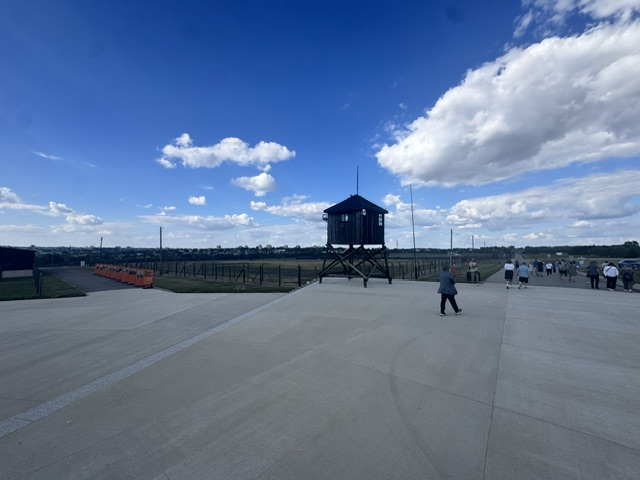
The next stop was Lublin and the Majdanek death camp.
“One can read the books, watch the films and visit the museums, but nothing prepares you for walking the grounds of the death camps and mass grave sites and the profound sadness and shock that accompany them,” observed Jewish Federation staffer Abby Flackman, who was also part of the mission. “Walking in Auschwitz, Majdanek and the forest graves of Chelmno, I felt, validated the lives that were taken. We take the memories of their experiences and assure that they will not be lost with time.
“But,” she added, “we also showed that we are still here. We are still laughing and feeling joy, supporting one another and proud of who we are.”
On the other side of the coin, the group witnessed the ongoing rebirth of Poland’s Jewish community. One site that Sheila Rabb recalled in particular was the reconstituted Lublin yeshiva. The yeshiva, which opened in 1930, was one of the largest in the world. The building was restored by the Jewish community in 2003 and reopened as a synagogue in 2007.
On the Friday of the tour, the group arrived in Krakow, where they toured the old Jewish quarter where, Ian Rabb noted, there are still many Jewish-owned businesses – also the Schindler factory museum. He reported that Krakow has a Jewish population of about 1,200, as well as home to the internationally known annual Krakow Jewish Festival.
Sheila Rabb spoke about a 97-year-old Holocaust survivor the group encountered, who told his story. Although he had lived in California most of his life, he felt the need to return to Poland two years ago.
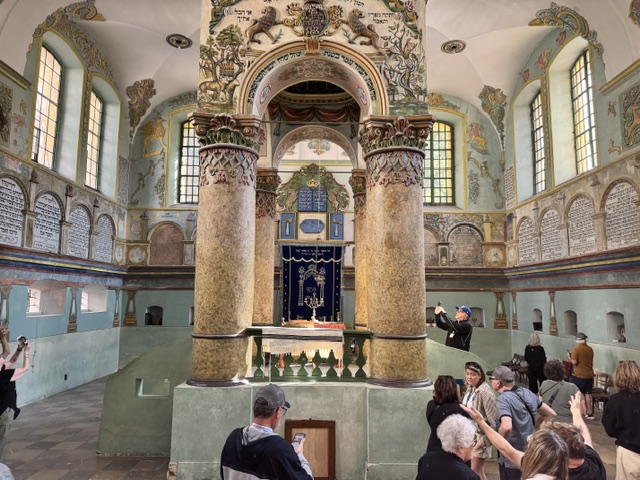
While in Krakow, the group made a day trip to nearby Lancut, formerly a Hasidic stronghold, where the members of the group toured the synagogue that was built in 1761 and has been well preserved.
“The synagogue was unreal,” Ian Rabb commented. “It has an art deco design that exudes spirituality and kabbalah.”
The Winnipeggers finished their tour with a visit to the Lodz ghetto. Lodz was an industrial city and the last Polish city to be made “Judenrein” because the Nazis needed the Jewish factory workers to build tanks and sew German soldiers’ uniforms.
For Sheila Rabb, one of the most difficult moments was standing on the site of the mass grave in the forest near the Chelmno death camp, not far from Lodz, where up to as many as 300,000 victims of the Chelmno gas chambers were buried.
“We recited kaddish over the site,” she said.
Sheila Rabb hac high praise for the Winnipeggers’ Polish and Israeli tour guides, Janush and Mordechai. ”They were outstanding,” she said. “They really brought history alive for us.”
Ian Rabb reports that his cousin (and Sheila’s nephew), Alan Pitch, who was also part of the group, is working on a documentary of the trip.
The last word goes to Abby Flackman. “My biggest takeaway,” she said, “is that we will control how our story ends. The Nazis tried to end our story of the Holocaust. They failed. We went elsewhere, built communities and institutions, grew again in numbers and continue to strive to become stronger, more resilient and thrive.”
Local News
Gray Academy enrolment continuing steady upward trend
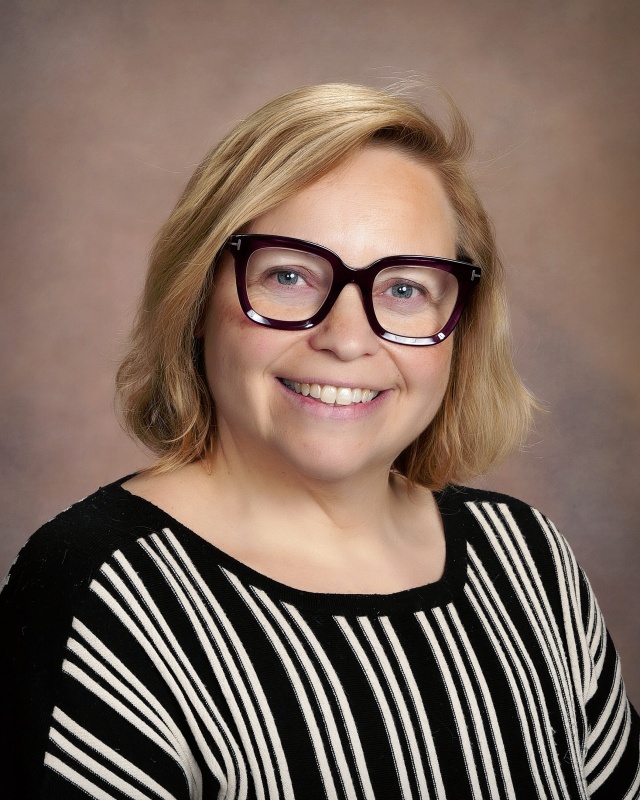
By MYRON LOVE Next year, Gray Academy of Jewish Education will celebrate its 30th anniversary – and Western Canada’s only JK-Grade 12 Jewish day school has much to celebrate.
For starters, enrolment continues to grow. Lori Binder, Gray Academy’s Head of School and CEO of the Winnipeg Board of Jewish Education, is pleased to report that this year’s opening enrolment stands at 521 – the highest number for September in 13 years.
For the third year in a row, Gray Academy is running three kindergarten classes, and all three are nearly full, as are the Grade 1 and 2 classes. While Early Years remains the main entry point for new families, the school also welcomed 37 new students to its elementary and high school this year – a total of 88 new students.
Lisa Boroditsky, the school’s admissions coordinator, points out that many kindergarten children are coming from the Kaufman Child Care Centre at the Rady JCC and Chabad-Lubavitch of Winnipeg’s Torah Tots early childcare program. At the high school level, she notes, Grade seven enrolment is also rising, with more students coming to Gray Academy after completing Brock Corydon Elementary School’s Hebrew Bilingual Program.
“From our parent surveys, we can report that parents are choosing Gray Academy not out of fear, but rather because they value the sense of Jewish community that is only available at Gray Academy,” Binder says. “The fact that so many current Gray Academy students are children of alumni also tells us that parents believe in the high academic standards and the positive Jewish experiences we offer.”
New for the school’s elementary School this year, Lori Binder reports, is a musical theatre program. Over the years, our community has produced a significant number of young performers who have not only graced local stages but have also made their mark in theatre and film throughout North America. (Incidentally, this school year, Gray Academy will present its high school musical production, “Mary Poppins,” in March.)
In addition to the annual musical, Binder reports, Gray Academy this school year will be hosting the annual Canadian Accredited Independent Schools national varsity boys’ basketball tournament. Students and staff alike are looking forward to welcoming participating team from independent schools across the country.
Students are also looking forward to the school’s 50th Yom Ha’atzmaut Song Festival. “We are excited for our current students to continue our long tradition of celebrating Israel through music,” Binder says. “We are also hoping for a lot of participation from past performers from the first five decades.”
Among newer programs for Gray Academy high school students are internship opportunities. One is with Drs. Lorrie Kirshenbaum and Inna Rabinovich-Nikitin at the Institute of Cardiovascular Sciences at St. Boniface Hospital – a great opportunity for students in Grades 11 and 12 who have an interest in pursuing studies in health sciences. The other program, which was piloted last year, is run in conjunction with the Saul and Claribel Simkin Centre, and gives students in Grade 9 and up opportunities to connect weekly with Simkin residents for hands-on activities.
The corollary to that is a new program that focuses on the school’s relationships with grandparents. The Gray Academy Grandpals program encourages grandparents (and other special seniors in the lives of Gray students) to connect with and volunteer at the school. Since the program launched two years ago, Grandpals have attended special events and come into the school to volunteer for challah making, hamantaschen baking, and even with building projects such as at the new Hypedome by the ice rink, which will provide student skaters with shelter to warm up and change their skates in winter.
Lori Binder points out that, in addition to new programming, the school maintains a strong focus on affordability. “It is very important to us that no child is turned away because a family can’t afford to pay,” she says.
She notes that Manitoba is one of only a few Canadian provinces that fund independent schools such as Gray Academy, with the school receiving approximately 50% of the funding public schools receive per student. She adds that the school offers a robust Bursary Assistance program, strongly supported by funding from the Jewish Federation of Winnipeg’s Combined Jewish Appeal. “Over 60% of our families receive some level of bursary support,” she reports. “We work with every family to ensure that no child is ever turned away because of inability to cover the full parental contribution.”
The school also continues to play an integral role in helping families moving to Winnipeg from Israel, Argentina, Brazil and other countries to adapt to their new homes. Over the past few years, the school has expanded its EAL (English as an additional language) programming significantly to accommodate growing needs.
In an increasingly troubled world, Gray Academy remains a beacon of light, offering Jewish students and their families a warm, welcoming environment, along with a top notch Jewish and general education.
For more information about what Gray Academy has to offer and application dates, phone 204 477-7425 or email admissions@grayacademy.ca.
Local News
Veteran actor Harry Nelken first recipient of new Winnipeg Jewish Theatre Chai Legacy Award
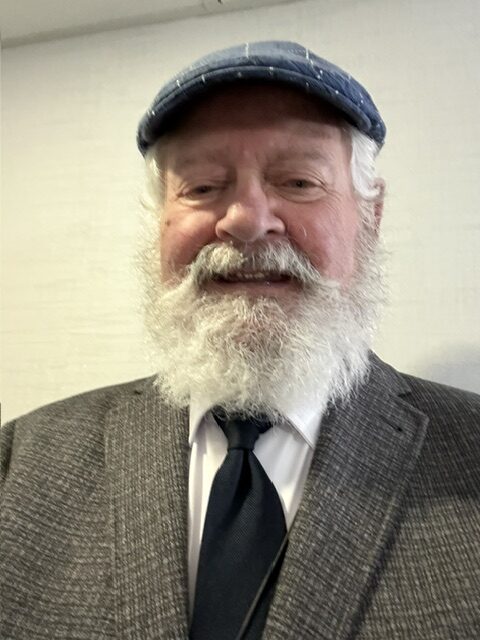
By MYRON LOVE The Winnipeg Jewish Theatre (WJT) has introduced a new award – the Chai Legacy Award. The award recognizes individuals for their “artistry, craft and lifetimes commitment to Jewish performing arts in Manitoba” – and the first recipient is none other than Harry Nelken.
A WJT press release described the new award as “a historic first for the company.” In making Harry Nelken the first recipient of the award, the WJT says it recognizes Nelken’s “artistry, craft, and incredible dedication to Jewish performing arts in Manitoba.
“To know Harry is to know the ultimate mensch,” the WJT press release continues. “Whether he is lighting up a room with his infectious, ear-to-ear smile while cheering on his fellow cast members, or bringing profound depth to the stage, his generosity of spirit is unmatched.
In response, Nelken, a veteran of more than 45 years gracing Winnipeg’s stages as well as other performing venues across Canada, says “It was a complete surprise,” to be the first recipient of the award.
The award was presented on Sunday, September 13, during the cast party following the last performance of the WJT’s joint presentation with Rainbow Stage of “Fiddler on the Roof.” “Dan (Petrenko – the WJT’s artistic director) and Carson (Nattrass – Rainbow’s artistic director) were talking about the input of the Jewish actors in Fiddler,” Nelken recalls, “and then I heard my name. I never expected to be singled out for my acting like this. I know I mumbled something. I checked with (fellow cast member) Debby Maslowsky to make sure I said thank you. She assured me that I did.”
Nelken’s history with the Winnipeg Jewish Theatre goes back to the very beginning of the WJT. He recalls that he was cast in the WJT’s first production in 1987. Bev Aronovitch was the artistic director (and WJT founder) and the production was “Today, I am a Fountain Pen,” in which Harry played the role of the bar mitzvah’ boy’s father.
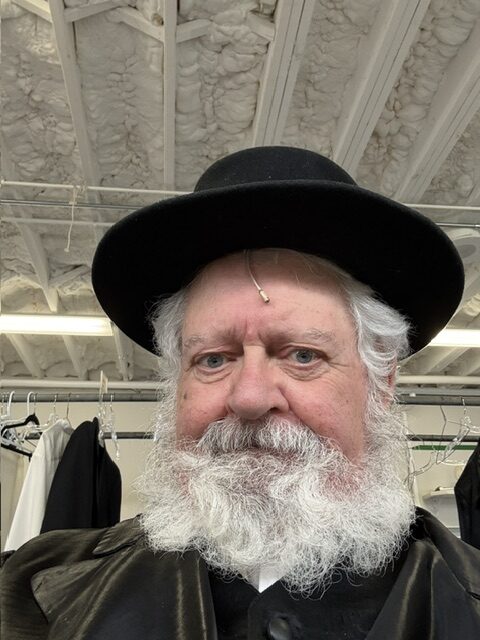
Over the years, he reports, he has appeared in 16 WJT productions. This most recent production of “Fiddler” was also the third time that he has appeared in a Rainbow Stage production of the show. His previous show performances were in 1984 and 1993. It’s also the second time that he has portrayed the rabbi. (He was cast as Lazar Wolf in the ’93 production.)
Nelken reports that he took the initiative to contact Carson Nattrass about the role of the rabbi after he learned about the planned joint production.
“I threw my shtreimel into the ring,” he jokes.
Every role, he notes, is a new learning experience for him. He prepared for the part this time by researching what life was like for a rabbi in a small eastern European shtetl.
“I realized that Jewish life has always been about resilience,” he points out. At the end of the play, after the Jews have been banished from Anatevka, when the rabbi’s son asks his father about how the Messiach will know where to find them, the rabbi replies that they will simply have to wait for him somewhere else.
“There is a great lesson to be learned here,” Nelken continues. “We don’t know what the future will bring. The question is do we put our faith in God or in man?”
Resilience is a primary feature of Harry Nelken’s career. He recounts a story about Abe Vigoda (“Fish” to some of us older readers who, when asked by Johnny Carson how he felt about becoming an overnight star, Vigoda’s response was that “I’m an overnight star but overnight was 25 years long.”)
In a much earlier interview I did with Harry for the Post, he recalled how his first acting gigs were in high school theatre. At the University of Ottawa, while studying criminology, he auditioned for and got a role in a play. From 1972 to 1979, he immersed himself in local amateur theatre.
He noted that even the busiest of working local actors – of which he has been one – barely scrape by and need a second source of income. For over 40 years, he supplemented his income by driving a cab.
”Particularly in my early years, when acting roles were sparse, driving a cab was my lifeline,” he recalls. “On occasion, even when doing a play at MTC, after the show, I would report for taxi duty for a night shift.”
In recent years roles have been fewer. In the last four years, he has been in five locally-shot film projects: two Hallmark films – “ Hanukah on Rye” and “ Haunted Wedding”; the feature film,”Normal, ”starringf Bob Odenkirk and Henry Winkler; (available on Amazon Prime); and the mini series “American Hostage,”,starring Jon Hamm and Giovanni Ribisi (available on Crave).
Nelken’s current film project is called “Pikohowin.” It’s the true story of how in 1990, Saskatoon police officers were revealed to be driving inebriated Indigenous people in winter out of the city and depositing them on the highway. Harry has the role of judge Shiebel.
“I’m 79 now,” Nelken says. “I am no longer willing to go out of town for stage or film work unless it is for a really undeniable role. I am happy to be doing more film work. I feel energized by the work. I am still regularly auditioning for film roles,
“Most of all, I appreciate that I can look back on a fulfilling career doing what I wanted to do more than anything else.”
