


Local News
Stanley Schwartz- it’s a long way from Waterloo

By GERRY POSNER For Stanley Schwartz, it all began on Waterloo Street. For those who remember the 1950s and 60s – take yourself back to the south end of Winnipeg. Waterloo between Corydon and Fleet had enough Jewish families to form its own High Holiday congregation. That is to say, there were a whole bunch of Jewish families there. Not quite McAdam Avenue in the north end – but close enough. One such family was that of Harold and Faye Schwartz, along with their children: Anita, Ruth, and Stanley.
Stanley graduated from Kelvin High School. In fact, he played football for the Kelvin Clipper. In addition, he was a participant in typical Jewish teen activities at the time, particularly AZA. He had a wide network of friends, some of whom remain vital connections to this day. Remember, in those days, there were no cell phones, no internet, and barely the beginnings of TV. So, as a teenage boy, Stanley spent a lot of time with his buddies.
Stanley went on to the University of Manitoba from where he graduated law in 1967. That was Stanley’s first step into a career that lasted close to 50 years. His second big step was his decision to forgo an offer to become a partner in a well known and established law firm in Winnipeg, and instead, go out on his own in a shared space arrangement. The shared space arrangement lasted several years and, during that time, he also opened up an office in Morris, Manitoba. Morris was once home to several Jewish families, but not when Stanley moved there to live.
Along his way to practicing law, Stanley got married – to the former Shirley Hooper, a woman originally from England who had moved to Vancouver and whom Stanley met by chance in Hawaii. They were blessed with two children and now have five grandkids. But the family did not end up in Winnipeg. In what was a huge life changing decision at that time, Stanley and Shirley boldly packed up their belongings and moved to Vancouver. Now, some of the thinking that entered into this move might well have been Shirley’s lack of fondness for the Manitoba winters (even though she had formed close relationships with many people in Winnipeg at that time – relationships she still maintainsto this day). But Stanley was also open to a fresh start in a new place. That decision, looking back on it now in 2025, was a wise one for both Stanley and Shirley Schwartz. For starters, who knew that Vancouver would explode with an immigrant population and with it, a dramatic increase in the value of property, caused in part by non-residents buying up land and buildings in Vancouver? Aside from that, Stanley had a specialty in his practice of law that was a perfect fit for Vancouver’s growing population- family law.
For the entirety of his legal career, Stanley focused on matrimonial law in every aspect, not the least of which was litigation. As a former lawyer myself, let me say that if there is an area of law filled with tension, aggravation, and sadness, it surely must be the field of marriage, children and custody battles, access, division of assets and all that goes with those issues. You often are not just a lawyer, but also a psychologist, father confessor and a lot more. You really have to be able to be able to watch some of the worst in humanity. And you have to be ready to, as they say, “ go for the jugular.”
You may never have to do it, but you have to be ready. Stanley Schwartz was ( nd remains so this day, in my view) on the face of it, not a likely candidate to be thought of as aggressive.That is because he was then and still is now, a friendly guy who does not seem to be one cut out for courtroom battles. But clearly, he was able to be “ rough and tough” when he had to be. When I asked Stanley what advice he would give to somebody wanting to employ him in a family law situation, he was quite frank. His immediate response to these kinds of clients was: “If you want a war, the winners will be two people -the two lawyers. The losers will be your children ( f there are kids in the picture.”)
Stanley might still have been at it, but he had medical issues relating to his back over a period of many years. He has had three spinal surgeries, and none of them has really worked satisfactorily. Standing for periods of time was hard for Stanley. He says he knew it was time to give up his practice of law when one day in court six or seven years ago, while he was in argument, he leaned against the dais and the judge told him that it was ok for him to sit down and argue. That episode confirmed what he had thought for a while: time to call it a day and a career. So with two metal rods in his back and pain in his legs, Stanley retired.
Though no longer involved in the legal world, Stanley has managed, very easily he would add, to settle into his non working life with as much travel as he and Shirley are able to do. That travel includes trips back to Winnipeg, also Winnipeg Beach – where he spent much of his youth. His visits also include time with his sister, Anita Ruth Neville, a name not exactly unknown to Manitobans given her role as the 26th Lieutenant Governor for the Province of Manitoba. And, with one daughter in Toronto, Shirley and Stanley also make regular stops in that city to see his family there.
Not that long ago, Stanley stepped into the world of octogenarians. He is quick to say that getting old is not for sissies, but at the same time, he is one to embrace what each phase of his life has brought.
Local News
The shift in the New Democrats
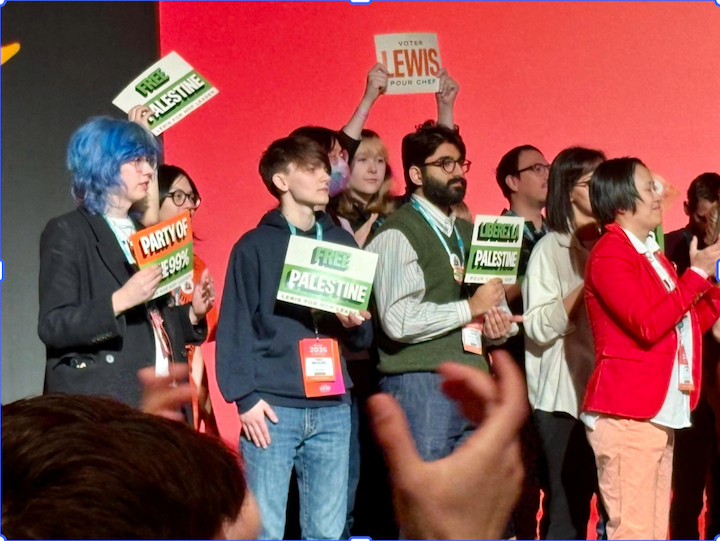
By NOAH STRAUSS The New Democrats have just wrapped up their 2026 national convention here in Winnipeg. While I was at the convention, I noticed a critical change in the party. Under the current NDP leadership the party and partygoers ignored promoting Canadian merchandise, including flags. It’s interesting to compare the party now to what it was when Jack Layton was the leader (from 2003-2011).
Layton was quite proud to be a Canadian. If you attended or saw any of his rallies you would have seen many Canadian flags, both on stage and in the crowd. Comparing Layton’s era to the current moment, not one Canadian flag was on stage at the recent national convention – only a Palestinian flag.
This should be concerning: Only one flag was present – and it wasn’t ours.
The NDP’s views have shifted and so has the membership. Approximately one in twenty people I saw were wearing keffiyehs. I wonder what was their affiliation to Palestine?
Avi Lewis is not helping the situation; he’s just pouring more gas on the fire. In his acceptance speech at the convention he proclaimed once more that he will not remain silent when Israel commits a genocide in Gaza. He had campaign signs that said ‘Free Palestine’ and ‘Libérer Palestine,’ both on stage and at his numerous campaign events.
In an email sent out to members of Independent Jewish Voices (IJV), an anti-Zionist organization, Lewis noted that he had become a member of that organization, saying “I was also proud to sign IJV’s Together Against Apartheid pledge.”
What does this all mean, though? The NDP have shifted from focusing on Canada and being proud of Canada to supporting a foreign cause and ignoring the facts. Avi Lewis doesn’t care about being Jewish, he cares about getting votes, and if that is what it takes, he’ll tell lies about Israel.
The NDP needs to remember that Canada needs to come first. To the person with the Palestinian flag on the stage: You need to put your Canadian pride first.
If the NDP wants to be seen as a real party, it will put Canada first once again.
Local News
Rachel Fish, leader in combating antisemitism in academia, this year’s Kanee Distinguished Lecture series speaker

By MYRON LOVE The Jewish Heritage Center of Western Canada would seem to have hit another home run with the announcement that Dr. Rachel Fish, a leading voice in tackling anti-Zionism and Jew hatred in North American academia, is this year’s guest speaker at the JHCWC’s upcoming annual Sol and Florence Kanee Distinguished Lecture – which is scheduled for Thursday, April 30, at the Shaarey Zedek Synagogue.
The theme of her timely lecture will be“How the Academy Has Created a Fertile Ground for Antisemitism,” a topic in which she is well versed. Fish has an impressive resumé. She is the co-founder of the nonprofit “Boundless,” a think tank partnering with community leaders across North America to revitalize Israel education and take bold collective action to combat antisemitism. She also serves as Director for The Brandeis University President’s Initiative on Antisemitism; is an associate research professor at the Cohen Center for Modern Jewish Studies; and teaches Israeli history and society at The George Washington University as Visiting Assistant Professor of Educational Leadership in the Graduate School of Education and Human Development.
In the past, she has served as Senior Advisor and Resident Scholar at the Paul E. Singer Foundation in New York City and Executive Director of the Schusterman Center for Israel Studies, where she trained the next generation of academics in the field of Israel Studies. She has also served on the faculty at Brandeis University, George Washington University, and Harvard University. She has has written articles for several publications in the mainstream press and academic journals, and co-edited the book “Essential Israel: Essays for the 21st Century.”
I had the pleasure of speaking with Dr. Fish a couple of weeks ago. My first question to her was how she finds the time to do all that she does. Her response is that there are not enough hours in the day. Her multiple activities remind me of an expression I heard once years ago while I was a member of a short-lived Jewish international development group – “if you want to make sure something gets done, you give it to the busiest person you know.”
Fish observes that she has been explaining Judaism to non-Jews all of her life. “I was raised in Tennessee in a place called Johnson City in the foothills of the Smokey Mountains,” she recounts. “My parents were originally from Ohio. There were very few Jews where we lived. My family spent a lot of time teaching our neighbours, teachers in my school and others we associated with about Jews, our practices and the State of Israel.”
She recalls – as early as 2001 when she was studying at Harvard’s Divinity School, that she was noticing what she describes as a “strong undercurrent of anti-Israel feeling and Jew-hatred”.
“I was determined to pursue a career in higher education,” she notes, “in part because I believe that education matters, because I derive oxygen from teaching, and I particularly enjoy dealing with complex issues. As well, I appreciate the opportunities that teaching at the university level gives me to share what I have learned in public forums such as the Kanee Lecture.”
Ideally, she observes, a professor should not – as much as humanly possible – be sharing her political or personal opinions in class. Higher education should be about creating a space where students can debate freely and challenge each other’s ideas. Instead (as I am sure many readers are aware), too many educators are focused on indoctrinating their students in the teacher’s beliefs – with students with dissident opinion facing hostility and risking ostracism.
Too many universities have become ideological monocultures where critical thinking is discouraged and there is a litmus test for new hires. She cites a FIRE (Foundation for Individual Rights and Expression) report in which an overwhelming majority of the faculty at many leading universities share a leftist – anti-Israel, anti-Christian and anti-Conservative worldview.
That is particularly true with Ivy league and other elite universities in both the United States and Canada – and especially in their liberal Arts and Humanities programs. Much of the anti-Zionist and antisemitic atmosphere – such as the takeover of university quadrants in the wake of October 7 – has been created by outside agitators and foreign funders – notably the oil rich Islamic sheikhdom of Qatar.
“Where you have universities with strong administrative leadership,” she points out, “the level of hostility to Jewish students and threats of violence have not been allowed to take root. It has only been the case where the administration and the board are weak.”
So why, I asked her, do so many Jewish students not seek out alternatives to these compromised campuses?. She responded that some Jewish students have chosen to enrol in universities in the southern United States where there is a more welcoming environment.
But many Jewish students, she observes, continue to enrol in leading universities such as Harvard and Yale, Cornell and UCLA (or York or the University of Toronto in Canada). Many Jewish students still share the belief that being identified with being affiliated with a top flight university will benefit their future careers.
Sadly, she further points out, this poison has filtered down to the K-12 level. Many university education departments have graduated numerous indoctrinated teachers who have taken control of school boards and administrations and seek to impose their vile doctrines on susceptible young minds.
Nevertheless, there are a great many state and lesser known universities that provide a more welcoming attitude to Jewish students.
Rachel Fish suggest that, for too long, North American Jewish communities have been complacent and not recognized the danger in our midst. She does see some hopeful signs though. She has observed that more and more communities, parents and student s have woken to the danger and begun to fight back.
“It’s difficult,” she acknowledges. “It can feel overwhelming. But we have to keep chipping away and not just let the other side win.”
The Sol and Florence Kanee Distinguished Lecture series was inaugurated by the Jewish Heritage Centre of Western Canada in 2006 to celebrate Sol Kanee’s 95th birthday. In welcoming the audience to that first lecture, lecture series co-chair Harold Buchwald paid tribute to Kanee, who died on April 23 at 97, as a man who “cast a giant shadow” on world Jewish history in the second half of the 20th century. The former resident of Melville, Saskatchewan, who spent almost all of his adult life in Winnipeg, Kanee was a leader in the development of Israel and the Free Soviet Jewry movement as well as a macher in our Jewish community and across Canada.
I would encourage readers who may be interested in learning more about the current state of antisemitism in academia – and want to support the JHCWC to go online at jhcwc.org for further information or to order tickets. The price of admission is $50.
Local News
Young tech entrepreneur Adam Fainman gathering accolades locally and internationally

By MYRON LOVE Winnipegger Adam Fainman is taking the world by storm. In fewer than three years his new AI start-up – Moonlite Labs – has attracted thousands of users in 550 cities in 95 countries world wide.
As he explained in an interview in the Winnipeg Sun last June, Moonlite Labs is “a creative content platform designed to make multimedia storytelling radically more accessible. With a few prompts,” he noted, “users can generate professional grade videos, animations, voiceovers, talking avatars, music-reactive visuals, and more.”
On Tuesday, February 24, the young entrepreneur garnered his newest accolade when Winnipeg-based North Forge, Canada’s only start-up incubator, accelerator and fabrication lab, gave Fainman its DARE Emerging Innovator Award at a reception at the Royal Aviation Museum of Western Canada.
“I dedicated the award to my zaida, Jacob T. Schwartz,” Fainman says, noting that his zaida was a prominent computer scientist and professor of Computer Science at the New York University Courant Institute of Mathematical Science, and founder, in 1964, of New York University’s Department of Computer Science – which he chaired for 16 years.
At the awards evening, Fainman adds, he had the opportunity to meet many of the movers and shakers in the industry here.
The son of Shane and Rachel Fainman began his life in Toronto. “My father is from Winnipeg, my mother from New York. They met in the Sinai Desert at a music festival.”
The family moved to Winnipeg in 2006 when Adam was in high school. After graduating from the University of Winnipeg Collegiate he went on to earn a B.Sc. in Computer Science from the University of Winnipeg.
“Performing was always my first love” he says.
Post university, he began a career as a rapper, beatboxer, and producer under the stage name Beatox, touring across Canada and central Europe with his rare ability to combine story-telling and singing.
In 2015, he enrolled in a two-year digital media and design program at Red River Community College. After graduation, on the encouragement of a University of Toronto professor, he continued his studies in Toronto earning a Masters Degree in Music Technology and Digital Marketing.
“During the Covid shutdown,” he recounts, “I began experimenting with AI and producing music videos combining music, story-telling and animation. I posted them on social media sites such as YouTube and TikTok. They went viral, garnering millions of views. People were asking me if I could help them with creating similar videos. I saw there was a gap in accessibility to this technology, so I decided I should create a platform as a solution”
“A friend of mine, Brayden Bernstein was involved in the tech scene in Winnipeg, saw the success I was having on TikTok and gave me some advice on how to go about this” Fainman continues. “As well, a few colleagues from the University of Winnipeg expressed interest in building a solution together.”
Wanting to create a platform that would make it easy for others to replicate what he was doing, Fainman sought out resources in Winnipeg that might be able to help him.
He pitched his idea first to NRC-IRAP (National Research Council of Canada Industrial Research Assistance Program), Canada’s leading innovation assistance program for small and medium-sized businesses,
“They loved the concept and traction I was getting, and agreed to help fund us,” Fainman says.
His next stop was North Forge – in 2024 – where Moonlite joined their Ascent Program and was matched with mentors.
In early 2025, Moonlite Labs made its official debut at the Manitoba AI Innovation Showcase where the new company was greeted with an award. “It was a massive confidence boost,” Fainman told the Sun in that earlier interview. “It was our first time sharing with the public what we’ve been up to for the last year. To win the award… that was very, very rewarding.”
Last June, the company made its presence known on the international stage at VivaTech 2025 in Paris — Europe’s largest startup and tech conference, with over 180,000 visitors.
Moonlite was selected as one of TechCrunch’s Top 30 Startups of the Year, a shortlist that included only two Canadian companies.
“Getting the AI Showcase award, getting into VivaTech, being selected as one of the top 30 startups of the Year by TechCrunch, that was pretty crazy,” Fainman told the Sun.“Backed by ScaleAI, Moonlite joined Canada’s official delegation at VivaTech, which had special visibility this year with Canada named Country of the Year at the conference.
“We had a massive space. The French president came through our whole area. It was the craziest thing,” Fainman recalled. “Everyone had their phones. It was like a mob… then we’re like, oh my God, it’s the French president. People were freaking out.”
As per the Sun story, Fainman was given two days to showcase Moonlite, with a booth for both the platform’s business-to-business (B2B) and business-to-consumer (B2C) offerings. But the most personal moment came on stage, where he delivered a presentation showcasing his journey from beatboxing artist to tech founder.
With Moonlite Labs growing exponentially, Faiman and his team of eight are hoping to become as ubiquitous as Adobe and Canva. “My ultimate goal is to help as many people as possible to create professional-grade videos and ultimately share their stories,” he comments.
He himself, he adds, is hoping to get back to live performances as well. “I recently appeared at Festival du Voyageur and I have just completed my 4th studio album. I can’t wait to use Moonlite for all my videos and world building” he reports.
Readers who might want to try Moonlite for themselves can go to https://moonlitelabs.com
You can get in touch with Adam Fainman at adam@moonlitelabs.com