



Uncategorized
Biden picks Jeff Zients, Jewish advisor who helped launch DC bagel chain, as new chief of staff
(JTA) — Days after his first chief of staff announced that he would step down, President Joe Biden has announced a replacement: another Jewish advisor, this time an investor in a popular Washington, D.C., Jewish deli.
Jeff Zients, led the Biden administration’s COVID-19 response from 2021 to 2022. He had previously held multiple positions in government, including as advisor to the Biden transition team and the Obama administration and director of the National Economic Council, following a career in business.
Zients is also known locally in Washington as the businessman who helped start the chain Call Your Mother, which says it serves “Jew-ish deli favorites.” Now operating in seven D.C.-area locations with an expansion planned to Denver, Call Your Mother offers bagels, smoked salmon, whitefish salad and black-and-white cookies, as well as an assortment of gear that has turned the Jewish catchphrase into a local fashion statement.
Some of the recipe testing for the deli’s first location was done at Zients’ home, according to Washingtonian magazine. Zients first connected with Andrew Dana, the Jewish chef behind Call Your Mother and his business partner, through Dana’s father’s friend from summer camp; he reportedly wanted the deli to be called Apples and Honey. Dana told the magazine that Zients had fallen out of communication with him after joining the Biden transition team.
“He has far more important things to worry about than bagels right now,” Dana said.
Starting next month, Zients will take over for Ron Klain, Biden’s chief of staff since he was inaugurated. Klain, who is open about his Jewish identity and tweets frequently about it, reportedly has described himself as worn down by the intensity of the chief of staff role.
—
The post Biden picks Jeff Zients, Jewish advisor who helped launch DC bagel chain, as new chief of staff appeared first on Jewish Telegraphic Agency.
Uncategorized
Mossad helped foil terrorist attack at 2024 Taylor Swift show in Vienna, former chief says
(JTA) — Mossad helped prevent an Islamic State-linked attack at a planned 2024 Taylor Swift concert at Ernst Happel Stadium in Vienna, the former chief of Israel’s foreign intelligence agency said on Monday.
David Barnea, Mossad’s director at the time, said during the ELNET Jerusalem Summit that Austrian intelligence shared a warning with Mossad ahead of the show scheduled for Aug. 9, 2024. ELNET promotes Israeli-European ties.
The Israeli agency analyzed Austria’s information to aid in the arrest of members of a suspected terrorist cell, Barnea said, adding that the arrests prevented the potential mass murder of “up to hundreds of young European men and women.”
The concert organizer Barracuda Music canceled the three back-to-back, sold-out concerts on Aug. 7, a day before Swift’s first show at the venue. Austrian national Beran A., whose last name was not shared in accordance with Austrian privacy rules, was sentenced in May 2026 to 15 years in prison after being convicted of offenses including planning the attack.
The CIA and other U.S. intelligence agencies helped disrupt the plot, then-CIA deputy director David Cohen said at the time.
This article originally appeared on JTA.org.
The post Mossad helped foil terrorist attack at 2024 Taylor Swift show in Vienna, former chief says appeared first on The Forward.
Uncategorized
In a small town in Germany, remnants of the family history my father no longer remembers
Whenever my parents travel, they like to find Jews. Living, dead — doesn’t matter. They just want to see the places their people once roamed. Send them to Greenland, and they’ll track down the tidal cavities that served as a mikveh circa 1571.
So when my brother, Ray, planned a family vacation to Croatia, we knew Jews would be involved. Zagreb, Dubrovnik, Split; we’d track down our landsmen even in the decidedly Catholic country.
But first, Ray wanted us to take a detour to Bad Soden-Salmünster, Germany, the freckle of a village outside Frankfurt where my father’s mother, Martha Ellin (née Grünebaum), grew up. Ray had visited a few years earlier and thought my parents might enjoy it. Left unspoken was that this would probably be my dad’s last trip, and that he wouldn’t understand why we were there.

At 89, my dad is a physical specimen. He walks about four miles a day, can lift 70-pound weights on the triceps machine, and jogs with the ease of a man 15 years younger. Last year he was hospitalized with pneumonia for 16 days, and the doctors said he would probably have died had he not been in such good shape. During my parents’ annual Jewish semester in Boca, my dad plays senior softball. He can hit! And catch! And run! He just can’t find the field.
His memory began quietly disintegrating years ago, but it got noticeably worse after the pandemic. The way my father tells it — and he tells it often, sometimes two or three times in a single conversation — he and my mother were sitting on a bench in Manhattan when suddenly something flew out of his body, something yellow, and hit a wall across the street. When that happened, he became a tabula rasa.
“Everything I knew went away,” he said.
Years of his life vanished. He has no idea how his oldest daughter died, that his brother was murdered, that he met my mother at Grossinger’s 62 years earlier. He does not recall that he worked as an engineer at Polaroid, designing cameras and the flash for the SX-70. He forgets that he loved to take things apart just for the joy of putting them back together.
Somehow, he can still read Hebrew. But he doesn’t really understand what things mean. (To be fair, does anyone?) A sukkah? “That’s a place where Jews hang out,” he told me recently. Technically true, I suppose, but not quite what I was angling for.
He is no longer familiar with Netanyahu, but he does know Hitler and Trump, with whom he “interfaced” a few years ago. (Nota bene: He did not.)
He knows he had parents, obviously, but the specifics are gone. He did not realize that they left Russia and Germany because, well, conscription and pogroms weren’t good for the Jews. My grandparents met in what was then Palestine and my dad was born in Herzliya in 1937. The family moved to a farm in Connecticut when he was 6 months old. My grandfather became a carpenter, and my grandmother ran the show. She was one of those 4’8” balabustas who could go blow for blow with Max Schmeling, and win. Almost all of her family was wiped out during the war, but she forced herself to watch Shoah. “It’s my duty,” she said, which meant it was mine, too. We watched it together.
Over the years I offered to take her back to her hometown, but she didn’t think she could handle it. “It would be too hard,” she said, and she looked so sad that I didn’t push it. I didn’t understand it then, but I do now. She often talked about her family: her father, Alexander Grünebaum, a leader of the Salmünster Jewish community; her evil stepmother, Emilie, who made her sweep the stairwell every day; her sister, Sophie, killed in a hit-and-run at 15; her brothers Isidore and Manfred-Jacob, both killed in camps. Who wants to visit a place filled with ghosts?
My grandmother died of a stroke at 88, the same age my father was when we brought him to Germany. Her memory was shot, too. One of the last things she asked was, “What is Jewish?”

My brother and I weren’t expecting much from our trip. No, that’s not true. We hoped for some kind of emotion from our dad, maybe a sliver of clarity, but nothing too dramatic. Just an acknowledgment that this was his mother’s birthplace, and that relatives he never knew had lived here, too.
Ray had befriended Thomas Hummel, a tidy Salmünsterian who spoke flawless English. Like most young people, Thomas had left the town; there was nothing there for them. He worked in Frankfurt as a civil servant but was highly invested in preserving local history.
Thomas walked us through the village (pop 14,000-ish), now a spa town with bubbling baths, hot stone massages, hiking trails, and a few boutique hotels. “Growing up in Salmünster, I was always aware that the town once had a vibrant Jewish community dating back to 1750,” he said.
Thomas had resistance in his bones. His great-grandfather, Franz Göbel, loathed the Führer. According to Hummel family lore, on the day Hitler was supposed to pass through Salmünster, Franz positioned an ox cart loaded with manure on the road where the motorcade would pass. Officials ordered him to remove the cart, but he wouldn’t budge.
“My great-grandfather calmly replied that he could not move the cart because the oxen simply refused to go any further,” Thomas said. So the soldiers unharnessed the oxen and replaced them with horses and pulled the cart away themselves. “The road was eventually cleared, but not before my great-grandfather had made his point.”
I’ve heard stories like this, or variations of them, so many times, and they always make me laugh. If every German had resisted the Nazis as much as they claim to have done, then the Holocaust would never have happened. (I’ve only met one person, a German living in Brazil, who, when asked what his ancestors did during the war, replied, “You know…” I appreciated his candor.)
But Thomas was lovely and seemed sincere; he spent a lot of time with us at no charge. He showed us my grandmother’s home at Frankfurter Straße 10, where my great-grandfather operated a department store. It now housed a nonprofit aid organization. And we saw the infamous wooden stairwell my grandmother scrubbed, which looked surprisingly like … a stairwell.
Around the corner was the Heritage museum, furnished to resemble a home from the early 20th century. Wooden hangers with the original Grünebaum logo were mounted on the wall along with other tchotchkes.
My dad was underwhelmed. “It’s a nice town,” he said with a shrug. But he felt no kinship. All he wanted to know was why we weren’t in Florida where he could play ball, and when we were going home. He had also left his hearing aid charger in the States, which meant he was navigating in silence. Whose idea was this trip, anyway?
We trekked to a two-story, timber-frame structure that had once been the synagogue. Erected in 1846, it served the community until Nov. 10, 1938, otherwise known as Kristallnacht. The SS gutted it, but because a non-Jewish family had bought the adjacent half of the semi-detached structure, the Nazis graciously refrained from burning the building down. It now housed the city’s Social Welfare Office.
Apart from a menorah on a bookshelf and a view of the stream that fed the mikveh, nothing about the place screamed Jewish. A painting of the Virgin Mary cradling baby Jesus was prominently displayed in the former women’s section. “I’m pretty sure that wasn’t on the wall when Grandma davened here,” said Ray.
Our last stop was the Jewish cemetery, tucked into the woods off a main thoroughfare. There were no signs or markers; just a few concrete steps in a thicket of brush. It was slightly uphill and muddy, the weeds tickling our shins. My father zipped up like it was nothing.
We hiked to an overgrown clearing with a cement pillar bearing the names of seven people buried there between 1920 and 1935, including my grandmother’s sister Sophie. Only two original headstones remained. Thomas had brought pebbles for us to set on the graves and pillar.
“OK,” my dad said, turning to walk back down the hill. “Let’s go.”

On our second and last day in Salmünster, we stood outside my grandmother’s old house. The mayor, Dominik Brasch, had shown up for a photo op, along with a reporter from a local newspaper. They wanted to document the American Jews in their midst.
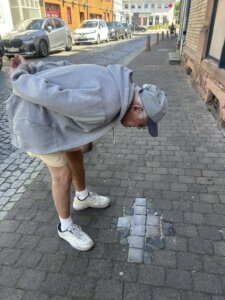
We posed in front of the Stolpersteine embedded into the sidewalk, the “stumbling blocks” that mark the last known residences of people persecuted by the Nazis. This included not only Jews, but also gays, Romani, political opponents, and those with disabilities.
The brass-plated plaques were created by artist Gunter Demnig and surreptitiously placed in Cologne in 1995 before gaining official approval. Today, more than 116,000 have been installed across Europe. Each one is engraved with the victim’s name, birth date, and, if known, the date and place of their deportation or murder.
The stones are supposed to be obstacles, designed to stop people in their tracks. If they don’t quite cause a stubbed toe, they at least prompt passersby to look down and acknowledge the person being remembered.
But apparently not everyone is on board. In late September, the right-wing city council of Heidenau, near Dresden, passed a motion to ban new Stolpersteine on its streets and sidewalks. The vote, by secret ballot, was 13 to 6, with one abstention.
Council members argued that it was “disrespectful” to tread on victims’ names. The five plaques already in Heidenau could stay, but future remembrance would be relegated to a Christian cemetery where it would be “impossible to step directly onto the memorial elements.”
Thomas disagreed. He had done research for the Stolpersteine project, tracing family histories and digging up archival records, and he supported the mission. “The stones return memory to the very locations from which it was once erased,” he said. “In my view, the fact that passersby stop, read, and reflect is not a weakness of the concept but its greatest strength. That direct connection between biography and place is something I have seen work remarkably well in Salmünster.”
I didn’t expect any of this to register with my dad. But for whatever reason, something clicked. He peered down at the three rows of tiles until his eyes settled on one: “Martha Grünebaum, born 1907, fled to Palestine in 1933 and then to America in 1937.”
“That’s Grandma!” I said.
“Isn’t that something?” my dad said. He crouched down like a shortstop fielding a ground ball. “She must have been very important to have her name on the sidewalk.” He positively kvelled.
Neither my brother nor I had the heart to tell him that the Stolpersteine were all over the country, that his mother wasn’t, unfortunately, unique in this way. We didn’t tell him that the names on the stones next to hers belonged to his ancestors, almost all of whom were annihilated in the camps.
My mother, who is 85 and completely compos mentis, frequently talks about her deceased relatives, mourning them aloud. When I compare my parents, I think, maybe my dad’s better off. Maybe it’s better to be physically fit and mentally addled, to forget the aunts and uncles you never met, the grandparents you never knew. I’m still not sure.
Six months later, my dad doesn’t remember our trip. But he does remember seeing his mother’s name on a brass-plated plaque somewhere. “I have no idea how it got there, what the motive was, or what the reason was,” he said.
I often think about the sidewalk outside my grandmother’s home, and the nine plaques embedded in the pavement out front. I think about my father, who interpreted his mother’s name as an honor. How the only tie he felt to her was from a 4-inch cube. How sometimes the heart processes what the mind can’t.
But mostly I think about how happy he was that his mother was celebrated in such a public way. This I know because he said so himself.
“She must have really been an upstanding citizen,” he said at the time. “I’m glad I planned this trip.”
The post In a small town in Germany, remnants of the family history my father no longer remembers appeared first on The Forward.
Uncategorized
Rep. Hakeem Jeffries prioritizes settler violence as Democratic majority remains divided over Israel
Rep. Hakeem Jeffries of New York, who is set to become the next speaker of the House, said in an interview published over the weekend that he plans to advance legislation targeting violent Israeli settlers in the West Bank when the new Congressional term begins in January, offering an early indication of how he intends to manage the growing divide over Israel within the Democratic Party.
“What I have made clear is that within the first 100 days, I think the most decisive step that we can take relative to the situation in the West Bank is to move the West Bank Settler Violence Protection and Prevention Act,” Jeffries said in an interview with The New York Times published Saturday. At least 225 incidents of settler violence were documented during 2025 and part of 2026 by Israeli watchdog Yesh Din.
The bill was introduced last year by Rep. Jerry Nadler, co-chair of the Congressional Jewish Caucus, who is retiring at the end of the year. It has 174 Democratic co-sponsors. France and the U.K. are among the countries that have already imposed sanctions on violent Israeli settlers. Former President Joe Biden announced similar measures in 2024, but President Donald Trump reversed them shortly after taking office in 2025.
At the same time, Jeffries stopped short of endorsing a pair of bills to block some U.S. weapons sales to Israel, a demand of progressive Democrats. “I haven’t articulated a position one way or the other with respect to any of these bills,” Jeffries said, “because we’re going to have a conversation about the steps that we need to take together as a caucus.”
The distinction is important for Jeffries, a longtime supporter of Israel, as he’s preparing to lead a Democratic majority that is increasingly divided over Israel. His approach suggests he wants to address concerns about Israeli government policies without endorsing measures to end some U.S. military support for Israel. Many Jewish Democrats have also criticized the policies of the current right-wing Israeli government, particularly on settlement expansion and violence against Palestinians in the West Bank.
The party’s divide over Israel goes deeper
The Democratic Party’s sweeping midterm victories have given Jeffries considerable room to manage the debate over Israel without depending on the votes of its most progressive members. Jeffries was nominated Wednesday by an overwhelming majority of his Democratic colleagues to become speaker, pending a House floor vote when the new Congress convenes on Jan. 3. Only 11, including the six newly elected members affiliated with the Democratic Socialists of America, voted against.
Rep. Ro Khanna of California, a Democrat who has pushed for restrictions on military assistance to Israel, acknowledged that political reality, saying that progressives “have not succeeded in getting any commitments yet on Gaza or Israel.”
The debate is unlikely to end with one vote. Jeffries will still face pressure from a growing movement inside Congress to end all U.S. military aid to Israel, including defensive and offensive weapons sales.
On Election Day earlier this month, President Donald Trump said that the U.S. would halt roughly $4 billion in annual aid to Israel by the end of 2026. He was unclear how he would implement that, given the current memorandum of understanding between the U.S. and Israel runs through 2028.
Earlier this year, 103 of 212 Democrats supported a measure to eliminate the annual military assistance to Israel and another 10 abstained. Dozens also co-sponsored a pair of measures – the Block the Bombs Act and Ceasefire Compliance Act – that would restrict certain offensive arms sales to Israel and increase oversight of Israel’s policies in the West Bank and in Gaza. The DSA said in a post-election event that it is planning to use its growing influence to push for a full arms embargo against Israel and ultimately “break” the longstanding alliance between the U.S. and the Jewish state.
Jeffries’ long record of supporting Israel
Jeffries, 56, has consistently defended the U.S.-Israel relationship since his election to the House in 2012, even as other Democrats have become more critical of Israel’s government.
In recent weeks, progressive activists have resurfaced clips of Jeffries and Sen. Chuck Schumer expressing strong support for Israel in speeches each made to Jewish groups, arguing that the leadership is out of step with voters’ changing perspectives.
Among them: declaring, “Israel today, Israel tomorrow, Israel forever,” at a 2014 rally in support of Israel; in 2023, describing Jerusalem as New York City’s sixth borough; and, in 2025, saying that the U.S. “can’t take our foot off the gas pedal until Iran is brought to its knees.”
In the Times interview, Jeffries said the suffering of Palestinian civilians in Gaza was “unacceptable, unsustainable and un-American.” He also said the early moves made by the incoming Congress will make a two-state solution more viable. In a new memoir published last week, Biden warned Israelis they may not be able to count on the same level of support from future American leaders if the status quo continues. “I hope Israel wakes up,” he writes. “The days of American leaders like me — passionate defenders of Israel to the core — are passing.”
Even if the House passes the settler sanctions bill, it could face a Republican filibuster in the Senate or a veto from Trump.
For now, Jeffries has the votes and the political standing to set the agenda on settler violence, but without making major concessions to the Democratic Party’s most outspoken Israel critics.
The post Rep. Hakeem Jeffries prioritizes settler violence as Democratic majority remains divided over Israel appeared first on The Forward.
