


Uncategorized
‘The gun is on the table’: Both sides of Israel’s debate say that a constitutional crisis is coming
(JTA) — In a country that is deeply divided, where attending anti-government protests has become a weekly ritual for many, at least one idea still unites the right and left: Israel appears to be hurtling toward a constitutional crisis.
The crisis — which Prime Minister Benjamin Netanyahu termed a “governmental breakdown” during a recent visit to Germany — would flow from legislation Netanyahu is pushing that would overhaul Israel’s judiciary. The proposal — which critics say threatens Israel’s democratic character — would increase the coalition’s control over the appointment of Supreme Court judges, and would enable Israel’s parliament, the Knesset, to override court decisions with a simple majority.
A constitutional crisis occurs when a country faces an unsolvable dispute between competing branches of government. Countries have recovered from constitutional crises in the past — the United States has had several over the centuries, including multiple ones related to the leadup to the Civil War and its aftermath — but the process can be difficult, and mistrust long-lasting.
In Israel’s case, what happens if the Knesset passes the judicial legislation, the Supreme Court strikes it down, and the Knesset doesn’t abide by that decision? Does the court or Knesset hold final authority?
However that question is answered, just getting to that point would represent a dramatic breakdown in a 75-year-old democracy. “The very idea that the government might not comply, might ignore the Supreme Court’s decision, would be an unprecedented crisis,” said Michal Saliternik, a law professor at Netanya Academic College.
In that dangerous moment, some Israelis see opportunity. In a perhaps ironic twist, Israel is on the precipice of a constitutional crisis but doesn’t actually have a constitution. It’s a risky bet, but a battle between the court and the coalition, said international law scholar Tamar Megiddo, might just force Israel into the long and arduous process of writing a governing document and figuring out how to balance the country’s competing authorities.
“The entire constitutional system here is held together by duct tape,” said Megiddo, who teaches at the College of Law and Business outside Tel Aviv. “It’s ridiculous. We have no protection of our constitutional regime, no protection of our separation of powers, no protection of checks and balances and no protection of human rights. The only reason this functioned for the past 75 years is because there was good faith.”
She added, “I think a lot of people view the current constitutional moment, or the realistically likely constitutional crisis, as also an opportunity for fixing everything that’s broken in the system.”
When asked how a clash between the government and courts could come to a head, those scholars and others all individually sketched out versions of the same scenario: The government passes a law giving itself control over judicial appointments, the court strikes down the law — and the government appoints new judges anyway. When those judges arrive for their first day of work, should the security guards let them in? Who should the guards obey — the government that appointed the judges, or the courts that declared their appointment illegal?
While that question is being debated, the courts may not be able to hear cases at all.
“At the end of the day, the state needs to function,” Saliternik said. “The courts have work to do. If the judges can’t enter their chambers, it will definitely impact everyone. It’ll be like a third world country in which institutions don’t function.”
The law on judicial appointments may be passed next week, and for rank-and-file Israelis, both Saliternik and Megiddo said, this question would hardly be theoretical. If Israel’s system of government descends into crisis, it could lead to a downgrade in the country’s credit rating and an economic downturn that ordinary citizens feel in their pockets. And given how invested Israelis have become in the face of the judicial reform — protesting in the streets by the hundreds of thousands — it’s unlikely they’ll ignore what ensues if and when it passes. Israeli President Isaac Herzog, who has a reputation for congeniality, gave a pained speech last week warning of the potential for civil war.
“If the court issues a ruling and the government does not comply, then the Israeli public will say, ‘This is the ultimate proof that this is not a democracy anymore,’” Saliternik said. “I say this with trepidation, but if there’s an open battle between the Supreme Court and the Knesset, it could result in street violence.”
Megiddo said that even the possibility of such a crisis has normalized tactics that were once on the fringe, such as refusal to perform military service, a duty seen as sacrosanct across much of Jewish Israeli society. Israeli Defense Minister Yoav Gallant reportedly warned that the possibility of mass refusal to serve could cause him to leave his post. On Tuesday, a group of military reservists said they plan to recruit tens of thousands more who will pledge to shirk reserve duty if the legislation goes through.
“People who refuse service were considered, in the Israeli public, to be a very extreme minority, and now it’s mainstream to say that people won’t serve the military for a dictatorship,” Megiddo said. “It’s unbelievable how mainstream saying that at the moment is, and that has long-term impact.”
Both supporters and opponents of the legislation in the Knesset are treating a constitutional crisis as a real possibility. The only thing they disagree about is who will be to blame — and both sides appear to be raising the stakes, vowing either to disobey government decisions, or disregard the court.
“The security situation is troubling,” said former Defense Minister Benny Gantz, an opponent of Netanyahu, in a speech last week referencing escalating violence between Israelis and Palestinians, and urging Netanyahu to pause the court legislation. “Don’t drag us into an irresponsible constitutional crisis during a security crisis.”
Netanyahu’s allies, unsurprisingly, say it is the opponents of the reform — and the justices of the court themselves — who would be responsible for a constitutional crisis, should the court strike down the law.
Striking down the reform legislation would be a “doomsday weapon,” wrote Dror Eydar, a columnist for the pro-Netanyahu tabloid Israel Hayom, in a piece titled “Inviting a constitutional crisis.” “This striking down would constitute a coup d’etat.”
(Another column four days later in the same publication, however, urged a compromise on the judicial reform in order to avert a constitutional crisis. That piece was written by Miriam Adelson, whose husband Sheldon — the late billionaire philanthropist — founded and funded the paper.)
Netanyahu’s coalition members are still worried enough about the prospect of a constitutional crisis that they’ve agreed to what they refer to as a “softening” of one piece of the legislation. Instead of giving the coalition total control over Supreme Court appointments, the new text of the bill would let the coalition control its first two judicial appointments.
“There’s no doubt that the change we made prevents any real claim that can create a constitutional crisis,” said Justice Minister Yariv Levin, who is spearheading the legislation, on an Israeli news show on Monday.
A view of the Israeli Supreme Court in Jerusalem. (Eddie Gerald via Getty Images)
But then he threw down the gauntlet: If the court still overturns the law, Levin said, “That would cross every red line. We definitely wouldn’t accept it.”
Responding to that claim, Yair Lapid, the leader of the parliamentary opposition, said that if the government disobeys the court, citizens should disobey the government.
“That’s it, the masks are off. The gun is on the table,” Lapid tweeted. “The real prime minister, Yariv Levin, is drawing us into total chaos and a constitutional crisis we won’t be able to come back from. If the justice minister is calling on the government not to obey the law, why should the citizens of Israel obey the government?”
Another Likud lawmaker, Economy Minister Nir Barkat, said he would respect the court’s ruling if it struck the law down. But in any case, the Likud bill doesn’t appear to be a promising avenue toward compromise. “This isn’t softening and compromise, this is Hungary and Poland on steroids,” Labor Party Chair Merav Michaeli said on a radio program on Monday, referring to countries where the government has increased its control over the court system. “From the start, I said we can’t negotiate with them.”
A predecessor of Michaeli’s in the Labor Party has also taken a hard line and — unlike the many voices who worry about a clash of government authorities — has suggested that he would prefer a constitutional crisis to compromise. Ehud Barak, a former Israeli prime minister, said that a constitutional crisis would force senior Israeli military commanders to take sides — and expressed confidence that they would choose to obey the courts.
“It would be a severe constitutional crisis,” Barak said in a speech last month. “That’s when the test of the gatekeepers and defenders of sovereignty would arrive: The head of the Shin Bet, the police commissioner, the chief of staff and the head of the Mossad. I’m convinced that they understand that in a democracy, the only choice is to recognize the supremacy of law and the Supreme Court.”
The mounting threats by military reservists, and comments by former military commanders opposing the court reform, may indicate that the military will opt to follow the court. But Saliternik hopes that’s a choice Israeli forces won’t have to confront.
“This is something that has never happened in Israel,” she said. “It’s so very hard to think about. I very much hope that that government will get a hold of itself and act responsibly.”
—
The post ‘The gun is on the table’: Both sides of Israel’s debate say that a constitutional crisis is coming appeared first on Jewish Telegraphic Agency.
Uncategorized
The 7 political stories Jews will be watching in 2026
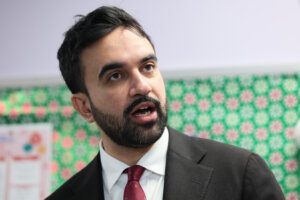
This year brought sweeping change in national politics, in the U.S.-Israel relationship and in New York, the city with the largest Jewish population.
At the Forward, we closely tracked the transition to President Trump’s second term and profiled his cabinet selections and controversial nominees and appointees who trafficked in antisemitism or had ties to white nationalists and expressed admiration for Nazis. We covered the president’s crackdown on the pro-Palestinian campus protests that defined 2024 and the weaponization of antisemitism that led to multimillion dollar settlements with Ivy League universities, including Columbia and Cornell.
We provided exclusive, on-the-ground reporting on the battle for the Jewish vote in the competitive New York City mayoral race. We conducted the first Jewish-media interview with Zohran Mamdani as his campaign began gaining traction, even while he was still polling a distant second in the Democratic primary. We also had inside access to the outgoing Eric Adams administration and its effort to counter rising antisemitism, and had the only local reporter accompanying Adams on his farewell trip to Israel.
Here are the seven political stories we’ll be watching most closely in 2026 that will shape American politics and the Jewish community in the U.S. and abroad.
Zohran Mamdani’s New York City
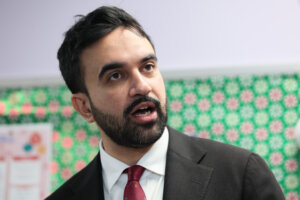
Mamdani will be sworn into office at midnight on Jan. 1, 2026 as the city’s first Muslim mayor. The swearing-in will be followed by an inauguration ceremony that day at a yet-undisclosed location.
He will immediately face a series of tests on the promises and priorities that carried him through the historic campaign at a moment when the city’s Jewish community remains divided over his stance on Israel. Mamdani’s mixed response to the protest outside the Park East Synagogue, which featured anti-Israel and antisemitic slogans last month, is likely to come under fresh scrutiny as his term begins. Mamdani has remained mum on whether he’d support new legislation that would create a buffer zone outside houses of worship to protect congregants from targeted protests.
Mamdani will also have to decide whether to rescind a recent executive order by Adams barring city agencies from participating in Boycott, Divestment and Sanctions efforts. He will also determine the fate of the recently-created mayor’s office to combat antisemitism, which has pursued a measure adopting the controversial International Holocaust Remembrance Alliance definition of antisemitism, which considers most forms of anti-Zionism as antisemitic. And he will need to decide whether to continue the New York City–Israel Economic Council, an initiative to strengthen economic ties with the Jewish state.
He will file top City Hall and government positions, including the potential appointments of his senior Jewish advisers.
Last month, Mamdani announced he’ll reappoint Jessica Tisch, the Jewish NYC police commissioner, as head of the police department he promised to reform.
The battle for the Jewish vote in the governor’s race
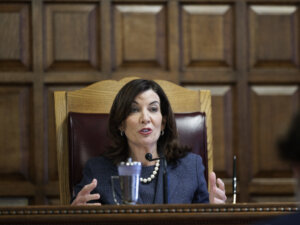
Mamdani’s first months in office and his legislative agenda will also shape the New York governor’s race.
Gov. Kathy Hochul, running for reelection for another full term, endorsed Mamdani in the general election after remaining neutral during the primary. She has signaled reservations about several key Mamdani priorities, like universal free buses, which will need the state’s approval, and has also distanced herself from Mamdani on Israel.
Hochul’s embrace of Mamdani could bolster her standing in the Democratic primary, where she faces a left-wing challenge from her lieutenant governor, Antonio Delgado, who is married to a Jewish woman.
But it could also complicate her outreach to Jewish voters in the general election. Bruce Blakeman, the first Jewish executive of Nassau County on Long Island, and Rep. Elise Stefanik, an upstate congresswoman who has made the fight against antisemitism on college campuses central to her congressional brand, are competing in a GOP primary to challenge Hochul. In 2022, former Rep. Lee Zeldin came within five percentage points of winning the governor’s race, powered by strong Jewish support.
Who will win Jerry Nadler’s seat?

After serving 17 terms in Congress, Rep. Jerry Nadler, co-chair of the Congressional Jewish Caucus, is set to retire to pave the way for generational change, a race that will be closely watched locally and across the nation.
The Manhattan district has one of the largest Jewish electorates in the nation. Jews in the 12th Congressional District account for about 30% of the vote in the Democratic primary. Nadler has, in recent years, campaigned on the need to preserve New York City’s Jewish representation in Congress.
The Jewish candidates vying for the seat include Micah Lasher, Jack Schlossberg, and Cameron Kasky. Assemblymember Alex Bores, whose wife, Darya Moldavskaya, is Jewish, and Councilmember Erik Bottcher are also considered viable candidates. Lasher, a protege of Nadler, has the longtime Jewish congressman’s support. Schlossberg, the grandson of former President John F. Kennedy, has made funding for security measures at synagogues and Jewish institutions a central pillar of his campaign.
Other New York congressional races

There are a few other House races in New York where pro-Israel incumbents are facing challenges from the left. Those primary contests are a crucial test of whether support for Israel and an alliance with the American Israel Public Affairs Committee has become a political liability.
Rep. Dan Goldman, the Jewish congressman representing the north of Brooklyn and the Lower Manhattan district since 2023, is being challenged in the primary by Brad Lander, the outgoing city comptroller and former mayoral candidate, who has the backing of Mamdani and other progressive firebrands. For his campaign, Lander hired Morris Katz, a Jewish strategist and ad maker who was behind Mamdani’s successful working-class appeal and inspiring TV commercials. Katz produced Lander’s Mr. Rogers-themed launch video.
Lander, who is also Jewish, has become more vocal about Palestinian rights in recent years. He supported Ben & Jerry’s decision to end sales in the occupied West Bank in 2021 and has regularly attended a weekly rally against the Israeli government’s handling of the war in Gaza. Recently, he acknowledged that he divested from Israel Bonds in 2023, ending the city’s decades-long practice of investing millions in Israeli government debt securities. In his candidacy announcement, Lander slammed Goldman’s support for the war in Gaza and accused him of “doing AIPAC’s bidding,” though the incumbent had early on called for humanitarian pauses and criticized Israeli Prime Minister Benjamin Netanyahu’s leadership.
Rep. Ritchie Torres, a three-term pro-Israel progressive from the Bronx, is facing three primary challengers, a crowded field that could ultimately make it easier for him to win reelection. Michael Blake, a former state legislator who ran for mayor in the Democratic primary and later endorsed Mamdani, is making attacks on AIPAC central to his campaign, and Dalourny Nemorin, an organizer for the Democratic Socialists of America’s local chapter, is testing the momentum behind newcomer and socialist candidates. Assemblywoman Amanda Septimo, who joined an AIPAC-sponsored trip to Israel in 2016 and visited Israel again following the Oct. 7, 2023 Hamas attacks, also announced her candidacy. Septimo is considered a member of Mamdani’s inner circle.
Rep. Michael Lawler, a Republican who has been a strong pro-Israel voice since his election in 2022, is expected to face the winner of an eight-person Democratic primary in a tough election cycle for Republicans. Lawler has the support of the growing Hasidic population in Rockland County. The leading candidates in the Democratic primary are Rockland County Legislator Beth Davidson, who is Jewish, and Army veteran Cait Conley.
Michigan Senate race a test for Democrats’ positions on Israel

The Michigan Senate race is shaping up to be one of the clearest tests of the Democratic coalition and of how the party navigates Israel.
The leading candidates in the Democratic primary are Abdul El-Sayed, an Egyptian-American who is seeking to channel the energy of the 2024 Uncommitted movement and build on Mamdani’s surprise success in New York, and Rep. Haley Stevens, a pro-Israel Democrat who defeated progressive Jewish Rep. Andy Levin in 2022 with significant help from AIPAC.
The outcome of the contest will offer an early read on whether the left’s anti-establishment momentum can break through in a battleground state, and how much pro-Israel groups retain their influence in Democratic primaries.
The Jewish governors running for reelection

Pennsylvania Gov. Josh Shapiro and Illinois Gov. JB Pritzker are widely expected to win reelection. Their margins, messages and national profile will position both as major figures in the early mix for the 2028 presidential race. Each is navigating the same balancing act that will challenge Democrats with national ambitions: trying to appeal to a base that is growing more critical of Israel while still keeping the trust of Jewish voters and pro-Israel allies.
Shapiro, who was viewed as a potential first Jewish president in 2024, remains on the narrow path he has carved out for himself. He highlights his Jewish identity, support for Israel and bipartisan appeal in all of his public appearances.
Pritzker, who governs a state with one of the largest Palestinian-American populations in the country, has become one of the most prominent voices of resistance to President Donald Trump. He has repeatedly invoked Nazi Germany in criticizing the administration’s policies and endorsed a Senate push to block U.S. arms sales to Israel to pressure Prime Minister Benjamin Netanyahu on the Israeli-Palestinian conflict.
Israeli elections
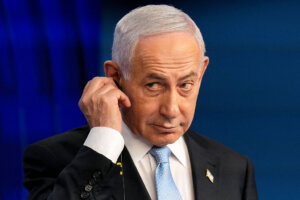
Israeli Prime Minister Benjamin Netanyahu will continue to be in the headlines in America. He is expected to spend New Year’s Eve in the United States after yet another meeting with Trump at the Mar-a-Lago resort — the sixth meeting this year — underscoring the unusually close alignment between the two leaders.
Netanyahu is better known to Americans than most world leaders. He is now Israel’s longest-tenured prime minister, having served for more than 18 years as the country’s leader. He grew up in Philadelphia in the early 1960s, attended college and graduate school in Boston, served as Israel’s ambassador to the U.N. in the mid-1980s, and has delivered four speeches to a joint session of Congress.
Following three tumultuous years, Israeli voters are poised to head back to the ballot box sometime in 2026 — depending on how long the coalition government holds onto power amid legislative challenges — for what will effectively be another referendum on Netanyahu’s leadership. A January 2024 poll found that only 15% of Israelis, including 36% of those who had previously voted for his Likud Party, wanted to see Netanyahu stay on as prime minister following the failure to protect Israel on Oct. 7.
But the landscape has shifted dramatically since then.
All living hostages have been freed, and the remains of all those held by Hamas — but for one — have been returned. Hamas and Hezbollah leaders have been killed, and Iran’s nuclear program was set back after the 12-day war earlier this year, and the conflict in Gaza ended on terms jointly shaped by Washington and Jerusalem. Netanyahu, receiving the political backing from Trump, has also requested a pre-conviction pardon from Israeli President Isaac Herzog. Meanwhile, the opposition remains fractured among several would-be successors, complicating a unified challenge to Netanyahu’s rule.
A majority of American Jews hold an unfavorable view of Netanyahu and senior pro-Israel Democrats have called for a leadership change in Israel.
Netanyahu is also expected to visit New York City, at the latest next September when he comes to address the annual United Nations General Assembly, which will test Mamdani’s pledge to order his arrest if he visits Manhattan.
The post The 7 political stories Jews will be watching in 2026 appeared first on The Forward.
Uncategorized
How Eastern Europe’s Jews celebrated a merry ‘nitl’ Christmas
(JTA) — Call me a softie, but I love a traditional Christmas Eve. If you don’t find me eating Chinese food and watching a movie, I might be catching Gotham Comedy Club’s “A Very Jewish Christmas!” show or comedian Joel Chasnoff’s “Christmas for the Jews.” Or I may just stay home, light a fire and listen to “Oy to the World: A Klezmer Christmas” by The Klezmonauts.
If none of that is your idea of traditional, you might want to get a copy of Jordan Chad’s new book, “Christmas in the Yiddish Tradition.”
A multidisciplinary researcher affiliated with the University of Toronto’s Centre for Jewish Studies, Chad offers up the “untold story” of how Yiddish-speaking Jews “celebrated” Christmas — not as the birth of the baby Jesus, heaven forbid. On what they called “Nitl-nacht,” or just plain “Nitl,” Jews cut loose with games and drink and a vacation from Torah studies in ways that ran parallel with what their Christian neighbors were up to.
And if that sounds like a provocation, Chad agrees.
“When I use the term ‘Jews celebrated Christmas,’ what’s really important to understand is that Christmas wasn’t interpreted as a Christian holiday by the Jews,” he said.
The idea of Jews enjoying Christmas Eve also runs counter to the stories Jews told after they left their Yiddish roots behind and encountered the New World. There, memories were shaped and distorted, and nitl was remembered as a night of fear and superstition. The lore holds that Jews stayed inside, locked their doors, avoided Torah study and huddled against the threat of antisemitic violence.
But Chad, 31, a translator with a background in theoretical physics (which makes him a Yiddishist physicist, which is very fun to say), suspected there was more to the story of Jews and Christmas. That hunch led him deep into Yiddish memoirs and folklore.
What he found startled him. Again and again, memoirists writing about 19th- and early 20th-century Eastern Europe wrote of their favorite “holiday”: nitl, commonly understood as a contraction of a Yiddish term meaning “not learning.”
Chad says that the version of Christmas as a season of foreboding is less remembrance than reinvention. Contemporary Yiddish accounts suggest that the holiday was more benign and even playful.
The key, he argues, is that for Jews and Christians alike, Dec. 24 was not so much a specifically Christian observance as a midwinter festival layered with supernatural anxiety, drinking, feasting and folk rituals. Easter was the central Christian holiday — and the actual season when Christians attacked Jews. By contrast, Christmas fell in the darkest season of the year and was marked with topsy-turvy behavior rife with pagan hand-me-downs, including the Christmas tree. Celebrants would suspend ordinary routines, play cards, tell ghost stories and stay awake to ward off malevolent spirits.
“Christians were doing this, and so were Jews,” Chad said. “It was common European folk culture.”
Only later, in part as a reaction to the revelry and their own encounter with the New World, did church leaders put the Christ back in Christmas, emphasizing the birth of Jesus. “In Europe, nobody was going to forget about Christianity,” Chad explained. “But in the New World, Jesus’s birth really needed to be the part of Christmas that Christians promoted.”
Once Christmas became more explicitly Christian, Jews distanced themselves. In the process, they retrofitted their own memories.
The ominous folklore about Christmas that was also part of Jewish tradition — for example, that Jesus might visit Jewish homes on Christmas eve to poison their drink with blood — was newly emphasized by Jews, turning a night of fun into a warning about assimilation. Stories about the dangers of Christmas — even when exaggerated — helped reinforce a sense of Jewish distinctiveness in a Christian-majority culture.
“Jewish immigrants weren’t going to tell their children, ‘When we were kids, we had a blast on Christmas Eve,’” Chad said. Instead, they leaned on reinterpretations that cast nitl as a defensive measure — a night too dangerous to study Torah, a holiday marked only by negation.
Chad consistently argues that Yiddish-speaking Jews were not cut off from the wider Christian culture, even if they had different religious structures, calendars and social and material status.
“I’d call it common European folk culture,” he said. “There were enormous differences between Jews and Christians — but when it came to fear of midwinter demons, the love of drinking, or the topsy-turvy atmosphere of Christmas Eve, the folklore overlaps are undeniable.”
Chad also draws a direct line between the “Yiddish” Christmas and the various ways Jews to continue to mark the Yuletide season. In many Hasidic communities, nitl is still a night when Torah study is suspended. If these Orthodox Jews aren’t playing cards or chess, they might be catching up on chores. Meanwhile, those Jewish events on Christmas Eve have become a growth industry, from singles-only “Matzo Balls” to Jewish cabarets to Christmas classics sung in Yiddish.
And then there’s Chinese food and a movie. Chad suggests that only in the late 20th century did Jews begin to reclaim Christmas as a kind of unofficial holiday of their own. By the 1980s, eating at Chinese restaurants — traditionally among the few places open — became a way to distinguish the day without crossing into Christian ritual. (As Darlene Love sang on “Saturday Night Live”: “They can finally see ‘King Kong’ without waiting in line / They can eat in Chinatown and drink their sweet-ass wine.”) What once was avoidance evolved into a playful counter-tradition, a way to be present in the surrounding culture without being absorbed by it.
If the book has a deeper message, it is that Jews have always negotiated Christmas, just in different registers. Sometimes the day has been used to draw lines; sometimes to soften them. It is all part of the ongoing Jewish effort to live distinctly within a world shaped by someone else’s holiday.
What emerges in “Christmas in the Yiddish Tradition” is not a sentimental argument for reviving a lost holiday, nor a polemic against drawing firm boundaries between Us and Them. It’s a reminder that Jewish life in Eastern Europe was far richer, weirder and more porous than memory often allows.
“I hope people understand that Jews didn’t think they were celebrating a Christian holiday,” Chad said. “They were celebrating a midwinter holiday they considered their own.”
He paused, then added with a laugh: “And they had a pretty good time doing it.”
The post How Eastern Europe’s Jews celebrated a merry ‘nitl’ Christmas appeared first on The Forward.
Uncategorized
Hanukkah shooting leaves at least 10 dead at Australia’s most popular beach
A Hanukkah celebration at Sydney’s Bondi Beach turned deadly on Sunday with reports of at least 10 dead, including a Chabad rabbi, amid rising antisemitism in Australia.
One suspect was killed at the scene and the other was arrested, in what local police are calling a “terror incident.”
“This is an attack on the Jewish community that deeply that pains us,” said Robert Gregory, the chief executive of the Australian Jewish Association.
Rabbi Eli Schlanger, who worked with Chabad of Bondi, was killed in the shooting, Chabad’s media director told The New York Times.
“This is a targeted attack on Jewish Australians on the first day of Hanukkah, which should be a day of joy,” said Australian Prime Minister Anthony Albanese. “An attack on Jewish Australians is an attack on every Australian.”
Earlier this month, a group of Jewish leaders from Argentina, Australia, Canada, France, Germany, the United Kingdom and the United States met in Sydney to coordinate responses to rising antisemitism there and internationally.
In recent months, two synagogues have been attacked in Melbourne.
The post Hanukkah shooting leaves at least 10 dead at Australia’s most popular beach appeared first on The Forward.